Multiple Many-to-Many Sequence Alignment for Combining
String-Valued Variables: A G2P Experiment
Steffen Eger Text Technology Lab
Goethe University Frankfurt am Main Frankfurt am Main, Germany [email protected]
Abstract
We investigate multiple many-to-many alignments as a primary step in integrat-ing supplemental information strintegrat-ings in string transduction. Besides outlining DP based solutions to the multiple alignment problem, we detail an approximation of the problem in terms of multiple sequence segmentations satisfying a coupling con-straint. We apply our approach to boosting baseline G2P systems using homogeneous as well as heterogeneous sources of sup-plemental information.
1 Introduction
String-to-string translation (string transduction) is the problem of converting one string x over an alphabet Σ into another string y over a possi-bly different alphabet Γ. The most prominent applications of string-to-string translation in nat-ural language processing (NLP) are grapheme-to-phoneme conversion, in which x is a letter-string and y is a string of phonemes, translit-eration (Sherif and Kondrak, 2007), lemmatiza-tion (Dreyer et al., 2008), and spelling error cor-rection (Brill and Moore, 2000). The classi-cal learning paradigm in each of these settings is to train a model on pairs of strings {(x,y)}
and then to evaluate model performance on test data. Thereby, all state-of-the-art modelings we are aware of (e.g., (Jiampojamarn et al., 2007; Bisani and Ney, 2008; Jiampojamarn et al., 2008; Jiampojamarn et al., 2010; Novak et al., 2012)) proceed by first aligning the string pairs (x,y)
in the training data. Also, these modelings ac-knowledge that alignments may typically be of a rather complex nature in which severalxsequence
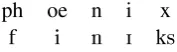
[image:1.595.372.461.248.274.2]ph oe n i x f i n I ks
Table 1: Sample monotone many-to-many align-ment betweenx= phoenix andy=finIks.
characters may be matched up with severaly se-quence characters; Table 1 illustrates. Once the training data is aligned, sincex andysequences are then segmented into equal number of seg-ments, string-to-string translation may be seen as a sequence labeling (tagging) problem in whichx (sub-)sequence characters are observed variables andy(sub-)sequence characters are hidden states (Jiampojamarn et al., 2007; Jiampojamarn et al., 2010).
In this work, we extend the problem of classi-cal string-to-string translation by assuming that, at training time, we have available (M + 2)-tuples of strings{(x,yˆ(1), . . . ,yˆ(M),y)}, wherexis the input string, yˆ(m), for 1 ≤ m ≤ M, are
sup-plemental information strings, and y is the de-sired output string; at test time, we wish to pre-dict y from (x,yˆ(1), . . . ,yˆ(M)). Generally, we may think of yˆ(1), . . . ,yˆ(M) as arbitrary strings over arbitrary alphabets Σ(m), for1 ≤ m ≤ M. For example, xmight be a letter-string andyˆ(m) might be a transliteration ofxin languageLm(cf.
Bhargava and Kondrak (2012)). Alternatively, and this is our model scenario in the current work,x might be a letter input string and yˆ(m) might be the predicted string of phonemes, given x, pro-duced by an (offline) systemTm. This situation
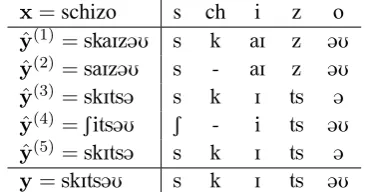
is outlined in Table 3. In the table, we also illus-trate a multiple (monotone) many-to-many align-mentof(x,yˆ(1), . . . ,yˆ(M),y). By this, we mean an alignment where (1)subsequencesof allM+2
strings may be matched up with each other
to-many alignments), and where (2) the match-ing up of subsequences obeys monotonicity. Note that such a multiple alignment generalizes classi-cal monotone many-to-many alignments between
[image:2.595.324.507.63.159.2]pairsof strings, as shown in Table 1. Furthermore, such an alignment may apparently be quite useful. For instance, while none of the stringsyˆ(m)in the table equals the true phonetic transcriptionyofx, taking a position-wise majority vote of the multi-ple alignment of(ˆy(1), . . . ,yˆ(M))yieldsy. More-over, analogously as in the case of pairs of aligned strings, we may perceive the so extended string-to-string translation problem as a sequence label-ing task once(x,yˆ(1), . . . ,yˆ(M),y) are multiply aligned, but now, with additional observed vari-ables(or features), namely, (sub-)sequence char-acters of each stringyˆ(m).
To further motivate our approach, consider the situation of training a new G2P system on the ba-sis of, e.g., Combilex (Richmond et al., 2009). For each letter form in its database, Combilex provides a corresponding phonetic transcription. Now, suppose that, in addition, we can poll an external knowledge source such as Wiktionary for (its) phonetic transcriptions of the respective Com-bilex letter words as outlined in Table 2. The
cen-Input form Wiktionary Combilex neutrino nju:tôi:noU nutrinF
wooded wUdId wUd@d wrench ôEnúS rEn<
Table 2: Input letter words, Wiktionary and Com-bilex transcriptions.
tral question we want to answer is: can we train a system using this additionalinformation which performs better than the ‘baseline’ system that ig-nores the extra information? Clearly, a system with more information should not perform worse than a system with less information (unless the ad-ditional information is highly noisy), but it is a priori not clear at all how the extra information can be included, as Bhargava and Kondrak (2012) note: output predictions may be in distinct alpha-bets and/or follow different conventions, and sim-ple rule-based conversions may even deteriorate a baseline system’s performance. Their solution to the problem is to let the baseline system out-put itsn-best phonetic transcriptions, and then to re-rank these n-best predictions via an SVM re-ranker trained on the supplemental representations
x=schizo s ch i z o
ˆ
y(1)=skaIz@U s k aI z @U
ˆ
y(2)=saIz@U s - aI z @U
ˆ
y(3)=skIts@ s k I ts @
ˆ
y(4)=Sits@U S - i ts @U
ˆ
y(5)=skIts@ s k I ts @ y=skIts@U s k I ts @U
Table 3: Left: Input string x, predictions of 5
systems, and output string y. Right: A multiple many-to-many alignment of(x,yˆ(1), . . . ,yˆ(5),y). Skips are marked by a dash (‘-’).
(see their figure 2). Our approach is much differ-ent from this: we character (or substring) align the supplemental information strings with the in-put letter strings and then sequentially transduce input character substrings as in the standard G2P approach, but where the sequential transducer is aware of the corresponding subsequences of the supplemental information strings.
Our goals in the current work are first, in Sec-tion 2, to formally introduce the multiple many-to-many alignment problem, which, to our knowl-edge, has not yet been formally considered, and to indicate how it can be solved (by standard ex-tensions of well-known DP recursions). Secondly, we outline an ‘approximation algorithm’, also in Section 2, with much better runtime complexity, to solving the multiple many-to-many alignment problem. This proceeds by optimallysegmenting
individual strings to align under the global con-straint that the number of segments must agree
across strings. Thirdly, we demonstrate exper-imentally, in Section 5, that multiple many-to-many alignments may be an extremely useful first step in boosting the performance of a G2P model. In particular, we show that by conjoining a base system with additional systems very high perfor-mance increases can be achieved. We also inves-tigate the effects of using our introduced approxi-mation algorithm instead of ‘exactly’ determining alignments. We discuss related work in Section 3, present data and systems in Section 4 and con-clude in Section 6.
denoted by w1, . . . ,wN (rather than x,yˆ(m),y,
etc.). Let eachwn, for1≤n≤N, be an arbitrary
string over some alphabetΣ(n). Let`n=|wn| de-note the length ofwn. Moreover, assume that a set
S ⊆ QNn=1{0, . . . , `n}\{0N} ofallowable steps
is specified, where0N = (0| {z }, . . . ,0 Ntimes
).1We interpret
the elements ofSas follows: if(s1, s2, . . . , sN)∈
S, then subsequences of w1 of length s1, subse-quences ofw2 of lengths2,. . ., subsequences of wN of length sN may be matched up with each
other. In other words,S defines the types of valid ‘many-to-many match-up operations’.2 While we could drop S from consideration and simply al-low every possible matching up of character sub-sequences, it is convenient to introduceSbecause algorithmic complexity may then be specified in terms ofS, and by choosing particularS, one may retrieve special cases otherwise considered in the literature (see next section).
As indicated, for us, a multiple alignment of
(w1, . . . ,wN)is any scheme
w1,1 w1,2 · · · w1,k
w2,1 w2,2 · · · w2,k
... ... ... ... wN,1 wN,2 · · · wN,k
such that (|w1,i|, . . . ,|wN,i|) ∈ S, for all i =
1, . . . , k, and such thatwn = wn,1· · ·wn,k, for
all 1 ≤ n ≤ N. Let AS = AS(w1, . . . ,wN)
denote the set of all multiple alignments of
(w1, . . . ,wN). For an alignment a ∈ AS,
de-note by score(a) = f(a) the score of align-ment a under alignment model f, where f :
AS(w1, . . . ,wN)→R. We now investigate
solu-tions to theproblem of finding the alignment with maximal score under different choices of align-ment modelsf, i.e., we search to efficiently solve
max
a∈AS(w1,...,wN)f(a). (1)
Unigram alignment model For our first align-ment modelf, we assume thatf(a), fora∈ AS,
is the score
f(a) =
k
X
i=1
sim1(w1,i, . . . ,wN,i) (2)
1Here,Qdenotes the Cartesian product of sets.
2In the case of two strings, this is sometimes denoted in
the mannerM-N(e.g.,3-2,1-0), indicating thatM charac-ters of one string may be matched up withNcharacters of the other string. Analogously, we could write heres1-s2-s3-· · ·.
for a real-valued similarity function sim1 :
QN
n=1 Σ(n)
∗
→ R. We call the model f in (2) a unigram model because f(a) is the sum of the similarity scores of the matched-up subse-quences(w1,i, . . . ,wN,i), ignoring context. Due
to this independence assumption, solving max-imization problem in Eq. (1) under specifica-tion (2) is straightforward via a dynamic pro-gramming (DP) recursion. To do so, define by MS,sim1(i1, i2, . . . , iN)the score of the best
align-ment, under alignment model f = Psim1 and set of stepsS, of(w1(1 :i1), . . . ,wN(1 :iN)).3
Then,MS,sim1(i1, . . . , iN)is equal to
max
(j1,...,jN)∈SMS,sim1(i1−j1, . . . , iN−jN)
+sim1 w(i1−j1+ 1 :i1), . . . ,w(iN−jN+ 1 :jN).
(3) This recurrence directly leads to a DP algorithm, shown in Algorithm 1, for computing the score
of the best alignment of (w1, . . . ,wN); the
ac-tual alignment can be found by storing pointers to the maximizing steps taken. If similarity evalua-tionssim1(w1,i, . . . ,wN,i) are thought of as
tak-ing constant time, this algorithm’s run time is
O(QNn=1`n· |S|). When`= `1 = · · ·= `nand
|S|=`N−1(‘worst case’ size ofS), then the
al-gorithm’s runtime is thusO(`2N), which quickly
becomes untractable asN, the number of strings to align, increases.
Of course, the unigram alignment model could be generalized to an m-gram alignment model. Anm-gram alignment model would exhibit worst-case runtime complexity of O(`(m+1)N) under
analogous DP recursions as for the unigram model.
Algorithm 1
1: procedure UNIGRAM-ALIGN(w1, . . . ,wN; S,sim1)
2: M(i1, . . . , iN) ← −∞ for all (i1, . . . , iN)∈ZN
3: M(0N)←0 4: fori1 = 0. . . `1do 5: for· · · do
6: foriN = 0. . . `N do
7: if(i1, . . . , iN)6=0N then 8: M(i1, . . . , iN)←Eq. (3)
9: returnM(`1, . . . , `N)
Separable alignment models For our sec-ond model class, assume that, for any a ∈
3We denote byx(a : b)the substringx
axa+1· · ·xbof
AS(w1, . . . ,wN),f(a)decomposes into
f(a) = Ψfw1(w1,1· · ·w1,k), . . . , fwN(wN,1· · ·wN,k)
(4) for some models fw1, . . . , fwN and where Ψ :
RN →Ris non-decreasing in its arguments (e.g.,
Ψ(fw1, . . . , fwN) =
PN
n=1fwn). Iff(a)
decom-poses in such a manner, then f(a) is called sep-arable.4 The advantage with separable models is that we can solve the ‘subproblems’fw1, . . . , fwN
independently. Thus, in order to find optimal multiple alignments of(w1, . . . ,wN)under such
a specification, we would only have to find the best segmentations of sequenceswn under
mod-elsfwn, for1≤n ≤N, subject to the constraint
that the segmentations must agree in theirnumber
of segments (the coupling variable). Let Swn ⊆
{0,1, . . . , `n} denote the constraints on segment
lengths, similar to the interpretation of steps in S. Iffwn is a unigram segmentation model then
the problem of finding the best segmentation of wnwith exactlyjsegments can be solved in time
O(`n|Swn|j). Thus, if each fwn is a unigram
segmentation model, worst-case time complexity for each subproblem would be O(`3
n) (if string
wn can be segmented into at most `n segments)
and then the overall problem (1) under specifica-tion (4) is solvable in worst-case timeN · O(`3). More generally, if each fwn is an m-gram
seg-mentation model, then worst-case time complexity amounts toN · O(`m+2). Importantly, this scales
linearly with the number N of strings to align, rather than exponentially as theO(`(m+1)N)
un-der the (non-separable)m-gram alignment model discussed above.
Unsupervised alignmentsThe algorithms pre-sented may be applied iteratively in order to in-duce multiple alignments in an unsupervised (EM-like) fashion in which sim1 is gradually learnt (e.g., starting from a uniform initialization of sim1). We skip details of this, as we do not make us of it in our current experiments. Rather, in our experiments below, we directly specify sim1 as a sum of pairwise similarity scores which we ex-tract from alignments produced by an off-the-shelf
pairwisealigner.
4Note the difference between Eqs. (2) and (4). While each
fwnin (4) operates on a ‘row’ of an alignment scheme,sim1 in (2) acts on the ‘columns’. In other words, the unigram alignment model correlates the multiply matched-up subse-quences, while the separable alignment model assumes inde-pendence here.
3 Related work
Monotone alignments have a long tradition, both in NLP and bioinformatics. The classical Needleman-Wunsch algorithm (Needleman and Wunsch, 1970) computes the optimal alignment between two sequences when only single charac-ter matches, mismatches, and skips are allowed. It is a special case of the unigram model (2) in optimization problem (1) for which N = 2, S ={(1,0),(0,1),(1,1)}andsim1 takes on val-ues from {0,−1}, depending on whether com-pared input subsequences match or not. As is well-known, this alignment specification is equiv-alent to the edit distance problem (Levenshtein, 1966) in which the minimal number of inser-tions, deletions and substitutions is sought that transforms one string into another. Substring-to-substring edit operations — or equivalently, (monotone) many-to-many alignments — have ap-peared in the NLP context, e.g., in (Deligne et al., 1995), (Brill and Moore, 2000), (Jiampoja-marn et al., 2007), (Bisani and Ney, 2008), (Ji-ampojamarn et al., 2010), or, significantly earlier, in (Ukkonen, 1985), (V´eronis, 1988). Learning
edit distance/monotone alignments in an unsuper-vised manner has been the topic of, e.g., (Ris-tad and Yianilos, 1998), (Cotterell et al., 2014), besides the works already mentioned. All of these approaches are special cases of our uni-gram model outlined in Section 2 — i.e., they consider particular S (most prominently, S = {(1,0),(0,1),(1,1)}) and/or restrict attention to onlyN = 2strings.5
Alignments between multiple sequences, i.e., multiple sequence alignment, has also been an is-sue both in NLP (e.g., Covington (1998), Bhar-gava and Kondrak (2009)) and bioinformatics (e.g., Durbin et al. (1998)). An interesting applica-tion of alignments of multiple sequences is to de-termine what has been calledmedian string (Ko-honen, 1985) or Steiner consensus string (Gus-field, 1997), defined as the string¯sthat minimizes the sum of distances, for a given distance function d(x,y), to a list of stringss1, . . . ,sN (Jiang et al.,
2012); typically, d is the standard edit distance. As Gusfield (1997) shows, the Steiner consen-sus string may be retrieved from a multiple
align-5In Cotterell et al. (2014), context influences alignments,
so that the approach goes beyond the unigram model sketched in (2), but there, too, the focus is on the situationN = 2and
ment ofs1, . . . ,sN by concatenating the
column-wise majority characters in the alignment, ignor-ing skips. Since median strignor-ing computation (and hence also the multiple many-to-many alignment problem, as we consider) is an NP-hard problem (Sim and Park, 2003), designing approximations is an active field of research. For example, Marti and Bunke (2001) ignore part of the search space by declaring matches-up of distant characters as un-likely, and Jiang et al. (2012) apply an approxima-tion based on string embeddings in vector spaces. Paul and Eisner (2012) apply dual decomposition to compute Steiner consensus strings. Via the ap-proach taken in this paper, median strings may be computed in case d is a (distance) function tak-ingsubstring-to-substring edit operationsinto ac-count, a seemingly straightforward, yet extremely useful generalization in several NLP applications, as indicated in the introduction.
Our approach may also be seen in the context of classifier combination for string-valued variables. While ensemble methods for structured prediction have been considered in several works (see, e.g., Nguyen and Guo (2007), Cortes et al. (2014), and references therein), a typical assumption in this situation is that the sequences to be combined have equal length, which clearly cannot be expected to hold when, e.g., the outputs of several G2P, transliteration, etc., systems must be combined. In fact, the multiple many-to-many alignment models investigated in this work could act as a preprocess-ing step in this setup, since the alignment precisely serves the functionality of segmenting the strings into equal number of segments/substructures. Of course, combining outputs with varying number of elements is also an issue in machine transla-tion (e.g., Macherey and Och (2007), Heafield et al. (2009)), but, there, the problem is harder due to the potential non-monotonicities in the ordering of elements, which typically necessitates (additional) heuristics. One approach for constructing multi-ple alignments is hereprogressive multiple align-ment(Feng and Doolittle, 1987) in which a multi-ple (typically one-to-one) alignment is iteratively constructed from successive pairwise alignments (Bangalore et al., 2001). Matusov et al. (2006) apply word reordering and subsequent pairwise monotone one-to-one alignments for MT system combination.
4 Data and systems
4.1 Data
We conduct experiments on the General Ameri-can (GA) variant of the Combilex data set (Rich-mond et al., 2009). This contains about 144,000 grapheme-phoneme pairs as exemplarily illus-trated in Table 2. In our experiments, we split the data into two disjoint parts, one for test-ing (about 28,000 word pairs) and one for train-ing/development (the remainder).
4.2 Systems
BASELINE Our baseline system is a linear-chain conditional random field model (CRF)6 (Lafferty et al., 2001) which we apply in the manner in-dicated in the introduction: after many-to-many aligning the training data as in Table 1, attraining time, we use the CRF as a tagging model that is trained to label each input character subsequence with an output character subsequence. As fea-tures for the CRF, we use all n-grams of subse-quences of x that fit inside a window of size 5 centered around the current subsequence (context features). We also include linear-chain features
which allow previously generated output character subsequences to influence current output charac-ter subsequences. In essence, our baseline model is a standard discriminative approach to G2P. It is, all in all, the same approach as described in Ji-ampojamarn et al. (2010), except that we do not include jointn-gram features. Attest time, we first segment a new input stringxand then apply the CRF. Thereby, we train the segmentation module on the segmentedxsequences, as available from the aligned training data.7
BASELINE+X As competitors for the base-line system, we introduce systems that rely on the predictions of one or several additional (black box/offline) systems. At training time, we first multiply many-to-many align the input string x, the predictions yˆ(1), . . . ,yˆ(M) and the true tran-scription y as illustrated in Table 3 (see Section 4.3 for details). Then, as for the baseline sys-tem, we train a CRF to label each input character
6We made use of the CRF++ package available at
https://code.google.com/p/crfpp/.
7To be more precise on the training of the segmentation
subsequence with the corresponding output char-acter subsequence. However, this time, the CRF has access to the subsequence suggestions (as the alignments indicate) produced by the offline sys-tems. Asfeaturesfor the extended models, we ad-ditionally include context features for all predicted strings yˆ(m) (all n-grams in a window of size 3 centered around the current subsequence predic-tion). We also include a joint feature firing on the tuple of the current subsequence value of x,
ˆ
y(1), . . . ,yˆ(M). To illustrate, when BASELINE+X tags position 2 in the (split up) input string in Ta-ble 3, it sees that its value isch, that the previous input position contains s, that the next contains
i, that the next two contain (i,z), that the predic-tion of the first system at posipredic-tion 2 isk, that the first system’s next prediction is ai, and so forth.
At test time, we first multiply many-to-many align x,yˆ(1), . . . ,yˆ(M), and then apply the enhanced CRF.
4.3 Alignments
To induce multiple monotone many-to-many alignments of input strings, offline system predic-tions and output strings, we proceed in one of two manners.
Exact alignments Firstly, we specify sim1 in Eq. (2), assim1(xi,yˆ(1)i , . . . ,yˆ(iM),yi) =
XM
m=1
psim(xi,yˆ(im))
+psim(xi,yi),
wherepsimis a pair-similarity function. The ad-vantage with this specification is that the similarity of a tuple of subsequences is defined as the sum of
pairwise similarity scores, which we can directly estimate from pairwise alignments of (x,yˆ(m)) that an off-the-shelf pairwise aligner can produce (we use the Phonetisaurus aligner for this). We set psim(u,v)as log-probability of observing the tu-ple(u,v)in the training data of pairwise aligned sequences. To illustrate, we define the similar-ity of (o,@U,@U,@,@U,@,@U) in the example in Table 3 as the pairwise similarity of (o,@U) (as inferred from pairwise alignments of x strings and sys-tem 1 transcriptions) plus the pairwise similarity of (o,@U) (as inferred from pairwise alignments of xstrings and system 2 transcriptions), etc. At test time, we use the same procedure but drop the term psim(xi,yi) when inducing alignments. For our
current purposes, we label the outlined modus as
exact (alignment) modus.
Approx. alignments Secondly, we derive the optimal multiple many-to-many alignment of the strings in question by choosing an alignment that satisfies the condition that (1) each individual stringx,yˆ(1), . . . ,yˆ(M),yis optimallysegmented (e.g., ph-oe-n-i-x rather than pho-eni-x, f-i-n-I-ks rather thanf-inIk-s) subject to the global constraint that (2) the number of segments must agree across the strings to align. This constitutes a separa-ble alignment model as discussed in Section 2, and thus has much lower runtime complexity as the first model. Segmentation models can be di-rectly learned from the pairwise alignments that Phonetisaurus produces by focusing on either the segmentedxory/yˆ(m) sequences; we choose to implement bigram individual segmentation mod-els. This second model type may be considered an
approximationof the first, since in a good align-ment, we would not only expect individually good segmentations and agreement of segment numbers but also that subsegments are likely correlations
of each other, precisely as our first model type captures. Therefore, we shall call this alignment modusapproximate (alignment) modus, for our present purposes.
5 Experiments
We now describe two sets of experiments, a con-trolled experiment on the Combilex data set where we can design our offline/black box sys-tems ourselves and where the black box syssys-tems are trained on a similar distribution as the base-line and the extended basebase-line systems. In partic-ular, the black box systems operate on the same output alphabet as the extended baseline systems, which constitutes an ‘ideal’ situation. Thereafter, we investigate how our extended baseline system performs in a ‘real-world’ scenario: we train a system on Combilex that has as supplemental in-formation corresponding Wiktionary (and PTE, as explained below) transcriptions.
5.1 A controlled experiment
In our first set of experiments, we let our of-fline/black box systems be the Sequitur G2P mod-eling toolkit (Bisani and Ney, 2008) (S) and the Phonetisaurus modeling toolkit (Novak et al., 2012) (P). We train them on disjoint sets
of 20,000 grapheme-to-phoneme Combilex string pairs each. The performance of these two sys-tems, on the test set of size 28,000, is indicated in Table 4. Next, we train BASELINE on
dis-Phonetisaurus Sequitur
[image:7.595.310.519.90.258.2]WACC 72.12 71.70
Table 4: Word-accuracy (in%) on the test data, for the two systems indicated.
joint sets (disjoint from both the training sets of P and S) of size 2,000, 5,000, 10,000 and 20,000. Making BASELINE’s training sets disjoint from the training sets of the offline systems is both re-alistic (since a black box system would typically follow a partially distinct distribution from one’s own training set distribution) and also prevents the extended baseline systems from fully adapting to the predictions of either P or S, whose train-ing set accuracy is an upward biased representa-tion of their true accuracy. As baseline extensions, we consider the systems BASELINE+P (+P), and BASELINE+P+S (+P+S).8
Results are shown in Figures 1 and 2. We see that conjoining the base system with the predictions of the offline Phonetisaurus and Se-quitur models substantially increases the base-line WACC,especially in the case of little train-ing data. In fact, WACC increases here by al-most 100%when the baseline system is comple-mented by yˆ(P) and yˆ(S). As training set size increases, differences become less and less pro-nounced. Eventually, we would expect them to drop to zero, since beyond some training set size, the additional features may provide no new infor-mation.9We also note that conjoining the two sys-tems is more valuable than conjoining only one system, and, in Figure 2, that the models which are based on exact multiple alignments outperform the models based on approximate alignments, but not
8We omit BASELINE+S since it yielded similar results as
BASELINE+P.
9In fact, in follow-up work, we find that the additional
information may also confuse the base system when training set sizes are large enough.
by a wide margin.
0.3 0.350.4 0.450.5 0.550.6 0.650.7 0.750.8
0 5T 10T 20T 30T
Accurac
y
Training set size BASELINE
[image:7.595.309.520.330.497.2]+P +P+S
Figure 1: WACC as a function of training set size for the system indicated. Exact align. modus.
0.67 0.68 0.69 0.7 0.71 0.72 0.73 0.74 0.75 0.76
0 5T 10T 20T 30T
Accurac
y
Training set size +P +P+S +PAPRX +P+SAPRX
Figure 2: Comparison of models based on exact and approximate alignments; WACC as a function of training set size. APRX denotes the approxima-tion alignment model.
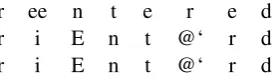
Concerning differences in alignments between the two alignment types, exact vs. approximate, an illustrative example where the approximate model fails and the exact model does not is (‘false’ align-ment based on the approximate model indicated):
r ee n t e r e d
r i E n t @‘ r d
r i E n t @‘ r d
[image:7.595.349.486.655.695.2]phonemic n, etc., seems quite unlikely. Still, it is very promising to see that these differences in alignment quality translate into very small differ-ences in overall string-to-string translation model performance, as Figure 2 outlines. Namely, dif-ferences in WACC are typically on the level of 1% or less (always in favor of the exact alignment model). This is a very important finding, as it in-dicates that string-to-string translation need not be (severely) negatively impacted by switching to the approximate alignment model, a tractable alterna-tive to the exact models, which quickly become practically infeasible as the number of strings to align increases.
5.2 Real-world experiments
To test whether our approach may also succeed in a ‘real-world setting’, we use as offline/black box systems GA Wiktionary transcriptions of our in-put forms as well as PhotoTransEdit (PTE) tran-scriptions,10 a lexicon-based G2P system which offers both GA and RP (received pronunciation) transcription of English strings. We train and test on input strings for which both Combilex and PTE transcriptions are available, and for which both Combilex and Wiktionary transcriptions are avail-able.11 Test set sizes are about 1,500 in the case of PTE and 3,500 in the case of Wiktionary. We only test here the performance of the exact alignment method, noting that, as before, approximate align-ments produced slightly weaker results.
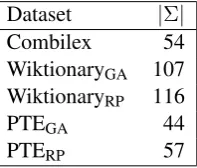
Clearly, Wiktionary and PTE differ from the Combilex data. First, both Wiktionary and PTE use different numbers of phonemic symbols than Combilex, as Table 5 illustrates. Some differences
Dataset |Σ|
Combilex 54 WiktionaryGA 107 WiktionaryRP 116
PTEGA 44
PTERP 57
Table 5: Sizes of phonetic inventaries of different data sets.
arise from the fact that, e.g., lengthening of vowels is indicated by two output letters in some data sets
10Downloadable from http://www.photransedit.com/. 11This yields a clear method of comparison. An alternative
would be to provide predictions for missing transcriptions. In any case, by our task definition, all systems must provide a hypothesis for an input string.
and only one in others. Also, phonemic transcrip-tion conventranscrip-tions differ, as becomes most strikingly evident in the case of RP vs. GA transcriptions — Table 6 illustrates. Finally, Wiktionary has many more phonetic symbols than the other datasets, a finding that we attribute to its crowd-sourced na-ture and lacking of normalization. Despite these differences in phonemic annotation standards be-tween Combilex, Wiktionary and PTE, we observe that conjoining input strings with predicted Wik-tionary or PTE transcriptions via multiple align-ments leads to very good improvealign-ments in WACC over only using the input string as information source. Indeed, as shown in Table 7, for PTE, WACC increases by as much as 80% in case of small training sample (1,099 string pairs) and as much as 37% in case of medium-sized training sample (2,687 string pairs). Thus, comparing with the previous situation of homogenous systems, we also observe that the gain from including hetero-geneous system is relatively weaker, as we would expect due to distinct underlying assumptions, but still impressive. Performance increases when in-cluding Wiktionary are slightly lower, most likely because it constitutes a very heterogenous source of phonetic transcriptions with user-idiosyncratic annotations (however, training set sizes are also different).12
BASEL. BASEL.+PTEGA BASEL.+PTERP
1,099 31.34 56.47 50.22
2,687 45.75 60.80 62.80
BASEL. BASEL.+WikGA BASEL.+WikRP
2,000 38.44 60.71 62.18
5,000 51.69 65.81 65.96
[image:8.595.133.232.546.630.2]10,000 58.97 67.30 68.66
Table 7: Top: WACC in % for baseline CRF model and the models that integrate PTE in the GA versions and RP versions, respectively. Bot-tom: BASELINEand BASELINE+Wiktionary.
6 Conclusion
We have generalized the task description of string transduction to include supplemental information strings. Moreover, we have suggested multiple
12To provide, for the interested reader, a comparison with
b o t ch i ng b o t S I N b A - tS I N
b a rr ed b a - d
b A r d
a s th m a t i c s
æ s - m æ t I k s
[image:9.595.75.516.63.103.2]a z 0 m a t I k s
Table 6: Multiple alignments of input string, predicted PTE transcription and true (Combilex) transcrip-tion. Differences may be due to alternative phonemic conventions (e.g., Combilex has a single phonemic character representing the soundtS) and/or due to differences in pronunciation in GA and RP, resp.
many-to-many alignments — and a subsequent standardly extended discriminative approach — for solving string transduction (here, G2P) in this generalized setup. We have shown that, in a real-world setting, our approach may significantly beat a standard discriminative baseline, e.g., when we add Wiktionary transcriptions or predictions of a rule-based system as additional information to the input strings. The appeal of this approach lies in the fact that almost any sort of external knowledge source may be integrated to improve the performance of a baseline system. For exam-ple, supplemental information strings may appear in the form of transliterations of an input string in other languages; they may be predictions of other G2P systems, whether carefully manually crafted or learnt from data; they might even ap-pear in the form of phonetic transcriptions of the input string in other dialects or languages. What distinguishes our solution to integrating supple-mental information strings in string transduction settings from other research (e.g., (Bhargava and Kondrak, 2011; Bhargava and Kondrak, 2012)) is that rather than integrating systems on the global
level of strings, we integrate them on the lo-cal level of smaller units, namely, substrings ap-propriated to the domain of application (e.g., in our context, phonemes/grapheme substructures). Both approaches may be considered complemen-tary. Finally, another important contribution of our work is to outline an ‘approximation algorithm’ to inducing multiple many-to-many alignments of strings, which is otherwise an NP-hard problem for which (most likely) no efficient exact solu-tions exist, and to investigate its suitability for the problem task. In particular, we have seen that ex-act alignments lead to better overall model perfor-mance, but that the margin over the approximation is not wide.
The scope for future research of our modeling is huge: multiple many-to-many alignments may be useful in aligning cognates in linguistic research; they may be the first necessary step for many other
ensemble techniques in string transduction as we have considered (Cortes et al., 2014), and they may allow, on a large scale, to boost G2P (translit-eration, lemmatization, etc.) systems by inte-grating them with many traditional (or modern) knowledge resources such as rule- and dictionary-based lemmatizers, crowd-sourced phonetic tran-scriptions (e.g., based on Wiktionary), etc., with the outlook of significantly outperforming current state-of-the-art models which are based solely on input string information.
Finally, we note that we have thus far shown that supplemental information strings may be ben-eficial in case of overall little training data and that improvements decrease with data size. Further in-vestigating this relationship will be of importance. Morevoer, it will be insightful to compare the exact and approximate alignment algorithms pre-sented here with other (heuristic) alignment meth-ods, such as iterative pairwise alignments as em-ployed in machine translation, and to investigate how alignment quality of multiple strings impacts overall G2P performance in the setup of additional information strings.
References
S. Bangalore, G. Bodel, and G. Riccardi. 2001. Com-puting consensus translation from multiple machine translation systems. In In Proceedings of IEEE Automatic Speech Recognition and Understanding Workshop (ASRU-2001, pages 351–354.
Susan Bartlett, Grzegorz Kondrak, and Colin Cherry. 2008. Automatic syllabification with structured svms for letter-to-phoneme conversion. In Kath-leen McKeown, Johanna D. Moore, Simone Teufel, James Allan, and Sadaoki Furui, editors,ACL, pages 568–576. The Association for Computer Linguis-tics.
43–48, Boulder, Colorado, June. Association for Computational Linguistics.
Aditya Bhargava and Grzegorz Kondrak. 2011. How do you pronounce your name?: Improving g2p with transliterations. InProceedings of the 49th Annual Meeting of the Association for Computational Lin-guistics: Human Language Technologies - Volume 1, HLT ’11, pages 399–408, Stroudsburg, PA, USA. Association for Computational Linguistics.
Aditya Bhargava and Grzegorz Kondrak. 2012. Lever-aging supplemental representations for sequential transduction. InHLT-NAACL, pages 396–406. The Association for Computational Linguistics.
Maximilian Bisani and Hermann Ney. 2008. Joint-sequence models for grapheme-to-phoneme conver-sion.Speech Communication, 50(5):434–451.
Eric Brill and Robert C. Moore. 2000. An improved error model for noisy channel spelling correction. In Proceedings of the 38th Annual Meeting on As-sociation for Computational Linguistics, ACL ’00, pages 286–293, Stroudsburg, PA, USA. Association for Computational Linguistics.
Corinna Cortes, Vitaly Kuznetsov, and Mehryar Mohri. 2014. Ensemble methods for structured prediction. InProceedings of the 31th International Conference on Machine Learning, ICML 2014, Beijing, China, 21-26 June 2014, pages 1134–1142.
Ryan Cotterell, Nanyun Peng, and Jason Eisner. 2014. Stochastic contextual edit distance and probabilis-tic FSTs. InProceedings of the 52nd Annual Meet-ing of the Association for Computational LMeet-inguistics (ACL), Baltimore, June. 6 pages.
Michael A. Covington. 1998. Alignment of multiple languages for historical comparison. InProceedings of the 36th Annual Meeting of the Association for Computational Linguistics and 17th International Conference on Computational Linguistics, Volume 1, pages 275–279, Montreal, Quebec, Canada, Au-gust. Association for Computational Linguistics. Sabine Deligne, Franois Yvon, and Fr´ed´eric Bimbot.
1995. Variable-length sequence matching for pho-netic transcription using joint multigrams. In EU-ROSPEECH. ISCA.
Markus Dreyer, Jason Smith, and Jason Eisner. 2008. Latent-variable modeling of string transductions with finite-state methods. InEMNLP, pages 1080– 1089. ACL.
Richard Durbin, Sean R. Eddy, Anders Krogh, and Graeme Mitchison. 1998. Biological Sequence Analysis: Probabilistic Models of Proteins and Nu-cleic Acids. Cambridge University Press.
Steffen Eger. 2013. Sequence segmentation by enu-meration: An exploration. Prague Bull. Math. Lin-guistics, 100:113–132.
D. F. Feng and R. F. Doolittle. 1987. Progressive se-quence alignment as a prerequisite to correct phy-logenetic trees. Journal of molecular evolution, 25(4):351–360.
Dan Gusfield. 1997.Algorithms on Strings, Trees, and Sequences - Computer Science and Computational Biology. Cambridge University Press.
Kenneth Heafield, Greg Hanneman, and Alon Lavie. 2009. Machine translation system combination with flexible word ordering. In Proceedings of the EACL 2009 Fourth Workshop on Statistical Machine Translation, pages 56–60, Athens, Greece, March. Sittichai Jiampojamarn, Grzegorz Kondrak, and Tarek
Sherif. 2007. Applying many-to-many alignments and hidden markov models to letter-to-phoneme conversion. In Human Language Technologies 2007: The Conference of the North American Chap-ter of the Association for Computational Linguistics; Proceedings of the Main Conference, pages 372– 379, Rochester, New York, April. Association for Computational Linguistics.
Sittichai Jiampojamarn, Colin Cherry, and Grzegorz Kondrak. 2008. Joint processing and discriminative training for letter-to-phoneme conversion. In Pro-ceedings of ACL-08: HLT, pages 905–913, Colum-bus, Ohio, June. Association for Computational Lin-guistics.
Sittichai Jiampojamarn, Colin Cherry, and Grzegorz Kondrak. 2010. Integrating joint n-gram features into a discriminative training framework. In HLT-NAACL, pages 697–700. The Association for Com-putational Linguistics.
Xiaoyi Jiang, Jran Wentker, and Miquel Ferrer. 2012. Generalized median string computation by means of string embedding in vector spaces. Pattern Recog-nition Letters, 33(7):842–852.
T. Kohonen. 1985. Median strings. Pattern Recogni-tion Letters, 3:309–313.
John Lafferty, Andrew McCallum, and Fernando Pereira. 2001. Conditional random fields: Prob-abilistic models for segmenting and labeling se-quence data. In Proc. 18th International Conf. on Machine Learning, pages 282–289. Morgan Kauf-mann, San Francisco, CA.
VI Levenshtein. 1966. Binary Codes Capable of Cor-recting Deletions, Insertions and Reversals. Soviet Physics Doklady, 10:707.
Wolfgang Macherey and Franz Josef Och. 2007. An empirical study on computing consensus transla-tions from multiple machine translation systems. In
EMNLP-CoNLL, pages 986–995. ACL.
2096 of Lecture Notes in Computer Science, pages 388–398. Springer.
Evgeny Matusov, Nicola Ueffing, and Hermann Ney. 2006. Computing consensus translation from multi-ple machine translation systems using enhanced hy-potheses alignment. InConference of the European Chapter of the Association for Computational Lin-guistics, pages 33–40, Trento, Italy, April.
Saul B. Needleman and Christian D. Wunsch. 1970. A general method applicable to the search for sim-ilarities in the amino acid sequence of two pro-teins. Journal of Molecular Biology, 48(3):443– 453, March.
Nam Nguyen and Yunsong Guo. 2007. Comparisons of sequence labeling algorithms and extensions. In Zoubin Ghahramani, editor, ICML, volume 227 of
ACM International Conference Proceeding Series, pages 681–688. ACM.
Josef R. Novak, Nobuaki Minematsu, and Keikichi Hi-rose. 2012. WFST-based grapheme-to-phoneme conversion: Open source tools for alignment, model-building and decoding. InProceedings of the 10th International Workshop on Finite State Meth-ods and Natural Language Processing, pages 45–49, Donostia–San Sebastin, July. Association for Com-putational Linguistics.
Michael J. Paul and Jason Eisner. 2012. Implicitly in-tersecting weighted automata using dual decompo-sition. InHLT-NAACL, pages 232–242. The Associ-ation for ComputAssoci-ational Linguistics.
Korin Richmond, Robert A. J. Clark, and Susan Fitt. 2009. Robust LTS rules with the Combilex speech technology lexicon. In INTERSPEECH, pages 1295–1298. ISCA.
Eric Sven Ristad and Peter N. Yianilos. 1998. Learn-ing strLearn-ing-edit distance. IEEE Trans. Pattern Anal. Mach. Intell., 20(5):522–532.
Tarek Sherif and Grzegorz Kondrak. 2007. Substring-based transliteration. In John A. Carroll, Antal van den Bosch, and Annie Zaenen, editors, ACL. The Association for Computational Linguistics. Jeong Seop Sim and Kunsoo Park. 2003. The
consen-sus string problem for a metric is np-complete. J. of Discrete Algorithms, 1(1):111–117, February. Esko Ukkonen. 1985. Algorithms for approximate
string matching. Information and Control, 64:100– 118.