Pairwise Neural Machine Translation Evaluation
Francisco Guzm´an Shafiq Joty Llu´ıs M`arquez and Preslav Nakov
ALT Research Group
Qatar Computing Research Institute — HBKU, Qatar Foundation
{fguzman,sjoty,lmarquez,pnakov}@qf.org.qa
Abstract
We present a novel framework for ma-chine translation evaluation using neural networks in a pairwise setting, where the goal is to select the better translation from a pair of hypotheses, given the reference translation. In this framework, lexical, syntactic and semantic information from the reference and the two hypotheses is compacted into relatively small distributed vector representations, and fed into a multi-layer neural network that models the interaction between each of the hypothe-ses and the reference, as well as between the two hypotheses. These compact repre-sentations are in turn based on word and sentence embeddings, which are learned using neural networks. The framework is flexible, allows for efficient learning and classification, and yields correlation with humans that rivals the state of the art.
1 Introduction
Automatic machine translation (MT) evaluation is a necessary step when developing or comparing MT systems.Reference-based MT evaluation, i.e., comparing the system output to one or more hu-man reference translations, is the most common approach. Existing MT evaluation measures typ-ically output an absolute quality score by com-puting the similarity between the machine and the human translations. In the simplest case, the similarity is computed by counting word n-gram matches between the translation and the reference. This is the case of BLEU (Papineni et al., 2002), which has been the standard for MT evaluation for years. Nonetheless, more recent evaluation mea-sures take into account various aspects of linguis-tic similarity, and achieve better correlation with human judgments.
Having absolute quality scores at the sentence level allows to rank alternative translations for a given source sentence. This is useful, for instance, for statistical machine translation (SMT) parame-ter tuning, for system comparison, and for assess-ing the progress durassess-ing MT system development. The quality of automatic MT evaluation metrics is usually assessed by computing their correlation with human judgments. To that end, quality rank-ings of alternative translations have been created by human judges. It is known that assigning an absolute score to a translation is a difficult task for humans. Hence, ranking-based evaluations, where judges are asked to rank the output of 2 to 5 systems, have been used in recent years, which has yielded much higher inter-annotator agree-ment (Callison-Burch et al., 2007).
These human quality judgments can be used to train automatic metrics. This supervised learning can be oriented to predict absolute scores, e.g., us-ing regression (Albrecht and Hwa, 2008), or rank-ings (Duh, 2008; Song and Cohn, 2011). A partic-ular case of the latter is used to learn in a pair-wise setting, i.e., given a reference and two al-ternative translations (or hypotheses), the task is to decide which one is better. This setting em-ulates closely how human judges perform evalu-ation assessments in reality, and can be used to produce rankings for an arbitrarily large number of hypotheses. In this pairwise setting, the chal-lenge is to learn, from a pair of hypotheses, which are the features that help to discriminate the better from the worse translation. Although the pairwise setting does not produce absolute quality scores (i.e., it is not an evaluation metric applicable to a single translation), it is useful and arguably suf-ficient for most evaluation and MT development scenarios.1
1We do not argue that the pairwise approach is better
than the direct estimation of human quality scores. Both ap-proaches have pros and cons; we see them as complementary.
Recently, Guzm´an et al. (2014a) presented a learning framework for this pairwise setting, based on preference kernels and support vector ma-chines (SVM). They obtained promising results using syntactic and discourse-based structures. However, using convolution kernels over complex structures comes at a high computational cost both at training and at testing time because the use of kernels requires that the SVM operate in the much slower dual space. Thus, some simplification is needed to make it practical. While there are some solutions in the kernel-based learning framework to alleviate the computational burden, in this pa-per we explore an entirely different direction.
We present a novel neural-based architecture for learning in the pairwise setting for MT evalua-tion. Lexical, syntactic and semantic information from the reference and the two hypotheses is com-pacted into relatively small distributed vector rep-resentations and fed into the input layer, together with a set of individual real-valued features com-ing from simple pre-existcom-ing MT evaluation met-rics. A hidden layer, motivated by our intuitions on the pairwise ranking problem, is used to cap-ture interactions between the relevant input com-ponents. Finally, we present a task-oriented cost function, specifically tailored for this problem.
Our evaluation results on the WMT12 metrics task benchmark datasets (Callison-Burch et al., 2012) show very high correlation with human judgments. These results clearly surpass (Guzm´an et al., 2014a) and are comparable to the best pre-viously reported results for this dataset, achieved by DiscoTK (Joty et al., 2014), which is a much heavier combination-based metric.
Another advantage of the proposed architecture is efficiency. Due to the vector-based compres-sion of the linguistic structure and the relatively reduced size of the network, testing is fast, which would greatly facilitate the practical use of this ap-proach in real MT evaluation and development. Finally, we empirically show that syntactically-and semantically-oriented embeddings can be in-corporated to produce sizeable and cumulative gains in performance over a strong combination of pre-existing MT evaluation measures (BLEU, NIST, METEOR, and TER). This is promising ev-idence towards our longer-term goal of defining a general platform for integrating varied linguistic information and for producing more informed MT evaluation measures.
2 Related Work
Contemporary MT evaluation measures have evolved beyond simple lexical matching, and now take into account various aspects of lin-guistic structures, including synonymy and para-phrasing (Lavie and Denkowski, 2009), syn-tax (Gim´enez and M`arquez, 2007; Popovi´c and Ney, 2007; Liu and Gildea, 2005), seman-tics (Gim´enez and M`arquez, 2007; Lo et al., 2012), and even discourse (Comelles et al., 2010; Wong and Kit, 2012; Guzm´an et al., 2014b; Joty et al., 2014). The combination of several of these aspects has led to improved results in metric evaluation campaigns, such as the WMT metrics task(Bojar et al., 2014).
In this paper, we present a general framework for learning to rank translations in the pairwise setting, using information from several linguistic representations of the translations and references. This work has connections with the ranking-based approaches for learning to reproduce human judg-ments of MT quality. In particular, our setting is similar to that of Duh (2008), but differs from it both in terms of the feature representation and of the learning framework. For instance, we integrate several layers of linguistic information, while Duh (2008) only used lexical and POS matches as fea-tures. Secondly, we use information about both the reference and the two alternative translations simultaneously in a neural-based learning frame-work capable of modeling complex interactions between the features.
Another related work is that of Kulesza and Shieber (2004), in which lexical and syntactic fea-tures, together with other metrics, e.g., BLEU and NIST, are used in an SVM classifier to discrimi-nate good from bad translations. However, their setting is not pairwise comparison, but a classifi-cation task to distinguish human- from machine-produced translations. Moreover, in their work, using syntactic features decreased the correla-tion with human judgments dramatically (although classification accuracy improved), while in our case the effect is positive.
However, in that work we used convolution ker-nels, which is computationally expensive and does not scale well to large datasets and complex struc-tures such as graphs and enriched trees. This in-efficiency arises both at training and testing time. Thus, here we use neural embeddings and multi-layer neural networks, which yields an efficient learning framework that works significantly better on the same datasets (although we are not using exactly the same information for learning).
To the best of our knowledge, the application of structured neural embeddings and a neural net-work learning architecture for MT evaluation is completely novel. This is despite the growing in-terest in recent years for deep neural nets (NNs) and word embeddings with application to a myr-iad of NLP problems. For example, in SMT we have observed an increased use of neural nets for language modeling (Bengio et al., 2003; Mikolov et al., 2010) as well as for improving the transla-tion model (Devlin et al., 2014; Sutskever et al., 2014).
Deep learning has spread beyond language modeling. For example, recursive NNs have been used for syntactic parsing (Socher et al., 2013a) and sentiment analysis (Socher et al., 2013b). The increased use of NNs by the NLP community is in part due to (i) the emergence of tools such as word2vec (Mikolov et al., 2013a) and GloVe (Pen-nington et al., 2014), which have enabled NLP re-searchers to learn word embeddings, and (ii) uni-fied learning frameworks, e.g., (Collobert et al., 2011), which cover a variety of NLP tasks such as part-of-speech tagging, chunking, named entity recognition, and semantic role labeling.
While in this work we make use of widely avail-able pre-computed structured embeddings, the novelty of our work goes beyond the type of infor-mation considered as input, and resides on the way it is integrated to a neural network architecture that is inspired by our intuitions about MT evaluation.
3 Neural Ranking Model
Our motivation for using neural networks for MT evaluation is twofold. First, to take advantage of their ability to model complex non-linear relation-ships efficiently. Second, to have a framework that allows for easy incorporation of rich syntac-tic and semansyntac-tic representations captured by word embeddings, which are in turn learned using deep learning.
3.1 Learning Task
Given two translation hypothesest1 andt2(and a
reference translationr), we want to tell which of the two is better.2 Thus, we have a binary classifi-cation task, which is modeled by the class variable
y, defined as follows:
y=
1 ift1is better thant2givenr 0 ift1is worse thant2 givenr (1)
We model this task using a feed-forward neural network (NN) of the form:
p(y|t1, t2, r) = Ber(y|f(t1, t2, r)) (2)
which is a Bernoulli distribution ofywith param-eterσ=f(t1, t2, r), defined as follows:
f(t1, t2, r) = sig(wTvφ(t1, t2, r) +bv) (3)
wheresigis the sigmoid function,φ(x)defines the transformations of the inputxthrough the hidden layer,wvare the weights from the hidden layer to
the output layer, andbvis a bias term.
3.2 Network Architecture
In order to decide which hypothesis isbettergiven the tuple(t1, t2, r) as input, we first map the
hy-potheses and the reference to a fixed-length vec-tor[xt1,xt2,xr], using syntactic and semantic em-beddings. Then, we feed this vector as input to our neural network, whose architecture is shown in Figure 1.
f(t1,t2,r)
ψ(t1,r) ψ(t2,r) h12
h1r
h2r
v xt2
xr xt1
t1
t2
r
sentences embeddings pairwise nodes pairwise features
[image:3.595.311.532.507.637.2]output layer
Figure 1: Overall architecture of the neural network.
In our architecture, we model three types of in-teractions, using different groups of nodes in the hidden layer. We have twoevaluationgroupsh1r
andh2rthat model how similar each hypothesisti is to the referencer.
2In this work, we do not learn to predict ties, and ties are
The vector representations of the hypothesis (i.e., xt1 or xt2) together with the reference
(i.e.,xr) constitute the input to the hidden nodes in these two groups. The third group of hidden nodesh12, which we callsimilaritygroup,
mod-els how closet1 andt2 are. This might be useful
as highly similar hypotheses are likely to be com-parable in quality, irrespective of whether they are good or bad in absolute terms.
The input to each of these groups is repre-sented by concatenating the vector representations of the two components participating in the inter-action, i.e., x1r = [xt1,xr], x2r = [xt2,xr], x12 = [xt1,xt2]. In summary, the transformation
φ(t1, t2, r) = [h12,h1r,h2r]in our NN
architec-ture can be written as follows:
h1r = g(W1rx1r+b1r)
h2r = g(W2rx2r+b2r)
h12 = g(W12x12+b12)
whereg(.)is a non-linear activation function (ap-plied component-wise),W∈RH×Nare the asso-ciated weights between the input layer and the hid-den layer, andbare the corresponding bias terms. In our experiments, we usedtanhas an activation function, rather thansig, to be consistent with how parts of our input vectors were generated.3
In addition, our model allows to incorporate ex-ternal sources of information by enablingskip arcs that go directly from the input to the output, skip-ping the hidden layer. In our setting, these arcs represent pairwise similarity features between the translation hypotheses and the reference (e.g., the BLEU scores of the translations). We denote these pairwise external feature sets as ψ1r = ψ(t1, r)
andψ2r =ψ(t2, r). When we include the external
features in our architecture, the activation at the output, i.e., eq. (3), can be rewritten as follows:
f(t1, t2, r) = sig(wTv[φ(t1, t2, r), ψ1r, ψ2r] +bv)
3.3 Network Training
The negative log likelihood of the train-ing data for the model parameters
θ= (W12,W1r,W2r,wv,b12,b1r,b2r, bv) can be written as follows:
Jθ= −
X
n
ynlog ˆynθ+ (1−yn) log (1−yˆnθ) (4) 3Many of our input representations consist of word
em-beddings trained with neural networks that usedtanhas an activation function.
In the above formula, yˆnθ = fn(t1, t2, r) is
the activation at the output layer for the n-th data instance. It is also common to use a reg-ularized cost function by adding a weight decay penalty (e.g.,L2 orL1 regularization) and to
per-form maximum aposteriori (MAP) estimation of the parameters. We trained our network with stochastic gradient descent (SGD), mini-batches and adagrad updates (Duchi et al., 2011), using Theano (Bergstra et al., 2010).
4 Experimental Setup
In this section, we describe the different aspects of our general experimental setup (we will discuss some extensions thereof in Section 6), starting with a description of the input representations we use to capture the syntactic and semantic charac-teristics of the two hypothesis translations and the corresponding reference, as well as the datasets used to evaluate the performance of our model.
4.1 Word Embedding Vectors
Word embeddings play a crucial role in our model, since they allow us to model complex relations between the translations and the reference using syntactic and semantic vector representations.
Syntactic vectors. We generate a syntactic vector for each sentence using the Stanford neural parser (Socher et al., 2013a), which generates a 25-dimensional vector as a by-product of syntactic parsing using a recursive NN. Below we will refer to these vectors asSYNTAX25.
Semantic vectors. We compose a semantic vector for a given sentence using the average of the em-bedding vectors for the words it contains (Mitchell and Lapata, 2010). We use pre-trained, fixed-length word embedding vectors produced by (i) GloVe (Pennington et al., 2014), (ii) COM-POSES (Baroni et al., 2014), and (iii) word2vec (Mikolov et al., 2013b).
Our primary representation is based on 50-dimensional GloVe vectors, trained on Wikipedia 2014+Gigaword 5 (6B tokens), to which below we will refer as WIKI-GW25.
We also experiment with the pre-trained, 300-dimensional word2vec embedding vectors, or WORD2VEC300, trained on 100B words from Google News. Finally, we use COMPOSES400, the 400-dimensional COMPOSES vectors trained on 2.8 billion tokens from ukWaC, the English Wikipedia, and the British National Corpus.
4.2 Tuning and Evaluation Datasets
We experiment with datasets of segment-level human rankings of system outputs from the WMT11, WMT12 and WMT13 Metrics shared tasks (Callison-Burch et al., 2011; Callison-Burch et al., 2012; Mach´aˇcek and Bojar, 2013). We focus on translating into English, for which the WMT11 and WMT12 datasets can be split by source lan-guage: Czech (cs), German (de), Spanish (es), and French (fr); WMT13 also has Russian (ru).
4.3 Evaluation Score
We evaluate our metrics in terms of correlation with human judgments measured using Kendall’s
τ. We reportτ for the individual languages as well as macro-averaged across all languages.
Note that there were different versions of τ at WMT over the years. Prior to 2013, WMT used a strict version, which was later relaxed at WMT13 and further revised at WMT14. See (Mach´aˇcek and Bojar, 2014) for a discussion. Here we use the strict version used at WMT11 and WMT12.
4.4 Experimental Settings
Datasets: We train our neural models on WMT11 and we evaluate them on WMT12. We further use a random subset of 5,000 examples from WMT13 as a validation set to implement early stopping.
Early stopping: We train on WMT11 for up to
10,000 epochs, and we calculate Kendall’s τ on the development set after each epoch. We then se-lect the model that achieves the highest τ on the validation set; in case of ties for the best τ, we select the latest epoch that achieved the highestτ.
Network parameters: We train our neural net-work using SGD with adagrad, an initial learning rate ofη = 0.01, mini-batches of size30, andL2
regularization with a decay parameterλ = 1e−4.
We initialize the weights for our matrices by sam-pling from a uniform distribution following (Ben-gio and Glorot, 2010). We further set the size of each of our pairwise hidden layers H to four nodes, and we normalize the input data using min-max to map the feature values to the range[−1,1].
5 Experiments and Results
The main findings of our experiments are shown in Table 1. Section I of Table 1 shows the re-sults for four commonly-used metrics for MT eval-uation that compare a translation hypothesis to the reference(s) using primarily lexical informa-tion like word and n-gram overlap (even though some allow paraphrases): BLEU, NIST, TER, and METEOR(Papineni et al., 2002; Doddington, 2002; Snover et al., 2006; Denkowski and Lavie, 2011). We will refer to the set of these four met-rics as 4METRICS. These metrics are not tuned and achieve Kendall’sτ between 18.5 and 23.5.
Section II of Table 1 shows the results for multi-layer neural networks trained on vectors from word embeddings only: SYNTAX25 and WIKI -GW25. These networks achieve modestτ values around 10, which should not be surprising: they use very general vector representations and have no access to word orn-gram overlap or to length information, which are very important features to compute similarity against the reference. How-ever, as will be discussed below, their contribution is complementary to the four previous evaluation metrics and will lead to significant improvements in combination with them.
Section III of Table 1 shows the results for neu-ral networks that combine the four metrics from 4METRICS with SYNTAX25 and WIKI-GW25. We can see that just combining the four metrics in a flat neural net (i.e., no hidden layer), which is equivalent to a logistic regression, yields aτ of 27.06, which is better than the best of the four met-rics by 3.5 points absolute, and also better by over 1.5 points absolute than the best metric that par-ticipated at the WMT12 metrics task competition (SPEDE07PP withτ = 25.4). Indeed, 4METRICS is a strong mix that involves not only simple lex-ical overlap but also approximate matching, para-phrases, edit distance, lengths, etc. Yet, adding to 4METRICSthe embedding vectors yields sizeable further improvements: +1.5 and +2.0 points abso-lute when adding SYNTAX25 and WIKI-GW25, respectively. Finally, adding both yields even further improvements close to τ of 30 (+2.64 τ
points), showing that lexical semantics and syn-tactic representations are complementary.
System Details Kendall’sτ
I 4METRICS: commonly-used individual metrics cz de es fr AVG
BLEU no learning 15.88 18.56 18.57 20.83 18.46
NIST no learning 19.66 23.09 20.41 22.21 21.34
TER no learning 17.80 25.31 22.86 21.05 21.75
METEOR no learning 20.82 26.79 23.81 22.93 23.59 II NN using embedding vectors: syntactic & semantic
SYNTAX25 multi-layer NN 8.00 13.03 12.11 7.42 10.14
WIKI-GW25 multi-layer NN 14.31 11.49 9.24 4.99 10.01
III NN using4METRICS+ embedding vectors
4METRICS logistic regression 23.46 29.95 27.49 27.36 27.06 4METRICS+SYNTAX25 multi-layer NN 26.09 30.58 29.30 28.07 28.51 4METRICS+WIKI-GW25 multi-layer NN 25.67 32.50 29.21 28.92 29.07
4METRICS+SYNTAX25+WIKI-GW25 multi-layer NN 26.30 33.19 30.38 28.92 29.70 IV Comparison to previous results on WMT12
DiscoTK (Joty et al., 2014) Best on the WMT12 dataset na na na na 30.5
SPEDE07PP 1st at the WMT12 competition 21.2 27.8 26.5 26.0 25.4 METEOR∗ 2nd at WMT12 the competition 21.2 27.5 24.9 25.1 24.7 (Guzm´an et al., 2014a) Preference kernel approach 23.1 25.8 22.6 23.2 23.7
[image:6.595.73.533.45.279.2]AMBER 3rd at the WMT12 competition 19.1 24.8 23.1 24.5 22.9
Table 1:Kendall’s tau (τ) on the WMT12 dataset for various metrics. Notes: (i) the version of METEORthat took part in the
WMT12 competition (marked with∗in section IV of the table) is different from the one used in our experiments (section I of
the table), (ii) values marked asnawere not reported by the authors.
We can see that 4METRICS is much stronger than the winner at WMT12, and thus arguably a baseline hard to improve upon. While our results are slightly behind those of DiscoTK (Joty et al., 2014), we should note that we only combine four metrics, plus the vectors, while DiscoTK com-bines over 20 metrics, many of which are costly to compute.
On the other hand, we work in a ranking frame-work, i.e., we are not interested in producing an absolute score, but in making pairwise decisions only. Mapping these pairwise decisions into an ab-solute score is challenging and in our experiments it leads to a slight drop inτ (results omitted here to save space).
The only other result on WMT12 by authors working with our pairwise framework is our own previous work (Guzm´an et al., 2014a), where we used a preference kernel approach to combine syn-tactic and discourse trees with lexical information; as we can see, our earlier results are 6 absolute points lower than those we achieve here. More-over, our NN approach offers advantages over SVMs in terms of computational cost.
Based on these results, we can conclude that word embeddings, whether syntactic or semantic, offer generalizations that efficiently complement very strong metric combinations, and thus should be considered when designing future MT evalua-tion metrics.
6 Discussion
In this section, we explore how different parts of our framework can be modified to improve its per-formance, or how it can be extended for further generalization. First, we explore variations of the feature sets from the perspective of both the pair-wise features and the embeddings. Then, we ana-lyze the role of the network architecture and of the cost function used for learning.
6.1 Fine-Grained Pairwise Features
We have shown that our NN can integrate syntactic and semantic vectors with scores from other met-rics. In fact, ours is a more general framework, where one can integrate thecomponents of a met-ric instead of its score, which could yield better learning. Below, we demonstrate this for BLEU.
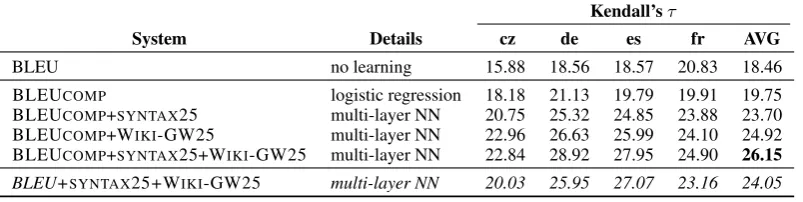
BLEU has different components: the n-gram precisions, the n-gram matches, the total num-ber ofn-grams (n=1,2,3,4), the lengths of the hy-potheses and of the reference, the length ratio be-tween them, and BLEU’s brevity penalty. We will refer to this decomposed BLEU as BLEUCOMP. Some of these features were previously used in SIMPBLEU (Song and Cohn, 2011).
Kendall’sτ
System Details cz de es fr AVG
BLEU no learning 15.88 18.56 18.57 20.83 18.46
[image:7.595.100.502.54.155.2]BLEUCOMP logistic regression 18.18 21.13 19.79 19.91 19.75 BLEUCOMP+SYNTAX25 multi-layer NN 20.75 25.32 24.85 23.88 23.70 BLEUCOMP+WIKI-GW25 multi-layer NN 22.96 26.63 25.99 24.10 24.92 BLEUCOMP+SYNTAX25+WIKI-GW25 multi-layer NN 22.84 28.92 27.95 24.90 26.15 BLEU+SYNTAX25+WIKI-GW25 multi-layer NN 20.03 25.95 27.07 23.16 24.05
Table 2: Kendall’sτon WMT12 for neural networks using BLEUCOMP, a decomposed version of BLEU. For comparison,
the last line shows a combination using BLEU instead of BLEUCOMP.
Source Alone Comb. WIKI-GW25 10.01 29.70
WIKI-GW300 9.66 29.90
CC-300-42B 12.16 29.68 CC-300-840B 11.41 29.88 WORD2VEC300 7.72 29.13
COMPOSES400 12.35 28.54
Table 3:Average Kendall’sτon WMT12 for semantic vec-tors trained on different text collections. Shown are results (i) when using the semantic vectors alone, and (ii) when com-bining them with 4METRICSandSYNTAX25. The improve-ments over WIKI-GW25 are marked in bold.
As before, adding SYNTAX25 and WIKI -GW25 improves the results, but now by a more sizable margin: +4 for the former and +5 for the latter. Adding both yields +6.5 improvement over BLEUCOMP, and almost 8 points over BLEU.
We see once again that the syntactic and seman-tic word embeddings are complementary to the in-formation sources used by metrics such as BLEU, and that our framework can learn from richer pair-wise feature sets such as BLEUCOMP.
6.2 Larger Semantic Vectors
One interesting aspect to explore is the effect of the dimensionality of the input embeddings. Here, we studied the impact of using semantic vectors of bigger sizes, trained on different and larger text collections. The results are shown in Table 3. We can see that, compared to the 50-dimensional WIKI-GW25, 300-400 dimensional vectors are generally better by 1-2 τ points absolute when used in isolation; however, when used in combina-tion with 4METRICS+SYNTAX25, they do not of-fer much gain (up to +0.2), and in some cases, we observe a slight drop in performance. We suspect that the variability across the different collections is due to a domain mismatch. Yet, we defer this question for future work.
Kendall’sτ
[image:7.595.106.257.210.297.2]Details cz de es fr AVG single-layer 25.86 32.06 30.03 28.45 29.10 multi-layer 26.30 33.19 30.38 28.92 29.70
Table 4: Kendall’s tau (τ) on the WMT12 dataset for al-ternative architectures using 4METRICS+SYNTAX25+WIKI -GW25 as input.
6.3 Deep vs. Flat Neural Network
One interesting question is how much of the learn-ing is due to the rich input representations, and how much happens because of the architecture of the neural network. To answer this, we exper-imented with two settings: a single-layer neural network, where all input features are fed directly to the output layer (which is logistic regression), and our proposed multi-layer neural network.
The results are shown in Table 4. We can see that switching from our multi-layer architecture to a single-layer one yields an absolute drop of 0.6
τ. This suggests that there is value in using the deeper, pairwise layer architecture.
6.4 Task-Specific Cost Function
Another question is whether the log-likelihood cost function J(θ) (see Section 3.3) is the most appropriate for our ranking task, provided that it is evaluated using Kendall’sτ as defined below:
τ = concord.concord+−disc.disc.+−tiesties (5)
whereconcord., disc. andtiesare the number of concordant, disconcordant and tied pairs.
Given an input tuple(t1, t2, r), the logistic cost
function yields larger values ofσ =f(t1, t2, r)if y = 1, and smaller ify = 0, where0 ≤σ ≤ 1is the parameter of the Bernoulli distribution. How-ever, it does not model directly the probability when the order of the hypotheses in the tuple is reversed, i.e.,σ0 =f(t
Kendall’sτ
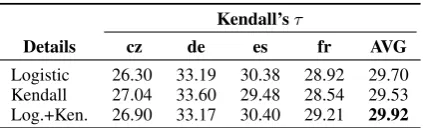
[image:8.595.76.288.50.114.2]Details cz de es fr AVG Logistic 26.30 33.19 30.38 28.92 29.70 Kendall 27.04 33.60 29.48 28.54 29.53 Log.+Ken. 26.90 33.17 30.40 29.21 29.92
Table 5: Kendall’s tau (τ) on WMT12 for alternative cost functions using 4METRICS+SYNTAX25+WIKI-GW25.
For our specific task, given an input tuple
(t1, t2, r), we want to make sure that the difference
between the two output activations∆ =σ−σ0is
positive wheny = 1, and negative wheny = 0. Ensuring this would take us closer to the actual objective, which is Kendall’sτ. One possible way to do this is to introduce a task-specific cost func-tion that penalizes the disagreements similarly to the way Kendall’s τ does.4 In particular, we de-fine a newKendall costas follows:
Jθ=−
X
n
ynsig(−γ∆n) + (1−yn) sig(γ∆n) (6) where we use the sigmoid functionsigas a differ-entiable approximation to the step function.
The above cost function penalizes disconcor-dances, i.e., cases where (i) y = 1 but∆ < 0, or (ii) wheny = 0but∆>0. However, we also need to make sure that we discourageties. We do so by adding a zero-mean Gaussian regularization termexp(−β∆2/2)that penalizes the value of∆
getting close to zero. Note that the specific val-ues for γ andβ are not really important, as long as they are large. In particular, in our experiments, we usedγ =β = 100.
Table 5 shows a comparison of the two cost functions: (i) the standard logistic cost, and (ii) our Kendall cost. We can see that using the Kendall cost enables effective learning, although it is even-tually outperformed by the logistic cost. Our in-vestigation revealed that this was due to a combi-nation of slower convergence and poor initializa-tion. Therefore, we further experimented with a setup where we first used the logistic cost to pre-train the neural network, and then we switched to the Kendall cost in order to perform some finer tuning. As we can see in Table 5 (last row), do-ing so yielded a sizable improvement over usdo-ing the Kendall cost only; it also improved over using the logistic cost only.
4Other variations for ranking tasks are possible, e.g., (Yih
et al., 2011).
7 Conclusions and Future Work
We have presented a novel framework for learn-ing a tunable MT evaluation metric in a pairwise ranking setting, given pre-existing pairwise human preference judgments.
In particular, we used a neural network, where the input layer encodes lexical, syntactic and se-mantic information from the reference and the two translation hypotheses, which is efficiently com-pacted into relatively small embeddings. The net-work has a hidden layer, motivated by our intuition about the problem, which captures the interactions between the relevant input components. Unlike previously proposed kernel-based approaches, our framework allows us to do both training and in-ference efficiently. Moreover, we have shown that it can be trained to optimize a task-specific cost function, which is more appropriate for the pair-wise MT evaluation setting.
The evaluation results have shown that our NN model yields state-of-the-art results when using lexical, syntactic and semantic features (the latter two based on compact embeddings). Moreover, we have shown that the contribution of the differ-ent information sources is additive, thus demon-strating that the framework can effectively inte-grate complementary information. Furthermore, the framework is flexible enough to exploit dif-ferent granularities of features such as n-gram matches and other components of BLEU (which individually work better than using the aggregated BLEU score). Finally, we have presented evidence suggesting that using the pairwise hidden layers is advantageous over simpler flat models.
In future work, we would like to experiment with an extension that allows for multiple refer-ences. We further plan to incorporate features from the source sentence. We believe that our framework can support learning similarities be-tween the two translations and the source, for an improved MT evaluation. Variations of this ar-chitecture might be useful for related tasks such as Quality Estimation and hypothesis re-ranking for Machine Translation, where no references are available.
References
Joshua Albrecht and Rebecca Hwa. 2008. Regression for machine translation evaluation at the sentence level. Machine Translation, 22(1-2):1–27.
Marco Baroni, Georgiana Dinu, and Germ´an Kruszewski. 2014. Don’t count, predict! A systematic comparison of context-counting vs. context-predicting semantic vectors. InProceedings of the 52nd Annual Meeting of the Association for Computational Linguistics, ACL ’14, pages 238–247, Baltimore, Maryland, USA.
Yoshua Bengio and Xavier Glorot. 2010. Understand-ing the difficulty of trainUnderstand-ing deep feedforward neural networks. InProceedings of AI & Statistics 2010, volume 9, pages 249–256, Chia Laguna Resort, Sar-dinia, Italy.
Yoshua Bengio, R´ejean Ducharme, Pascal Vincent, and Christian Janvin. 2003. A neural probabilistic lan-guage model. Journal of Machine Learning Re-search, 3:1137–1155.
James Bergstra, Olivier Breuleux, Fr´ed´eric Bastien, Pascal Lamblin, Razvan Pascanu, Guillaume Des-jardins, Joseph Turian, David Warde-Farley, and Yoshua Bengio. 2010. Theano: a CPU and GPU math expression compiler. In Proceedings of the Python for Scientific Computing Conference, SciPy ’10, Austin, Texas.
Ondrej Bojar, Christian Buck, Christian Federmann, Barry Haddow, Philipp Koehn, Johannes Leveling, Christof Monz, Pavel Pecina, Matt Post, Herve Saint-Amand, Radu Soricut, Lucia Specia, and Aleˇs Tamchyna. 2014. Findings of the 2014 workshop on statistical machine translation. InProceedings of the Ninth Workshop on Statistical Machine Transla-tion, WMT ’14, pages 12–58, Baltimore, Maryland, USA.
Chris Callison-Burch, Cameron Fordyce, Philipp Koehn, Christof Monz, and Josh Schroeder. 2007. (Meta-) evaluation of machine translation. In Pro-ceedings of the Second Workshop on Statistical Machine Translation, WMT ’07, pages 136–158, Prague, Czech Republic.
Chris Callison-Burch, Philipp Koehn, Christof Monz, and Omar Zaidan. 2011. Findings of the 2011 workshop on statistical machine translation. In Pro-ceedings of the Sixth Workshop on Statistical Ma-chine Translation, WMT ’11, pages 22–64, Edin-burgh, Scotland.
Chris Callison-Burch, Philipp Koehn, Christof Monz, Matt Post, Radu Soricut, and Lucia Specia. 2012. Findings of the 2012 Workshop on Statistical Ma-chine Translation. In Proceedings of the Sev-enth Workshop on Statistical Machine Translation, WMT ’12, pages 10–51, Montr´eal, Canada.
Ronan Collobert, Jason Weston, L´eon Bottou, Michael Karlen, Koray Kavukcuoglu, and Pavel Kuksa.
2011. Natural language processing (almost) from scratch. Journal of Machine Learning Research, 12:2493–2537.
Elisabet Comelles, Jes´us Gim´enez, Llu´ıs M`arquez, Irene Castell´on, and Victoria Arranz. 2010. Document-level automatic MT evaluation based on discourse representations. In Proceedings of the Joint Fifth Workshop on Statistical Machine Trans-lation and MetricsMATR, WMT ’10, pages 333– 338, Uppsala, Sweden.
Michael Denkowski and Alon Lavie. 2011. Meteor 1.3: Automatic metric for reliable optimization and evaluation of machine translation systems. In Pro-ceedings of the Sixth Workshop on Statistical Ma-chine Translation, WMT ’11, pages 85–91, Edin-burgh, Scotland.
Jacob Devlin, Rabih Zbib, Zhongqiang Huang, Thomas Lamar, Richard Schwartz, and John Makhoul. 2014. Fast and robust neural network joint models for sta-tistical machine translation. In Proceedings of the 52nd Annual Meeting of the Association for Com-putational Linguistics, ACL ’14, pages 1370–1380, Baltimore, Maryland, USA.
George Doddington. 2002. Automatic evaluation of machine translation quality using n-gram co-occurrence statistics. In Proceedings of the Sec-ond International Conference on Human Language Technology Research, HLT ’02, pages 138–145, San Francisco, California, USA. Morgan Kaufmann Publishers.
John Duchi, Elad Hazan, and Yoram Singer. 2011. Adaptive subgradient methods for online learning and stochastic optimization. Journal of Machine Learning Research, 12:2121–2159.
Kevin Duh. 2008. Ranking vs. regression in ma-chine translation evaluation. In Proceedings of the Third Workshop on Statistical Machine Translation, WMT ’08, pages 191–194, Columbus, Ohio, USA. Jes´us Gim´enez and Llu´ıs M`arquez. 2007.
Linguis-tic features for automaLinguis-tic evaluation of heterogenous MT systems. InProceedings of the Second Work-shop on Statistical Machine Translation, WMT ’07, pages 256–264, Prague, Czech Republic.
Francisco Guzm´an, Shafiq Joty, Llu´ıs M`arquez, Alessandro Moschitti, Preslav Nakov, and Massimo Nicosia. 2014a. Learning to differentiate bet-ter from worse translations. In Proceedings of the 2014 Conference on Empirical Methods in Natural Language Processing, EMNLP ’14, pages 214–220, Doha, Qatar.
Shafiq Joty, Francisco Guzm´an, Llu´ıs M`arquez, and Preslav Nakov. 2014. DiscoTK: Using discourse structure for machine translation evaluation. In Pro-ceedings of the Ninth Workshop on Statistical Ma-chine Translation, WMT ’14, pages 402–408, Balti-more, Maryland, USA.
Alex Kulesza and Stuart M. Shieber. 2004. A learn-ing approach to improvlearn-ing sentence-level MT evalu-ation. InProceedings of the 10th International Con-ference on Theoretical and Methodological Issues in Machine Translation.
Alon Lavie and Michael Denkowski. 2009. The ME-TEOR metric for automatic evaluation of machine translation. Machine Translation, 23(2–3):105–115. Ding Liu and Daniel Gildea. 2005. Syntactic fea-tures for evaluation of machine translation. In Pro-ceedings of the ACL Workshop on Intrinsic and Ex-trinsic Evaluation Measures for Machine Transla-tion and/or SummarizaTransla-tion, pages 25–32, Ann Ar-bor, Michigan, USA.
Chi-kiu Lo, Anand Karthik Tumuluru, and Dekai Wu. 2012. Fully automatic semantic MT evaluation. In
Proceedings of the Seventh Workshop on Statisti-cal Machine Translation, WMT ’12, pages 243–252, Montr´eal, Canada.
Matouˇs Mach´aˇcek and Ondˇrej Bojar. 2013. Results of the WMT13 metrics shared task. InProceedings of the Eighth Workshop on Statistical Machine Trans-lation, WMT ’13, pages 45–51, Sofia, Bulgaria. Matouˇs Mach´aˇcek and Ondˇrej Bojar. 2014. Results of
the WMT14 metrics shared task. InProceedings of the Ninth Workshop on Statistical Machine Transla-tion, WMT ’14, pages 293–301, Baltimore, Mary-land, USA.
Tomas Mikolov, Martin Karafi´at, Lukas Burget, Jan Cernock´y, and Sanjeev Khudanpur. 2010. Re-current neural network based language model. In 11th Annual Conference of the International Speech Communication Association, pages 1045– 1048, Makuhari, Chiba, Japan.
Tomas Mikolov, Ilya Sutskever, Kai Chen, Greg S. Cor-rado, and Jeff Dean. 2013a. Distributed representa-tions of words and phrases and their composition-ality. InAdvances in Neural Information Process-ing Systems 26, NIPS ’13, pages 3111–3119. Lake Tahoe, California, USA.
Tomas Mikolov, Wen-tau Yih, and Geoffrey Zweig. 2013b. Linguistic regularities in continuous space word representations. In Proceedings of the 2013 Conference of the North American Chapter of the Association for Computational Linguistics: Human Language Technologies, NAACL-HLT ’13, pages 746–751, Atlanta, Georgia, USA.
Jeff Mitchell and Mirella Lapata. 2010. Composition in distributional models of semantics. Cognitive Sci-ence, 34(8):1388–1439.
Kishore Papineni, Salim Roukos, Todd Ward, and Wei-Jing Zhu. 2002. BLEU: a method for automatic evaluation of machine translation. In Proceedings of 40th Annual Meting of the Association for Com-putational Linguistics, ACL ’02, pages 311–318, Philadelphia, Pennsylvania, USA.
Jeffrey Pennington, Richard Socher, and Christopher Manning. 2014. Glove: Global vectors for word representation. InProceedings of the Conference on Empirical Methods in Natural Language Process-ing, EMNLP ’14, pages 1532–1543, Doha, Qatar. Maja Popovi´c and Hermann Ney. 2007. Word error
rates: Decomposition over POS classes and applica-tions for error analysis. InProceedings of the Sec-ond Workshop on Statistical Machine Translation, WMT ’07, pages 48–55, Prague, Czech Republic. Matthew Snover, Bonnie Dorr, Richard Schwartz,
Lin-nea Micciulla, and John Makhoul. 2006. A study of translation edit rate with targeted human annotation. InProceedings of the 7th Biennial Conference of the Association for Machine Translation in the Ameri-cas, AMTA ’06, Cambridge, Massachusetts, USA. Richard Socher, John Bauer, Christopher D. Manning,
and Ng Andrew Y. 2013a. Parsing with compo-sitional vector grammars. In Proceedings of the 51st Annual Meeting of the Association for Com-putational Linguistics (Volume 1: Long Papers), ACL ’13, pages 455–465, Sofia, Bulgaria.
Richard Socher, Alex Perelygin, Jean Wu, Jason Chuang, Christopher D. Manning, Andrew Ng, and Christopher Potts. 2013b. Recursive deep models for semantic compositionality over a sentiment tree-bank. In Proceedings of the 2013 Conference on Empirical Methods in Natural Language Process-ing, EMNLP ’13, pages 1631–1642, Seattle, Wash-ington, USA.
Xingyi Song and Trevor Cohn. 2011. Regression and ranking based optimisation for sentence-level MT evaluation. In Proceedings of the Sixth Workshop on Statistical Machine Translation, WMT ’11, pages 123–129, Edinburgh, Scotland.
Ilya Sutskever, Oriol Vinyals, and Quoc V. Le. 2014. Sequence to sequence learning with neural net-works. In Proceedings of the Neural Information Processing Systems, NIPS ’14, Montreal, Canada. Billy Wong and Chunyu Kit. 2012. Extending
ma-chine translation evaluation metrics with lexical co-hesion to document level. In Proceedings of the 2012 Joint Conference on Empirical Methods in Natural Language Processing and Computational Natural Language Learning, EMNLP-CoNLL ’12, pages 1060–1068, Jeju Island, Korea.