Syntactically Guided Neural Machine Translation
Felix Stahlberg† and Eva Hasler† and Aurelien Waite‡ and Bill Byrne‡†
†Department of Engineering, University of Cambridge, UK
‡SDL Research, Cambridge, UK
Abstract
We investigate the use of hierarchical phrase-based SMT lattices in end-to-end neural machine translation (NMT). Weight pushing transforms the Hiero scores for complete translation hypotheses, with the full translation grammar score and full n-gram language model score, into posteri-ors compatible with NMT predictive prob-abilities. With a slightly modified NMT beam-search decoder we find gains over both Hiero and NMT decoding alone, with practical advantages in extending NMT to very large input and output vocabularies.
1 Introduction
We report on investigations motivated by the idea that the structured search spaces defined by syn-tactic machine translation approaches such as Hi-ero (Chiang, 2007) can be used to guide Neural Machine Translation (NMT) (Kalchbrenner and Blunsom, 2013; Sutskever et al., 2014; Cho et al., 2014; Bahdanau et al., 2015). NMT and Hiero have complementary strengths and weaknesses and differ markedly in how they define probabil-ity distributions over translations and what search procedures they use.
The NMT encoder-decoder formalism provides a probability distribution over translationsy=yT
1 of a source sentencexas (Bahdanau et al., 2015)
P(y1T|x) = T
Y
t=1
P(yt|y1t−1,x) =
T
Y
t=1
g(yt−1, st, ct) (1) where st = f(st−1, yt−1, ct) is a decoder state variable and ct is a context vector depending on the source sentence and the attention mechanism.
This posterior distribution is potentially very powerful, however it does not easily lend itself
to sophisticated search procedures. Decoding is done by ‘beam search to find a translation that ap-proximately maximizes the conditional probabil-ity’ (Bahdanau et al., 2015). Search looks only one word ahead and no deeper than the beam.
Hiero defines a synchronous context-free gram-mar (SCFG) with rules: X → hα, γi, where α andγare strings of terminals and non-terminals in the source and target languages. A target language sentence y can be a translation of a source lan-guage sentencexif there is a derivationDin the grammar which yields bothyandx: y =y(D),
x = x(D). This defines a regular language Y
over strings in the target language via a projection of the sentence to be translated: Y = {y(D) :
x(D) = x}(Iglesias et al., 2011; Allauzen et al., 2014). Scores are defined over derivations via a log-linear model with features {φi} and weights λ. The decoder searches for the translationy(D) inYwith the highest derivation scoreS(D) (Chi-ang, 2007, Eq. 24) :
ˆ
y=y
argmax
D:x(D)=xPG(D)PLM(y(D))
λLM
| {z }
S(D)
(2)
where PLM is an n-gram language model and PG(D)∝Q(X→hγ,αi)∈DQiφi(X→ hγ, αi)λi.
Hiero decoders attempt to avoid search er-rors when combining the translation and lan-guage model for the translation hypotheses (Chi-ang, 2007; Iglesias et al., 2009). These procedures search over a vast space of translations, much larger than is considered by the NMT beam search. However the Hiero context-free grammars that make efficient search possible are weak models of translation. The basic Hiero formalism can be ex-tended through ‘soft syntactic constraints’ (Venu-gopal et al., 2009; Marton and Resnik, 2008) or by
adding very high dimensional features (Chiang et al., 2009), however the translation score assigned by the grammar is still only the product of prob-abilities of individual rules. From the modelling perspective, this is an overly strong conditional in-dependence assumption. NMT clearly has the po-tential advantage in incorporating long-term con-text into translation scores.
NMT and Hiero differ in how they ‘consume’ source words. Hiero applies the translation rules to the source sentence via the CYK algorithm, with each derivation yielding a complete and unam-biguous translation of the source words. The NMT beam decoder does not have an explicit mecha-nism for tracking source coverage, and there is ev-idence that may lead to both ‘over-translation’ and ‘under-translation’ (Tu et al., 2016).
NMT and Hiero also differ in their internal rep-resentations. The NMT continuous representa-tion captures morphological, syntactic and seman-tic similarity (Collobert and Weston, 2008) across words and phrases. However, extending these rep-resentations to the large vocabularies needed for open-domain MT is an open area of research (Jean et al., 2015a; Luong et al., 2015; Sennrich et al., 2015; Chitnis and DeNero, 2015). By contrast, Hiero (and other symbolic systems) can easily use translation grammars and language models with very large vocabularies (Heafield et al., 2013; Lin and Dyer, 2010). Moreover, words and phrases can be easily added to a fully-trained symbolic MT system. This is an important consideration for commercial MT, as customers often wish to customise and personalise SMT systems for their own application domain. Adding new words and phrases to an NMT system is not as straightfor-ward, and it is not clear that the advantages of the continuous representation can be extended to the new additions to the vocabularies.
NMT has the advantage of including long-range context in modelling individual translation hy-potheses. Hiero considers a much bigger search space, and can incorporate n-gram language mod-els, but a much weaker translation model. In this paper we try to exploit the strengths of each ap-proach. We propose to guide NMT decoding using Hiero. We show that restricting the search space of the NMT decoder to a subset ofYspanned by Hi-ero effectively counteracts NMT modelling errors. This can be implemented by generating translation lattices with Hiero, which are then rescored by the
NMT decoder. Our approach addresses the lim-ited vocabulary issue in NMT as we replace NMT OOVs with lattice words from the much larger Hi-ero vocabulary. We also find good gains from neu-ral and Kneser-Ney n-gram language models.
2 Syntactically Guided NMT (SGNMT) 2.1 Hiero Predictive Posteriors
The Hiero decoder generates translation hypothe-ses as weighted finite state acceptors (WFSAs), or lattices, with weights in the tropical semiring. For a translation hypothesisy(D)arising from the Hi-ero derivation D, the path weight in the WFSA is−logS(D), after Eq. 2. While this representa-tion is correct with respect to the Hiero translarepresenta-tion grammar and language model scores, having Hi-ero scores at the path level is not convenient for working with the NMT system. What we need are predictive probabilities in the form of Eq. 1.
The Hiero WFSAs are determinised and min-imised with epsilon removal under the tropical semiring, and weights are pushed towards the ini-tial state under the log semiring (Mohri and Riley, 2001). The resulting transducer is stochastic in the log semiring, i.e. the log sum of the arc log prob-abilities leaving a state is 0 (= log 1). In addi-tion, because the WFSA is deterministic, there is a unique path leading to every state, which corre-sponds to a unique Hiero translation prefix. Sup-pose a path to a state accepts the translation prefix y1t−1. An outgoing arc from that state with symbol y has a weight that corresponds to the (negative log of the) conditional probability
PHiero(yt=y|y1t−1,x). (3) This conditional probability is such that for a Hi-ero translationyT
1 =y(D)accepted by the WFSA
PHiero(yT1) =
T
Y
t=1
2.2 NMT–Hiero Decoding
As above, suppose a path to a state in the WFSA accepts a Hiero translation prefixyt1−1, and letyt be a symbol on an outgoing arc from that state. We define the joint NMT+Hiero score as
logP(yt|yt1−1,x) =
λHierologPHiero(yt|y1t−1,x) +
λNMT
logPNMT(yt|y1t−1,x) yt∈ΣNMT logPNMT(unk|y1t−1,x) yt6∈ΣNMT
(5)
Note that the NMT-HIERO decoder only con-siders hypotheses in the Hiero lattice. As dis-cussed earlier, the Hiero vocabulary can be much larger than the NMT output vocabularyΣNMT. If a Hiero translation contains a word not in the NMT vocabulary, the NMT model provides a score and updates its decoder state as for an unknown word. Our decoding algorithm is a natural extension of beam search decoding for NMT. Due to the form of Eq. 5 we can build up hypotheses from left-to-right on the target side. Thus, we can represent a partial hypothesis h = (yt
1, hs) by a transla-tion prefix yt
1 and an accumulated score hs. At each iteration we extend the current hypotheses by one target token, until the best scoring hypothesis reaches a final state of the Hiero lattice. We re-fer to this step asnode expansion, and in Sec. 3.1 we report the number of node expansions per sen-tence, as an indication of computational cost.
We can think of the decoding algorithm as breath-first search through the translation lattices with a limited number of active hypotheses (a beam). Rescoring is done on-the-fly: as the de-coder traverses an edge in the WFSA, we update its weight by Eq. 5. The output-synchronous
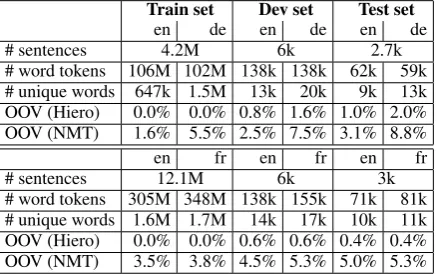
char-Train set Dev set Test set
en de en de en de
# sentences 4.2M 6k 2.7k
# word tokens 106M 102M 138k 138k 62k 59k # unique words 647k 1.5M 13k 20k 9k 13k OOV (Hiero) 0.0% 0.0% 0.8% 1.6% 1.0% 2.0% OOV (NMT) 1.6% 5.5% 2.5% 7.5% 3.1% 8.8%
en fr en fr en fr
# sentences 12.1M 6k 3k
[image:3.595.73.293.594.731.2]# word tokens 305M 348M 138k 155k 71k 81k # unique words 1.6M 1.7M 14k 17k 10k 11k OOV (Hiero) 0.0% 0.0% 0.6% 0.6% 0.4% 0.4% OOV (NMT) 3.5% 3.8% 4.5% 5.3% 5.0% 5.3% Table 1: Parallel texts and vocabulary coverage on news-test2014.
acteristic of beam search enables us to compute the NMT posteriors only once for each history based on previous calculations.
Alternatively, we can think of the algorithm as NMT decoding with revised posterior probabil-ities: instead of selecting the most likely sym-bol yt according the NMT model, we adjust the NMT posterior with the Hiero posterior scores and delete NMT entries that are not allowed by the lat-tice. This may result in NMT choosing a different symbol, which is then fed back to the neural net-work for the next decoding step.
3 Experimental Evaluation
We evaluate SGNMT on the WMTnews-test2014 test sets (the filtered version) for English-German (En-De) and English-French (En-Fr). We also re-port results on WMTnews-test2015En-De.
The En-De training set includes Europarl v7, Common Crawl, andNews Commentary v10. Sen-tence pairs with senSen-tences longer than 80 words or length ratios exceeding 2.4:1 were deleted, as were Common Crawl sentences from other lan-guages (Shuyo, 2010). The En-Fr NMT system was trained on preprocessed data (Schwenk, 2014) used by previous work (Sutskever et al., 2014; Bahdanau et al., 2015; Jean et al., 2015a), but with truecasing like our Hiero baseline. Follow-ing (Jean et al., 2015a), we usenews-test2012and news-test2013as a development set. The NMT vo-cabulary size is 50k for En-De and 30k for En-Fr, taken as the most frequent words in training (Jean et al., 2015a). Tab. 1 provides statistics and shows the severity of the OOV problem for NMT.
The BASIC NMT system is built using the Blocks framework (van Merri¨enboer et al., 2015) based on the Theano library (Bastien et al., 2012) with standard hyper-parameters (Bahdanau et al., 2015): the encoder and decoder networks consist of 1000 gated recurrent units (Cho et al., 2014). The decoder uses a single maxout (Goodfellow et al., 2013) output layer with the feed-forward at-tention model (Bahdanau et al., 2015).
(Jean et al., 2015a, Tab. 2) SGNMT Setup BLEU Setup BLEU BASICNMT 16.46 BASICNMT 16.31
NMT-LV 16.95 HIERO 19.44
+ UNK Replace 18.89 NMT-HIERO 20.69
– – + Tuning 21.43
+ Reshuffle 19.40 + Reshuffle 21.87 + Ensemble 21.59
(a) English-German
(Jean et al., 2015a, Tab. 2) SGNMT Setup BLEU Setup BLEU BASICNMT 29.97 BASICNMT 30.42
NMT-LV 33.36 HIERO 32.86
+ UNK Replace 34.11 NMT-HIERO 35.37
– – + Tuning 36.29
+ Reshuffle 34.60 + Reshuffle 36.61 + Ensemble 37.19
[image:4.595.87.515.60.158.2](b) English-French
Table 2: BLEU scores onnews-test2014calculated withmulti-bleu.perl. NMT-LV refers to the RNNSEARCH-LV model from (Jean et al., 2015a) for large output vocabularies.
Search Vocab. NMT Grammar KN-LM NPLM # of node exp- BLEU BLEU space scores scores scores scores ansions per sen. (single) (ensemble)
1 Lattice Hiero X X – 21.1 (Hiero)
2 Lattice Hiero X X X – 21.7 (Hiero)
3 Unrestricted NMT X 254.8 19.5 21.8
4 100-best Hiero X 2,233.6
(DFS: 832.1)
22.8 23.3
5 100-best Hiero X X X 22.9 23.4
6 100-best Hiero X X X X 22.9 23.3
7 1000-best Hiero X 21,686.2
(DFS: 6,221.8)
23.3 23.8
8 1000-best Hiero X X X 23.4 23.9
9 1000-best Hiero X X X X 23.5 24.0
10 Lattice NMT X 243.3 20.3 21.4
11 Lattice Hiero X 243.3 23.0 24.2
12 Lattice Hiero X X 243.3 23.0 24.2
13 Lattice Hiero X X 240.5 23.4 24.5
14 Lattice Hiero X X X 243.9 23.4 24.4
15 Lattice Hiero X X X X 244.3 24.0 24.4
16 Neural MT – UMontreal-MILA (Jean et al., 2015b) 22.8 25.2
Table 3: BLEU English-Germannews-test2015scores calculated withmteval-v13a.pl.
Our SGNMT system1is built with the Pyfst
inter-face2to OpenFst (Allauzen et al., 2007).
3.1 SGNMT Performance
Tab. 2 compares our combined NMT+Hiero de-coding with NMT results in the literature. We use a beam size of 12. In En-De and in En-Fr, we find that our BASIC NMT system performs similarly (within 0.5 BLEU) to previously published results (16.31 vs. 16.46 and 30.42 vs. 29.97).
In NMT-HIERO, decoding is as described in Sec. 2.2, but with λHiero = 0. The decoder searches through the Hiero lattice, ignoring the Hiero scores, but using Hiero word hypotheses in place of any UNKs that might have been produced by NMT. The results show that NMT-HIERO is much more effective in fixing NMT OOVs than the ‘UNK Replace’ technique (Luong et al., 2015); this holds in both En-De and En-Fr.
For the NMT-HIERO+TUNINGsystems, lattice MERT (Macherey et al., 2008) is used to optimise λHieroandλNMT on the tuning sets. This yields further gains in both En-Fr and En-De, suggesting
1http://ucam-smt.github.io/sgnmt/html/ 2https://pyfst.github.io/
that in addition to fixing UNKs, the Hiero predic-tive posteriors can be used to improve the NMT translation model scores.
Tab. 3 reports results of our En-De system with reshuffling and tuning on news-test2015. BLEU scores are directly comparable to WMT’15 re-sults3. By comparing row 3 to row 10, we see that
constraining NMT to the search space defined by the Hiero lattices yields an improvement of +0.8 BLEU for single NMT. If we allow Hiero to fix NMT UNKs, we see a further +2.7 BLEU gain (row 11). The majority of gains come from fix-ing UNKs, but there is still improvement from the constrained search space for single NMT.
We next investigate the contribution of the Hi-ero system scores. We see that, once lattices are generated, the KN-LM contributes more to rescoring than the Hiero grammar scores (rows 12-14). Further gains can be achieved by adding a feed-forward neural language model with NPLM (Vaswani et al., 2013) (row 15). We observe that n-best list rescoring with NMT (Neubig et al., 2015) also outperforms both the Hiero and NMT
Figure 1: Performance with NPLM over beam size on English-Germannews-test2015. A beam of 12 corresponds to row 15 in Tab. 3.
Determini- Minimi- Weight Sentences sation sation pushing per second
X 2.51
X X 1.57
[image:5.595.72.290.62.184.2]X X X 1.47
Table 4: Time for lattice preprocessing operations on English-Germannews-test2015.
baselines, although lattice rescoring gives the best results (row 9 vs. row 15). Lattice rescoring with SGNMT also uses far fewer node expansions per sentence. We report n-best rescoring speeds for rescoring each hypothesis separately, and a depth-first (DFS) scheme that efficiently traverses the n-best lists. Both these techniques are very slow compared to lattice rescoring. Fig. 1 shows that we can reduce the beam size from 12 to 5 with only a minor drop in BLEU. This is nearly 100 times faster than DFS over the 1000-best list.
Cost of Lattice Preprocessing As described in Sec. 2.1, we applied determinisation, minimisa-tion, and weight pushing to the Hiero lattices in order to work with probabilities. Tab. 4 shows that those operations are generally fast4.
Lattice Size For previous experiments we set the Hiero pruning parameters such that lattices had 8,510 nodes on average. Fig. 2 plots the BLEU score over the lattice size. We find that SGNMT works well on lattices of moderate or large size, but pruning lattices too heavily has a negative ef-fect as they are then too similar to Hiero first best hypotheses. We note that lattice rescoring involves nearly as many node expansions as unconstrained NMT decoding. This confirms that the lattices at 8,510 nodes are already large enough for SGNMT. 4Testing environment: Ubuntu 14.04, Linux 3.13.0, single IntelR XeonR X5650 CPU at 2.67 GHz
Figure 2: SGNMT performance over lattice size on English-German news-test2015. 8,510 nodes per lattice corresponds to row 14 in Tab. 3.
Local Softmax In SGNMT decoding we have the option of normalising the NMT translation probabilities over the words on outgoing words from each state rather than over the full 50,000 words translation vocabulary. There are∼4.5 arcs per state in our En-De’14 lattices, and so avoiding the full softmax could cause significant computa-tional savings. We find this leads to only a modest 0.5 BLEU degradation: 21.45 BLEU in En-De’14, compared to 21.87 BLEU using NMT probabili-ties computed over the full vocabulary.
Modelling Errors vs. Search Errors In our En-De’14 experiments with λHiero = 0 we find that constraining the NMT decoder to the Hiero lattices yields translation hypotheses with much lower NMT probabilities than unconstrained BA -SICNMT decoding: under the NMT model, NMT hypotheses are 8,300 times more likely (median) than NMT-HIEROhypotheses. We conclude (ten-tatively) that BASIC NMT is not suffering only from search errors, but rather that NMT-HIERO discards some hypotheses ranked highly by the NMT model but lower in the evaluation metric.
4 Conclusion
We have demonstrated a viable approach to Syn-tactically Guided Neural Machine Translation for-mulated to exploit the rich, structured search space generated by Hiero and the long-context transla-tion scores of NMT. SGNMT does not suffer from the severe limitation in vocabulary size of basic NMT and avoids any difficulty of extending dis-tributed word representations to new vocabulary items not seen in training data.
Acknowledgements
[image:5.595.85.279.249.302.2]References
Cyril Allauzen, Michael Riley, Johan Schalkwyk, Wo-jciech Skut, and Mehryar Mohri. 2007. OpenFst: A general and efficient weighted finite-state transducer library. InImplementation and Application of Au-tomata, pages 11–23. Springer.
Cyril Allauzen, Bill Byrne, de Adri`a Gispert, Gonzalo Iglesias, and Michael Riley. 2014. Pushdown au-tomata in statistical machine translation.Volume 40, Issue 3 - September 2014, pages 687–723.
Dzmitry Bahdanau, Kyunghyun Cho, and Yoshua Ben-gio. 2015. Neural machine translation by jointly learning to align and translate. InICLR.
Fr´ed´eric Bastien, Pascal Lamblin, Razvan Pascanu, James Bergstra, Ian Goodfellow, Arnaud Bergeron, Nicolas Bouchard, David Warde-Farley, and Yoshua Bengio. 2012. Theano: new features and speed im-provements. In Deep Learning and Unsupervised Feature Learning NIPS 2012 Workshop.
David Chiang, Kevin Knight, and Wei Wang. 2009. 11,001 new features for statistical machine transla-tion. InACL, pages 218–226.
David Chiang. 2007. Hierarchical phrase-based trans-lation. Computational Linguistics, 33(2):201–228. Rohan Chitnis and John DeNero. 2015.
Variable-length word encodings for neural translation models. InEMNLP, pages 2088–2093.
Kyunghyun Cho, Bart van Merrienboer, Caglar Gul-cehre, Fethi Bougares, Holger Schwenk, and Yoshua Bengio. 2014. Learning phrase representations using RNN encoder-decoder for statistical machine translation. InEMNLP.
Ronan Collobert and Jason Weston. 2008. A unified architecture for natural language processing: Deep neural networks with multitask learning. In Pro-ceedings of the 25th International Conference on Machine Learning, pages 160–167. ACM.
Adri`a de Gispert, Gonzalo Iglesias, Graeme Black-wood, Eduardo R Banga, and William Byrne. 2010. Hierarchical phrase-based translation with weighted finite-state transducers and shallow-n grammars.
Computational Linguistics, 36(3):505–533.
Ian Goodfellow, David Warde-farley, Mehdi Mirza, Aaron Courville, and Yoshua Bengio. 2013. Max-out networks. InICML, pages 1319–1327.
Kenneth Heafield, Ivan Pouzyrevsky, Jonathan H. Clark, and Philipp Koehn. 2013. Scalable modified Kneser-Ney language model estimation. In ACL, pages 690–696.
Gonzalo Iglesias, Adri`a de Gispert, Eduardo R Banga, and William Byrne. 2009. Hierarchical phrase-based translation with weighted finite state transduc-ers. InNAACL-HLT, pages 433–441.
Gonzalo Iglesias, Cyril Allauzen, William Byrne, Adri`a de Gispert, and Michael Riley. 2011. Hier-archical phrase-based translation representations. In
EMNLP, pages 1373–1383.
S´ebastien Jean, Kyunghyun Cho, Roland Memisevic, and Yoshua Bengio. 2015a. On using very large target vocabulary for neural machine translation. In
ACL, pages 1–10.
S´ebastien Jean, Orhan Firat, Kyunghyun Cho, Roland Memisevic, and Yoshua Bengio. 2015b. Montreal neural machine translation systems for WMT15. In
Proceedings of the Tenth Workshop on Statistical Machine Translation, pages 134–140.
Nal Kalchbrenner and Phil Blunsom. 2013. Recurrent continuous translation models. In EMNLP, page 413.
Jimmy Lin and Chris Dyer. 2010. Data-intensive text processing with MapReduce. Morgan &Claypool.
Minh-Thang Luong, Ilya Sutskever, Quoc V Le, Oriol Vinyals, and Wojciech Zaremba. 2015. Addressing the rare word problem in neural machine translation. InACL.
Wolfgang Macherey, Franz Josef Och, Ignacio Thayer, and Jakob Uszkoreit. 2008. Lattice-based minimum error rate training for statistical machine translation. InEMNLP, pages 725–734.
Yuval Marton and Philip Resnik. 2008. Soft syntac-tic constraints for hierarchical phrased-based trans-lation. InACL, pages 1003–1011.
Mehryar Mohri and Michael Riley. 2001. A weight pushing algorithm for large vocabulary speech recognition. InInterspeech, pages 1603–1606.
Mehryar Mohri, Fernando Pereira, and Michael Ri-ley. 2002. Weighted finite-state transducers in speech recognition. Computer Speech and Lan-guage, 16(1).
Graham Neubig, Makoto Morishita, and Satoshi Naka-mura. 2015. Neural reranking improves subjective quality of machine translation: NAIST at WAT2015. InWorkshop on Asian Translation, pages 35–41.
Holger Schwenk. 2014. Universit du Maine. http://www-lium.univ-lemans.fr/
˜schwenk/nnmt-shared-task/. [Online;
accessed 1-March-2016].
Rico Sennrich, Barry Haddow, and Alexandra Birch. 2015. Neural machine translation of rare words with subword units. arXiv preprint arXiv:1508.07909.
Ilya Sutskever, Oriol Vinyals, and Quoc V Le. 2014. Sequence to sequence learning with neural net-works. InAdvances in Neural Information Process-ing Systems, pages 3104–3112.
Zhaopeng Tu, Zhengdong Lu, Yang Liu, Xiaohua Liu, and Hang Li. 2016. Coverage-based neural machine translation. arXiv preprint arXiv:1601.04811. Bart van Merri¨enboer, Dzmitry Bahdanau, Vincent
Du-moulin, Dmitriy Serdyuk, David Warde-Farley, Jan Chorowski, and Yoshua Bengio. 2015. Blocks and fuel: Frameworks for deep learning. arXiv preprint arXiv:1506.00619.
Ashish Vaswani, Yinggong Zhao, Victoria Fossum, and David Chiang. 2013. Decoding with large-scale neural language models improves translation. In
EMNLP, pages 1387–1392.