Proceedings of the 55th Annual Meeting of the Association for Computational Linguistics (Short Papers), pages 317–323 Vancouver, Canada, July 30 - August 4, 2017. c2017 Association for Computational Linguistics
Proceedings of the 55th Annual Meeting of the Association for Computational Linguistics (Short Papers), pages 317–323 Vancouver, Canada, July 30 - August 4, 2017. c2017 Association for Computational Linguistics
Bootstrapping for Numerical Open IE
Swarnadeep Saha
Department of CSE I.I.T. Delhi [email protected]
Harinder Pal∗
Microsoft Corporation [email protected]
Mausam
Department of CSE I.I.T. Delhi [email protected]
Abstract
We design and release BONIE, the first opennumericalrelation extractor, for ex-tracting Open IE tuples where one of the arguments is a number or a quantity-unit phrase. BONIE uses bootstrapping to learn the specific dependency patterns that express numerical relations in a sentence. BONIE’s novelty lies in task-specific cus-tomizations, such as inferringimplicit re-lations, which are clear due to context such as units (for e.g., ‘square kilometers’ sug-gests area, even if the word ‘area’ is miss-ing in the sentence). BONIE obtains 1.5x yield and 15 point precision gain on nu-merical facts over a state-of-the-art Open IE system.
1 Introduction
Open Information Extraction (Open IE) systems extract relational tuples from text, without re-quiring a pre-specified vocabulary (Etzioni et al.,
2008; Mausam, 2016), by constructing the rela-tion phrases and arguments from within the sen-tences themselves. Early works on Open IE such as REVERB (Etzioni et al., 2011) extract
verb-mediated relations via a handful of human-defined patterns. OLLIE improves recall by learning de-pendency patterns, using bootstrapping over RE
-VERB extractions (Mausam et al., 2012). Open
IE 4.2, a state-of-the-art open information extrac-tor, is based on a combination of SRLIE, a verb-mediated extractor over SRL frames (Christensen et al.,2011), and RELNOUN2.0, which performs
special linguistic processing for extraction from complex noun phrases (Pal and Mausam, 2016).
1
∗Most work was done when the author was a graduate student at IIT Delhi.
1https://github.com/knowitall/openie
1. Sentence:Hong Kong’s labour force is 3.5 million.
Open IE 4.2:(Hong Kong’s labour force; is; 3.5 million)
BONIE:(Hong Kong; has labour force of; 3.5 million)
2. Sentence:Microsoft has 100,000 employees.
Open IE 4.2:(Microsoft; has; 100,000 employees)
BONIE:(Microsoft; has number of employees; 100,000)
3. Sentence:James Valley is nearly 600 miles long.
Open IE 4.2:(James Valley; is; nearly 600 miles long)
BONIE:(James Valley; has length of; nearly 600 miles)
4. Sentence:Donald Trump is 70 years old.
Open IE 4.2:(Donald Trump; is; 70 years old)
BONIE:(Donald Trump; has age of; 70 years)
5. Sentence:James Valley has 5 sq kms of fruit orchards.
Open IE 4.2:(James Valley; has; 5 sq kms of fruit orchards)
BONIE:(James Valley; has area of fruit orchards; 5 sq kms)
Table 1: Comparison of Open IE 4.2 and BONIE
In this work, we present and release2 the
first system for open numerical extraction, which we name BONIE for Bootstrapping-based Open NumericalInformationExtractor. It is important to note that existing Open IE systems, like Open IE 4.2, may also extract numerical facts. How-ever, they are oblivious to the presence of numbers in arguments. Therefore, they may miss important extractions and may not always output the best nu-merical facts. Table1compares extractions gener-ated by Open IE 4.2 and BONIE on some of the sample sentences.
At a high level BONIE follows OLLIE’s de-sign of identifying seed facts, constructing training data by bootstrapping sentences that may mention a seed fact, pattern learning and ranking. Madaan et al (2016) note that bootstrapping for numerical IE is challenging; it can lead to high noise and missed recall, since numbers can easily match out of context, and numbers may not match due to ap-proximations. In response, similar to most previ-ous works (e.g., LUCHS (Hoffmann et al.,2010)) BONIE matches a number if it is within a percent-age threshold. Additionally, BONIE uses a quan-tity extractor (Roy et al., 2015), which provides
2Available athttps://github.com/Open-NRE
the units mentioned in the sentence – BONIE bootstraps a sentence only when the units match.
When compared to OLLIE, BONIE contributes several numerical IE specific customizations. (1) Since no open facts are available for this task, we first manually define a set of high-precision seed patterns, which are run over a large corpus to gen-erate seed facts. (2) Not all seeds are fit for boot-strapping – many don’t even have an entity as first argument. We develop heuristics to identify an in-formative subset from these. After bootstrapping and pattern learning, we find that we are miss-ing important tuples. E.g., sentence #3 in Table
1 above has no explicit relation word – the rela-tion “has length of” is implicit via the adjective ‘long’. And, sentence #5 expresses the relation ‘area’ via the units. (3) BONIE identifies implicit relations using additional processing of units and adjectives. (4) Finally, BONIE can tag a quantity ascountand prepends “number of” in the relation phrase (sentence #2).
2 Related Work
One of the first Open IE systems to obtain sub-stantial recall is OLLIE (Mausam et al., 2012), which is a pattern learning approach based on a bootstrapped training data using high precision verb-based extractions. Other methods augment the linguistic knowledge in the systems – Exem-plar (de S´a Mesquita et al., 2013) adds new rules over dependency parses, SRLIE develops extrac-tion logic over SRL frames (Christensen et al.,
2011). Several works identify clauses and op-erate over restructured sentences (Schmidek and Barbosa, 2014; Corro and Gemulla, 2013; Bast and Haussmann,2013). Other approaches use tree kernels (Xu et al., 2013), qualia-based patterns (Xavier et al., 2015), and simple within-sentence inference (Bast and Haussmann,2014). However, none of them handle numbers specifically, and hence do not work for our problem.
Numerical Relations:Numbers play an impor-tant role in extracting information from text. Early works have seen people working on understanding numbers that express temporal information (Ling and Weld, 2010). More recently, the focus has been on numbers that express physical quantities or measures, either mentioned in text (Chaganty and Liang, 2016) or in the context of web tables (Ibrahim et al., 2016; Neumaier et al., 2016), or on numbers that represent cardinalities of relations (Mirza et al.,2017).
One of the prior works that applies to generic numerical relations is LUCHS (Hoffmann et al.,
2010), where the system uses distant supervision to create 5,000 relation extractors, which included numerical relations as well. Researchers have also specifically developed numerical relation extrac-tors to extract those relations where one of the ar-guments is a quantity (Vlachos and Riedel,2015;
[image:2.595.309.534.232.398.2]Intxaurrondo et al., 2015; Madaan et al., 2016). However, all of them extract only an ontology rela-tion, and hence are not directly applicable to Open IE.
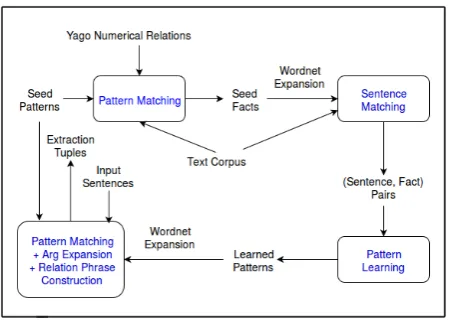
Figure 1: BONIE flow diagram
3 Open Numerical Relation Extraction
The goal of Open Numerical Relation Extraction is to process a sentence that has a quantity mention in it, and extract any tuple of the form (Arg1, rela-tion phrase, Arg2) where Arg2 (or Arg1) is a quan-tity. As a first step, BONIE learns patterns where Arg2 is a quantity, as most English sentences tend to express numerical facts in active voice. Fig-ure1outlines BONIE’s algorithm, which operates in two phases: training and extraction. BONIE’s training includes creation of seed facts, genera-tion of training data via bootstrapping, and pat-tern learning over dependency parses. In the ex-traction phrase, BONIE performs pattern match-ing and parse-based expansion to construct numer-ical tuples. These numernumer-ical tuples are made more coherent by a novel relation construction step.
Figure 2: Seed Dependency Patterns in BONIE
This training example will help learn a new pat-tern.3 This pattern, when applied to the sentence
“Microsoft Windows is the most popular operat-ing system, with a customer base of 300 million users”, will extract (Microsoft Windows; has cus-tomer base of; 300 million users).
While BONIE’s skeleton broadly resembles that of OLLIE’s (Mausam et al., 2012), it brings in customizations specific to the problem of numeri-cal extraction such as a modified pattern language, heuristics for generating high quality seed set and training data, special processing for non-noun re-lations, and a novel relation construction step. We now describe BONIE’s algorithm in detail.
3.1 Generation of Seed Facts
Since open numerical facts are not readily avail-able, we first write a handful of high-precision dependency patterns (see Figure 2 for a list). Each dependency pattern encodes the minimal sub-tree of the dependency parse connecting the relation, quantity and argument in that sen-tence. BONIE encodes a node in a pattern via ‘<depLabel>#<word>#<POSTag>’, where ‘depLabel’ is the edge connecting the node to its parent, ‘word’ is the word at the node, ‘POSTag’ is its part of speech tag; ‘#’ is a delimiter separat-ing them. {rel}, {arg} and{quantity}in the pat-terns are placeholders for relation, argument and quantity headwords, respectively. BONIE gener-ates seed facts by parsing the corpus and match-ing seed patterns with the parse. In case of a suc-cessful match, a seed fact of the form (arg head-word; relation headhead-word; quantity; unit) is gen-erated. Argument and relation headwords are ex-tracted directly from the parse. For the other two, it uses Illinois Quantifier (Roy et al.,2015), which returns both the quantity and unit separately.
Since seed facts form the basis of our training task, they must be as clean as possible – BONIE
3<(#is#verb)<(nsubj#{arg}#nnp|nn)(prep#with#in)< (pobj#{rel}#nnp|nn)<(prep#of#in)<(pobj#{quantity}#.+) >>>>>
adds several filters to reduce noise. It considers a seed fact as valid only when the quantity node in the pattern is within some quantity span given by Illinois Quantifier. It also rejects any fact whose argument is not a proper noun.
After these filters it gets high-precision extrac-tions, but not necessarily good seeds – many seeds are generic, which may easily match unrelated sentences. E.g., (Michael; drove; 20; kms) isn’t a good seed, since ‘Michael’ isn’t specific, and could erroneously match sentences mentioning an-other Michael with some unrelated reference of a 20 km drive. To improve the set, BONIE checks for the presence of a seed fact in Yago KB (Hoffart et al., 2013) and keeps only those that are com-mon. Since Yago has many numerical facts for height, area, latitude, GDP, etc., this gives BONIE a diverse set of clean facts for further training.
Finally, some numerical facts may be expressed without using a nominal relation word. BONIE uses WordNet (Miller, 1995) to generate new seeds from such seed facts using the derivation-ally related noun form of the relation headword. For example, (Brown ; tall ; 13 ; inches) gets trans-formed to (Brown; height; 13; inches), which gets added as a seed fact.
3.2 Bootstrapping
Similar to OLLIE, BONIE finds sentences that contain all words in a seed fact and generates (sen-tence, fact)pairs. But unlike OLLIE, BONIE has quantities and units, and matching them as words isn’t appropriate. Illinois Quantifier performs an internal normalization for both, e.g, changes ‘dol-lars’ and ‘$’ to ‘US$’, and ‘%’ to ‘percent’. Since seed facts also have normalized units, we run Illi-nois quantifier on candidate sentences and match normalized units directly. Moreover, BONIE maintains a percentage thresholdδ to control the
3.3 Open Pattern Learning
For each (sentence, fact)pair, BONIE parses the sentence, and replaces the argument and relation words of the fact with ‘{arg}’ and ‘{rel}’
place-holders. For quantity and unit words, BONIE replaces the one at a higher level in the parse with ‘{quantity}’. The minimal path containing
‘{arg}’, ‘{rel}’ and ‘{quantity}’ is learned as a
pattern. Since quantity and unit are typically ex-pected to remain close to each other in a sentence, BONIE rejects all such patterns where the distance between them exceeds a certain threshold value.
Some patterns are learned with specific words such as ‘contains’ in example (partial)
<(#contains#verb)<(dobj#{quantity}#.+)<... We believe that this pattern should work with all inflections and synonyms of ‘contain’, BONIE uses WordNet to expand the pattern by including all inflections and synset synonyms. Each pattern is scored based on the number of times it is learned from the data.
3.4 Constructing Extractions
After matching a pattern to a new sentence, sim-ilar to OLLIE, arg/rel phrases are completed by expanding the extracted headnouns on poss, det, num, neg, amod, quantmod, nn, and pobj edges. If one of the children of the argument headword is a prep, rcmod or partmod edge, the whole sub-tree under that is extracted. Quantity phrase is extracted by Illinois quantifier, but if any sibling node of the quantity node is connected by a prep edge, with the word ‘of’, BONIE expands the en-tire subtree below it. This allows “10 percent of 100 dollars”to be included in the quantity phrase. Relation Phrase Construction: Whenever the relation headword is an adjective or an adverb, BONIE uses WordNet to get its derivationally re-lated noun form and that becomes the new rela-tion. This transforms the tuple (Donald Trump ; old ; about 70 years) to (Donald Trump ; has age of ; about 70 years).
Sometimes, sentences don’t use a numerical re-lation word – it is obvious from the units. E.g., sentence #4 on page 1 expresses the ‘area’ relation implicitly. BONIE infers these implicit relations using the unit analysis in UnitTagger (Sarawagi and Chakrabarti, 2014). Whenever BONIE sees a unit (sq kms) getting mistreated as a relation it uses UnitTagger to infer relations from units and postprocesses the extraction accordingly. The
ex-traction, as a result changes from (James Valley; has sq kms of ; 5 of fruit orchards) to (James Val-ley ; has area of fruit orchards ; 5 sq kms).
Finally, in cases when a plural noun relation word also appears as a unit in the quantifier, BONIE hypothesizes that it is a count extraction, and prepends ‘number of’ to the relation headword and removes the unit from the quantity phrase. E.g., (Microsoft; has employees; 100,000 employ-ees) from sentence #2 becomes (Microsoft; has number of employees; 100,000).
4 Experiments
We build BONIE over data from ClueWeb12,4
fil-tered so as to keep only the sentences that contain numbers. We further remove those where quantity represents a date, time, or duration, and where the quantity is accompanied by document words like ‘Section’, ‘Table’, or ‘Figure’. We use the depen-dency parser from ClearNLP5. We generate about
21,000 seed facts from roughly 20 million numeri-cal sentences. These are matched against 7 million numerical sentences obtaining about 18,500 (sen-tence, fact) pairs.
We tried different values of δ (the matching
threshold) and found results to not be sensitive as long asδ varies in the range of 2% to 5%. So we
setδ=2% during the final evaluation. The distance
threshold between the quantity and unit mentioned in Section 2.3 is set to 3 and is based on our gen-eral understanding of parse trees.
BONIE learns around 7,000 new patterns. Since pattern frequency is a good indicator of pattern quality (Wu and Weld,2010), we rank the patterns on the basis of frequency and take the top 1,000 patterns for further analysis. We find that almost all patterns beyond the top 1,000 are learned only once or twice on our training set. Our decision to ignore all patterns beyond the top 1,000 is so that we have a support of at least three for each pattern. We sample a random testset of 2,000 numeri-cal sentences from ClueWeb12 (not used in train-ing). Two annotators with NLP experience anno-tate each extraction for correctness. We obtain an inter-annotator agreement of 97%, and report the results on the subset where both annotators agree. Since there are no open numerical extractors available, we compare BONIE against an Open IE system and another closed numerical IE system.
Setting Precision Yield
NumberRule 50.00 6
Open IE 4.2 62.50 296
BONIE (seed patterns only) 85.71 72
+ learned patterns 13.88 362
+ fact filters 55.27 351
[image:5.595.74.301.62.156.2]+ Yago + WordNet expansion on facts 72.69 418 + Relation phrase construction 77.91 448 + WordNet expansion on patterns 77.23 458
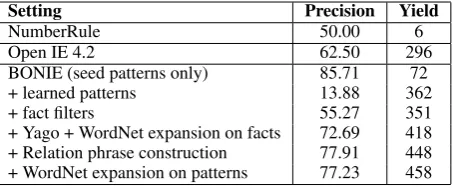
Table 2: Precision and Yield (#correct numerical extrac-tions) on a dataset of 2000 ClueWeb12 numerical sentences.
Table2reports the precisions and yields of all sys-tems. We first compare against numerical tuples from Open IE 4.2,6 a publicly available
state-of-the-art Open IE system that combines SRLIE and RELNOUN. BONIE outputs a much higher
preci-sion and yield on numerical facts, as compared to Open IE 4.2. We also compare against Number-Rule, a state-of-the-art closed numerical IE sys-tem (Madaan et al.,2016). NumberRule7 can be
quickly re-targeted to any new semantic relation by inputting keywords. We feed all of Yago nu-merical relation words as keywords to Number-Rule, but still find that it was able to generate only 12 extractions on our testset.
Figure 3: Comparison of Precision-Yield curves for BONIE and Open IE 4.2. BONIE achieves substantially larger area under the curve than Open IE 4.2.
We also perform additional ablation study to evaluate the value of each component. Just the seed patterns themselves have a significantly higher precision but much smaller yield. This is expected, since the seeds must be highly precise for bootstrapping. If Yago matching and other seed filtering heuristics are turned off, the preci-sion of the system goes down drastically due to a very noisy bootstrapped set. If the post-processing of relation phrase construction is turned off, there is a 5 point precision loss and about 7% yield reduction due to some incorrect extracted tuples, which are corrected by post-processing. Finally,
6https://github.com/knowitall/openie 7https://github.com/NEO-IE
Wordnet-based expansion has marginal increase in yield and slight precision loss.
Open IE 4.2 associates a confidence value with each extraction - ranking against which generates a precision-yield curve. For BONIE, we rank the patterns in such a way that the seed patterns are at the top, followed by the learned patterns. The learned patterns are ordered based on their fre-quencies. Figure3reports the curves for both the systems and we find that BONIE has a larger area under the curve as compared to Open IE 4.2.
Estimating recall in Open IE is difficult since it requires annotators to exhaustively tag all open extractions in a sentence. To get an estimate, an author manually tagged 100 sentences with all nu-merical extractions. We find that BONIE’s recall is about 48%. Two-thirds of missed recall is be-cause of missing conjuncts. E.g., it misses the tu-ple relating retirement age with 68 years in“The retirement age for men is 65 years and 68 years for women.” Other missed recall is due to complexity of sentences or inaccuracy of parsers.
5 Conclusions
We release BONIE8, the first open numerical
lation extractor and other resources for further re-search. BONIE is based on bootstrapping and pat-tern learning and follows previous similar works such as OLLIE. However, for effective bootstrap-ping and training, it implements various cus-tomizations specific to numerical relations in cu-ration of seed fact set, matching of sentences, and construction of relation phrase at the time of ex-traction. BONIE significantly outperforms both open non-numerical IE, and closed numerical IE systems with 1.5x yield and 15 point precision gain over a state-of-the-art Open IE system. We find that better conjunction processing is an im-portant future step for improving BONIE’s recall even further.
Acknowledgements
This work is supported by Google language un-derstanding and knowledge discovery focused re-search grants, a Bloomberg award, a Visvesvaraya faculty award by Govt. of India and an IRD seed grant at I.I.T, Delhi. We also thank Microsoft for the Microsoft Azure sponsorship and a Microsoft Travel grant in support of the work.
[image:5.595.76.284.371.523.2]References
Hannah Bast and Elmar Haussmann. 2013. Open in-formation extraction via contextual sentence decom-position. In2013 IEEE Seventh International Con-ference on Semantic Computing, Irvine, CA, USA, September 16-18, 2013. pages 154–159.
Hannah Bast and Elmar Haussmann. 2014. More infor-mative open information extraction via simple infer-ence. InAdvances in Information Retrieval - 36th European Conference on IR Research, ECIR 2014, Amsterdam, The Netherlands, April 13-16, 2014. Proceedings. pages 585–590.
Arun Tejasvi Chaganty and Percy Liang. 2016. How much is 131 million dollars? putting numbers in perspective with compositional descriptions. In Pro-ceedings of the 54th Annual Meeting of the Associ-ation for ComputAssoci-ational Linguistics, ACL 2016, Au-gust 7-12, 2016, Berlin, Germany, Volume 1: Long Papers.
Janara Christensen, Mausam, Stephen Soderland, and Oren Etzioni. 2011. An analysis of open infor-mation extraction based on semantic role labeling. In Proceedings of the 6th International Conference on Knowledge Capture (K-CAP 2011), June 26-29, 2011, Banff, Alberta, Canada. pages 113–120. Luciano Del Corro and Rainer Gemulla. 2013. Clausie:
clause-based open information extraction. In 22nd International World Wide Web Conference, WWW ’13, Rio de Janeiro, Brazil, May 13-17, 2013. pages 355–366.
Filipe de S´a Mesquita, Jordan Schmidek, and Denil-son Barbosa. 2013. Effectiveness and efficiency of open relation extraction. InProceedings of the 2013 Conference on Empirical Methods in Natural Language Processing, EMNLP 2013, 18-21 Octo-ber 2013, Grand Hyatt Seattle, Seattle, Washington, USA, A meeting of SIGDAT, a Special Interest Group of the ACL. pages 447–457.
Oren Etzioni, Michele Banko, Stephen Soderland, and Daniel S. Weld. 2008. Open information extraction from the web. Commun. ACM51(12):68–74. Oren Etzioni, Anthony Fader, Janara Christensen,
Stephen Soderland, and Mausam. 2011. Open infor-mation extraction: The second generation. InIJCAI 2011, Proceedings of the 22nd International Joint Conference on Artificial Intelligence, Barcelona, Catalonia, Spain, July 16-22, 2011. pages 3–10. Johannes Hoffart, Fabian M. Suchanek, Klaus
Berberich, and Gerhard Weikum. 2013. YAGO2: A spatially and temporally enhanced knowledge base from wikipedia. Artif. Intell.194:28–61.
Raphael Hoffmann, Congle Zhang, and Daniel S. Weld. 2010. Learning 5000 relational extractors. In
ACL 2010, Proceedings of the 48th Annual Meet-ing of the Association for Computational LMeet-inguis- Linguis-tics, July 11-16, 2010, Uppsala, Sweden. pages 286– 295.
Yusra Ibrahim, Mirek Riedewald, and Gerhard Weikum. 2016. Making sense of entities and quan-tities in web tables. InProceedings of the 25th ACM International on Conference on Information and Knowledge Management, CIKM 2016, Indianapolis, IN, USA, October 24-28, 2016. pages 1703–1712.
Ander Intxaurrondo, Eneko Agirre, Oier Lopez de La-calle, and Mihai Surdeanu. 2015. Diamonds in the rough: Event extraction from imperfect microblog data. InNAACL HLT 2015, The 2015 Conference of the North American Chapter of the Association for Computational Linguistics: Human Language Tech-nologies, Denver, Colorado, USA, May 31 - June 5, 2015. pages 641–650.
Xiao Ling and Daniel S. Weld. 2010. Temporal infor-mation extraction. In Proceedings of the Twenty-Fourth AAAI Conference on Artificial Intelligence, AAAI 2010, Atlanta, Georgia, USA, July 11-15, 2010.
Aman Madaan, Ashish Mittal, Mausam, Ganesh Ra-makrishnan, and Sunita Sarawagi. 2016. Numer-ical relation extraction with minimal supervision. In Proceedings of the Thirtieth AAAI Conference on Artificial Intelligence, February 12-17, 2016, Phoenix, Arizona, USA.. pages 2764–2771.
Mausam. 2016. Open information extraction systems and downstream applications. InProceedings of the Twenty-Fifth International Joint Conference on Arti-ficial Intelligence, IJCAI 2016, New York, NY, USA, 9-15 July 2016. pages 4074–4077.
Mausam, Michael Schmitz, Stephen Soderland, Robert Bart, and Oren Etzioni. 2012. Open language learn-ing for information extraction. In Proceedings of the 2012 Joint Conference on Empirical Methods in Natural Language Processing and Computational Natural Language Learning, EMNLP-CoNLL 2012, July 12-14, 2012, Jeju Island, Korea. pages 523– 534.
George A. Miller. 1995. Wordnet: A lexical database for english. Commun. ACM38(11):39–41.
Paramita Mirza, Simon Razniewski, Fariz Darari, and Gerhard Weikum. 2017. Cardinal virtues: Extract-ing relation cardinalities from text.
Sebastian Neumaier, J¨urgen Umbrich, Josiane Xavier Parreira, and Axel Polleres. 2016. Multi-level se-mantic labelling of numerical values. InThe Seman-tic Web - ISWC 2016 - 15th International SemanSeman-tic Web Conference, Kobe, Japan, October 17-21, 2016, Proceedings, Part I. pages 428–445.
Subhro Roy, Tim Vieira, and Dan Roth. 2015. Rea-soning about quantities in natural language. TACL
3:1–13.
Sunita Sarawagi and Soumen Chakrabarti. 2014. Open-domain quantity queries on web tables: anno-tation, response, and consensus models. InThe 20th ACM SIGKDD International Conference on Knowl-edge Discovery and Data Mining, KDD ’14, New York, NY, USA - August 24 - 27, 2014. pages 711– 720.
Jordan Schmidek and Denilson Barbosa. 2014. Im-proving open relation extraction via sentence re-structuring. In Proceedings of the Ninth Interna-tional Conference on Language Resources and Eval-uation (LREC-2014), Reykjavik, Iceland, May 26-31, 2014.. pages 3720–3723.
Andreas Vlachos and Sebastian Riedel. 2015. Iden-tification and verification of simple claims about statistical properties. In Proceedings of the 2015 Conference on Empirical Methods in Natural Lan-guage Processing, EMNLP 2015, Lisbon, Portugal, September 17-21, 2015. pages 2596–2601.
Fei Wu and Daniel S. Weld. 2010. Open informa-tion extracinforma-tion using wikipedia. InACL 2010, Pro-ceedings of the 48th Annual Meeting of the Asso-ciation for Computational Linguistics, July 11-16, 2010, Uppsala, Sweden. pages 118–127.
Clarissa Castell˜a Xavier, Vera L´ucia Strube de Lima, and Marlo Souza. 2015. Open information extrac-tion based on lexical semantics.J. Braz. Comp. Soc.
21(1):4:1–4:14.