Munich Personal RePEc Archive
Research Evaluation, Bibliometric
Indicators and Impact on Knowledge
Development
Fernandes, Graca and Margarida, Lopes
CEMAPRE UNIVERSITY OF LISBON, SOCIUS CSG
-University of Lisbon
September 2017
Online at
https://mpra.ub.uni-muenchen.de/86618/
Research Evaluation, Bibliometric Indicators
and Impact on Knowledge Development:
The Case of ISEG (Lisbon School of Economics
and Management)
Graça Leão Fernandes* andMargarida Chagas Lopes**
With increased globalization and international competition among research centers and universities, bibliometrics has regained a new élan. As a matter of fact, it became the most important criterion— sometimes the only one—used for the evaluation of scientific papers and thereby for the faculty’s classification and progression in the academic and research careers. Accreditation procedures and the building of international rankings reinforced this trend as well as the major role played by reference repertoires. This self-feeding and circular process deserves a deeper insight mostly because it generates important knowledge waste. This is so because non-English speaking scientific communities usually face meaningful obstacles to access the above-mentioned repertoires. And accordingly, their scientific papers risk becoming unknown or underutilized, even though they develop matters and topics which are relevant for their authors’ societies. At the same time, progression in academic or research careers goes in parallel with the reproduction and transmission of official knowledge and generally neglects alternative thinking. In this paper, we shed light on these issues. After a brief literature review, we quantitatively and qualitatively analyze the situation of a Portuguese higher education research institution, with the results confirming the above-mentioned main trends.
* Lecturer, ISEG, Lisbon School of Economics and Management, ULisboa and CEMAPRE; and is the corresponding author. E-mail: gleao@ iseg.ulisboa.pt
* * IS EG, Lisbon S c hool of Ec onomic s and Management , ULisboa and C S G & S O C IUS . E-mail: mchagaslopes@ gmail.com
Introduction
T he turn of the millennium brought to Portugal a very significant development in the field of Science and Technology (S&T) and Research and Development (R&D). This was essentially due to the combination of two factors: the presence and governmental responsibility of formerly expatriate intellectuals who hold a modern, democratic and inclusive view of public policies in these areas, and the inflow of European Commission’s (EC) funds, mainly under the programs of the European Social Fund (ESF).
T he number of Full T ime Equivalent (FT E) researchers, which in the European Union (EU) as a whole increased by 38%, grew by 91% in Portugal between 2004 and 2015, according to EUROSTAT data. Also, the comparison of the increase in total R& D expenses between Portugal and the EU average, in Purchasing Power Parity (PPP), proved to be extremely favorable to the country: + 95% against a 42% increase in the EU-28.
Author please provide the place
-do-Author please
T he IUP Journal of Knowledge Management, Vol. XV, No. 1, 2018 2
Regarding what interests us the most—the number of Internationally Peer-Reviewed (IPR) articles—it increased by about three times between 2000 and 2015/16.
T his disparity in the data between Portugal and other EU countries is due to the relatively large backlog that characterized scientific development in Portugal in the past. But this amazing evolution has not yet been enough to bridge the gap with the more developed countries in this field. Moreover, during the last decade and a half, the country suffered a severe backlash on R& D and S& T investment as a consequence of the financial restrictions imposed by the Troïka, as well as the bureaucratic and authoritarian view of science that characterized the right-center wing that ruled between 2011 and 2015.
Growing international competition among universities is increasingly requiring accreditation by renowned international agencies, such as T he Association to Advance Collegiate Schools of Business (AACSB ), towards which ISEG (Lisbon School of Economics and Management) is now in the process of accreditation. One of the important criteria for accreditation is the evaluation of scientific productivity through bibliometric indicators of the scientific articles published in renowned international journals. T hese journals are classified in highly reputed international repertoires, such as ISI, SCOPUS and ABS. For a number of reasons, mentioned below, such journals restrict their publications to topics that disseminate mainstream economic and social thinking. T his impairs the classification of research from countries with less developed scientific communities, such as Portugal, despite the very favorable outcomes produced in the first decades of the 21st century.
W hy Is That So?
T he imperative transformation and huge competition that the globalization process has imposed on research systems requires scientific results to be increasingly harmonized and comply with benchmarks of international recognition, namely, for accreditation purposes. T hese benchmarks are set by the above-mentioned repertoires which belong, most of the times, to important international organizations. T heir definition stems largely from the size of the market they serve and is greatly enhanced by the largest USA and UK research and higher education entities.
Having English as their primary language favors an increase in the number of readings, downloads and quotations. Furthermore, as the US and UK control a large share of the world’s R& D budget, half of which is reinvested in the US itself, the citation and cross-referencing mechanism increasingly favors American research units and their values, which are then widespread throughout the world.
In this paper, we examine:
• T he proportion of faculty’s scientific papers published in IPR Journals, as well as
the impact of the metrics concerning reference repertoires’ publishing on the faculty’s classification and academic progression; and
• T he weight of published papers which are not IPR or falling outside reference
repertoires (ISI, SCOPUS, ABS) and their relevance to the knowledge and discussion of important Portuguese socioeconomic issues.
Having this research in mind, we took ISEG as an object of study. Firstly, because there is a great disparity between the different universities on how they ‘translate’ bibliometric indicators into the classification of teacher; and secondly, because this kind of information is commonly reserved, and so we only have had access—and with difficulty—to the data of the institution where we teach and do research.
Based on the results of our research, we discuss the more significant consequences of bibliometrics and their use on faculty’s classification as well as on the positive or negative development of scientific research and knowledge.
Literature Review
In the described context which imposes more and more the need for Higher Education (HE) institutions to get international accreditation and increasingly stringent evaluation criteria for the corresponding faculty, international HE rankings are the rule. Especially for research universities, the pressure becomes enormous either from national or international leaders, as Bornmann and Leyedesdorff (2014) and Bornmann et al. (2014) have clearly stated.
In most cases, evaluation criteria—both internationally and internally—do not take into consideration national culture, values or social goals, as well as scientific area’s specificities. T his was what has been happening in Portugal during the period 2011 to 2015 when a center-right government, ideologically neoliberal, runned science, research and innovation policies. Subordination towards mainstream criteria and austerity measures led to a hierarchization of the scientific domains elected for funding, which became very favorable to hard sciences taken as the more prone to produce marketable results (Lopes, 2016).
Relatively to faculty’s evaluation and classification, bibliometrics became the leading criteria for accreditation purposes and academic career’s progression. By selecting ‘reference’ journals, bibliometrics enlightens the way scientific and academic outputs are communicated and how do they circulate, which is positive. But the (mis)use and preponderance of this methodology, which has been recurrently pointed by several authors, has a number of negative consequences.
Among the latter we may recall the “American orientation” and the corresponding trend towards ‘insularity’, in the words of Altbach (2015). Mingers and Willmott (2012) explain this mechanism by which auto-citation among American and British researchers increases and thereby inflates the perceived prestige of the journals and repertoires in which they
T he IUP Journal of Knowledge Management, Vol. XV, No. 1, 2018 4
publish. Actually, bibliometrics can be very misleading: a higher number of citations does not necessarily mean that the corresponding articles are better in quality, only that, most of the times, they are more accessible.
Bibliometrics, due to its heavy weight on evaluation, has several other negative impacts on scientific research. Referring to ABS list of journals, Mingers and Willmott (2012) state that the use of journal lists conditions the research activity of academics and cultivates a research monoculture in which particular criteria, favored by a given list, assume the status of a universal benchmark of performance. Furthermore, although those journals and lists are, generally, the mainstream journals in English language for each discipline, they are but a small part of the worldwide scientific journals (Zanon, 2012; Anninos, 2014; and Altbach, 2015).
T his has two major implications as it reinforces:
• T he research topics and methodologies preferred by English-speaking researchers
and, in general, by more scientifically developed societies, while the research themes that most concern the peripheral countries are increasingly ignored, thus restricting the potential for knowledge development on the latter; and
• T he values, beliefs and social norms dominant in the countries of greater scientific
development, favoring the dominant thinking that is increasingly assumed as official knowledge (Apple, 2014).
Also, the reference repertoires often belong to important international organizations like Elsevier or T hompson Reuters, ruled according to management strategies and profit goals.
Several authors as, Bertocchi et al. (2013), advise the combination of bibliometrics with the informed peer review criteria. Most of the times, only this double methodology allows for the knowledge and dissemination of articles outside mainstream journals, but which topics are of most relevance, and which otherwise risk becoming ignored by the scientific communities.
Authors as Beigel (2014) explain how less developed countries are compelled to comply with the paradigms behind these journals for sake of noticeable publishing which will increase the opportunities to get higher financing and a faster academic career progression.
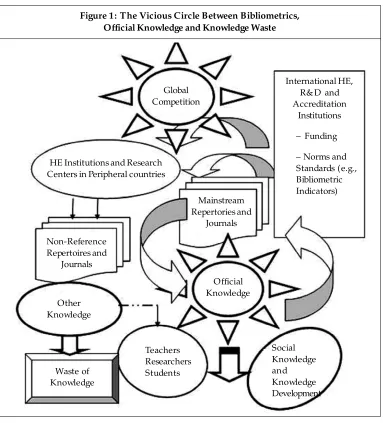
T hus an important vicious circle is generated and self-sustaining, which strongly restricts the development of knowledge, as represented in Figure 1.
Figure 1: The Vicious Circle Between Bibliometrics, Official Knowledge and Knowledge Waste
Global Competition
HE Institutions and Research Centers in Peripheral countries
Non-Reference Repertoires and
Journals
Other Knowledge
Waste of Knowledge
Teachers Researchers Students
Social Knowledge and Knowledge Development Official
Knowledge Mainstream Repertories and
Journals
International HE, R& D and Accreditation
Institutions
– Funding
– Norms and Standards (e.g., Bibliometric Indicators)
But as Beigel points out, there are also important financial and linguistic constraints in the access to publication in more consecrated journals of researchers from peripheral countries. T hus, publication in NMJ allows bridging between those journals, mainstream repertoires and the scientific communities which cannot access the mainstream ones, contributing to a wider dissemination of knowledge. In general, this option has a negative effect on the classifications and career opportunities for researchers.
Bornmann and Leyedesdorff (2014), among others, summarize much of the theoretical discussion in the following questions:
• To what extent can researcher’s productivity be adequately computed by the number
T he IUP Journal of Knowledge Management, Vol. XV, No. 1, 2018 6
• Do bibliometric measurement and assessment lead to an effective change in
scientific research?
Even if the answer to these questions is positive, there is a lack of evidence that bibliometric assessment and classification will by itself contribute to an effective improvement of knowledge research and development processes.
We agree with Anninos (2014) that the evaluation and classification of faculty by bibliometric criteria should be carried out with greatest precaution, taking into account the specificities of the different disciplines and scientific areas as well as their types of outputs, faculty size and observation period.
Furthermore we think that using bibliometrics as the dominant criteria to measure productivity, which in turn affects academic careers, has a negative impact on research. T he faculty tends to restrict their research to the topics valued by mainstream repertoires, leaving behind more meaningful questions about the economic and social problems of their countries and communities.
Data and Methodology
In ISEG, internal evaluation of faculty’s performance depends, among other things, on the number of IPR articles published in each five-year period. So, we used the database of publications of ISEG’s faculty in the last five years collected by the Office of Studies and Planning and ISEG faculty’s classification database produced by the same office for the period under analysis.
T he database displays information about 94 ISEG’s teachers. T his is the number of teachers that published at least one paper in the period 2012-2016/17 which gives a total of 1,428 published articles irrespective of its nature.
We took for analysis variables like number of faculty that published articles in IPR journals, total number of faculty publications and faculty classification.
We ranked IPR journals in three classes: (1) Top Tier PRJ Article or equivalent; (2) PRJ Article – JCR, SCOPUS or equivalent; and (3) PRJ Article – non-JCR, SCOPUS or equivalent. PRJ and JCR refer to Peer-Reviewed Journals and to Journal Citation Reports (ISI Web of Knowledge), respectively. Faculty is classified as Scholarly Academics (SA), the top position, or others according to AACSB demands.
We performed a quantitative and a qualitative analysis of the data. For quantitative analysis, we computed frequencies, crosstabs and chi-square test of independence.
T he analysis of the frequencies of the main variables allowed a first description of the phenomenon under study. We computed frequencies for the number of published papers in all three classes and crosstabs for number of published papers by faculty classification.
are independent random variables. In particular, we analyzed the hypothesis of independence between the number of published papers and faculty classification.
In the qualitative analysis, each paper published in the same interval—2012-2016/2017— was analyzed looking at the internal or international nature of its dissemination, the corresponding form of editing and the scientific areas covered.
Results and Discussion
Quantitative Analysis
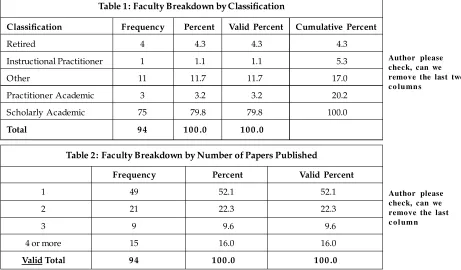
[image:8.595.106.567.319.589.2]From the data collected, we computed the total number of teachers that published 1, 2, 3 or 4 and more papers in this five-year period. T he total number of teachers for which we have data is divided as in Table 1 according to their classification. In what follows we will consider only those classified as SA or other which are the relevant categories for the analysis of career progression.
Table 1: Faculty Breakdown by Classification
Classification Frequency Percent Valid Percent Cumulative Percent
Retired 4 4.3 4.3 4.3
Instructional Practitioner 1 1.1 1.1 5.3
Other 11 11.7 11.7 17.0
Practitioner Academic 3 3.2 3.2 20.2
Scholarly Academic 75 79.8 79.8 100.0
Total 94 100 .0 100 .0
Table 2: Faculty Breakdown by Number of Papers Published
Frequency Percent Valid Percent
1 49 52.1 52.1
2 21 22.3 22.3
3 9 9.6 9.6
4 or more 15 16.0 16.0
Valid Total 94 100 .0 100 .0
T he results in Table 2 show that a little more than half among the faculty only publish at the most one paper but there are 16% who publish four or more:
When we split the data in Table 1 by faculty classification, we get a more clear picture about how the number of papers published are distributed between SA and others (Table 3).
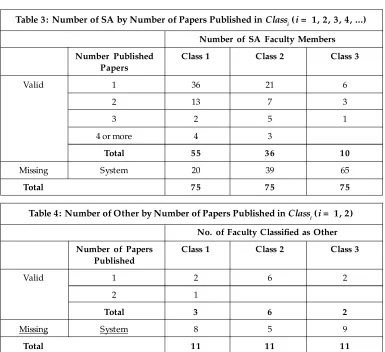
Table 3 shows the number of SA that published 1, 2, 3, 4 or more IPR papers of classes 1, 2 and 3. Notice that each SA can publish a number of papers in each one of the 3 classes and so the figures in Table 2 are not the sum of those in Table 3.
Author please check, can we remove the last two c o lu mn s
Author please check, can we remove the last c o l um n
T he IUP Journal of Knowledge Management, Vol. XV, No. 1, 2018 8
Table 3: Number of SA by Number of Papers Published in Classi (i = 1, 2, 3, 4, ...)
Number of SA Faculty Members
Number Published Class 1 Class 2 Class 3
Papers
Valid 1 36 21 6
2 13 7 3
3 2 5 1
4 or more 4 3
Total 55 36 10
Missing System 20 39 65
Total 75 75 75
Among SA, more than two-thirds published several papers in class 1 (Top IPR journals) and almost 50% published in class 2 (Other IPR journals).
A comparison between the figures in Tables 3 and 4 shows that faculty classified as other published at the most two papers in the five-year period under study. Furthermore, their number of publications is much lower than the one of those classified as SA and most other published in class 2 IPR journals.
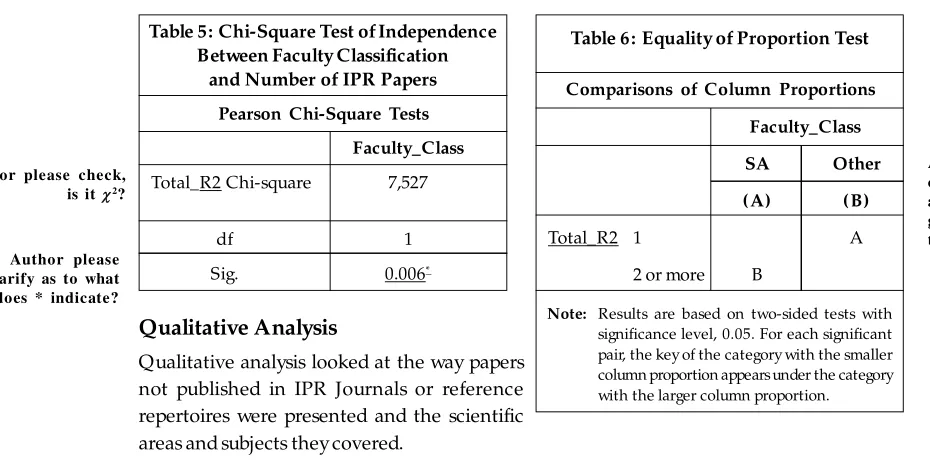
However, the above information does not allow any conclusion about the association between total number of papers published and the classification of faculty. T he results of a chi-square test of independence between the two variables, in Table 5, reject the hypothesis of independence at 5% significance level. T hus, we can say that the faculty classification is not independent from the number of papers published in IPR Journals.
Moreover, a test of equality of proportions between SA and Others that published 1 or 2 or more papers in IPR Journals shows evidence that others published in a larger proportion just one paper, while SA published two or more (Table 6).
Table 4: Number of Other by Number of Papers Published in Classi (i = 1, 2)
No. of Faculty Classified as Other
Number of Papers Class 1 Class 2 Class 3
Published
Valid 1 2 6 2
2 1
Total 3 6 2
Missing System 8 5 9
Total 11 11 11
Qualitative Analysis
Qualitative analysis looked at the way papers not published in IPR Journals or reference repertoires were presented and the scientific areas and subjects they covered.
Among the 1,428 scientific papers that ISEG’s faculty published between 2012 and 2016/ 2017, only 455, say around 32%, were published in IPR journals or repertoires.
T he remaining papers, 68%, have been published as non-IPR articles, conference minutes, books or chapters in books, working papers and pedagogical resources. T hey cover areas such as labor law, applied mathematics (operational research, actuarial sciences), Portuguese economic and social analysis (budget, taxes, labor market, poverty, demography, immigration, gender issues, history and education) which focus on very important issues and problems concerning the country.
T he areas of unemployment containment, regulation and changes in the legal framework of the labor market, global economic growth, among others, should be analyzed throughout the various phases of the economic cycle and especially in the periods of economic recession as the one considered in this study. As has been widely debated in the economic and political fora, these topics are strongly associated with governments’ fiscal, income and budgetary policies. From 2008 to 2015, austerity measures imposed by Troïka (European Commission, European Central Bank and International Monetary Fund) on Southern European Countries, like Portugal, severely conditioned the government’s policies and likewise have heavily affected the economy and society. T hey contributed to aggravate the severe economic recession and to a significant rise in the levels of inequality and poverty. It would be interesting to compare, under a scientific perspective, this situation with the impact of policies implemented since 2015 by a new government. T hese new policies have already proved to have led to a stable growth of the economy and a growing level of social wellbeing. T he repercussions of this change in economic and social areas, namely, on poverty and inequalities, migration and demography, among others, would greatly benefit from an higher visibility and a wider dissemination of scientific work on these issues which rigorously characterized the prevalent
Table 6: Equality of Proportion Test
Comparisons of Column Proportions
Faculty_Class
SA Other
(A) (B)
Total_R2 1 A
2 or more B
[image:10.595.37.502.116.349.2]Note: Results are based on two-sided tests with significance level, 0.05. For each significant pair, the key of the category with the smaller column proportion appears under the category with the larger column proportion.
Table 5: Chi-Square Test of Independence Between Faculty Classification
and Number of IPR Papers
Pearson Chi-Square Tests
Faculty_Class
Total_R2 Chi-square 7,527
df 1
Sig. 0.006*
Author please check, is it 2?
Author please clarify as to what does * indicate?
T he IUP Journal of Knowledge Management, Vol. XV, No. 1, 2018 1 0
situation, as in most ‘remaining 68%’ papers. Because many times these topics do not deserve the attention of mainstream journals and repertoires, relevant knowledge produced becomes lost or hidden.
Conclusion
In the data analyzed there is evidence that 89% of faculty classified as SA published their scientific papers in IPR Journals, but these publications are only 32% among all the scientific papers published by ISEG’s faculty.
It is clear the great influence on career progression in ISEG of international publication, mostly in English language repertoires—European, American and British—and, above all in the ones taken as a reference by accreditation procedures. T hese results confirm the evidence and theoretical developments of Altbach (2015) and Mingers and Willmott (2012), among others, regarding the mechanisms which increase the visibility and (perceived) prestige of scientific articles published in those repertoires’ journals.
T here is also evidence of a statistical association between the number of IPR articles published and their authors’ classification (SA/Other). SA publish more than others and publish more in IPR class 1 journals. T herefore, it seems that the metrics concerning publications in these class 1 repertoires have a positive impact on faculty’s classification which is the main criteria for academic career progression.
Qualitative data analysis revealed evidence that the weight of ISEG faculty’s papers published outside both the IPR journals or reference repertoires (ISI, SCOPUS, ABS) is large (68%) but also that these papers are relevant to the knowledge and discussion of important Portuguese socioeconomic issues (knowledge gap-filling); most of these issues risk remaining ‘in the dark’ because they do not belong to mainstream journals’ scope.
T his translates into an important waste of knowledge on essential aspects of the Portuguese economy and society. T his finding is in line with Anninos (2014), Altbach (2015) and Lopes (2016) developments and findings. It is evidence in favor of the existence of an important vicious circle in the production, dissemination and use of scientific knowledge’s results described in Figure 1. T he results of knowledge that fall outside the international reference repertories become obscured and underutilized, irrespective of their relevance to the country in question, even if they are published in other types of scientific publications. On the other hand, knowledge disseminated throughout those repertoires is well recognized, widely disseminated and perceived as prestigious, even though it has little or nothing to do with the specific characteristics and problems of the society which correspond to the scientific community that produces them. It often assumes the character of ‘official knowledge’,in the words of Michael Apple,that successive generations run the risk of being fed with.
References
1. Altbach Ph G (2015), “T he Tyranny of Citations”, International Higher Education, e-Journal, available at http://ejournals.bc.edu/ojs/index.php/ihe/article/viewFile/7889/ 7040
2. Anninos L (2014), “Research Performance Evaluation: Some Critical T houghts on Standard Bibliometric Indicators”, Studies in Higher Education, Vol. 39, No. 9, available at h t t p: //www. t a n dfon lin e . c om/doi/full/1 0 . 1 0 8 0 /0 3 0 7 5 0 7 9 . 2 0 1 3 . 8 0 1 4 2 9 ? scroll= top& needAccess= true
3. Apple M W (2014), Official Knowledge – Democratic Education in a Conservative Age, 3rd
Edition, Routledge, New York and London.
4. Beigel F (2014), “Publishing from the Periphery: Structural Heterogeneity and Segmented Circuits. T he Evaluation of Scientific Publications for Tenure in Argentina’s CONICET ”, Current Sociology, Vol. 62, No. 5, pp. 743-765.
5. Bertocchi G, Gambardella A, Jappelli T et al. (2013), “Bibliometric Evaluation vs. Informed Peer Review: Evidence from Italy”, IZA DP No. 7739, available at http:// ftp.iza.org/dp7739.pdf
6. Bornmann L and Leyedesdorff L (2014), “Scientometrics in a Changing Science Landscape”, EMBO Reports, Vol. 15, No. 12, pp. 1228-1232, available at http:// embor.embopress.org/content/15/12/1228
7. Bornmann L, Stefaner M, de Moya Anegón F and Mutz R (2014), “Ranking and Mapping of Universities and Research-Focused Institutions Worldwide Based on Highly-Cited Papers: A Visualisation of Results from Multi-Level Models”, Online Information Review, Vol. 38, No. 1, pp. 43-58.
8. Chavarro D A, Tang P and Rafols I (2017), “W hy Researchers Publish in Non-Mainstream Journals: Training, Knowledge Bridging, and Gap Filling”, Research Policy,
Vol. 46, No. 9, pp. 1666-1680.
9. Lopes Margarida Chagas (2016), “T he Dynamics of Knowledge in Portugal – T he Role Played by Public Institutions”, MPRA Paper 80171, University Library of Munich.
10. Mingers J and Willmott H (2012), “Taylorizing Business School Research: On the ‘One Best Way’ Performative Effects of Journal Ranking Lists”, Human Relations, Vol. 66, No. 8, pp. 1051-1073.
11. Zanon B (2012), “Research Quality Assessment and Planning Journals. The Italian Perspective”, Italian Journal of Planning Practice, Vol. 2, No. 2, pp. 96123.