http://www.scirp.org/journal/ojn ISSN Online: 2162-5344 ISSN Print: 2162-5336
DOI: 10.4236/ojn.2017.79077 Sep. 22, 2017 1058 Open Journal of Nursing
Learning Outcomes Using Cooperative Learning
in Communication Classes: Evaluation Using
Text Analysis
Mayumi Uno
1, Yukari Katayama
21Department of Nursing Science, Graduate School of Medicine, Course of Health Science, Osaka University, Osaka, Japan
2Doshisya Women’s College of Liberal Arts, Kyoto, Japan
Abstract
Objectives: The study examined nursing students’ acquisition of good com-munication skills via text analysis of learning outcomes using cooperative learning. Methods: The study involved 90 first-year students enrolled in the nursing department of a Japanese university. Participants were asked to learn three learning tasks considered to heighten communicative ability through firsthand experience using the discussion-based technique of cooperative learning: 1) to engage in self-reflection, 2) to imagine something beyond your own experience, and 3) to accept something that does not fit within the scope of your own experience or thought. A questionnaire survey consisted of five items, including learning challenges 1) to 3) as well as 4) “Satisfaction with the exercises” and 5) “Students’ hopes.” These items were evaluated using text analysis. Results: A total of 79 survey questionnaires were collected (87.8% recovery rate) for analysis. “Self-reflection and self-realizations prompted by the communication exercise” was observed as a characteristic of Task 1, “be-coming aware of ideas and opinions different than one’s own by listening to the opinions of others” as a characteristic of Task 2, “deepening relationships by learning about diverse ideas and values through interactions with others” as a characteristic of Task 3, and “the effects of communicating with student subjects” as a characteristic of Task 4. The responses to Task 5 were diverse; no common characteristics were found. The intervention was found to be useful for student engagement and the communication required of nurses. Conclusions: Using cooperative learning discussion in communication class was found to be effective. As nursing is an inherently interpersonal occupa-tion, such effects include important elements.
Keywords
Active Learning, Think-Pair-Share, Round Robin, Communication, Student
How to cite this paper: Uno, M. and Ka-tayama, Y. (2017) Learning Outcomes Using Cooperative Learning in Communication Classes: Evaluation Using Text Analysis. Open Journal of Nursing, 7, 1058-1068.
https://doi.org/10.4236/ojn.2017.79077 Received: August 31, 2017
Accepted: September 19, 2017 Published: September 22, 2017 Copyright © 2017 by authors and Scientific Research Publishing Inc. This work is licensed under the Creative Commons Attribution International License (CC BY 4.0).
DOI: 10.4236/ojn.2017.79077 1059 Open Journal of Nursing
Engagement, Text Analysis
1. Introduction
Active learning, a learning method based on a learner-centered paradigm, can be defined as a blanket term for learning behavior that accompanies the externali-zation of the cognitive processes of giving voice to one’s own ideas and listening to those of others [1].
Reference [2], in advocating a shift from a teacher-centered paradigm to a learner-centered one, indicated the goals of university education to consist of the following points: “developing competence,” “managing emotion,” “developing autonomy,” “establishing identity,” “developing mature interpersonal relation-ships,” “developing purpose,” and “developing integrity.”
More recently, the elements of learning experience have been summarized as consisting of “foundational knowledge” (understanding and recall of key con-cepts and terms), “application” (knowing ways to use and apply what they know), “the human dimension” (gaining personal and social insight by learning about a subject), “caring” (taking an interest in a subject), and “learning how to learn” (knowing ways to continue to learn after class) [3]. The significance of learning goes beyond the mere acquisition of knowledge; extending to the broad-based development of skills and attitudes (abilities) and the learner’s growth as a human being [3].
One teaching strategy based on the concept of active learning that encom-passes these is “cooperative learning.” Cooperative learning has been described in various reports as a form of structured group learning in which students work together as a team on assignments, assuming responsibility for group learning [4]-[9]. In addition, in comparison with competitive learning or individualistic methods, cooperative learning has been shown to have a higher learning efficacy [10] as well as a higher order of group dynamics that fosters social interdepen-dence. Cooperative learning techniques come in a variety of forms, including discussion and reciprocal peer teaching [11].
Given that communication is an important part of the nursing practice [12], effective communication is a core clinical skill that underpins every aspect of di-agnosis, treatment, and care [13].
DOI: 10.4236/ojn.2017.79077 1060 Open Journal of Nursing
course of their work, and then begin to be able to engage in self-identification [10].
In addition, one way to perceive a phenomenon as it exists is to focus on words related to the phenomenon in question and then perform an objective text analysis with a computer. Qualitative analysis is generally impeded by the con-cern that the determination of results will be biased by the subjectivity of the re-searchers. The advantage of the analysis used in the current research is that it represents a determinant indicator of objective results.
2. Methods
2.1. Study Design
The study is a research on intervention in teaching practice. This study uses text analysis to evaluate the efficacy of “cooperative learning.”
2.2. Study Subjects
The study involved 90 first-year nursing students at a university in the Kinki district of Japan.
2.3. Study Procedure, Data Collection, and Ethical Considerations
Learning tasks: Three abilities that are considered the basis of communication skills for nursing students to learn are identified as follows:1) To engage self-reflection.
2) To imagine something beyond one’s own experience.
3) To accept things beyond the scope of one’s experience or thought.
2.3.1. Intervention Method
Communication classes were held over three 90-minute sessions, consisting of a total of 270 minutes. In terms of content, these sessions involved knowledge- transfer lectures (traditional learning methods) on definitions and theory (equi- valent to 20% of the total time), with cooperative learning making up the re-maining 80%. Students were randomly assigned to groups, with each group be-ing composed of five students. By specifybe-ing the learnbe-ing tasks, the sessions en-couraged cooperation between the instructors and students and among the stu-dents.
For communication-based cooperative learning, the intervention used the discussion techniques “Think-Pair-Share” [11], in which students start by thinking individually and then discussing their ideas with partners in their groups, and “Round Robin,” in which students take turns generating ideas that are written on a list.
2.3.2. Data Collection
DOI: 10.4236/ojn.2017.79077 1061 Open Journal of Nursing
faculty supervision. The words used in the answers for each question were sum-marized (with a single word chosen to replace words with similar meanings).
2.3.3. Ethical Considerations
As for ethical considerations, it was explained to students that the data would not allow the identification of individual respondents, would not be used for any purpose other than the study, would be strictly managed, and would be de-stroyed upon completion of the study. Cooperation was voluntary, and it was guaranteed that evaluations for the class would not be affected either way. Con-sent was obtained with recovery. The study was approved by the Ethical Review Committee of the researchers’ home institution at the time (No. 6).
2.4. Survey Content
The questionnaire survey items were the three learning tasks in 2.3, paraphrased in language that would be easier for students to understand as follows:
1) “Perceptions from re-examining your own ideas”.
2) “What you have learned from listening to the experiences and ideas of other students”.
3) “Interactions from peer learning among students”.
In addition, to glean students’ candid opinions, the questionnaire included questions 4) on “satisfaction with the exercises” and 5) “students’ hopes.” The survey was composed of a total of five items.
2.5. Data Analysis
To identify trends in the text used for each question, the study carried out a word-frequency analysis with co-occurrence network analysis as associated ana-lyses. The analytics software used was IBM SPSS Text Analytics for Surveys 4.01, IBM SPSS Statics ver. 22, R ver. 3.1.3, and KH coder.
2.6. Interpreting the Data Analysis
Word frequency analysis: This analysis refers to the simple tabulation of data obtained by word extraction and is available for checking the frequency of ap-pearance of words. This analysis is also ideal for assessing with a list by parts of speech and in the order corresponding to frequency.
DOI: 10.4236/ojn.2017.79077 1062 Open Journal of Nursing
3. Results
3.1. Descriptive Data
An anonymous descriptive survey questionnaire was distributed to 90 students (79 women and 11 men). Students were between 18 and 24 years old. Of these, 79 were collected (recovery rate 87.8%) and analyzed.
3.2. Word Frequency Analysis and co-Occurrence Network
Analysis
All responses to the questions were subjected to word frequency and co-occur- rence network analyses.
The word frequency analysis lists five words extracted in order of highest fre-quency of appearance, with the number of occurrences shown in parentheses (). The results of the co-occurrence network analysis are shown in Figures 1-4, with the portions showing significant results enclosed in the figures.
3.3. Analytical Results
[image:5.595.218.538.430.705.2]Q1 was “Perceptions from re-examining your own ideas.”The words extracted in order of highest frequency of appearance by the word frequency analysis were “myself (57),” “think (55),” “communication (31),” “person (23),” and “idea (21).” The following results were found in the characteristics of the co-occur- rence network analysis (Figure 1): ① Speaking after listening to the conversa-tion (from the group composed of “conversaconversa-tion,” “listening,” and “speaking”);
Figure 1. Re-examining my own ideas.
DOI: 10.4236/ojn.2017.79077 1063 Open Journal of Nursing
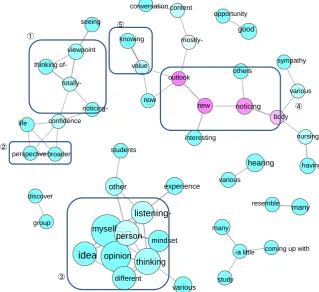
Figure 2. Learning from listening to the opinion of others.
Figure 3. Peer learning among students. myself idea mindset value outlook perspective confidence life opinion group discover content conversation sympathy various now mostly-thinking various different listening-experience various hearing others noticing nursing having viewpoint thinking of-knowing seeing noticing- broaden resemble many opportunity good new interesting study a little many
DOI: 10.4236/ojn.2017.79077 1064 Open Journal of Nursing
Figure 4. Excercise satisfaction.
② Reflecting on past behavior (from the group composed of “reflecting,” “again,” “past,” and “behavior”); and ③ Considering other ideas that I might have myself based on the thoughts and ideas of others (from the group com-posed of “person [other than myself],” “myself,” “thinking,” “idea,” “consider,” “opinion,” “other,” and “having”). Synthesizing results ① to ③ yields the inter-pretation “self-reflections and self-realizations prompted by the communication exercise.”
Q2 was “What you have learned from listening to the experiences and ideas of other students?”The words extracted in order of highest frequency of appearance by the word frequency analysis were “myself (54),” “opinion (48),” “thinking (37),” “person (33),” and “idea (30).” The following results were found in the characteristics of the co-occurrence network analysis (Figure 2): ① Noticing or coming up with totally different viewpoints (from the group composed of “per-ception,” “coming up with,” “totally,” and “noticing”); ② Perspectives became broader (from the group composed of “perspectives” and “broadening”); ③ I heard the opinions and mindsets of people who were different from myself (from the group composed of “myself,” “opinion,” “mindset,” “person,” “differ-ent,” “idea,” and “listening”); ④ I noticed and incorporated new outlooks (from the group composed of “outlook,” “new,” “noticing,” “body,” and “other people”); and ⑤ I came to know their sense of values (from the group composed of “knowing” and “values”).
group work
myself
opportunity
communication
class opinion
satisfaction discover
important various
time abundant
A lot
important
now
presentation today
thinking
learning
speaking
usual considering
engaging
listening-converse
Can learn
knowing in front
various
Can know understanding hearing
Take away fun
many
deep
sleepy
anew actual
person
nursing
site
①
DOI: 10.4236/ojn.2017.79077 1065 Open Journal of Nursing
A synthesis of results ① to ⑤ can be interpreted as “becoming aware of ideas and opinions different than one’s own by listening to the opinions of others.”
Q3 was “interactions from peer learning among students.”The words ex-tracted in order of highest frequency of appearance by the word frequency anal-ysis were “speaking (45),” “person (41),” “opinion (29),” “thinking (18),” and “kids: students (14).”
The following results were found in the characteristics of the co-occurrence network analysis (Figure 3): ① My interactions with student partners were good (from the group composed of “students,” “good,” “partner,” and “interaction”); ② Our mindsets were mutually compatible (from the group composed of “mindset” and “responding”); ③ I gained new friends after getting to know the first kid (from the group composed of “self,” “introduction,” “new,” “friends,” “proliferate,” “know,” “first,” and “kid = students”); ④ Value differences made me think (from the group composed of “values” and “consider”); and ⑤ My re-lations grew deeper (from the group composed of “rere-lations” and “deepening”). By synthesizing results ① to ⑤, these can be interpreted as “deepening rela-tionships by learning about diverse ideas and values through interactions with others.”
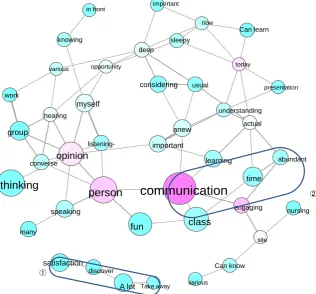
Q4 was “Satisfaction with the exercises.”The words extracted in order of highest frequency of appearance by the word frequency analysis were “commu-nication (29),” “group (10),” “myself (9),” “work (4),” and “opportunity (3).” The following results were found in the characteristics of the co-occurrence network analysis (Figure 4): ① I discovered a lot, which was satisfying (from the group composed of “a lot,” “take away,” “discover,” and “satisfied”); and ② We spent an abundant amount of time engaging in communication (from the group composed of “communication,” “engaging,” “time,” and “abundant”). Synthe-sizing ① and ② gives the interpretation “the effects of engaging in communica-tion with student subjects.”
Q5 was “Students’ hopes.” The words extracted in order of highest frequency of appearance by the word frequency analysis were “specific (17),” “test (3),” “national exam (2),” “listening (2),” and “wish (1),” with a variety of other words that also appeared only one time. In the co-occurrence network analysis, several of unique answers were extracted, such that no significant characteristics were found.
4. Discussion
4.1. Student Engagement
DOI: 10.4236/ojn.2017.79077 1066 Open Journal of Nursing
others.
Moreover, this research used the discussion techniques known as “Think- Pair-Share” and “Round Robin.” In this regard as well, having students interact with one another as members of a learning community seems to have fostered student engagement, yielding the synergistic effects of motivation and active learning [15].
Student reactions after the lesson on “perceptions from re-examining your own ideas” (Task 1) were characterized as results stemming from “self-reflec- tions and self-realizations prompted by the communication exercise.” Thus, in the context of a small group environment, clarifying one’s own ideas enhances the ability to reflect on one’s own past experiences and processes [16].
In addition, despite the abstract nature of the tasks, a learning effect was iden-tified without departing from the task, which seems to stem from the fact that conceptual learning and problem-solving skills are heightened through group dynamics [17].
4.2. Communication as Nursing Students
Student reactions after the lesson on “what you have learned from listening to the experiences and ideas of other students” (Task 2) were characterized as re-sults stemming from “becoming aware of ideas and opinions different than one’s own by listening to the opinions of others.” This outcome was suggested in the process by which students engaged in mutual problem solving after addressing themselves to the same task. However, although not apparent in the survey re-sults, the experiences students spoke of in front of other students, unlike the fun communication with their friends, were also accompanied by a modicum of pain and anxiety, as well as other unpleasant feelings.
Therefore, regardless of whether such embodied experiences also occur for others at the same time, encountering and sympathizing with the thoughts of other group members also serves as a form of training. Indeed, human care, which is the essence of nursing, is something that is refined in the context of in-terpersonal relationships [18]; the ability to recognize sensations that humans possess is an important element of nursing. In other words, by seeing oneself re-flected in the eyes of an interlocutor, people can derive an emotional under-standing of what it is to be a human being. From these, collaborative learning experience can be thought to serve as training for an emotional engagement with patients’ feelings when students engage with patients as nurses.
DOI: 10.4236/ojn.2017.79077 1067 Open Journal of Nursing
5. Limitations
This study only used cooperative learning discussion techniques for the com-munication unit. To heighten the effectiveness of cooperative learning, it will be necessary to introduce it systematically to other lessons as well.
6. Conclusion
Using cooperative learning discussion techniques in communications lessons, it was found to be effective in achieving the assigned tasks. As nursing is an inhe-rently interpersonal occupation, such effects include important elements. For this reason, it will be necessary to continue systematic education. When instruc-tors evaluate educational techniques, rather than simply analyzing only the data obtained, it is also necessary to consider insights on what students have chosen not to express in the data.
Acknowledgements
We extend our heartfelt appreciation to all those who kindly assisted with this study. This research did not receive any specific grant from any funding agency in the public, commercial, or not-for-profit sectors. There are no conflicts of in-terest to declare.
References
[1] Chickering, A.W. and Gamson, Z.F. (1987) Seven Principles for Good Practice in Undergraduate Education. AAHE Bulletin, 39, 3-7.
[2] Chickering, A.W. (1969) Education and Identity. Jossey-Bass, San Francisco. [3] Fink, L.D. (2010) Designing Our Courses for Greater Student Engagement and
Bet-ter Student Learning. Perspectives on Issues in Higher Education, 13, 3-12. https://doi.org/10.1044/ihe13.1.3
[4] Goodfellow, L.M. (1995) Cooperative Learning Strategies: An Effective Method of Teaching Nursing Research. Nurse Educator, 20, 26-29.
https://doi.org/10.1097/00006223-199507000-00010
[5] Huff, C. (1997) Cooperative Learning: A Model for Teaching. Journal of Nursing Education, 36, 434-436.
[6] Rowles, C.J. and Brigham, C. (1998) Strategies to Promote Critical Thinking and Active Learning. Teaching in Nursing: A Guide for Faculty. WB Saunders, Phila-delphia, 247-274.
[7] Matthews, R.S., Cooper, J.L., Davidson, N. and Hawkes, P. (1995) Building Bridges between Cooperative and Collaborative Learning. Change, 27, 35-40.
https://doi.org/10.1080/00091383.1995.9936435
[8] Lazarowitz, R., Hertz-Lazarowitz, R. and Baird, J.H. (1994) Learning Science in a Cooperative Setting: Academic Achievement and Affective Outcomes. Journal of Research in Science Teaching, 31, 1121-1131.
https://doi.org/10.1002/tea.3660311006
DOI: 10.4236/ojn.2017.79077 1068 Open Journal of Nursing 32, 291-299. https://doi.org/10.1002/tea.3660320308
[10] Johnson, D.W. and Johnson, R.T. (2005) New Developments in Social Interdepen-dence Theory. Genetic, Social, and General Psychology Monographs, 131, 285-358. https://doi.org/10.3200/MONO.131.4.285-358
[11] Barkley, E.F., Cross, K.P. and Major, C.H. (2005) Collaborative Learning Tech-niques: A Handbook for College Faculty. John Wiley & Sons, Inc., New York. [12] Okaya, K. (1995) Reliance between a Patient and Nurse. Nursing Today, 10, 6-11. [13] Walsh, T.D., Caraceni, A.T., Fainsinger, R., Foley, K.M., Glare, P., Goh, C., Lloyd-
Williams, M., Olarte, J.N. and Radbruch, L. (2008) Palliative Medicine. Elsevier Health Sciences, Saint Louis.
[14] Bowen, S. (2005) Engaged Learning: Are We All on the Same Page? Peer Review, 7, 4-7.
[15] Barkley, E.F. (2010) Student Engagement Techniques: A Handbook for College Professors. Jossey-Bass, San Francisco.
[16] Copp, S.L. (2002) Using Cooperative Learning Strategies to Teach Implications of the Nurse Practice Act. Nurse Educator, 27, 236-241.
https://doi.org/10.1097/00006223-200209000-00013
[17] Cohen, E.G. (1986) Designing Groupwork: Strategies for the Heterogeneous Class-room. Teachers College Press, Columbia University, New York.
[18] Watson, J. (1988) Nursing: Human Science and Human Care: A Theory of Nursing. Jones & Bartlett Learning, Sudbury.
[19] Kapitanoff, S.H. (2009) Collaborative Testing: Cognitive and Interpersonal Processes Related to Enhanced Test Performance. Active Learning Higher Education, 10, 56-70.https://doi.org/10.1177/1469787408100195
[20] Lusk, M. and Conklin, L. (2003) Collaborative Design to Promote Learning. Journal of Nursing Education, 42, 121-124.
[21] Roschelle, J. (1922) Learning by Collaborating: Convergent Conceptual Change.
The Journal of the Learning Science, 2, 235-276. https://doi.org/10.1207/s15327809jls0203_1
Submit or recommend next manuscript to SCIRP and we will provide best service for you:
Accepting pre-submission inquiries through Email, Facebook, LinkedIn, Twitter, etc. A wide selection of journals (inclusive of 9 subjects, more than 200 journals)
Providing 24-hour high-quality service User-friendly online submission system Fair and swift peer-review system
Efficient typesetting and proofreading procedure
Display of the result of downloads and visits, as well as the number of cited articles Maximum dissemination of your research work