A Computational Approach to Automatic Prediction of
Drunk-Texting
Aditya Joshi1,2,3 Abhijit Mishra1 Balamurali AR4 Pushpak Bhattacharyya1 Mark James Carman2
1IIT Bombay, India,2Monash University, Australia
3IITB-Monash Research Academy, India4Aix-Marseille University, France {adityaj, abhijitmishra, pb}@cse.iitb.ac.in
[email protected],[email protected]
Abstract
Alcohol abuse may lead to unsociable behavior such as crime, drunk driving, or privacy leaks. We introduce auto-matic drunk-texting prediction as the task of identifying whether a text was writ-ten when under the influence of alcohol. We experiment with tweets labeled using hashtags as distant supervision. Our clas-sifiers use a set of N-gram and stylistic fea-tures to detect drunk tweets. Our observa-tions present the first quantitative evidence that text contains signals that can be ex-ploited to detect drunk-texting.
1 Introduction
The ubiquity of communication devices has made social media highly accessible. The content on these media reflects a user’s day-to-day activities. This includes content created under the influence of alcohol. In popular culture, this has been re-ferred to as ‘drunk-texting’1. In this paper, we
in-troduce automatic ‘drunk-texting prediction’ as a computational task. Given a tweet, the goal is to automatically identify if it was written by a drunk user. We refer to tweets written under the influ-ence of alcohol as ‘drunk tweets’, and the opposite as ‘sober tweets’.
A key challenge is to obtain an annotated dataset. We use hashtag-based supervision so that the authors of the tweets mention if they were drunk at the time of posting a tweet. We create three datasets by using different strategies that are related to the use of hashtags. We then present SVM-based classifiers that use N-gram and stylis-tic features such as capitalisation, spelling errors, etc. Through our experiments, we make subtle points related to: (a) the performance of our fea-tures, (b) how our approach compares against
1Source: http://www.urbandictionary.com
human ability to detect drunk-texting, (c) most discriminative stylistic features, and (d)an error analysisthat points to future work. To the best of our knowledge, this is a first study that shows the feasibility of text-based analysis for drunk-texting prediction.
2 Motivation
Past studies show the relation between alcohol abuse and unsociable behaviour such as aggres-sion (Bushman and Cooper, 1990), crime (Carpen-ter, 2007), suicide attempts (Merrill et al., 1992), drunk driving (Loomis and West, 1958), and risky sexual behaviour (Bryan et al., 2005). Merrill et al. (1992) state that “those responsible for assess-ing cases of attempted suicide should be adept at detecting alcohol misuse”. Thus, a drunk-texting prediction system can be used to identify individ-uals susceptible to these behaviours, or for inves-tigative purposes after an incident.
Drunk-texting may also cause regret. Mail Goggles2 prompts a user to solve math questions
before sending an email on weekend evenings. Some Android applications3 avoid drunk-texting
by blocking outgoing texts at the click of a button. However, to the best of our knowledge, these tools require a user command to begin blocking. An on-going text-based analysis will be more helpful, es-pecially since it offers a more natural setting by monitoring stream of social media text and not ex-plicitly seeking user input. Thus, automatic drunk-texting prediction will improve systems aimed to avoid regrettable drunk-texting. To the best of our knowledge, ours is the first study that does a quantitative analysis, in terms of prediction of the drunk state by using textual clues.
Several studies have studied linguistic traits associated with emotion expression and mental
2
http://gmailblog.blogspot.in/2008/10/new-in-labs-stop-sending-mail-you-later.html
3https://play.google.com/store/apps/details?id=com.oopsapp
health issues, suicidal nature, criminal status, etc. (Pennebaker, 1993; Pennebaker, 1997). NLP tech-niques have been used in the past to address so-cial safety and mental health issues (Resnik et al., 2013).
3 Definition and Challenges
Drunk-texting prediction is the task of classifying a text as drunk or sober. For example, a tweet ‘Feeling buzzed. Can’t remember how the evening went’ must be predicted as ‘drunk’, whereas, ‘ Re-turned from work late today, the traffic was bad’ must be predicted as ‘sober’. The challenges are:
1. More than topic categorisation:
Drunk-texting prediction is similar to topic cate-gorisation (that is, classification of docu-ments into a set of categories such as ‘news’, ‘sports’, etc.). However, Borrill et al. (1987) show that alcohol abusers have more pro-nounced emotions, specifically, anger. In this respect, drunk-texting prediction lies at the confluence of topic categorisation and emo-tion classificaemo-tion.
2. Identification of labeled examples: It is
dif-ficult to obtain a set of sober tweets. The ideal label can be possibly given only by the author. For example, whether a tweet such as ‘I am feeling lonely tonight’ is a drunk tweet is ambiguous. This is similar to sar-casm expressed as an exaggeration (for ex-ample, ‘This is the best film ever!), where the context beyond the text needs to be consid-ered.
3. Precision/Recall trade-off: The goal that a
drunk-texting prediction system must chase depends on the application. An application that identifies potential crimes must work with high precision, since the target popula-tion to be monitored will be large. On the other hand, when being used to avoid regret-table drunk-texting, a prediction system must produce high recall in order to ensure that a drunk message does not pass through.
4 Dataset Creation
We use hashtag-based supervision to create our datasets, similar to tasks like emotion classifica-tion (Purver and Battersby, 2012). The tweets are downloaded using Twitter API (https://dev.
twitter.com/). We remove non-Unicode
characters, and eliminate tweets that contain hy-perlinks4 and also tweets that are shorter than 6
[image:2.595.337.496.194.320.2]words in length. Finally, hashtags used to indi-cate drunk or sober tweets are removed so that they provide labels, but do not act as features. The dataset is available on request. As a result, we cre-ate three datasets, each using a different strcre-ategy for sober tweets, as follows:
Figure 1: Word cloud for drunk tweets
1. Dataset 1(2435 drunk, 762 sober): We
col-lect tweets that are marked as drunk and sober, using hashtags. Tweets containing hashtags #drunk, #drank and #imdrunk are considered to be drunk tweets, while those with #notdrunk, #imnotdrunk and #sober are considered to be sober tweets.
2. Dataset 2 (2435 drunk, 5644 sober): The
drunk tweets are downloaded using drunk hashtags, as above. The list of users who cre-ated these tweets is extracted. For the nega-tive class, we download tweets by these users, which do not contain the hashtags that corre-spond to drunk tweets.
3. Dataset H(193 drunk, 317 sober): A
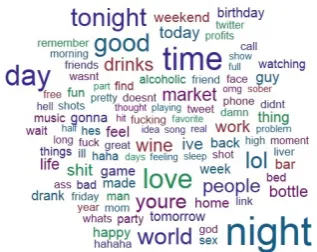
sepa-rate dataset is created where drunk tweets are downloaded using drunk hashtags, as above. The set of sober tweets is collected using both the approaches above. The resultant is the held-out test setDataset-H that contains no tweets in common with Datasets 1 and 2. The drunk tweets for Datasets 1 and 2 are the same. Figure 1 shows a word-cloud for these drunk tweets (with stop words and forms of the word ‘drunk’ removed), created using
4This is a rigid criterion, but we observe that tweets with
Feature Description
N-gram Features
Unigram & Bigram (Presence) Boolean features indicating unigrams and bigrams Unigram & Bigram (Count) Real-valued features indicating unigrams and bigrams
Stylistic Features
LDA unigrams (Presence/Count) Boolean & real-valued features indicating unigrams from LDA POS Ratio Ratios of nouns, adjectives, adverbs in the tweet
#Named Entity Mentions Number of named entity mentions #Discourse Connectors Number of discourse connectors
Spelling errors Boolean feature indicating presence of spelling mistakes
Repeated characters Boolean feature indicating whether a character is repeated three times consecutively
Capitalisation Number of capital letters in the tweet
Length Number of words
[image:3.595.72.524.62.283.2]Emoticon (Presence/Count) Boolean & real-valued features indicating unigrams Sentiment Ratio Positive and negative word ratios
Table 1: Our Feature Set for Drunk-texting Prediction
WordItOut5. The size of a word indicates its
fre-quency. In addition to topical words such as ‘bar’, ‘bottle’ and ‘wine’, the word-cloud shows senti-ment words such as ‘love’ or ‘damn’, along with profane words.
Heuristics other than these hashtags could have been used for dataset creation. For example, timestamps were a good option to account for time at which a tweet was posted. However, this could not be used because user’s local times was not available, since very few users had geolocation en-abled.
5 Feature Design
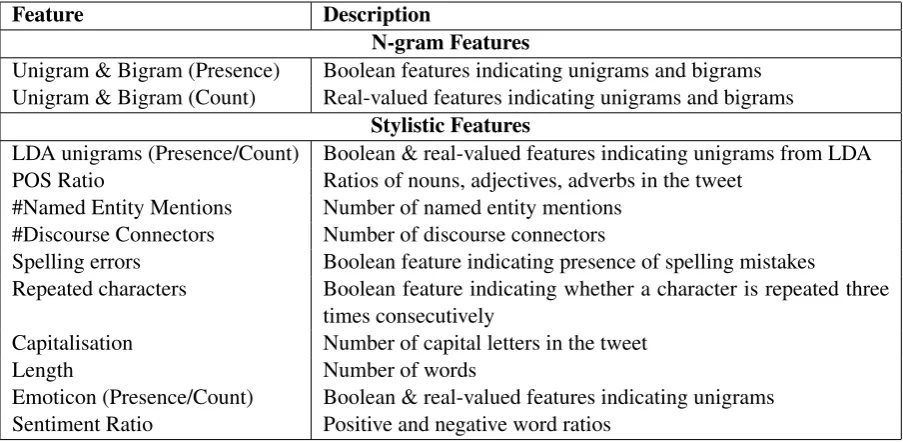
[image:3.595.308.508.561.702.2]The complete set of features is shown in Table 1. There are two sets of features: (a) N-gram fea-tures, and (b) Stylistic features. We use unigrams and bigrams as N-gram features- considering both presence and count.
Table 1 shows the complete set of stylistic fea-tures of our prediction system. POS ratios are a set of features that record the proportion of each POS tag in the dataset (for example, the proportion of nouns/adjectives, etc.). The POS tags and named entity mentions are obtained from NLTK (Bird, 2006). Discourse connectors are identified based on a manually created list. Spelling errors are identified using a spell checker by Aby (2014). The repeated characters feature captures a situ-ation in which a word contains a letter that is repeated three or more times, as in the case of
5www.worditout.com
happpy. Since drunk-texting is often associated with emotional expression, we also incorporate a set of sentiment-based features. These features in-clude: count/presence of emoticons and sentiment ratio. Sentiment ratio is the proportion of posi-tive and negaposi-tive words in the tweet. To deter-mine positive and negative words, we use the sen-timent lexicon in Wilson et al. (2005). To identify a more refined set of words that correspond to the two classes, we also estimated 20 topics for the dataset by estimating an LDA model (Blei et al., 2003). We then consider top 10 words per topic, for both classes. This results in 400 LDA-specific unigrams that are then used as features.
A
(%) NP(%) PP(%) NR(%) PR(%)
Dataset 1
N-gram 85.5 72.8 88.8 63.4 92.5 Stylistic 75.6 32.5 76.2 3.2 98.6 All 85.4 71.9 89.1 64.6 91.9
Dataset 2
N-gram 77.9 82.3 65.5 87.2 56.5 Stylistic 70.3 70.8 56.7 97.9 6.01 All 78.1 82.6 65.3 86.9 57.5
6 Evaluation
Using the two sets of features, we train SVM clas-sifiers (Chang and Lin, 2011)6. We show the
five-fold cross-validation performance of our fea-tures on Datasets 1 and 2, in Section 6.1, and on Dataset H in Section 6.2. Section 6.3 presents an error analysis. Accuracy, positive/negative preci-sion and positive/negative recall are shown as A, PP/NP and PR/NR respectively. ‘Drunk’ forms the positive class, while ‘Sober’ forms the nega-tive class.
Top features
# Dataset 1 Dataset 2
1 POS NOUN Spelling error 2 Capitalization LDA drinking 3 Spelling error POS NOUN 4 POS PREPOSITION Length 5 Length LDA tonight 6 LDA Llife Sentiment Ratio 7 POS VERB Char repeat 8 LDA today LDA today 9 POS ADV LDA drunken 10 Sentiment Ratio LDA lmao
Table 3: Top stylistic features for Datasets 1 and 2 obtained using Chi-squared test-based ranking
[image:4.595.356.476.152.212.2]6.1 Performance for Datasets 1 and 2
Table 2 shows the performance for five-fold cross-validation for Datasets 1 and 2. In case of Dataset 1, we observe that N-gram features achieve an ac-curacy of 85.5%. We see that our stylistic features alone exhibit degraded performance, with an ac-curacy of 75.6%, in the case of Dataset 1. Ta-ble 3 shows top stylistic features, when trained on the two datasets. Spelling errors, POS ratios for nouns (POS NOUN)7, length and sentiment
ratios appear in both lists, in addition to LDA-based unigrams. However, negative recall reduces to a mere 3.2%. This degradation implies that our features capture a subset of drunk tweets and that there are properties of drunk tweets that may be more subtle. When both N-gram and stylis-tic features are used, there is negligible improve-ment. The accuracy for Dataset 2 increases from
6We also repeated all experiments for Na¨ıve Bayes. They
do not perform as well as SVM, and have poor recall.
7POS ratios for nouns, adjectives and adverbs were nearly
similar in drunk and sober tweets - with the maximum differ-ence being 0.03%
77.9% to 78.1%. Precision/Recall metrics do not change significantly either. The best accuracy of our classifier is 78.1% for all features, and 75.6% for stylistic features. This shows that text-based clues can indeed be used for drunk-texting predic-tion.
A1 A2 A3 A1 - 0.42 0.36 A2 0.42 - 0.30 A3 0.36 0.30
-Table 4: Cohen’s Kappa for three annotators (A1-A3)
A
(%) NP(%) PP(%) NR(%) PR(%)
Annotators 68.8 71.7 61.7 83.9 43.5
Training
Dataset Our classifiers
[image:4.595.73.288.229.397.2]Dataset 1 47.3 70 40 26 81 Dataset 2 64 70 53 72 50
Table 5: Performance of human evaluators and our classifiers (trained on all features), for Dataset-H as the test set
6.2 Performance for Held-out Dataset H
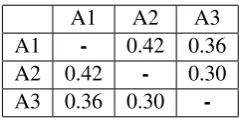
Using held-out dataset H, we evaluate how our system performs in comparison to humans. Three annotators, A1-A3, mark each tweet in the Dataset H as drunk or sober. Table 4 shows a moderate agreement between our annotators (for example, it is 0.42 for A1 and A2). Table 5 compares our classifier with humans. Our human annotators per-form the task with an average accuracy of 68.8%, while our classifier (with all features) trained on Dataset 2 reaches 64%. The classifier trained on Dataset 2 is better than which is trained on Dataset 1.
6.3 Error Analysis
Some categories of errors that occur are:
1. Incorrect hashtag supervision: The tweet
[image:4.595.308.528.258.369.2]2. Seemingly sober tweets: Human annotators as well as our classifier could not identify whether ‘Will you take her on a date? But really she does like you’ was drunk, although the author of the tweet had marked it so. This example also highlights the difficulty of drunk-texting prediction.
3. Pragmatic difficulty: The tweet ‘National
dress of Ireland is one’s one vomit.. my fam-ily is lovely’ was correctly identified by our human annotators as a drunk tweet. This tweet contains an element of humour and topic change, but our classifier could not cap-ture it.
7 Conclusion & Future Work
In this paper, we introduce automatic drunk-texting prediction as the task of predicting a tweet as drunk or sober. First, we justify the need for drunk-texting prediction as means of identifying risky social behavior arising out of alcohol abuse, and the need to build tools that avoid privacy leaks due to drunk-texting. We then highlight the chal-lenges of drunk-texting prediction: one of the challenges is selection of negative examples (sober tweets). Using hashtag-based supervision, we cre-ate three datasets annotcre-ated with drunk or sober labels. We then present SVM-based classifiers which use two sets of features: N-gram and stylis-tic features. Our drunk prediction system obtains a best accuracy of 78.1%. We observe that our stylistic features add negligible value to N-gram features. We use our heldout dataset to compare how our system performs against human annota-tors. While human annotators achieve an accuracy of 68.8%, our system reaches reasonably close and performs with a best accuracy of 64%.
Our analysis of the task and experimental find-ings make a case for drunk-texting prediction as a useful and feasible NLP application.
References
Aby. 2014. Aby word processing website, January. Steven Bird. 2006. Nltk: the natural language toolkit.
In Proceedings of the COLING/ACL on Interactive presentation sessions, pages 69–72. Association for Computational Linguistics.
David M Blei, Andrew Y Ng, and Michael I Jordan. 2003. Latent dirichlet allocation. the Journal of ma-chine Learning research, 3:993–1022.
Josephine A Borrill, Bernard K Rosen, and Angela B Summerfield. 1987. The influence of alcohol on judgement of facial expressions of emotion. British Journal of Medical Psychology.
Angela Bryan, Courtney A Rocheleau, Reuben N Rob-bins, and Kent E Hutchinson. 2005. Condom use among high-risk adolescents: testing the influence of alcohol use on the relationship of cognitive corre-lates of behavior. Health Psychology, 24(2):133. Brad J Bushman and Harris M Cooper. 1990. Effects
of alcohol on human aggression: An intergrative re-search review.Psychological bulletin, 107(3):341. Christopher Carpenter. 2007. Heavy alcohol use and
crime: Evidence from underage drunk-driving laws.
Journal of Law and Economics, 50(3):539–557. Chih-Chung Chang and Chih-Jen Lin. 2011.
Lib-svm: a library for support vector machines. ACM Transactions on Intelligent Systems and Technology (TIST), 2(3):27.
Ted A Loomis and TC West. 1958. The influence of al-cohol on automobile driving ability: An experimen-tal study for the evaluation of certain medicologi-cal aspects. Quarterly journal of studies on alcohol, 19(1):30–46.
John Merrill, GABRIELLE MILKER, John Owens, and Allister Vale. 1992. Alcohol and attempted sui-cide.British journal of addiction, 87(1):83–89. James W Pennebaker. 1993. Putting stress into words:
Health, linguistic, and therapeutic implications. Be-haviour research and therapy, 31(6):539–548. James W Pennebaker. 1997. Writing about emotional
experiences as a therapeutic process. Psychological science, 8(3):162–166.
Matthew Purver and Stuart Battersby. 2012. Experi-menting with distant supervision for emotion classi-fication. In Proceedings of the 13th Conference of the European Chapter of the Association for Com-putational Linguistics, pages 482–491. Association for Computational Linguistics.
Philip Resnik, Anderson Garron, and Rebecca Resnik. 2013. Using topic modeling to improve prediction of neuroticism and depression. In Proceedings of the 2013 Conference on Empirical Methods in Nat-ural, pages 1348–1353. Association for Computa-tional Linguistics.