808
Transferable Multi-Domain State Generator for Task-Oriented
Dialogue Systems
Chien-Sheng Wu†∗, Andrea Madotto†, Ehsan Hosseini-Asl‡, Caiming Xiong‡, Richard Socher‡and Pascale Fung†
†The Hong Kong University of Science and Technology
‡Salesforce Research
Abstract
Over-dependence on domain ontology and lack of knowledge sharing across domains are two practical and yet less studied problems of dialogue state tracking. Existing approaches generally fall short in tracking unknown slot values during inference and often have diffi-culties in adapting to new domains. In this paper, we propose aTRAnsferableDialogue statE generator (TRADE) that generates di-alogue states from utterances using a copy mechanism, facilitating knowledge transfer when predicting(domain, slot, value)triplets not encountered during training. Our model is composed of an utterance encoder, a slot gate, and a state generator, which are shared across domains. Empirical results demonstrate that TRADE achieves state-of-the-art joint goal ac-curacy of 48.62% for the five domains of Mul-tiWOZ, a human-human dialogue dataset. In addition, we show its transferring ability by simulating zero-shot and few-shot dialogue state tracking for unseen domains. TRADE achieves 60.58% joint goal accuracy in one of the zero-shot domains, and is able to adapt to few-shot cases without forgetting already trained domains.
1 Introduction
Dialogue state tracking (DST) is a core component in task-oriented dialogue systems, such as restau-rant reservation or ticket booking. The goal of DST is to extract user goals/intentions expressed during conversation and to encode them as a com-pact set of dialogue states, i.e., a set of slots and their corresponding values. For example, as shown in Fig.1,(slot, value)pairs such as(price, cheap)
and(area, centre)are extracted from the conver-sation. Accurate DST performance is crucial for
∗
Work partially done while the first author was an intern at Salesforce Research.
Usr: I am looking for a cheaprestaurant in the centre of the city. Sys: There is a cheap chinese restaurant called Dojo Noodle Bar. Usr: Yes please , for 8 people at 18:30 on Thursday. …
Usr: I am also looking for some entertainment close to the restaurant. Sys: Is there any type of attraction you would like me to search? Usr: Why do not you try an architectural attraction.
Sys: All Saints Church looks good , would you like to head there? …
Usr: I also need to book a taxi between the restaurant and the church. Sys: What time would you like the taxi from Dojo Noodle Bar? Usr: 20:30, please.
Restaurant: (price, cheap), (area, centre), (people, 8), (time, 18:30), (day, Thursday), (name, Dojo Noodle Bar)
Multi-Domain Dialogue State Tracking
Attraction: (type, architecture), (area, centre) Taxi: (leaveAt, 20:30), (destination, All Saints Church), (departure, Dojo Noodle Bar)
[image:1.595.307.524.226.391.2]Hotel: Train: Dialogue History
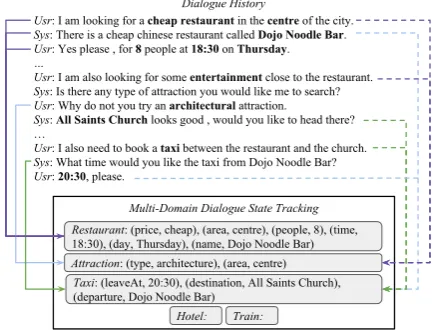
Figure 1: An example of multi-domain dialogue state tracking in a conversation. The solid arrows on the left are the single-turn mapping, and the dot arrows on the right are multi-turn mapping. The state tracker needs to track slot values mentioned by the user for all the slots in all the domains.
appropriate dialogue management, where user in-tention determines the next system action and/or the content to query from the databases.
Traditionally, state tracking approaches are based on the assumption that ontology is defined in advance, where all slots and their values are known. Having a predefined ontology can splify DST into a classification problem and im-prove performance (Henderson et al., 2014b;
of possible values. Therefore, many of the previ-ous works that are based on neural classification models may not be applicable in real scenario.
Budzianowski et al. (2018) recently intro-duced a multi-domain dialogue dataset (Multi-WOZ), which adds new challenges in DST due to its mixed-domain conversations. As shown in Fig. 1, a user can start a conversation by asking to reserve a restaurant, then requests information regarding an attraction nearby, and finally asks to book a taxi. In this case, the DST model has to de-termine the corresponding domain, slot and value at each turn of dialogue, which contains a large number of combinations in the ontology, i.e., 30 (domain, slot) pairs and over 4,500 possible slot values in total. Another challenge in the multi-domain setting comes from the need to perform multi-turn mapping. Single-turn mapping refers to the scenario where the(domain, slot, value)triplet can be inferred from a single turn, while in multi-turn mapping, it should be inferred from multiple turns which happen in different domains. For in-stance, the(area, centre) pair from theattraction
domain in Fig.1can be predicted from thearea in-formation in therestaurantdomain, which is men-tioned in the preceding turns.
To tackle these challenges, we emphasize that DST models should share tracking knowledge across domains. There are many slots among different domains that share all or some of their values. For example, the area slot can exist in many domains, e.g., restaurant, attraction, and
taxi. Moreover, thenameslot in therestaurant do-main can share the same value with thedeparture
slot in the taxi domain. Additionally, to enable the DST model to track slots in unseen domains, transferring knowledge across multiple domains is imperative. We expect DST models can learn to track some slots in zero-shot domains by learning to track the same slots in other domains.
In this paper, we propose a transferable dialogue state generator (TRADE) for multi-domain task-oriented dialogue state tracking. The simplicity of our approach and the boost of the performance is the main advantage of TRADE. Contributions in this work are summarized as1:
• To overcome the multi-turn mapping problem, TRADE leverages its context-enhanced slot gate and copy mechanism to properly track slot
1The code is released at github.com/
jasonwu0731/trade-dst
values mentioned anywhere in dialogue history.
• By sharing its parameters across domains, and without requiring a predefined ontology, TRADE can share knowledge between domains to track unseen slot values, achieving state-of-the-art performance on multi-domain DST.
• TRADE enables zero-shot DST by leveraging the domains it has already seen during train-ing. If a few training samples from unseen do-mains are available, TRADE can adapt to new few-shot domains without forgetting the previ-ous domains.
2 TRADE Model
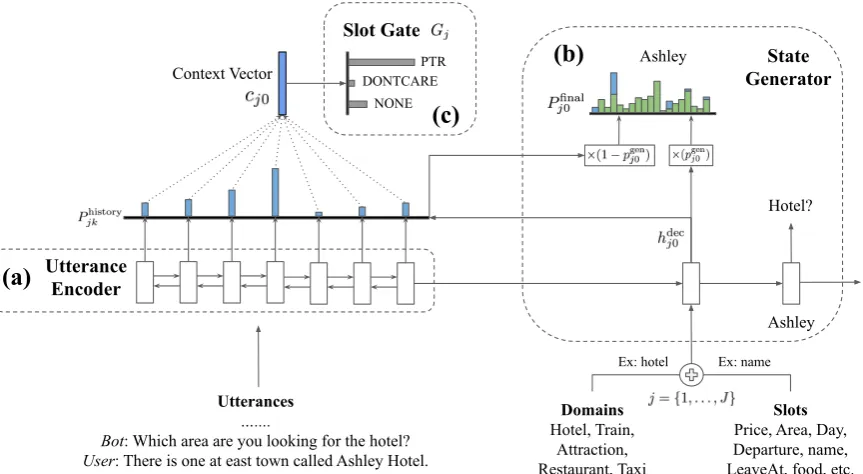
The proposed model in Fig. 2 comprises three components: an utterance encoder, a slot gate, and a state generator. Instead of predicting the probability of every predefined ontology term, our model directly generates slot values. Simi-lar toJohnson et al. (2017) for multilingual neu-ral machine translation, we share all the model parameters, and the state generator starts with a different start-of-sentence token for each(domain, slot)pair.
The utterance encoder encodes dialogue utter-ances into a sequence of fixed-length vectors. To determine whether any of the(domain, slot)pairs are mentioned, the context-enhanced slot gate is used with the state generator. The state gener-ator decodes multiple output tokens for all (do-main, slot)pairs independently to predict their cor-responding values. The context-enhanced slot gate predicts whether each of the pairs is actually trig-gered by the dialogue via a three-way classifier.
Let us define X = {(U1, R1), . . . ,(UT, RT)}
as the set of user utterance and system re-sponse pairs in T turns of dialogue, and B =
{B1, . . . , BT} as the dialogue states for each
turn. Each Bt is a tuple (domain:Dn, slot:Sm,
value:Yvalue
j ), whereD = {D1, . . . , DN}are the
N different domains, andS ={S1, . . . , SM}are
theMdifferent slots. Assume that there areJ pos-sible (domain, slot) pairs, and Yvalue
j is the true
word sequence forj-th(domain ,slot)pair.
2.1 Utterance Encoder
NONE DONTCARE
PTR Context Vector
Ex: hotel Ashley Slot Gate
Utterances
…....
Bot: Which area are you looking for the hotel? User: There is one at east town called Ashley Hotel.
Domains
Hotel, Train, Attraction, Restaurant, Taxi
Slots
Price, Area, Day, Departure, name, LeaveAt, food, etc. Utterance
Encoder
Ex: name State Generator
Ashley
(a)
(c)
(b)
[image:3.595.84.516.68.305.2]Hotel?
Figure 2: The architecture of the proposed TRADE model, which includes (a) an utterance encoder, (b) a state generator, and (c) a slot gate, all of which are shared among domains. The state generator will decodeJ times independently for all the possible(domain, slot)pairs. At the first decoding step, state generator will take thej-th
(domain, slot)embeddings as input to generate its corresponding slot values and slot gate. The slot gate predicts whether thej-th(domain, slot)pair is triggered by the dialogue.
encode the dialogue history. The input to the utterance encoder is denoted as history Xt =
[Ut−l, Rt−l, . . . , Ut, Rt] ∈ R|Xt|×demb, which is
the concatenation of all words in the dialogue his-tory. l is the number of selected dialogue turns anddemb indicates the embedding size. The
en-coded dialogue history is represented as Ht =
[henc1 , . . . , henc|X
t|] ∈ R
|Xt|×dhdd, where d
hdd is the
hidden size. As mentioned in Section1, due to the multi-turn mapping problem, the model should in-fer the states across a sequence of turns. There-fore, we use the recent dialogue history of lengthl
as the utterance encoder input, rather than the cur-rent utterance only.
2.2 State Generator
To generate slot values using text from the in-put source, a copy mechanism is required. There are three common ways to perform copying, i.e., index-based copy (Vinyals et al., 2015), hard-gated copy (Gulcehre et al.,2016;Madotto et al.,
2018;Wu et al.,2019) and soft-gated copy (See et al., 2017; McCann et al., 2018). The index-based mechanism is not suitable for DST task be-cause the exact word(s) of the true slot value are not always found in the utterance. The hard-gate copy mechanism usually needs additional
supervi-sion on the gating function. As such, we employ soft-gated pointer-generator copying to combine a distribution over the vocabulary and a distribution over the dialogue history into a single output dis-tribution.
We use a GRU as the decoder of the state gen-erator to predict the value for each(domain, slot)
pair, as shown in Fig.2. The state generator de-codes J pairs independently. We simply supply the summed embedding of the domain and slot as the first input to the decoder. At decoding step
k for the j-th (domain, slot) pair, the generator GRU takes a word embedding wjk as its input
and returns a hidden state hdecjk . The state gener-ator first maps the hidden state hdecjk into the vo-cabulary spacePjkvocab using the trainable embed-dingE ∈R|V|×dhdd, where|V|is the vocabulary size. At the same time, the hdecjk is used to com-pute the history attentionPjkhistoryover the encoded dialogue historyHt:
Pvocab
jk =Softmax(E·(hdecjk)>)∈R| V|,
Pjkhistory=Softmax(Ht·(hjkdec)>)∈R|Xt|. (1)
weighted-sum of two distributions,
Pjkfinal=pgenjk ×Pjkvocab
+ (1−pgenjk )×Pjkhistory∈R|V|. (2)
The scalarpgenjk is trainable to combine the two dis-tributions, which is computed by
pgenjk =Sigmoid(W1·[hjkdec;wjk;cjk])∈R1,
cjk=Pjkhistory·Ht ∈Rdhdd (3)
whereW1is a trainable matrix andcjk is the
con-text vector. Note that due to Eq (2), our model is able to generate words even if they are not pre-defined in the vocabulary.
2.3 Slot Gate
Unlike single-domain DST problems, where only a few slots that need to be tracked, e.g., four slots in WOZ (Wen et al., 2017), and eight slots in DSTC2 (Henderson et al.,2014a), there are a large number of (domain, slot) pairs in multi-domain DST problems. Therefore, the ability to predict the domain and slot at current turntbecomes more challenging.
Our context-enhanced slot gate G is a simple three-way classifier that maps a context vector taken from the encoder hidden statesHtto a
prob-ability distribution over ptr, none, and dontcare
classes. For each (domain, slot) pair, if the slot gate predictsnoneordontcare, we ignore the val-ues generated by the decoder and fill the pair as “not-mentioned” or “does not care”. Otherwise, we take the generated words from our state gener-ator as its value. With a linear layer parameterized by Wg ∈ R3×dhdd, the slot gate for thej-th
(do-main, slot)pair is defined as
Gj =Softmax(Wg·(cj0)>)∈R3, (4)
wherecj0is the context vector computed in Eq (3)
using the first decoder hidden state.
2.4 Optimization
During training, we optimize for both the slot gate and the state generator. For the former, the cross-entropy lossLgis computed between the predicted
slot gateGj and the true one-hot labelygatej ,
Lg=
J
X
j=1
−log(Gj·(ygatej )>). (5)
For the latter, another cross-entropy loss Lv
be-tweenPjkfinal and the true wordsYjlabel is used. We defineLv as
Lv =
J
X
j=1
|Yj| X
k=1
−log(Pjkfinal·(yjkvalue)>). (6)
Lv is the sum of losses from all the(domain, slot)
pairs and their decoding time steps. We optimize the weighted-sum of these two loss functions us-ing hyper-parametersαandβ,
L=αLg+βLv. (7)
3 Unseen Domain DST
In this section, we focus on the ability of TRADE to generalize to an unseen domain by consider-ing zero-shot transferrconsider-ing and few-shot domain ex-panding. In the zero-shot setting, we assume we have no training data in the new domain, while in the few-shot case, we assume just 1% of the origi-nal training data in the unseen domain is available (around 20 to 30 dialogues). One of the motiva-tions to perform unseen domain DST is because collecting a large-scale task-oriented dataset for a new domain is expensive and time-consuming (Budzianowski et al.,2018), and there are a large amount of domains in realistic scenarios.
3.1 Zero-shot DST
3.2 Expanding DST for Few-shot Domain
In this section, we assume that only a small number of samples from the new domain (X, Dtarget, Starget, Ytargetvalue) are available, and the purpose is to evaluate the ability of our DST model to transfer its learned knowledge to the new main without forgetting previously learned do-mains. There are two advantages to perform-ing few-shot domain expansion: 1) beperform-ing able to quickly adapt to new domains and obtain decent performance with only a small amount of training data; 2) not requiring retraining with all the data from previously learned domains, since the data may no longer be available and retraining is often very time-consuming.
Firstly, we consider a straightforward naive baseline, i.e., fine-tuning with no constraints. Then, we employ two specific continual learn-ing techniques: elastic weight consolidation (EWC) (Kirkpatrick et al., 2017) and gradient episodic memory (GEM) (Lopez-Paz et al.,2017) to fine-tune our model. We define ΘS as the
model’s parameters trained in the source domain, andΘindicates the current optimized parameters according to the target domain data.
EWC uses the diagonal of the Fisher informa-tion matrix F as a regularizer for adapting to the target domain data. This matrix is approximated using samples from the source domain. The EWC loss is defined as
Lewc(Θ) =L(Θ) +
X
i
λ
2Fi(Θi−ΘS,i)
2, (8)
where λ is a hyper-parameter. Different from EWC, GEM keeps a small number of samplesK
from the source domains, and, while the model learns the new target domain, a constraint is ap-plied on the gradient to prevent the loss on the stored samples from increasing. The training pro-cess is defined as:
MinimizeΘL(Θ)
Subject toL(Θ, K)≤L(ΘS, K),
(9)
whereL(Θ, K) is the loss value of theK stored samples. Lopez-Paz et al. (2017) show how to solve the optimization problem in Eq (9) with quadratic programming if the loss of the stored samples increases.
Hotel Train Attraction Restaurant Taxi
Slots price,
type, parking,
stay, day, people,
area, stars, internet,
name
destination, departure,
day, arrive by,
leave at, people
area, name, type
food, price, area, name, time, day, people
destination, departure,
arrive by, leave by
Train 3381 3103 2717 3813 1654
Valid 416 484 401 438 207
[image:5.595.308.524.62.189.2]Test 394 494 395 437 195
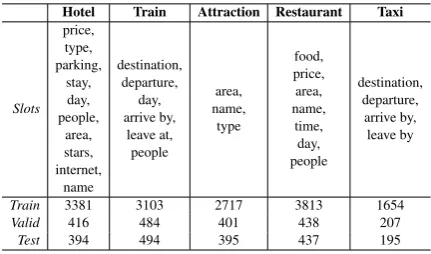
Table 1: The dataset information of MultiWOZ. In to-tal, there are 30(domain, slot)pairs from the selected five domains. The numbers in the last three rows indi-cate the number of dialogues for train, validation and test sets.
4 Experiments
4.1 Dataset
Multi-domain Wizard-of-Oz (Budzianowski et al.,
2018) (MultiWOZ) is the largest existing human-human conversational corpus spanning over seven domains, containing 8438 multi-turn dia-logues, with each dialogue averaging 13.68 turns. Different from existing standard datasets like WOZ (Wen et al.,2017) and DSTC2 (Henderson et al.,2014a), which contain less than 10 slots and only a few hundred values, MultiWOZ has 30 (do-main, slot) pairs and over 4,500 possible values. We use the DST labels from the original training, validation and testing dataset. Only five domains (restaurant,hotel,attraction,taxi,train) are used in our experiment because the other two domains (hospital, police) have very few dialogues (10% compared to others) and only appear in the train-ing set. The slots in each domain and the corre-sponding data size are reported in Table1.
4.2 Training Details
Multi-domain Joint Training The model is
trained end-to-end using the Adam optimizer (Kingma and Ba, 2015) with a batch size of 32. The learning rate annealing is in the range of [0.001,0.0001]with a dropout ratio of 0.2. Both
in-crease model generalization and simulate an out-of-vocabulary setting, a word dropout is utilized with the utterance encoder by randomly masking a small amount of input tokens, similar to Bow-man et al.(2016).
Domain Expanding For training, we follow the
same procedure as in the joint training section, and we run a small grid search for all the methods us-ing the validation set. For EWC, we set different values of λfor all the domains, and the optimal value is selected using the validation set. Finally, in GEM, we set the memory sizesKto 1% of the source domains.
4.3 Results
Two evaluation metrics, joint goal accuracy and slot accuracy, are used to evaluate the perfor-mance on multi-domain DST. The joint goal accu-racy compares the predicted dialogue states to the ground truth Bt at each dialogue turn t, and the
output is considered correct if and only if all the predicted values exactly match the ground truth values inBt. The slot accuracy, on the other hand,
individually compares each (domain, slot, value) triplet to its ground truth label.
Multi-domain Training We make a comparison
with the following existing models: MDBT ( Ra-madan et al., 2018), GLAD (Zhong et al.,
2018), GCE (Nouri and Hosseini-Asl,2018), and SpanPtr (Xu and Hu, 2018), and we briefly de-scribe these baselines models below:
• MDBT 2: Multiple bi-LSTMs are used to en-code system and user utterances. The seman-tic similarity between utterances and every pre-defined ontology term is computed separately. Each ontology term is triggered if the predicted score is greater than a threshold.
• GLAD3: This model uses self-attentive RNNs to learn a global tracker that shares parameters among slots and a local tracker that tracks each slot. The model takes previous system actions and the current user utterance as input, and com-putes semantic similarity with predefined ontol-ogy terms.
• GCE: This is the current state-of-the-art model on the single-domain WOZ dataset (Wen et al.,
2
github.com/osmanio2/ multi-domain-belief-tracking
3github.com/salesforce/glad
MultiWOZ MultiWOZ (Only Restaurant)
Joint Slot Joint Slot
MDBT 15.57 89.53 17.98 54.99
GLAD 35.57 95.44 53.23 96.54
GCE 36.27 98.42 60.93 95.85
SpanPtr 30.28 93.85 49.12 87.89
[image:6.595.310.524.63.174.2]TRADE 48.62 96.92 65.35 93.28
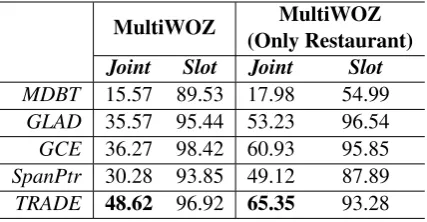
Table 2: The multi-domain DST evaluation on
Mul-tiWOZ and its single restaurant domain. TRADE
has the highest joint accuracy, which surpasses current state-of-the-art GCE model.
2017). It is a simplified and speed up version of GLAD without slot-specific RNNs.
• SpanPtr: Most related to our work, this is the first model that applies pointer networks (Vinyals et al.,2015) to the single-domain DST problem, which generates both start and end pointers to perform index-based copying.
To have a fair comparison, we modify the orig-inal implementation of the MDBT and GLAD models by: 1) addingname, destination, and de-partureslots for evaluation if they were discarded or replaced by placeholders; and 2) removing the hand-crafted rules of tracking the booking slots such asstayandpeopleslots if there are any; and 3) creating a full ontology for their model to cover all(domain, slot, value)pairs that were not in the original ontology generated by the data provider.
As shown in Table 2, TRADE achieves the highest performance, 48.62% on joint goal accu-racy and 96.92% on slot accuaccu-racy, on MultiWOZ. For comparison with the performance on single-domain, the results on the restaurant domain of MultiWOZ are reported as well. The performance difference between SpanPtr and our model mainly comes from the limitation of index-based copying. For examples, if the true label for the price range slot ischeap, the relevant user utterance describ-ing the restaurant may actually be, for example,
economical,inexpensive, orcheaply. Note that the MDBT, GLAD, and GCE models each need a pre-defined domain ontology to perform binary clas-sification for each ontology term, which hinders their DST tracking performance, as mentioned in Section 1.
Joint Slot Joint Slot Joint Slot Joint Slot Joint Slot Evaluation on 4 Domains Except Hotel Except Train Except Attraction Except Restaurant Except Taxi
Base Model (BM)
training on 4 domains 58.98 96.75 55.26 96.76 55.02 97.03 54.69 96.64 49.87 96.77
Fine-tuning BM on 1% new domain
Naive 36.08 93.48 23.25 90.32 40.05 95.54 32.85 91.69 46.10 96.34
EWC 40.82 94.16 28.02 91.49 45.37 84.94 34.45 92.53 46.88 96.44
GEM 53.54 96.27 50.69 96.42 50.51 96.66 45.91 95.58 46.43 96.45 Evaluation on New Domain Hotel Train Attraction Restaurant Taxi
Training 1% New Domain 19.53 77.33 44.24 85.66 35.88 68.60 32.72 82.39 60.38 72.82
Fine-tuning BM on 1% new domain
Naive 19.13 75.22 59.83 90.63 29.39 60.73 42.42 86.82 63.81 79.81 EWC 19.35 76.25 58.10 90.33 32.28 62.43 40.93 85.80 63.61 79.65
[image:7.595.76.523.62.201.2]GEM 19.73 77.92 54.31 89.55 34.73 64.37 39.24 86.05 63.16 79.27
Table 3: We run domain expansion experiments by excluding one domain and fine-tuning on that domain. The first row is the base model trained on the four domains. The second row is the results on the four domains after fine-tuning on 1% new domain data using three different strategies. One can find out that GEM outperforms Naive and EWC fine-tuning in terms of catastrophic forgetting on the four domains. Then, we evaluate the results on new domain for two cases: training from scratch and fine-tuning from the base model. Results show that fine-tuning from the base model usually achieves better results on the new domain compared to training from scratch.
parking internet
fo
o
d
name typ
e
area
pricerange
stars sta
y
p
eople da
y
time
destination departure
arriv
eb
y
lea
veat
parking internet food name type area pricerange stars stay people day time destination departure arriveby leaveat
Figure 3: Embeddings cosine similarity visualization. The rows and columns are all the possible slots in Mul-tiWOZ. Slots that share similar values or have corre-lated values learn similar embeddings. For example
destination vs. departure(which share similar values) or price range vs. starsexhibit high correlation.
slot embeddings are not close to each other, which is expected because the model only depends on these features as start-of-sentence embeddings to distinguish different slots. Note that some slots are relatively close because either the values they track may share similar semantic meanings or the slots are correlated. For example, destination
anddeparturetrack names of cities, while people
andstay track numbers. On the other hand,price rangeandstar in hotel domain are correlated be-cause high-star hotels are usually expensive.
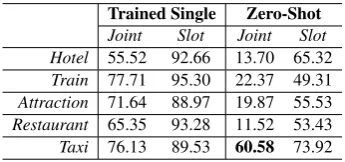
Zero-shot We run zero-shot experiments by
ex-cluding one domain from the training set. As
Trained Single Zero-Shot Joint Slot Joint Slot Hotel 55.52 92.66 13.70 65.32
Train 77.71 95.30 22.37 49.31
Attraction 71.64 88.97 19.87 55.53
Restaurant 65.35 93.28 11.52 53.43
[image:7.595.330.503.302.383.2]Taxi 76.13 89.53 60.58 73.92
Table 4: Zero-shot experiments on an unseen domain. Intaxidomain, our model achieves 60.58% joint goal accuracy without training on any samples fromtaxi do-main.Trained Singlecolumn is the results achieved by training on 100% single-domain data as a reference.
shown in Table 4, the taxi domain achieves the highest zero-shot performance, 60.58% on joint goal accuracy, which is close to the result achieved by training on all thetaxidomain data (76.13%). Although performances on the other zero-shot domains are not especially promising, they still achieve around 50 to 65% slot accuracy without using any in-domain samples. The reason why the zero-shot performance on thetaxidomain is high is because all four slots share similar values with the corresponding slots in thetraindomain.
Domain Expanding In this setting, the TRADE
[image:7.595.95.265.304.466.2]us-ing their in-domain trainus-ing data, and the Train-ing 1% New Domain row indicates the results achieved by training from scratch using 1% of the new domain data. In general, GEM outper-forms naive and EWC fine-tuning in terms of over-coming catastrophic forgetting. We also find that pre-training followed by fine-tuning outperforms training from scratch on the single domain.
Fine-tuning TRADE with GEM maintains higher performance on the original four domains. Take the hotel domain as an example, the per-formance on the four domains after fine-tuning with GEM only drops from 58.98% to 53.54% (-5.44%) on joint accuracy, whereas naive fine-tuning deteriorates the tracking ability, dropping joint goal accuracy to 36.08% (-22.9%).
Expanding TRADE from four domains to a new domain achieves better performance than training from scratch on the new domain. This observa-tion underscores the advantages of transfer learn-ing with the proposed TRADE model. For ex-ample, our TRADE model achieves 59.83% joint accuracy after fine-tuning using only 1% ofTrain
domain data, outperforming the trainingTrain do-main from scratch, which achieves 44.24% using the same amount of new-domain data.
Finally, when considering hotel andattraction
as new domain, fine-tuning with GEM outper-forms the naive fine-tuning approach on the new domain. To elaborate, GEM obtains 34.73% joint accuracy on theattractiondomain, but naive fine-tuning on that domain can only achieve 29.39%. This implies that in some cases learning to keep the tracking ability (learned parameters) of the learned domains helps to achieve better perfor-mance for the new domain.
5 Error Analysis
An error analysis of multi-domain training is shown in Fig. 4. Not surprisingly, name slots in therestaurant,attraction, andhoteldomains have the highest error rates, 8.50%, 8.17%, and 7.86%, respectively. It is because this slot usually has a large number of possible values that is hard to rec-ognize. On the other hand, number-related slots such as arrive by, people, and stay usually have the lowest error rates. We also find that thetype
slot ofhoteldomain has a high error rate, even if it is an easy task with only two possible values in the ontology. The reason is that labels of the (ho-tel, type)pair are sometimes missing in the dataset,
0.00 0.01 0.02 0.03 0.04 0.05 0.06 0.07 0.08 taxi-arriveby
restaurant-book peoplehotel-book stayhotel-book day taxi-leaveat hotel-book peoplehotel-stars restaurant-book day restaurant-book timetrain-destinationattraction-area restaurant-foodtrain-departuretrain-arriveby train-day train-book peoplehotel-area hotel-internet restaurant-areahotel-parking hotel-pricerange restaurant-pricerangeattraction-typetrain-leaveat taxi-destinationtaxi-departurehotel-type hotel-name attraction-name restaurant-name
[image:8.595.310.523.62.225.2]Slot Error Rate
Figure 4: Slots error rate on test set of multi-domain training. Thenameslot inrestaurant domain has the highest error rate, 8.50%, and thearrive byslot intaxi
domain has the lowest error rate, 1.33%
0 20 40 60 80 100
internet book staybook day type pricerangearea book peoplename stars parking
(a) Hotel
0 10 20 30 40 50 60 70 80
area name food pricerange book day book people book time
(b) Restaurant
Figure 5: Zero-shot DST error analysis on (a)hoteland (b)restaurantdomains. The x-axis represents the num-ber of each slot which has correct non-empty values. Inhoteldomain, the knowledge to trackpeople, area, price range, anddayslots are successfully transferred from other domains seen in training.
which makes our prediction incorrect even if it is supposed to be predicted.
In Fig. 5, the zero-shot analysis of two se-lected domains,hotelandrestaurant, which con-tain more slots to be tracked, are shown. To bet-ter understand the behavior of knowledge trans-ferring, here we only consider labels that are not empty, i.e., we ignore data that is labeled as “none” because predicting “none” is relatively easier for the model. In bothhotelandrestaurant domains, knowledge about people, area, price range, and
day slots are successfully transferred from the other four domains. For unseen slots that only ap-pear in one domain, it is very hard for our model to track correctly. For example,parking, starsand
[image:8.595.316.523.317.406.2]6 Related Work
Dialogue State Tracking Traditional dialogue
state tracking models combine semantics extracted by language understanding modules to estimate the current dialogue states (Williams and Young,
2007; Thomson and Young, 2010; Wang and Lemon,2013;Williams,2014), or to jointly learn speech understanding (Henderson et al., 2014b;
Zilka and Jurcicek,2015;Wen et al.,2017). One drawback is that they rely on hand-crafted fea-tures and complex domain-specific lexicons (be-sides the ontology), and are difficult to extend and scale to new domains.
Mrkˇsi´c et al. (2017) use distributional repre-sentation learning to leverage semantic informa-tion from word embeddings to and resolve lex-ical/morphological ambiguity. However, param-eters are not shared across slots. On the other hand, Nouri and Hosseini-Asl (2018) utilizes global modules to share parameters between slots, and Zhong et al. (2018) uses slot-specific local modules to learn slot features, which has proved to successfully improve tracking of rare slot val-ues. Lei et al.(2018) use a Seq2Seq model to gen-erate belief spans and the delexicalized response at the same time. Ren et al. (2018) propose StateNet that generates a dialogue history repre-sentation and compares the distances between this representation and value vectors in the candidate set. Xu and Hu(2018) use the index-based pointer network for different slots, and show the ability to point to unknown values. However, many of them require a predefined domain ontology, and the models were only evaluated on single-domain setting (DSTC2).
For multi-domain DST, Rastogi et al. (2017) propose a multi-domain approach using two-layer bi-GRU. Although it does not need an ad-hoc state update mechanism, it relies on delexicalization to extract the features. Ramadan et al. (2018) pro-pose a model to jointly track domain and the di-alogue states using multiple bi-LSTM. They uti-lize semantic similarity between utterances and the ontology terms and allow the information to be shared across domains. For a more general overview, readers may refer to the neural dialogue review paper from Gao et al.(2018).
Zero/Few-Shot and Continual Learning
Dif-ferent components of dialogue systems have pre-viously been used for zero-shot application, e.g.,
intention classifiers (Chen et al., 2016), slot-filling (Bapna et al., 2017), and dialogue pol-icy (Gaˇsi´c and Young, 2014). For language generation, Johnson et al. (2017) propose sin-gle encoder-decoder models for zero-shot machine translation, and Zhao and Eskenazi (2018) pro-pose cross-domain zero-shot dialogue generation using action matching. Moreover, few-shot learn-ing in natural language applications has been ap-plied in semantic parsing (Huang et al.,2018), ma-chine translation (Gu et al.,2018), and text clas-sification (Yu et al.,2018) with meta-learning ap-proaches (Schmidhuber,1987;Finn et al.,2017). These tasks usually have multiple tasks to per-form fast adaptation, instead in our case the num-ber of existing domains are limited. Lastly, sev-eral approaches have been proposed for contin-ual learning in the machine learning commu-nity (Kirkpatrick et al., 2017; Lopez-Paz et al.,
2017; Rusu et al., 2016; Fernando et al., 2017;
Lee et al., 2017), especially in image recognition tasks (Aljundi et al., 2017;Rannen et al., 2017). The applications within NLP has been compara-tively limited, e.g., Shu et al.(2016, 2017b) for opinion mining, Shu et al.(2017a) for document classification, and Lee(2017) for hybrid code net-works (Williams et al.,2017).
7 Conclusion
We introduce a transferable dialogue state gen-erator for multi-domain dialogue state tracking, which learns to track states without any predefined domain ontology. TRADE shares all of its param-eters across multiple domains and achieves state-of-the-art joint goal accuracy and slot accuracy on the MultiWOZ dataset for five different domains. Moreover, domain sharing enables TRADE to per-form zero-shot DST for unseen domains and to quickly adapt to few-shot domains without forget-ting the learned ones. In future work, transferring knowledge from other resources can be applied to further improve zero-shot performance, and col-lecting a dataset with a large number of domains is able to facilitate the application and study of meta-learning techniques within multi-domain DST.
Acknowledgments
References
Rahaf Aljundi, Punarjay Chakravarty, and Tinne Tuyte-laars. 2017. Expert gate: Lifelong learning with a network of experts. In Proceedings of the IEEE Conference on Computer Vision and Pattern Recog-nition, pages 3366–3375.
Ankur Bapna, Gokhan Tur, Dilek Hakkani-Tur, and
Larry Heck. 2017. Towards zero-shot frame
se-mantic parsing for domain scaling. arXiv preprint arXiv:1707.02363.
Samuel R. Bowman, Luke Vilnis, Oriol Vinyals, An-drew Dai, Rafal Jozefowicz, and Samy Bengio.
2016. Generating sentences from a continuous
space. InProceedings of The 20th SIGNLL Confer-ence on Computational Natural Language Learning, pages 10–21. Association for Computational Lin-guistics.
Paweł Budzianowski, Tsung-Hsien Wen, Bo-Hsiang Tseng, I˜nigo Casanueva, Stefan Ultes, Osman Ra-madan, and Milica Gasic. 2018. Multiwoz-a large-scale multi-domain wizard-of-oz dataset for task-oriented dialogue modelling. InProceedings of the 2018 Conference on Empirical Methods in Natural Language Processing, pages 5016–5026.
Yun-Nung Chen, Dilek Hakkani-T¨ur, and Xiaodong He. 2016. Zero-shot learning of intent embeddings for expansion by convolutional deep structured se-mantic models. In 2016 IEEE International Con-ference on Acoustics, Speech and Signal Processing (ICASSP), pages 6045–6049. IEEE.
Junyoung Chung, Caglar Gulcehre, KyungHyun Cho, and Yoshua Bengio. 2014. Empirical evaluation of gated recurrent neural networks on sequence model-ing. arXiv preprint arXiv:1412.3555.
Chrisantha Fernando, Dylan Banarse, Charles Blun-dell, Yori Zwols, David Ha, Andrei A Rusu, Alexan-der Pritzel, and Daan Wierstra. 2017. Pathnet: Evo-lution channels gradient descent in super neural net-works. arXiv preprint arXiv:1701.08734.
Chelsea Finn, Pieter Abbeel, and Sergey Levine. 2017. Model-agnostic meta-learning for fast adaptation of deep networks. InProceedings of the 34th Interna-tional Conference on Machine Learning-Volume 70, pages 1126–1135. JMLR. org.
Jianfeng Gao, Michel Galley, and Lihong Li. 2018. Neural approaches to conversational ai. In The 41st International ACM SIGIR Conference on Re-search & Development in Information Retrieval, pages 1371–1374. ACM.
Milica Gaˇsi´c and Steve Young. 2014. Gaussian pro-cesses for pomdp-based dialogue manager
optimiza-tion. IEEE/ACM Transactions on Audio, Speech,
and Language Processing, 22(1):28–40.
Jiatao Gu, Yong Wang, Yun Chen, Victor O. K. Li, and Kyunghyun Cho. 2018. Meta-learning for low-resource neural machine translation. In Proceed-ings of the 2018 Conference on Empirical Methods in Natural Language Processing, pages 3622–3631. Association for Computational Linguistics.
Caglar Gulcehre, Sungjin Ahn, Ramesh Nallap-ati, Bowen Zhou, and Yoshua Bengio. 2016.
Pointing the unknown words. arXiv preprint
arXiv:1603.08148.
Kazuma Hashimoto, Caiming Xiong, Yoshimasa Tsu-ruoka, and Richard Socher. 2016. A joint many-task model: Growing a neural network for multiple nlp tasks.arXiv preprint arXiv:1611.01587.
Matthew Henderson, Blaise Thomson, and Jason D Williams. 2014a. The second dialog state tracking challenge. InProceedings of the 15th Annual Meet-ing of the Special Interest Group on Discourse and Dialogue (SIGDIAL), pages 263–272.
Matthew Henderson, Blaise Thomson, and Steve Young. 2014b. Word-based dialog state tracking with recurrent neural networks. In Proceedings of the 15th Annual Meeting of the Special Inter-est Group on Discourse and Dialogue (SIGDIAL), pages 292–299.
Po-Sen Huang, Chenglong Wang, Rishabh Singh,
Wen-tau Yih, and Xiaodong He. 2018. Natural
language to structured query generation via meta-learning. InProceedings of the 2018 Conference of the North American Chapter of the Association for Computational Linguistics: Human Language Tech-nologies, Volume 2 (Short Papers), pages 732–738. Association for Computational Linguistics.
Melvin Johnson, Mike Schuster, Quoc V. Le, Maxim Krikun, Yonghui Wu, Zhifeng Chen, Nikhil Thorat, Fernanda Vi´egas, Martin Wattenberg, Greg Corrado, Macduff Hughes, and Jeffrey Dean. 2017. Google’s multilingual neural machine translation system: En-abling zero-shot translation.Transactions of the As-sociation for Computational Linguistics, 5:339–351.
Diederik P Kingma and Jimmy Ba. 2015. Adam: A method for stochastic optimization. International Conference on Learning Representations.
James Kirkpatrick, Razvan Pascanu, Neil Rabinowitz, Joel Veness, Guillaume Desjardins, Andrei A Rusu, Kieran Milan, John Quan, Tiago Ramalho, Ag-nieszka Grabska-Barwinska, et al. 2017. Overcom-ing catastrophic forgettOvercom-ing in neural networks. Pro-ceedings of the national academy of sciences, page 201611835.
Sungjin Lee. 2017. Toward continual
learn-ing for conversational agents. arXiv preprint
arXiv:1712.09943.
Wenqiang Lei, Xisen Jin, Min-Yen Kan, Zhaochun Ren, Xiangnan He, and Dawei Yin. 2018. Sequic-ity: Simplifying task-oriented dialogue systems with single sequence-to-sequence architectures. In Pro-ceedings of the 56th Annual Meeting of the Associa-tion for ComputaAssocia-tional Linguistics (Volume 1: Long Papers), volume 1, pages 1437–1447.
David Lopez-Paz et al. 2017. Gradient episodic mem-ory for continual learning. In Advances in Neural Information Processing Systems, pages 6467–6476.
Andrea Madotto, Chien-Sheng Wu, and Pascale Fung. 2018. Mem2seq: Effectively incorporating knowl-edge bases into end-to-end task-oriented dialog sys-tems. InProceedings of the 56th Annual Meeting of the Association for Computational Linguistics (Vol-ume 1: Long Papers), volume 1, pages 1468–1478.
Bryan McCann, Nitish Shirish Keskar, Caiming Xiong, and Richard Socher. 2018. The natural language de-cathlon: Multitask learning as question answering.
arXiv preprint arXiv:1806.08730.
Nikola Mrkˇsi´c, Diarmuid ´O S´eaghdha, Tsung-Hsien Wen, Blaise Thomson, and Steve Young. 2017.
Neural belief tracker: Data-driven dialogue state tracking. InProceedings of the 55th Annual Meet-ing of the Association for Computational LMeet-inguistics (Volume 1: Long Papers), pages 1777–1788, Van-couver, Canada. Association for Computational Lin-guistics.
Elnaz Nouri and Ehsan Hosseini-Asl. 2018.
To-ward scalable neural dialogue state tracking model. In Advances in neural information processing sys-tems (NeurIPS), 2nd Conversational AI workshop.
https://arxiv.org/abs/1812.00899.
Jeffrey Pennington, Richard Socher, and Christopher
Manning. 2014. Glove: Global vectors for word
representation. InProceedings of the 2014 confer-ence on empirical methods in natural language pro-cessing (EMNLP), pages 1532–1543.
Osman Ramadan, Paweł Budzianowski, and Milica Gasic. 2018. Large-scale multi-domain belief track-ing with knowledge shartrack-ing. InProceedings of the 56th Annual Meeting of the Association for Compu-tational Linguistics (Volume 2: Short Papers), pages 432–437. Association for Computational Linguis-tics.
Amal Rannen, Rahaf Aljundi, Matthew B Blaschko, and Tinne Tuytelaars. 2017. Encoder based lifelong learning. InProceedings of the IEEE International Conference on Computer Vision, pages 1320–1328.
Abhinav Rastogi, Dilek Hakkani-T¨ur, and Larry Heck. 2017. Scalable multi-domain dialogue state track-ing. In 2017 IEEE Automatic Speech Recognition and Understanding Workshop (ASRU), pages 561– 568. IEEE.
Liliang Ren, Kaige Xie, Lu Chen, and Kai Yu. 2018. Towards universal dialogue state tracking. In Pro-ceedings of the 2018 Conference on Empirical Meth-ods in Natural Language Processing, pages 2780– 2786.
Andrei A Rusu, Neil C Rabinowitz, Guillaume Des-jardins, Hubert Soyer, James Kirkpatrick, Koray Kavukcuoglu, Razvan Pascanu, and Raia Hadsell. 2016. Progressive neural networks. arXiv preprint arXiv:1606.04671.
Jurgen Schmidhuber. 1987. Evolutionary principles in self-referential learning. on learning now to learn: The meta-meta-meta...-hook. Diploma thesis, Tech-nische Universitat Munchen, Germany, 14 May.
Abigail See, Peter J Liu, and Christopher D Manning. 2017. Get to the point: Summarization with pointer-generator networks. InProceedings of the 55th An-nual Meeting of the Association for Computational Linguistics (Volume 1: Long Papers), volume 1, pages 1073–1083.
Lei Shu, Bing Liu, Hu Xu, and Annice Kim. 2016. Lifelong-rl: Lifelong relaxation labeling for sepa-rating entities and aspects in opinion targets. In Pro-ceedings of the Conference on Empirical Methods in Natural Language Processing. Conference on Em-pirical Methods in Natural Language Processing, volume 2016, page 225. NIH Public Access.
Lei Shu, Hu Xu, and Bing Liu. 2017a. Doc: Deep
open classification of text documents. In Proceed-ings of the 2017 Conference on Empirical Methods in Natural Language Processing, pages 2911–2916. Association for Computational Linguistics.
Lei Shu, Hu Xu, and Bing Liu. 2017b. Lifelong learn-ing crf for supervised aspect extraction. In Pro-ceedings of the 55th Annual Meeting of the Associa-tion for ComputaAssocia-tional Linguistics (Volume 2: Short Papers), pages 148–154. Association for Computa-tional Linguistics.
Blaise Thomson and Steve Young. 2010. Bayesian
update of dialogue state: A pomdp framework for spoken dialogue systems. Computer Speech & Lan-guage, 24(4):562–588.
Oriol Vinyals, Meire Fortunato, and Navdeep Jaitly. 2015. Pointer networks. InAdvances in Neural In-formation Processing Systems, pages 2692–2700.
Zhuoran Wang and Oliver Lemon. 2013. A simple
and generic belief tracking mechanism for the dia-log state tracking challenge: On the believability of observed information. In Proceedings of the SIG-DIAL 2013 Conference, pages 423–432.
the European Chapter of the Association for Compu-tational Linguistics: Volume 1, Long Papers, pages 438–449. Association for Computational Linguis-tics.
Jason D Williams. 2014. Web-style ranking and slu combination for dialog state tracking. In Proceed-ings of the 15th Annual Meeting of the Special Inter-est Group on Discourse and Dialogue (SIGDIAL), pages 282–291.
Jason D Williams, Kavosh Asadi, and Geoffrey Zweig. 2017. Hybrid code networks: practical and efficient end-to-end dialog control with supervised and rein-forcement learning. InProceedings of the 55th An-nual Meeting of the Association for Computational Linguistics (Volume 1: Long Papers), pages 665– 677. Association for Computational Linguistics.
Jason D Williams and Steve Young. 2007. Partially observable markov decision processes for spoken dialog systems. Computer Speech & Language, 21(2):393–422.
Chien-Sheng Wu, Richard Socher, and Caiming Xiong. 2019. Global-to-local memory pointer networks for task-oriented dialogue. In Proceedings of the 7th International Conference on Learning Representa-tions.
Puyang Xu and Qi Hu. 2018. An end-to-end approach for handling unknown slot values in dialogue state tracking. InProceedings of the 56th Annual Meet-ing of the Association for Computational LMeet-inguistics (Volume 1: Long Papers), pages 1448–1457. Asso-ciation for Computational Linguistics.
Mo Yu, Xiaoxiao Guo, Jinfeng Yi, Shiyu Chang, Saloni Potdar, Yu Cheng, Gerald Tesauro, Haoyu Wang, and Bowen Zhou. 2018. Diverse few-shot text clas-sification with multiple metrics. In Proceedings of the 2018 Conference of the North American Chap-ter of the Association for Computational Linguistics: Human Language Technologies, Volume 1 (Long Pa-pers), pages 1206–1215. Association for Computa-tional Linguistics.
Tiancheng Zhao and Maxine Eskenazi. 2018. Zero-shot dialog generation with cross-domain latent ac-tions. In Proceedings of the 19th Annual SIGdial Meeting on Discourse and Dialogue, pages 1–10.
Victor Zhong, Caiming Xiong, and Richard Socher. 2018. Global-locally self-attentive encoder for dia-logue state tracking. InProceedings of the 56th An-nual Meeting of the Association for Computational Linguistics (Volume 1: Long Papers), pages 1458– 1467. Association for Computational Linguistics.