LEABHARLANN CHOLAISTE NA TRIONOIDE, BAILE ATHA CLIATH TRINITY COLLEGE LIBRARY DUBLIN
OUscoil Atha Cliath The University of Dublin
Terms and Conditions of Use of Digitised Theses from Trinity College Library Dublin Copyright statement
All material supplied by Trinity College Library is protected by copyright (under the Copyright and Related Rights Act, 2000 as amended) and other relevant Intellectual Property Rights. By accessing and using a Digitised Thesis from Trinity College Library you acknowledge that all Intellectual Property Rights in any Works supplied are the sole and exclusive property of the copyright and/or other I PR holder. Specific copyright holders may not be explicitly identified. Use of materials from other sources within a thesis should not be construed as a claim over them.
A non-exclusive, non-transferable licence is hereby granted to those using or reproducing, in whole or in part, the material for valid purposes, providing the copyright owners are acknowledged using the normal conventions. Where specific permission to use material is required, this is identified and such permission must be sought from the copyright holder or agency cited.
Liability statement
By using a Digitised Thesis, I accept that Trinity College Dublin bears no legal responsibility for the accuracy, legality or comprehensiveness of materials contained within the thesis, and that Trinity College Dublin accepts no liability for indirect, consequential, or incidental, damages or losses arising from use of the thesis for whatever reason. Information located in a thesis may be subject to specific use constraints, details of which may not be explicitly described. It is the responsibility of potential and actual users to be aware of such constraints and to abide by them. By making use of material from a digitised thesis, you accept these copyright and disclaimer provisions. Where it is brought to the attention of Trinity College Library that there may be a breach of copyright or other restraint, it is the policy to withdraw or take down access to a thesis while the issue is being resolved.
Access Agreement
By using a Digitised Thesis from Trinity College Library you are bound by the following Terms & Conditions. Please read them carefully.
A Diagnostic for th e General Linear Model
An Application to Time Series
by
Carl Sullivan
Thesis submitted for the degree of Doctor of Philisophy
Department of Statistics
Trinity College Dublin
Supervisor: Prof. John Haslett,
Department of Statistics, Trinity College Dublin
D ecla ra tio n
This thesis is entirely the author’s own work. The contents of this thesis have
not been subm itted as an exercise for a degree at any other University. The
contents of this thesis may be lent or copied without the author’s consent by
the Library at Trinity College Dublin.
Signature of A uthor
Sum m ary
An outlier is an observation which is thought to be unusual. The detection
of such extreme values is an important issue. Developing a model based on
data containing even a single outlier can seriously bias population inferences.
The valuable role marginal and conditional residuals play in assuring model
robustness is well established in the context of general linear models. The
purpose of this thesis is to explore the potential of a statistic, developed
for general linear models which incorporates both marginal and conditional
residuals, as a diagnostic tool for time series and longitudinal data.
Theory is developed which enables this statistic to be applied in a wider
range of situations. Empirical evidence is presented which displays the di
agnostic’s ability at detecting a wide variety of aberrant behaviour in times
series. Particular attention is paid to single outliers and groups of outlying
points. These methods generalize for multi-dimensional variables. Detecting
influential observations is examined as well.
A cknow ledgem ents
I would like to thank my parents for encouraging my pursuit of knowledge
and I promise to get a job soon. A special thanks to my supervisor, John
Haslett, for all his tim e and enthusiasm.
Thanks Deazer for being a friend and p u tting up with my thursday rants.
Thanks for the camping experience Vince. I ’d like to thank Cassian for all
the games of pool and snooker, and yes I’m in the lead frame-wise. Thanks
for the raindeer m eat and the Finnish vodka Niko. Rome was great and
Teramo was even b etter thanks Aldo (My Master). Greek culture seems sur
prisingly similar to Irish culture someday Georgos I will make it to Greece.
Thanks G ilbert and Jan for the experience th a t was Keele University and of
course the fine English Ales as well. Finally, I’d like to thank Cathal, Clare,
Breedette, Ronnie, Pete, Eoin, Ingelin and Eleisa for making postgraduate
life a little more interesting.
C ontents
1 In tro d u ctio n
1
1.1 Summary of re s e a rc h ...
1
1.2 Extensions in Original F i e l d ...
2
1.3 Computationally Cheap A pproxim ations...
3
1.4 Application to Time S e rie s...
4
1.5 Diagnostics for Longitudinal D a t a ...
5
1.6 Mahalanobis Distance A pproach...
5
2 C on trib u tion M eth o d o lo g y
7
2.1 Outlier Diagnostic ...
7
2.2 Residuals ...
8
2.2.1
Marginal R e sid u a ls...
8
2.2.2
Conditional Residuals ... 10
2.3 C o n trib u tio n s... 11
2.5
A p p licatio n s... 14
2.5.1
Contributions and Simple Linear M o d e ls ... 15
2.5.2
Contributions and General Linear Models ... 20
2.6
Unusual Negative C o n trib u tio n s... 23
2.6.1
Upper B o u n d ...
23
2.6.2
Lower B o u n d ... 24
2.6.3
Application of B o u n d s ... 25
2.7 General Linear Models to Time S eries...27
3 A pproxim ating Standardized Contributions
28
3.1
Com putational Efficiency... 28
3.2
Influence and R a n g e s ... 29
3.3
S u b se ts... 33
3.4
Fixed effects are k n o w n ...36
3.5
Fixed effects are u n k n o w n ... 40
3.5.1
Independent O b s e rv a tio n s ... 40
3.5.2
General Covariance S t r u c t u r e ... 44
3.6
A Cheap Approximation of
...48
3.7
C o n c lu s io n s ...50
4.2
Prediction Error D eco m p o sitio n ...53
4.3
Time Series Diagnostic R ev iew ...57
4.3.1 Reviewing D V ( A ) ... 58
4.3.2 Likelihood Ratio ...
594.3.3 Leave-K/i-Out D ia g n o s tic s ... 60
4.4 A Single O u tlie r... 62
4.4.1 An Additive O utlier ... 62
4.4.2 An Innovative Outlier ...
664.5
Subsets of Unusual O bservations... 71
4.6
Level
S h i f t s ...76
4.7
C o n c lu sio n s...80
5 L on gitu d inal M odels
81
5.1
Laird-Ware M o d e ls ... 81
5.2
Random E ffe c ts ...82
5.2.1
Outlying O b s e rv a tio n s ... 83
5.2.2
Outlying I n d iv id u a ls ...
865.3
Random Effects and
AR{1) E rro rs ...
885.4
C o n c lu sio n s...
956.2
Mahalanobis Distance
... 98
6.3
Additive P ro p e rty ... 99
6.4
Application of M i S ta tis tic ...100
6.4.1
Single Outliers
...100
6.4.2
Groups of O u t l i e r s ...101
6.5
C o n c lu sio n s...106
7 Further R esearch
107
7.1
Possible Theoretical E x te n s io n s ... 107
7.2
C o n c lu s io n s ... 108
A p p en d ices
A A d d itio n a l P ro o fs
109
A .l Propositions used in C hapter 2
109
A.2 Compound Symmetry and
'Ja...114
A.3
(j)Afor Experimental U n i t s ...116
B G eneral Form o f
118
B .l Covariance of
and e(^)
... 118
List o f Tables
2.1 Analysis of Forbes’ D a t a ... 16
2.2 Analysis of Huber’s D a t a ... 18
2.3 Analysis o f Ice-cream D a t a ... 22
2.4 Negative Contributions of Ice-cream d a t a ...26
3.1
and
7^ associated with Forbes’ D a t a ... 43
3.2
(f)Aand
j aassociated with Huber’s D a t a ...44
4.1 Diagnostic Results for a Single Additive O u t l i e r ...65
4.2 Diagnostic Results for a Single Innovation O u t lie r ... 69
4.3 Diagnostic Results for a Patch of Additive O u t l i e r s ...73
4.4 Unusual Contributions for Nile D a t a ...78
5.1 Contributions for Individual with Single Outlying Observation
85
5.2 Contributions for Outlying In d iv id u a l... 88
5.3 Observations with UnusuaJ Contributions in Zerbe’s D ata . . . 91
5.4
Unusual Standardized Residuals of Observations associated
with Outlying I n d iv i d u a ls ... 93
6.2 Mi Analysis of a Single ^novation Outlier
6.3 M, Analysis of a Patch of Additive Outliers
6.4 Unusual Mi values for Nile D a ta ...
List o f Figures
2.1 Forbes’ D a ta ... 15
2.2 Huber’s D a t a ... 18
2.3 Ice-cream D a t a ...21
3.1
(j)A
and
jaassociated with AR{1) processes...39
3.2
(j)A
and
j aassociated with Ice-cream D a t a ... 47
3.3
T
aand
taassociated with Ice-cream D a t a ... 47
3.4
T
aand
associated with Ice-cream D a t a ... 50
4.1
Single Additive O u tlie r... 63
4.2 Rate of Detection for An Additive O u t l i e r ...65
4.3 Single Innovation O u tlie r... 68
4.4 Rate of Detection for An Innovation O u tli e r ...70
4.5 Patch of Additive O u tlie rs... 72
4.6 Rate of Detection for a Patch of Additive O u tliers...74
4.7 Rate of Detection for a Patch of Additive Outliers using
DV{i) 75
4.8
Annual Flow Volume of
the N ile ...76
4.10 Level Shift Diagnostics with the year 1913 O m i t t e d ...79
5.1
Single Outlying O b se rv a tio n ...
5.2
Single Outlying I n d iv id u a l... ...
5.3 Zerbe’s D a t a ... gg
5.4
Expected Plasma Inorganic P h o s p h a te ...
9 05.5
Taversus
Dafor In d iv id u a ls ...
9 25.6
(j)Aand
j aassociated w ith an I n d iv id u a l...
9 45.7
Ta, t'Xand
t aassociated with an I n d iv id u a l...
9 56.1
P values of M(^a
) ...105
C hapter 1
In trod u ction
1.1
Sum m ary o f research
Detecting and explaining observations th a t are outlying has generated con
siderable m aterial in books and journals. New developments in theory and
application are continuously occurring. The detection of outliers continues
to remain an im portant issue. As new models are developed and applied,
an understanding of their robustness and sensitivity to unusual observations
is im portant. A single outlier or ju st a small subset of unusual observations
may greatly influence the inferences made about the entire population. Out
liers may also provide evidence of model inadequacies.
This thesis focuses on th e viability of using a statistic, developed for gen
in tim e series and longitudinal data. Theoretical developm ents presented in this thesis allows th e application o f this statistic to a wider range o f situa tions. Empirical evidence leads to th e development of com putationally cheap approxim ations and bounds for th is diagnostic.
This statistic is referred to as the c o n trib u tio n of a single datum or
collection of data points to the lack of fit. The contribution statistic has
an additive property, detailed in chapter 2, which makes it highly computa
tionally efficient compared to existing diagnostics. Remarkably this additive
property is valid even when observations are correlated such as those com
mon to time series and longitudinal data. It is this property which instigated
the research contained in this thesis.
1.2
E x ten sio n s in O riginal F ield
Chapter 2 of this thesis defines, explores and extends this statistic in its
original field of development. In the case of simple linear models,
~
N{X/3,a'^I), the relationship between internally studentized residuals and
the standardized version of this statistic is established. Clearly, in this case,
the standardized contributions have a simple and easily interpretable mean
ing. The contributions and their standardized versions are always positive if
Y
N{Xl3,a^I).
When y
N{ X/ 3, V)
the contributions and the standardized contribu
tions may take negative values. Considerable effort is spent in Haslett and
Hayes [29] to show how unusual observations can be detected by examining
the contributions of the data points to the lack of fit. However all of these
unusual observations generate large positive contributions. The authors were
unable to establish what information lies in the negative tail of the contri
butions’ distributions. Indeed, no methods were even proposed to detect
unusually large negative contributions.
The problem of large negative contributions is first detailed in chapter
2. Empirical evidence in chapter 4 indicates a type of outlier found in time
series that can generate large negative contributions. Theory is developed
in chapter 2 to enable the detection of unusual observations which gener
ate unusually large negative contributions. These theoretical developments
make the contribution diagnostics a far more comprehensive methodology for
outlier detection.
1.3
C om p u tation ally Cheap A pproxim ations
increases. To standardize a contribution two parameters must be evaluated.
One parameter is computationally cheaper than the other hence it is more
desirable to work with this easily obtained parameter if possible.
Chapter 3 focuses on the relationship between these two parameters. The
ory is derived which establishes when both these parameters are equal. Em
pirical evidence suggests situations when they are approximately the same.
Their relationship to subset size is also explored. As a result of this analysis
the conditions under which the contributions are themselves good approxi
mations of their standardized versions are established. For cases when the
contributions differ greatly from their standardized contributions computa
tionally cheap approximations are proposed.
1.4
A p p lication to T im e Series
Serial correlation is fundamental to time series, hence any diagnostics applied
to these series must be able to utilize the correlation structure. Haslett and
Hayes [29] go to great lengths to emphasize the ability of the contribution
methodology to detect outliers when observations are correlated; in fact all
the examples presented in their paper assume non-independence. These ex
amples along with the examples and theory in chapter 2 justify exploring the
contribution approach with respect to time series analysis.
Chapter 4 reviews existing diagnostics in time series analysis and com
pares then to the contribution approach. Empirical evidence illustrates the
ability of contribution diagnostics at detecting additive and innovation out
liers, see Fox [23]. The detect of unusual subsets and level shifts are also
explored.
1.5
D iagnostics for Longitudinal D ata
The contribution methodology is applied to longitudinal data in chapter 5. A
very general class of models is considered in Chi and Reinsel [10] which allow
for fixed effects, random effects and for the errors to have a serial correlation
structure. Empirical evidence is presented of the standardized contribution
diagnostic’s ability at detecting both outlying observations and individuals
for such models. The data set analyzed in Chi and Reinsel [10] provides
further empirical evidence of the accuracy of the computationally cheap ap
proximations put forward in chapter 3 for the standardized contributions.
1.6
M ahalanobis D istan ce A pproach
generate the contributions. This statistic is geometrically more interpretive
then the contribution approach. Its relationship to the contribution statistic
is theoretical established.
Examples are presented which illustrates the ability of this new diagnostic
at detecting a range of unusual behaviour experience by time series. This
diagnostic is not as com putationally efficient as the contribution approach
and numerical difficulties can arise due to singular covariance matrices.
C hapter 2
C ontribution M ethodology
2.1
O utlier D iagn ostic
large negative contributions. These new developments aid in the intrepreta-
tion and range of applications of the contribution methodology.
2.2
R esiduals
The concept of a residual is fundamental to applied statistics. In its simplest
form it can be defined as:
residual = observation — fitted value.
Given a set of observations
Y
and a set of estimates
Y
for these observations
the vector of residuals are given by
Y - Y .
Clearly the values of the residuals
depends on how
Y
was obtained. Thus different estimates of
Y
will generate
different residuals. By examining residuals the appropriateness of models
can be assessed, the strength of underlying assumptions of normality or ho-
moscedasicity can be gauged and outlying observations can be detected.
Two different types of residuals are used to construct the contribution
statistic and they are referred to as marginal and conditional residuals. Both
these residuals are reviewed in the following subsections.
2.2.1
M arginal R esid u als
Given a set of observations
Y
N(XP, V) ,
where /3 and
V
are known then
the set of marginal residuals are defined as e = y —
E[Y] = Y — X
The
marginal residual associated with the data point
i
is denoted Cj and
C
a corresponds to the marginal residuals of the set of observations
A.
In many situations
/3,
commonly referred to as the fixed effects of the
model, is unknown and has to be estimated. The marginal residuals are
now defined
as e = Y - X $
where ^ is an estimate for the unknown pa
rameter
p.
For generad linear models the classical estimate for
is given by
p = { x ' ^ v - ^ x y ^ x ' ^ v - ^ Y =
B y.
It is also common for the covariance matrix of Y, denoted
V,
to be un
known. The covariance matrix
V
can be written as V =
a'^R{Q)
where cr^
is associated with the variance of individual components of
Y
and H(0) de
scribes the correlation structure associated with
Y.
For general linear models
the classical estimate for
is given by
=
e^R{Q)~^e/{n—p)
where p is the
rank of
X
and
n
is the number of observations in
Y.
The correlation param
eters used to construct
R{Q)
are denoted by 0 and if they are unknown they
can be estimated by maximum likelihood or restricted maximum likelihood.
For the moment, it is assumed
V
is known or an estimate is available. In
this chapter, the covariance matrix
V
or its estimate will simply be referred
to as
V.
as
v a r { e ) = V Q V = G.The variance of a single marginal residual
Cjis
given by the
z*'*diagonal element of the matrix
Ghence
gu = v a r { e i ) .The
variance of
follows and is given by
G a a
=
var[e/^. This representation
can be found in Haslett and Hayes [29].
2.2.2
Conditional R esiduals
The conditional residual, e(j), for an observation
yi is defined as:
6(0 = I/i - y(i)
where y(j) =
E[yi\yi-,
V]. y^i) is the best linear unbiased predictor (BLUP),
see Robinson [49], of yi given the observations y; = (t/i,. . . ,
j/ii, . . . , y n )
-P^i) is used to denote the estim ate o f the fixed effects
P om itting the obser
vation
yi. However the estim ate o f the variance structure
V
is based on the
entire data set. The conditional residuals associated w ith a subset A is given
by:
= y A - V{A)
where y(^) =
E[yA\yA\ P(,A)ty]- The expected value o f the conditional resid
uals is zero and their variance is
=
{ Qa a) ~ ^ ,see H aslett and Hayes [29].
The following formula
shows the relationship between the marginal and conditional residuals. It
is interesting to note that Haslett and Hayes [29] showed this relationship
in the context of general linear models and that de Jong and Penzer [18]
proved it in a time series context. In time series analysis it is common
for the conditional residual to be referred to as a cross-validation residual,
see Christensen [11] section 2.2, or as a leave-«^-out residual in Bruce and
Martin [8]. However, leave-/Cyi-out residuals as defined in Bruce and Martin
[8] involve the re-estimation of the covariance structure with
kaobservations
removed whereas in this thesis
V
is not re-estimated.
2.3
C ontributions
The contributions arise from the decomposition of the lack of fit which is
denoted
S
and is defined
as S = {Y — X 0 ) V~^{y — X 0 )
=
e^V~^e.
It is
possible to express
S
in terms of both maurginal and conditional residueds
S = f: r f r 'e ,e n ,= f ; T ,
i = l »=1
I
= { l , 2 , . . . , n } denote the indexing set. For time series a n a tu ral indexing
set exits, however for general linear models an artificial indexing m ay have
to be defined.
I
maybe partitioned into an arbitrary number of subsets,
I
=
{ A i , A
2,
Ar} of dimensions «i,/Ca, • • • , such that n=X)i=i
and
Ki < n - p for all z. This p artitioning of the indexing set allows the lack of
fit to be expressed as follows
s = i: T A .
i=l
where
T
a^
=
is referred to as the contribution of the data
subset A i to the lack of fit 5. T h e contribution Ta, of an arbitrary subset A,
can be expressed as
ieA
which is a sum m ation of the individual contributions of each d atu m indexed
by the set
A . Thus the contributions of any subset can be obtained by adding
the contributions of each datum in the subset. Thus th e contribution for any
a rb itrary subset can be generated with com putational ease.
H aslett and Hayes [29] show th a t the contribution of a subset
A
can be
expressed as follows
+
(
7
a-
-
2
^
' ^
contri-butions E \T
a\=
E[Ti] = — Y , i ^ A ^ Q ) u ,see H aslett and Hayes
[29]. The variance of the contributions is given by
variTA)=
and
'yAis defined as follows
74 = tr{(GLoj'GL)'} = E ’f.’
»6>11 1
where TTj are the eigenvalues of F =
G \a^ a ^ a a>^^e Haslett and Hayes [29].
The properties of 4>
a and 'Ja are explored in chapter 3.Although the expected value of T
aand its variance are available, calcu
lating
P { Ta < t) where t is an axbitrary real number can only be achievedby simulation or numerical approxim ation methods, see M athai and Provost
[41]. However, this representation of contributions allows the application of a
transform ation found in M athai and Provost [41], section 4.6, which enables
Tato be standardized to an approxim ately
random variable. This new
statistic is referred to as the standardized contribution.
2.4
Standardized C ontributions
is denoted
t aand is defined as
f
{T
a- 4>
a)V ^
, ,
where
E [ t a ]=
kaand
var{rA)
=
2
k/i.Ta
isapproximately
distributed.
Unfortunately the standardizing contribution
t adoes not share the same
additive property as
T athus
t a
/
Y.T'i-i €A
As a result generating
t arequires a lot more computations then
Ta-2.5
A pplications
Three d a ta sets are examined in this section. A simple linear model is as
sumed for two of these d ata sets while a general linear model is applied to
th e third. All the models require the estim ation of two fixed effects: an in
tercept and a slope. Each of these examples contains only one outlier which
is represented graphically by the symbol 0 . However each outlier provides
its own unique challenge. Leverage is not an issue for Forbes’ d a ta which
be-Figure 2.1: Forbes’ Data
■2135
196
- r
201 206
X « boiling p o in t ( ° F )
tween observations. The ability of the contributions to detect these unusual
observations with this variety of challenges is shown.
2.5.1
C ontributions and Sim ple Linear M odels
It is assumed in this subsection that
Y
~
N{XP,a"^I).
The first data set to
be examined is Forbes’ data amd is displayed in Figure 2.1. This data set was
collected in the 1840s and 1850s by James D. Forbes, see Weisberg [50], and
was used to estimate altitude by understanding the relationship between the
[image:28.490.3.479.13.724.2]Table 2.1; Analysis of Forbes’ Data
Index
Vi XiTi
Ti6(i)
h aA
1
131.79
194.5
0.42
0.53
-0.25
-0.31
0.19
0.33
2
131.79
194.3
0.03
0.04
-0.07
-0.08
0.20
0.02
3
135.02
197.9
0.03
0.03
-0.06
-0.07
0.11
0.02
4
135.55
198.4
0.00
0.00
0.02
0.02
0.10
0.00
5
136.46
199.4
0.01
0.01
0.04
0.04
0.08
0.01
6
136.83
199.9
0.01
0.01
-0.04
-0.05
0.08
0.01
7
137.82
200.9
0.02
0.02
0.05
0.06
0.07
0.01
8
138.00
201.1
0.02
0.02
0.05
0.06
0.07
0.01
9
138.06
201.4
0.17
0.18
-0.16
-0.17
0.06
0.10
10
138.05
201.3
0.04
0.04
-0.08
-0.08
0.06
0.02
11
140.04
203.6
0.15
0.16
-0.15
-0.15
0.06
0.08
12
1 4 2 .3 4
2 0 4 .6
1 2 .8 7
1 3 .7 5
1 .3 6
1 .4 5
0 .0 6
7 .3 4
13
145.47
209.5
0.00
0.00
0.00
0.00
0.14
0.00
14
144.34
208.6
0.73
0.82
-0.32
-0.37
0.12
0.47
15
146.30
210.7
0.41
0.50
-0.24
-0.29
0.17
0.30
16
147.54
211.9
0.04
0.05
-0.08
1
o
o
0.21
0.03
17
147.80
212.2
0.05
0.07
-0.09
-0.11
0.22
0.04
of introducing the concept of simple linear regression. The Forbes’ d a ta is
used in Atkinson [2] to illustrate the detection and effects of an outlier on
simple linear models. Observation 12 of this data is deemed to be unusual in
Atkinson [2]. Prom Table 2.1 it is clear th a t the contribution associated with
this observation is extremely large compared to the contributions generated
by the other d ata points. The standardized contributions provides further
evidence th at observation 12 is outlying. Cook’s distance denoted
D i , seeCook [13], reveals th a t this d atu m is adso influential in the estimation of the
fixed effects. The leverage of th e
observation is denoted
h aand from
Table 2.1 it is clear no observation has an unusually large leverage.
The next d a ta set explored is H uber’s d a ta and is displayed in Figure
2.2.
This d ata is a synthetic exam ple used in Huber [30] to illustrate
the effects of points with high leverage on model selection and param eter
estim ation. This example differs from any application presented in Haslett
and Hayes [29] as th e issue of leverage arises. Cook’s distance generates an
exceptionally large vaJue for observation 6, see Table 2.2. It is interesting
to note th a t the contribution associated with this d atu m does not appear
unusual when contrasted with the contributions of th e o ther d a ta points.
However its standardized contribution indicates th a t this point is
unusual.W hat causes this dram atic difference?
Figure 2.2: Huber’s Data
2
1
0
■1
2
-5.5 -3.0 -0.5 ZO 4.5 7.0 9.5
X
Table 2.2: Analysis of Huber’s Data
Index
Vi Xi T i Ti6(0
h aA
1
2.48
-4
1.81
2.55
2.09
2.94
0.29
1.79
2
0.73
-3
0.07
0.09
0.42
0.55
0.24
0.06
3
-0.04
-2
0.03
0.04
-0.27
-0.34
0.20
0.02
4
-1.44
-1
1.05
1.27
-1.59
-1.93
0.17
0.77
5
-1.32
0
0.8
0.96
-1.39
-1.67
0.17
0.58
6
0.00
10
0.23
3.62
0.75
11.64
0.93
28.21
Hayes [29] state that when
Y
N{XP,a'^I)
then the contributions of an
arbitrary subset indexed by
A
can be expressed as
i&A ^
The authors failed to simplify the standardized contributions. When
V = d^I
then it follows, see Appendix A. 1.3, th at the standardized contribution of an
arbitrary observation can be expressed as
r =
-‘ <72(1 - / I , , )
where
ha
is the leverage of the
d ata point. Thus Tj, in this case, can be
viewed as an internally studentized residual which is squared, see Atkinson
[2]. This allows the Cook’s distance corresponding to this observation to be
expressed as
A =
p (l -
ha)
where
p
is the rank of the design matrix. In this situation, the Cook’s dis
tance of a single observation is a scalar multiple of r^. The standardized
contribution of a subset of observations. A, can be expressed as
=
e?
_
i^aTasee Appendix A. 1.4.
their standardized versions when leverage is an issue. It is also worth noting
that both
T
a.
and
depend on the square of the marginal residuals and this
is the reason they can never be negative when
y ^ N{Xl3,a'^I).
2.5.2
C ontributions and G eneral Linear M odels
It is assumed in this subsection that
Y
~
N{XP,V).
The Ice-cream data set
is displayed in Figure 2.3. This data set was collected in the 1950s in America
and was used to explore the relationship between ice-cream consumption and
such factors as weekly family income, the price of ice-cream and monthly
mean temperatures, see Kadiyala [34], A detailed analysis of this data is
performed in Martin [40] with an emphasis on outlier detection. The same
model is used for the analysis now performed on the Ice-cream data as that
proposed in Martin [40]. This model was selected by Martin [40] on the
grounds of parsimony and fit. The data is modeled with a straight line
regression on the mean temperature and the errors, Ct, are assume to be
from an autoregressive process of order one
g{ = <pet-i + £t
where
(p —
0.75 and
= 0.00105, see Diggle [21] section 2.4 for an intro
duction of autoregressive processes.
Figure 2.3: Ice-cream Data
c 0.51
-*2.
c 0.41
0.31
0.21 ---1---1--- r
20 30 40 50
X » Temperature ( “F )
60 70
seen in Table 2.3 that this observation has both an exceptionally high con
tribution and standardized contribution. This point is not influential, in fact
there are no influential observations present in this data set. Leverage is not
an issue.
W hat makes this d ata set different from the previous two examples is that
some of the contributions Jtad indeed some standardized contributions are
negative. Haslett and Hayes [29] note th at negative contributions may occur
when observations are assumed to be correlated. However, they remain un
Table 2.3: Analysis of Ice-cream
Data
Index
V i X i T i T i^ ii) h i i
A
1
0.39
41
1.89
1.99
0.04
0.06
0.11
0.19
2
0.37
56
0.87
0.94
-0.02
-0.03
0.02
0.01
3
0.39
63
0.36
0.56
-0.02
-0.01
0.00
0.00
4
0.43
68
-0.20
0.14
-0.01
0.02
0.01
0.00
5
0.41
69
-0.53
-0.11
-0.03
0.01
0.01
0.00
6
0.34
65
2.92
2.44
-0.08
-0.02
0.00
0.00
7
0.33
61
0.95
1.01
-0.08
-0.01
0.03
0.00
8
0.29
47
1.69
1.52
-0.08
-0.01
0.00
0.00
9
0.27
32
-0.42
-0.02
-0.05
0.01
0.02
0.00
10
0.26
24
0.27
0.53
-0.04
-0.00
0.05
0.00
11
0.29
28
0.04
0.27
-0.02
-0.00
0.01
0.00
12
0.30
26
-0.02
0.28
-0.00
0.00
0.03
0.00
13
0.33
32
0.28
0.50
0.01
0.02
0.00
0.00
14
0.32
40
1.09
1.10
-0.03
-0.03
0.02
0.01
15
0.38
55
-0.32
0.07
-0.01
0.02
0.02
0.00
16
0.38
63
2.28
1.96
-0.04
-0.04
0.00
0.00
17
0.47
72
1.65
1.59
0.03
0.04
0.03
0.03
18
0.44
72
-0.02
0.28
-0.00
0.01
0.01
0.00
19
0.39
67
0.70
0.81
-0.04
-0.01
0.00
0.00
20
0.34
60
2.55
2.19
-0.07
-0.03
0.03
0.01
21
0.32
44
-0.64
-0.17
-0.04
0.01
0.04
0.00
22
0.31
40
0.13
0.38
-0.04
-0.00
0.00
0.00
23
0.28
32
1.56
1.46
-0.04
-0.03
0.01
0.00
24
0.33
27
1.16
1.20
0.02
0.04
0.02
0.01
25
0.31
28
-0.01
0.28
0.00
-0.03
0.01
0.00
26
0.36
33
1.13
1.14
0.03
0.02
0.01
0.00
27
0.38
41
-0.22
0.13
0.03
-0.01
0.01
0.00
28
0.42
52
0.59
0.72
0.03
0.01
0.00
0.00
29
0.44
64
-1.28
-0.66
0.02
-0.05
0.01
0.01
[image:35.490.10.479.1.759.2]There are ten negative contributions in Table 2.3 so one third of the data
generate negative contributions. Observation 29 appears to have a large neg
ative contribution compared to the other negative values. Concerns about
observation 29 are mentioned in M artin [40] due to this datum generating a
large negative studentized residual, approximately -2. Thus a large negative
contribution appears to indicate a departure from the model. The detection
of observations which generate large negative contributions is considered in
the next section.
2.6
Unusual N egative Contributions
Calculating
P(T
a< —t)
where
T
ais the contribution of an arbitrary subset
indexed by
A
and i is a positive real number can only be achieved by sim
ulations or numerical approximation methods, see section 2.2. A method is
proposed, in this section, of detecting unusually large negative contributions
by obtaining upper and lower bounds for P(T^ <
—t).
These bounds can be
easily generated.
2.6.1
U p p er B ound
The following proposition shows how an upper bound for
P{T
a< “ 0
P r o p o sitio n 2.6.1
L e t t e d such that t >
0
then
P ( T
a< - * ) < ! -
P { ^ <
- ^
)
1a-4>a
where a; ~ y? .
P r o o f By definition
where
Vi~
x l ^and
V2~
x l ^ ■definition
7
^ > 0 and
^ a> 0. It
follows th a t if
<
0then
'Ja > (f>a- N o wP(r,<-*) =
p C - ^ n - ^ - ^ v . < - t )
< p (_ i2 iL z M u 2 <
- t )
2k a
Df
\
Uk a \=
=
\-p {v ,< :^ ^ ).
I
- 0/4
2.6.2
Lower B ound
The following proposition gives a lower bound for
P { Ta<
—t)-Unfortu
nately this lower bound is only valid for subsets of size one or two. Finding
lower bounds for subsets greater th an two is an area of current research.
P r o p o s i t i o n 2 .6 .2
L e t t e d s u ch th at t >0
th e nP (T a
< - * ) > ! - P ( i <
where x
~
= 1 or
ka=
2.
P r o o f Let
Vi
~
xl^
and
V
2~ x L
definition
P { T A < - t ) =
Let
/ N nC 7/1 “ <^>1 ^ + 7/1 + ^
note
g{v\)
is a convex function when /c^ = 1 or
= 2, see appendix A.1.1.
Hence
>
by Jensen’s Inequedity, see Mood
et al.
[43]
r>f 7/1 ^ , 7/1 "t” 171 r i\
= P(„,>
+
7/1 - <P A J A - 4>A
1 n / ^ 2 i/t/i 7 a + 4* A n
2.6.3
A p p lication of Bounds
These bounds are used to exam ine the negative contributions generated by
Table 2.4: Negative Contributions of Ice-cream d a ta
Index
Ti
Lower Bound
Upper Bound
4
-0.20
0.04
0.45
5
-0.53
0.02
0.21
9
-0.42
0.03
0.27
12
-0.02
0.05
0.82
15
-0.32
0.03
0.35
18
-0.02
0.05
0.83
21
-0.64
0.02
0.18
25
-0.01
0.05
0.84
27
-0.22
0.04
0.43
29
-1.28
0.01
0.06
values increase in m agnitude the difference between the bounds decreases.
In fact V
€ { 1 ,2 ,3 ,...}
lim
t-foo l A - < l > A l A - (l>A -
P{v. <
l A - <f>AII
=0
,T he probability of observing a negative contribution of larger
m agnitudethan observation 29 is between 0.01 and 0.06. This range indicates that
although the contribution of observation 29 is n ot exceptionally
unusualthere is still some evidence th a t observation 29 deviates from the
model.When the Ice-Cream data is re-analyzed with the outlying observation 30
omitted then observation 29 generates a positive contribution close to zero.
In Martin [40] when the analysis is redone with observation 30 removed then
observation 29 generates a positive studentized residual close to zero. This
shows th at contributions can suffer from sm earing, see Bruce and Martin
[8], where smearing is used to define non-outlying observations being detected
as outlying due to the influence of outlying points elsewhere.
2.7
G eneral Linear M od els to T im e Series
Each unusual observation in the three data sets was detected by the stan
dardized contributions. These examples provide further empirical evidence
of the ability of this approach at detecting unusual observations in simple
and general lineaj models.
The success of this method to detect outlying points in the presence of
high serial correlation opens the way forward to application in the field of
time series analysis. It is now possible to detect unusually large negative con
tributions. The importance of this development with respect to time series
analysis is explored in chapter 4. It has also been established th at contribu
tions and standardized contributions suffer from smearing so care must be
Chapter 3
A pp roxim atin g Standardized
C ontributions
3.1
C om putational E fficiency
The additive property of the contributions,
Ta =makes them more
desirable to work w ith from a com putational view point th an their non
additive standardized versions. Thus for com putational efficiency it would
be very useful to know when
T ais a good approxim ation for
t a -The rela
tionship between
T aand
t ais determ ined by the param eters
<f>Aand
j a -It
is these param eters which indicate the models for which
T ais a good approx
im ation for
T aand for which it is not. W hen
T ais not a good
a p p r o x im a t io ncom putationally cheap approxim ation.
Except for models where observations are assumed to be independent, the
param eter 74 is computationally more difficult to obtain then the param eter
4
>a- This computational difference arises from the fact th at (f)A =thus
(j)A can be obtained for a rb itrary subsets by adding eachcorrespond
ing to the observations in the set
A .The param eter 7^ does not share this
additive property except when observations are assumed to be independent;
w ithout this assumption there appears to be no simple relationship between
74 and {7i|i e A}. However this chapter provides evidence th a t in many
situations
<j)Ais a good approxim ation for
'^a- This approxim ation enablesthe p value associated w ith
T ato be used as a bound for the p value of
ta-The following sections in this chapter focus on the param eters
<f>Aand 7^.
Theoretical exploration, along w ith com putations of these param eters, gives
insight into the relationship between
T aand
t a -T he result of this work is
com putationally cheap approxim ations and bounds for
t abased on
T a .3.2
Influence and R anges
For observations where homoscedasicity is assumed
(f>Aand
'Jaare
independent of the variance of the observations. It is the correlation structure of
thethe values taken by
and
7>i. This can easily be seen in th e case of the
param eter
0^; by definition
= tr({I - X { X - ^ R - ' X ) - ' x ' ^ R - \ ^ )
since
V = a“
^R,
where H is a correlation m atrix. It can be shown in a similar
m anner th at
is independent of the variance of observations. If the vari
ance of the d a ta is not constant then the param eters
and
j awill both be
influenced by the variance of the observations.
The ranges of the param eters
4>
aand
7^ will now be defined. From
proposition 3.2.1 it is established th a t, for any general linear model, the pa
ram eter
<I)A
has a limited range from zero to
k a-
Proposition 3.2.2 proves
th a t
j a> 0- The example after proposition 3.2.2 provides evidence th at any
upper bound of
j awould depend on the correlation stru ctu re of the obser
vations. From the example presented in this section a correlation structure
can be constructed such th a t
7^ is exceptionally large. As a result
T
ahas
the potential to be very different from
t a-P r o p o s it io n 3 .2 .1
The param eter (f>i has the following range
0 < ( f > i < l .
In the general case
has the following range
0 < ( p A < l i A
where
kais the size of the subset A.
P r o o f
By definition
<!>< = {VQ)u
where
VQ = I - X{ X' ^ V - ^ X ) ~ ^ X ' ^ V - ^ = I - H .
Both
VQ
and
H
are idempotent matrices. Idempotent matrices have eigen
values equal to one or zero, see Graybill [26] section 12.3. Since the eigen
values of y Q and
H
are either one or zero it follows th at both
V Q
and
H
are non-negative definite matrices, see Graybill [26] section 12.2. Since
H
is
non-negative definite then
h a>
0. But
= I —
h a >0
hence
0 <
h a <I.
Thus 0 <
< 1. It immediately follows th at
^ < <j>A
>^
a-
I
P ro p o sitio n 3.2.2
The parameter
7^
has the following range
' y A > 0
provided D
ais positive definite.
P r o o f
By definition
where
F
=
G \ ^ D / G \ ^ .
By definition
D
ais a symmetric positive definite
_1 i i
matrix thus
D /
is positive definite matrix. It follows that
is
a non-negative definite matrix. It immediately follows that
1 A > ^ -
I
E x a m p le Consider a set of n observations such that
Y
~
N{ 0 , V )
where
the covariance matrix is defined as follows
/
1
- n — 1
1
ip
n —2v/here
|v?| < 1. This type of model is used to describe an autoregressive
process of order one,
see Box and Jenkins [7]. This process is sta
tionary provided
\^p\ <
1, see Harvey [27], which implies that the variance
of observations are constant. This model has a known mean hence no fixed
effects have to be estimated. For this model the marginal residual associated
with observation
i
is denoted e* and the corresponding conditional residual
is represented by e(j). Recall the notation Cj and e(j), defined in the previous
chapter, is used to indicate the use of fixed effects estimates in calculating
marginal and conditional residuals. The variance of any marginal residual
associated with this model is given by i>ar(ej) =
where
i
6
The variances of the corresponding conditional residuals are given by
<
7^,
if i =
1orn
o
otherwise.
var{e^))
=Haslett and Hayes [29] show that
7i =
\J v a rie ^ / var{e{^-^)
thus for this type
of model
if i =
1or n
7i =
otherwise.
Clearly the value
7< takes depends on the correlation parameter
as j(/?| —> 1
then
7j —> oo.
3.3
Subsets
This section is concerned with understanding the relationship between
and
(f)B
when A is a subset of B,
A
C
B .
T he relationship between
7^ and
7
b is also examined. First the values of
(j>,
and
7. are established where •
represents a set which indexes the entire data.
P r o p o s it i o n 3 .3 .1
Given a set of n observations such that Y
~
N { X P , V )
and p is the rank of the design matrix X then
<f>, = n - p .
P r o o f Since • indexes the entire data set then
=
t r { i n - x { x ^ v - ^ x y ^ x ' ^ v - ^ )
=
t r i Q - t r { x { x ' ^ v - ^ x ) - ' x ^ v - ^ )
= t r { I n ) - t r { X ' ^ V - ^ X { X ' ^ V - ^ X ) - ^ )
=
tr{In) - tr{Ip)
= n - p .
I
P ro p o s itio n 3.3.2
Given a set of n observations such that Y
rs-*
m x / n . v )
and p is the rank of the design matrix X then
'y, = n - p .
P r o o f By definition
7
. =
tr{F^)
where
F
=
G^D~^G^.
When the entire d a ta set is indexed the resulting
F
m atrix is idempotent, see appendix A .1.2, thus
7
, =
tr{F).
Prom the definition of
F
then
7. = <r(G5L>-'G*)
= ir(G5QG*)
=
tr{GQ)
=
t r i V Q V Q )
=
tr{VQ)
= n - p .
I
P ro p o s itio n 3.3.3
Provided that
A
is a subset of B ,
A C
B, then
(f>B
>
(pA-P r o o f The set
B
can be expressed as the union of two mutually exclusive
subsets
B = { B n A) U { B n A)
where
A
is the complement of
A.
However
A C B
hence
B = A \ J { B n A ) .
It follows that
4>b = <t>A-^
XI
»e(Brii5)
Prom proposition 3.1.1
> 0 thus
(f>B
^
4>
a-
I
From proposition 3.3.1 and proposition 3.3.3 it can be concluded for any
arbitrary subset
A
th at
(f>A
is bound above by n — p. Also given a sequence
of subsets such th at
A i
C
C . . . C • then
<f>Ai < <f>a, <■■■<
<f>--parameters
7^ and
7^ do not share the same relationship
as 4>a
section it was established for th at model 7i
oo as |(^| —> 1. This model
has no fixed effects. Applying proposition 3.3.2 then
7,
= n.Thus
(fcan be
sufficiently large to ensure
7i >
7.- For example assume a data set with a
hundred observations,
n= 100 and
=-99999 then
7 1= 223.6 thus
7 1>
7..
However if </? = .9 then
7 1= 2.29 hence
7, >
7 1. Unlike the monotone
increasing relationship between
<f)A
and
<I>b, 4>b
>
(j>A
when
B D A,
the
relationship between
7^ and
7b depends on the correlation of observations.
3.4
Fixed effects are known
For models where the fixed effects are assumed to be known proposition 3.4.1
establishes th at
(j)A
=
and th at
J
a>
<j>A-
Proposition 3.4.2 uses these
properties to establish for such models that
T
acan be used as a bound for
the p value of
tawhen
A
indexes a set which
tadetects as outlying.
P ro p o sitio n 3.4.1
Given a set of data Y
~
N { X ^ , V ) such that the fixed
effects,
are known then
(j)A =
kaand
j a>
<t>A-P r o o f
Since
is known then
Q
=
V~^
hence
4>a = t r { { V Q ) ^ ^ )
=
tr{lA)
= Ka
-Proposition
3
.3.1
and proposition
3
.3.2
established that if
Aindexes th e entire
d a ta set,
A = •then
7
, = 0 ,. A rbitrary subsets are now considered which
do not index the entire d a ta set. By definition
-fA
= fr(F5)
where
F = G \aDa^ G \a-Since
Pis known
Gaa = ( ^ Q y ) A A=
and
Da^ = Qaa =
possible to express
as follows
=
VXl
+V
x}V
aaV^^\V
aaV
aI
Hence
F = v l v x \ v } ^ + v i v x i v ^ i v ^ ^ \ v ^ ^ v ; [ i v l
- I — I
where
C=
is a non-negative definitive m atrix. Thus
all the eigenvalues, A, of
Care non-negative. Note
F = Ia + C
= Ia~^ B A B ^
where
Bcomprises the eigenvectors of
C= B { I
a+ A)B'^.
It follows th a t th e eigenvalues of
Fare of the form
1
+ Aj where
Xi >P ro p o s itio n 3.4.2
Given a set of data Y
~
N{ Xp, V) such that the fixed
effects, P, are knovm and let A index a set such that P{x >
ta) <
0.05
where
P r o o f If
P{x > T
a) <
0.05 then
ta>
since
kais the mean of
By
definition
thus in order for
t a>
k athen
Ta —
> ^-
Since
Ta —
(f>A> ^
and from
proposition 3.4.1
7^ >
(f)A
then
Although it has been shown in proposition 3.4.1 th a t
j a> 4>
ait remains
mate
T
ais for
T
a-
This question was explored by computation. Obviously
it is not possible to examine every conceivable collection of subsets even for
relatively small d ata sets so attention is focused on contiguous blocks of ob
servations. Three
A R { \)
models where
(p
took the value 0.3, 0.6 and 0.9
were examined. It was assumed th a t the mean of each process was known
Ta > 'T/I.I
{ J 'a — Ka) V ^" n
I
n
/
m
+
1> since
=
kafrom proposition 3.4.1
Ta.
I
unclear how much greater. This difference would indicate how good an
Figure 3.1:
(j)^
and
'Y
aassociated with
AR{1)
processes
100
-0.3
80
--0.9
60
-40
-20
-50 70
10 30 90
Subset Size
and equal to zero. Figure 3.1 is a plot of
(f>A
and
7
^, corresponding to the
AR{1)
processes, against the subset
A
where if ^ = 10 then this corresponds
to a contiguous block of observations stretching from the first observation to
the tenth observation. Figure 3.1 contains four curves where three of these
curves correspond to
j a
when
(p
= 0.3,
(p
= 0.6 and
<p
= 0.9. The fourth
curve in Figure 3.1 is of
(f>A=
k a -It is clear from Figure 3.1 th at
<i>A«
7 aover a considerable range of
(p
and subset sizes. This suggests that
(f>A
~
7a
for models where observations are assumed not to be extremely
correlated . [image:52.469.10.443.12.505.2]good approximation of
t afor m odels where the fixed effects are known. It
also provides evidence that for such models the difference between
Taand
Ta
is not very sensitive to changes in the correlation parameters.
3.5
Fixed effects are unknow n
In chapter 2 the relationship between T< and Tj was explored and it was shown
that if leverage is an issue then Tj can be quite different from Tj. The data
sets used to illustrate this relationship are revisited in this section. These sets
of data will be used to explore the relationship between
Taand
t awhere
Ais a subset of observations. This exploration starts by examining the values
that
(j>Aand
'^atake when fixed effects axe unknown and must be estimated.
3.5.1
Independent O bservations
Proposition 3.5.1 shows that when the observations are independent and
identically distributed then
'^a = 4>a-In this situation, these parameters can
be expressed in terms o f leverages.
P ro p o sitio n 3.5.1
Given a set of data Y
~
N{ XP, a ^ I ) then
<f>A-P ro o f
By definition
VQ = I - X{X'^V-'^X)~^X'^V-^
=
I - X { X ' ^ X ) ^X'^
since y = a^ /.By definition
<I>A = tr{(VQ)A^)
= E C l - M
i eAieA
where
H
=
X { X ' ^ X ) ~ ^ X ’^
and
ha
is the
diagonal element of
H.
The
term
ha
is known as the leverage of the
observation.
By definition
j A =
tr(F^)
where F = G ^ ^ ^ a ^ ^ a a ' But G =
V Q V
= a ‘*Q hence
G
aa=
o'^Q
a a-
Since
=
Q
aait follows th at
F
=
o^Q
a a-
Thus
')A = t r { o ^ Q A A )
= E (
1
- M
i
€/4
—
^ A^
ie
-4
The first d a ta set encountered in chapter 2 is Forbes’ d a ta and this
d a ta set contains one unusual observation indexed by the num ber 12. There
are no points with a high leverage. Prom Table 3.1 it can be seen th a t
7i =
^ ^
= -88 where n = 17 is the number of observations and
p = 2is the number of fixed effects estim ated. The values of
(f>Awhere
A= {1},
A
= {1,2},
A= {1,2,3}, etc are presented in Table 3.1. It is clear th at
4>a . 8 8 * K A -
A lthough
Tadoes not increment up as smoothly as
(pA
it is clear th a t
Tais a good estim ate of
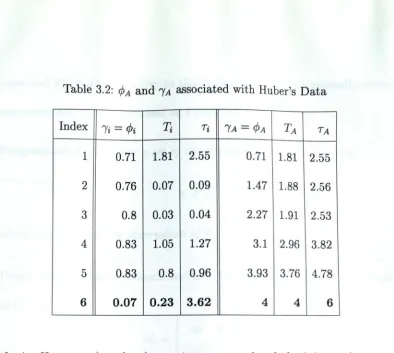
t a-The second d a ta set analyzed in chapter 2 is Huber’s d a ta and this data
set contains one unusual observation indexed by the number 6. This unusual
point has a very high leverage. From Table 3.2 it is not always the case th at
(}>i
is approximated by
and subsequently
(f>Acan be quite different from
k a
*
The contribution associated vidth observation six is considerably
different from its standardized version. The non-standardized contribution
is not sufficient to detect this unusual observation.
It is deduced from proposition 3.4.1 and b o th these examples th a t
T ais not a suitable estim ate for
t awhen leverage is a concern. This is due to
the fact th a t
and subsequently
'y aare considerably different from
k a ■As
a result when these param eters are used to standardize
T athey cause
t