190
Joint Learning of Named Entity Recognition and Entity Linking
Pedro Henrique MartinsÈ Zita MarinhoÁç and Andr´e F.T. MartinsÈÆ
ÈInstituto de Telecomunicac¸˜oes ÁPriberam Labs çInstitute of Systems and Robotics ÆUnbabel [email protected], [email protected],
Abstract
Named entity recognition (NER) and entity linking (EL) are two fundamentally related tasks, since in order to perform EL, first the mentions to entities have to be detected. How-ever, most entity linking approaches disre-gard the mention detection part, assuming that the correct mentions have been previously de-tected. In this paper, we perform joint learn-ing of NER and EL to leverage their related-ness and obtain a more robust and generalis-able system. For that, we introduce a model inspired by the Stack-LSTM approach (Dyer et al.,2015). We observe that, in fact, doing multi-task learning of NER and EL improves the performance in both tasks when compar-ing with models trained with individual objec-tives. Furthermore, we achieve results com-petitive with the state-of-the-art in both NER and EL.
1 Introduction
In order to build high quality systems for com-plex natural language processing (NLP) tasks, it is useful to leverage the output information of lower level tasks, such as named entity recognition (NER) and entity linking (EL). Therefore NER and EL are two fundamental NLP tasks.
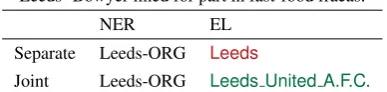
NER corresponds to the process of detecting mentions of named entities in a text and classify-ing them with predefined types such as person, lo-cation and organisation. However, the majority of the detected mentions can refer to different entities as in the example of Table1, in which the mention “Leeds” can refer to “Leeds”, the city, and “Leeds United A.F.C.”, the football club. To solve this am-biguity EL is performed. It consists in determin-ing to which entity a particular mention refers to, by assigning a knowledge base entity id.
In this example, the knowledge base id of the entity “Leeds United A.F.C.” should be selected.
Leeds’ Bowyer fined for part in fast-food fracas.
NER EL
Separate Leeds-ORG Leeds
[image:1.595.320.514.232.278.2]Joint Leeds-ORG Leeds United A.F.C.
Table 1: Example showing benefits of doing joint learn-ing. Wrong entity in red and correct in green.
In real world applications, EL systems have to perform two tasks: mention detection or NER and entity disambiguation. However, most approaches have only focused on the latter, being the mentions that have to be disambiguated given.
In this work we do joint learning of NER and EL in order to leverage the information of both tasks at every decision. Furthermore, by having a flow of information between the computation of the representations used for NER and EL we are able to improve the model.
One example of the advantage of doing joint learning is showed in Table1, in which the joint model is able to predict the correct entity, by knowing that the type predicted by NER is Organ-isation.
This paper introduces two main contributions:
• A system that jointly performs NER and EL, with competitive results in both tasks.
• A empirical qualitative analysis of the advan-tage of doing joint learning vs using separate models and of the influence of the different components to the result obtained.
2 Related work
Action Buffer Stack Output Entity [Obama, met, Donald, Trump] [] []
Shift [met, Donald, Trump] [Obama] []
Reduce-PER [met, Donald, Trump] [] [(Obama)-PER] Barack Obama
Out [Donald, Trump] [] [(Obama)-PER, met] Barack Obama
Shift [Trump] [Donald] [(Obama)-PER, met] Barack Obama Shift [] [Donald, Trump] [(Obama)-PER, met] Barack Obama
Reduce-PER [] [] [(Obama)-PER, met, Barack Obama,
[image:2.595.72.526.61.184.2](Donald Trump)-PER] Donald Trump
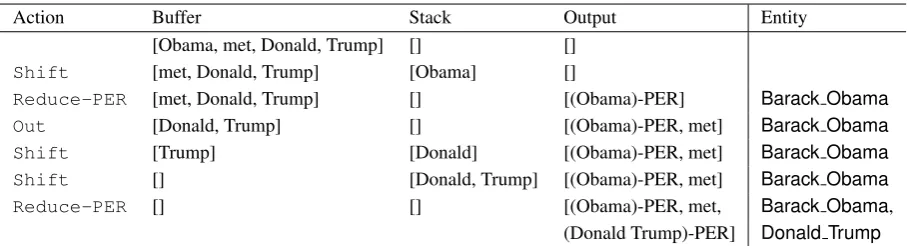
Table 2: Actions and stack states when processing sentence “Obama met Donald Trump”. The predicted types and detected mentions are contained in the Output and the entities the mentions refer to in the Entity.
et al., 2016;Chiu and Nichols, 2016). Recently, NER systems have been achieving state-of-the-art results by using word contextual embeddings, ob-tained with language models (Peters et al.,2018; Devlin et al.,2018;Akbik et al.,2018).
Most EL systems discard mention detection, performing only entity disambiguation of previ-ously detected mentions. Thus, in these cases the dependency between the two tasks is ignored. EL state-of-the-art methods often correspond to local methods which use as main features a candidate entity representation, a mention representation, and a representation of the mention’s context (Sun et al.,2015;Yamada et al.,2016,2017;Ganea and Hofmann, 2017). Recently, there has also been an increasing interest in attempting to improve EL performance by leveraging knowledge base infor-mation (Radhakrishnan et al.,2018) or by allying local and global features, using information about the neighbouring mentions and respective entities (Le and Titov,2018;Cao et al.,2018;Yang et al., 2018). However, these approaches involve know-ing the surroundknow-ing mentions which can be im-practical in a real case because we might not have information about the following sentences. It also adds extraneous complexity that might implicate a longer time to process.
Some works, as in this paper, perform end-to-end EL trying to leverage the relatedness of mention detection or NER and EL, and obtained promising results. Kolitsas et al.(2018) proposed a model that performs mention detection instead of NER, not identifying the type of the detected men-tions, as in our approach. Sil and Yates (2013), Luo et al. (2015), and Nguyen et al. (2016) in-troduced models that do joint learning of NER and EL using hand-engineered features. (Durrett and Klein,2014) performed joint learning of
en-tity typing, EL, and coreference using a structured CRF, also with hand-engineered features. In con-trast, in our model we perform multi-task learning (Caruana, 1997; Evgeniou and Pontil, 2004), us-ing learned features.
3 Model Description
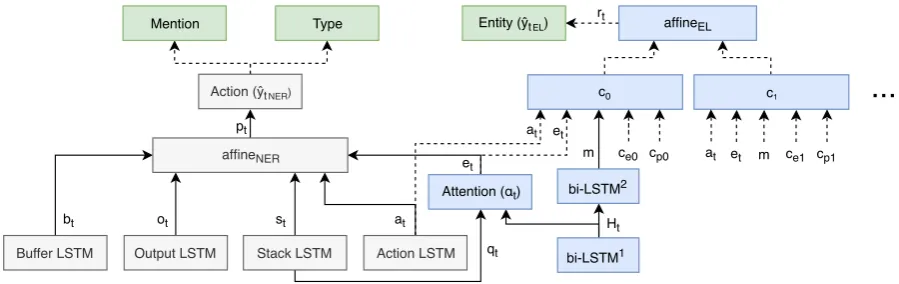
In this section firstly, we briefly explain the Stack-LSTM (Dyer et al., 2015; Lample et al., 2016), model that inspired our system. Then we will give a detailed explanation of our modifications and of how we extended it to also perform EL, as showed in the diagram of Figure1. An example of how the model processes a sentence can be viewed in Table2.
3.1 Stack-LSTM
The Stack-LSTM corresponds to an action-based system which is composed by LSTMs augmented with a stack pointer. In contrast to the most com-mon approaches which detect the entity mentions for a whole sequence, with Stack-LSTMs the en-tity mentions are detected and classified on the fly. This is a fundamental property to our model, since we perform EL when a mention is detected.
This model is composed by four stacks: the
Stack, that contains the words that are being pro-cessed, the Output, that is filled with the com-pleted chunks, the Action stack, which contains the previous actions performed during the process-ing of the current document, and theBuffer, that contains the words to be processed.
For NER, in the Stack-LSTM there are three possible types of actions:
Buffer LSTM Output LSTM Stack LSTM Action LSTM affineNER
bi-LSTM1 bi-LSTM2
Action (ŷt NER) c0
ce0 cp0
c1
ce1 cp1 m et at
...
affineEL Entity (ŷt EL)
Mention
m
at
et
st ot
bt
Type
pt
rt
Attention (αt)
Ht
qt
[image:3.595.71.521.63.205.2]at et
Figure 1: Simplified diagram of our model. The dashed arrows only occur when the action isReduce. The blocks in blue correspond to our extensions to the Stack-LSTM and the green blocks correspond to the model’s predictions. The grey blocks correspond to the stack-LSTM, the blue blocks to our extensions, and the green ones to the outputs.
• Out, that pops a word off the buffer and in-serts it into theOutput. It means that the last word of theBufferis not part of a named en-tity.
• Reduce, that pops all the words in theStack
and pushes them into the Output. There is one action Reduce for each possible type of named entities, e.g. Reduce-PER and
Reduce-LOC.
Moreover, the actions that can be performed at each step are controlled: the actionOutcan only occur if the stack is empty and the actionsReduce
are only available when theStackis not empty.
3.2 Our model
NER. To better capture the context, we comple-ment the Stack-LSTM with a representationvtof the sentence being processed, for each action step
t. For that the sentence x1, . . . ,x|w| is passed
through a bi-directional LSTM, beingh1w the hid-den state of its 1st layer (bi-LSTM1 in Figure1), that corresponds to the word with indexw:
{h11, . . . ,h1|w|}= BiLSTM1(x1, . . . ,x|w|).
We compute a representation of the words con-tained in the Stack, qt, by doing the mean of the hidden states of the 1stlayer of the bi-LSTM that correspond to the words contained in the stack at action stept, setSt,:
qt= P
k∈Sth
1
k
|St|
.
This is used to compute the attention scoresαt:
ztw =u>(W1h1w+W2qt)
αt= softmax(zt),
whereW1,W2, anduare trainable parameters.
The representation vt is then obtained by doing the weighted average of the bi-LSTM 1st layer’s hidden states:
vt=
|w| X
w=1
h1wαtw.
To predict the action to be performed, we imple-ment an affine transformation (affineNER in
Fig-ure1) whose input is the concatenation of the last hidden states of theBufferLSTMbt,StackLSTM
st,ActionLSTMat, andOutputLSTMot, as well as the sentence representationvt.
dt= [bt; st; at; ot; vt]
Then, for each stept, we use these representations to compute the probability distributionptover the set of possible actions A, and select the action
b
ytNER with the highest probability:
pt= softmax(affine(dt))
b
ytNER = arg max
a∈ A
The NER loss function is the cross entropy, with the gold action for steptbeing represented by the one-hot vectorytNER:
LN ER=− T
X
t=1
y>tNERlog(pt).
whereT is the total number of action steps for the current document.
EL. When the action predicted is Reduce, a mention is detected and classified. This mention is then disambiguated by selecting its respective en-tity knowledge base id. The disambiguation step is performed by ranking the mention’s candidate entities.
The candidate entities c∈ C for the present mention are represented by their entity embedding
ce and their prior probabilitycp. The prior prob-abilities were previously computed based on the co-occurrences between mentions and candidates in Wikipedia.
To represent the mention detected the 2nd layer
of the sentence bi-LSTM (bi-LSTM2in Figure1), is used, being the representation m obtained by averaging the hidden statesh2wthat correspond to the words contained in the mention, setM:
{h21, . . . ,h2|w|}= BiLSTM2(h11, . . . ,h1|w|)
m= P
w∈M h2w
|M| .
These features are concatenated with the represen-tation of the sentencevt, and the last hidden state of theActionstack-LSTMat:
ci = [cei; cpi; m; vt; at].
We compute a score for each candidate with affine transformations (affineELin Figure 1) that havec
as input, and select the candidate entity with the highest score,ybtEL:
lt= affine(tanh(affine(ci, . . . ,cn)))
rt= softmax(lt)
b
ytEL = arg max
c∈ C
(rt(c)).
The EL loss function is the cross entropy, with the gold entity for steptbeing represented by the one-hot vectorytEL:
LEL=−
T
X
t=1
y>tELlog(rt)).
whereTis the total number of mention that corre-spond to entities in the knowledge base.
Due to the fact that not every mention detected has a corresponding entity in the knowledge base, we first classify whether this mention contains an entry in the knowledge base using an affine trans-formation followed by a sigmoid. The affine’s in-put is the stack LSTM last hidden statest:
d= sigmoid(affine(st)).
The NIL loss function, binary cross-entropy, is given by:
LN IL =−(yN ILlog(d)+(1−yN IL) log(1−d)),
where yN IL corresponds to the gold label, 1 if mention should be linked and0otherwise.
During training we perform teacher forcing, i.e. we use the gold labels for NER and the NIL classi-fication, only performing EL when the gold action isReduceand the mention has a corresponding id in the knowledge base. The multi-task learning loss is then obtained by summing the individual losses:
L=LN ER+LEL+LN IL.
4 Experiments
4.1 Datasets and metrics
documents. In this dataset, the entity mentions are classified as person, location, organisation and miscellaneous. It also contains the knowledge base id of the respective entities in Wikipedia.
For the NER experiments we report the F1 score while for the EL we report the micro and macro F1 scores. The EL scores were obtained with the Gerbil benchmarking platform, which offers a re-liable evaluation and comparison with the state-of-the-art models (R¨oder et al.). The results were obtained using strong matching settings, which re-quires exactly predicting the gold mention bound-aries and their corresponding entity.
4.2 Training details and settings
In our work, we used100dimensional word em-beddings pre-trained with structured skip-gram on the Gigaword corpus (Ling et al., 2015). These were concatenated with 50 dimensional charac-ter embeddings obtained using a bi-LSTM over the sentences. In addition, we use contextual em-beddings obtained using a character bi-LSTM lan-guage model by Akbik et al. (2018). The entity embeddings are300dimensional and were trained byYamada et al.(2017) on Wikipedia. To get the set of candidate entities to be ranked for each men-tion, we use a pre-built dictionary (Pershina et al., 2015).
The LSTM used to extract the sentence and mention representations, vt and m is composed by2hidden layers with a size of100and the ones used in the Stack-LSTM have 1 hidden layer of size100. The feedforward layer used to determine the entity id has a size of 5000. The affine layer used to predict whether the mention is NIL has a size of 100. A dropout ratio of 0.3 was used throughout the model.
The model was trained using the ADAM opti-miser (Kingma and Ba, 2014) with a decreasing learning rate of0.001and a decay of0.8and0.999
for the first and second momentum, respectively.
4.3 Results
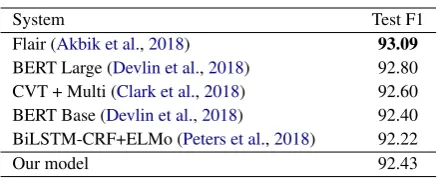
Comparison with state of the art models. We compared the results obtained using our joint learning approach with state-of-the-art NER mod-els, in Table3, and state-of-the-art end-to-end EL models, in Table4. In the comparisons, it can be observed that our model scores are competitive in both tasks.
System Test F1
Flair (Akbik et al.,2018) 93.09
BERT Large (Devlin et al.,2018) 92.80 CVT + Multi (Clark et al.,2018) 92.60 BERT Base (Devlin et al.,2018) 92.40 BiLSTM-CRF+ELMo (Peters et al.,2018) 92.22
[image:5.595.307.527.59.149.2]Our model 92.43
Table 3: NER results in CoNLL 2003 test set.
System Validation F1 Test F1
Macro Micro Macro Micro
Kolitsas et al.(2018) 86.6 89.4 82.6 82.4
Cao et al.(2018) 77.0 79.0 80.0 80.0
Nguyen et al.(2016) - - - 78.7
[image:5.595.306.528.181.255.2]Our model 82.8 85.2 81.2 81.9
Table 4: End-to-end EL results on validation and test sets in AIDA/CoNLL.
Comparison with individual models. To un-derstand whether the multi-task learning approach is advantageous for NER and EL we compare the results obtained when using a multi-task learning objective with the results obtained by the same models when training with separate objectives. In the EL case, in order to perform a fair compari-son, the mentions that are linked by the individ-ual system correspond to the ones detected by the multi-task approach NER.
These comparisons results can be found in Ta-bles5and6, for NER and EL, respectively. They show that, as expected, doing joint learning im-proves both NER and EL results consistently. This indicates that by leveraging the relatedness of the tasks, we can achieve better models.
System Validation F1 Test F1
Only NER 95.46 92.34
[image:5.595.318.514.632.684.2]NER + EL 95.72 92.52
Table 5: Comparison of Named Entity Recognition multi-task results with single model results.
System Validation F1 Test F1 Macro Micro Macro Micro
Only EL 81.3 83.5 79.9 80.2
NER + EL 82.6 85.2 81.1 81.8
Table 6: Comparison of Entity Linking results multi-task results with single model results.
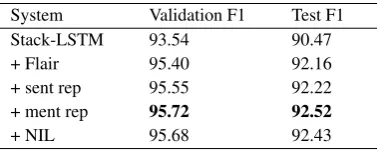
obtained scores, we performed an ablation test for each task, which can be seen in Tables 7 and 8, for NER and EL, respectively. These experiments show that the use of contextual embeddings (Flair) is responsible for a big boost in the NER perfor-mance and, consequently, in EL due to the bet-ter detection of mentions. We can also see that the addition of the sentence representation (sent rep vt) improves the NER performance slightly. Interestingly, the use of a mention representation (ment repm) for EL that is computed by the sen-tence LSTM, not only yields a big improvement on the EL task but also contributes to the improve-ment of the NER scores. The results also indi-cate that having a simple affine transformation se-lecting whether the mention should be linked, im-proves the EL results.
System Validation F1 Test F1
Stack-LSTM 93.54 90.47
+ Flair 95.40 92.16
+ sent rep 95.55 92.22
+ ment rep 95.72 92.52
[image:6.595.87.277.303.378.2]+ NIL 95.68 92.43
Table 7: Ablation test for Named Entity Recognition.
System Validation F1 Test F1
Macro Micro Macro Micro Stack-LSTM 81.95 84.76 80.37 80.12
+ Flair 82.59 85.75 80.86 81.05
+ sent rep 82.31 85.43 80.49 80.62 + ment rep 82.64 85.17 81.07 81.76
+ NIL 82.78 85.23 81.19 81.94
Table 8: Ablation test for Entity Linking.
5 Conclusions and Future Work
We proposed doing joint learning of NER and EL, in order to improve their performance. Results show that our model achieves results competitive with the state-of-the-art. Moreover, we verified that the models trained with the multi-task ob-jective have a better performance than individual ones. There is, however, further work that can be done to improve our system, such as training en-tity contextual embeddings and extending it to be cross-lingual.
Acknowledgements
This work was supported by the European Re-search Council (ERC StG DeepSPIN 758969),
and by the Fundac¸˜ao para a Ciˆencia e Tecnolo-gia through contracts UID/EEA/50008/2019 and CMUPERI/TIC/0046/2014 (GoLocal). We thank Afonso Mendes, David Nogueira, Pedro Balage, Sebasti˜ao Miranda, Gonc¸alo Correia, Erick Fon-seca, Vlad Niculae, Tsvetomila Mihaylova, Mar-cos Treviso, and the anonymous reviewers for helpful discussion and feedback.
References
Alan Akbik, Duncan Blythe, and Roland Vollgraf. 2018. Contextual string embeddings for sequence labeling. In Proceedings of the 27th International Conference on Computational Linguistics, pages 1638–1649. Association for Computational Linguis-tics.
Yixin Cao, Lei Hou, Juanzi Li, and Zhiyuan Liu. 2018.
Neural collective entity linking. InProceedings of the 27th International Conference on Computational Linguistics, pages 675–686. Association for Compu-tational Linguistics.
Rich Caruana. 1997. Multitask learning. Machine learning, 28(1):41–75.
Jason PC Chiu and Eric Nichols. 2016. Named entity recognition with bidirectional lstm-cnns. Transac-tions of the Association for Computational Linguis-tics, 4:357–370.
Kevin Clark, Minh-Thang Luong, Christopher D. Man-ning, and Quoc Le. 2018. Semi-supervised se-quence modeling with cross-view training. In Pro-ceedings of the 2018 Conference on Empirical Meth-ods in Natural Language Processing, pages 1914– 1925. Association for Computational Linguistics.
Jacob Devlin, Ming-Wei Chang, Kenton Lee, and Kristina Toutanova. 2018. Bert: Pre-training of deep bidirectional transformers for language understand-ing.arXiv preprint arXiv:1810.04805.
Greg Durrett and Dan Klein. 2014. A joint model for entity analysis: Coreference, typing, and link-ing. Transactions of the association for computa-tional linguistics, 2:477–490.
Chris Dyer, Miguel Ballesteros, Wang Ling, Austin Matthews, and Noah A. Smith. 2015. Transition-based dependency parsing with stack long short-term memory. InProceedings of the 53rd Annual Meeting of the Association for Computational Lin-guistics and the 7th International Joint Conference on Natural Language Processing (Volume 1: Long Papers), pages 334–343. Association for Computa-tional Linguistics.
[image:6.595.82.282.421.508.2]Jenny Rose Finkel, Trond Grenager, and Christopher Manning. 2005. Incorporating non-local informa-tion into informainforma-tion extracinforma-tion systems by gibbs sampling. InProceedings of the 43rd annual meet-ing on association for computational lmeet-inguistics, pages 363–370. Association for Computational Lin-guistics.
Octavian-Eugen Ganea and Thomas Hofmann. 2017. Deep joint entity disambiguation with local neural attention. InProceedings of the 2017 Conference on Empirical Methods in Natural Language Process-ing, pages 2619–2629.
Johannes Hoffart, Mohamed Amir Yosef, Ilaria Bor-dino, Hagen F¨urstenau, Manfred Pinkal, Marc Span-iol, Bilyana Taneva, Stefan Thater, and Gerhard Weikum. 2011. Robust disambiguation of named entities in text. InProceedings of the Conference on Empirical Methods in Natural Language Process-ing, pages 782–792. Association for Computational Linguistics.
Diederik Kingma and Jimmy Ba. 2014. Adam: A method for stochastic optimization.
arXiv:1412.6980 [cs.LG], pages 1–13.
Nikolaos Kolitsas, Octavian-Eugen Ganea, and Thomas Hofmann. 2018. End-to-end neural entity linking. In Proceedings of the 22nd Conference on Computational Natural Language Learning, pages 519–529. Association for Computational Linguistics.
Guillaume Lample, Miguel Ballesteros, Sandeep Sub-ramanian, Kazuya Kawakami, and Chris Dyer. 2016. Neural architectures for named entity recognition.
arXiv preprint arXiv:1603.01360.
Phong Le and Ivan Titov. 2018. Improving entity link-ing by modellink-ing latent relations between mentions. In Proceedings of the 56th Annual Meeting of the Association for Computational Linguistics (Volume 1: Long Papers), pages 1595–1604.
Wang Ling, Chris Dyer, Alan W Black, and Isabel Trancoso. 2015. Two/too simple adaptations of word2vec for syntax problems. In Proceedings of the 2015 Conference of the North American Chap-ter of the Association for Computational Linguistics: Human Language Technologies, pages 1299–1304. Association for Computational Linguistics.
Gang Luo, Xiaojiang Huang, Chin-Yew Lin, and Za-iqing Nie. 2015. Joint entity recognition and disam-biguation. InProceedings of the 2015 Conference on Empirical Methods in Natural Language Pro-cessing, pages 879–888.
Dat Ba Nguyen, Martin Theobald, and Gerhard Weikum. 2016. J-nerd: joint named entity recogni-tion and disambiguarecogni-tion with rich linguistic features.
Transactions of the Association for Computational Linguistics, 4:215–229.
Maria Pershina, Yifan He, and Ralph Grishman. 2015. Personalized page rank for named entity disam-biguation. InProceedings of the 2015 Conference of the North American Chapter of the Association for Computational Linguistics: Human Language Tech-nologies, pages 238–243.
Matthew E Peters, Mark Neumann, Mohit Iyyer, Matt Gardner, Christopher Clark, Kenton Lee, and Luke Zettlemoyer. 2018. Deep contextualized word rep-resentations. InProceedings of NAACL-HLT, pages 2227–2237, New Orleans, Louisiana.
Priya Radhakrishnan, Partha Talukdar, and Vasudeva Varma. 2018. Elden: Improved entity linking us-ing densified knowledge graphs. InProceedings of the 2018 Conference of the North American Chap-ter of the Association for Computational Linguistics: Human Language Technologies, Volume 1 (Long Pa-pers), pages 1844–1853.
Michael R¨oder, Ricardo Usbeck, and Axel-Cyrille Ngonga Ngomo. Gerbil–benchmarking named en-tity recognition and linking consistently. Semantic Web, (Preprint):1–21.
Avirup Sil and Alexander Yates. 2013. Re-ranking for joint named-entity recognition and linking. In Pro-ceedings of the 22nd ACM international conference on Information & Knowledge Management, pages 2369–2374. ACM.
Yaming Sun, Lei Lin, Duyu Tang, Nan Yang, Zhen-zhou Ji, and Xiaolong Wang. 2015. Modeling mtion, context and entity with neural networks for en-tity disambiguation. InTwenty-Fourth International Joint Conference on Artificial Intelligence.
Ikuya Yamada, Hiroyuki Shindo, Hideaki Takeda, and Yoshiyasu Takefuji. 2016. Joint learning of the em-bedding of words and entities for named entity dis-ambiguation. InProceedings of The 20th SIGNLL Conference on Computational Natural Language Learning, pages 250–259.
Ikuya Yamada, Hiroyuki Shindo, Hideaki Takeda, and Yoshiyasu Takefuji. 2017. Learning distributed rep-resentations of texts and entities from knowledge base. TACL, 5:397–411.