6059
Automatic Grammatical Error Correction for
Sequence-to-sequence Text Generation:
An Empirical Study
Tao Ge Xingxing Zhang Furu Wei Ming Zhou
Microsoft Research Asia
{tage, xizhang, fuwei, mingzhou}@microsoft.com
Abstract
Sequence-to-sequence (seq2seq) models have achieved tremendous success in text genera-tion tasks. However, there is no guarantee that they can always generate sentences without grammatical errors. In this paper, we present a preliminary empirical study on whether and how much automatic grammatical error cor-rection can help improve seq2seq text genera-tion. We conduct experiments across various seq2seq text generation tasks including ma-chine translation, formality style transfer, sen-tence compression and simplification. Exper-iments show the state-of-the-art grammatical error correction system can improve the gram-maticality of generated text and can bring task-oriented improvements in the tasks where tar-get sentences are in a formal style.
1 Introduction
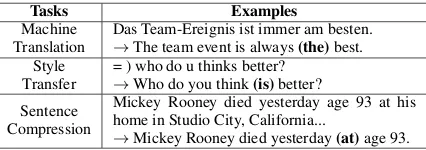
Sequence-to-sequence (seq2seq) text generation (Cho et al., 2014; Sutskever et al., 2014) has attracted growing attention in natural language processing (NLP). Despite various advantages of seq2seq models, they tend to have a weakness: there is no guarantee that they can always gener-ate sentences without grammatical errors. Table1
shows examples generated by seq2seq models in various taskswithgrammatical errors.
One valid solution to this challenge is conduct-ing grammatical error correction (GEC) for ma-chine generated sentences. Recent GEC systems (Chollampatt and Ng, 2018; Junczys-Dowmunt et al.,2018;Grundkiewicz and Junczys-Dowmunt,
2018;Ge et al.,2018a,b) can achieve human-level performance in GEC benchmarks. We are curi-ous whether they can help improve seq2seq based natural language generation (NLG) models. We therefore propose an empirical study on GEC post editing for various text generation tasks (i.e., ma-chine translation, style transfer, sentence
compres-Tasks Examples
Machine Translation
Das Team-Ereignis ist immer am besten.
→The team event is always(the)best. Style
Transfer
= ) who do u thinks better?
→Who do you think(is)better? Sentence
Compression
Mickey Rooney died yesterday age 93 at his home in Studio City, California...
[image:1.595.311.524.221.296.2]→Mickey Rooney died yesterday(at)age 93.
Table 1: Seq2seq model outputs for German-English translation, formality style transfer and sentence com-pression. The texts in round brackets are edits by GEC.
sion and simplification) using both automatic and human evaluation methods. Experimental results demonstrate that a state-of-the-art GEC system is helpful for improving the grammaticality of gen-erated text and that it can bring task-oriented im-provements in the tasks where target sentences are in a formal style.
The contributions of this paper are twofold:
• We present an empirical study on GEC post editing for seq2seq text generation. To the best of our knowledge, it is the first work to study improving seq2seq based NLG models using GEC.
• We show some interesting results by thor-oughly comparing and analyzing GEC post editing for various seq2seq text generation tasks, shedding light on the potential of GEC for NLG.
2 Background
2.1 Sequence-to-sequence Text Generation
usually trained by minimizing the negative log-likelihood of the training source-target sentence pairs. During inference, an output sequencexois generated (one token at a time) with beam search by maximizingPΘ(xo|xs).
2.2 Automatic Grammatical Error Correction
Most recent GEC systems are based on the seq2seq framework and are trained with error-corrected sentence pairs. Due to massive train-ing data, the state-of-the-art GEC system ( Grund-kiewicz and Junczys-Dowmunt, 2018; Ge et al.,
2018b) can achieve human-level performance in GEC benchmarks and be practically used for cor-recting grammatical errors.
3 Experiments and Evaluation
We use the state-of-art GEC system (Ge et al.,
2018b) as our GEC model which is a 7-layer con-volutional seq2seq model trained with a fluency boost learning strategy on both original GEC train-ing data and augmented fluency boost sentence pairs. We use the GEC model to do post edit-ing for sentences decoded by a seq2seq model to test if GEC improves the results. We choose ma-chine translation, style transfer, sentence compres-sion and simplification as typical seq2seq text gen-eration tasks.
Due to the page limit, the detailed configuration of the models we implemented in this section are put in the supplementary notes.
3.1 Machine translation
We take Machine translation (MT) as the main task to study whether GEC helps improve trans-lation quality. We conduct experiments by us-ing GEC to edit the results of the state-of-the-art neural machine translation (NMT) system (Google Translate) on the French-English (FR-EN) in WMT14, German-English (DE-EN) and Chinese-English (ZH-EN) news test sets in WMT17.
Table2shows BLEU with/without post-editing by the GEC system. Although GEC post-editing does not improve BLEU much, when we look into the results by analyzing the sentences edited by GEC, we observe only a small proportion of sen-tences are modified by the GEC system – approxi-mately 5% in FR-EN and DE-EN, while 10% in ZH-EN test sets. The sentence-level BLEU of around 50% of the edited sentences are improved,
NMT NMT+GEC #edited
[image:2.595.305.528.61.100.2]FR-EN 38.70 38.69(−0.01) 131 (63↑68↓) out of 3,003 DE-EN 35.45 35.48(+0.03) 141 (65↑76↓) out of 3,004 ZH-EN 28.85 28.96(+0.11) 271 (148↑123↓) out of 2,001
Table 2: BLEU with/without post editing by GEC.
#edited shows the number of sentences modified by GEC, where↑and↓indicate the number of sentences whose BLEU improves or decreases.
MT MT+GEC Unsupervised SMT 27.09 27.33(+0.24)
Unsupervised NMT 28.30 28.52(+0.22)
[image:2.595.324.508.171.214.2]Google Translate 38.70 38.69(−0.01)
Table 3: BLEU of the unsupervised SMT and NMT systems in the WMT14 FR-EN test set.
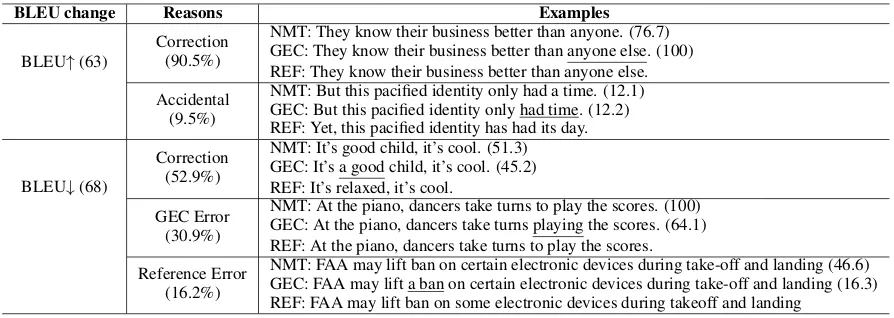
while the remaining suffer a BLEU decrease. To understand the reasons for the BLEU changes, we manually check each sentence edited by GEC in WMT14 FR-EN dataset and show the results in Table4. The main reason (90.5% cases) for a BLEU improvement is that GEC corrects er-rors in NMT’s results and improves the transla-tion quality. In contrast, the reasons why BLEU decreases are various. First, the correction of grammatical errors by GEC may decrease BLEU though it improves the sentence’s grammaticality, as shown in Table4. Second, the GEC system is not perfect: it sometimes edits a sentence with-out grammatical errors. Even though such edits usually bring no adverse effects, it is likely to de-crease BLEU. Last, we find reference sentences occasionally have grammatical errors, as Refer-ence Error in Table 4 shows. When GEC fixes the errors in such cases, BLEU decreases.
Moreover, we test the effects of GEC on MT in a low resource setting. We use the state-of-the-art unsupervised SMT and NMT model inRen et al.
(2019) and use the GEC system to edit their re-sults. According to the results shown in Table3, the unsupervised MT systems benefit more from GEC than the state-of-the-art supervised NMT (i.e, Google translate) because they are more likely to generate sentences that are not fluent than the supervised MT models, which can be addressed by GEC.
BLEU change Reasons Examples
BLEU↑(63)
Correction (90.5%)
NMT: They know their business better than anyone. (76.7) GEC: They know their business better than anyone else. (100) REF: They know their business better than anyone else.
Accidental (9.5%)
NMT: But this pacified identity only had a time. (12.1) GEC: But this pacified identity only had time. (12.2) REF: Yet, this pacified identity has had its day.
BLEU↓(68)
Correction (52.9%)
NMT: It’s good child, it’s cool. (51.3) GEC: It’s a good child, it’s cool. (45.2) REF: It’s relaxed, it’s cool.
GEC Error (30.9%)
NMT: At the piano, dancers take turns to play the scores. (100) GEC: At the piano, dancers take turns playing the scores. (64.1) REF: At the piano, dancers take turns to play the scores.
Reference Error (16.2%)
[image:3.595.73.520.61.220.2]NMT: FAA may lift ban on certain electronic devices during take-off and landing (46.6) GEC: FAA may lift a ban on certain electronic devices during take-off and landing (16.3) REF: FAA may lift ban on some electronic devices during takeoff and landing
Table 4: Reasons for BLEU changes in WMT14 FR-EN dataset. The numbers in the round brackets following example sentences are sentence-level BLEU.
Informal→Formal Formal→Informal
BLEU Acc BLEU Acc
Transformer 73.79 83.0 38.49 68.7
Transformer+GEC 74.84 84.2 38.85 47.1
State-of-the-art 75.37 - 39.09
-Table 5: Results for GEC post-editing on formality style transfer on the GYAFC test set in “Family & Re-lationships” domain, containing about 1,000 sentences. Acc is evaluated with the help of a CNN model for style classification. The state-of-the-art (Niu et al.,2018) is an ensemble model trained with additional data.
3.2 Formality style transfer
In addition to MT, we test GEC on the text style transfer task. We study formality style transfer which transfers an informal (formal) sentence to a formal (informal) style and choose GYAFC cor-pus (Rao and Tetreault,2018) as our testbed. We use a 2-layer transformer model as our base model and train a model with approximately 100K paral-lel sentences in the GYAFC corpus for informal→
informal and formal→informal respectively. We use the GEC model to edit the base models’ out-puts, and show the result in Table5.
While GEC improves BLEU in both transfer directions, we observe differences when we look into style accuracy. For Informal→Formal trans-fer, accuracy is improved (83.0% → 84.2%) af-ter GEC post editing; while for Formal→Informal transfer, it decreases (68.7% → 47.1%) because grammaticality improvements by GEC may make a sentence become less like an informal sentence.
3.3 Sentence compression and simplification
We also test effects of GEC post-editing on tence compression and simplification. For sen-tence compression, following Filippova et al.
(2015), we train a 2-layer LSTM seq2seq model, which generates a 0/1 sequence to indicate whether to delete a word, as our base model and test on Google’s sentence compression dataset1 (GoogComp). For sentence simplification, we use the state-of-the-art deep reinforcement model DRESS (Zhang and Lapata, 2017) as our base model and test on Newsela text simplification dataset.
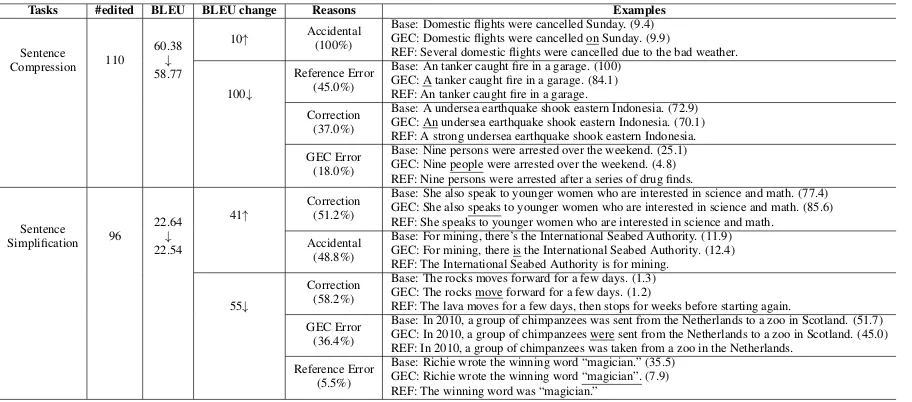
Table 6 shows the results for the effects of GEC on sentence compression and simplification. For sentence compression, BLEU decreases from 60.38 to 58.77 after GEC post editing. We man-ually analyze the results and find there are many grammatical errors in the reference sentences. This is not surprising, since the reference sen-tences are constructed with an automatic approach (Filippova and Altun,2013). The grammatical er-rors in the references affect the BLEU evaluation and make it less reliable.
The BLEU decrease is also observed in sen-tence simplification task but for a different reason. In the Newsela dataset, the reference sentences are written by humans and therefore have much fewer grammatical errors compared to GoogComp. In contrast to sentence compression where reference errors are the main reason for the BLEU decrease, the BLEU decrease in sentence simplification usu-ally happens in the cases where the correction of grammatical errors reduces the sentence’s n-gram overlap with the reference sentence, as shown in Table 6 (similar to the phenomenon observed in the experiments for MT; see Table4). In addition, GEC errors and occasional errors in reference
sen-1
[image:3.595.75.289.271.320.2]Tasks #edited BLEU BLEU change Reasons Examples
Sentence Compression 110
60.38
↓
58.77
10↑ Accidental
(100%)
Base: Domestic flights were cancelled Sunday. (9.4) GEC: Domestic flights were cancelled on Sunday. (9.9)
REF: Several domestic flights were cancelled due to the bad weather.
100↓
Reference Error (45.0%)
Base: An tanker caught fire in a garage. (100) GEC: A tanker caught fire in a garage. (84.1) REF: An tanker caught fire in a garage.
Correction (37.0%)
Base: A undersea earthquake shook eastern Indonesia. (72.9) GEC: An undersea earthquake shook eastern Indonesia. (70.1) REF: A strong undersea earthquake shook eastern Indonesia.
GEC Error (18.0%)
Base: Nine persons were arrested over the weekend. (25.1) GEC: Nine people were arrested over the weekend. (4.8) REF: Nine persons were arrested after a series of drug finds.
Sentence Simplification 96
22.64
↓
22.54 41↑
Correction (51.2%)
Base: She also speak to younger women who are interested in science and math. (77.4) GEC: She also speaks to younger women who are interested in science and math. (85.6) REF: She speaks to younger women who are interested in science and math.
Accidental (48.8%)
Base: For mining, there’s the International Seabed Authority. (11.9) GEC: For mining, there is the International Seabed Authority. (12.4) REF: The International Seabed Authority is for mining.
55↓
Correction (58.2%)
Base: The rocks moves forward for a few days. (1.3) GEC: The rocks move forward for a few days. (1.2)
REF: The lava moves for a few days, then stops for weeks before starting again.
GEC Error (36.4%)
Base: In 2010, a group of chimpanzees was sent from the Netherlands to a zoo in Scotland. (51.7) GEC: In 2010, a group of chimpanzees were sent from the Netherlands to a zoo in Scotland. (45.0) REF: In 2010, a group of chimpanzees was taken from a zoo in the Netherlands.
Reference Error (5.5%)
[image:4.595.74.530.61.262.2]Base: Richie wrote the winning word “magician.” (35.5) GEC: Richie wrote the winning word “magician”. (7.9) REF: The winning word was “magician.”
Table 6: Results for sentence compression and sentence simplification. As in Table4, the numbers in the round brackets following the example sentences are sentence-level BLEU.
tences lead to a decrease of BLEU after GEC post editing.
3.4 Human Evaluation
In addition to automatic evaluation (e.g., BLEU), we present human evaluation results for GEC post editing on the tasks. The evaluation includes two aspects: First, we evaluate how much helpful GEC is for improving the grammaticality of sentences generated by the seq2seq models, which is inde-pendent to a specific task; Second, we evaluate if GEC’s edits bring task-oriented improvements. The evaluation is done by a human judge through comparing the results with/without GEC’s edits.
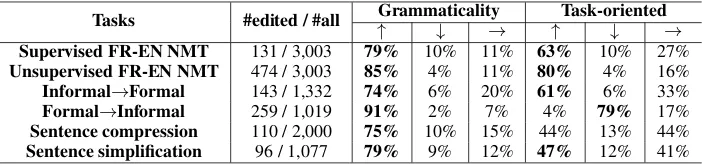
Table 7 shows the human evaluation results. For most sentences edited by GEC, their gram-maticality is improved; while the bad cases are only in a small proportion (≤10%) in all the six tasks. In contrast, the task-oriented im-provements vary across the tasks. For exam-ple, for Informal→Formal style transfer, GEC performs well because most of its edits improve the sentences’ grammaticality and make the sen-tences become more formal; in contrast, for Formal→Informal style transfer, GEC improves sentences’ grammaticality but affects their styles, making them become less informal.
Moreover, it is observed that GEC is more ben-eficial to the seq2seq models trained in a low re-source setting, by comparing the results of super-vised and unsupersuper-vised MT, which is consistent with results in Table3. For sentence compression and simplification, many grammatical
improve-ments do not bring task-oriented improveimprove-ments. The reason is that the parts GEC edits are not the content that should be kept in the results. Also, it is notable that except for Formal→Informal style transfer whose target sentences should be in an informal style, GEC brings much more improve-ments than adverse effects on the tasks, demon-strating the potential of GEC for NLG.
4 Related Work and Discussion
The most related work to ours is the automatic post editing (APE) (Bojar et al.,2016) which has been extensively studied for MT (e.g., (Pal et al.,2016,
2017;Chatterjee et al.,2017;Hokamp,2017;Tan et al.,2017)) in the past few years. These APE ap-proaches are usually trained with source language input data, target language MT output and target language post editing (PE) data. Although these APE models and systems have proven to be suc-cessful in improving MT results, they are task-specific and cannot be used for other NLG tasks.
Tasks #edited / #all Grammaticality Task-oriented
↑ ↓ → ↑ ↓ →
[image:5.595.124.475.62.145.2]Supervised FR-EN NMT 131 / 3,003 79% 10% 11% 63% 10% 27% Unsupervised FR-EN NMT 474 / 3,003 85% 4% 11% 80% 4% 16% Informal→Formal 143 / 1,332 74% 6% 20% 61% 6% 33% Formal→Informal 259 / 1,019 91% 2% 7% 4% 79% 17% Sentence compression 110 / 2,000 75% 10% 15% 44% 13% 44% Sentence simplification 96 / 1,077 79% 9% 12% 47% 12% 41%
Table 7: Human evaluation results for the sentences edited by GEC.↑,↓and→denote GEC makes a sentence better, worse and neither better nor worse. The percentages are the proportion of the corresponding cases.
tasks where target sentences are in a formal style, especially in a low-resource setting.
Acknowledgments
We thank the anonymous reviewers for their valu-able comments. Specially, we thank Shujie Liu for the discussion and constructive suggestions to this paper. We also thank Shuo Ren, Shuangzhi Wu, Zhirui Zhang and Yi Zhang for their help with the evaluation in the machine translation and formal-ity style transfer task.
References
Ondrej Bojar, Rajen Chatterjee, Christian Federmann, Yvette Graham, Barry Haddow, Matthias Huck, An-tonio Jimeno Yepes, Philipp Koehn, Varvara Lo-gacheva, Christof Monz, et al. 2016. Findings of the 2016 conference on machine translation. In
ACL 2016 FIRST CONFERENCE ON MACHINE TRANSLATION (WMT16), pages 131–198. The As-sociation for Computational Linguistics.
Rajen Chatterjee, M Amin Farajian, Matteo Negri, Marco Turchi, Ankit Srivastava, and Santanu Pal. 2017. Multi-source neural automatic post-editing: Fbks participation in the wmt 2017 ape shared task. In Proceedings of the Second Conference on Ma-chine Translation, pages 630–638.
Kyunghyun Cho, Bart Van Merri¨enboer, Caglar Gul-cehre, Dzmitry Bahdanau, Fethi Bougares, Holger Schwenk, and Yoshua Bengio. 2014. Learning phrase representations using rnn encoder-decoder for statistical machine translation. arXiv preprint arXiv:1406.1078.
Shamil Chollampatt and Hwee Tou Ng. 2018. A multi-layer convolutional encoder-decoder neural network for grammatical error correction. arXiv preprint arXiv:1801.08831.
Katja Filippova, Enrique Alfonseca, Carlos A Col-menares, Lukasz Kaiser, and Oriol Vinyals. 2015. Sentence compression by deletion with lstms. In
Proceedings of the 2015 Conference on Empirical Methods in Natural Language Processing, pages 360–368.
Katja Filippova and Yasemin Altun. 2013. Overcom-ing the lack of parallel data in sentence compression. In Proceedings of the 2013 Conference on Empiri-cal Methods in Natural Language Processing, pages 1481–1491.
Tao Ge, Furu Wei, and Ming Zhou. 2018a. Fluency boost learning and inference for neural grammatical error correction. InProceedings of the 56th Annual Meeting of the Association for Computational Lin-guistics (Volume 1: Long Papers), volume 1, pages 1055–1065.
Tao Ge, Furu Wei, and Ming Zhou. 2018b. Reaching human-level performance in automatic grammatical error correction: An empirical study. arXiv preprint arXiv:1807.01270.
Roman Grundkiewicz and Marcin Junczys-Dowmunt. 2018. Near human-level performance in grammati-cal error correction with hybrid machine translation.
arXiv preprint arXiv:1804.05945.
Chris Hokamp. 2017. Ensembling factored neu-ral machine translation models for automatic post-editing and quality estimation. arXiv preprint arXiv:1706.05083.
Marcin Junczys-Dowmunt, Roman Grundkiewicz, Shubha Guha, and Kenneth Heafield. 2018. Ap-proaching neural grammatical error correction as a low-resource machine translation task. arXiv preprint arXiv:1804.05940.
Xing Niu, Sudha Rao, and Marine Carpuat. 2018. Multi-task neural models for translating between styles within and across languages. arXiv preprint arXiv:1806.04357.
Santanu Pal, Sudip Kumar Naskar, Mihaela Vela, and Josef van Genabith. 2016. A neural network based approach to automatic post-editing. In Proceed-ings of the 54th Annual Meeting of the Association for Computational Linguistics (Volume 2: Short Pa-pers), volume 2, pages 281–286.
Sudha Rao and Joel Tetreault. 2018. Dear sir or madam, may i introduce the gyafc dataset: Corpus, benchmarks and metrics for formality style transfer. InProceedings of the 2018 Conference of the North American Chapter of the Association for Computa-tional Linguistics: Human Language Technologies, Volume 1 (Long Papers), volume 1, pages 129–140.
Shuo Ren, Zhirui Zhang, Shujie Liu, Ming Zhou, and Shuai Ma. 2019. Unsupervised neural ma-chine translation with smt as posterior regulariza-tion. arXiv preprint arXiv:1901.04112.
Sara Stymne and Lars Ahrenberg. 2010. Using a gram-mar checker for evaluation and postprocessing of statistical machine translation. InLREC.
Ilya Sutskever, Oriol Vinyals, and Quoc V Le. 2014. Sequence to sequence learning with neural net-works. InAdvances in neural information process-ing systems, pages 3104–3112.
Yiming Tan, Zhiming Chen, Liu Huang, Lilin Zhang, Maoxi Li, and Mingwen Wang. 2017. Neural post-editing based on quality estimation. InProceedings of the Second Conference on Machine Translation, pages 655–660.