Proceedings of the 16th Workshop on Computational Research in Phonetics, Phonology, and Morphology, pages 218–228 218
Action-Sensitive Phonological Dependencies
Yiding Hao Yale University New Haven, CT, USA
Dustin Bowers University of Arizona
Tucson, AZ, USA
Abstract
This paper defines a subregular class of functions called the tier-based synchronized strictly local(TSSL) functions. These func-tions are similar to the the tier-based input– output strictly local (TIOSL) functions, except that the locality condition is enforced not on the input and output streams, but on the com-putation history of the minimal subsequential finite-state transducer. We show that TSSL functions naturally describe rhythmic syncope while TIOSL functions cannot, and we argue that TSSL functions provide a more restricted characterization of rhythmic syncope than ex-isting treatments within Optimality Theory.
1 Introduction
The subregular program in phonology seeks to de-fine subclasses of the regular languages and finite-state functions that describe attested phonotactic constraints and phonological processes. These subclasses provide a natural framework for ty-pological classification of linguistic phenomena while allowing for the development of precise the-ories of language learning and processing. The traditional view in subregular phonology is that most phonotactic dependencies are described by
tier-based strictly local languages (TSL, Heinz et al., 2011; McMullin and Hansson, 2016; Mc-Mullin, 2016), while most phonological process are described by strictly local functions ( Chan-dlee,2014;Chandlee et al.,2015,In prep). These classes of languages and functions are defined by a principle known aslocality—that dependencies between symbols must occur over a bounded dis-tance within the string. To account for longer-distance dependencies, Heinz et al. (2011) pro-poses atier projection mechanism that allows ir-relevant intervening symbols to be exempt from the locality condition.
Recent work in subregular phonology has iden-tified a number of exceptions to the traditional view. On the language side, unbounded culmi-native stress systems (Baek,2018), Uyghur back-ness harmony (Mayer and Major,2018), and San-skrit n-retroflexion (Graf and Mayer, 2018) have been shown to lie outside the class of TSL lan-guages. These observations have led to an en-hancement ofHeinz et al.’s (2011) tier projection system. On the function side, a number of pro-cesses, including bidirectional harmony systems (Heinz and Lai,2013) and certain tonal processes (Jardine,2016), have been shown to be not subse-quential, and therefore not strictly local. At least two proposals, both known as the weakly deter-ministicfunctions, have been made in order to cap-ture these processes (Heinz and Lai,2013; McCol-lum et al.,2018).
This paper identifiesrhythmic syncopeas an ad-ditional example of a phonological process that is not strictly local. In rhythmic syncope, every sec-ond vowel of an underlying form is deleted in the surface form, starting with either the first or the second vowel. While rhythmic syncope cannot be expressed as a local dependency between symbols, it can be viewed as a local dependency between
actions in the computation history of the mini-mal subsequential finite-state transducer (SFST). We formalize such dependencies by proposing thetier-based synchronized strictly localfunctions (TSSL). See Bowers and Hao (To appear) for a discussion of TSSL functions oriented towards the phonological literature.
This paper is structured as follows. Section 2
enumerates standard definitions and notation used throughout the paper, while Section3reviews ex-isting work on strictly local functions. Section4
al-gebraic definition and a definition in terms of a canonical SFST. Section 6develops some formal properties of the TSSL functions, showing that they are incomparable to the full class strictly lo-cal functions. Section7compares our proposal to existing OT treatments of rhythmic syncope, and Section8concludes.
2 Preliminaries
As usual, N denotes the set of nonnegative
inte-gers.ΣandΓdenote finite alphabets not including the left and right word boundary symbolso and n, respectively. The length of a stringxis denoted
by|x|, andλdenotes the empty string. Alphabet symbols are identified with strings of length1, and individual strings are identified with singleton sets of strings. Fork∈N,αk denotesαconcatenated
with itself k-many times, α<k denotes Ski=0−1αi, α∗ denotes S∞
i=0αi, and α+ denotes αα ∗. The
longest common prefixof a set of stringsA is the longest string lcp(A) such that every string in A begins withlcp(A). Thek-suffixof a stringx, de-notedsuffk(x), is the string consisting of the last k-many symbols ofokx.
Asubsequential finite-state transducer (SFST) is a 6-tupleT =hQ,Σ,Γ, q0,→, σi, where
• Qis the set ofstates, withq0 ∈ Qbeing the
start state;
• ΣandΓare the inputandoutput alphabets, respectively;
• →:Q×Σ→Q×Γ∗is thetransition func-tion; and
• σ:Q→Γ∗is thefinal output function.
For x ∈ Σ∗;y ∈ Γ∗; andq, r ∈ Q, the notation q−−→x:y rmeans thatT emitsyto the output stream and transitions to stater if it readsx in the input stream while it is in stateq. Lettingf : Σ∗ →Γ∗, we say that T computes f if for every x ∈ Σ∗, f(x) = yσ(q), where q0
x:y
−−→ q. A function is
subsequentialif it is computed by an SFST. An SFSTT =hQ,Σ,Γ, q0,→, σiisonwardif for every stateqother thanq0,
lcpny
∃x∃r.q
x:y
−−→ro∪ {σ(q)}=λ.
Putting T in onward form allows us to impose structure on the timing with which SFSTs produce output symbols.
Definition 1. Let f : Σ∗ → Γ∗. We define the functionf←: Σ∗ →Γ∗by
f←(x) := lcp ({f(xy)|y ∈Σ∗}).
For anyx, y ∈Σ∗,fx→(y)denotes the string such thatf(xy) = f←(x)fx→(y). We refer to fx→ as thetranslation offbyxand tof←asf top.1
SupposeTcomputesf. The following facts are apparent.
• Fixw, x∈Σ∗and writeq0
x:y
−−→qandq0
x:z −−→
r. Ifq=r, thenfw→=fy→.
• Tis onward if and only if for allq ∈Q\{q0}, ifq0
x:y
−−→q, theny=f←(x).
These observations allow us to construct the min-imal SFST forf by identifying each state with a possible translationfx→(Raney,1958).
LetAandBbe alphabets that are possibly infi-nite. A functionh:A∗ →B∗is ahomomorphism
if for everyx, y∈A∗,h(xy) =h(x)h(y).
3 Background
The strictly local functions are classes of subse-quential functions proposed byChandlee (2014),
Chandlee et al. (2015), and Chandlee et al. (In prep) as transductive analogues of the strictly lo-cal languages (McNaughton and Papert, 1971). Whereas phonotactic dependencies can usually be described usingtier-based strictly locallanguages (Heinz et al.,2011;McMullin and Hansson,2016;
McMullin, 2016), Chandlee (2014) has argued that local phonological processes can be modelled as strictly local functions when they are viewed as mappings between underlying representations and surface representations. A survey overview of the related literature can be found inHeinz(2018).
Intuitively, strictly local functions are functions computed by SFSTs in which each state represents thei−1most recent symbols in the input stream and the j−1most recent symbols in the output stream along with the current input symbol, for some parameter valuesi, j fixed. Such functions are “local” in the sense that the action performed on each input symbol depends only on informa-tion about symbols in the input and output streams
1This terminology followsSakarovitch(2009, pp. 692– 693). In the transducer inference literature, Oncina et al. (1993) refer tofx→as thetails ofxinf, andChandlee et al.
within a bounded distance. In this paper, we aug-ment strictly local functions withtier projection, a mechanism introduced by Heinz et al. (2011) and elaborated by Baek (2018), Mayer and Ma-jor(2018), andGraf and Mayer(2018) that allows the locality constraint to bypass irrelevant alpha-bet symbols, extending the distance over which dependencies may be enforced.
Definition 2. For any alphabetΣ, atier onΣis a homomorphismτ : Σ∗ → Σ∗ such that for each a∈Σ, eitherτ(a) =aorτ(a) =λ. In the former case, we say thataison τ; in the latter case, we say thataisoffτ.
Chandlee (2014), Chandlee et al. (2015), and
Chandlee et al. (In prep) give two definitions of the strictly local functions. Firstly, they state the locality condition in terms of the algebraic repre-sentation of minimal SFSTs.
Definition 3. Fix i, j > 0 and letτ be a tier on Σ∪Γ. A function f : Σ∗ → Γ∗ is i, j-input– output strictly local on tierτ (i, j-TIOSL) if for allw, x∈Σ∗, if
• suffi−1(τ(w)) = suffi−1(τ(x))and
• suffj−1(τ(f←(w))) = suffj−1(τ(f←(x))),
thenfw→=fx→. A function isi-input strictly local on tierτ (i-TISL) if it isi,1-TIOSL on tierτ, and it isj-output strictly local on tierτ (j-TOSL) if it is1, j-TIOSL on tierτ.
Secondly, they define strictly local functions in terms of canonical SFSTs that directly encode(i−
1)-suffixes of the input stream and(j−1)-suffixes of the output stream in their state names.
Definition 4. Fix i, j > 0 and letτ be a tier on Σ∪Γ. An SFST T = hQ,Σ,Γ, q0,→, σi isi, j
-input–output strictly local on tierτ (i, j-TIOSL) if the following conditions hold.
• Q = ({o} ∪Σ)i−1 × ({o} ∪Γ)j−1 and q0 =
oi−1,oj−1.
• Ifha, bi −−→ hx:y c, di, thenc = suffi−1(τ(ax)) andd= suffj−1(τ(by)).
An SFST isi-input strictly local on tierτ (i-TISL) if it is i,1-TIOSL on tier τ, and it is j-output strictly local on tierτ (j-TOSL) if it is1, j-TIOSL on tierτ.
These definitions turn out to be equivalent when the canonical SFSTs are required to be onward.
o
start @ V
C:C
V :@ C:C
V :V C:C
[image:3.595.326.508.64.133.2]V :@
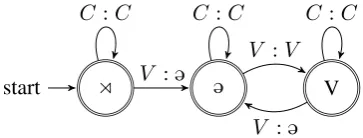
Figure 1: An SFST for rhythmic reduction.
Theorem 5 (Chandlee, 2014; Chandlee et al.,
2015,In prep). A function isi, j-TIOSL on tierτ
if and only if it is computed by an onward SFST that isi, j-TIOSL on tierτ.
Example 6. Rhythmic reductionis a phonological process in which alternating vowels in a word un-dergo reduction. The examples in (7) show rhyth-mic reduction in the Odawa variety of Ojibwe circa 1912, as documented by Edward Sapir. In our representation of reduction, vowels are re-duced to @, starting from the first vowel. There is no reason to believe that@appears in underlying forms.
(7) Rhythmic reduction in Ojibwe circa 1912 (Rhodes et al.,2012)
a. /m2kIzIn2n/;[m@kIz@n2n] ‘shoes’ b. /gUtIgUmIn2gIbIna:d/;
[g@tIg@mIn@gIb@na:d] ‘if he rolls him’
Figure 1 shows an SFST that implements the rhythmic reduction pattern illustrated in (7). We represent the pattern using an alphabet of three symbols: C, representing consonants; V, repre-senting vowels that have not been reduced; and@, representing vowels that have been reduced. Ob-serve that this SFST is onward and2-TOSL, with Coff the tier: each state represents the most recent vowel in the ouput stream.2
4 Rhythmic Syncope
Rhythmic syncope is a phonological process in which every second vowel in a word is deleted. The examples of (8) show rhythmic syncope in Macushi, in which deletion begins with the first vowel.3
(8) Rhythmic syncope in Macushi (Hawkins,
1950)
a. /piripi/;[pripi] ‘spindle’ b. /wanamari/;[wnamri] ‘mirror’
In this section, we show that rhythmic syncope is not TIOSL. To see this, we formalize rhythmic syncope as a function over two alphabet symbols: C, representing consonants, and V, representing vowels. This idealization does not affect the ar-gument that rhythmic syncope is not TIOSL, pre-sented in Proposition10.
Definition 9. The rhythmic syncope functionρ :
{C, V}∗ → {C, V}∗ is defined as follows. For c0, c1, . . . , cn∈C∗,
ρ(c0V c1V c2. . . V cn) =c0v1c1v2c2. . . vncn,
where for eachi,vi =V ifiis even andvi=λif
iis odd.
The intuition underlying the argument pre-sented below is that(i−1)-suffixes of the input and(j−1)-suffixes of the output do not contain information about whether vowels occupy even or odd positions within the input and output strings. Therefore, while ani, j-TIOSL SFST can record the most recent vowels read from the input stream and emitted to the output stream, this information is not sufficient for determining whether or not the SFST should delete a vowel.
Proposition 10. The rhythmic syncope function is noti, j-TIOSL on tierτ for anyi, j > 0and any
τ :{C, V}∗ → {C, V}∗.
Proof. Let k > i be even. Consider the strings w:=Vkandx :=Vk+1. Observe thatρ←(w) = ρ←(x) = Vk/2; thus suffj−1(τ(ρ←(w))) = suffj−1(τ(ρ←(x))). Now, if V is on τ, then suffi−1(τ(w)) = Vi−1 = suffi−1(τ(x)), and if V is off τ, then suffi−1(τ(w)) = oi−1 =
suffi−1(τ(x)). Thus, if ρisi, j-TIOSL on tierτ, thenρ→w =ρ→x . However, lettingy := Vk/2, ob-serve that
y=ρ(wV) =ρ←(w)ρ→w(V) =y ρ→w(V)
yV =ρ(xV) =ρ←(x)ρ→x (V) =y ρ→x (V).
This means thatρ→w(V) =λbutρ→x (V) = V, so ρis noti, j-TIOSL on tierτ.
5 Synchronized Strictly Local Functions
Proposition10raises the question of how to char-acterize the kind of computation that effects rhyth-mic syncope. To investigate this question,Figure 2
o
start V :λ V :V
C:C
V :λ C:C
V :V C:C
[image:4.595.326.509.64.146.2]V :λ
Figure 2: An SFST for rhythmic syncope.
shows a natural SFST implementation of rhythmic syncope. The states in this SFST record the most recent action performed by the SFST. If the most recent action was to delete a vowel (V : λ), then the next vowel the SFST encounters is not deleted (V :V); otherwise, the next vowel is deleted. This SFST is strikingly similar to the rhythmic reduc-tion SFST in Figure 1. There, the special sym-bol@, which is not part of the input alphabet, indi-cates the location of a reduced vowel, effectively recording the previous action in the output. Since there is no way to mark the location of a deleted symbol, the SFST inFigure 2explicitly records its previous action in its state names. Thus, the rhyth-mic syncope SFST may be seen as a generalization of the rhythmic reduction SFST. The goal of this section is to define a class of functions, known as the tier-based synchronized strictly local(TSSL) functions, based on this intuition. Following Sec-tion 2, we begin by defining the TSSL functions algebraically in terms of the minimal SFST, and then we define a canonical SFST format for the TSSL functions.
Recall that at each time step, an SFST must read exactly one input symbol while producing an out-put string of any length. Since the minimal SFST for a functionfmust producef←(z)after reading the input stringz, we can determine the possible actions of f by comparing f←(z) with f←(zx) for arbitraryz∈Σ∗andx∈Σ.
Definition 11. Let f : Σ∗ → Γ∗. The actions off are the alphabetA(f) ⊆ Σ×Γ∗ defined as follows.
A(f) :={hx, yi|∃z∈Σ∗.f←(zx) =f←(z)y}
We denote elementshx, yiofA(f)byx:y.
Strings overA(f)represent computation histo-ries of the minimal SFST forf.
• If|x| ≤1, thenf⇐(x) :=x:f←(x).
• Ifx = yz, where|y| ≥1and|z| = 1, then f⇐(x) := f⇐(y)(z : w), where w is the unique string such thatf←(x) =f←(y)w.
The notation f⇐ allows us to define the TSSL functions in a straightforward manner, highlight-ing the analogy to the TIOSL functions.
Definition 13. Fix k > 0 and letτ be a tier on Σ×Γ∗. A functionf : Σ∗ →Γ∗isk-synchronized strictly local on tierτ (k-TSSL) if for allx, y ∈
Σ∗, ifsuffk−1(τ(f⇐(x))) = suffk−1(τ(f⇐(y))), thenfx→=fy→.
Now, let us define the canonical SFSTs for TSSL functions. We define the actions of an SFST to be its possible transition labels.
Definition 14. LetT =hQ,Σ,Γ, q0,→, σibe an SFST. Theactions ofT are the alphabet
A(T) :={hx, yi|∃q∃r.→(q, x) =hr, yi}.
We denote elementshx, yiofA(T)byx:y.
Again, the definition of the TSSL SFSTs is di-rectly analogous to that of the TIOSL SFSTs.
Definition 15. Fix k > 0 and letτ be a tier on Σ×Γ∗. An SFSTT = hQ,Σ,Γ, q0,→, σiisk
-synchronized strictly local on tier τ (k-TSSL) if the following conditions hold.
• Q= ({o} ∪ A(T))k−1andq0 =ok−1.
• For everyq ∈Q, if→(q, x) =hr, yi, then
r = suffk−1(τ(q(x:y))).
As is the case with TIOSL SFSTs, TSSL SFSTs compute exactly the class of TSSL functions when they are required to be onward.
Theorem 16. Fix k > 0, and let τ be a tier on
Σ×Γ∗. A function isk-TSSL on tierτ if and only if it is computed by an onward SFST that isk-TSSL on tierτ.
We leave the proof of this fact to AppendixA.
6 Properties of TSSL Functions
Having now defined the TSSL functions, this sec-tion investigates some of their formal properties. Subsection 6.1 compares the TSSL functions to the TISL, TOSL, and TIOSL functions. Subsec-tion 6.2 observes that TSSL SFSTs compute a large class of functions when they are not required to be onward.
6.1 Relation to TIOSL Functions
A natural first question regarding the TSSL func-tions is that of how they relate to previously-proposed classes of subregular functions. We know from the discussion of rhythmic syncope that the TSSL functions are not a subset of the TIOSL functions: we have already seen that the rhythmic syncope function is2-TSSL but noti, j-TIOSL for any i, j. We will see in this section that the TIOSL functions are not a sub-set of the TSSL functions, though both function classes fully contain the TISL and TOSL func-tions. Therefore, the two function classes are in-comparable, and offer two different ways to gen-eralize the TISL and TOSL functions.
The fact that the TSSL functions contain the TISL and TOSL functions follows from the obser-vation that actions contain information about in-put and outin-put symbols. Remembering theimost recent actions automatically entails remembering the i most recent input symbols, and the j most recent output symbols can be extracted from thej most recent actions if deletions are ignored.
Proposition 17. Fixk >0. Everyk-TISL function and everyk-TOSL function isk-TSSL.
Proof. Let f : Σ∗ → Γ∗, and letτ be a tier on Σ∪Γ. First, suppose thatfisk-TISL on tierτ. Let υbe a tier onΣ×Γ∗defined as follows: an action x:yis onυif and only ifxis onτ. Now, suppose w, x ∈ Σ∗ are such thatsuffk−1(υ(f⇐(w))) = suffk−1(υ(f⇐(x))). Write
υ(f⇐(w)) = (w1:y1)(w2 :y2). . .(wn:yn)
υ(f⇐(x)) = (x1 :z1)(x2:z2). . .(xn:zn).
Then, we haveτ(w) = w1w2. . . wn andτ(x) =
x1x2. . . xn. For all i > n−k+ 1, wi : yi =
xi : zi, and therefore wi = xi. But this means
thatsuffk−1(τ(w)) = suffk−1(τ(x)), and sincef isk-TISL on tierτ,fw← =fx←. We conclude that f isk-TSSL on tierυ.
Next, suppose thatf isk-TOSL on tierτ. Letϕ be a tier onΣ×Γ∗defined as follows: an actionx: yis on ϕif and only if τ(y) 6= λ. Now, suppose w, x ∈ Σ∗ are such that suffk−1(ϕ(f⇐(w))) = suffk−1(ϕ(f⇐(x))). Write
ϕ(f⇐(w)) = (w1 :y1)(w2:y2). . .(wn:yn)
ϕ(f⇐(x)) = (x1 :z1)(x2 :z2). . .(xn:zn).
Now, τ(f←(w)) = y1y2. . . yn andτ(f←(x)) =
o,o
start
a, a
b, b a, b
b, a a:a
b:b
a:λ
a:λ b:d
b:c
b:c
a:λ
a:λ
[image:6.595.81.286.65.223.2]b:d
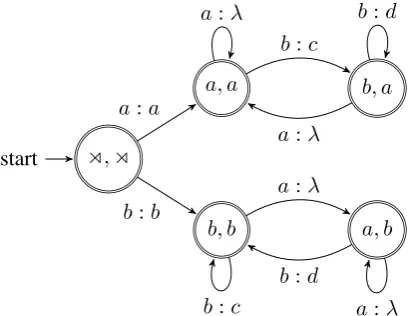
Figure 3: An onward 2,2-TIOSL SFST computing a function that is notk-TSSL for anyk.
wi:yi =xi:zi, soyi =zi. Observe that
suffk−1(τ(f←(w))) = suffk−1(yjyj+1. . . yn)
= suffk−1(zjzj+1. . . zn) = suffk−1(τ(f←(x))),
wherej =n−k+ 2. Sincef isk-TOSL on tier τ,fw→=fx→, sof isk-TSSL on tierϕ.
This intuition does not carry over to the TIOSL functions. In Proposition17, the proposed action tiers ignore symbols off the input and output tiers, thus ensuring that the relevant input and output symbols can always be recovered from the com-putation history. This approach encounters prob-lems when an onward TIOSL SFST deletes sym-bols on the tier. Such SFSTs perform actions of the formx : λ, where xis on the tier. These ac-tions do not record any output symbols, but they must be kept on the tier in a TSSL implementa-tion so that the input symbolxcan be recovered. If too many(x :λ)s are performed consecutively, they can overwhelm the memory of a TSSL SFST, causing it to forget the most recent output sym-bols. The following construction features exactly this kind of behavior.
Proposition 18. There exists a function that isi, j -TIOSL for somei, jbut notk-TSSL for anyk.
Proof. LetT be the SFST shown inFigure 3, and let f : {a, b}∗ → {a, b, c, d}∗ be the function computed byT.4 Observe thatT is onward and 2,2-TIOSL on tierτ, whereaandbare on τ but c anddare not, sof is2,2-TIOSL on tierτ. T always copies the first symbol of its input to the
4The angle brackets are omitted from the state names.
output. Thereafter, T behaves as follows: all as are deleted; abis changed to acif the most recent input symbol is the same as the first input sym-bol; abis changed to adotherwise. For example, f(baabb) =bdc.
Let k > 0, and let υ be a tier on {a, b} × {a, b, c, d}∗. Suppose that either k = 1ora : λ is not onυ, and consider the stringsw := baand x:= b. Observe thatf⇐(w) = (b:b)(a:λ)and f⇐(x) = (b : b). Either suffk−1(υ(f⇐(x))) =
ok−2(b : b) = suffk−1(υ(f⇐(x)))ifk > 1 and
b : b is onυ, or suffk−1(υ(f⇐(x))) = ok−1 =
suffk−1(υ(f⇐(x)))ifk = 1orb :bis not onυ. However,fw→(b) =dbutfx→(b) =c, sof cannot bek-TSSL on tierυ.
Next, suppose that k > 1 and a : λis on υ. Consider the input strings w := ak+1 and x := bak. Observe that f⇐(w) = (a :a)(a :λ)k and f⇐(x) = (b:b)(a:λ)k, thus
suffk−1(υ(f⇐(w))) = (a:λ)k−1
= suffk−1(υ(f⇐(x))).
However,fw→(b) = cbutfx→(b) = d, sof is not k-TSSL on tierυ.
6.2 Non-Onward TSSL SFSTs
The equivalence between the two definitions of the TSSL functions presented in Section 5 crucially depends on the criterion that TSSL SFSTs be on-ward. In this subsection we show that without this criterion, TSSL SFSTs compute a rich class of subsequential functions. To illustrate how this is possible, let us consider an example that witnesses the separation between TSSL functions and TSSL SFSTs.
Proposition 19. There exists a2-TSSL SFST that computes a function that is notk-TSSL for anyk.
Proof. Consider the SFST inFigure 4. This SFST is clearly2-TSSL on a tier containing all actions, and the function it computes is given byf(xy) = xyx, wherex ∈ {a, b}andy ∈ {a, b}∗. Observe that for anyz ∈ {a, b}∗,f←(z) = z. Therefore, writingz=z1z2. . . znwith|zi|= 1for eachi,
f⇐(z) = (z1 :z1)(z2:z2). . .(zn:zn).
We need to show thatf is notk-TSSL for anyk > 0and for any tierτ over{a, b} × {a, b}∗.
o
start
a:a
b:b
b:λ
a:aa
a:ba
b:ab
b:bb
a:λ :a
:a
:bb
:b
:b
:b
:b :ab
a:a
b:b a:a
b:λ
b:bb
a:ba
a:λ b:λ
a:λ b:λ
a:λ b:λ
a:λ b:λ
a:aa
[image:7.595.97.503.64.296.2]b:ab
Figure 4: A non-onward2-TSSL SFST computing a function that is notk-TSSL for anyk.
thatf⇐(w) = (a:a)k+1andf⇐(x) = (b:b)(a: a)k, so
suffk−1(τ(f⇐(w))) = (a:a)k−1
= suffk−1(τ(f⇐(x))).
However,fw→(λ) = abutfx→(λ) =b, sof is not k-TSSL on tierτ.
Next, suppose a : a is not on τ, and consider the input strings w = b and x = ab. We have f⇐(w) =b:bandf⇐(x) = (a:a)(b:b), so
suffk−1(τ(f⇐(w))) = suffk−1(τ(b:b))
= suffk−1(τ(a:a)τ(b:b))
= suffk−1(τ((a:a)(b:b)))
= suffk−1(τ(f⇐(x))).
However,fw→(λ) = bbutfx→(λ) = a, sof is not k-TSSL on tierτ.
Let f be the function described in Proposition
19. As discussed in the proof, an onward SFST computingf must copy the current input symbol to the output stream during each time step. At the end of the computation, the final output function is responsible for adding the first input symbol to the end of the output string. Any onward TSSL SFST that attempts to compute f will eventually forget the identity of the first input symbol, so the final output function cannot determine what to add to the output. The SFSTT inFigure 4avoids this problem by exploiting its non-onwardness. If the
first symbol of its input is ana, thenT behaves in an onward manner, copying the current input sym-bol at each time step. This can be seen in the left column of the state diagram. If the first symbol ofT’s input is ab, thenT alternates between pro-ducing no output and propro-ducing two symbols of output. Every timeT performs a non-deleting ac-tionx:y,ycontains both the symbol that the on-ward SFST would produce at the current time step and the symbol that the onward SFST would have produced at the previous time step. This way,T encodes the identity of the first symbol of its input using the manner in which it produces output—if T produces output at every time step, then the first symbol is ana, and if it produces output every two time steps, then the first symbol is ab. In general, this kind of encoding trick can be applied to a wide range of SFSTs, including all SFSTsV that do not perform deletions. Informally, we enumerate the states ofV by{q0, q1, . . . , qn}, and we construct a
TSSL SFSTSthat simulatesV by producing out-put at various frequencies. For eachi,Sproduces output everyi+ 1time steps ifV is in stateqi. If
Sremembers at least2(n+ 1)-many actions, then it can always deduceV’s state at any point in the computation, allowing it to simulateV.
7 Rhythmic Syncope in Phonology
phonolog-ical theory. McCarthy (2008) identifies two ma-jor approaches to rhythmic syncope in Optimal-ity Theory. In thepseudo-deletionapproach (e.g.,
Kager,1997), the locations of symbols deleted by syncope are marked with blank symbols. This essentially makes rhythmic syncope identical to rhythmic reduction, which we have seen is 2 -TOSL. McCarthy himself proposes a Harmonic Serialismapproach in which rhythmic syncope is implemented in multiple steps. Firstly, stress is assigned to every second vowel in the underlying form. Then, the unstressed vowels are deleted, re-sulting in syncope. This kind of derivation is illus-trated in (20).
(20) Rhythmic syncope in Harmonic Serialism (McCarthy,2008)5
/wanamari/ Underlying Form wan´amar´ı Stress
[wn´amr´ı] Syncope
In both approaches, rhythmic syncope is de-composed into a 2-TOSL function and a homo-morphism. In the pseudo-deletion approach, the 2-TOSL function is rhythmic reduction, and the homomorphism removes the@s. In (20), the rhyth-mic stress step is2-TOSL, while the syncope step is a homomorphism. In general, this kind of ap-proach is extremely powerful.
Proposition 21. Every subsequential function f
can be written in the formf = h◦g, wheregis
2-TOSL andhis a homomorphism.
Proof. Let T = hQ,Σ,Γ, q0,→, σi be the mini-mal SFST forf. Definegas follows. Letg(λ) :=
hσ, f(λ)i. Forx1, x2, . . . , xn∈Σ, write
q0
x1:y1 −−−→q1
x2:y2 −−−→q2
x3:y3
−−−→. . .−−−−−−→xn−1:yn−1 qn.
Then, g(x1x2. . . xn) := hq1, y1ihq2, y2i. . .hqn,
ynihσ, σ(qn)i. Next, define h so that for any hq, yi, h(hq, yi) = y. It is clear that f(x) = h(g(x)) for every x. We now show that g is 2 -TOSL on a tier containing the full output alphabet. Fix w, x ∈ Σ∗. Observe that for all z ∈ Σ∗, g←(z) ∈ (Q × Γ∗)∗. Therefore, suppose that suff1(g←(w)) = suff1(g←(x)) = hq, yi. This means that q0 −−→w:u q and q0 −−→x:v q for some u, v∈Γ∗, sogu→=g→v by definition.
5The full derivation proposed by McCarthy (2008) in-cludes syllabification and footing steps, which are omitted here for simplicity.
In both pseudo-deletion and Harmonic Seri-alism, non-segmental phonological symbols are used to encode state information in the output, making rhythmic syncope 2-TOSL. Proposition
21shows that this technique can be applied to arbi-trary SFSTs, and therefore results in massive over-generation. By contrast, we have already seen that the TSSL functions are a proper subset of the sub-sequential functions, making action-sensitivity a more restrictive alternative to current approaches to rhythmic syncope.
8 Conclusion
The classic examples of TIOSL phenomena in phonology are local processes and unidirectional spreading processes (Chandlee,2014). Rhythmic syncope is qualitatively different from these phe-nomena in that it leaves no evidence that the pro-cess has occurred. As we have seen in Section
4, the fact that rhythmic syncope is not TIOSL is a consequence of this property. In defining the TSSL functions, we have proposed that rhythmic syncope should be viewed as a dependency be-tween incremental steps in a derivation, here for-malized as the actions of the minimal SFST.
A potential risk of such an analysis is that the notion of “action” is specific to the computational system used to implement rhythmic syncope, and therefore potentially subject to a broad range of interpretations. In this paper, we have used on-wardness and the existence of the minimal SFST to formulate a notion of “action-sensitivity” that is both formalism-independent and implementation-independent. In Subsection 6.2, we have seen that action-sensitivity can be made very power-ful if we relax our assumptions about the nature of the computation. This means that if action-sensitivity is to be incorporated into phonological analyses of rhythmic syncope, then care should be taken to avoid loopholes like the one featured in Proposition19. Based on Proposition21, a similar warning can be made regarding the composition of phonological processes. When decomposing phonemena into several processes, as McCarthy
(2008) does in the Harmonic Serialism analysis, care should be taken to ensure that theoretical pro-posals do not allow for overgeneration.
References
Hyunah Baek. 2018. Computational representation of unbounded stress: Tiers with structural features. In Proceedings of CLS 53 (2017), volume 53, pages 13–24, Chicago, IL, USA. Chicago Linguistic So-ciety.
Dustin Bowers. To appear. The Nishnaabemwin Re-structuring Controversy: New Empirical Evidence. Phonology.
Dustin Bowers and Yiding Hao. To appear. Rhythmic Syncope in Subregular Phonology. InProceedings of the 42nd Annual Penn Linguistics Conference, volume 26.1 ofPenn Working Papers in Linguistics, Philadelphia, PA, USA. Penn Graduate Linguistics Society.
Jane Chandlee. 2014. Strictly Local Phonological Pro-cesses. PhD Dissertation, University of Delaware, Newark, DE, USA.
Jane Chandlee, R´emi Eyraud, and Jeffrey Heinz. 2015.
Output Strictly Local Functions. InProceedings of the 14th Meeting on the Mathematics of Language, pages 112–125, Chicago, IL, USA. Association for Computational Linguistics.
Jane Chandlee, R´emi Eyraud, and Jeffrey Heinz. In prep. Input–output strictly local functions and their efficient learnability.
Thomas Graf and Connor Mayer. 2018. Sanskrit n-Retroflexion is Input–Output Tier-Based Strictly Lo-cal. In Proceedings of the Fifteenth Workshop on Computational Research in Phonetics, Phonology, and Morphology, pages 151–160, Brussels, Bel-gium. Association for Computational Linguistics.
W. Neil Hawkins. 1950.Patterns of Vowel Loss in Ma-cushi (Carib). International Journal of American Linguistics, 16(2):87–90.
Jeffrey Heinz. 2018. The computational nature of phonological generalizations. In Larry M. Hyman and Frans Plank, editors, Phonological Typology, number 23 in Phonology and Phonetics, pages 126– 195. De Gruyter Mouton, Berlin, Germany.
Jeffrey Heinz and Regine Lai. 2013. Vowel Harmony and Subsequentiality. In Proceedings of the 13th Meeting on the Mathematics of Language (MoL 13), pages 52–63, Sofia, Bulgaria. Association for Com-putational Linguistics.
Jeffrey Heinz, Chetan Rawal, and Herbert G. Tan-ner. 2011. Tier-based Strictly Local Constraints for Phonology. In Proceedings of the 49th Annual Meeting of the Association for Computational Lin-guistics: Human Language Technologies, pages 58– 64, Portland, OR, USA. Association for Computa-tional Linguistics.
Adam Jardine. 2016. Computationally, tone is differ-ent.Phonology, 33(2):247–283.
Ren´e Kager. 1997. Rhythmic vowel deletion in Op-timality Theory. In Iggy Roca, editor, Deriva-tions and Constraints in Phonology, pages 463–499. Clarendon Press, Oxford, United Kingdom.
Connor Mayer and Travis Major. 2018. A Challenge for Tier-Based Strict Locality from Uyghur Back-ness Harmony. InFormal Grammar 2018, 23rd In-ternational Conference, FG 2018, Sofia, Bulgaria, August 11-12, 2018, Proceedings, volume 10950 of Lecture Notes in Computer Science, pages 62–83, Berlin, Germany. Springer Berlin Heidelberg.
John J. McCarthy. 2008. The serial interaction of stress and syncope. Natural Language & Linguistic The-ory, 26(3):499–546.
Adam McCollum, Eric Bakovi´c, Anna Mai, and Eric Meinhardt. 2018. The expressivity of segmental phonology and the definition of weak determinism. LingBuzz, lingbuzz/004197.
Kevin McMullin and Gunnar ´Olafur Hansson. 2016.
Long-Distance Phonotactics as Tier-Based Strictly
2-Local Languages. InProceedings of the 2014 An-nual Meeting on Phonology, Proceedings of the An-nual Meetings on Phonology, pages 13–24, Cam-bridge, MA, USA. Linguistic Society of America.
Kevin James McMullin. 2016. Tier-Based Locality in Long-Distance Phonotactics: Learnability and Typology. PhD Dissertation, University of British Columbia, Vancouver, Canada.
Robert McNaughton and Seymour A. Papert. 1971. Counter-Free Automata. Number 65 in Research Monograph. MIT Press, Cambridge, MA, USA.
Jos´e Oncina, Pedro Garcia, and Enrique Vidal. 1993.
Learning Subsequential Transducers for Pattern Recognition Interpretation Tasks. IEEE Transac-tions on Pattern Analysis and Machine Intelligence, 15(5):448–458.
George N. Raney. 1958. Sequential Functions. Jour-nal of the Association for Computing Machinery, 5(2):177–180.
Richard A. Rhodes, Karl S. Hele, and J. Randolph Valentine. 2012. Algonquian Trade Languages Re-visited. InPapers of the Fortieth Algonquian Con-ference/Actes Du Congr`es Des Algonquinistes, Pa-pers of the Algonquian Conference, pages 358–369, Albany, NY, USA. State University of New York Press.
Jacques Sakarovitch. 2009. Elements of Automata Theory. Cambridge University Press, Cambridge, United Kingdom.
A Proof of Theorem 16
Definition 22. Let f : Σ∗ → Γ∗ be k-TSSL on tier τ. Define the SFST transducer T(f) =
hQ,Σ,Γ, q0,→, σias follows.
• Q:= ({o} ∪ A(f))k−1 andq0:=ok−1.
• For eachx ∈ Σ, →(q0, x) := hr, f←(x)i, wherer= suffk−1(τ(x:f←(x))).
• For each q ∈ Q\{q0}, let x ∈ Σ∗ be such that suffk−1(τ(f⇐(x))) = q, and let w : y ∈ A(f)be such thatf←(xw) =f←(x)y. We define →(q, w) := hr, yi, where r = suffk−1(τ(q(w:y))).
• Fixq ∈ Q. If q = q0, then σ(q) := f(λ). Otherwise, we defineσ(q) := fx→(λ), where suffk−1(τ(f⇐(x))) =q.
Remark 23. T(f)isk-TSSL on tierτ.
Note that in the third and fourth bullet points of Definition22, the actionw : y and the string fx→(λ)only depend onq and not onx, sincef is k-TSSL on tierτ. We now need to show thatT(f) computesf and that it is onward.
Lemma 24. Letf : Σ∗→Γ∗bek-TSSL on tierτ, and writeT(f) = hQ,Σ,Γ, q0,→, σi. For every x∈Σ+, ifq0
x:y
−−→r, theny=f←(x).
Proof. Let us induct on|x|. For the base case, sup-pose|x|= 1. Then,y=f←(x)by definition.
Now, fixn >1, and suppose that if0<|u|< n andq0
u:v
−−→ r, thenv = f←(u). Fixw ∈ Σn−1 andx ∈Σ, and suppose thatq0
w:y
−−→s−−→x:z t. By the induction hypothesis,y=f←(w). The defini-tion ofT(f)states thatzis the unique string such thatf←(wx) =f←(w)z. Thus,yz=f←(w)z= f←(wx), and the proof is complete.
Lemma 25. Letf : Σ∗→Γ∗bek-TSSL on tierτ, and writeT(f) =hQ,Σ,Γ, q0,→, σi. For allx∈ Σ+, ifq0
x:y
−−→r, thenr= suffk−1(τ(f⇐(x))).
Proof. Let us induct on|x|. For the base case, sup-pose |x| = 1. Since f⇐(x) = x : f←(x), by definitionr= suffk−1(τ(f⇐(x))).
Now, fix n > 1, and suppose that if |w| < n and q0
w:y
−−→ r, then r = suffk−1(τ(f⇐(w))). We need to show that for all w ∈ Σn−1 and x ∈ Σ, if q0
w:y
−−→ r −−→x:z s, then s = suffk−1(τ(f⇐(wx))). The induction hypothe-sis gives us r = suffk−1(τ(f⇐(w))). Since
hs, zi=→(r, x), by the definition ofT(f),
s= suffk−1(τ(r(x:z)))
= suffk−1(τ(r)τ(x:z))
= suffk−1τsuffk−1(τ(f⇐(w)))τ(x:z)
= suffk−1(τ(τ(f⇐(w)))τ(x:z))
= suffk−1(τ(f⇐(w))τ(x:z))
= suffk−1(τ(f⇐(w)(x:z)))
= suffk−1(τ(f⇐(wx))), (26)
as desired.
Proposition 27. Iff : Σ∗ →Γ∗isk-TSSL on tier
τ, thenT(f)computes f.
Proof. We need to show that for every x ∈ Σ∗,
T(f) outputs f(x) on input x. Write T(f) =
hQ,Σ,Γ, q0,→, σi and q0
x:y
−−→ q. By Lemma
24, y = f←(x), and by Lemma 25, q = suffk−1(τ(f⇐(x))). Definition22then states that σ(q) = fx→(λ), so yσ(q) = f←(x)fx→(λ) = f(x), thusT(f)outputsf(x)on inputx.
Corollary 28. Iff : Σ∗ → Γ∗ isk-TSSL on tier
τ, thenT(f)is onward.
We then complete the proof by showing that ev-ery onward TSSL SFST computes a TSSL func-tion.
Lemma 29. Let T = hQ,Σ,Γ, q0,→, σi be
on-ward andk-TSSL on tierτ. Letf be the function computed byT. For allx∈ Σ∗, ifq0
x:y
−−→ q, then
q= suffk−1(τ(f⇐(x))).
Proof. Let us induct on|x|. For the base case, sup-pose|x|= 1. SinceT is onward,y=f←(x), so
q= suffk−1
τ
ok−1(x:y)
= suffk−1τok−1(x:f←(x))
= suffk−1
τ
ok−1f⇐(x)
= suffk−1τok−1
τ(f⇐(x))
= suffk−1(τ(f⇐(x))).
Now, fix n > 1, and suppose that if |w| < n and q0
w:y
−−→ q, then q = suffk−1(τ(f⇐(w))). We need to show that for all w ∈ Σn−1 and x ∈ Σ, if q0
w:y
Proof of Theorem 16. Proposition 27 has already shown the forward direction. Let T =
hQ,Σ,Γ, q0,→, σi be an onward SFST com-puting f that is k-TSSL on tier τ. Suppose x, y ∈ Σ∗ are such that suffk−1(τ(f⇐(w))) = suffk−1(τ(f⇐(x))). Writeq0
w:y
−−→r andq0
x:z −−→