RBPB: Regularization-Based Pattern Balancing Method for Event
Extraction
Lei Sha1,2, Jing Liu2, Chin-Yew Lin2, Sujian Li1, Baobao Chang1, Zhifang Sui1
1Key Laboratory of Computational Linguistics, Ministry of Education
School of Electronics Engineering and Computer Science, Peking University
2Knowledge Computing Group, Microsoft Research
1{shalei, lisujian, chbb, szf}@pku.edu.cn
2{liudani,cyl}@microsoft.com
Abstract
Event extraction is a particularly chal-lenging information extraction task, which intends to identify and classify event triggers and arguments from raw text. In recent works, when determining event types (trigger classification), most of the works are either pattern-only or feature-only. However, although patterns cannot cover all representations of an event, it is still a very important feature. In addition, when identifying and classifying arguments, previous works consider each candidate argument separately while ignoring the relationship between arguments. This paper proposes aRegularization-BasedPatternBalancing Method (RBPB). Inspired by the progress in representation learning, we use trigger embedding, sentence-level embedding and pattern features together as our features for trigger classification so that the effect of patterns and other useful features can be balanced. In addition, RBPB uses a regularization method to take advantage of the relationship between arguments. Experiments show that we achieve results better than current state-of-art equivalents.
1 Introduction
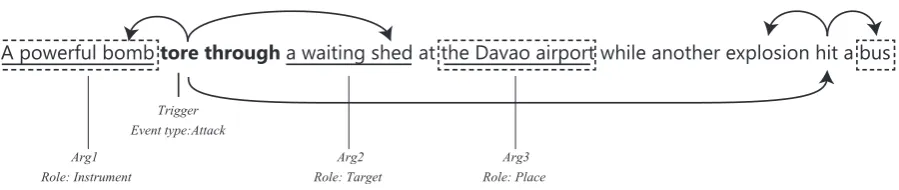
Event extraction has become a popular research topic in the area of information extraction. ACE 2005 defines event extraction task1 as three sub-tasks: identifying the trigger of an event, identifying the arguments of the event, and distinguishing their corresponding roles. As an example in Figure 1, there is an “Attack” event
1http://www.itl.nist.gov/iad/mig/tests/ace/2005/
triggered by “tear through” with three arguments. Each argument has one role.
In the trigger classification stage, some previous approaches (Grishman et al., 2005; Ji and Grishman, 2008; Liao and Grishman, 2010; Huang and Riloff, 2012) use patterns to decide the types of event triggers. However, pattern-based approaches suffer from low recall since real world events usually have a large variety of representations. Some other approaches (Hong et al., 2011; Li et al., 2013; Lu and Roth, 2012) identify and classify event triggers using a large set of features without using patterns. Although these features can be very helpful, patterns are still indispensable in many cases because they can identify a trigger with the correct event type with more than 96% accuracy according to our data analysis on ACE 2005 data sets.
In argument identification and classification, most approaches identify each candidate argument separately without considering the relation between arguments. We define two kinds of argument relations here: (1) Positive correlation: if one candidate argument belongs to one event, then the other is more likely to belong to the same event. For example, in Figure 1, the entity “a waiting shed” shares a common dependency head “tore” with “a powerful bomb”, so when the latter entity is identified as an argument, the former is more likely to be identified. (2) Negative correlation: if one candidate argument belongs to one event, then the other is less likely to belong to the same event. For example, in Figure 1, “bus” is irrelevant to other arguments, so if other entities are identified as arguments “bus” is less likely to be identified. Note that although all the above relation examples have something to do with dependency analysis, the positive/negative relationship depends not only on dependency parsing, but many other aspects as well.
A powerful bomb tore through a waiting shed at the Davao airport while another explosion hit a bus
Trigger Event type:Attack
Arg1 Role: Instrument
Arg2 Role: Target
[image:2.595.74.524.58.153.2]Arg3 Role: Place
Figure 1: Event example: This is an event trigger by “tear through” with three arguments
In this paper, we propose using both patterns and elaborately designed features simultaneously to identify and classify event triggers. In addition, we propose using a regularization method to model the relationship between candidate arguments to improve the performance of argument identification. Our method is called Regularization-Based Pattern Balancing Method method.
The contributions of this paper are as follows:
• Inspired by the progress of representation learning, we use trigger embedding, sentence-level embedding, and pattern features together as the our features for balancing.
• We proposed a regularization-based method in order to make use of the relationship be-tween candidate arguments. Our experiments on the ACE 2005 data set show that the reg-ularization method does improve the perfor-mance of argument identification.
2 Related Work
There is a large body of previous work devoted to event extraction. Many traditional works focus on using pattern based methods for identifying event type (Kim and Moldovan, 1993; Riloff and others, 1993; Soderland et al., 1995; Huffman, 1996; Freitag, 1998b; Ciravegna and others, 2001; Califf and Mooney, 2003; Riloff, 1996; Riloff et al., 1999; Yangarber et al., 2000; Sudo et al., 2003; Stevenson and Greenwood, 2005; Grishman et al., 2005; Ji and Grishman, 2008; Liao and Grishman, 2010; Huang and Riloff, 2012). (Shinyama and Sekine, 2006; Sekine, 2006) are unsupervised methods of extracting patterns from open domain texts. Pattern is not always enough, although some methods (Huang and Riloff, 2012; Liu and Strzalkowski, 2012) use bootstrapping to get more patterns.
There are also feature-based classification methods (Freitag, 1998a; Chieu and Ng, 2002; Finn and Kushmerick, 2004; Li et al., 2005; Yu et al., 2005). Apart from the above methods, weakly supervised training (pattern-based and rule-based) of event extraction systems have also been explored (Riloff, 1996; Riloff et al., 1999; Yangarber et al., 2000; Sudo et al., 2003; Stevenson and Greenwood, 2005; Patwardhan and Riloff, 2007; Chambers and Jurafsky, 2011). In some of these systems, human work is needed to delete some nonsense patterns or rules. Other methods (Gu and Cercone, 2006; Patwardhan and Riloff, 2009) consider broader context when deciding on role fillers. Other systems take the whole discourse feature into consideration, such as (Maslennikov and Chua, 2007; Liao and Grishman, 2010; Hong et al., 2011; Huang and Riloff, 2011). Ji and Grishman (2008) even consider topic-related documents, proposing a cross-document method. (Liao and Grishman, 2010; Hong et al., 2011) use a series of global features (for example, the occurrence of one event type lead to the occurrence of another) to improve role assignment and event classification performance. Joint models (Li et al., 2013; Lu and Roth, 2012) are also considered an effective solution. (Li et al., 2013) make full use of the lexical and contextual features to get better results. The semi-CRF based method (Lu and Roth, 2012) trains separate models for each event type, which requires a lot of training data.
The dynamic multi-pooling convolutional neu-ral network (DMCNN) (Chen et al., 2015) is cur-rently the only widely used deep neural network based approach. DMCNN is mainly used to model contextual features. However, DMCNN still does not consider argument-argument interactions.
sepa-rately while ignoring the relationship between arguments, which is also important for argument identification. Even the joint method (Li et al., 2013) does not model argument relations directly. We use trigger embedding, sentence-level embedding, and pattern features together as our features for trigger classification and design a regularization-based method to solve the two problems.
3 ACE Event Extraction Task
Automatic Content Extraction (ACE) is an event extraction task. It annotates 8 types and 33 sub-types of events. ACE defines the following termi-nologies:
• Entity: an object or a set of objects in one of the semantic categories of interest
• Entity mention: a reference to an entity, usu-ally a noun phrase (NP)
• Event trigger: the main word which most clearly expresses an event occurrence
• Event arguments: the entity mentions that are involved in an event
• Argument roles: the relation of arguments to the event where they participate, with 35 total possible roles
• Event mention: a phrase or sentence within which an event is described, including trigger and arguments
Given an English document, an event extraction system should identify event triggers with their subtypes and arguments from each sentence. An example is shown in Figure 1. There is an “Attack” event triggered by “tear through” with three arguments. Each argument has a role type such as “Instrument”, “Target”, etc.
For evaluation, we follow previous works (Ji and Grishman, 2008; Liao and Grishman, 2010; Li et al., 2013) to use the following criteria to determine the correctness of the predicted event mentions.
• A trigger is considered to be correct if and only if its event type and offsets (position in the sentence) can match the reference trigger;
• An argument is correctly identified if and on-ly if its event type and offsets can match any reference arguments;
• An argument is correctly identified and clas-sified if and only if its event type, offsets, and role match any of the reference arguments.
4 Baseline: JET Extractor for Events Many previous works take JET as their baseline system, including (Ji and Grishman, 2008), (Liao and Grishman, 2010), (Li et al., 2013). JET extracts events independently for each sentence. This system uses pattern matching to predict trigger and event types, then uses statistical modeling to identify and classify arguments. For each event mention in the training corpus of ACE, the patterns are constructed based on the sequences of constituent heads separating the trigger and arguments. After that, three Maximum Entropy classifiers are trained using lexical features.
• Argument Classifier: to distinguish argu-ments from non-arguargu-ments
• Role Classifier: to label arguments with an argument role
• Reportable-Event Classifier: to determine whether there is a reportable event mentioned (worth being taken as an event mention) according to the trigger, event type, and a set of arguments
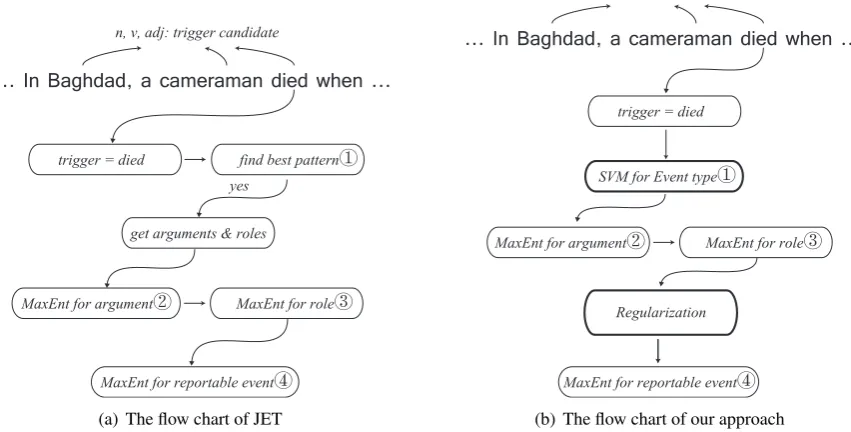
Figure 2(a) shows the whole test procedure. In the test procedure, each sentence is scanned for nouns, verbs and adjectives as trigger candidates. When a trigger candidate is found, the system tries to match the context of the trigger against the set of patterns associated with that trigger. If this pattern matching process is successful, the best pattern will assign some of the entity mentions in the sentence as arguments of a potential event mention. Then JET uses the argument classifier to judge if the remaining entity mentions should also be identified. If yes, JET uses the role classifier to assign it a role. Finally, the reportable-event classifier is applied to decide whether this event mention should be reported.
5 Regularization-Based Pattern Balancing Method
... In Baghdad, a cameraman died when ...
n, v, adj: trigger candidate
trigger = died find best pattern①
get arguments & roles yes
MaxEnt for argument② MaxEnt for role③
MaxEnt for reportable event④
(a) The flow chart of JET
... In Baghdad, a cameraman died when ...
n, v, adj: trigger candidatetrigger = died
SVM for Event type①
MaxEnt for argument② MaxEnt for role③
Regularization
MaxEnt for reportable event④
[image:4.595.86.512.73.289.2](b) The flow chart of our approach
Figure 2: The left is the flow chart for JET. The right is the flow chart for our approach. The thick line block is our contribution
use a regularization-based method to make full use of the relation between candidate arguments.
The thick-edge blocks in Figure 2(b) represent our improvements. Since JET only uses pattern-s when predicting the event type, we upattern-se a SVM classifier to decide each candidate trigger’s even-t even-type (classify even-the even-trigger). This classifier uses trigger embedding, sentence-level embedding and pattern features together for balancing. After the outputs of argument and role classifier are calcu-lated, we make use of the argument relationship to regularize for a better result.
5.1 Balancing the Pattern effects
Deciding the event type is the same as classifying an event trigger. JET only uses patterns in this step: for a candidate trigger, we find that the best matched pattern and the corresponding event type are assigned to this trigger. We propose using feature-based methods while not ignoring the effect of patterns. Inspired by progress in representation learning, we use trigger embedding, sentence-level embedding and pattern embedding together as our features.
A pattern example is as follows:
(weapon) tore [through] (building) at (place)⇒Attack{Roles...}
where each pair of round brackets represents an entity and the word inside is one of the 18entity
types defined by UIUC NER Tool2. The word in the square brackets can choose to exist or not. Af-ter the right arrow there is an event schema, which can tell us what kind of event this is and which roles each entity should take.
Each pattern has a corresponding event type. A candidate trigger may match more than one pattern so that it has an event type distribution. Assume that there areNT event types in total, we denote the pattern feature vector (namely, the event type’s probability distribution calculated by the trigger’s pattern set) asPE ∈ RNT, which is calculated by Eq 1.
PE(i) = #(matched patterns of event type#(all matched patterns) i) (1)
Trigger embeddings are obtained usingWORD2VEC3 with the default “text8” training text data with length 200.
Since all of the NPs are potential roles in the event, they must contain the main information of the event. We extract all the NPs in the sentence and take the average word embedding of these NPs’ head word as the sentence-level embedding. For example, in Figure 1, these NPs’ head words are bomb, shed, and airport.
Pattern feature vectors, as distributions of event types over patterns, are also composed using
continuous real values, which allows them to be viewed as a kind of pattern embedding and treated similarly to trigger and sentence embedding.
5.2 Capturing the Relationship Between Arguments
We find that there are two typical relations between candidate arguments: (1) positive correlation: if one candidate argument belongs to one event, then the other is more likely to belong to the same event; (2) negative correlation: if one candidate argument belongs to one event, then the other is less likely to belong to the same event.
We calculate a score for all the candidate arguments in a sentence to judge the quality of the argument identification and classification. For capturing the two kinds of relations, we intend to make that (1) the more positive relations the chosen arguments have, the higher the score is; (2) the more negative relations the chosen arguments have, the lower the score is.
For a trigger, if there arencandidate arguments, we set an×nmatrixCto represent the relation-ship between arguments. IfCi,j = 1, then argu-mentiand argumentjshould belong to the same event. If Ci,j = −1, then argumenti and argu-mentjcannot belong to the same event. We will illustrate how to get matrixCin the next section.
We use an-dim vectorXto represent the iden-tification result of arguments. Each entry ofXis0 or1. 0represents “noArg”,1represents “arg”. X can be assigned by maximizingE(X)as defined by Eq 2.
X = argmax
X E(X)
E(X) =λ1XTCX +λ2Psumarg
+ (1−λ1−λ2)Psumrole
(2)
Here,XTCXmeans adding up all the relationship values if the two arguments are identified. Hence, the more the identified arguments are related, the larger the value XTCX is. Parg
sum is the sum of all chosen arguments’ probabilities. The proba-bility here is the output of the arguments’ max-imum entropy classifier. Prole
sum is the sum of all the classified roles’ probabilities. The probability here is the output of the roles’ maximum entropy classifier.
Eq 2 shows that while we should identify and classify the candidate arguments with a larger probability, the argument relationship evaluation
should also be as large as possible. The arguments should also follow the following constraints. These constraints together with Eq 2 can make the argument identification and classification help each other for a better result.
• Each entity can only take one role
• Each role can belong to one or more entities
• The role assignment must follow the event schema of the corresponding type, which means that only the roles in the event schema can occur in the event mention
We use the Beam Search method to search for the optimal assignmentXas is shown in Algorithm 1. The hyperparametersλ1andλ2 can be chosen ac-cording to development set.
Input: Argument relationship matrix: C
the argument probabilities required by Psumarg
the role probabilities required byProle sum
Data: K: Beam size
n: Number of candidate arguments
Output: The best assignmentX
Set beamB ←[ϵ];
fori←1· · ·ndo
buf← {z′◦l|z′ ∈ B, l ∈ {0,1}}; B ←[ϵ];
whilej←1· · ·Kdo
xbest= argmaxx∈bufE(x);
B ← B ∪ {xbest}; buf←buf−{xbest};
end end
SortBdescendingly according toE(X); returnB[0];
Algorithm 1:Beam Search decoding
algorith-m for event extraction.◦means to concatenate an element to the end of a vector.
5.2.1 Training the Argument Relationship Structure
data) are used for our training data. We choose the following features:
• TRIGGER: the trigger of the event. The whole model is a pipelined model, so when classifying the argument relationship, the trigger has been identified and classified. So the “trigger” is a feature of the argument relation.
• ENTITY DISTANCE: the distance between the two candidate arguments in the sentence, namely the number of intervening words
• Whether the two candidate arguments occur on the same side of the trigger
• PARENTDEPENDENCY DISTANCE: the dis-tance between the two candidate arguments’ parents in the dependency parse tree, namely, the path length.
• PARENT POS: if the two candidate ar-guments share the same parent, take the common parent’s POS tag as a feature
• Whether the two candidate arguments occur on the same side of the common parent if the two candidate arguments share the same par-ent
For an entity pair, if both of the entities belong to the same event’s arguments, we take it as positive example. For each positive example, we randomly exchange one of the entities with an irrelevant en-tity (an irrelevant enen-tity is in the same sentence as the event, but it is not the event’s argument) to get a negative example. In the testing procedure, we predict the relationship between entityiand entity jusing the maximum entropy classifier.
When the output of the maximum entropy classifier is around 0.5, it is not easy to figure out whether it is the first relation or the second. We call this kind of information “uncertain information”(unclear correlation). For better per-formance, we strengthenthe certain information and weaken the uncertain information. We set two thresholds, if the output of the maximum entropy classifier is larger than 0.8, we set Ci,j = 1 (positive correlation), if the output is lower than 0.2, we set Ci,j = −1 (negative correlation), otherwise, we set Ci,j = 0(unclear correlation). The strengthen mapping is similar to the hard tanh in neural network. If we do not do this,
according to the experiment, the performance cannot beat most of the baselines since the uncertain information has very bad noise.
6 Experiments
6.1 Data
We utilize ACE 2005 data sets as our testbed. As is consistent with previous work, we randomly select 10 newswire texts from ACE 2005 training corpo-ra as our development set, and then conduct blind test on a separate set of 40 ACE 2005 newswire texts. The remaining 529 documents in ACE train-ing corpus are used as the traintrain-ing data.
The training dataset of the argument relation-ship matrix contains 5826 cases (2904 positive and 2922 negative) which are randomly generated ac-cording to the ground truth in the 529 training doc-uments.
6.2 Systems to Compare
We compare our system against the following sys-tems:
• JET is the baseline of (Grishman et al., 2005), we report the paper values of this method;
• Cross-Document is the method proposed
by Ji and Grishman (2008), which uses topic-related documents to help extract events in the current document;
• Cross-Eventis the method proposed by Liao
and Grishman (2010), which uses document-level information to improve the performance of ACE event extraction.
• Cross-Entity is the method proposed by
Hong et al. (2011), which extracts events using cross-entity inference.
• Joint is the method proposed by Li et al.
(2013), which extracts events based on structure prediction. It is the best-reported structure-based system.
• DMCNN is the method proposed by Chen
et al. (2015), which uses a dynamic multi-pooling convolutional neural network to extract events. It is the only neural network based method.
Method ClassificationTrigger IdentificationArgument ArgumentRole
P R F1 P R F1 P R F1
[image:7.595.126.474.61.228.2]JET 67.6 53.5 59.7 46.5 37.2 41.3 41.0 32.8 36.5 Cross-Event 68.7 68.9 68.8 50.9 49.7 50.3 45.1 44.1 44.6 Cross-Entity 72.9 64.3 68.3 53.4 52.9 53.1 51.6 45.5 48.3 Joint 73.7 62.3 67.5 69.8 47.9 56.8 64.7 44.4 52.7 DMCNN 75.6 63.6 69.1 68.8 51.9 59.1 62.2 46.9 53.5 RBPB(JET) 62.3 59.9 61.1 50.4 45.8 48.0 41.9 36.5 39.0 + ET 66.7 65.9 66.3 60.6 56.7 58.6 49.2 48.3 48.7 + Regu 67.2 61.7 64.3 62.8 57.5 60.0 52.6 48.4 50.4 + ET + Regu 70.3 67.5 68.9 63.2 59.4 61.2 54.1 53.5 53.8
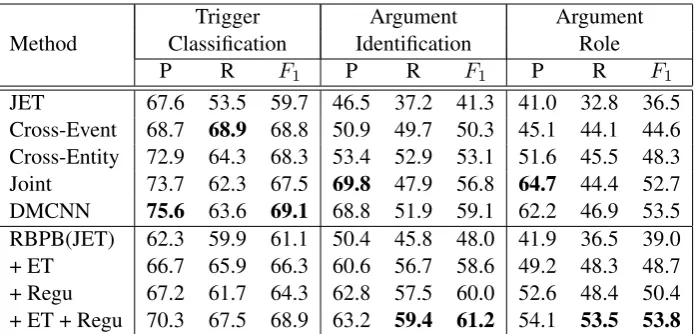
Table 1: Overall performance with gold-standard entities, timex, and values, the candidate arguments are annotated in ACE 2005. “ET” means the pattern balancing event type classifier, “Regu” means the regularization method
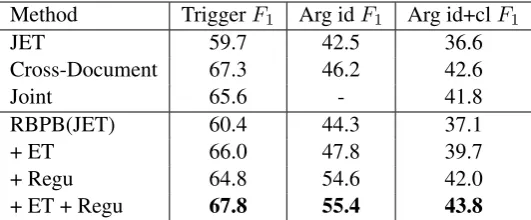
methods, Cross-Event, Cross-Entity, and DM-CNN make use of the gold-standard entities, timex, and values annotated in the corpus as the argument candidates. Cross-Document uses the JET system to extract candidate arguments. Li et al. (2013) report the performance with both gold-standard argument candidates and predicted argument candidates. Therefore, we compare our results with methods based on gold argument candidates in Table 1 and methods based on predicted argument candidates in Table 2.
We have done a series of ablation experiments:
• RBPB(JET): Our own implementation of
JET
• RBPB(JET) + ET: Add pattern balanced
event type classifier to RBPB(JET)
• RBPB(JET) + Regu: Add regularization
mechanism to RBPB(JET)
• RBPB(JET) + ET + Regu: Add both pattern
balanced event type classifier and regulariza-tion mechanism to RBPB(JET)
6.2.1 The Selection of Hyper-parameters
We tune the coefficientsλ1 andλ2 of Eq 2 on the development set, and finally we setλ1= 0.10and λ2 = 0.45. Figure 3 shows the variation of ar-gument identification’sF1 measure and argument classification’s F1 measure when we fix one pa-rameter and change another. Note that the third coefficient1−λ1−λ2must be positive, which is the reason why the curve decreases sharply when λ2 is fixed andλ1 > 0.65. Therefore, Figure 3
illustrates that the robustness of our method is very good, which means if the hyperparametersλ1,λ2 are larger or smaller, it will not affect the result very much.
6.3 Experiment Results
We conduct experiments to answer the following questions. (1) Can pattern balancing lead to a higher performance in trigger classification, argument identification, and classification while retaining the precision value? (2) Can the regularization step improve the performance of argument identification and classification?
Table 1 shows the overall performance on the blind test set. We compare our results with the JET baseline as well as the Event, Cross-Entity, and joint methods. When adding the event type classifier, in the line titled “+ ET”, we see a significant increase in the three measures over the JET baseline in recall. Although our trigger’s pre-cision is lower than RBPB(JET), it gains 5.2% im-provement on the trigger’sF1measure, 10.6% im-provement on argument identification’s F1 mea-sure and 9.7% improvement on argument classifi-cation’sF1measure. We also test the performance with argument candidates automatically extracted by JET in Table 2, our approach “+ ET” again sig-nificantly outperforms the JET baseline. Remark-ably, our result is comparable with the Joint model although we only use lexical features.
identifi-Method TriggerF1 Arg idF1 Arg id+clF1
JET 59.7 42.5 36.6
Cross-Document 67.3 46.2 42.6
Joint 65.6 - 41.8
RBPB(JET) 60.4 44.3 37.1
+ ET 66.0 47.8 39.7
+ Regu 64.8 54.6 42.0
[image:8.595.166.432.62.172.2]+ ET + Regu 67.8 55.4 43.8
Table 2: Overall performance with predicted entities, timex, and values, the candidate arguments are extracted by JET. “ET” is the pattern balancing event type classifier, “Regu” is the regularization method
0.1 0.2 0.3 0.4 0.5 0.6 0.7 0.8 0.9 1 0.58
0.585 0.59 0.595 0.6 0.605 0.61 0.615 0.62
Another coefficient
Argument Identify F1
λ2=0.45, λ
1∈(0,1]
λ1=0.10, λ2∈(0,1]
(a) Arg Identify
0.1 0.2 0.3 0.4 0.5 0.6 0.7 0.8 0.9 1 0.47
0.48 0.49 0.5 0.51 0.52 0.53
Another coefficient
Argument Classifier F1
λ2=0.45, λ
1∈(0,1]
λ1=0.10, λ
2∈(0,1]
[image:8.595.99.489.228.386.2](b) Arg Classify
Figure 3: The trend graph when fix one coefficient and change another
cation’s F1 measure of “+ Regu” is significantly higher. In Table 2, the “+ Regu” again gains a higherF1measure than the JET, Cross-Document, joint model baseline and “+ ET”.
The complete approach is denoted as “RBPB” in Table 1 and Table 2. Remarkably, our approach performances comparable in trigger classification with the state-of art methods: Cross-Document, Cross-Event, Cross-Entity, Joint model, DMCNN and significantly higher than them in argument identification as well as classification although we did not use the cross-document, cross-event information or any global feature. Therefore, the relationship between argument candidates can indeed contribute to argument identification performance. The event type classifier also contributes a lot in trigger identification & classification. We do the Wilcoxon Signed Rank Test on trigger classification, argument identification and argument classification, all the three havep <0.01.
A more detailed study of the pattern feature’s effect is shown in Table 3. We can see that RBPB with both plain feature and pattern feature can gain
Method (RBPB) Trigger Arg id Arg id+cl + Plain feature 66.0 60.5 50.4 + Pattern feature 65.8 60.1 49.2
+ Both 68.9 61.2 53.8
Table 3: The effect (F1value) of pattern feature
much better performance than with two kinds of features alone.
However, our approach is just a pipeline approach which suffers from error propagation and the argument performance may not affect the trigger too much. We can see from Table 1 that although we use gold argument candidates, the trigger performance is still lower than DMCNN. Another limitation is that our regularization method does not improve the argument classifi-cation too much since it only uses constraints to affect roles. Future work may be done to solve these two limitations.
6.4 Analysis of Argument Relationships
Powerful bombA waiting shedDavao airportBus
Powerful bomb
A waiting shed
Davao airport
Bus
Powerful bombA waiting shedDavao airportBus
Powerful bomb
A waiting shed
Davao airport
[image:9.595.78.485.75.232.2]Bus
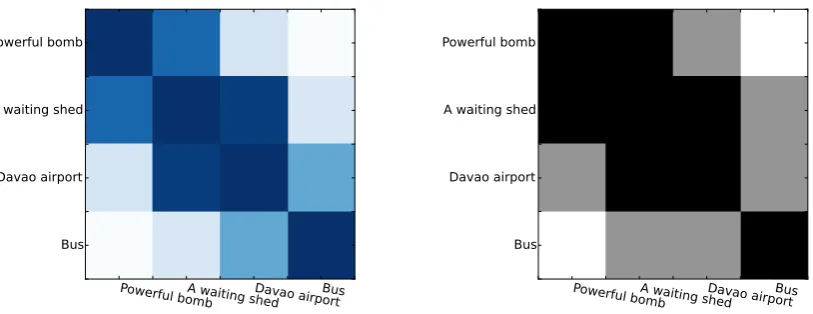
Figure 4: The Argument Relationship Matrix. Left is the origin matrix. Right is the strengthened matrix
for the sentence in Fig 1. In the left part of Fig 4, we can see the argument relationship we capture directly (the darker blue means stronger connec-tion, lighter blue means weaker connection). After strengthening, on the right, the entities with strong connections are classified as positive correlations (the black squares), weak connections are classi-fied as negative correlations (the white squares). Others (the grey squares) are unclear correlation-s. We can see that positive correlation is between “Powerful bomb” and “A waiting shed” as well as “A waiting shed” and “Davao airport”. Therefore, these entities tend to be extracted at the same time. However, “Powerful bomb” and “Bus” has a neg-ative correlation, so they tend not to be extracted at the same time. In practice, the argument prob-ability of “Powerful bomb” and “A waiting shed” are much higher than the other two. Therefore, “Powerful bomb”, “A waiting shed” and “Davao airport” are the final extraction results.
7 Conclusion
In this paper, we propose two improvements based on the event extraction baseline JET. We find that JET depends too much on event patterns for event type priori and JET considers each candidate argument separately. However, patterns cannot cover all events and the relationship between candidate arguments may help when identifying arguments. For a trigger, if no pattern can be matched, the event type cannot be assigned and the arguments cannot be correctly identified and classified. Therefore, we develop an event type classifier to assign the event type, using both pattern matching information and other features,
which gives our system the capability to deal with failed match cases when using patterns alone.
On the other hand, we train a maximum entropy classifier to predict the relationship between can-didate arguments. Then we propose a regulariza-tion method to make full use of the argument rela-tionship. Our experiment results show that the reg-ularization method is a significant improvement in argument identification over previous works.
In summary, by using the event type classifier and the regularization method, we have achieved a good performance in which the trigger classification is comparable to state-of-the-art methods, and the argument identification & classification performance is significantly better than state-of-the-art methods. However, we only use sentence-level features and our method is a pipelined approach. Also, the argument classification seems not to be affected too much by the regularization. Future work may be done to integrate our method into a joint approach, use some global feature, which may improve our performance. The code is available at https://github.com/shalei120/ RBPB/tree/master/RBET_release
Acknowledgements
References
Mary Elaine Califf and Raymond J Mooney. 2003. Bottom-up relational learning of pattern matching rules for information extraction. The Journal of Machine Learning Research, 4:177–210.
Nathanael Chambers and Dan Jurafsky. 2011. Template-based information extraction without the templates. InProceedings of the 49th Annual Meet-ing of the Association for Computational LMeet-inguistic- Linguistic-s: Human Language Technologies-Volume 1, pages 976–986. Association for Computational Linguistic-s.
Yubo Chen, Liheng Xu, Kang Liu, Daojian Zeng, and Jun Zhao. 2015. Event extraction via dy-namic multi-pooling convolutional neural networks. In Proceedings of the 53rd Annual Meeting of the Association for Computational Linguistics and the 7th International Joint Conference on Natural Lan-guage Processing (Volume 1: Long Papers), pages 167–176, Beijing, China, July. Association for Com-putational Linguistics.
Hai Leong Chieu and Hwee Tou Ng. 2002. A max-imum entropy approach to information extraction from semi-structured and free text. AAAI/IAAI, 2002:786–791.
Fabio Ciravegna et al. 2001. Adaptive information extraction from text by rule induction and general-isation. In International Joint Conference on Ar-tificial Intelligence, volume 17, pages 1251–1256. LAWRENCE ERLBAUM ASSOCIATES LTD. Aidan Finn and Nicholas Kushmerick. 2004.
Multi-level boundary classification for information extrac-tion. Springer.
Dayne Freitag. 1998a. Multistrategy learning for information extraction. InICML, pages 161–169. Dayne Freitag. 1998b. Toward general-purpose
learn-ing for information extraction. InProceedings of the 36th Annual Meeting of the Association for Compu-tational Linguistics and 17th International Confer-ence on Computational Linguistics-Volume 1, pages 404–408. Association for Computational Linguistic-s.
Ralph Grishman, David Westbrook, and Adam Meyers. 2005. Nyus english ace 2005 system description.
ACE, 5.
Zhenmei Gu and Nick Cercone. 2006. Segment-based hidden markov models for information extraction. InProceedings of the 21st International Conference on Computational Linguistics and the 44th annual meeting of the Association for Computational Lin-guistics, pages 481–488. Association for Computa-tional Linguistics.
Yu Hong, Jianfeng Zhang, Bin Ma, Jianmin Yao, Guodong Zhou, and Qiaoming Zhu. 2011. Us-ing cross-entity inference to improve event extrac-tion. InProceedings of the 49th Annual Meeting of
the Association for Computational Linguistics: Hu-man Language Technologies-Volume 1, pages 1127– 1136. Association for Computational Linguistics.
Ruihong Huang and Ellen Riloff. 2011. Peeling back the layers: detecting event role fillers in secondary contexts. InProceedings of the 49th Annual Meet-ing of the Association for Computational LMeet-inguistic- Linguistic-s: Human Language Technologies-Volume 1, pages 1137–1147. Association for Computational Linguis-tics.
Ruihong Huang and Ellen Riloff. 2012. Bootstrapped training of event extraction classifiers. In Proceed-ings of the 13th Conference of the European Chapter of the Association for Computational Linguistics, pages 286–295. Association for Computational Lin-guistics.
Scott B Huffman. 1996. Learning information ex-traction patterns from examples. In Connectionist, Statistical and Symbolic Approaches to Learning for Natural Language Processing, pages 246–260. Springer.
Heng Ji and Ralph Grishman. 2008. Refining event extraction through cross-document inference. In
Proceedings of the 46st Annual Meeting of the As-sociation for Computational Linguistics (Volume 1: Long Papers), pages 254–262.
Jun-Tae Kim and Dan I Moldovan. 1993. Acquisition of semantic patterns for information extraction from corpora. In Artificial Intelligence for Application-s, 1993. Proceedings., Ninth Conference on, pages 171–176. IEEE.
Yaoyong Li, Kalina Bontcheva, and Hamish Cunning-ham. 2005. Using uneven margins svm and per-ceptron for information extraction. InProceedings of the Ninth Conference on Computational Natural Language Learning, pages 72–79. Association for Computational Linguistics.
Qi Li, Heng Ji, and Liang Huang. 2013. Joint event extraction via structured prediction with global fea-tures. InProceedings of the 51st Annual Meeting of the Association for Computational Linguistics (Vol-ume 1: Long Papers), pages 73–82, Sofia, Bulgaria, August. Association for Computational Linguistics.
Shasha Liao and Ralph Grishman. 2010. Using doc-ument level cross-event inference to improve event extraction. InProceedings of the 48th Annual Meet-ing of the Association for Computational LMeet-inguis- Linguis-tics, pages 789–797. Association for Computational Linguistics.
Wei Lu and Dan Roth. 2012. Automatic event extrac-tion with structured preference modeling. In Pro-ceedings of the 50th Annual Meeting of the Associ-ation for ComputAssoci-ational Linguistics: Long Papers-Volume 1, pages 835–844. Association for Compu-tational Linguistics.
Mstislav Maslennikov and Tat-Seng Chua. 2007. A multi-resolution framework for information extraction from free text. InANNUAL
MEETING-ASSOCIATION FOR COMPUTATIONAL
LINGUISTICS, volume 45, page 592. Citeseer. Siddharth Patwardhan and Ellen Riloff. 2007.
Ef-fective information extraction with semantic affinity patterns and relevant regions. In EMNLP-CoNLL, volume 7, pages 717–727. Citeseer.
Siddharth Patwardhan and Ellen Riloff. 2009. A unified model of phrasal and sentential evidence for information extraction. InProceedings of the 2009 Conference on Empirical Methods in Natural Lan-guage Processing: Volume 1-Volume 1, pages 151– 160. Association for Computational Linguistics. Ellen Riloff et al. 1993. Automatically constructing a
dictionary for information extraction tasks. InAAAI, pages 811–816.
Ellen Riloff, Rosie Jones, et al. 1999. Learning dic-tionaries for information extraction by multi-level bootstrapping. InAAAI/IAAI, pages 474–479. Ellen Riloff. 1996. Automatically generating
extrac-tion patterns from untagged text. In Proceedings of the national conference on artificial intelligence, pages 1044–1049.
Satoshi Sekine. 2006. On-demand information ex-traction. In Proceedings of the COLING/ACL on Main conference poster sessions, pages 731–738. Association for Computational Linguistics.
Yusuke Shinyama and Satoshi Sekine. 2006. Preemp-tive information extraction using unrestricted rela-tion discovery. InProceedings of the main confer-ence on Human Language Technology Conferconfer-ence of the North American Chapter of the Association of Computational Linguistics, pages 304–311. Associ-ation for ComputAssoci-ational Linguistics.
Stephen Soderland, David Fisher, Jonathan Aseltine, and Wendy Lehnert. 1995. Crystal: Inducing a con-ceptual dictionary. arXiv preprint cmp-lg/9505020. Mark Stevenson and Mark A Greenwood. 2005. A
semantic approach to ie pattern induction. In Pro-ceedings of the 43rd Annual Meeting on Association for Computational Linguistics, pages 379–386. As-sociation for Computational Linguistics.
Kiyoshi Sudo, Satoshi Sekine, and Ralph Grishman. 2003. An improved extraction pattern representa-tion model for automatic ie pattern acquisirepresenta-tion. In
Proceedings of the 41st Annual Meeting on Associa-tion for ComputaAssocia-tional Linguistics-Volume 1, pages
224–231. Association for Computational Linguistic-s.
Roman Yangarber, Ralph Grishman, Pasi Tapanainen, and Silja Huttunen. 2000. Automatic acquisition of domain knowledge for information extraction. In
Proceedings of the 18th conference on Computation-al linguistics-Volume 2, pages 940–946. Association for Computational Linguistics.