J. Range Manage.
47249-354 September 1994
Understanding cause/effect relationships in stock- ing rate change over time
R. C. ROWAN, LARRY D. WHITE, AND J. RICHARD CONNER
Authors are research associate, Department of Rangeland Ecology and Management, College Station 77843-2126: profess- SOT and Extension Range Specialist, Texas Agricultural Extension Service, College Station 77843-2126; and professor;
Department of Agricultural Economics, Texas A&M University, College Station 77843-2124. At the time of the research, Rowan was Tom Slick Senior Graduate Fellow, Department of Rangeland Ecology and Management, Texas A&M University.
Abstract
Decisions made by Texas ranchers over a 10 year period (MO- 1990) concerning stocking rate levels were dominated by percep- tions about weather. A regression model explained 64% of the variability in stocking rate change over time, with the rainfall/drought variable explaining the majority of variability. As ranchers’ perception of a positive rainfall effect increase-d, so did stocking rates, and vice versa. Although the presence or absence of rainfall cannot be managed per se, proactive stocking decisions should include a strategy for adjusting stocking levels in response to changing environmental conditions.
Other factors with significant (a =0.05), albeit trivial, path co- efficients on stocking rate change were age, grazing rights (owned vs. leased), traditional stocking rate factors, traditional grazing program factors, and weed/brush information factors. Older ranchers (>65 years) and ranchers who leased all of their range- land tended to decrease stocking rates over time. Rangeland op- erators indicated they considered “improved livestock perfor- mance” as the most important benefit from initiating a grazing program. Evidence also suggested that ranchers who rely on their neighbors for advice about weed/brush decisions are not benefit- ting from the latest technology information. Adoption of econom- ic factors (cost/benefits) for selection of weed/brush technology did not have a significant impact on stocking rates over the 10 year period.
Key words: principal component, path coefficient analysis, IV- gression, ranch decision-making, direct and indirect effects
It may not be news to range professionals that ranchers around the country often think differently! But the discussion doesn’t end there.
An enlightening thing about sociological research is not so much that people think differently about values and beliefs, but that they fre- quently think similarly. Similarities among human populations point to groups or clusters of people who embrace similar beliefs or ideas which become springboards for causing change as these groups exert influence. There is no reason to think that the ranching community be- haves any differently.
Social science is unliie the “hard” sciences in that the subjects be- ing studied cannot be observed under laboratory conditions.
Sociologists do not control all of the conditions under which human populations are observed. Similarities in people are observable and, to some extent, measurable when asked to respond to specific questions,
Rcscarch fu ded b the USDA S 3 C
Agricultuml Eensi”, Serkx. Authors Gih t%~%. Se. dthT pTrP&+ &tcn~~
Computer Specialist, for his contributions to data analysis.
Manuscript accepted 22 Feb. 1994.
such as the statewide survey of Texas ranchers (Hanselka et al. 1990).
Techniques such as discriminant analysis have been developed to compare and contrast human responses. Path analysis has been used in biological research to segregate treatment cause/effects (Singh and Chowdhury 1983, Kang et al. 1983, van Bruggen and Ameson 1986, Bowers et al. 1990, Mebrahtu et al. 1991). However, the procedure has been infrequently used in rangeland research. White (1968) was one of the earliest rangeland researchers to use the technique to quan- tify the factors affecting susceptibility of creosotebush, Larrea triden- rata (D.C.) Cov., to burning. Path coefficient regression analysis in bi- ological systems is characterized by high R* values reflecting the con- trol of unrelated variables. Inclusion of sociological data in path analysis may reduce explanatory power of regression models because of extraneous influences, but the interpretations on human behavior are no less important.
Modeling rancher decision-making is a process of generating a pri- ori assumptions, formulating a causal scheme among variables (Li 1975), calculating path effects, and proposing plausible interpreta- tions about significant pathways. Because human ecological systems are complex interactions between value-based decision-making and the surrounding environment, causal schemes should include biologi- cal as well as sociological variables and the model structure should be such that significant effects are interpretable (Li 1975). The con- straints in “real world” situations continue to be the complex and in- dividualistic factors that both precede and characterize a rancher’s de- cision process. Identification and measurement of relevant character- istics in conjunction with discovery of cause/effect pathways should provide better understanding of rancher’s decision-making and the im- pacts on rangeland resources. The main objective of this study was to determine significant (PsO.05) direct and indirect effects of rancher attributes, ranch characteristics, rainfall effects, Percent of total in- come from various sources, and decision variables on stocking rate change over a 10 year period for all Texas rangeland operators.
Methods
Procedures like path coefficient regression analysis can be used to trace the cause and effect relationships between quantifiable charac- teristics and the changes they effect. More precisely, path analysis is the decomposition of observed correlation between variables in a hy- pothesized causal scheme. Correlation coefficients are by definition standardized covariances. Since covariances can be subdivided into various parts, correlation coefficients may also be subdivided to see the cause/effect structure among variables.
A path model was constructed from variables representing personal rancher attributes, ranch characteristics, rainfall effects, on and off- ranch income levels as a percent of total income, and principal com- ponent decision variables to determine their effects on animal stock-
of ranch
r
FQ. 1. Significant pathways from combined -s&n models of personsl, ranch and rainfall characteristics; income sources; and influencing stocking rate change over time.
ing rate change over time (see Fig. 1 for variable scheme). The de- pendent variable was measured as decreased stocking rate, no change in stocking rate, or increased stocking rate Over the 10 year period from 1980-1990.
Variables for age of the rancher, years of ranching experience and size of the ranch were measured as interval variables. Tbe variable for level of education was given numerical scores for regression analysis’.
Grazing rights were scored from 1 to 3. The higher the number the closer to full ownership of the ranch’.
Ranchers who owned land but leased it tu someone else were elim- inated fmm this portion of the study because this category did nut tit the ordering towards full ownership/management. Animal diversity was also scored with larger numbers representing mute animal enter- prises operated on the ranch. The rainfall variable was a composite of answers tu specific portions of 2 questions. Specifically, ranchers were given the opportunity tu register their perception of either
“drought” or “rainfall” as factors affecting either increased or de- creased stocking. If respondents did nut check either response, their response was coded as “no effect.”
Regional ranch location was entered into regression analysis as dummy variables after Kennedy (1989: 180). The procedures for dum- my variables puts the effect of the omitted variable, or base variable, into the intercept term. Each dummy variable is then compared against this base variable. Regression coefficients for dummy vari- ables represent their departure, either positively or negatively, frum the base variable. Tbe base variable for location was specified as the High Plains region.
Independent variables measuring income sources were defined as follows: on-ranch income was the combined percent of total family
income from livestock, wildlife, and hay/seed production: and off- ranch income was the combined percent of total family income fmm off-ranch investments and off-ranch employment.
The 6 decision variables representing the three categories (2 ptinci- pal components for each category): stocking rate. grazing programs, and weed/blush techniques were derived fmm the scoring coefficients of the principal component analysis (Rowan et al. 1994). Tbe number of principal components selected for each category was based cm eigenvalues greater than 1.0.
The direct effects, and subsequently the indirect effects of variables on stocking rate change, were derived fmm standardized coefficients from the following regressions: (1) regressing age. education, years ranching, size of ranch, region of ranch, grazing rights, animal diver- sity and rainfall effects, individually, on on-ranch and off-ranch in- come percentages, (2) regressing age, education, years ranching, size of ranch, region of ranch. grazing rights, animal diversity. rainfall ef- fects, on-ranch and off-ranch income percentages, individually, on each of the decision variables. and (3) regressing all variables on past stucking rate changes. Values for direct effects were simply the stan- dardized path coefficient between the independent variable and the overall dependent variable in the model (i.e., in tbis model it was stocking rate change). Indirect effects were calculated as the product of a path coefficient and a correlation coefficient (1~
6
Pjk). Fat eXa.tn-
pie. the indirect effect of Agei on Stocking Rate hangek through Stocking Rate Componentl, would be traced back along significant pathways from Stocking d, te Change through Age. Percent On- Ranch Income, and Stocking Rate Component1 (rij) and then fmm Stocking Rate Component1 to Stocking Rate Change (Pik) to com- plete the lwp.
Standardization of regression coefficients enabled comparison across variables. Tbe coefficients could then be interpreted as that change in the standard deviation of the dependent &able resulting fmm a 1 unit change in the standard deviation of the causation vari- able. Regression coefficients which tested significantly different from zero were retained until all regressions were completed.
JOURNAL OF RANGE MANAGEMENT 47 (5) September 1994
Lastly, variables for age, grazing rights, and rainfall were segregat- ed into categories to test if partial variable effects had significant but opposing coefficient signs. Each category of thethree variables was coded into dichotomous dummy variables and tested individually in the regression models. The dummy variable for age was coded as presence or absence in the following groups: ~35 years, 36-65 years, and %5 years. Likewise, grazing rights was coded (0,l) for cate- gories: leased all land, owned and leased land, and owned and operat- ed all land. Dummy variable for rainfall represented a rancher’s per- ception of a drought effect, no effect, or an increased rainfall effect.
Results and Discussion
Twenty-two variables, including the dependent variable, were in- volved in the regression analysis. Bivariate correlation coefficients of the exogenous variables were examined to identify statistically signif- icant associations. For example, size of the ranch was positively cor- related (.185) and age was negatively correlated (-. 143) with animal diversity (see Fig. 1). Thus, ranchers operating larger ranches tended to have more animal enterprises on the ranch, while older ranchers tended to have fewer animal enterprises.
Age of the rancher and the number of years of ranching experience were highly correlated (605). Furthermore, age of ranchers and years of ranching experience were each negatively correlated with educa- tion, indicating older and more experienced ranchers had lower levels of formal education. The positive correlation (.299) between age of the rancher and tendency toward full ownership of the ranch was not unexpected. In addition, rancher age was inversely correlated, albeit trivial, with the rainfall variable, which meant that older ranchers were more likely to perceive a drought effect changing stocking rate levels.
Diit Effects on Percent On-Ranch Income
Only the direct effects will be reported for each model because the indirect effects were generally well below 0.018 and considered triv- ial. The model regressing personal attributes, ranch characteristics, and rainfall effects explained 22% of the variation in percent of total family income from on-ranch sources (Table 1). The path coefficient between age and percent on-ranch income was negative (-.200).
Repeating the regression with age segregated into 3 dummy cate- gories (135 years, 36-65 years, and ~65 years) showed that the younger group obtained a larger (. 108) and the older group a smaller portion (-.065) of their total family income from on-ranch sources.
lsble 1. Tests of significant path coefficients for the regression of person- al attributes, ranch characteristics, and rainfall effects on percent of to- tal income from on-ranch sources.
Source Intercept
Regression Path t
Coefficients Coefficients’ Value
51.4455 0.0000 9.434***
Personal Attributes
Years ranching 0.6723 0.3317 9.848***
Age - 0.4452 - 0.1998 - 5.794***
Education - 2.6927 - 0.1039 - 3.775***
. . CB
Size of ranch 0.0002 0.1395 5.194***
Blacklands region - 8.0690 - 0.1195 - 4.065***
Coastal Prairie region - 9.8550 - 0.0889 - 3.208**
Rio Grande Plains region - 7.5336 - 0.0935 - 3.369;
Grazing rights - 2.1160 - 0.0585 - 2.093***
Animal diversity 3.4076 0.1663 5.914***
n = 1173 R’= 0.2156 Adj. R2 = 0.2095
Non-significant variables: Rolling Plains region, Tram Pecos region, Edwards Plateau region, Rainfall effects
The path coefftcient between number of years of ranching experi- ence and percent on-ranch income was 0.332. Each standard deviation change in the number of years ranching caused a 0.332 change in stan- dard deviation of percent of total family income from on-ranch sources. Although there was a positive correlation between age and ranching exerpence, ranchers with more years of experience had larg- er portions of their incomes derived from on-ranch sources, but this was not necessarily true for older ranchers.
The path coefficient for the grazing rights variable was also nega- tive. Although the coefficient was small (-.058), the implication was that as ranchers move toward full ownership they derive a signiti- cantly smaller portion of total family income from on-ranch sources, thus they were ostensibly more reliant on other income sources.
Partitioning of grazing rights showed that on-ranch income was more important to ranchers who leased all of their land from others (.052) than ranchers who owned all of their land (-.051).
Direct Effects on Percent Off-Ranch Income
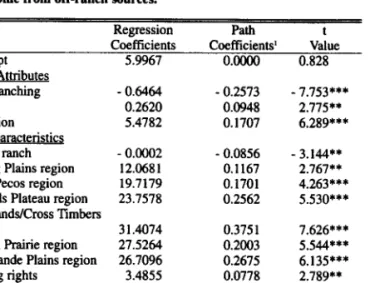
Regressing personal attributes, ranch characteristics, and rainfall ef- fects on percent of total family income from off-ranch sources pro- duced a model (Pc.0001) explaining 24% of the variation in off-ranch income. T-tests revealed significant relationships (Table 2) between all exogenous variables and percent off-ranch income except the rain- fall variable (P=.lll). Percent off-ranch income significantly in- creased with age (.095), and segregation of age confirmed that the younger age group derived a significantly smaller portion of their to- tal family income from off-ranch income (-.081) than did other age groups. The path coefficient for the “over 65” age category was also negative, but not significant. Presumably, the proportion of off-ranch employment income decreased for this group while off-ranch invest- ments increased. (Rowan and White 1994).
Path coefficients for size of ranch, animal diversity and years ranch- ing were negative, hence off-ranch income was less important on larg- er ranches, on ranches with more animal enterprises, and for ranchers with more years of ranch experience.
Direct Effects on Traditional Stocking Rate Factors
Personal attributes, ranch characteristics, rainfall effects, and in- come sources regressed on the importance of traditional stocking rate factors (i.e., forage and livestock considerations, weather and past ex- perience) produced a model (Pc.0001) explaining 6% of the variation in traditional stocking rate factors. Ranchers who had been ranching longer, who utilized multiple animal enterprises, and who obtained higher percentages of on-ranch income tended to rate the traditional stocking rate factors more importantly (on the Likert scale of impor- tance).
Partitioning age effects on the importance of traditional stocking rate factors showed that ranchers in the 36-65 age category considered these factors significantly more important to them. Evidently, ranch- ers c36 and >65 years had little affinity for the traditional stocking rate factors and their influence rendered the overall age effect non- significant.
Direct Effects on Nontraditional Stocking Rate Factors
Personal attributes, ranch characteristics, rainfall effects, and in- come sources regressed against the importance of nontraditional stocking rate factors (i.e., wildlife considerations and other people’s advice) produced a significant model explaining 8% of the variability in the dependent variable.
Ranchers with more animal enterprises (.249) and who were closer to having full ownership of their ranches (.155) considered other peo- ple’s advice and wildlife considerations to be more important.
Segregation of the grazing rights variable indicated that the signifi-
Table. 2. Tests of significant path coeffkients for the regression of person- al attributes, ranch characteristics, and rainfall effects on percent of to- tal income from off-ranch sources.
Regression Path t
Source CoLfficients Coefficients’ Value
Intercept 5.9967 0.0000 0.828
Personal Attributes Years ranching Age Education Ranch Characteristics
Size of ranch Rolling Plains region Trans Pecos region Edwards Plateau region BlacklandsKross limbers region
Coastal Prairie region Rio Grande Plains region Grazing rights
- 0.6464 - 0.2573 -7.753***
0.2620 0.0948 2.775*+
5.4782 0.1707 6.289***
- 0.@302 12.0681 19.7179 23.7578 31.4074 27.5264 26.7096 3.4855 Animal diversity - 5.4129
n = 1173 R2 = 0.2417
Non-significant variable: Rainfall effects
- 0.0856 - 3.144**
0.1167 2.767**
0.1701 4.263***
0.2562 5.530***
0.3751 7.626***
0.2003 5.544***
0.2675 6.135***
0.0778 2.789**
- 0.2132 -7.427***
Adj. R2 = 0.2339
‘Path coefficients are standardized regression coefficients.
*. **.*** Indicates significant diKerences at the 0.05, 0.01 and 0.001 levels, respectively.
ership (.168). Ranchers with a leased component in their operations (owned & leased or leased all land) felt the nontraditional stocking rate factors were less important to them. Lastly, those ranchers with more years of ranching experience (-.084) and more education (-.081) gave less credence to other people’s advice and wildlife considera- tions.
Direct Effects on ‘lkaditional Grazing Prugram Factors
Regressing personal attributes, ranch characteristics, rainfall ef- fects, and income sources on the importance of traditional grazing program factors produced a model (PC.0009) explaining 2% of the variability. Apparently, there was considerable variability in the graz- ing program decisions of ranchers. Ranchers who owned and leased land (more likely full-time ranchers) rated the traditional grazing fac- tors (i.e., improved livestock performance, improved amount or kind of forage, improved grazing distribution, etc.) to be significantly more important to them than did full-ownership or tenant ranchers.
Diit Effects on Nontraditional Grazing Program Factors The model (Pc.0001) which regressed personal attributes, ranch characteristics, rainfall effects, and income sources on the importance of nontraditional grazing program factors explained 7% of the vari- ability in the dependent variable. Ranchers with more animal enter- prises tended to consider the nontraditional grazing factors (i.e., ob- tain other people’s approval, improved wildlife habitat, and reduced labor requirements) to be more important to them. Those ranchers who had higher levels of formal education considered the nontradi- tional grazing program factors to be less important. Evidently, better educated ranchers discounted these 3 variables in their operations.
Direct Effects on Weed/Brush Technique Information Factors Regressing personal attributes, ranch characteristics, rainfall ef- fects, and income sources on the importance of information factors upon weed/brush treatment techniques produced a significant model explaining 4% of the variability in the dependent variable. Ranchers in the Rolling Plains and Rio Grande Plains rated the weed/brush in- formation factors (i.e., advice from neighbors, fear of treatment method, advice from agencies, etc.) higher than ranchers in other re- gions. However, ranchers with more ranching experience, with more
formal education, and with larger portions of their incomes from off- ranch sources considered the information factors to be less important.
Ranchers between the ages of 35 and 65 were more likely to em- brace the sources of information for weed/brush treatment techniques than other age categories (P=.O86). Older ranchers (>65 years) did not perceive weed/brush information sources as important to them as did other ages (P=.O67).
Direct Effects on Weed/Brush Economic Factors
The model regressing personal attributes, ranch characteristics, rainfall effects, and income sources on weed/brush economic factors (i.e., plant attributes, projected economic returns, cost of treatment, etc.) explained 6% of variability in the dependent variable. Percent of total income from on-ranch sources had the largest impact on weed/brush economic factors (.177). Ranchers who derived higher percentages of their total family income from on-ranch sources tend- ed to rate the weed/brush economic factors more importantly. In addi- tion, ranchers who had more animal enterprises and those who were closer to full ownership of their ranches tended to consider the weed/brush economic factors to be more important.
The second largest path coefficient was the rainfall variable (-.127).
The negative coeffkient meant that as conditions move toward a pos- itive rainfall effect, ranchers considered the weed/brush economic fac- tors to be less important. Individual dummy effects of “drought” and
“no effect” had significant and opposite coeffkient signs. Ranchers who perceived a drought effect over the previous 10 year period con- sidered economic factors of weed/brush decision-making to be more important. Apparently, the importance of economic considerations be- gins to wane when the effect of rainfall is either neutral or positive.
Direct Effects on Stocking Rate Change Over Tie
The regression of personal attributes, ranch characteristics, rainfall effects, and all 6 decision variables on stocking rate change produced a significant model explaining 64% of the variability in stocking rate change (Table 3). A strong, positive relationship (.782) exists between perceived rainfall effects and stocking rate change. Conversely, parti- tioning the effects of the rainfall variable revealed that a perceived drought effect by ranchers strongly influenced a decline in stocking rates over time (-.775).
Five variables had small direct effects on stocking rate change.
Rancher age had a negative effect (-.054) on stocking rate change while grazing rights had a positive effect (.046). Ranchers over 65
Table 3. Tests of significant path coefficients for the regression of personal attributes, ranch characteristics, rainfall effects, income sources, and decision variables on stocking rate change over time.
Source Interceot
Regression Path t
Coefficients Coefticients’ Value -0.7218 O.OOOO -3.631***
personal Attributes
Age .
Panch Charact_en&s Grazing rights Rainfall Effects
- 0.0035 - 0.0544 - 2.385*
0.0448 0.0458 2.024*
1.1770 0.7820 35.783***
Bcision VW
Traditional stocking factors 0.0742 0.0578 2.506*
Traditional grazing-factors 0.0864 0.0730 3.152**
‘&ed&ush information factors- 0.0454 - 0.0593 - 2.714**
n=780 Rz = 0.6338 Adj. R2 = 0.6340
Non-significant variables: Education, Years ranching, Size of ranch, Rolling Plains region, Tram Pecos region, Edwards Plateau region, BlacklandsKross Timbers region, Coastal Prairie region, Rio Grande Plains region, Animal di- versity, Percent On-ranch income, Percent Off-ranch income
‘Path coefficients are standardized regression coefticients.
*, **, ***Indicates significant differences at the 0.05.0.01 and 0.001 levels, respectively.
352 JOURNAL OF RANGE MANAGEMENT 47 (5) September 1994
years of age tended to reduce stocking rates (P=.OEZ) more than did other ages of ranchers. Likewise, ranchers who leased all of their land from someone else tended to reduce stocking rates over time (P=.OiX) more than did other tenure types.
Path coefficients for each of the first principal components between stocking rate factors (.058), grazing programs (.073). and weed/brush techniques (-,059) and stocking rate change were significant.
Although pathways connected personal attributes and ranch charac- teristics to both income sources, to simplify the model (Fig. I) only variables with significant direct paths to the response variable, stuck- ingrate change, were retained in the final model (Pig. 2). Examination of the decision variables showed that the second component of each category did nut significantly impact stocking rate change, thus they were removed from the model.
Increasing stocking rates over time appears to lx motivated by a rancher’s perception of increased rainfall. Alternately, ranchers react to drought by decreasing stocking levels. Neither of these manage- ment practices are good measures of the state of the land. “Trends in animal pmduction are obscured by large peaks and tmughs caused by the rainfall. As an ecosystem degrades, domestic stock show an abili- ty to maintain production by switching to less palatable plants or plant communities, but then may crash to a lower level of production, per- haps when drought intervenes to apply the coup de grace to the al- ready stressed paennial pasture plants” (Havington et al. 1984). This is the essence of crisis management. “Rainfall more than any other factor influences the pmductivity of range pastures...Any rancher then has to be able to predict the effects of a poor rainfall year, and has to be able to modify his management strategies to tit in with a sudden downturn in rainfall received..This means that the rancher has to un- derstand the rainfall pattern in his environment” (Wilcox 198219).
Although the presence or absence of rainfall cannot be managed per se, proactive stocking rate decisions should include a strategy for ad- justing stocking levels in response to changing environmental condi- tions (Wdson and Ma&cd 1991). Survey results indicated 45% of ranchers do nut make seasonal adjustments to livestock numbers. If reductions in livestock numbers were reported by ranchers, most re- ductions were “blamed” on drought. Wilson et al. (1984) noted that if a conservative stocking rate strategy were employed, a 30.50% stock reduction would be required during short-term drought and 75% or more during long-term droughts. However. less than 20% of ranchers use a quantifiable technique (photopoints and/or exclosures) to moni- tor their grazing management or stocking rate decisions over the short or long term (Hans&a 1990). Ranchers should utilize knowledge about precipitation patterns and probabilities, plant gmwtb cycles, forage inventory procedures to balance forage supply/demand. and flexible livestock marketing techniques to achieve their goals.
Path analysis showed that age and ownership have statistically sig- nificant, albeit small, effects on stocking rate change. Age is a diffw sion variable which has been shown to be a statistically signif&nt predictor of adoption (Ladewig 1977, Thomas et al. 1990). Older Texas ranchers reported a lower stocking rate level uver time. It is hard to determine if this is a purposeful reduction with increased ti- nancial security, a more conservative approach (i.e., less stress and less risk) due to past “bad” experiences during drought situations, or a reaction to declining efficiency of the rancher over the family-firm cy- cle.
Because 75% of rangeland leases are short-term (five years or less) and payment is made on a per-acre basis (Hanselka 1990). stocking rates have uaditionally been excessive, thus pmmoting range deterio- ration. This scenario is supported by results showing ranchers who lease all of their land tend tu decrease stocking rates over time. Lease contracts that are long-term, charge on a per animal unit basis. and in-
Fig. 2. Final model of sigubicant direct and indirect effects of age, grazing rights, rainfall characteristics, traditional stocking rate factors, traditional graziag Pmgmm factors snd weed/brush information factors on stecking rate change.
JOURNAL OF RANGE MANAGEMENT 47 (5) September 1994 353
chide some provision for seasonal adjustment and limitation of live- stock numbers should be encouraged. Long-term leases that encour- age range improvement would benefit the current lessee as well as the landowner.
Stocking rate, by its very nature, should be a planning tool to achieve some goal for the future (e.g., maximize animal produc- tion/unit area, optimize profit/unit area, or increase condition and trend of the grazing land). As defined for this study, traditional stock- ing decisions include biotic (plants and animals) and abiotic factors (weather and experience). Ranchers are able to identify the stocking rate change (derived by squaring the standardized path coefficient).
Other factors that explain stocking rate decision-making (other than traditional factors) may need to be explored to see their impact on stocking rate change over time.
The traditional grazing program factors had the largest impact of the decision variables on stocking rate change. Grazing programs are gen- erally designed to improve the health and vigor of plant populations (Hanselka et al. 1988). When that goal is achieved, benefits may be increased production per unit area (Heitschmidt and Taylor 1991).
Grazing programs can increase individual animal performance if the quality of forage presented to the animals is high. Rangeland opera- tors indicated they considered improved livestock performance as the most important benefit from initiating a grazing program. Combined with a positive path coefficient linking the grazing component to stocking rate change, this would imply that ranchers expect to benefit from increased stocking rate levels and animal performance simulta- neously. This scenario would be expected only if previous stocking levels were below the critical stocking rate (Heitschmidt and Taylor 1991). This obscure picture which ranchers have about the effects of grazing programs distorts efforts to improve range condition and trend.
Two components explained the variability in choices of treatment techniques for weed/brush control. The first was an information- sources component where ranchers put advice from neighbors and fear of treatment method at the top of the list. Thomas et al. (1990) re- ported that farmers with small gross farm sales were the ones to val- ue their neighbors advice as the most important source of information.
They showed that group meetings and contacts with extension and university professionals made the biggest impact on adoption of tech- nology. This evidence suggests that ranchers who rely on their neigh- bors for advice are not getting the latest information, possibly because they too have relatively small ranch incomes. Whatever the reason, the outcome is that ranchers embracing these weed/brush information- sources had decreased stocking levels over time. One conclusion might be that ranchers who adopt a reactive stance about weed/brush treatment techniques defer decisions to treat, or alternately, informa- tion sources they utilize frustrate weed/brush technology adoption and eventually result in a reactive decline in stocking rate levels.
The second weed/brush component was an economic one that had no significant effect on stocking rate change. Thus, ranchers did not attribute much importance to costs and benefits of weed/brush treat- ment in altering their stocking rate levels. Herein is an extremely im- portant educational opportunity for rangeland educators. It is unclear from this study if ranchers do not have the economic tools to connect short- or long-term weed/brush improvements with stocking rate lev- els or if they have simply omitted that knowledge from the decision- making process.
One implication of this study is that a number of points about ranch- er decision-making are indistinct and should be studied further by change agents. An attempt to segregate proactive factors from reactive is indicated in future research projects so their respective effects on re- sources can be measured. If we are to successfully shift the burden for cause and effect of decision-making to ranchers themselves, we must have better information about factors precipitating those decisions.
Literature Cited
Bowers, J.H., R.M. Sonoda, and DJ. Mitchell 1990. Path coefficient analy- sis of the effect of rainfall variables on the epidemiology of Phytophthora blight of pepper caused by Phytophthora capsici. Phytopathology 80:1439-
1446.
Hanselka, C.W., BJ. Ragsdale, and B. Rector. 1988. Grazing systems for profitable ranching. Texas Agric. Ext. Serv. L-221 1. Texas A&M Univ., College Station.
Hans&a, C.W., A. McGlnty, B.S. Rector, R.C. Rowan, and L.D. White.
1990. Grazing and brush management on Texas rangelands: an analysis of management decisions. Texas Agric. Ext. Serv. Texas A&M Univ., College Station.
Harrlngton, G.N., A.D. Wilson, and M.D. Young. 1984. Management of rangeland ecosystems, p. 3-12. In: G.N. Harrington, A.D. Wilson, and M.D.
Young. Management of Australia’s rangelands. CSIRO, Australia.
Heitschmidt, RK. and C.A. Taylor. 1991. Livestock production, p. 161-177.
In: R.K. Heitschmidt and J.W. Stuth (eds.). Grazing management: an eco- .
logical perspective. Timber Press, Inc., Portland, Ore.
Rang, M.S., M.S. Zuber, and G.F. J&muse. 1983. Path coefficient analyses of grain yield and harvest grain moisture in maize. Trop. Agric. (Trinidad) 60:253-256.
Kennedy, P. 1989. A guide to econometrics. The MIT Press, Cambridge, Mass.
LadewIg, H.W. 1977. Community satisfaction and public policy: theory and measurement. Ph.D. Diss. North Carolina State University, Raleigh.
Li, C.C. 1975. Path analysis: a primer. The Boxwood Press, Pacific Grove, Calif.
Mebrahtu, T., W. Mershie, and M. Rangappa. 1991. Path coefftcient analy- sis of ozone effects on seed yield and seed yield components of bean (Phase&s vulgaris L.). J. Hott. Sci. 6659-66.
Rowan, R.C. and L.D. White. 1994. Regional differences among Texas rangeland operators. I. Range Manage. 47:338-343.
Rowan, R.C., H.W. Ladewig, and L.D. White. 1994. Perceptions vs. recom- mendations: a rangeland decision-making dilemma. J. Range Manage.
49:344-348.
Sing& B.P. and RK Chowdhury. 1983. Correlation and path coefficient analysis of seed yield and oil content in mustard (Brussica juncea). Can. J.
Genet. Cytol. 25312-317.
Thomas, J.K., H. Ladewig, and W.A. McIntosh. 1990. The adoption of in- tegrated pest management practices among Texas cotton growers. Rural Sociology 55(3):395-410.
White, L.D. 1968. Factors affecting susceptibility of creosotebush (Luwea tri- ahrara (D.C.) Cov.) to burning. Ph.D. Diss. Univ. of Arizona, Tucson.
Wilcox, D.G. 1982. The importance of flexibility in ranch management strate- gies, p. 15-26. In: L.D. White and A.L. Hoermann (eds.). Proc. Effective Ranch Management, International Ranchers Roundup. Aug., 1982, Del Rio, Tex.
Wilson, A.D. and N.D. Mackod. 1991. Overgrazing: present or absent? J.
Range Manage. 44~475482.
Win, A.D., G.N. Earrington, and I.F. Beaie. 1984. Grazing management, p, 129-139. In: G.N. Harrington, A.D. Wilson, and M.D. Young.
Management of Australia’s rangeland. CSIRO, Australia.
354 JOURNAL OF RANGE MANAGEMENT 47 (5) September 1994