Munich Personal RePEc Archive
Transportation Project Evaluation
Methods/Approaches
M. Rouhani, Omid
McGill University
7 January 2019
Online at
https://mpra.ub.uni-muenchen.de/91451/
Transportation Project Evaluation Methods/Approaches
Omid M. Rouhani1
1 Assistant Professor
Department of Civil Engineering and Applied Mechanics, McGill University 817 Sherbrooke Street West, Montreal, Quebec H3A 0C3
Tel: +1 (514) 398-6935; Email: [email protected]
Abstract
In this paper, I briefly review the key methods to evaluate transportation projects. These methods are: Financial analysis; Cost benefit (economic analysis); Multi-criteria analysis; Cost-effectiveness analysis; Social welfare analysis; and Risk analysis (Monte Carlo simulation). The importance of understanding these methods lies in the fact that transportation projects offer huge social benefits and costs; some are impossible or very complex to measure in monetary terms.
2
Background
Transportation systems are complex requiring constant improvements/evaluations (Rouhani et al., 2016a; Beheshtian et al., 2017). Traditional approaches for providing infrastructure are not to meet national and regional needs (NSTIFC, 2009; Rouhani, 2012; Winston, 2012). Moreover, transportation projects are generally very costly while most governments are facing fiscal constraints (Rouhani et al., 2013; Rouhani and Beheshtian, 2013; Rouhani et al., 2014). On one hand, the search for a silver bullet project that improves the system forever is almost impossible [Rouhani et al., 2015a]. On the other hand, a small improvement in our transportation systems can offer travel time and energy savings, enhance safety, and can decrease health implications (Rouhani, 2013).
The question is then how to choose among the set of public projects, which almost all lead to a better system performance [Poorzahedy and Rouhani, 2007]. Project evaluation helps authorities, public administrators, and their advisers to examine project ideas, also for pre-feasibility studies in early stages of the project lifecycle. The overall goal is to develop and implement an approach to evaluate projects which will be beneficial to all actors and stakeholders. The approach should be comprehensive and examine many different aspects, including project funding and finance options (Rouhani and Niemeier, 2011; Rouhani 2016; Rouhani and Gao, 2016), project planning and delivery (Rouhani et al., 2014a; Madani et al., 2014; Rouhani et al., 2015a; Rouhani et al., 2018), externalities (Rouhani et al, 2015b; Rouhani, 2018), environmental implications (Booth and Schulz, 2004; Rouhani and Beheshtian, 2013), and life-cycle asset management (Lin et al., 2009; Jones et al., 2018).
Traditionally, the project evaluation was synonym to estimating the monetary costs and benefits of a project. The alternative project that maximizes the return on investment was recommended for implementation. However, we are becoming increasingly interested in non-monetary costs and benefits: air quality (Rouhani and Gao, 2014; Daher et al., 2018), network impacts (Rouhani and Niemeier, 2014b), community cohesion (Litman, 2017), energy consumption (Rouhani and Zarei, 2014), equitable distribution of resources (Van Wee, 2012), economic development (Do et al., 2019), etc.
Project evaluation is defined as a process whereby the potential consequences of project alternatives (yet to be implemented) are evaluated (generally, before the implementation). The key consequences to be considered are:
Monetary costs;
Monetary benefits;
Environmental impacts;
Societal impacts;
Consistency with standards and regulations; and
Consistency with goals, objectives and values of decision-make.
3
steps (checkmarks) for a good project appraisal, only the last 3 are project evaluation methods (Policy-EU guide, 2008):
1) Qualitative discussion of the socio-economic context & the objectives;
2) Clear identification of the project (scope, all essential features, indirect effects, boundaries of the project, etc.);
3) Feasibility study (constraints, demand for service, etc.) & alternatives;
4) Financial analysis (costs, return on investments, financial sustainability); 5) Economic analysis (impact on prices/tariffs, externalities, B/C ratios); and 6) Risk assessment (sensitivity analysis, acceptable & mitigate risks).
In this paper, I briefly review the key methods to evaluate projects. Note that there might be other variations of each approach (for example, the analytical hierarchy process (AHP) is one version of multi-criteria analysis). The methods to be reviewed are:
Financial analysis;
Cost benefit (economic analysis);
Multi-criteria analysis;
Cost-effectiveness analysis;
Social welfare analysis; and
Risk analysis (Monte Carlo simulation).
Key Project Evaluation Approaches Financial (CBA) Analysis
The private sector usually evaluates projects using a financial cost benefit analysis, which calculates net return indicators. The public sector could use a similar approach, but it might be irrelevant since the public sector should consider the impacts of a project in a much more inclusive way. However, for the CBA approach, we examine only the DIRECT MONETARY costs and benefits. The key factors to be considered in the analysis are:
Costs: capital and operational costs over the project lifetime
Benefits: revenues from project operations such as toll revenues from a toll road project.
The question is how we evaluate the financial (economic) viability of a project. After determining the cost and benefit items in each time period, we can use one of the following approaches to determine the measure to choose among the possible projects (Rouhani and Beheshtian, 2016):
Benefit-Cost Ratio;
Net Present Value;
Annual Worth (Annual payments- series); and
Rate of Return.
Social or Economic Cost-Benefit Analysis (CBA)
4
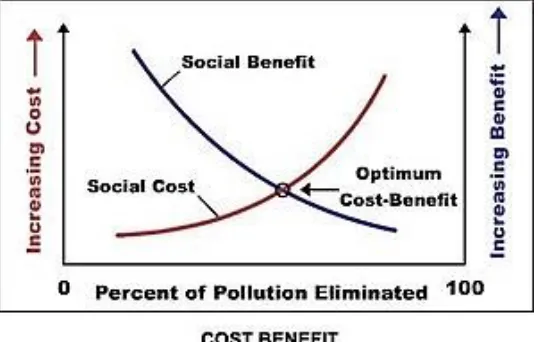
contrary, for a social cost benefit analysis, we should consider social opportunity costs instead of observed distorted prices (e.g., the social cost of Carbon versus its market price) and the markets that aren’t available or they don’t reflect true prices (e.g., health-related impacts of air pollution) (Rouhani et al., 2016b). Figure 1 shows an illustrative example of a social CBA.
The idea of a social or economic CBA is simple: all the costs and benefits associated with a project can be monetised, then, the overall impact can be expressed as a rate of return or, usually, as a benefit/cost ratio. Many researchers have examined transportation projects considering a more general approach for their evaluations (Weisbrod and Weisbrod, 1997). Several important considerations for a social CBA:
1. Regardless of particular characteristics of each factor (time, emissions, etc.), all items should be reduced to a common MONETARY metric;
2. CBA money is just a convenient broader economic metric (not financial); and 3. Fiscal corrections: economic transfers such as taxes should be removed.
Generally for an economic CBA, we consider additional attributes/factors, in addition to what is captured in a financial analysis. These attributes are:
– Indirect impacts to society, but tangible and can be valued in monetary terms;
– Costs of environmental impacts;
– Social benefits from using the project (Consumer surplus); and
– Public safety.
Although more inclusive than a financial CBA, an economic CBA is unable to consider the impacts on various sectors of economy and various stakeholder groups, and it usually considers the primary impacts, not the secondary impacts. A social welfare analysis could offer such missing information.
Multi-Criteria Analysis (MCA) or Multi-Criteria Decision Analysis (MCDA)
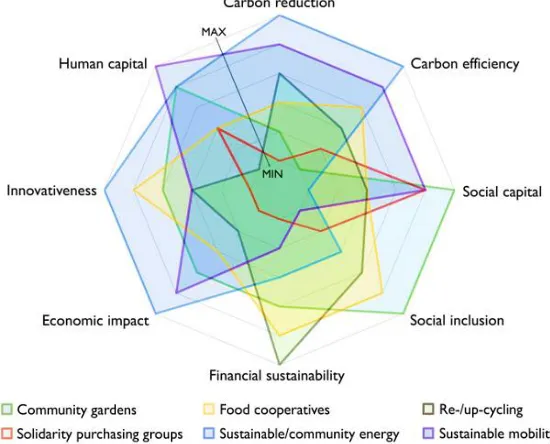
[image:5.612.173.442.145.316.2]Transport projects, or all infrastructure projects, arguably lead to substantial impacts in our life. The impacts could be measured by a set of different criteria that are not necessarily in monetary
5
terms, and in some cases, the criteria might be impossible to monetize (e.g., the value of life for an endangered species). Using an MCA, we capture a variety of impacts, including: (i) Direct costs and benefits in monetary terms; (ii) External impacts in their own units (e.g., reductions in emissions in tons). In fact, financial net present value (NPV) becomes one criterion in addition to other environmental, economic, social impacts. Several variations of MCA exist in the literature, e.g., the analytical hierarchy process (Dey, 2006; Bertolini et al., 2006), all approaches, however, follow a relatively similar procedure. The MCA approaches, combined with multi-actor methods, have been used extensively in the transportation field (Macharis et al. 2009).
The first step in a multi-criteria analysis is the definition and the identification of the alternatives or projects. The various relevant stakeholders are then identified as well as their key objectives (Step 2). Then, these objectives are translated into criteria and then given a relative importance (weights) (Step 3). For each criterion, one or more indicators are constructed (e.g., direct quantitative estimates such as money spent, number of lives saved, emissions reductions, etc. or scores on an ordinal indicator such as high/medium/low for criteria with values that are difficult to quantify) (Step 4). The measurement of each alternative performance is the next step. We need to construct an evaluation matrix aggregating each project’s contribution to the objectives of all stakeholders (Step 5). The MCA provides a ranking of the various alternative projects and determines the strong and weak points of the proposed projects (Step 6). The last steps includes the actual implementation and choice of the preferred project(s). Figure 2 shows one example of an MCA that includes various criteria.
Source:
http://www.tess-transition.eu/new-report-available-multi-criteria-analysis-for-carbon-efficient-projects-deliverable-4-2/
Cost-effectiveness (CE) analysis
[image:6.612.159.434.386.608.2]The CE analysis could be viewed as one version of CBA. The difference is that either costs or benefits could not be expressed in monetary terms. The evaluation is based on the efficiency of a
6
project in providing a service or mitigating an externality, for instance, the incremental cost per unit of additional outcome (Altshuler et al., 1980).
The question is when do we use cost-effectiveness? The answer is:
– If a project has especially one main intended benefit
– If we know the (reduced) cost but not the monetary benefit
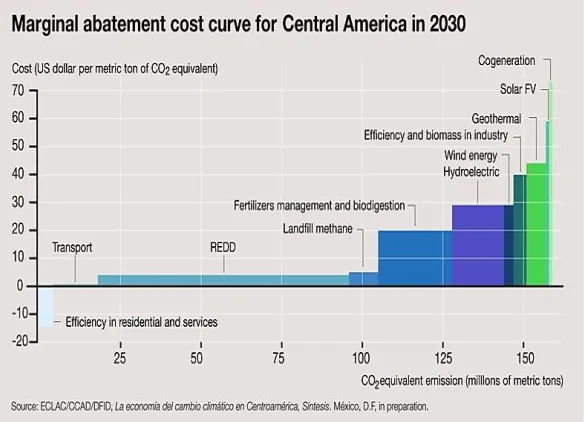
Usually we express costs of a project in $, and the benefits in their own units (for instance, tons of GHG reductions). The resulting CE measure will be in the unit of benefit/$ spent, for instance, 5 tons of reduced GHG emissions per dollar of money spent for the project or 0.2 dollars per ton. Although the CE measure could be informative, it focuses on only one benefit while transport projects usually provide many co-benefits, not only one. Nevertheless, transport researchers and practitioners have used this approach, mainly for climate-change-related transport projects (Nocera et al., 2015). Figure 3 shows one example of CE analysis for energy resources.
Social Welfare Analysis
To appraise transport projects, and generally public projects, the criterion for the evaluation should determine whether or not the approach serves the overall public interest, more general than the previously-discussed approaches (Rouhani, 2016). The social cost/benefit analysis, with the emphasis usually on net profits or sometimes on congestion management, is one common criterion that has been employed extensively. However, the most appropriate evaluation criterion is the overall social welfare impacts of projects. In addition, benefit/cost analyses generally lack the details required to examine impacts on various stakeholder groups and the sensitivity analysis to determine the impacts under various scenarios.
[image:7.612.162.454.281.492.2]The welfare (economic) effects of a project can be modelled by solving a general equilibrium model before and after the introduction of the project, even for small/local projects (Diewert, 1983). However, a detailed social welfare analysis can provide a framework that examines a variety of other factors. Although a few studies have examined the social welfare approach for
7
transport projects (Rouhani et al., 2016a), researchers and practitioners should develop detailed models required to capture welfare improvements from public projects, e.g., how to separate/categorize various stakeholders (Do et al., 2019), how to measure environmental and equity impacts in monetary terms (Rouhani and Niemeier, 2014a), what types of models required for the analysis, etc.
The social welfare is defined as the well-being of the entire society, concerned with the quality of life. The questions then are how we can measure social welfare and what types of models are required. Based on the economic theory, social welfare W(.) is a function of the utility functions of all individuals Ui(.), which are themselves functions of the goods Qij they consume and inputs
Iikthey produce. In fact, we should define it as W(Ui(Qij , Iik)).
Now, how the welfare of a society is related to utility of individuals? There are several theories: (i) Utilitarianism (Jeremy Bentham): “The greatest good to the greatest number.” (Bentham 1789)
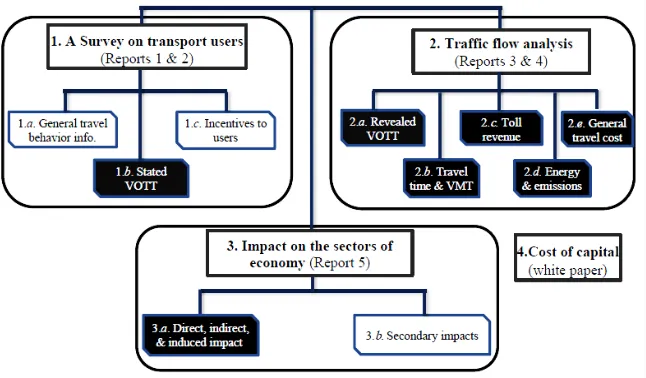
[image:8.612.146.469.427.616.2]Everyone’s utility should count equally, (ii) Rawls’ Theory of Social Justice: “Raise the well-being of the worst-off.”, where only the utility of the worst-off individual(s) counts. The key idea is that we do not need to determine the utility functions for all individuals, necessarily. We can determine the change in welfare as a result of a new project and use it as a proxy. The change in welfare results from the impacts on various stakeholder groups (users, residents, government, the private sector, employees, etc.), and the analysis can also examine the impacts for subgroups (different income level groups). Studies are moving toward considering many different aspects, and a social welfare analysis provides a unified criterion that can measure the overall impact of each project. Figure 4 shows one of my research studies estimating social welfare impacts of transport projects (Do et al., 2019).
Monte Carlo Simulation
A high degree of uncertainty exists in project analysis. Pohl and Mihaljek (1992) prove this by examining over 1,000 World Bank’s projects in terms of the rate of return. One important question
8
is how the government should treat the uncertainty associated with its decisions, including implementing new infrastructure projects (Arrow and Lind, 1978).
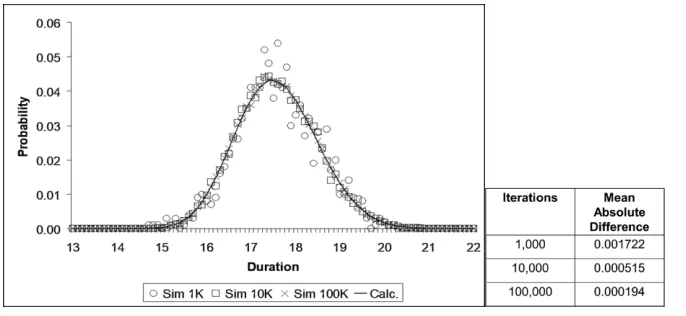
Because of uncertainty in task durations and also in revenues/costs, we should determine/consider the items as random variables. To overcome this, we can use Monte Carlo simulation approaches. The general idea is to generate new task durations or cost/revenue values (randomly pick), calculate the total project duration or the net present value. Each scenario run has a set of randomly picked values for all random variables. As a result, we will end up with a distribution(s) considering many scenarios. Note that the final outcome can be the total duration of a project or it can be the net present value of a project (Figure 5).
Source: Ahmed Sameh, Presentation Slides for Advanced Project Management
Conclusions
Transportation projects offer social benefits and costs. Transportation projects, more than many other infrastructure projects, have huge implications in our daily life. Moreover, for most transport projects, the public sector, in fact everyone in the society, should pay millions (billions) of dollars. These large costs and benefits demonstrate the importance of how to choose and how to evaluate these projects. Another important note is that the early appraisal of a project should apply essentially the same evaluation criteria as in ex post evaluation, and thus increase the likelihood of a successful project outcome (Samset and Christensen, 2017). In this paper, I overviewed the key common approaches for evaluating transportation projects.
Copyright Note
[image:9.612.139.482.241.399.2]The author certifies that he has the right to deposit the contribution with MPRA.
9 References
Altshuler, Alan, James P. Womack, and John R. Pucher, 1980. "The urban transportation system: Politics and policy innovation." Journal of Economic Literature 18, no. 3.
Arrow, K. J., & Lind, R. C., 1978. “Uncertainty and the evaluation of public investment decisions.” In Uncertainty in Economics (pp. 403-421).
Beheshtian et al. (2017). "Planning resilient motor-fuel supply chain" International Journal of Disaster Risk Reduction 24 (2017): 312-325.
Bertolini, M., Braglia, M., & Carmignani, G., 2006. “Application of the AHP methodology in making a proposal for a public work contract.” International Journal of Project Management, 24(5), 422-430.
Booth, P., & Schulz, A. K. D., 2004. “The impact of an ethical environment on managers' project evaluation judgments under agency problem conditions.” Accounting, Organizations and
Society, 29(5-6), 473-488.
Daher, N., F. Yasmin, M. Wang, E. Moradi, and O. M. Rouhani. (2018) "Perceptions,
Preferences, and Behavior Regarding Energy and Environmental Costs: The Case of Montreal Transport Users." Sustainability 10, 2 (2018): 514.
Diewert, W. E., 1983. “Cost-benefit analysis and project evaluation: A comparison of alternative approaches.” Journal of Public Economics, 22(3), 265-302.
Dey, P. K., 2006. “Integrated project evaluation and selection using multiple-attribute decision-making technique.” International Journal of Production Economics, 103(1), 90-103.
Do, W.; Rouhani, O.M.; Geddes, R.; Beheshtian, A. (2019). A Comprehensive Welfare Impact Analysis for Road Expansion Projects: A Case Study. Working paper.
Jones, H. L., Moura, F., & Domingos, T., 2018. “Transportation Infrastructure Project Evaluation: Transforming CBA to Include a Life Cycle Perspective.” In Handbook of Sustainability Science and Research (pp. 745-771). Springer, Cham.
Lin, C. Y., et al. (2009) "The implications of an E10 ethanol-blend policy for California." California State Controller John Chiang Statement of General Fund Cash Receipts and Disbursements 5.5 (2009): 6-7.
Litman, T. (2017). “Community cohesion as a transport planning objective.” Victoria Transport Policy Institute.
Macharis, C., De Witte, A., & Ampe, J., 2009. The multi‐actor, multi‐criteria analysis
10
Madani, K., et al. (2014) "A negotiation support system for resolving an international trans-boundary natural resource conflict." Environmental modelling & software 51 (2014): 240-249.
National Surface Transportation Infrastructure Financing Commission (NSTIFC), 2009. “Paying Our Way: A New Framework for Transportation Finance”, February 2009, 108,
https://financecommission.dot.gov/Documents/NSTIF_Commission_Final_Report_Mar09FNL.p df (accessed February 5, 2017).
Nocera, S., Tonin, S., & Cavallaro, F., 2015. “The economic impact of greenhouse gas abatement through a meta-analysis: Valuation, consequences and implications in terms of transport policy.” Transport Policy, 37, 31-43.
Poorzahedy, H., & Rouhani, O. M. (2007). “Hybrid meta-heuristic algorithms for solving network design problem.” European Journal of Operational Research, 182(2), 578-596.
Policy EU Guide (2008). “Guide to cost-benefit analysis of investment projects.” The EU.
https://ec.europa.eu/inea/sites/inea/files/cba_guide_cohesion_policy.pdf (accessed February 5, 2017).
Pohl, G., & Mihaljek, D., 1992. “Project evaluation and uncertainty in practice: A statistical analysis of rate-of-return divergences of 1,015 World Bank projects.” The World Bank Economic Review, 6(2), 255-277.
Rouhani, O.M. et al. (2013) “Integrated modeling framework for leasing urban roads: A case study
of Fresno, California.” Transportation Research Part B, 48 (1): 17-30.1
Rouhani, O. M. (2013) "Clean development mechanism: an appropriate approach to reduce greenhouse gas emissions from transportation." Transportation Research Board 92 (2013).
Rouhani, O.M., and A. Beheshtian (2013) “Social and Private Costs of Driving.” Lecture presentation at the 2013 Annual Conference of the International Transportation Economics Association, Northwestern University, Evanston, Illinois.
Rouhani, O., and D. Niemeier (2011). “Urban Network Privatization: Example of a Small Network.” Transportation Research Record: Journal of the Transportation Research Board, (2221), 46-56.
Rouhani, O.M., and D. Niemeier (2014a) “Resolving the Property Right of Transportation Emissions through Public-Private Partnerships.” Transportation Research Part D, 31: 48-60.
Rouhani, O.M., and D. Niemeier (2014b) “Flat versus Spatially Variable Tolling: A Case Study
11
Rouhani, O.M., and H. Zarei (2014) “Fuel Consumption Information: An Alternative for
Congestion Pricing?” Road and Transport Research, 23(3), 52-64.
Rouhani, O.M., and H.O. Gao (2014) “An Advanced Traveler General Information System for
Fresno, CA”, Transportation Research Part A, 67: 254-267.
Rouhani, O. M. (2012) Frameworks for public-private partnerships. University of California, Davis, 2012.
Rouhani, O. M. (2016) "Next Generations of Road Pricing: Social Welfare Enhancing." Sustainability 8.3 (2016): 1-15.
Rouhani, O. M. (2018) "Beyond Standard Zonal Congestion Pricing: A Detailed Impact Analysis." Journal of Transportation Engineering, Part A: Systems 144, 9 (2018): 04018052.
Rouhani, O. M., and A. Beheshtian. (2016) "Energy Management." Book chapter in Multi Vol. Set on Energy Science and Technology.
Rouhani, O. M., and H. O. Gao. (2016) "Evaluating various road ownership structures and potential competition on an urban road network." Networks and Spatial Economics 16.4 (2016): 1019-1042.
Rouhani, O. M. et al. (2014) "Road supply in central London: Addition of an ignored social cost." Journal of the Transportation Research Forum. Vol. 53. No. 1. Transportation Research Forum, 2014.
Rouhani, O. M., et al. (2015a) "Policy lessons for regulating public–private partnership tolling schemes in urban environments." Transport Policy 41 (2015): 68-79.
Rouhani, O. M., et al. (2015b) “Implications of fuel and emissions externalities, spillovers to the outside, and temporal variations on zonal congestion pricing schemes.” TRB paper No. 15-0905. 2015.
Rouhani, O. M., et al. (2016a) "Social welfare analysis of investment public–private partnership approaches for transportation projects." Transportation Research Part A: Policy and Practice 88 (2016): 86-103.
Rouhani, O. M., et al. (2016b) "Cost-benefit analysis of various California renewable portfolio standard targets: Is a 33% RPS optimal?" Renewable and Sustainable Energy Reviews 62 (2016): 1122-1132.
12
Samset, K., & Christensen, T., 2017. “Ex ante project evaluation and the complexity of early decision-making.” Public Organization Review, 17(1), 1-17.
Weisbrod, G., & Weisbrod, B., 1997. “Assessing the economic impact of transportation projects: How to choose the appropriate technique for your project.” Transportation Research Circular, (477).
Winston, C., 2012, “U.S. Transportation System Performance: It’s Effects on the Economy and Alternative Policy Reforms”, Washington, DC: Brookings Institution working paper, 2012.