A Thesis Submitted for the Degree of PhD at the University of Warwick
http://go.warwick.ac.uk/wrap/36103
This thesis is made available online and is protected by original copyright. Please scroll down to view the document itself.
By
Mesfer M. M. M. Al-Ajmi
A Thesis Submitted for the Degree of Doctor of Philosophy in Industrial and Business Studies (Finance)
Accounting & Finance Department Warwick Business School
Table of Contents
Acknowledgements Abstract
List of Tables List of Figures List of Appendices Abbreviations
Chapter I Introduction
1.1 Introduction
1.2 The Study's Methodology
1.3 The Need for this Research
1.4 Organisation and Outline of this Study
Chapter II The Structure of the Gulf Equity Markets
2.1 Introduction
2.2 Kuwait
2.2.1 Country Background
2.2.2 Financial and Banking System
2.2.3 Development and the Structure of the Kuwaiti Equity Market
2.3 Saudi Arabia
2.3.1 Country Background
2.3.2 Financial and Banking System
2.3.3 Development and the Structure of the Saudi Equity Market
2.4 Bahrain
2.4.1 Country Background
2.4.2 Financial and Banking System
2.4.3 Development and the Structure of the
Bahrain Equity Market 62
2.5 Oman 71
2.5.1 Country Background 71
2.5.2 Financial and Banking System 72 2.5.3 Development and the Structure of the
Oman Equity Market 74
2.6 Comparisons and Conclusion 81 Chapter III Literature Review of Capital Market Efficiency 91
3.1 Introduction 91
3.2 Background and the Definition of Market Efficiency 92
3.3 Debate of Market Efficiency Definition 98
3.4 Efficient Market Anomalies 102
3.5 The Role of Transaction Costs in an Efficient Market 108
3.6 Significance of Capital Market Efficiency 112
3.7 Weak Form Tests of Market Efficiency 114
3.8 Evidence of the Semi Strong & Strong Form 138
3.9 Problems for Testing for Market Efficiency 144
3.10 Conclusion 147
Chapter IV Survey Interview of the Gulf Equity Markets 152
4.1 Introduction 152
4.2 Sampling 153
4.3 Data Collection 154
4.4 Data Analysis 155
4.4.1 Section One 156
4.4.2 Section Two 157
4.4.2.1 Analysis by Country 157
4.4.3 Section Three 183
4.4..4 Section Four 195
4.5 Conclusion
Chapter V Data and Methodology
5.1 Introduction
5.2 Data collection
5.3 Sampling of Data and Selection of Actual Stocks
5.4 Data Transformation
5.5 Adjustments of the Sample Data
5.6 Methodology
5.6.1 The Random walk 5.6.2 Distributions Statistics 5.6.3 The Hypotheses 5.6.4 Day-of-the Week Test
5.6.5 Measurements of Transaction Costs
5.7 Conclusion
Chapter VI Results of Weak Form Efficiency
6.1 Introduction
6.2 Distribution Statistics
6.3 Serial Correlation Results
6.4 Runs Test results
6.5 Day-of-the Week Results
6.6 Conclusion
Chapter VII Results of Transaction Costs
7.1 Introduction
7.2 The Roll Methods Results
7.3 The Modified Method Results
7.4 Conclusion 275
Chapter VIII Conclusion and Policy Implications 278
8.1 Introduction 278
8.2 Common Factors 282
8.3 Implication of the Study 283
8.4 General Policy Implication 286
8.4.1 Prospective Role for GIC 286
8.5 Limitation of the Study 291
8.6 Suggestion for Further Research 292
Bibliography 295
Acknowledgements
My sincere thanks to all the people who have made this thesis possible. I extend to those named herein my appreciation for their valuable time and support given this endeavour.
First, I would like to express my sincere thanks to my first supervisor Professor Anthony Steele for his excellent academic suggestions throughout the completion of my thesis. His stand, support and encouragement to me during the most difficult time (the invasion of Kuwait in 1990) had a significant impact on my morale during that period. His confidence in my ability has made this work achievable, words will not be able to express my thanks.
Second, I am indebted to my second supervisor Dr. Jack Broyles for his very experienced and valuable comments during my work. I would like to acknowledge Dr. George Diacogiannis my previous supervisor for giving me the supervision during the period of November 1989 to March 1991. Many thanks also goes to Dr. Claire Morris from the Operational Research Group at Warwick University for her comments on my results.
I am grateful to Mrs Frances Halstead for all the help regarding my enquires about the use of SAS Software and also to Mr. Keith Halstead the director of the Computing Centre at Warwick University who helped me set out some of my programs to run my statistical analysis. Thanks to the friends who helped me in certain aspects of my work; Sanji Yadof and Kerry Patefield.
I would like to extend my thanks to the Saudi Arabian Monetary Agency (Department of Shares' Control) and Muscat Securities Market for freely supplying me with the raw data and also my thanks to the staff of the four Gulf Equity Markets for helping me to conduct my survey.
Abstract
The present study extends the literature available on the equity markets of developing countries by describing the development, the structure and by investigating the performance of the Gulf Equity markets in Kuwait, Saudi Arabia, Bahrain and Oman.
First, an attempt was made to evaluate these equity markets by briefly examining the financial systems, providing a historical background to their development and introducing their current structure.
Second, the thesis examines the performance of these markets by; (a) conducting a survey interviews to find out the obstacles for growth and investments in these markets; (b) investigating whether share returns are independent (c) investigating whether successive share returns are random (d) examining whether there is any pattern, for instance, day-of-the -week effect on the share returns; (e) estimating their transaction costs (the effective bid-ask spread).
To analyse the performance, the study employed the classical techniques of Fama (1965), Errunza and Losoq (1985) and Dickinson and Muragu (1994) to determine the independency and randomness of share returns. The method of French (1980), Solnik and Bousquet (1990) and Insup Lee et al (1990) is used to test for the day-of-the week effect. Roll (1984) and Hsia, Fuller and Kao (1994) methods were used to estimate the transaction costs (the effective bid-ask spread).
To summarise, the results show that the Gulf Equity Markets have a dependency on their share returns for Kuwait, Saudi Arabia, Bahrain and a lesser dependency for Oman Market. On the other hand, the share returns on each of the four markets were shown to be non random. The day of the week effect was not found in the market of Kuwait, Bahrain and Oman, whereas the Saudi Market showed the day-of-the week effect in the two periods tested.
List of Tables
Table
2.1 Summary of Kuwait Public Revenues
2.2 Commercial Banks Assets (Kuwait)
2.3 Total Assets of Specialised Banks in Kuwait
2.4 Kuwait Share Holding Companies
2.5 Value of Traded Shares of Kuwait Stock Market
2.6 Total Assets of the Saudi Commercial Banks
2.7 Saudi Commercial Banks Operating Branches
2.8 Total Assets of Saudi Specialised Credit Institutions
2.9 Credit Disbursements by the Saudi Specialised Credit Institutions
2.10 Saudi Arabia Public Oil Revenues
2.11 Saudi Traded Companies
2.12 Classification of Share Prices Commissions
2.13 Annual Movement of the Saudi Traded Shares
2.14 Total Assets of the Bahraini Specialised Banks
2.15 First Bahraini Established Companies
2.16 Traded Companies at the Bahraini Stock Market
2.17 Annual Statistics of the Bahrain Market
2.18 First Established Omani Companies
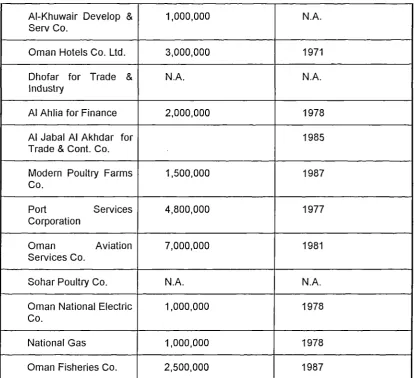
2.19 Omani Traded Companies
2.20 Omani Stock Market Statistics
2.21 Organisation and Structure of the Gulf Equity Markets
88 89 89 125 130 134 157 160 177 181 184 188 192 230 232 232 235 236 237 242 244 251 2.22 Aggregate Statistics of the Gulf Equity Markets
2.23 Comparison of Market Capitalisation of the World Stock Markets
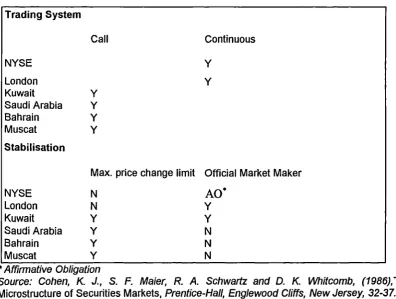
2.24 Trading Systems and Stabilisation of the US, UK and the Gulf
3.1 Tests of Weak-Form of UK Market
3.2 Tests of Weak-Form of European Markets
3.2 Tests of Weak-Form of Non-European Markets
4.1 Respondents by Country
4.2 Analysis of Responses by Country
4.3 Analysis of Responses by Occupation
4.4 Analysis of Responses by Years of Experience
4.5 Ranking Importance by Country
4.6 Ranking Importance by Occupation
4.7 Ranking Importance by Years of Experience
6.1 Average Empirical Distribution (Daily)
6.2 Average Empirical Distribution (Weekly)
6.3 Differences of Range of Standard Deviation (Daily)
6.4 Differences of Range of Standard Deviation (Weekly)
6.5 Moments of Statistics of Daily Observations
6.6 A Comparison of Mean Absolute Value of the Gulf Markets
6.7 A Comparable Results of Mean Absolute Value of Other Markets
6.8 Absolute Mean of the Standardised Value of the Runs Tests
6.10 Moments Statistics for the Two Periods for the Saudi Market 255
6.11 Results of the Mean Equality Across Days of the Week 256
6.12 Summary Results for the Gulf Markets 258
7.1 The Estimated Bid-Ask Spread 263
7.2 The Percentage of Imaginary Values in the
Daily and Weekly Data 265
7.3 The Relation between Size and Spread 266
7.4 The Relation between the Spread and the Frequency of Trade 263
7.5 The Direct Estimate of the Spread 269
7.6 The Mean Spread Estimates of the
Daily, Weekly and Monthly Data 272
7.7 A Comparison of the Spread Estimates
List of Figures
Figure
Figure 2-1 Map of the Gulf Countries
Figure 2-2 Financial & Banking System in Kuwait
Figure 2-3 Financial & Banking System in Saudi Arabia
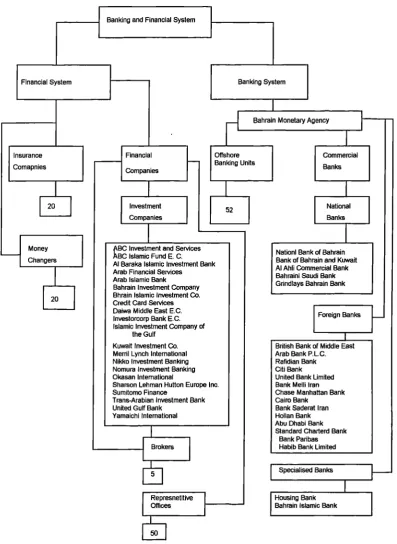
Figure 2-4 Financial & Banking System in Bahrain
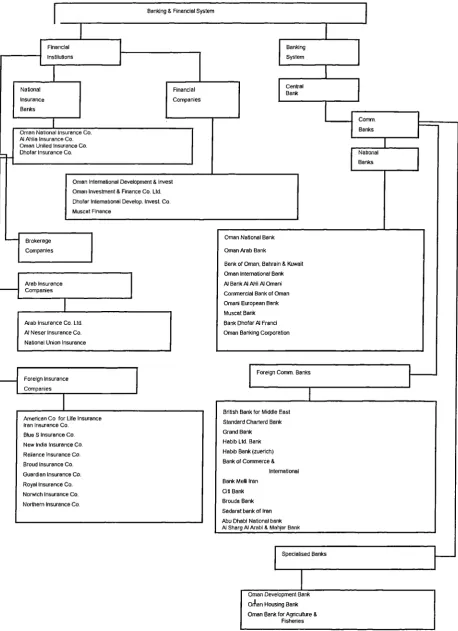
Figure 2-5 Financial & Banking System In Oman
Figure 4.1 Increase Number of Companies
Figure 4.2 Dissemination of Information by Government Agencies
Figure 4.3 Analysis By Country
Figure 4.4 A Comparison By Occupation
Figure 4.5 Responses By Years Of Experience
Figure 5.1 The Path of Bid (Ask) Price
Figure 5.2 Joint Probability of Successive Price Changes
Figure 5.3 The Probability between Price and Spread
Figure 6.1 Comparison of Randomness
Figure 7.1 A Comparison of the Spread (Roll)
Figure 7.2 A Comparison of the Transaction
Costs between the Gulf and the US
Page
12
18
0
55
73
162
170
186
190
194
219
219
220
250
264
List of Appendices
Appendix
2.1 Aggregate Statistics of The Gulf Countries
4.1 Survey Interview of the Gulf Equity Markets
4.2 Survey Analysis Programme
6.1(a) Empirical Distribution Programme
6.1(b) Runs Test Programme
7.1(a) Modified Method Programme
6.1(1) Empirical Frequency Distribution for Kuwait (Daily)
6.1(2) Empirical Frequency Distribution for Kuwait (Weekly)
6.1(3) Empirical Frequency Distribution for Saudi Arabia (Daily)
6.1(4) Empirical Frequency Distribution for Saudi Arabia (Weekly)
6.1(5) Empirical Frequency Distribution for Bahrain (Daily)
6.1(6) Empirical Frequency Distribution for Bahrain (Weekly)
6.1(7) Empirical Frequency Distribution for Oman (Daily)
6.1(8) Empirical Frequency Distribution for Oman (Weekly)
6.2(1) Serial Correlation Coefficients of Kuwait (Daily)
6.2(2) Serial Correlation Coefficients of the Kuwait (Weekly)
6.2(3) Serial Correlation Coefficients of Saudi Arabia (Daily)
6.2(4) Serial Correlation Coefficients of Saudi Arabia (Weekly)
6.2(5)Serial Correlation Coefficients of Bahrain (Daily)
6.2(6) Serial Correlation Coefficients of Bahrain (Weekly)
6.2(7) Serial Correlation Coefficients of Oman (Daily)
6.2(8) Serial Correlation Coefficients of Oman (Weekly) 351
6.3(1) Runs Results for the Daily Data of Kuwait 352
6.3(2) Runs Results for the Weekly Data of Kuwait 352
6.3(3) Runs Results for the Daily Data of Saudi Arabia 353
6.3(4) Runs Results for the Weekly Data of Saudi Arabia 353
6.3(5) Runs Results of the Daily Data for Bahrain 354
6.3(6) Runs Results of the Weekly Data for Bahrain 354
6.3(7) Runs Results for the Daily Data of Oman 354
6.3(8) Runs Results for the Weekly Data of Oman 354
7.1 Spread Estimates for Kuwait Market 355
7.2 Spread Estimates for Saudi Arabia Market 356
7.3 Spread Estimates for Bahrain Market 358
7.4 Spread Estimates for Oman Market 359
7.5 Spread Estimates for Kuwait (Modified Method) 360
7.6 Spread Estimates for Saudi Arabia (Modified Method) 361
7.7 Spread Estimates for Bahrain (Modified Method) 363
Abbreviations
Abbreviations
SAMA = Saudi Monetary Agency
GCC = Gulf Cooperation Council
CBK = Central Bank of Kuwait
BMA = Bahrain Monetary Agency
bn = Billion
SR = Saudi Riyal KD = Kuwaiti Dinar
BD = Bahraini Dinar
OR Omani Riyal
OBU = Off Shore Bank Unit
EMH = Efficient Market Hypothesis
Chapter II: The Development and Structure of the Gulf Equity Markets
2.1 Introduction
There are six countries that constitutes the Gulf Co-operation Council:
Kuwait, Saudi Arabia, Bahrain, Oman, Qatar and the United Arab
Emirates. A treaty was signed by the head of the Council States on 25
May 1981 to form the council with the underlying aim of effecting the
social and economic integration of the member states.
Since 1981, some progress has been made towards the goals of the
Unified Economic Treaty between the Gulf States. Two articles constitute
Chapter Two of the treaty about the movement of capital and individuals
and the exercise of economic activity. Article No. 81 of the Chapter states:
"The Member States shall agree on executive principles to ensure that each Member State shall grant the citizens of all other Member States the same treatment as is granted to its own citizens without any discrimination of differentiation in the following fields:
1. Freedom of movement, work and residence. 2. Right of ownership, inheritance and bequest. 3. Freedom of exercising economic activity. 4. Freedom of movement of capital."
Also, Chapter six about the financial and monetary co-operation is set into
three articles. Article No. 212 states:
and. Article No. 22 states:
"Member States shall seek to Co-ordinate their financial, monetary and banking policies and enhance co-operation between monetary agencies and central banks, including the endeavour to establish a joint currency in order to further their desired economic goals".
These countries share a similar great dependency on the exporting of oil.
Figures of 1989 show the oil as percentage of the total export: 86% in
Saudi Arabia, 83.7% in Kuwait, UAE 87%, Oman 87.9%, Bahrain 41.6%,
and Qatar 90%. That had affected directly the development and the
evolvement of equity markets on the CCC Countries (see appendix No.
2.1).
Permission for citizens of GCC Countries to own shares was granted at
the GCC summit in December 1988 in Bahrain. Even though the
permission of share's ownership has been granted, there are still
obstacles in the way of making it a practicality.
The accounts describe economies which have undergone rapid
development over the last 50 years, with sophisticated financial
institutions to match this development. The evolution of regulation follows
linked but separate paths, resulting in a collection of equity markets which
are similar but not identical.
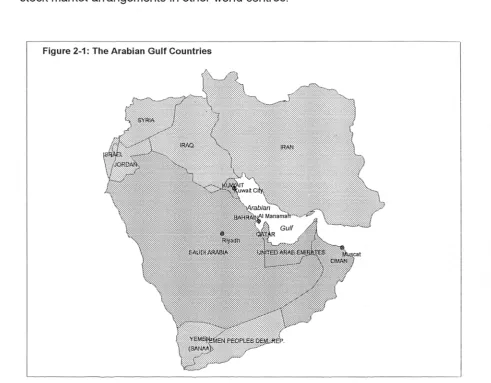
The focus of the study will be on four of the Gulf States Countries as in
figure No. 2.1 (Kuwait, Saudi Arabia, Oman and Bahrain) and this chapter
is to give a a background and a brief introduction to the financial systems
of each country. Second, it gives details of their equity markets:
comparision of the market microstructures of the Gulf markets, with the
[image:18.595.62.554.116.499.2]stock market arrangements in other world centres.
Figure 2-1: The Arabian Gulf Countries
There is very little economic literature which covers the ground we must
tread. Inevitably drawing on institutional sources one is drawn to the small
scale detail of the regulations. In the analysis which follows we aim for a
middle level description which sets out the institutional facts, but also
draws themes and threads of the historical development of these markets
2.2 Kuwait.
2.2.1 The Country Background
Kuwait lies at the head of the Arabian Gulf on the western side bordered by Saudi Arabia and Iraq. Its total area of 17,818 sq. km includes the mainland, the sizeable island of Bubiyan and other off-shore islands, and the Kuwait share of the Partitioned Zone. The Partitioned Zone was, until 1966, referred to as the Neutral Zone, and had been owned and administered jointly by Saudi Arabia and Kuwait since1922. In 1966 administration over the partitioned halves was yielded to the sovereign states, although production of oil and gas from concession in the Zone still shared equally4.
Until the commercial production of oil began in 1945, Kuwait was only a city-state comprising the present capital which was a significant port in terms of pearl fishing and general entrepot trading. This concentration has largely persisted to this day, with 66 per cent of the 1985 census population located within the capital or its suburbs. The only other significant urban area is south of Kuwait City in the Al-Ahmadi industrial heartland, although a large new town is scheduled to be built at the northern end of the country over the next decade.
OCb CD
.to o• 0 o
SI
(b C) o -' :Co U CD C) CD z 0 C, CD CD C CD Cl) 0-0) 0) 0) 0) 0) 0) 0)
0) - 0) 01 4 C,) N)
- - N) N) N) N) N) oo
CD - 0 .f CD 0) CD
CD 0) CD CD N) 0) 0) <
- ) - 0.) C.') - -i CD
CD -J -J _0)
-CD
(I,
N) N) N) N) N) 1\) 1\)
0) -1 (31 (71 01 0) - CI)
0 -J 0 0 - J. <
0.) CDCD
CD C')
N) - N) N) C.') N) 0.) -1
N) -.J 0) - 0) 0 0
01 0.) 4 -1 0 0
- 0 01 (31 N) 0)
CD - 4 0 01
- - - - -
-CD CO CD CD CD CD CD
CD CD CD CD 0) 0)
0.) N) - 0 CD 0)
-- - - - - - Cl
CO (0 CD (0 CD CD
(0 CD CD CD CD 0)
-ri. 0) N) - 0 CD
N) N) * * 0
- 0 CD 0
- 0) CD 0)
CD 01 91 01 (11 CD
0) CO
-CD 0)
N) N) - N) N) 0)
CD -J (71 0) CD CD
0) - CD P N
CD 4 CD CD -.1 -,
C
CD ()
N) N) 0) N) 0.) N) -1
0) 4 -J N) 0.) 0
- 0) -I C.') 0.) 0)
C.') C
0) 0)
-I-The seventh population census of Kuwait which was conducted in April 1985, showed that population of Kuwait reached 1,697,301. and then a later census taken in 1990 showed the population had increased to 2,O9O,O00'and it is be expected to be around 3 million by year 2000.
2.2.2 The Financial and the Banking Sector:
The main institutions today operating within the framework of the financial and banking sector in Kuwait. are the Ministry of Finance, Ministry of Commerce, and the Central Bank. The role of the public authorities is a recent development and previously the private sector was far less regulated.
When the first currency regulation was introduced in 1960, the banking sector constituted only of four banks - the National Bank of Kuwait, Gulf Bank, Bank of Kuwait and Middle East (between 1941 and 1970 known as the British Bank for the Middle East), and the Commercial Bank. After 1960, there was a rise in the number of banks and the range of their activities, and also the rise of other financial companies. The Saving and Credit Bank was established in 1961, followed by the Kuwait Investment Company in 1962 as the first investment company. Then in 1964, the Kuwait Foreign, Trading, Contracting, and Investment Company was formed.(KFTCIC).
The constituents of the banking sector in Kuwait are: the Central Bank of Kuwait, six commercial banks, one commercial bank of joint-ownership (between Kuwait and Bahrain), three specialised banks, and one Islamic bank. The commercial banks are ; National Bank of Kuwait, Gulf Bank, Bank of Kuwait and Middle East, Commercial Bank, Al Ahli Bank, Burgan Bank and the Bank of Kuwait and Bahrain. The assets of the commercial banks are shown in Table 2.2.
Table 2.2: Kuwait Commercial Banks Assets (Million Dinars)
End of the Total Assets End of the Total Assets
Period Period
1985 9053,3 1990 11135.3
1986 9307,8 1991 8413.1
1987 9942,5 1992 8359.7
1988 10401,9 1993 7839.0
1989 10972.0
Source: Kuwait Central Bank, (1989), Quarterly Statistical Bulletin (June-July)
The Islamic bank is the Kuwait Finance House, and the specialised banks are the Industrial Bank of Kuwait, the Credit and Saving, and the Real Estate Bank. The main activities of these banks which have been set up by government, are to fund industrial projects, private housing and industrial units respectively. Table 2.3 shows the assets of the specialised banks.
genera! partnership, limited partnership, joint stock company, limited liability company, and the joint venture. The law is administrated by the Companies' Department at the Ministry of Commerce and Industry. Figure 2.2 provides an overview of the financial and banking framework in Kuwait.
Table 2.3: Total Assets of Specialised Banks(Million Dinars)
End of the Total Assets End of the Total Assets
Period Period
1985 2088.3 1990 1046.6
1986 2057.1 1991 761.6
1987 2051.8 1992 794.2
1988 2061.1 1993 695.9
1989 1013.9
Source: Kuwait Central Bank, 1989, Quarterly Statistical bulletin (June-July)
2.2.3 Development and the Structure of the Kuwaiti Equity Market
The purpose of this section is to describe the historical stages of development of the equity market. The changing face of the economy from pearl fishing and trading to one based on the exploitation of mineral resources has lead to a rapid development in financial institutions.
National Banks
National Bank of Kuwait Commercial Bank Gulf Bank Al Ahli Bank Bank of Kuwait & Middle East Burgan Bank
Bank of Bahrain & Kuwait Kuwait Finance
House
Specialised Banks
Saving & Credit Bank Real Estate Bank
Industrial Bank
[image:24.595.78.430.98.766.2]18
Figure NO. 2-2: Financial & Banking Sector in Kuwait
The Financial & Banking Sector
Financial Institutions Banking Sector
Insurance Investment Central Bank
Companies Companies of Kuwait
Kuwait Insurance Co. Gulf Insurance Co. Al Ahlia Insurance Warba Insurance
Kuwait Investment Co. KFTICIC
African Arabic Investment Co. Kuwait International Invest. Co.
International Financial Advisors
Kuwait Financial Center Kuwait Co. for International
Finance Arabian Credit Co. Al Ahelia for Investment Arabian Invest, in Asia
Kuwait Financial Group Kuwait Euopean for Invest. National Invest. Group Commercial Facilities Arabian Securities Group Kuwait Finance Co. Securities House Co. Financial Circular Group First National Group for Invest First Brokerage Co.
International Invest. Trust Co. Kuwait Intersts for Financial
Invest. Jawhra for Invest. Middle East for Invest.
market until August 1990 when Iraq invaded the country. This resulted in
the closure of the market until 28 September 1992.
The Initial Stage
The period reflected the beginning of the transformation of the economy.
Following the discovery of oil in the Burgan field in 1938 the British Bank
of the Middle East opened its first branch in Kuwait in 1941. This was the
first modern financial institution in the country. Oil generated financial
resources were distributed to the citizens through government-established
domestic share holding companies in which shares were sold at a
discount to nationals.
The Kuwait National Bank was the first to be established in 1952. Its
capital of 13,100,000 Rupees 7 was divided into 131,000 shares with a
nominal value of 100 Rupees each. It was followed by the National Kuwait
Cinema Company in 1954 with a capital of KD 1.630.263, National
Airways in 1956, and Kuwait Petroleum Transport Company in 1957 with a
capital of KD 25.936.605. Due to this limited share issue there was no
securities market. Moreover, there was no speculation - the investors who
were involved in share trading were investment minded.
Between 1960 and 1970 many more share-holding companies were
established. Nine companies were established in 1961-1962 and eight
companies in 1963-1 968. Companies and trading began to be regulated
by Company Law in Law No. 15 in 1961, and organised trading began
after Law No. 27 in 1962.
By the end of 1968 there were twenty-five companies with a nominal
government and fifty-three per cent by the private sector. As the period closed, in 1970, Law No. 30 was issued to regulate share trading through a special advisory committee. The incorporation of the new companies and the increase of the capital of existing ones had increased the activities on the market and expansion of the new issues in this period.
The Second Stage: the Stock Market in the Period 1971 -1 980.
Law No. 32 of November 1970 established the basis for securities trading. The law was supervised by a department in the Ministry of Commerce and Industry in August 1971. Meanwhile, between 1971 and 1973 there were eleven new companies, between 1972 and 1974 eight companies in the real estate sector alone. The growth of the companies in real estate brought new depth to the market introducing many smaller investors to the market and made it possible for them to participate in the real estate market in which they could not invest individually.
There was a great deal of demand for these new companies. For example, the Kuwait International Investment Company was over-subscribed by 136 times. Furthermore, the general average price of stocks increased from about KD 15 in September 1970 to KD 20.4 in September 1971 and to more than KD 45 at the end of 1973.8 However, this spectacular increase was not accompanied by similar growth in the assets and profits of the companies or a qualitative change in their performance. For instance, the rise in prices even included stocks of newly established companies that had not started operations.
amount of premium earned through forward deals depended on several
factors, including the liquidity, intensity of trading and rates of share's
price increases. After these excesses it was inevitable that between
January 1974 and the end of March 1975 the market underwent an
adjustment to restore the price level to a realistic level.
One major factor in this readjustment was the Ministerial Decision No. 52
of 1974 which prohibited forward transactions in the securities markets.
Another factor was that this decline in the value of the shares coincided
with a general increase in the international interest rates which proved an
alternative attraction to local funds. Finally, Law No. 15 of 1960 was
reformed through the Amiri Decree No. 3 of 1975. Under this new rule, the
founders of new companies were under legal obligation to check the
subscriptions on application forms to prevent applications in duplicate
names. In support of the ban on forward trading, this regulation also
forbade trading in new companies before the publication of their first
balance sheet.
Under enabling legislation to fulfil Amiri No. 3, the nominal price of shares
was reduced KD 10 to KD 1 to widen share ownership among the public.
As a result, seven new public share holding companies were incorporated
between 1975 and November 1976 with a total capital of KD 45.75 million
divided into 45.75 million shares which included the Kuwait National
Petroleum Company and the Petrochemical Industries Company. These
two were fully acquired by the government which then withdrew their
shares from the market.
After a decline in 1974, the market revived during 1975 and 1976. Trading
immediately reflected in the prices. Finally, in the second quarter of 1976
the prices rose sharply to reflect the speculation. The average stock price amounted to as much as eleven times its average nominal value and as much as six times its book value.9
The speculation of 1976 originated in the real estate sector and passed from there to other sectors in the stock market, It was the result of a huge demand for commercial offices and land which led to the increase of rents and real estate prices. There were several factors which also helped the speculation. These included the easing of credit by the banks for real estate investments, the distributing of housing plots by the government, and the increase of amounts of social and housing loans provided by the Credit and Saving Bank. There were also other related elements. These were: the extension of bank credit facilities which increased liquidity and the resumption of forward deals which went out of the control of the Ministry of Commerce.
Share prices peaked in the second half of 1976, but because this was based mainly on speculation this was followed by a decline in prices and demand. In response the Ministry of Trade and Industry set up a security committee with broad authority for organising securities trading. Action to control the boom in bank credit was taken by the Central Bank.
In 1977, a stock exchange was introduced. Soon, measures were put in place to regulate forward transactions which involved defining the basis for concluding such deals and putting them under the supervision of the Ministry. As part of these measures the establishment of new companies was suspended and the capital of existing companies was restricted. Later, in December 1977, the government intervened through the Kuwait Foreign and Trading Company and International Contracting (KFTCIC) to buy stocks at the lowest prevailing prices. Moreover, banks were instructed to reduce interest rates on loans and extend the period of repayment for an additional two years, including the possibility of a further extension. Later on, when these measures appeared successful the ban on the establishment of new companies was lifted. The General Warehouse Company was formed in September 1979 as the first company after the ban was lifted.
Stock Market in the Period of 1980-1 990.
The stock markets in the 1980's can be divided into two periods which are separated by the Al-Manakh Crisis. I discuss the two periods: before the Al Manakh crisis 1980-1982 ,and after the crisis 1983-1 990, in turn.
24
Table 2.4: Kuwait Share Holding Companies:
Name Total Assets No. of Establishment ______________________ (K.D.) Shares Date
National Bank of 3,476,219 773,070 19.05.1952 Kuwait
Gulf Bank 1,897,391 574,771 23.11.1960 Kuwait Commercial 1,786,157 492,688 19.06.1960 Bank
Al-al-AhII Bank of 1,752,733 456,936 23.05.1967 Kuwait
Kuwait & Middle 1,062,704 432,671 24.02.1971 East Bank
Kuwait Real Estate 514,357 257,428 13.05.1992 Bank
Bank of Burgan 1,265,064 580,797 27.12.1975 Kuwait Finance 1,172,836 261,514 23.03.1977 House
First Gulf Bank 32,100 12,000 12.05.1979
Bahrain 104,932 699,604 10.05.1982
International Bank
Bahrain Middle 145,030 559,775 5.07.1982 East Bank
Kuwait Investment 331,730 518,832 25.11.1961 Co.
KFCTIC 656,641 540,000 16.01.1965
Kuwait International 146,905 319,022 22.09.1973 Invest.
Commercial 75,136 105,193 13.11.1976 Facilities
International 33,131 335,000 30.01.1974 Financial Advisor
National Investment 127,194 557,041 6.09.1987 Co.
Coast Investment & 64,270 440,000 27.07.1980 Development
Arabian General 36,241 581,518 25.04.1979 Investment_Corp. _______________ _______________ ______________ Kuwait Insurance 79,130 160,000 30.07.1960 Co.
Gulf Insurance Co. 40,640 113,100 09.04.1962 Al-AhIi Insurance 35,960 80,000 12.06.1962 Co.
Warba Insurance 17,666 57,531 24.10.1976 Co.
Arab International 2,379 16,800 8.03.1981 Insurance Co.
National Industries 102,022 242,975 8.01.1961 Co.
Kuwait Metal Pipes 31,990 152,070 24.08.1966 Manufacturing Co.
Kuwait Cement Co. 43,904 256,163 09.11.1968 Refrigeration 19,232 66,862 8.03.1973 Industries Co.
Gulf Cable & 41,965 56,345 15.03.1975 ElectricalIndustries ________________ ________________
________________-Kuwait 17,112 99,193 25.06.1980
Pharmaceutical Indust. Co.
Kuwait shipbuilding 18,882 251,004 2.04.1974 & Repair yard Co.
Contracting & 28,020 75,000 13.09.1973 Marine Services
UmmAl-Qaiwain 22,262 636.900 11.2.1982 Cement Industries 17,814 195,000 11.02.1982 Co.
Kuwait Real Estate 128,073 450,000 16.05.1972 Co.
National Real 62,349 360,544 16.07.1973 Estate Co.
Salhiah Real Estate 40,569 192,000 16.09.1974 Co.
Livestock Transport 42,022 216,618 28.11.1973 & Trading Co.
Kuwait United 10,721 70,000 07.02.1972 Fisheries
Kuwait United 17,119 115,404 30.11.1974 Poultry
Kuwait Foods Co. 40,367 1123,878 29.09.1963
Over Land 8,205 49,927 6.07.1977
Transport
Kuwait National 16,157 70,000 5.10.1954 Cinemas Co.
Kuwait Hotels Co. 9,174 50,000 12.06.1962
The Public 36,924 269,338 17.09.1979 Warehousing Co.
Kuwait Commercial 14,238 115,102 9.02.1982 Markets Complex
Co.
Mobile Telephone 42,180 249,998 9.01.1983 Systems Co.
Kuwait Computer 6,759 50,625 22.03.1983 Co.
Gulf Medical 5,873 67,500 1,08.1979 Projects Co.
source: fruwait stock Market, /-lnnual Keport, Various Issues.
A: 1980-1 982 (Before Souk Al Manakh Crisis)10
three companies led some investors to establish new companies in the other Gulf States.
Consequently, the restrictions were relaxed. In 1981, two new types of companies were created; closed joint companies and Gulf joint stock companies. By December 1981, there were six companies allowed to offer shares to the public, with a total capital of KD 51 million. Two Gulf1' companies, the Gulf Agricultural Development Company and Gulf Real Estate Investment Company, were also registered amounting to 33 KD million. There was much interest for share trading of the Gulf companies which led to the formation of local offices to conduct local transactions in what was called Souk Al-Manakh.
The significant interest of share trading in these companies led to the creation of a consulting committee chaired by the Ministry of Trade and Industry. The committee offered several proposals to regulate such companies. These included proposals for the following: the regulation of the trading of the Gulf companies; regulation by the Ministry for any changes related to these companies (for example. capital adjustments); the guidelines provided by the Ministry concerning the status of a company, should be taken into consideration.
to any financial logic and speculation on the unofficial market due to lack of regulation and control.
B: The Stock Market During the Period 1983-1 990.
During this recent period, the market was subjected to a number of new regulations and measures intended to maintain economic development and prevent a recurrence of the Crisis.
The government introduced several measures in response to the Al-Manakh Crisis which included fixing the maximum capital payable to creditors. Many of these had post-dated cheques and were willing to cooperate with the government in order to solve their problem through a specially constructed trust fund. Under the rules of this fund any amount up to KD 25 thousand was to be paid in cash to the creditor and the balance collected in the form of bonds with a maturity range from six months to six years.
Another response to the Crisis was creation of the Forward Shares Transaction Settlement Corporation in April 1983. Its function was to undertake the settlement of transactions, and also to evaluate the assets of people referred to the corporation. Another one of its functions was that it was legally authorised to manage, liquidate and execute settlements and, furthermore, to act on behalf of creditors whose debts resulted from forward share transactions.
functions of this Committee were to deal with the application of rules to regulate securities, the supervision of securities transactions. Furthermore, the Committee was empowered to act against any unlawful act on the market and to stop deals on the market when it became necessary.
Further regulation was introduced in November 1983. These brought new measures for the following important subjects: market objectives, management, membership, budget, disputes, and arbitration. They also specified preconditions for brokerage; the company and all its partners must be Kuwaiti, the brokers must be Kuwaitis with good qualifications and considerable experience, and those holding positions of management should not either have a criminal record or have been declared bankrupt. Finally, for brokerage companies the Committee required bank guarantees which would act as a ceiling for the sums the company could deal with.
Another forward step for the equity markets was the opening of the new stock exchange building in September 1984, which operate with the application of the system of written bidding in trading transactions, was opened. This was accompanied with internal rules and memorandum to improve the operation of the market itself.
concerning the preparation and submission of these companies' final accounts.
In October 1985, the government suspended trading the Gulf shares pending an assessment of their value. This review was undertaken by the Central Bank. Following this review of thirty-three companies, four of them were liquidated, a further four were merged. The board of directors of eleven more were changed, and the exclusive management of another ten were also changed. This review also involved companies which were not open to public ownership. Following this review of sixty-two private (closed) 12 companies three were closed, twenty-five were liquidated and a further five were merged.
Following a review of the stock market in Kuwait, two strategies were implemented to help channel savings toward profitable investments. These initiatives began in 1986. The first policy was intended to stabilise market turnover and to restrain speculation Those companies which had survived the review were felt to be solid and it was felt that increasing new issues by existing companies and forming new companies would channel saving toward real investments.
and 9 closed' 3 companies to be traded on the stock exchange. The
unofficial market would be created on the main floor with 30 Gulf
companies (f) there would be an annual fee of KD 10.000 incurred, plus
0.001 per cent of the capital of the listed companies (g) broking would be
conducted by a firm with a minimum capital of KD 100.000 and security
deposit of KD 250.000 (h) eleven stock Broking firms were licensed (i) two
companies would act as market makers (Security Group and Securities
House) (j) Kuwaiti Dinar Bonds would be admitted to the stock exchange.
Several rules for regulating the market's activities were issued by the
authorities. A price unit system was set to soften the speculations. This
provided that price increment during the trading session should not
exceed five points. A Ministerial Decision No. 5 entitled the management
to specify the brokerage companies through which foreword shares might
be traded and provided that the differential between the price of a forward
transaction and its spot price should not exceed 25 % of the total value of
the transaction.
Decision No. 16 on listing and regulating the work of market makers
stipulated that a company should be share holding company or Kuwaiti
financial institution , while its paid capital should not be less than KD IOM.
The third rule resulted in decision No. 132 which amended the provisions
of the commercial companies law. The first amendment divided all public
companies' shares into units worth one tenth of their value. The second
amendment authorised companies to buy up to 10% of their own shares.
The third amendment was to reduce the procedures for share title transfer.
A fourth Decree regulated the procedures of securities trading settlement
The following table shows the number and the value of the traded shares
for the years 1985-1 992. The year of 1988 shows an increase volume of
the traded shares and that mainly dependent on the stabilisation of the
region when the Iraq-Iran War finished. Also, it is noticeable the effect of
the Gulf War on 1990 on the market activities from 1990-1992.
Table 2.5: Kuwait Stock Market Value of Traded Shares (Official Market)
Period No. of Shares Value of shares No. of
Traded (Million Traded (Million Transaction
__________ KD) KD) _______________
1985 179.3 116.3 11229
1986 478.5 384.6 25236
1987 970.5 828.9 74526
1988 2798.3 710.7 63977
1989 1613 502.1 33506
1990 754 260.3 13810
1992 302 116.3 9100
Source:Kuwait Central Bank, (199, Quarterly Statistical Bulletin (June-July). Kuwait Stock Market, Annual Report, Various Issues.
In general, the trading on stocks of public share holding companies'
shares must be through the stock market. The exchange operates through
a conservative auction system which permits only moderate price changes
limiting the scale of daily movements in individual shares. When the
market is going in one direction, the market makers (Securities Group and
The new stock exchange is believed not following its original function
since there was a lack of participants in the market, attributed to the
large-scale government ownership of shares. It is believed that the government
in 1987 owned more than 5Q%14 of the shares of the 47 listed
companies' 5.
As can be seen, the market has gone through different stages of
development. In the initial period more new companies were established
with a large number of them established between 1960-1970. In the
1970's, trading increased as result of organising the secondary market. In
1977, the Stock Exchange was opened, followed by a large volume of
trading. The then market collapsed, as a result of speculation and lack of
regulation in Souk Al-Manakh in August 1982 .The government stood
strong by offering and imposing different solutions and measures. This led
to the adoption of new regulations and further measures to prevent a crisis
similar to that which occurred in Al-Manakh. A new stock exchange
opened in September 1984 under the supervision of a representative
committee. Until 2 August 1990 (the Iraqi invasion of the country), the
market witnessed a stable and more mature period.
2.3 Saudi Arabia
2.3.1 The Country Background
Saudi Arabia covers about four-fifths of the Arabian peninsula and has an
estimated area of 2.15 million sq. km . The international borders to the
south and east with the Yemen Arab Republic, Oman and the United Arab
Emirates are recently defined, while in the settlement of frontiers with
Kuwait and Iraq in the Northwest an attempt was made to protect the
rights of the region's nomadic population. The country is divided into four
al-Hasa (Eastern province) on the Arabian Gulf. South of Nejd lies the
Rub' al-Khali, or empty Quarter, where climatic conditions are generally
too harsh to support any kind of civilisation. The west coast is separated
from the central plateau by mountains, which provide more regular rainfall
and some agricultural potential in the Southwest. Oil and gas production
to date has been carried out in and off-shore in the low-lying Eastern
province, where several large oasis settlements are also located16
Apart from Saudi Arabia's oil and gas reserves, there are believed to be
sizeable deposits of other minerals. Although at present only salt,
limestone and gypsum are produced commercially, old gold and silver
mines in the western mountains have recently been reopened, and
deposits of phosphate, copper, bauxite and uranium are considered to be
of economic potential.
The 1992 Saudi census gave total population of 16.9 million people of
whom 12.3 Saudi nationals and 4.6 million resident foreigners. The annual
rate of growth of population in 1992 was 3.3 percent (Metz, 1992). The
1970s and early 1980s the pace of economic development and the
demand for labour prompted a situation in which many Saudi nationals
migrated to the towns, creating a shortage of agricultural labour. Also the
government and private sector were in competition for employees, with the
result that the significant increase in employment of Saudi nationals in
many sectors was obscured by an even greater increase in expatriate
employment. In 1985, the civilian work force totalled 4,446,000 of which
Saudi nationals represented 40 per cent. The overall work force, and the
number of expatriates, are both considered to be below the1985 levels at
present, with the fall in foreign workers being proportionately much larger
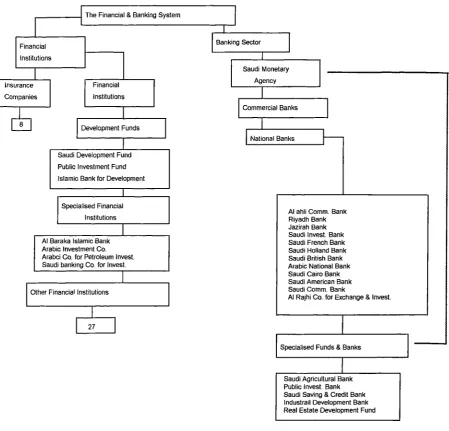
Other Financial Institutions Al Baraka Islamic Bank Arabic Investment Co. Arabci Co. for Petroleum Invest. Saudi banking Co. for Invest.
Specialised Financial
Institutions Al ahli Comm. BankRiyadh Bank Jazirah Bank Saudi Invest. Bank Saudi French Bank Saudi Holland Bank Saudi British Bank Arabic National Bank Saudi Cairo Bank Saudi American Bank Saudi Comm. Bank
Al Rajhi Co. for Exchange & Invest.
2.3.2 The Financial and the Banking Sector.
The main authorities concerned with finance in Saudi Arabia are the
Ministry of Trade, the Ministry of Finance and National Economy, and the
Ministry of Labour and Social Affairs. However, the only authority directly
concerned with the working of the financial system is the Ministry of
Finance and National Economy. These are four main aspects of
supervision which I shall discuss in turn. These are the Saudi Arabian
Monetary Agency (SAMA), the commercial banks, specialised government
[image:41.595.80.530.327.758.2]institutions, and investment sources (Pillimpan, 1989).
Figure NO. 2-3: The Saudi Financial & Banking System
The Financial & Banking System
Financial Banking Sector
Institutions
Saudi Monetary
Insurance Financial Agency
Companies Institutions
Commercial Banks
Development Funds
National Banks
Saudi Development Fund Public Investment Fund Islamic Bank for Development
27
Specialised Funds & Banks
Saudi Arabian Monetary Agency (SAMA).
SAMA was established in 1952 to supervise the banking and financial
sectors, monetary policy and foreign asset management on behalf of the
government.
It regulates foreign exchange bank deposits. One of its functions is to
regulate the markets to ensure that they conform to the Islamic law and
that no interest is paid. When share trading became regulated in 1985,
SAMA was made the responsible authority, and a new department called
"Shares Control" was established to supervise the day-to-day trading of
shares through commercial banks.
Commercial Banks and Money Changers:
The first commercial bank to be established in the Kingdom was a branch
of the Netherlands Trading Society in 1927. This was followed by other
banks, some foreign, some local such as - the National Commercial Bank
in 1938, followed by the Riyadh Bank in 1956. (See table 7).
From 1976 to 1983 the government pursued a Saudization policy which
involved transferring the foreign banks into Saudi joint stock companies.
The Saudization of foreign banks resulted in the formation of new banks:
AI-Jazirh Bank1 Saudi Investment Bank, Saudi Holland Bank, Saudi
French Bank. Saudi Cairo Bank, Arab National Bank, Saudi American
Bank, Saudi United Commercial Bank, Saudi British Bank, Riyadh Bank,
Al-Rajhi for Exchange and Investment.
Consequently, 60.6% of the ownership of these banks was transferred to
the Saudi private sector Which provided SAMA with a greater control of the
investors an opportunity in the domestic economy, and second, it
increased the capitalisation of the banks which widened their financial
market capabilities.
Table No. 2.6: Total Assets of Saudi Commercial Banks (Millions SR)
End of the Period Total Assets
1987 191,059
1988 216,239
1989 233,585
1990 232,055
Source: Saudi Monetary Agency, (1990), Annual Report.
The widening of the financial market capabilities resulted in more
competition between the commercial banks especially in the increased
role in short and mid-term financing, and through the increase in the
number of branches. The commercial banks began to offer interest on the
saving and deposit accounts despite the prohibition against usury The
banks were offering loans and charging interest, calling it a service
charge. However, when the customer failed to repay the loan, banks could
not legally claim it back, and that, in general, made the market restrictive
and conservative.
During the increase in oil prices in the 1970s and the Second
Development Plan (1975-1 980), banks were encouraged to become more
flexible in loan security requirements. Later, this policy was to have a
a difficulty of claiming their loans and interest from customers (because of the interest charged).
Commercial banks also faced competition from the bureaux des changes who performed most of the banks' activities up until 1982. There were four major companies which had 250 branches. Then a new regulatory regime was adopted by SAMA. An important change was the proof of the financial soundness of the money changers was needed, before licenses were given.
In 1983, SAMA introduced a further regulation which was aimed at preventing the money changers from receiving new deposits. By 1985, money changers were restricted only to currency exchange. If they wanted to engage in the range of activities they had previously done, they would have to register as commercial banks. Thus, large companies such as Rajhi for Exchange and Trade registered as a bank under a new name Al-Rajhi Exchange for Investment.
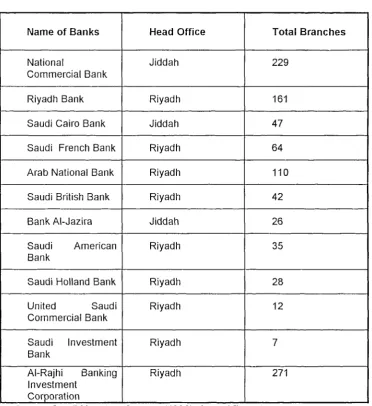
The regulation of share trading in 1985 further added responsibilities to the commercial banks since it restricted share trading to their branches. Table 2.7 shows the number of branches of commercial banks.
bureau de change which recently registered as a bank, the AI-Rajhi
Exchange for Investment also owns a significant number of shares in eight
Saudi joint stock companies. As can be seen from here, the government
connected institutional investors in Saudi Arabia thus consititute important
and significant b'ocks, which make the Saudi stock market different from
[image:45.595.75.448.249.656.2]Kuwait.
Table 2.7: Saudi Commercial Banks Operating Branches
Name of Banks Head Office Total Branches
National Jiddah 229
Commercial Bank
Riyadh Bank Riyadh 161
Saudi Cairo Bank Jiddah 47 Saudi French Bank Riyadh 64 Arab National Bank Riyadh 110 Saudi British Bank Riyadh 42
Bank Al-Jazira Jiddah 26
Saudi American Riyadh 35
Bank
Saudi Holland Bank Riyadh 28
United Saudi Riyadh 12
Commercial Bank
Saudi Investment Riyadh 7 Bank
Al-Rajhi banking Riyadh - 271 Investment
Corporation_______________________ _______________________ Source: Saudi Monetary Agency, (1990), Annual Report.
Government Specialised Credit Institutions.
The prime source of these institutions is the government. They are a major
during the first government plan period 1970-1975: The Saudi Agricultural Bank, The Real Estate Development Fund, Saudi Industrial Development Fund, The Specialised Funding Programme and Public Investment Funding.
The Saudi Agricultural Bank supplies the finance for implementing agricultural projects while residential and commercial construction projects are financed by the Real Estate Development Fund. The Saudi Industrial Development Fund focuses on financing electricity and long-term manufacturing projects. The Specialised Funding Programme has a wider range which includes funding for contractors, bakeries and importers of heavy equipment. Saudi Credit Bank finances small vocational business.
Table No. 2.8: The Total Assets of Saudi Specialised Credit lnstitutions(Million SR)
End of Period Total Assets
1987 197,570.9
1988 197,334.9
1989 196,684.7
1990 203,780.2
Source: Saudi Monetary Agency, (1990), Annual F?eport.
Table No. 2.9: Credit Disbursements by the Saudi Specialised Credit lnstitutions(Millions Ris)
Name 1987 1988 1989 1990
Saudi Agricultural 694 627 651 664 Bank_____________ _____________ _____________ _____________ Saudi Credit Bank 273 288 324 274 Public Investment 382 130 40 364 Fund____________ ____________ ____________ ____________
Saudi Indust. 542 440 828 667
Dev._Fund ___________ ___________ ___________ ___________
Real Estate Dev. 3,972 3,389 2,978 2,445 Fund_____________ _____________ _____________ _____________
Source: Saudi Monetary Agency, (199(J), Annual Heport.
Government Secondary Investment Sources.
In addition to direct influence by government, a number of government agencies have indirect or secondary influence. The General Organisation for Social Insurance and Retirement Pension Agency have both
contributed to the financial activities in Saudi Arabia. Their goals of establishment are:
1) To generate their own revenue.
2) To support the development projects of the country-and thus, they both participate in the capital ownership of various Saudi Joint Stock Companies.
Company and around 3% in Real Estate and Taibah Companies while the
General Organisation for Social Insurance holds 10% of Yanbah cement
Company, Saudi Cement and SAPTCO. It also holds 8% in the Saudi
Investment Bank and 5% on seven traded Companies.
Private Credit Institutions.
The concern of private credit Institutions is to finance short term projects
mainly for domestic requirements and small companies. They are licensed
by the Ministry of Trade. They have a limited effect on the financial
market, mostly because they use the Islamic way of financing , referred to
as 'Murabahah' and also lease-purchase finance.
The Private Sector.
The government in Saudi Arabia has promoted the role of the private
sector in building the infrastructure of the country. As a result, the private
sector enjoys several incentives including interest free loans from some of
the government agencies discussed above, exemption from custom duties
for raw materials and plant machinery, and public procurement policies
favouring private local investors.
Private sector companies range in size from small businesses to large
multinational corporations. These are generally established as joint stock
companies. Since 1982, establishing a joint stock company requires
registration with the Ministry of Trade. There are five classes of company
which require registration as a joint stock company directly from the
Council of Ministers. These are concessionary companies, companies
managing public utilities, companies receiving subsidies from the
government, companies in which the government or government agencies
2.3.3 Development and the Structure of the Saudi Equity Market
In the 1960s, there were few Saudi joint stock companies. The number
increased in the 1980s to thirty-seven joint stock companies with $ 5.7
billion of capital. The number of companies has increased substantially to
seventy-eight joint stock companies in the 1990's of which sixty are public
joint stock companies with a combined capital of $ 18 billion by 1992. This
section will procedure to give a description of the different stages of
development of the Saudi equity market.
The Initial Stage:
The first public joint stock company - a limited liability company in which
shares could be purchased by the public - was established in 1935. This
was the Arabian Automobile Company. The company failed and was
quickly liquidated. The oldest of the public joint stock companies still
trading is the Arab Cement Company which was made public in 1954.
Since the country at that time lacked even basic facilities, the main
companies which were established were in basic industries such as
cement, construction and electricity.
Only later were companies established in the financial sector. In 1956, the
Riyadh Bank was established with a capital of SR 50 million. Similarly, the
first joint stock company with foreign equity was only established in 1963.
The Arab Petro!eum Exploration company was formed with a capital of SR.
10 million of which forty-nine per cent was held by foreign partners. By
1964, there were seventeen joint companies with a capital of SR 2955
million consisting of 28.9 million shares. Most of these companies were in
The growth of the equity market really occurred after the announcement of the Company Act (1965/1385' ) which made it easier to become established as a company. Between 1965 and 1974 thirty-seven new companies were established with SR 3,000 million in capital. However, these were still in the basic industries. Thirty one of them were in the electricity industry. Of the remaining six, four were closed joint petroleum companies, i.e. without their shares traded publicly, and the remaining two companies were the Saudi Arabian Fertiliser Company and the National Gas Industry Company.
At that time share investment was limited partly due to lack of awareness of trading and the related tendency to retain shares for a long time, and partly due to the small size of the traded market. These problems were overcome by the establishment of the Beirut stock exchange followed by the introduction of share regulation in Kuwait. EventuaHy, these regulations cutminated in the formation of a stock market in Kuwait in
1977, and later a stock market was also established in Oman in 1978. As
increasing numbers of investors were attracted to the markets, there was an increase of activity and sophistication.
Table No. 2.10: Saudi Arabia Public Oil Revenues (U.S. $) 1972-1 976.
Year 1972 1973 1974
Total 2,744 4,340 22,573
Year 1975 1976 1977
Total 25,676 30,754 36,540
Source: Saudi Arabian Monetary Agency, Annual Report, Various Issues.
This boom period coincided with the Second Development Plan (1975-1980). During this period, a further forty-five joint stock companies were established. Ten of these were closed-joint-stock companies whose shares are not publicly traded. Another four companies were originally closed but share issues have recently been offered to the public. However, these companies are not yet publicly traded. The other thirty-one companies were established as publicly traded companies. The increase in share trading activities led to many small offices, particularly real estate offices, becoming involved in share dealing (Philmpan, 1986).
During the Third Development Plan, 1980-1985, there was Saudization of
the five remaining foreign banks through mergers. Two new banks were
formed: the Saudi American Bank and the Saudi United Commercial Bank
(60% Saudi ownership). This nationalisation enlarged the base of the
shareholders as these new companies were publicly quoted and
encouraged share trading. Another noticeable increase occurred in the
number of publicly traded companies in this period of economic prosperity.
Fifteen new companies were floated in different sectors with total
paid-in-capital of Saudi Riyals SR 21 billion (SR 3.75= $ 1 US) were offered to the
public ( Al-Dukheil, 1988).
One important feature of these IPO's was the insistence of the government
that the shares were offered at a par value (far below the actual value of
these shares) as a form of redistributing to the general public the recent
oil-generated revenue. The government move also succeeded in
increasing shareholder interest in the Saudi stock market. The creation of
new companies and the involvement of many investors in share trading
encouraged many more brokers' offices to be established. However,
because of the pace of these developments there was an inadequate
regulatory framework. These offices were opened and operated without
any permission or formal regulation, or required skills or indeed
experience in dealing and trading with shares. This growth of speculation
contributed to increases in the values of share prices.
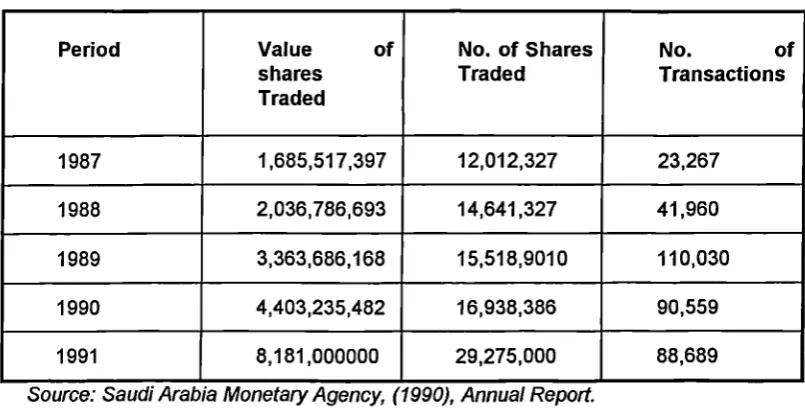
The table below shows the historical date and the size of Saudi joint
Table No. 2.11: Saudi Traded Companies (1991)
Name Total Assets Establishment No of Shares Date
Riyadh Bank 44,408,884 1965 2,000,000
Jizirah Bank 3.895,511 1976 1,000,000
Saudi Investment Bank 4,601,248 1976 900,000
Saudi Holland Bank 9.524,322 1977 2.1 00.000
Saudi French Bank 18,787,350 1977 4,000,000
Saudi British Bank 14,577,936 1978 4,000,000
Saudi Cairo Bank 11,425,578 1979 6,000,000
Arab National Bank 14,383,252 1979 6,000,000
Saudi American Bank 29,672,479 1980 6,000,000
Saudi United Commercial 6,237,092 1982 2,500,000
Bank
Al-Rajhi Exchange.for 18,510,727 1988 7,500,000
Investment Industry Sector
Saudi Basic Industry 32,851,575 1976 100,000.000
(SABIC)
Saudi Fertilisers (SAFCO) 2,278,519 1385 2,000,000
Saudi Refineries 70,360 1959 400,000
Saudi Ceramic 329,825 1978 1,500,000
Saudi Vegetable Oil 359,095 1979 1,200,000
National Industries 376,660 1985 6,000,000
Saudi Pharmaceu. md. 616,363 1963 3,000,000
National Gas & md 1,178,598 1963 5,000,000
National Gypsum 121,803 1958 720,000
Cements Sectoc
Arabian Cement 990,231 1956 12,000,000
Al-Yamama Cement 1,177,186 1959 9,000,000
Al-Qasim Cement 621,187 1978 3,000,000
Southern Cement 1,139,617 1979 7,000,000
Yanba Cement 769,645 1979 7,000,000
Saudi Bahrairi Cement 1,061,291 1981 12,000,000
Saudi Kuwait Cement 1,199,606 1984 6,450,000
Services Industry:
Saudi Hotels 756,550 1977 5,000,000
Saudi Real Estate 1,598,531 1977 6,000,000
National Shipping 1,599,809 1977 25,000,000
Saudi Public Transport 1,466,974 1979 10,000,000
Saudi Automobile Service 402,272 1983 6,000,000
Saudi Live Stock 270,290 1982 5,000,000
Tihama for Advertisement 270,290 1975 5,000,000
AssearTrading 179,127 1977 2,000,000
Taibah for Investment 53,775 1987 500,000
Electricities Sector:
Saudi Consolidated 22,892,471 1979 80,000,000
Electricity. (Central)
Saudi Consolidated 24,000,166 1982 73,000,000
Electricity.(West)
Saudi Consolidated 24,050,884 1979 42,000,000
Electricity.(East)
Saudi Consolidated 8,370,540 1981 40,000,000
Electricity (South)
Tabuk Electricity N.A. 1972 N.A.
Arar Electricity N.A. 1969 80,297,000
Domat Al-Jandoul N.A. 1974 500,000,00.
Electricity
Hakel Electricity N.A. 1976 N.A.
Rafha Electricity N.A. 1973 N.A.
Agricultural Sector:
National Agricultural 999,615 1978 4,000,000
Development
Al-Qasim Agricultural 349,540 1985 5,000,000
Hail Agricultural 692,988 1983 3,000,000
Tabouk Agricultural 466,587 1984 2,000,000
Saudi Fishers 305,139 1981 1,000,000
Eastern Agricultural 99,793 1986 3,600,000
Al-Jawf Agriculture 122,902 1988 2,000,000
Source: Saudi Monetary Agency, Annual Report, Various Issues.
Saudi Registration Company, (1991), The Saudi ShareHolding Companies, June.
The growth of speculation in share trading prompted the government to
start a regulatory regime to assist the longer-term development of the
stock market. Procedures were instituted to prevent a recurrence of the
crisis of unofficial stock markets which had taken place in Kuwait in 1982
which were widely blamed on the speculative tendencies in that market.
The Second Stage:
Until 23 December 1984, the government did not regulate stock trading.
About eighty stockbrokers informally intermediated between buyers and
sellers of stocks. These brokers operated without licenses and did not
meet any capital requirements. The attitude of the government changed
after the Al-Manakh crisis in Kuwait which was discussed in section 2.2. A
study was ordered in Saudi Arabia to evaluate the current market in Saudi
Arabia as a means of preventing a similar crisis. The study concluded that:
1) There was a lack of investing awareness on part of investors and brokers.
2) Illegal practises and misuses were being conducted on the market.
3) The share volume available for trade was small.
4) The whole market was divided into a range of small markets, each with its own brokers, investors and speculators.
5) There was an increase of unpermitted brokers' offices.
6) many brokers were acting Illegally as result of:
a) limited resources ( only a telephone and desk).
b) Discrete contribution to the market rather than a continuous one.
c) No sense of social responsibility on the part of the brokers' offices.
Legislative action followed and the Council of Ministers soon felt in