0
Haptic cues as an additional value on the
product's health perception:
The effects of
multi-sensory package design on the health perception,
taste evaluation and product evaluations of green ice tea.
Master Thesis December, 2017 Linda Zwiers
University of Twente Enschede
MSC Communication Studies - Marketing Communication Supervisors:
Dr. T. J. L. van Rompay (first)
Dr. A. Fenko (second)
1
Haptic cues as an additional value on the
product's health perception:
The effects of
multi-sensory package design on the health perception,
taste evaluation and product evaluations of green ice tea.
Master Thesis December, 2017
Linda Zwiers
University of Twente Enschede
MSC Communication Studies - Marketing Communication Supervisors:
Dr. T. J. L. van Rompay (first)
Dr. A. Fenko (second)
2 ABSTRACT
Research shows that package design is a powerful tool in marketing. Product package may draw consumers' attention and hence, influence consumers' product evaluation and choice. However, so far, research mainly focused on the visual aspects of product packaging and its impact on product evaluation. Though, currently, researchers pay more and more attention to the influence of multi-sensory packages, such as visual-tactual package design. A multi-multi-sensory product experience creates an additional and novel dimension to the product and may steer product experience. Since the high need to promote healthy foods, due to the major problem of obesity and the
increasing popularity of healthy foods, this study focuses on manipulating the product package of green ice tea. The research presented here investigates the impact of a visual-tactual product package, as opposed to a visual-only product package, on the product's health perception,
naturalness perception, taste evaluation/overall evaluation, and price expectation. Further, different types of green ice tea (pure and sweetened) are included to investigate if the degree of the product's healthiness interplays with the product design. For that purpose, three bottle labels were designed with either no natural associations (control bottle), a 2D-design of leaves (vision-only bottle), or a 3D-design of leaves, to which a surface texture was added (vision+touch bottle), and handed out to participants who tasted the product and subsequently assessed it. In addition, General Health
Interest (GHI) was measured and inserted as a moderator to investigate whether GHI interacted with package design. The findings presented indicate that the addition of a natural surface texture to the product package of green ice tea positively influenced the product's taste evaluation/overall
evaluation. On the contrary, the results presented indicate that associations portrayed by surface texture did not transfer to health perception, naturalness perception, and price expectation. Finally, the findings presented suggest that participants with a high score on GHI, as opposed to participants with a low score on GHI, are more susceptible to multi-sensory package manipulation, with respect to naturalness perception.
3 CONTENTS
1. INTRODUCTION 4
2. THEORETICAL FRAMEWORK 6
2.1The importance of package design 6
2.2 Multi-sensory product design 7
2.3 Vision, touch, and (in)congruence 8
2.4 The influence of surface texture 9
2.5 Price expectation 11
2.6 Taste versus healthiness 12
2.7 General Health Interest 12
3. PRETEST 14
3.1 Pretest 1 14
3.2 Pretest 2 15
4. METHOD MAIN STUDY 19
4.1 Research design 19
4.2 Participants and procedure 19
4.3 Measures 20
5. RESULTS 21
5.1 Results of the 3x2x2 design 21
5.2 Results of the 2x2x2 design 22
5.2.1 Health perception 23
5.2.2 Naturalness perception 23
5.2.3 Taste evaluation/overall evaluation 24
5.2.4 Price expectation 24
5.2.5 Relative price expectation 24
6. DISCUSSION 25
6.1 General discussion of results 25
6.2 Limitations and recommendations for future research 27
6.3 Practical implications 28
6.4 Conclusion 29
7. RESOURCES 30
APPENDIX A – Background information 34
APPENDIX B – Questionnaire and results pretest 1 39 APPENDIX C – Questionnaire and results pretest 2 40
4 1. INTRODUCTION
In the past few years, people seem to be increasingly more interested in healthy foods. This indicates that people desire to maintain a more healthy lifestyle, not only in the field of diet, but also in the field of physical activity. Meanwhile, a major problem in recent times is the increasing
incidence of overweight and obesity, which jeopardizes human health. Back in 1948, when the global pattern of diseases was considered by the World Health Organization, obesity was already recognized as a disease (James, 2008). Even though, not everyone in the medical world agreed with this, because any clinical problems caused by obesity were easy to cure by reducing food intake (James, 2008). Yet, obesity impairs normal bodily function to a great extent (Apovian, Garvey & Ryan, 2015), and even leads to increased morbidity and mortality (Pi-Sunyer, 2002).
Hence, the need to promote a positive change in lifestyle is great. Since an improvement in human health is most likely achieved by changing eating habits (Beirreiro-Hurle, Gracia, and de-Magistris, 2010) it is interesting to investigate the possibilities to communicate the product's health. By the fast majority of humans, sweetness is experienced as a palatable taste, and this preference for sweetness is responsible for a significant sugar intake (Tappy & Lê, 2010). Food producers glorify their products by adding sugars or sweet substitutes, such as stevia, into their products, making it difficult to promote healthy products. In addition, as a result of the growing interest in healthy foods, the amount of healthy products has increased, making it harder to stand out among competitors.
When standing in front of the supermarket shelves, consumers are confronted with a wide range of products. Thereby, consumers are increasingly confronted with food labels filled with nutrition information. Barreiro-Hurle, Gracia, and de-Magistris (2010) argued that the presence of multiple nutrition and health information labels, as opposed to individual labels, has no positive impact on consumers' utility when making food choices. Therefore, research is needed to communicate health information in an innovative manner which is easy to process.
At point of purchase, package design is one of the most important means to draw consumers' attention (Van Rompay, Finger, Saakes & Fenko, 2016) and hence, influences consumer product evaluation and choice (Creusen & Schoormans, 2005). In recent years, researchers already looked into the visual influences (e.g. shape, colour and size) on product evaluation (e.g. Becker, Van Rompay, Schifferstein & Galetzka, 2011; Deliza, MacFie & Hedderley, 1996; Schifferstein, 2009; Spence & Wan, 2015; Westerman et al., 2012) However, besides the visual aspect, research currently pays more attention to the effects of multi-sensory product packages, such as adding tactile elements (e.g. Biggs, Juravle & Spence, 2016; Piqueras-Fiszman & Spence, 2012; Van Rompay, Finger, Saakes & Fenko, 2016).
5 Consumption of products that consist of natural substances, such as green tea can help treat obesity and, thus, improve human health (Kovacs, Lejeune, Nijs & Westerterp-Plantenga, 2004). Research from Dulloo et al. (1999) showed that green tea increases energy expenditure and fat oxidation twenty-four-hour. Also, nowadays, green (iced) tea seems to be a popular trend and is, if no sugar added, a healthier product compared to most other beverages, such as soft drinks and sweetened lemonades*. Inspired by its healthy nature, this research focuses on manipulating the package of green ice tea with both visual and tactile elements in order to investigate the possibilities for multi-sensory packages to increase among others the product's health perception and to find out if the multi-sensory product package positively affects the product's taste evaluation and overall evaluation.
This study focuses on the distinction between vision-only elements and vision+touch elements, which means that it will be examined if there is a significant difference in the perceived healthiness of green ice tea between a 2D-design (vision-only) and a 3D-design (vision+touch), where in addition to the visual aspect, a tangible aspect (a surface texture) is added. The design contains images of green leaves to ensure an association with nature. In addition, a control version is added to the design, containing a random printing without natural associations, to ensure that the addition of leaves (regardless of a 2D-design or a 3D-design) influences health perception.
In addition to the focus on perceived healthiness of green ice tea, this study also focuses on influencing perceived naturalness, taste evaluation/overall evaluation, and price expectation. Finally, to find out if the impact of the conditions (control versus vision-only versus vision+touch) varies among a more healthier type of green ice tea (pure) and a less healthier type of green ice tea (sweetened), the type of green ice tea (pure versus sweetened) is inserted as a second independent variable. This leads to the following research question:
RQ:To what extent do the type of elements added on the package (control versus vision-only versus vision+touch) and the type of green ice tea (pure versus sweetened) influence the product's perceived healthiness, perceived naturalness, taste evaluation/ overall evaluation, and price expectation?
Finally, General Health Interest (GHI), a scale which is used to measure the extent to which participants are focused on health (Roininen, Lähteenmäki & Tuorila, 1999), is inserted as a moderator. Participants' GHI is measured in order to find out if health perception outcomes differ among participants who are high health orientated and participants who are low (or not) interested in healthiness.
Goal of the study
Product package design is a powerful tool in marketing, because it can influence product decision (Schoormans & Robben, 1997) and the way consumers experience a product (Becker, Van Rompay, Schifferstein & Galetzka, 2011). Many research is conducted in the field of package design, though research conducted in the field of multi-sensory package design is limited. The goal of this study is to find out to what extent the addition of multi-sensory modalities (vision+touch) affects, among others, the product's health perception. More specifically, this study aims to find out if the tangible element in package design has an additional value to attain certain product
characteristics, such as healthiness and taste evaluation. On a theoretical level, food brands may benefit from the results emerged from this research in order to improve promotion of their healthy products and subsequently increase their sales.
6 2. THEORETICAL FRAMEWORK
2.1 The importance of package design
Next to the protection of the product and the facilitation of distribution, the package of a product also has many communication functions, such as product identification and price
information (Schoormans & Robben, 1997). In addition, product design attracts consumers and may even increase the quality of the product due to usage experiences (Bloch, 1995). Attraction of attention is the precondition for information processing, which can be achieved by marketing stimuli (Schoormans & Robben, 1997). Therefore, package design is important for primarily attracting consumers' attention and subsequently communicate the beneficial aspects of the product in order to sell the product. Shortly, the package design may have an influence on the level of sales and the success of a business.
A product package may, thus, affect consumers' product choices between several similar products of different brands. One possible way to communicate a product's features is by food labelling. Peters-Taxeira and Badrie (2005) argued that food labelling is important since 92.7% of participants agreed that nutrition information should be visible on a food product. However, their research also showed that 36.6% of respondents indicated that they did not read this information due to its complexity. Therefore, it is interesting to, instead of presenting the product's features in letter and logos on the label, investigate whether manipulation of the package appearance (e.g. shape, pictures, colours) has an influence on how the product is experienced,
The focus of this study is aimed at the impact of the aesthetic features of the package design on the perceived quality of the product, in order to increase the product's evaluation. Aesthetic originally refers to sensory perception and understanding (Hekkert, 2006). Nowadays, however, the meaning of the term is transformed to 'gratification of the senses or sensuous delight' (Goldman, 2001 as cited by Hekkert, 2006 p. 158), and is now generally used with reference to visual art (Hekkert, 2006). These aesthetic qualities, resulting in a package that is pleasing to the eye, may steer consumer decision making. Creusen and Schoormans (2005) argued that the aesthetic and symbolic roles of package appearance influence product perception and are rated as most decisive in consumer product choice. Consumers find looking at a beautiful product rewarding and in case of similar functioning and price, consumers prefer a product that appeals the most to them
aesthetically (Creusen & Schoormans, 2015).
Based on its packaging, consumers make certain assumptions about the quality of its content. This is an implicit process in which consumers draw inferences from the aesthetic and symbolic product package and assign these characteristics to its content (Becker, Van Rompay, Schifferstein & Galetzka, 2011). Thus, consumers develop certain expectations about a product when viewing and touching the product's package, which is interesting because the packaging features are not directly related to the product's content. Briefly summarized, product packages can communicate product aspects and create a certain image of the product and above all may steer consumer decision making.
7
2.2 Multi-sensory product design
Humans know five sensory modalities, which are; vision, audition, touch, olfaction (or smell), and taste (Fenko, Schifferstein & Hekkert, 2010). Although it may seem unlikely, in product experience, multiple sensory modalities (and sometimes even all sensory modalities) contribute to consumers' experience with the product. For example, when using your tablet, the product
experience is not solely dependent on the visual appearance of the product. Also the touch of the screen, the size, the sound, and probably the weight of the tablet are decisive for a positive (or perhaps a negative) product experience. The same applies for sport sneakers. In addition to the visual appearance, its touch, smell, and sound is also important and will form the product's experience.
Creusen and Schoormans (2005) argued that the most important product value for
consumers should be the starting point of the product's appearance design. The sensory modalities that are important during product usage seem to be dependent on the primary function of the product (Fenko, Schifferstein & Hekkert, 2010). Important is, thus, to consider which sensory modalities are important in the case of drinking ice tea from a drinking bottle. Although, it is believed that vision is the most dominant sensory modality in human experience (Schifferstein, 2006), vision is not always the only important, and not even always the most important sensory modality during product usage (Fenko, Schifferstein & Hekkert, 2010; Schifferstein, 2006). For instance, with the use of a deodorant, the smell of the product has probably greater value than the visual appearance of the product. As well as with music devices, visual appearance is probably less important than the sound that is produced by the musical instrument.
Though, this does not mean that product designers should focus their design solely on the dominant sensory modality of the product. The trick is to design a product that ensures satisfaction of all sensory modalities involved. As a result, the multi-sensory experience creates an additional and novel dimension to the product, and may enhance consumers' product experience (Lwin, Morrin & Krishna, 2010). Orth, Campana, and Malkewitz (2010) found an attractiveness-quality relation in their research and stated that quality perceptions could be improved by designing packages that are more elaborate than competitors in their segment.
Vision is often considered to dominate human experiences, which could strongly suggest that human experiences are for the biggest part dependent on the visual information they perceive (Schifferstein, 2006). In product evaluations, the product's aesthetic features are often found important for durable products, since they are used for a longer period of time and are visible to other people (Creusen & Schoormans, 2005). Though, the overall visual dominance effect may not hold for all product experiences.
A study from Schifferstein (2006) showed that dependent on the product category, different sensory modalities are rated as most important. For hand tools, such as a computer mouse and a pen, touch is rated as most important sensory modality, followed by its visual appearance (Schifferstein, 2006). In order to judge the roughness of a product surface, consumers' judgments are more
dependent on tactile cues as opposed to visual cues (Lederman, Thorne & Jones, 1986). Arguably, for beverage consumption the look and the feel of the product are most important. Since a drinking bottle is touched by the hands during usage, it is important to not solely focus on the visual
8
2.3 Vision, touch and (in)congruence
Many studies have shown that vision dominates touch (e.g. Hekkert, 2006; Krishna, 2006; Rock & Victor, 1964; Schifferstein, 2006; Thesen et al., 2004;), which means that humans rely more on their visual sense than their haptic sense. However, Berkeley (1907), as cited by Krishna (2006) stated that 'it must be acknowledged that we never see and feel one and the same object. That which is seen is one thing, and that which is felt is another' (p. 557). This means that we perceive objects with both our visual sense and our haptic sense.
The information derived from our visual and haptic senses can be congruent, meaning that what is seen and what is felt is providing the same information. In addition, tactile and visual modalities can also interact with each other. For instance, the so-called size-weight illusion
(Charpentier, 1891) suggests that bigger objects of the same weight can feel lighter because of their visual appearance (Krishna, 2006). In addition, research from Gibson (1933) showed that when vertical lines were distorted by a prism and bended into curves, the straight lines did not only look curved, but also felt curved. However, when participants closed their eyes, the lines felt straight. In research from Ludden, Schifferstein, and Hekkert (2009) participants felt a lamp, which seemed to be made of glass and, thus, should feel rigid and fragile. However, the lamp was actually made out of rubber and felt flexible.
Ludden, Schifferstein & Hekkert (2009) argued that the visual perception creates
expectations for what will be perceived through touch. Their research showed that incongruence of visual and tactile elements disconfirm formed expectations which evokes a surprise reaction. This reaction of surprise may in turn cause experiences of admiration (Ludden, Schifferstein & Hekkert, 2009) and in industrial design, the experience of novelty is often experienced as pleasurable and may even positively affect the product's aesthetic evaluation (Hekkert, Snelders & Van Wieringen, 2003).
However, Hekkert (2006) argued that an unifying principle of aesthetic pleasure is that we tend to prefer products that express the same message to our different senses. For instance, research from Zellner, Bartoli, and Eckard (1991) showed that in odour identification, participants identify odour more accurately when paired with an appropriate colour (e.g. red-cherry) and less accurately when paired with an inappropriate colour (e.g. red-lemon) or when colour cues were absent. Also, research from Schifferstein and Verlegh (1996) showed that adding a matching odour enhances the taste and that congruent odour-taste combinations are rated as more pleasant. Finally, research from Becker et al., 2011) showed that when meanings elicited by package colour and shape were
9
2.4 The influence of surface texture
Barnett-Cowan (2010) argued that the feel of the food when holding it in the hand may influence the perception of that food while eating it. In his study, participants rated the freshness and crispness of a fresh or stale pretzel. In case of incongruence of information provided to the hand and presented to the mouth, the freshness and crispness were systematically altered. More
specifically, when holding a fresh part of the pretzel, and biting in a stale part of the pretzel, participants rated the stale part of the pretzel as being significantly fresher and crispier in-mouth because the hand held what felt like a fresh pretzel, and visa versa.
More surprising is that the feel of a non-food item (indirect contact with the product), such as a product container, can influence food (or beverage) perception during consumption. For example, Piqueras-Fiszman et al. (2011) studied the influence of the weight of the dish in which food is served on the product's perception. Their results indicated that yoghurt served in a heavier bowl, as opposed to a lighter bowl, was perceived as denser (in the mouth), and was expected to be more expensive. Further, their research showed that, in lesser extent, the yoghurt served in a heavier bowl, compared to a lighter bowl, was rated higher on flavour intensity and liking.
A study from Krishna and Morrin (2008) was conducted to find out if the firmness of a cup has an effect on participants' judgements of the water that is served in the cup. Characteristics of the cups, such as firmness, weight, or surface texture, should not affect the quality or taste of the water itself, which are called nondiagnostic haptic cues. Though, their research showed that drinking water form a flimsy cup (low quality nondiagnostic haptic cue) negatively affects quality
perceptions of the water that is served within the cup. Conversely, drinking the same water from a firm cup (high quality nondiagnostic haptic cue) significantly reduced negative thoughts about the quality of the water.
Another example of a research into the effects of a beverage container on the product's perception is that from Tu, Yang, and Ma (2015), which showed that a Chinese cold tea served in a glass container was rated higher on perceived iceness and coldness compared to a plastic or paper container. These results suggest that the haptic quality of the beverage container has an influence on the perceived quality of the product that is served within.
In addition, research from Piqueras-Fiszman and Spence (2012) showed that crunchiness and hardness ratings of biscuits can be affected by tactile information presented by the hands. Their research showed that biscuits served from a pot finished with rough sandpaper, compared to a pot with a smooth finish, are rated as significantly crunchier and harder. This means that the haptic information we perceive through our hands, can be transferred to the perception of the food texture.
Likewise, a recent study from Biggs, Jaravle, and Spence (2016) showed that haptically and visually perceived texture of plateware can influence both mouthfeel judgements of the food texture and its taste or flavour. The study extends findings from previous research demonstrating the effects of package feel (e.g. Krishna & Morrin, 2008; Piqueras-Fiszman & Spence, 2012), with a
substantially larger sample size (N=654). The results show that biscuits feel rougher in the mouth when served from a rough plate, whereas they feel smoother (melting in the mouth) when served from the smooth plate. Moreover, the same effect emerged with respect to taste; biscuits tasted more salty and gingery when served on a rough plate, whereas they tasted sweeter when served on a smooth plate.
Based on aforementioned studies, it would appear that what people feel in their hand, can affect the product's sensory properties during consumption, which can be explained by the
phenomenon of sensation transference (Cheskin, 1957; Biggs, Juravle & Spence, 2016). Sensation transference has been defined as 'the phenomenon whereby certain sensory attributes of a product perceived via one or more of the senses (such as vision and touch) can bias a consumer's
perception of other product attributes derived from other sensory modalities, and by so doing, modulate a person's overall (multisensory) product experience' (Piqueras-Fiszman & Spence, 2012,
10 Likewise, Spence and Gallace (2011) argued that the product's surface texture can influence consumers' tactile experience of that product and in turn affects consumers' product evaluation. For example, Velvet packaged their toilet tissue in plastic that really felt like velvet, which corresponded to the brand image, namely toilet paper as soft as velvet. Also, Hovis softened its crust-less bread package so that this feel of softness was associated with the softness of the bread (Spence & Gallace, 2011). This means that the feel of the package can influence consumers' perceptions of the product that is within.
Although contrast effects may surface (Zampini, Mawhinney & Spence, 2006),
aforementioned studies suggest that product perception, such as softness and product quality can be influenced by manipulating the product package semantically congruent with how the product should be experienced (soft package = soft product). Likewise, Piqueras-Fiszman and Spence (2012) argued that participants' ratings were only affected by haptic information in case of
congruence between textural attributes of the package and the textural attributes of the food being rated.
In sum, this research aim is to address the influence of a visual+tactual product package on the product's health perception, natural perception, taste evaluation/overall evaluation and price expectation. Taken into account above mentioned research findings and theorizing on the
relationship between congruence of sensory package design and product experience, the following hypothesis is drawn:
H1: A multi-sensory package surface, as opposed to a visual-only package surface, results in a higher product's taste evaluation/overall evaluation.
To test whether the surface texture of a green ice tea drinking bottle affects the product's perceptions with respect to naturalness and healthiness, the natural feeling of the product package is taken into account. Naturalness and healthiness are highly correlated (Van Lith, 2015), meaning that when a product is perceived as healthy, it is most likely also perceived as natural (and visa versa). By manipulating the surface texture of the package, or more specifically manipulating the natural feeling of the product package, this research seeks to investigate if the addition of a more natural touch to the product package translates into the product's perception (natural feeling = natural product). Taken into account aforementioned studies, this leads to the following hypotheses:
H2: A multi-sensory package surface, as opposed to a visual-only package surface, results in a higher product's health perception
H3: A multi-sensory package surface, as opposed to a visual-only package surface, results in a higher product's naturalness perception
Furthermore, the research seeks to find out whether a possible effect of package texture manipulation applies to both product types (pure green ice tea vs. sweetened green ice tea). Based on the study from Van Rompay et al. (2016) and aforementioned studies on the relation between congruence of sensory stimuli and the positive effect on the product's evaluation and accuracy of product identification (Becker et al., 2001; Hekkert, 2006; Schifferstein & Verlegh, 1996; Zellner, Bartoli & Eckard, 1991), the following explorative hypothesis (EH) is drawn:
11
2.5 Price expectation
The so called attractiveness-quality link, or beautiful=good relation suggests that
'attractiveness relates positively to quality judgments' (Kamins 1990; Parekh & Kanekar, 1994, as sited by Orth, Campana & Malkewitz, 2010, p. 28). Research from Orth, Campana and Malkewitz (2010) suggests that package design can influence expectation of product price through quality and attractiveness judgements. Their study showed that respondents expected a higher price for products with a more elaborate design*, which was partly mediated via quality and attractive judgements.
Also, research from Krishna and Morrin (2008) found that price expectations can be influenced by non-diagnostic haptic cues, such as package quality. Their study showed that water from a firm bottle (high quality) is expected to be more expensive as opposed to water from a flimsy bottle (low quality). This means that the package's quality may influence the product's price expectation, and more specifically, that consumers are willing to pay a higher price for products consisting of a high quality container.
Further, van Rompay and Pruyn (2011) argued that congruence of different visual symbolic meanings is important with respect to price expectations. Their study showed that consumers expect a higher price for congruent products, because they are perceived as more attractive. Since product judgments are more positive under congruence, as opposed to incongruence, conditions (Littel & Orth, 2013), this effect might also be applicable to visual-tactual products in congruence and the expectation of price. Based on above mentioned findings, the following hypotheses are drawn for price expectation:
H4: A multi-sensory package surface, as opposed to a visual-only package surface, results in a higher product's price expectation.
EH2: A multi-sensory package surface combined with a congruent pure green ice tea beverage (rather than an incongruent sweetened green ice tea beverage) results in a higher product's price expectation.
12
2.6 Taste versus healthiness
Food and beverages have different properties that determine consumers' product quality (Mai & Hoffman, 2012), such as taste, texture, healthiness, and aroma. Preference for which property is leading in quality assessment, is personally dependent. Research from Mai and Hoffmann (2012) showed that, concerning food contributes, the (health-unrelated) property taste
was valued highest by consumers (21.4%), and that sugar content was valued lowest (7.9%). Mai and Hoffmann (2012) differentiated two segments; taste lovers and nutrition fact seekers. Further, their research showed that taste lovers have a lower health consciousness, and neglect factors that indicate unhealthiness. Conversely, nutrition fact seekers have a higher health conscious and pay more attention to unhealthy factors, such as sugar content (Mai & Hoffmann, 2012).
Taste and health seem to be diametrically opposed to each other. Raghunathan, Naylor, and Hoyer (2006) claim that unhealthy food is rated as better tasting and more enjoyable during consumption. Participants believed that healthiness and tastiness are negatively correlated. This so called unhealthy = tasty intuition is generated by the unwholesome = fun intuition and by constantly exposure to compatible messages in the media (Raghunathan, Naylor & Hoyer, 2006). Also, Lloyd, Paisley, and Mela (1995) argued that food low in fat reduces perceived taste quality. Contrary, in France, the opposite intuition reigns, namely the healthy = tasty intuition (Werle, Trendel & Ardito, 2013). Healthy foods are rated as more tasteful, more pleasurable and of better quality, while unhealthy foods are associated with bad taste in France (Werle, Trendel & Ardito, 2013).
2.7 General Health Interest
It is of great importance to find out how consumers differ in their food/beverage choices. By consumer segmentation, different types of products (taste-focused, health-focused) can be targeted on the corresponding segment of consumers (taste lovers, nutrition fact seekers). Roininen,
Lähteenmäki, and Tuorila (1999) designed several scales in order to measure consumers' health and taste attitudes towards foods. Healthiness and hedonic characteristics are substantial predictors of food liking and food consumption (Roininen, Lähteenmäki & Tuorila, 1999). One health-related scale, referred to as General Health Interest (GHI) (Roininen, Lähteenmäki & Tuorila, 1999), can be used to measure the extent to which participants are health focused concerning their food choices. This scale consists of eight items, with a Cronbach's alpha of 0.89, indicating that it is a good scale to measure participants' health interest.
Research from Contento, Michela, and Goldberg (1988) showed that adolescents who are motivated to obtain healthful food, are less influenced by taste. Conversely, the group of
adolescents for whom taste is the most influential factor for food choices, are relatively unhealthy orientated, which means that health characteristics of foods are not important factors for their food choices. Though, intention to consume healthy foods does not necessarily result in actual behaviour of consuming healthy foods. However, a study from Contento, Michela, and Goldberg (1988) did show that participants from the health oriented group had the most healthful eating patterns and, on the contrary, participants from the taste oriented group had the most unhealthful eating patterns. The taste oriented group consumed larger amounts of fat and sugar compared to the health oriented group. This means that, in general, consumers interested in healthy foods also actually consume more healthy foods and that consumers interested in tasty foods compromise on healthiness.
13 In this research, GHI is inserted as a moderator in order to find out if participants with a high (or low) score on GHI score differently on health perception and/or taste evaluation/overall
evaluation of the tested green ice tea. Effects of package design on food/beverage perception varies among intrapersonal factors (e.g. design sensitivity (Krishna & Morrin, 2008)) (Van Rompay, Deterink & Fenko, 2016), suggesting that depending on personal characteristics, the persuasiveness of a package manipulation may vary. In this case, General Health Interest is such a personal
characteristic, which may have an influence on a person's susceptibility to healthy package manipulation.
Because health oriented consumers actually consume more healthy foods (Contento, Michela & Goldberg, 1988) and rate healthy products as more healthy as opposed to consumers with a low score on GHI (Roinen, Lahteenmake & Tuorila, 1991), it is assumed that health oriented consumers have knowledge of and recognize healthy products more accurately compared to
consumers with a low score on GHI.
Research from Aschemann-Witzel, Maroscheck, and Hamm (2013) showed that occasional organic consumers are more influenced by nutrition and health claims on products, because they are less sceptical about the health-related information. More intensive organic consumers are more sceptical about health-related information and therefore less susceptible to health claims. In addition, research from Van Rompay, Deterink, and Fenko (2016) showed that visitors of a discount
supermarket (price sensitive buyers) are influenced by package manipulation, in which a more healthy package appearance positively affected the yoghurt's healthiness. Conversely, visitors of a 'green' supermarket (organic buyers) were not influenced by healthy package manipulations.
It is, therefore, predicted that health oriented consumers are not (or less) influenced by package manipulation in order to make the product appear healthier. Conversely, taste-oriented consumers are more focused on good taste and are probably less able to recognize healthy products. Therefore, it is hypothesized that taste-focused (low GHI) consumers are more influenced by package manipulation, with respect to health features. In sum, it is expected that GHI moderates the effects of the types of package (control, vision-only, vision+touch) on health perception and
naturalness perception of green ice tea.
14
3.
PRETESTPrior to the main study, two pretests were conducted in order to find out which types of bottles and which types of green ice tea are most appropriate to use as stimulus materials during the main study. These pretests serve as manipulation checks, to ensure that the stimulus materials actually differ in terms of tangibility (concerning the bottles) and taste (concerning the green ice teas).
3.1 Pretest 1
In pretest 1, three variations of green ice tea are tasted and criticized to ensure a deviation in pureness/sweetness between the drinks. The green ice teas are prepared by making hot green tea and cooling it down by storing it in the fridge. For preparation of the ice teas, freshly dried green tea leaves are used, which means that there are no added ingredients. The three green ice tea variants differ solely in the area of sweetness. Green ice tea 1 is pure, while the other two green ice teas are added with an amount of sugar. Green ice tea 2 contains 5 grams of sugar on one bottle of 330 ml, and in green ice tea 3, a double amount of sugar is added (10 grams).
A total of 9 participants (4 male, 5 female; mean age 32.56 years) rated among others
sweetness, added sugars and pureness on a 7-point Likert scale (ranging from “strongly disagree” to “strongly agree”). Comparisons of means showed that both sweetened green ice teas are perceived as sweeter compared to the pure green ice tea (Mpure = 1,89, SD = 1.05, M5gram = 4.67, SD = 1.50,
M10gram = 5.56, SD = 1.67). An analysis of variance revealed that these scores differ significantly
(F(2, 24) = 16.09, p < 0.001, ƞ² = 0.57) and Pairwise Comparisons confirmed that both sweetened variants are significantly sweeter compared to the pure variant (p5gram = 0.001, p10gram <0.001).
In addition, an analysis of means showed that the sweetened variants differentiated most clearly on added sugars compared to the pure variant (Mpure = 1,56, SD = 0.88, M5gram = 5.22, SD =
1.64, M10gram = 6.00, SD = 0.87), which indicates that this difference in added sugars is clearly
noticeable. Moreover, comparisons of means showed that the pure variant is perceived as more pure compared to the two sweetened variants (Mpure = 4.56, SD = 1.67, M5gram = 3.44, SD = 1.51, M10gram
= 2.89, SD = 1.69). However, an analysis of variance, with pureness as dependent variable, did not obtain a significant difference between the three variants (F(2, 24) = 2.46, p = 0.107, ƞ² = 0.17).
Since both sweetened variants are perceived as significantly sweeter compared to the pure variant, and the amount of added sugars is clearly noticeable, both sweetened variants are
15
3.2 Pretest 2
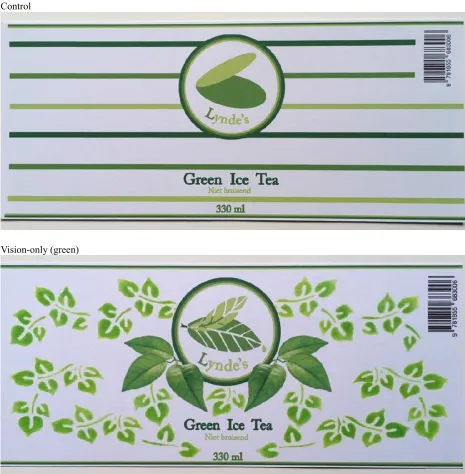
[image:16.595.56.522.245.720.2]For this pretest, five labels of green ice tea bottles are designed containing a deviation in the area of appearance (display of leaves or not) and tangibility (presence or absence of relief). All five ice tea bottles are equipped with a label from off-white cardboard paper. The first bottle that is tested in this pretest is the control bottle, which is not associated with nature. This label, which is quite basic, contains a random green printing and an abstract logo in order to minimalize association with leaves. The other four bottles are considered as natural and are displayed with green leaves. Bottles 2 and 3, and 4 and 5 are considered as couples, because these bottles have a similar appearance, though, differ in tangibility. Additional leaves displayed on bottle 2 (vision-only) and bottle 3 (vision+touch) are green coloured, while these leaves are colourless (or white) in bottles 4 (vision-only) and 5 (vision+touch). Images of the five labels can be found in Fig. 1.
Fig. 1 Five labels tested in pretest 2
Control
16 Vision+touch (green)
Vision-only (white)
17 The purpose of this pretest was to investigate whether the tangibility of the packages is distinguishable enough concerning its relief and the extent to which the surface of the label feels natural. A total of 23 participants (9 male, 14 female; mean age: 27.09 years) rated feeling natural
and feeling relief on a 7-point Likert scale (raging from “strongly disagree” to “strongly agree”). Comparisons of means showed that both vision+touch bottles score higher on feeling natural compared to both vision-only bottles (see Table 1). An analysis of variance confirmed that there is a significant difference between the bottles (F(4, 110) = 7.51, p < 0.001 ƞ² = 0.22). Pairwise Comparisons obtained a significant difference between the vision-only variants and the vision+touch variants (pgreen pair = 0.022; pwhite pair < 0.001). On the other hand, while the white
[image:18.595.57.395.242.330.2]variant of the vision+touch bottle scores significantly higher on feeling natural compared to the control bottle, the green variant of the vision+touch bottle does not (pgreen = 0.115, pwhite = 0.049). Table 1. Descriptive Statistics – Feeling Natural
Mean Std. Deviation N
Bottle 1 - control 5.04 1.19 23
Bottle 2 - vision-only green 4.83 1.40 23
Bottle 3 - vision+touch green 5.83 0.78 23
Bottle 4 - vision-only white 4.57 1.24 23
Bottle 5 - vision+touch white 5.96 0.56 23
Further, a manipulation check, with regard to the clarity of feeling relief, confirmed that participants clearly feel more relief in both vision+touch bottles compared to both vision-only bottles and the control bottle (see Table 2) . An analysis of variance revealed a strong significant difference in feeling relief between the five bottles (F(4, 110) = 196.31, p < 0.001, ƞ² = 0.88) and Pairwise Comparisons showed that the vision+touch bottles score indeed significantly higher on
[image:18.595.58.395.445.533.2]feeling relief compared to the vision-only bottles and the control bottle (all p's < 0.001).
Table 2. Descriptive Statistics – Feeling Relief
Mean Std. Deviation N
Bottle 1 - control 1.96 1.40 23
Bottle 2 - vision-only green 1.70 1.46 23
Bottle 3 - vision+touch green 6.96 0.21 23
Bottle 4 - vision-only white 1.26 0.92 23
Bottle 5 - vision+touch white 6.96 0.21 23
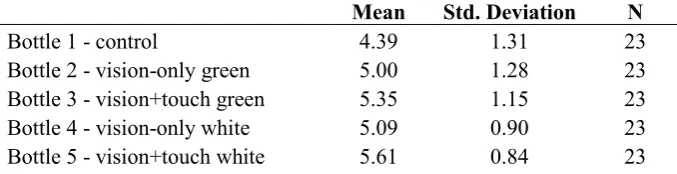
Finally, in order to ensure credibility of existence of the product, the bottles are criticized for its realistic appearance (see Table 3). Although the control bottle scored lower on its realistic
appearance compared to the other four bottles, this score is above moderate and therefore all bottles are considered as appropriate for the main study.
Table 3. Descriptive Statistics – Realism
Mean Std. Deviation N
Bottle 1 - control 4.39 1.31 23
Bottle 2 - vision-only green 5.00 1.28 23
Bottle 3 - vision+touch green 5.35 1.15 23
Bottle 4 - vision-only white 5.09 0.90 23
Bottle 5 - vision+touch white 5.61 0.84 23
[image:18.595.56.395.621.708.2]18 Fig. 2. Stimulus Materials Selection
19 4. METHOD MAIN STUDY
4.1 Research design
[image:20.595.57.391.191.385.2]The main purpose of this research is to find out if product texture has an influence on product perception regarding its healthiness, naturalness, taste evaluation/overall evaluation, and price expectation. Further, it is examined if product type, concerning its sweetness, interacts with product design. These effects were explored in a 3 (control vs. vision-only vs. vision+touch) x 2 (pure green ice tea vs. sweetened green ice tea) x 2 (low GHI vs. high GHI) between-subjects experimental design. The research model of this study is shown in Fig. 3.
Fig. 3. Research model
4.2 Participants and procedure
A total of 130 respondents participated in the research (57 male, 73 female; Mage = 34.90, SD
= 14.90). Table 4 presents age and gender distribution across the six conditions. An analysis of variance confirmed that age was equally distributed (F(5, 124) = 2.11, p = 0.069) Likewise, an analysis of variance did not obtain a significant difference in gender (F < 1, ns).
Table 4. Age and gender distribution across the six conditions
N Age Gender
Condition M SD Female (%) Male (%)
1 - Control - pure 22 37.23 18.14 59.1 40.9
2 - Vision-only - pure 22 34.73 14.78 45.5 54.5
3 - Vision+touch - pure 21 40.67 14.37 66.7 33.3
4 - Control - sweetened 21 37.86 16.69 61.9 38.1
5 - Vision-only - sweetened 21 30.52 11.64 61.9 38.1
6 - Vision+touch - sweetened 23 28.87 10.66 43.5 56.5
Respondents were approached at staff rooms from two secondary schools, at a canteen of a physiotherapy company, and at University of Twente. Participants were asked if they were willing to participate in a product sampling taste test for a new green ice tea. When agreed, respondents were asked if they had any medical restrictions on consuming green ice tea and/or sugars (no participants were excluded based on this screening question). Subsequently, participants were requested to hold (touch), and check the product. Since it was inconvenient to randomly assign each respondent to one condition, each variant was tested per day-part or by a certain group of
[image:20.595.57.551.494.608.2]20
4.3 Measures
The dependent variables 'health perception', 'naturalness perception', 'taste evaluation/ overall evaluation', and 'price expectation', and the moderator 'GHI' are measured by scales consisting of multiple items. All items are measured by a 7-point Likert scale (ranging from 'strongly disagree' to 'strongly agree'), except for 1 item concerning the expected price of the product, which is measured with an open question.
Health perception
The dependent variable health perceptionis measured by a scale which consists of four items; 'I think this product is healthy', 'I think this product is high in calories (R)', 'I think this product in responsible', and 'I think this product makes me fat (R)'. These items together form a scale with a Cronbach's Alpha of .62. Even though this is a fairly low score, deleting one of the items from the scale did not result in an increased Cronbach's Alpha score.
Naturalness perception
The perception of naturalness is a dependent variable measured by six items; 'I think this product is pure', 'I think this product contains added colourings (R)', 'I think this product contains added flavourings (R)', 'I think this product is natural', 'I think this product contains extracts from real green tea leaves', and 'I think this product is artificial (R)'. The six items together form a reliable scale with a Cronbach's Alpha of .81.
Taste evaluation/overall evaluation
The taste evaluation and overall evaluation are measured together by a scale consisting of five items; 'I find this product tasteful (delicious)', 'I would like to consume this product more often', 'This product is unappealing to me (R)', 'I would buy this product', and 'I asses this product as a good quality product'. These five items together form a reliable scale with a Cronbach's Alpha of .88.
Price expectation
The expectation of price is a dependent variable measured by two items. The first item is measured by the 7-point Likert scale; 'I think that, compared to other green ice teas, this is a relatively expensive product'. The second item is an open question in which respondents could answer a number; 'I think this product will cost €....?' However, the two items together do not
particularly form a reliable scale, since the Cronbach's Alpha score is .44. Therefore, the expectation of price and the measurement of relative expensiveness are measured separately.
General Health Interest
General Health Interest is measured by an existing scale from Roininen et al. (1999), which consists of eight items. In this study, the eight items together also form a reliable scale with a Cronbach's Alpha of .87. The eight items of the General Health Interest scale are; 'The healthiness of food has little impact on my food choices (R)', 'I am very particular about the healthiness of food I eat', 'I eat what I like and I do not worry much about the healthiness of food (R)', 'It is important for me that my diet is low in fat', 'I always follow a healthy and balanced diet', 'It is important for me that my daily diet contains a lot of vitamins and minerals', 'The healthiness of snacks makes no difference to me (R)', and 'I do not avoid foods, even if they may raise my cholesterol (R)'.
21 5. RESULTS
5.1 Results of the 3x2x2 design
In this section, the main effects and interaction effects of the 3x2x2 design are shown in Table 5. Analysis of variance are conducted with type of bottle (control, vs. vision-only vs.
[image:22.595.59.478.190.742.2]vision+touch), type of tea (pure vs. sweetened), and GHI (low score vs. high score) as independent variables and health perception, naturalness perception, taste evaluation/overall evaluation, price expectation and relative price expectation as dependent variables.
Table 5. Results of the 3x2x2 design
Independent variable(s) Dependent variable F p
Type of bottle Health perception .15 .865
Type of tea Health perception 8.73 .004
GHI Health perception 3.77 .055
Type of bottle x type of tea Health perception 1.21 .303
Type of bottle x GHI Health perception 1.09 .340
Type of tea x GHI Health perception 3.50 .064
Type of bottle x type of tea x GHI Health perception 1.20 .304
Type of bottle Naturalness perception .33 .720
Type of tea Naturalness perception 1.70 .195
GHI Naturalness perception .28 .600
Type of bottle x type of tea Naturalness perception .08 .923
Type of bottle x GHI Naturalness perception 2.25 .110
Type of tea x GHI Naturalness perception .79 .376
Type of bottle x type of tea x GHI Naturalness perception 2.04 .135
Type of bottle Taste/overall evaluation 2.97 .055
Type of tea Taste/overall evaluation .87 .354
GHI Taste/overall evaluation <0.001 .994
Type of bottle x type of tea Taste/overall evaluation .38 .687
Type of bottle x GHI Taste/overall evaluation .22 .802
Type of tea x GHI Taste/overall evaluation 3.72 .056
Type of bottle x type of tea x GHI Taste/overall evaluation 1.01 .369
Type of bottle Price expectation .84 .437
Type of tea Price expectation 3.98 .048
GHI Price expectation .58 .450
Type of bottle x type of tea Price expectation .80 .453
Type of bottle x GHI Price expectation .13 .880
Type of tea x GHI Price expectation .63 .429
Type of bottle x type of tea x GHI Price expectation .67 .512
Type of bottle Relative price expectation 1.49 .230
Type of tea Relative price expectation .05 .822
GHI Relative price expectation 1.74 .190
Type of bottle x type of tea Relative price expectation 1.00 .370
Type of bottle x GHI Relative price expectation .78 .463
Type of tea x GHI Relative price expectation .03 .854
22
5.2 Results of the 2x2x2 design
Since it appeared that the control bottle deviates extremely from predictions, it is decided to left out the control bottle from the results section. The control bottle was, namely, expected to score lowest on feeling natural and feeling relief, though, the output of pretest 2 showed that the scores of the control bottle are located between the vision-only and vision+touch variants. Likewise, the results from the main study showed that the control bottle still deviated from predictions and scored highest on health perception, and higher on naturalness perception and overall evaluation
[image:23.595.57.478.234.783.2]compared to the vision-only bottle. Since the control bottle may have disturbed potential significant effects between the 2D-design (vision-only) and the 3D-design (vision+touch), which is the main question of the research, the results section below discusses the outcomes of the 2x2x2 design. The main effects and interaction effects are shown in Table 6.
Table 6. Results of the 2x2x2 design
Independent variable(s) Dependent variable F p
Type of bottle Health perception .02 .904
Type of tea Health perception 2.72 .103
GHI Health perception .55 .462
Type of bottle x type of tea Health perception 1.17 .284
Type of bottle x GHI Health perception .25 .617
Type of tea x GHI Health perception .47 .497
Type of bottle x type of tea x GHI Health perception .52 .475
Type of bottle Naturalness perception .54 .464
Type of tea Naturalness perception .81 .371
GHI Naturalness perception .20 .654
Type of bottle x type of tea Naturalness perception .12 .734
Type of bottle x GHI Naturalness perception 4.06 .047
Type of tea x GHI Naturalness perception <0.01 .956
Type of bottle x type of tea x GHI Naturalness perception 2.34 .130
Type of bottle Taste/overall evaluation 6.77 .011
Type of tea Taste/overall evaluation 1.76 .188
GHI Taste/overall evaluation .15 .695
Type of bottle x type of tea Taste/overall evaluation .01 .942
Type of bottle x GHI Taste/overall evaluation .05 .832
Type of tea x GHI Taste/overall evaluation 6.35 .014
Type of bottle x type of tea x GHI Taste/overall evaluation .02 .886
Type of bottle Price expectation <0.01 .961
Type of tea Price expectation 4.65 .034
GHI Price expectation .59 .447
Type of bottle x type of tea Price expectation .42 .518
Type of bottle x GHI Price expectation .15 .699
Type of tea x GHI Price expectation 1.42 .237
Type of bottle x type of tea x GHI Price expectation .26 .615
Type of bottle Relative price expectation 1.20 .276
Type of tea Relative price expectation .30 .586
GHI Relative price expectation .74 .394
Type of bottle x type of tea Relative price expectation 1.50 .225
Type of bottle x GHI Relative price expectation 1.38 .243
Type of tea x GHI Relative price expectation .10 .750
23 In this section, relevant main effects and interaction effects will be described. Analyses of variance are conducted with type of bottle (vision-only vs. vision+touch), type of tea (pure vs. sweetened), and GHI (low score vs. high score) as independent variables and health perception, naturalness perception, taste evaluation/overall evaluation, price expectation and relative price expectation as dependent variables. Pairwise Comparisons, with a Bonferroni correction, is used to find out between what groups significant differences exist.
5.2.1. Health perception
An ANOVA, with health perception as dependent variable, did not reveal a significant main effect for type of bottle (F < 1, ns), type of tea (F(1, 78) = 2.72, p = 0.103, ƞ² = 0.03), and GHI (F < 1, ns). Further, the ANOVA did not obtain a significant interaction between type of bottle and type of tea (F(1, 78) = 1.17, p = 0.284, ƞ² = 0.02). Likewise, all other interactions were found not significant (all F's < 1, ns).
5.2.2. Naturalness perception
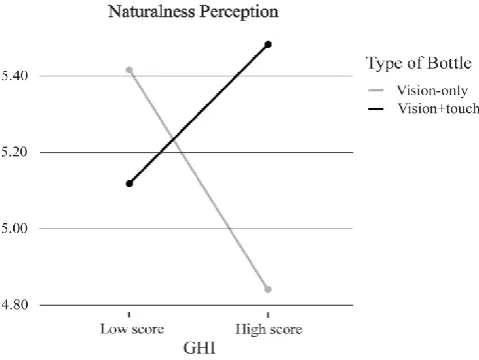
The ANOVA, with naturalness perception as dependent variable, did not obtain any main effects for type of bottle, type of tea, and GHI (all F's < 1, ns). However, the ANOVA revealed a significant interaction effect between type of bottle and GHI (F(1, 78) = 4.06, p = 0.047, ƞ² = 0.05) (Fig. 4). Participants with a high score on GHI perceived the vision+touch bottle significantly higher in naturalness compared to the vision-only bottle (p = 0.047). On the other hand, participants with a low score on GHI perceived the vision-only bottle higher in naturalness compared to the vision+touch bottle. This difference, however, was not significant (p = 0.384). Further, for the vision-only condition, there was a marginal difference in naturalness perception between
participants with a low score on GHI and participants with a high score on GHI (p = 0.092). For the vision+touch condition, this difference was not significant (p = 0.260).
[image:24.595.61.301.465.645.2]Further, the interactions of type of bottle x type of tea, and type of tea x GHI were not significant (both F's < 1, ns). Likewise, there was no significant three-way interaction found for type of bottle x type of tea x GHI on naturalness perception (F(1, 78) = 2.34, p = 0.130, ƞ² = 0.03).
24
5.2.3. Taste evaluation/overall evaluation
Most interestingly, the expected main effect for type of bottle on taste evaluation and overall evaluation surfaced (F(1, 78) = 6.77, p = 0.011, ƞ² = 0.08), showing that (regardless of the type of tea) the vision+touch bottle, as opposed to the vision-only bottle, is higher evaluated (Mv+t = 4.16, SDv+t = 1.15, Mv-o = 3.49, SDv-o = 1.37). On the other hand, the ANOVA, with taste
evaluation/ overall evaluation as dependent variable, did not obtain significant main effects for type of tea (F(1, 78) = 1.76, p = 0.188, ƞ² = 0.02) and GHI (F < 1, ns).
Further, the ANOVA revealed a significant interaction effect between type of tea and GHI (F(1, 78) = 6.35, p = 0.014, ƞ² = 0.08). As shown in Fig. 5, for participants who scored high on GHI, comparison of means revealed a significantly higher score on taste evaluation/overall
evaluation for the sweetened green ice tea as opposed to the pure green ice tea (p = 0.006). However, for participants with a low score on GHI, this difference was not significant (p = 0.418). In addition, in the sweetened condition, participants with a high score on GHI yielded in a significantly higher score on taste evaluation/overall evaluation compared to participants with a low score on GHI (p = 0.041). Conversely, in the pure condition, this difference in taste evaluation/overall evaluation between the low and high GHI-groups was not significant (p = 0.404).
[image:25.595.61.283.332.501.2]Finally, the AVOVA did not reveal a significant interaction effect for type of bottle x type of tea, and type of bottle x GHI (both F's < 1, ns). Likewise, the ANOVA did not obtain a significant three-way interaction between type of bottle, type of tea, and GHI (F < 1, ns).
Fig. 5. Interaction effect type of tea and GHI on taste/overall evaluation
5.2.4. Price expectation
An AVOVA, conducted with price expectation as dependent variable, revealed a significant main effect for type of tea (F(1, 78) = 4.65, p = 0.034, ƞ² = 0.06), showing that (as expected) the pure green ice tea is perceived as significantly more expensive (M = 1.71, SD = 0.76) compared to the sweetened green ice tea (M = 1.37, SD = 0.60). On the other hand, the ANOVA did not reveal a significant main effect for type of bottle and GHI (both F's < 1, ns). Likewise, the ANOVA did not obtain an interaction effect between type of bottle and type of tea (F < 1, ns), type of bottle and GHI (F < 1, ns), type of tea and GHI (F(1, 78) = 1.42, p = 0.237, ƞ² = 0.02), and neither for the three-way interaction (F < 1, ns).
5.2.5. Relative price expectation
Finally, for relative price expectation, the ANOVA did not reveal a significant main effect for type of bottle (F(1, 78) = 1.20, p = 0.276, ƞ² = 0.02), and neither for type of tea and GHI (both
F's < 1, ns). Likewise, the ANOVA did not obtain a significant interaction effect between type of bottle and type of tea (F(1, 78) = 1.50, p = 0.225, ƞ² = 0.02), type of bottle and GHI (F(1, 78) = 1.38, p = 0.243, ƞ² = 0.02), and type of tea and GHI (F < 1, ns). At last, the ANOVA did not reveal a significant three-way interaction effect on relative price expectation (F(1, 78) = 1.10, p = 0.297, ƞ²
25 6. DISCUSSION
6.1 General discussion of results
Inspired by trends towards multi-sensory packaging and promotion of healthy foods, this research aimed to investigate the effects of tactile package manipulation on the perceived healthiness, perceived naturalness, taste evaluation/overall evaluation, and price expectation of green ice tea (pure and sweetened variants). The results presented show that adding a natural tangible relief to the package of green ice tea positively influences taste evaluation and overall evaluation. This finding corresponds to the research of Spence and Gallace (2011) who argued that the product's surface texture can influence consumers' product evaluation. Presumably, the multi-sensory experience created an additional and novel dimension to the product, which enhanced product experience (Lwin, Morrin & Krishna, 2010). This is probably due to the fact that product experience is not solely dependent on the visual appearance. More specifically, touch is rated as most important sensory modality for 'hand tools' (Schifferstein, 2006). In addition, this finding underlines the research of Krishna and Morrin (2008), who found that a high quality haptic cue results in a more positive experience of the product's quality. On a theoretical level, this finding suggests that (with regard to green ice tea) vision+touch packages, rather than vision-only packages, might indeed result in a higher taste evaluation and overall product evaluation.
Although similar positive effects of adding tactile elements to the package were expected for perceived healthiness and perceived naturalness, these effects did not occur. The expectations derived from research from Spence and Gallace (2011), who argued that product perception can be influenced by manipulating the product package semantically congruent with how the product should be experienced. Since results from the the pretest clearly showed that the vision+touch package felt more natural compared to the vision-only package, it was expected that the vision+touch package positively influenced the perceived naturalness of the product.
A possible explanation for the absence of this result is that, despite the vision+touch package felt significantly more natural as opposed to the vision-only package, both packages scored
considerably high on feeling natural, which is probably due to choice of material. A research from Van Lith (2015) found that a package from cardboard paper is perceived as most healthy and natural compared to (low and high shine) plastic and organic paper. On top of that, participants had the opportunity to compare the feel of the packages during the pretest which could have lead to a greater difference in naturalness scores. During the main study, the natural feeling of the packages might not have deviated enough to obtain a significant effect on naturalness perception and healthiness perception.
Further, from the pretest it appeared that the appearance of both bottles are perceived as rather high on naturalness and healthiness. Moreover, analysis of variance did not obtain a significant difference in natural appearance and healthy appearance between the vision-only bottle and
vision+touch bottle, which might indicate that the visual aspect of the packages are quite similar. A logical consequence is that (based on appearance) the contents of the bottles did not differ in terms of naturalness and healthiness. This may indicate that the addition of surface texture was too subtle to obtain a difference in health perception and naturalness perception. On top of that, the optical illusion of relief in the vision-only bottle, which actually did not felt three dimensional, could have led to a surprise reaction, which in turn could have led to experiences of admiration (Ludden, Schifferstein & Hekkert, 2008; Ludden, Schifferstein & Hekkert, 2009).
26 Likewise, the expected positive effect of adding tactile elements to the package on the
expected price did not surface. Even though the pretest confirmed that the vision+touch bottle was significantly more beautiful in appearance as opposed to the vision-only bottle, the means of the expected prices were close to each other (v-o: €1,53, v+t €1,54). Although these amounts are both
relatively high for a 330 ml bottle, which may indicate that both packages are perceived as rather luxurious, mean scores of relative price expectation indicate that, compared to other green ice teas, both packages are perceived as equally expensive. However, the results revealed a significant difference in price expectation between the two tea variants, showing that the pure green ice tea (regardless of the type of package) was expected to be significantly more expensive as opposed to the sweetened variant. Since people mostly relate healthy products with high prices, it was expected that the pure, more healthy variant of green ice tea, is rated as more expensive compared to the sweetened variant.
Further, the experiment yielded a few results which were opposite to the expectations. Since health oriented consumers actually consume more healthy foods (Contento, Michela & Goldberg, 1988) and, therefore, recognize these healthy products, it was hypothesized that participants who scored high on GHI were less influenced by package manipulations. On the contrary, participants who scored low on GHI were expected to be more affected by package manipulations and, therefore, were expected to assess the product as healthier and more natural. The results, however, showed that participants with a high score on GHI, rather than participants with a low score on GHI, were susceptible to tactile package manipulation. Against expectation, participants with a high score on GHI assessed the vision+touch package (regardless of type of tea) as more natural compared to the vision-only bottle. Further, compared to participants with a low score on GHI, participants who scored high on GHI assessed the product packaged in the vision-only bottle as less natural.
One explanation for this unexpected result might be that health oriented consumers are able to evaluate healthy products (including their package) more accurately because they are more familiar with healthy foods. In addition, it appeared from the pretest that both variants of green ice tea were assessed as healthy and natural (no significant difference), which may had the consequence that participants with a low GHI score recognized the product's healthiness less accurately because they are less familiar with healthy foods. On a theoretical level, this might indicate that health oriented consumers can be influenced by tactile package manipulation concerning natural perception. This might mean that when targeting a healthy product on health oriented consumers, tactile product packages may increase naturalness perception for the target group, though, may not be influential for consumers who are less health focused.
27
6.2 Limitations and recommendations for future research
The main aim of this research was to investigate the effects of a multi-sensory (visual+tactual) product packaging, as opposed to a singular-sensory (visial-only) product packaging on the
product's perceptions, with regard to its healthiness, naturalness, taste and overall evaluations, and price expectations. More specifically, the goal of this research was to find out if adding a haptic cue to the product package positively influences the product's characteristics. Initial, the research was conducted with three types of bottles; the control bottle, the vision-only bottle, and the vision+touch bottle. Though, since the results of the pretest and main study revealed deviant outcomes for the control bottle, which could have disturbed the outcomes of the main question, the control bottle was omitted from the results section.
The control bottle, which was considered as the variant without natural associations, was designed as a neutral package in order to test the effects of adding natural elements to the package (regardless of 2D or 3D variant). Because of its natural origin, it was expected that depiction of (green) leaves would lead to a higher health perception and naturalness perception. Though, against expectations, the control bottle appeared to be perceived as more natural compared to the vision-only bottle and even as more healthy as opposed to the vision-vision-only and vision+touch bottles. This might be due to a greater presence of the natural colour green that is used in the control version, as opposed to the white/grey coloured leaves on the vision-only and vision+touch bottles.
Further, during the main study, the control bottle obtained a higher overall evaluation score compared to the vision-only bottle. This might indicate that participants have a preference for a basic, more abstract design compared to a more massive and imposing design. Also during the pretest, participants assessed both the control bottle and the vision-only bottle as rather beautiful in appearance. This higher overall evaluation for the control bottle as opposed to the vision-only bottle might be due to a probably more fluently processable design, which leads to a more positive
aesthetic pleasure and a more positive evaluation (Reber, Schwarz & Winkielman, 2004). A mild experience, such as an abstract design, is what humans generally find beautiful (Reber, Schwarz & Winkielman, 2004). Future research could respond to this gap in the effects of combining different types of package design styles and multi-sensory elements on among others health perception and overall evaluation. In this follow-up research, package designs could be distinguished in
abstractness/impressiveness, in order to find out if package design interacts with multi-sensory elements.
Further, since the results of the main study revealed only few effects of multi-sensory package manipulation on the perceptions of different product types (regarding its healthiness), future
research could further zoom in on the impact of visual+tactual package design on the perceptions of healthy and unhealthy product types. One recommendation here is to make a more clearer
distinction between the product's' health perceptions. Finally, since this research revealed