University of Warwick institutional repository: http://go.warwick.ac.uk/wrap A Thesis Submitted for the Degree of PhD at the University of Warwick
http://go.warwick.ac.uk/wrap/3657
This thesis is made available online and is protected by original copyright. Please scroll down to view the document itself.
Fuzzy Control and its Application
to a
pH
Process
K. E. Huang
A Thesis Submitted to the University of Warwick for the degree of
Doctor of Philosophy
Department of Engineering
University of Warwick
Summary
In the chemical industry, the control of pH is a well-known problem that presents difficulties due to the large variations in its process dynamics and the static nonlinearity between pH and concentration. pH control requires the application of advanced control techniques such as linear or nonlinear adaptive control methods. Unfortunately, adaptive controllers rely on a mathematical model of the process being controlled, the parameters being determined or modified in real time. Because of its characteristics, the pH control process is extremeIy difficult to model accurately.
Fuzzy logic, which is derived from Zadeh's theory of fuzzy sets and algorithms, provides an effective means of capturing the approximate, inexact nature of the physical world. It can be used to convert a linguistic control strategy based on expert knowledge, into an automatic control strategy to control a system in the absence of an exact mathematical model. The work described in this thesis sets out to investigate the suitability of fuzzy techniques for the control of pH within a continuous flow titration process.
Initially, a simple fuzzy development system was designed and used to produce an experimental fuzzy control program. A detailed study was then performed on the relationship between fuzzy decision table scaling factors and the control constants of a digital PI controller. Equation derived from this study were then confmned experimentally using an analogue simulation of a first order plant. As a result of this work a novel method of tuning a fuzzy controller by adjusting its scaling factors, was derived. This technique was then used for the remainder of the work described in this
thesis.
operating characteristics, but also that the fuzzy controller was much better at controlling the highly non-linear pH process, than a conventional digital PI controller. The fuzzy controller achieved a shorter settling time, produced less over-shoot, and was less affected by contamination than the digital PI controller.
One of the most important characteristics of the tunable fuzzy controller is its ability to implement a wide variety of control mechanisms simply by modifying one or two control variables. Thus the controller can be made to behave in a manner similar to that of a conventional PI controller, or with different parameter values, can imitate other forms of controller. One such mode of operation uses sliding mode control, with the fuzzy decision table main diagonal being used as the variable structure system (VSS) switching line. A theoretical explanation of this behavior, and its boundary conditions, are given within the text.
Contents
Summary
Acknowledgements
1. Introduction . . . .. 1
1.1 pH propress Model Equations and pH Control Problems . . . .. 1
1.2 Reasons for Using Fuzzy Logic in the control of pH process . . . .. 4
1.3 Description of the Contents of this Thesis . . . .. 6
2. Theory and Design a Fuzzy Logic Controller . . . .. 8
2. 1 Basic Definitions and the Fuzzy Set . . . .. 8
2.2 Structure of a Fuzzy Controller. . . .. 12
2.3 Design considerations for an FLC . . . .. 15
2.3.1 Fuzzification strategies . . . .. 16
2.3.2 Defuzzification strategies . . . .. 17
2.3.3 Data Base consideration . . . .. 20
2.3.3. 1 Discretization / normalization methods for the universes of discourse 20 2.3.3.2 The choice of the membership functions for the primary fuzzy sets 22 2.3 .3.3 The fuzzy partition of the input and output space . . . 24
2.3.4 Rule Base consideration . . . 25
2.3.4.1 Choice of the state and control variables for the fuzzy control rules 25 2.3.4.2 The derivation of fuzzy control rules. . . .. 26
2.3.4.3 The justification of fuzzy control rules . . . .. 28
2.3.4.4 The choice of the fuzzy control rule types 29 2.3.5 Decision making logic consideration '. . . .. 31
2.4 Current uses of Fuzzy Techniques and other Non-linear methods in Control of the pH Process . . . 44
2.4.2 Dynamic Modeling and Reaction Invariant Control of pH(1983) 44 2.4.3 An Experimental Study of a Class of Algorithms for Adaptive pH
Control (1985) . . . 45
2.4.4 Non-linear State Feedback Synthesis for pH Control (1986) 45 2.4.5 Non-linear Controller for a pH Process (1990) 45 2.4. 6Non-linear Control of pH Process Using the Strong Acid Equivalents (1991) . 45 2.4. 7 Fuzzy Control of pH Using Genetic Algorithms (1993) 46 2 .4. 8 Summary . . . 46
3. Implementation of a Real-Time Fuzzy Controller
48 3.1 Industrial Application of FLC Techniques . . . 483.1. 1 The Structure of a Fuzzy Control System . . . 49
3.1.2Technical Considerations When Developing a Fuzzy Control System 51 3.2 FLC Implementation methods . . . .. 52
3.2.1 Implementation Using the FKB Compilation Method 53 3.2.2 Implementation Using the FKB Interpretation Method . . . 56
3.2.3 A Comparison of Implementation Methods . . . .. 57
3.2.4 The Fuzzy Development System 58 3.3 Implementing an Experimental FLC . . . .. 61
3.3.1 System Description . . . .. 61
3.3.2 Fuzzy Control Program Design . . . 73
3.4 Experimental Setup for the Fuzzy Controller. . . .. 76
4. The Relationship between Fuzzy Decision Table Scaling Factors and
the Control Constants of a Digital PI Controller . . . .
784.1. Comparing Various Control Decision Tables 79 4.1. 1 A comparision of digital PI and fuzzy controllers . . . .. 79
4.1. 2 Comparing various decision tables . . . 80
4.2 Comparing Fuzzy Logic with Classical Controller Design . . . .. 82
5. The Effect of Scaling Factors on a Fuzzy PI Controller . . . ..
875. 1 Experiment setup . . . .. 88
5.3 The fuzzy PI controller experiments performe . . . 91
5.3.1 The effect of varying the decision table ranges on the behaviour of a Fuzzy PI controller and its comparison with the control constant of a digital PI PI controller. . . 91
5.3.2 Limitation of the decision table ranges . . . 94
5.4 Sliding control of a fuzzy PI controller caused by choosing too small value of D or too large value of E 101 5.4.1 The negative gain caused by choosing too small value of D 101 5.4.2 Theoretical explanation of the sliding mode control caused by the introduction of a negative gain in the controller to form a variable structure system (VSS) 105 5.4.3 Mathematical existence conditions for a sliding regime lOX 111 5.4.4 The sliding regime caused by choosing too large value of E 116 5.4.5 The sliding regime for a general first order plant controllered by a fuzzy PI controller. . . .. 121
5.5 A Fuzzy integral controller. . . .. 122
5.6 Modification of the fuzzy PI controller by temporarily switching the decision table range to a new value. . . .. 125
6. The Characteristics of the pH Process Experimental Model Plant 132 6.1. pH Process Model Equations. . . .. 132
6.2. Experiment set up . . . .. 135
6.3 Static and dynamic behavior of the pH process model plant. . . .. 137
6.3.1 Dynamic characteristics 138 6.3.2 Calibration of pH sensor and actuator. . . .. 138
6.3.3 Non-linear titration characteristics. . . .. 140
6.4 Summary . . . .. 145
7. Fuzzy Control of the pH Process . . . .. 146
7.2.1 Digital and fuzzy PI control with large K, and small
K,
at pH=7 151 7.2.2 Digital and fuzzy PI control with small K, and largeK, at pH=7 1547.2.3 Comparing digital and fuzzy control at pH = 8. . . .. 156
7.3 The effect of the choice of U on the fuzzy pH process control response 158 7.4 An investigation of the effects of setting the error change range D to 0.0003V or less. . . .. 163
7.5 Enlarging the D range while keeping error range E constant 165 7.5.1 The relationship between the strength of the fuzzy controller output and the sweeping area of the decision table . . . .. 166
7.5.2An experimental study between D and U 167 7.6 Fuzzy control at pH = 5
9
and 10 . . . .. 1697.7 Fuzzy PI control for different load concentrations and with load perturbations. .. 173
7.8 Conclusions from the experiment performed . . . .. 174
8. Conclusion . . . ., 177
8.1 Assessment of the Fuzzy PI Controller . . . ., 179
8.2 Recommendations for future work . . . ., 180
Reference . . . .. 181
Acknowledgement
There are many people to whom grateful thanks are due, without them this research
would not have been possible. Firstly, I would like to thank Dr. Neil Storey and Dr. Peter
Jones for their supervision and encouragement at all stages of my study at Warwick
University. They have always given me advice and support whenever I needed it. I would
also like to thank Dr. J. F. Craine for his advice and technical support in constructing my
fuzzy control program generator.
I would like to acknowledge the support of Kuang-chih Huang, President of the
National Kaohsiung Institute of Technology in the early stages of my application for paid
leave for one year and for his encouragement during my period of study.
Special thanks go to Dr. T. I. Kuo who helped me to build my pH process control
model plant, and to Dr. M. R. Cheng who has inspired me and helped me in many ways.
Above all, my deepest appreciation goes to my family. Without their complete support
and the love of my two lovely daughters and my wife, my study in England for a doctoral
degree would not have been possible.
Chapter 1
Introduction
In the chemical industry and in waste water treatment, the control of pH (the
concentration of hydrogen ions) is a well-known problem that presents difficulties due
to large variations in process dynamics and the static nonlinearity between pH and
concentration. Usually it requires the application of advanced control techniques such
as linear adaptive control[1 ,2,3 ,4,5], nonlinear adaptive control[6] or nonlinear control
using a nonlinear transformation method[7]. However, these design methods are often
complicated, as will be seen later in the survey section of this thesis (section 2.4).
1.1. pH Process Model Equations and pH Control Problems
pH is a measure of [H+], which denotes the concentration of hydrogen ions, in a
solution. It is defmed by:
pH = -log [H+ ] (1-1)
A well established method for modeling the dynamics of pH in a stirred tank is that
developed by McAvoy[8]. This method, for single acid/single base systems, uses
F
BC
Base~ - - Controller
Figure 1-1 pH control system.
equilibrium equations and an electroneutrality restraint. For a typical pH control system
as shown in Figure 1-1, there is a strong acid, HA, neutralized by a strong base, BOH,
with the assumptions of constant volume, perfect mixing, and no species other than
water present, the mole balances of the cation of the acid and the anion of the base are:
(1-2)
(1-3)
here, CArepresents acid anion concentration and CBrepresents base cation concentration
in the effluent stream. CAcid is the acid concentration in the acidic stream entering into
this continuous stirred tank reactor (CSTR). CBase is the base concentration in the basic
stream entering CSTR. V is the volume of CSTR. FA and FBare flow rate of acidic and
basic streams. These dynamic equations will be discussed in detail in chapter 6. To
illustrate the difficulty of pH control, let
x
=CB- CA, the relation between the pH valuepH= f(x) x]
2
The graph of the function
f
is called the titration curve. It is the fundamental nonlinearity for the neutralization problem. An example of the titration curve is shownin Fig 1-2. There is considerable variation in the slope of titration curves. In Figure 1-2,
it also shows the titration curve for a weak acid and strong base. It can be seen that in
this case the curve is not symmetrical about pH
=
7.0.02 0.015
0.01
c;ase(N) 0.005
-I~
O.OlNHAc
L---J
---~NHCl
~
2
o
4 8
6 10 12
[image:12.709.170.561.402.637.2]pH
Figure 1-2 typical titration curves. (reproduced from[9])
Since the titration curve varies drastically with pH, if the pH process has been
controlled by a conventional PI controller, the critical gain will vary accordingly. Some
values are listed below for different values of the pH of the mixture[lO].
pH Critical gain
7 0.009
8 0.046
9 0.46
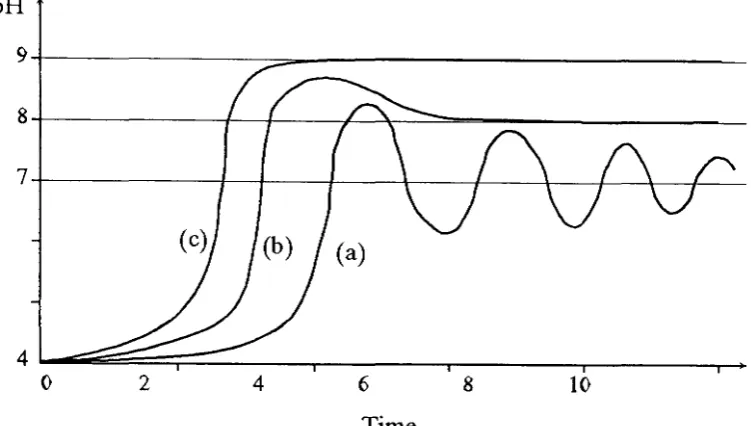
From these estimated critical gains, it showed that to make sure that the closed loop system is stable for small perturbations around an equilibrium of pH = 7, the gain should thus be less than 0.009. A reasonable value of the gain for operation at pH = 8 is k = 0.01, but this gain will give an unstable system at pH = 7 and is too low for a reasonable response at pH =9. Figure 1-3 shows a PI control with gain 0.01 to control the pH process at different set-points.
pH
9-r---:::;:~---10 8
6 4
2
7-t---t--+---+---+---f---\---,f---\--/--
[image:13.704.182.558.331.544.2]8-t---f--I----I-~\__.::::=:.~---Time
Figure 1-3. The pH outputs of a pH control process which controlled by a PI controller with
set-point equal to (a)7; (b)8; (c)9.
1.2. Reasons for Using Fuzzy Logic in the Control of pH Process
Difficulties arise in the control of the pH process due to the severe process non-linearity and frequent load changes. For example, changes in the influent composition or flow rate. The non-linearity can be understood from the S-shaped titration curve shown in Figure 1-2. Frequent and rapid load changes are common for most waste water treatment facilities since the influents come from the waste of a number of sources. It
is therefore very difficult to analyze and derive the system model of a pH control process. However, experience shows that they are often controlled successfully by experienced human operator. Therefore, an alternative approach to the control of pH process is to investigate the control strategies employed by the human operators. A human operator can control a complex process effectively by simply attributing the difficulties he experienced to the rate or manner of information displayed or to the depth to which he may evaluate decisions. The operator's control strategy is based on intuition and experience, and can be considered as a set of heuristic decision rules. Usually these rules are expressed linguistically, and are often very difficult to convert into a quantitative control strategy.
The theory of fuzzy sets and algorithms developed by Zadeh[ll, 12] can be used to evaluated these imprecise linguistic statements directly. Fuzzy logic provides an effective means of capturing the approximate, inexact nature of the physical world. Therefore, it can be used to provide an algorithm which can convert a linguistic control strategy based on expert knowledge, into an automatic control strategy. The pioneering research of Mamdani and his colleagues on fuzzy control was started early in 1974 [13,14,15]. They developed a fuzzy controller for a boiler and steam engine. This showed that the fuzzy control system was less sensitive than conventional control systems to process parameter changes and that it gave good control at all operating points.
techniques for the control of pH within a continuous flow titration process.
1.3 Description of the Contents of this Thesis
The second chapter describes the basic concepts of fuzzy sets theory, fuzzy logic and
approximate reasoning and also the design considerations for a fuzzy logic controller
(FLC). Thi s material will become the basis for later chapters. At the end of this
chapter, current uses of fuzzy techniques and other non-linear methods in pH control are
discussed briefly.
FLC industrial application techniques and FLC implementation methods are
mentioned in the third chapter. After studying these implementation methods, a simple
fuzzy developing system was designed and by which an experimental fuzzy control
program was generated.
The fourth chapter gives a detailed study on the relationship between fuzzy decision
table scaling factors and the control constants of a digital PI controller. Equations
derived in this chapter are confirmed by experiments in the next chapter and become the
basic tuning tools for all the fuzzy controllers used in later experiments.
Using an analog simulation of a plant, a fuzzy PI controller was compared with a
conventional digital PI controller and described in beginning of the fifth chapter. It then
describes a detailed study of the effects of the choice of scaling factors on the control
actions of a fuzzy PI controller. It shows that, in some cases, a special sliding motion
phenomenon will happen if the error change range of the decision table is too small.
The boundary conditions of this sliding regime is also discussed. At the end of this
chapter, by using these scaling factors, several other controllers are constructed which
includes an integral controller and variable structure systems (VSS) formed by switching
A discussion of the characteristics of the pH process and its experimental models
provide the content of the sixth chapter. This includes the structure of the pH process
model plant, the m del equations and static and dynamic behavior of the process.
Chapter seven contains the results and details of the pH control experiments
performed. It shows that the fuzzy PI controller can make the system settle down easier
and faster than the digital PI controller. The damping effect caused by the decision table
near the set-point is also study in detail. Finally, the fuzzy PI control of pH process
under varying set-points and noise are tested.
The last chapter provides the conclusions drawn from this study and some
zxm ,.
Chapter 2
Theory and Design of a Fuzzy Logic
Controller
After Mamdani's work on using a fuzzy controller to control an industrial process,
reports of the application of fuzzy control techniques were widely spread through a
number of fields, such as water quality control [16], automatic train operation systems
[17], elevator control [18], nuclear reactor control [19], and roll and moment control for
a flexible wing aircraft [20]. The literature on fuzzy control has grown rapidly, and in
1990 Lee[21] produced a comprehensive survey of control applications.
The following sections give a brief description of the basic concepts of fuzzy set
theory and fuzzy logic, and includes elements from Lee's survey. This material will
form a basis for later chapters.
2.1 Basic DefInitions and the Fuzzy Set
A set U, denoted generally by {u}, is normally defined as a collection of elements
or objects that can be discrete or continuous. U is called the universe of discourse and
u are generic elements of U. Each element can either belong to or not belong to, a set
A, A E U. By defining a membership function for a set in which 1 indicates
membership and 0 indicates nonmembership, a classical set can be represented by a set
have values between 0 and 1 to represent different degree of membership for the elements of a given set. Therefore, a fuzzy set F in a universe of discourse U is characterized by a membership function I-tP, which takes values in the interval [0,1] namely,
Definition 1: Fuzzy set: A fuzzy set F in a universe of discourse U can be represented as a set of ordered pairs of a generic element u and its grade of membership function: F
= {
(u,l-tp(u»I
u E U }. When U is discrete, a fuzzy set F is described byn
F =
L
11F( Ui) / Ui1=1
where the symbol "/" is a separator and "E" means union. When U is continuous, a fuzzy set F can be written concisely as
Definition 2: Support and Fuzzy Singleton: The support of a fuzzy set F, S(F), is the crisp set of all u E U such that I-tp(u)
>
O. In particular, a fuzzy set whose support is a single point in U with I-tp=
1.0 is referred to as fuzzy singleton.A fuzzy set is denoted in terms of its membership function. Therefore, the set theoretic operations of union, intersection and complement for fuzzy sets will be defined via their membership functions. Let A and B be two fuzzy sets in U with membership functions I-tA and JJ-B' respectively. Some basic operations for fuzzy sets are
Definition 3: Intersection: The membership function /lc(u) of the intersection C=AnB is pointwise defined by
U E U
Definition 4: Union: The membership function /lc(u) of the union C=AUB IS
pointwise defined by
U E U
Definition 5: Complement: The membership function Jlii.. of the complement of a fuzzy set A is pointwise defined as
P"A ( u) = 1 - PA ( u)
Definition 6: Cartesian Product: If AI' ... ,An are fuzzy sets in UI,'" ,Un' respectively. Then, the Cartesian product of AI' ... ,An is a fuzzy set in the product space U IX- XUn with the membership function
P A x · · · XA (u1 , u2 , ' • " un) = min { PA (u1 ) , ' • "P A (Un)}
1 n 1 n
or
PA x . . . xA ( U 1' U2,' . . , Un) = PAl ( U 1 ) • PA
2 ( U2) • . • PA ( Un)
l ' , n n
Definition 7:
Fuzzy
Relation: An n-ary fuzzy relation is a fuzzy set in U I X ··XUnandDefinition 8: Fuzzy relation: Sup-Star Composition: If Rand S are fuzzy relations in UXV and VXW, respectively. Then the composition of Rand S is a fuzzy relation
denoted by R 0 S and is defined by
RoS = {[ (u, w), SUP(11R ( u, v)
*
11s ( v, w))], UEU, VE V, WEW}V
Definition 9: Fuzzy number: A fuzzy number F is a fuzzy set in the continuous universe U which is normal and convex, that is
max 11F ( u) = 1
UEU
11F(AU1 + (1-A)u2 )
> min ( 11F( u1 ) ,11F( u2 ) ) ,
(normal)
( convex) u1 ' u2E U, A E [ 0 , 1 ]
Definition 10: Linguistic Variables: A linguistic variable is defmed by a quintuple (x,T(x),U,G,M) in which x is the name of a fuzzy variable; T(x) is the set of names of linguistic values of x with each value represented by a fuzzy number defined in U; G is a syntactic rule to generate the names for x; and M is a semantic rule to give the meaning of the x value. Usually, a linguistic variable can be regarded either as a variable whose value is a fuzzy number or as a variable whose value are defined in linguistic terms. For example, if there is a linguistic variable called "speed", then the term set T(speed) could be defined as
Each term in T(speed) is characterized by a fuzzy set in the universe of discourse U =
[0,60] as shown in Figure 2-1. where "slow" could be interpreted as "a speed below
about 15 mph", "medium" as "a speed close to 30 mph", and "fast" as "a speed more
than 45 mph", etc.
Slow Medium Fast
o ' - - - - .L..-- ~ ~ _____.J
60 45
15
o 30
Speed
Figure 2-1. Diagrammatic representation of fuzzy "speed."
Definition 11: Sup-star Composition Rule of Inference: If R is a fuzzy relation in UXV,
and u is a fuzzy set in U, then this rule asserts that the fuzzy set v in V induced by u
is given by
v =u 0 R
where u 0 R is the sup-star composition of u and R.
This defInition will become Zadeh's composition rule of inference if the star
represents the minimum operator.
2.2 Structure of a Fuzzy Controller
The basic configuration of a Fuzzylogic controller (FLC) has been described by Lee
in the survey paper discussed earlier[21]. He points out that usually there are four
principal components in a FLC as shown in Figure 2-2. These components are a
fuzzification interface, an inference engine (or decision-making logic), a knowledge base
Fuzzification interface I I I I I I I I I I I
r--7-I I I I I FuzzyL...- ....J tenus
FLC
Knowledge Base I I Inference Engine or Decision making logic Fuzzy terms1
Defuzzification interface L I Process output and state Controlled [image:22.704.139.607.140.427.2]System Actual control Nonfuzzy
Figure 2-2. Basic configuration of a fuzzy logic controller (FLC).
(1) The fuzzification interface performs the following functions:
(a) it measures the values of the input variables (or the system state variables);
(b) it transfers the range of the values of the input variables into the corresponding universe of discourse by scale mapping. Usually this is done by normalization. (c) it converts the input data into proper linguistic values which will be viewed as
labels of fuzzy set.
(2) The knowledge base consists of a database and a linguistic control rule base. Its main functions are:
(a) to provide the necessary definitions, which are used to define the linguistic control rules and fuzzy data manipulation information.
(b) to provide the control goals and control policy of the domain experts which are written using a set of linguistic control rules.
(3) The inference engine is the kernel of the fuzzy logic controller.
by fuzzy implication and the rules of inference of fuzzy logic.
(4) The defuzzification interface performs the following functions:
(a) it converts the range of values of output variables into the corresponding
universe of discourse.
(b) it generates non-fuzzy control actions from the inferred fuzzy control action
outputs.
A fuzzy system is characterized by a set of linguistic statements based on expert
knowledge, which is usually in the form of "if-then" rules of the form:
IF (a set of conditions are satisfied)
THEN (a set of consequences will be inferred).
where both the set of conditions and the set of consequences are fuzzy terms. They are
directly associated with fuzzy concepts and are referred to as "fuzzy conditional
statements". Therefore, a fuzzy control rule is a fuzzy conditional statement in which
the antecedent is a condition in its application domain and the consequent is a control
action for the system under control.
The collection of these fuzzy control rules forms the rule base or the rule set of an
fuzzy logic controller (FLC). For instance, if
x,
and x2 denote the state variables of thetarget plant, and y is the output of the FLC, then the IF (antecedent)-THEN
(consequence) control rule might be expressed as a control algorithms of the form:
if
x,
is small and x2 is big then y is mediumThe antecedent (A and B) is interpreted as a fuzzy set Ax Bin the production space U xV with membership functions JLAXB(U,v) and will be discussed latter in section 2.3.5(2). Therefore, a fuzzy control rule, such as "if (x is Aj and y is Bj) then (z is Cj"
can be implemented by a fuzzy implication (relation) R, as follows:
11R ~ 11(A . /\ B .-+C .) ( u, v, w )
i J. J. J.
Where Ai and B, are fuzzy sets, AjXBjin UXV.The fuzzy implication RjA(Aj and B)
~ C, is in U xV xW; "~" denotes a fuzzy implication (relation) function which will also be discussed later in section 2.3.5(1)
2.3 Design considerations for an FLC
As mentioned earlier, the main function of the FLC is to provide an algorithm which can convert the linguistic control strategy based on expert knowledge into an automatic control strategy. Then, the principle design considerations for an FLC may be divided into five parts:
These are:
(1) fuzzification strategies; (2) defuzzification strategies; (3) data base considerations:
(a) discretization/normalization methods for the universes of discourse, (b) the choice of the membership functions for the primary sets,
(4) rule base considerations:
(a) the choice of the state and control variables for the fuzzy control rules, (b) the derivation of fuzzy control rules,
(c) the justification of fuzzy control rules, (d) the choice of fuzzy control rule types. (5) decision making logic considerations:
(a) the definition of fuzzy implications,
(b) the interpretation of sentence connectives "and" and "also", (c) the definition of compositional operators,
(d) the inference mechanisms;
These five parts will be discussed in the following sections.
2.3. 1 Fuzzification strategies
Fuzzification couldbe defmed as a mapping from an observed input space tofuzzy sets in a certain input universe of discourse. The data manipulation in an FLC is based on the fuzzy set theory, however, in control applications the observed data are usually crisp values. Therefore, fuzzification is necessary at an early stage. Fuzzification is normally achieved in one of two ways. Its results are shown in Figure 2-3(a) and (b). Both cases show an ordinary fuzzy set B intersecting with a fuzzy set A. A is a fuzzy set coming from the input signal Xc after fuzzification. In Figure 2-3(a), A is a singleton but in (b) A is a triangular fuzzy set. The two fuzzification methods are
is that no processing is required for fuzzification in this case. This strategy has been
widely used in fuzzy control applications, since it is very easy to implement.
jlA 1 - - - + - - - 1
B
X
o (a) Fuzzy singleton A.
Jl
A [image:26.702.114.620.225.459.2](b) Triangular fuzzy set A
a
= standard deviation. X0= mean value.Figure 2-3.methods of fuzzification: The measured data are (a) converted to a fuzzy singleton. (b) converted to a triangular fuzzy set.
(2) In many applications the observed data are disturbed by random noise. In this
case, it is more appropriate to choose an isosceles triangle as the fuzzification function.
The vertex of this triangle corresponds to the mean value of a data set, while the base
is twice the standard deviation of the data set. Then, we can use this fuzzy number for
control manipulation. Figure 2-3(b) shows the second method of fuzzification. The fuzzy
set A with its vertex at Xo and having the base width equals to 20- is the resulting
triangular set. The point Xo is the mean value and 0- is the standard deviation of the
measured data set.
2.3.2 Defuzzification strategies
In many practical applications a crisp control action is required to drive the system.
represents the possibility distribution of the inferred fuzzy control action. In other words,
the defuzzification process is a mapping between a space of fuzzy control actions
defined over an output universe of discourse, and a space of non-fuzzy control actions.
There are several kinds of strategies being commonly used. These include the maximum
criteria, the mean of maximum and the center of area methods.
(a) The maximum criteria method
This method produces the point at which the possibility distribution of the control
action reaches a maximum value.
(b) The Mean of Maximum Method (MOM)
The MOM strategy generates a control action which represents the mean value of all
local control actions whose membership functions reach the maximum. In the case of
a discrete universe, the control action will be expressed as
n
Zo =
L
j=l
where wj is the support value at which the membership function value p-/wj ) reaches the
maximum, and n is the total number of such support values.
(c) The Center of Area Method
The COA method is the most popular method currently being used by control
engineers. This strategy generates the center of gravity of the possibility distribution of
In the case of a discrete universe, the method yields
(d) The Center of Sums
This method is the same as the CGA method except that the overlapping areas of the
membership functions must be counted twice during the calculation. The calculation
formula is adjusted as
f zz·fJ.1c( z) dz
fzf
J.1c( z) dz(e) The Height method
This method issimpler than the CGA approach, since there is no integration during
calculation. The calculation formula is
v:«.».
L- .1 .1Zo =
where hi is the strength of the inferred antecedent output of the ith rule, and
z,
is the center of the corresponding output fuzzy set of the ith rule.Braae and Rutherford[22] have performed detailed analysis of various defuzzification
those obtained with a conventional PI controller. However, the MOM strategy yields a better transient performance, while the COA method is better in its steady state performance.
2.3.3 Data Base consideration
The concepts associated with a data base are used to characterize fuzzy control rules and fuzzy data manipulation in an FLC. Since these concepts are basically defined according to experience and engineering judgement, a "good" choice of the membership functions of a fuzzy set will play an essential role in the success of the fuzzy controller application. In this section some of the important considerations relating to the construction of the data base will be discussed.
2.3.3. 1Discretization / normalization methods for the universes of discourse
The method used for the representation of linguistically described information using fuzzy sets usually depends on the nature of the universe of discourse. A universe of discourse in a FLC may be either discrete or continuous. If it is continuous then some discretization and normalization process will be needed before the primary fuzzy sets are applied on it.
(a) Discretization: The process of discretizing a universe of discourse is frequently referred to as the quantitization process. This process divides a universe of discourse into a number of segments.
Table 2-1
Quantization and Primary Fuzzy sets Using a Numerical Definition
Level No. Range NB NM NS ZE PS PM PB
-4 x <-4 1 0.7 0 0 0 0 0
-3 -4<x~-2.5 0.7 1 0.5 0 0 0 0
-2 -2.5 <x<-1.5 0 0.7 0.7 0 0 0 0
-1 -1.5 < x< -0.5 0 0.3 1 0.3 0 0 0
0 -O.5<x<O.5 0 0 0.3 1 0.3 0 0
1 O.5<x<1.5 0 0 0 0.3 1 0.3 0
2 1.5<x~2.5 0 0 0 0 0.7 0.7 0
3 2.5<x<4 0 0 0 0 0.5 1 0.7
4 4<x 0 0 0 0 0 0.7 1
levels with 7 primary fuzzy sets defined on it. Note that the scale mapping of the measured variable values x into the discretized universe can be uniform or nonuniform. Looking into Table 2-1 we fmd that it is not a uniform mapping, since the width of the ranges for all the quantitization levels are equal to 1 except level 3. The shape of the membership functions of primary fuzzy sets, such as ZE and PM, will be discussed in
next section.
(b) Normalization: The normalization of a continuous universe requires a discretization of the universe of discourse into a finite number of segments, with each segment mapped into a segment of the normalized universe. Then, using an explicit function, a
I
fuzzy set will be defmed to its membership function. One example is shown in Table 2-2. where the universe of discourse, [-6, +4.5] is mapped into the normalized interval
Table 2-2
Quantization and Primary Fuzzy sets Using a Numerical Definition
Normalized Normalized Primary Fuzzy
Universe Segments Range f.1 a Sets
[-1.0,-0.5] [-6.9,-4.1] -1.0 0.4 NB
[-0.5,-0.3] [-4.1,-2.2] -0.5 0.2 NM
[-0.3,-0.0] [-2.2,-0.0] -0.2 0.2 NS
[-1.0,+ 1.0] [+0.0, +0.2] [+0.0, + 1.0] 0.0 0.2 ZE
[+0.2, +0.6] [+ 1.0,+ 2.5] 0.2 0.2 PS
[+0.6, + 1.0] [+2.5,+4.5] 0.5 0.2 PM
1.0 0.4 PB
2.3.3.2The choice of the membership functions for the primary fuzzy sets
There are two kinds of fuzzy set definitions, depending on whether the universe of
discourse is discrete or continuous.
(a) Numerical Defmition: In this case, the grade of membership function of a fuzzy set is represented by a vector of numbers. The dimension of the vector depends on the degree of discretization. If the membership function of a primary fuzzy set of this kind
has the fonn
7
=
L
a
i. 1 u .
.1.= ~
where a
=
[0.1,0.3,0.7, 1.0,0.7,0.3,0.1] is the vector of grades, its dimension is equal to 7. Therefore, the primary fuzzy set "ZE" in Table 2-1 can be represented by its membership function together with its correspondingu,
as followingo
0ZE
= [ - , - ,
-4 -3
o
- ,
-2
0.3 -1 '
1
-,
o
0.3 0 0Therefore, under this definition a fuzzy singleton will have the form of s= [0,0,0,0,0, 1,0] without showing its value of quentitization level.
(b) Functional Definition: The membership function of a fuzzy set can sometimes be expressed in a functional form, typically using triangle or bell shaped functions. It is very easy to describe a triangle shape by function, for example, one could define a triangle fuzzy set named "slow", which has vertex at 20 km and two base points at
°
kmand 40 lan. The following function can then be used to calculate its grade:
].1slow(x) = 20 -
Ix -
20l
20 , i f 0~x~40
When using bell shaped fuzzy sets, a Gaussian normal distribution curve is commonly used. This may be described by the equation:
f( x )
=
exp ( : (x - ].1) 2 )202
where Jl denotes the mean value and (J denotes the standard deviation.
The method used to assign the grades of membership to the primary fuzzy set using these functions is very important. If the incoming signals are disturbed by noise, then the membership functions should be wide enough to reduce the sensitivity to this noise. Methods of storing these functional fuzzy sets within computer memory will be discussed later. Figure 2-4 and 2-5 shows the triangle and the Gaussian curve shaped
o
11
I1(X)==a-(a-\x-b\)VO,
a>O
1 NB NM NS
zo
P-S PM PBFigure 2-4. The triangle shaped fuzzy sets.
1 NB NM NS
zo
PS PM PB1
o
o
' - : " - - - _ . L - - - ----...l-1
Figure 2-5. The bell shaped fuzzy sets
2.3.3.3The fuzzy partition of the input and output space
Within fuzzy systems, both the input (antecedent) and output (consequence)
linguistic variables form fuzzy spaces with respect to their own universes of discourse.
In general, a linguistic variable is associated with a term set, with each term in the term
set being defmed on the same universe of discourse. A fuzzy partition determines how
many terms exist within the term set. A fme partition produces more terms than a coarse
one. Figure 2-6 shows two typical examples of fuzzy partitions in the same normalized
universe [-1,
+
1].1
o (b) partition of the fuzzy input!output
control rules is 7x7 =49.The fuzzy determines the maximum number
of fuzzy control rules that can be
coarse
1 N Z P
constructed. For instance, in the case of two-input, one-output fuzzy
0
controller, if the cardinalities of the -1 (a)0 1
term sets of these two inputs are all
finer
1 NB NM NS ZE PS
7, then, the maximum number of
space, is normally non-deterministic and has no unique solution. A
Figure 2-6. Diagrammatic representation of fuzzy partition. (a) 3 terms coarse partition(b) 7 terms finer partition. heuristic cut and trial procedure is
usually needed to get the appropriate number of fuzzy partitions.
2.3.4 Rule Base consideration
A primary task in the design of a fuzzy controller is the construction of the control rule base. Topics to be considered include: the choice of process state and control (output) variables; the derivation and justification of control rules; the type of fuzzy control rules to be used; and issues of consistency, interactivity, and completeness [21]
of control rules.
2.3.4.1 The choice of the state and control variables for the fuzzy control rules
state error integral, the state error derivative, etc.
2.3.4.2The derivation of fuzzy control rules
Tagaki and Sugeno [23] concluded that there are four ways to generate a set of fuzzy control rules. These four ways are not mutually exclusive, and may be combined to form an effective way to construct the fuzzy control rules.
(a) Using Expert Experience and Control Engineering Knowledge:
In everyday live most of the information on which our decisions are based is linguistic rather than numerical in nature. In this respect, fuzzy control rules provide a natural framework for the characterization of human behavior and for analyzing the decision making process. It was realized that fuzzy control rules could provide a convenient way to express domain knowledge. Therefore, most FLCs are based on the knowledge and experience which are expressed in the language of fuzzy if-then rules [14],[24] ,[25].
The formulation of fuzzy control rules can be done in two ways. The first one involves an introspective verbalization of human expertise. Examples of such verbalization are those operating manuals for the production plant. The second includes an interrogation of experienced experts or operators using a carefully organized questionnaire. By these two methods a prototype set of fuzzy control rules can be produced for a particular application. However, it will generally be necessary to optimize the performance of the system using a trial and error approach.
(b) Using lnfonnation on Operator's Control Actions:
not known sufficiently clearly, to make it possible to employ classical control theory for
modeling and simulation. However, human operation can perform quite complex tasks
in the absence of such models. For example, a skilled driver can park a car successfully
without being aware of a quantitative model of the car. In fact, a set of fuzzy if-then
control rules is being employed consciously or subconsciously by the car operator.
Therefore, rules deduced from the observation of a human controller's actions, are a
useful source of information of a rule base. Sugeno has presented a series of papers
discussing the automation of this process [26][27][28].
(c) Using a Fuzzy Model of a Process:
By analogy with classical control system modeling, a linguistic description of the
dynamic characteristics of a control system can be viewed as a fuzzy model of the
system. Based on this fuzzy model, it is possible to obtain a set of fuzzy control rules
for achieving near optimal control of the system. This set of control rules can then be
used as the rule base of an FLC.
Some fuzzy modeling techniques have been reported [29] [30], but this approach to the design of an FLC has not been fully developed [21].
(d) Using Technique Based on Learning:
Early in 1979 Procyk and Mamdani presented the first self-organizing controller
(SOC)[31]. Such controllers are very attractive in applications as they automatically
tune, and retune, themselfs on line, and require no special expertise from the operator
once installed [45] . The SOC has a hierarchical structure which consists of two rule
bases. The first is the general fuzzy rule base of an FLC. However, the second is
base, based on the desired overall performance of the system. In 1991, Lee presented a new method of SOC [32]. He employed an approximation reasoning and neural net concept for a self-learning rule-based controller. In Lee's controller there are two very important units: the Associative Critic Neuron (ANC), and the Associative Learning Neuron (ALN). The former evaluates the output response produced by present control action and creates an evaluation signal. The latter adjusts the break point of the membership functions in the rule base based on signals received from the ACN. Combining neural network theory with fuzzy control theory is seen as an area of great potential in the design of FLCs.
2.3.4.3The justification of fuzzy control rules
The most common method applied to the justification of fuzzy control rules is called "scale mapping", which was first presented by King and Mamdani [33]. Rule justification is done by considering the nature of the response of the system when plotted on a phase plane diagram. This process is best understood through the use of an example phase plane analysis.
Consider a system using the error E and change of error DE as input variables and a rule linguistically described as follows:
IF E (error) =PB and DE (change of error) =PS THEN y (output) =NM
( PB: positive big, PS: positive small, NM: negative medium.)
changed to NB. This would increase the retarding force to reduce the overshoot or
adjust the value of membership function for NM to improve it.
A similar method was suggested by Braae and Rutherford [34]. They tracked the
linguistic trajectory of the closed loop system in a 'linguistic phase plane' . The pmciples
involved in this approach is similar to those described above.
DE
c
/
over shoot
E
rise time
s.p,
a
E +
DE
m
+ + - - + + - - + + time
+ + - - + + + +
-(a) phase plane trajectory (b) system step response
Figure 2-7. Rule justification by using phase plane.
2.3.4.4 The choice of the fuzzy control rule types
Two types of fuzzy control rules are currently in use in the design of FLCs. These
are "state evaluation" fuzzy control rules and "object evaluation" fuzzy control rules. A
third type, slightly modified from the first of these, is also quite popular in the industrial
application. Its consequent instead of using linguistic values is represention as a function
of the process variables. These three types of fuzzy control rules are discussed briefly
below
(a) State Evaluation Fuzzy Control Rules:
State evaluation fuzzy control rules are the most commonly used form of rules in
characterized by the following form
where X,'" ,yand z are linguistic variables representing the process state variables and
the fuzzy control output variable; Ai,"',Bj and C, are the linguistic values of the
linguistic variables x, "',y, and z.
(b) State Evaluation Fuzzy control Rules with Functional Output :
In such rules, the consequent is represented as a function of the process state
variables X,"',y .i.e.,
R: if
x
is Aj , ' " ,and y is B, then zhex, ...
,y)Such type of rules were first proposed by Sugeno[23], and are now widely used in
industry.
(c) Object Evaluation Fuzzy Control Rules:
Fuzzycontrol using objective evaluationcontrol rules is also called 'predictivefuzzy
control', and was first proposed by Yasunobu, Miyamoto, and Ihara[35]. A control
command is inferred from an objective evaluation of a fuzzy control result that satisfies
the desired states and objectives. The rule will be described as
A control command u takes a crisp set as a value, such as "changed" or "not changed", and x, y are performance indices for the evaluation of the ith rule, taking values such as "good" or "bad". Then the most likely control rules will be selected through predicting the results (x,y) corresponding to every control command C,
This rule can be interpreted linguistically as: "if the performance index x is Aj and index y is Bj when a control command u is chosen to be C, then this rule is selected
and the control command C, will be taken to be the output of the controller. "
In practical, it is possible that more than one system state will give the same result and prediction becomes more complicated.
2.3.5 Decision making logic consideration
The use of an FLC can be viewed as trying to emulate human decision making within the conceptual framework of fuzzy logic and approximate reasoning. In this context, the forward data-driven inference (generalized modus ponens), this term will be explained later, plays a very important role. In this section, the properties of fuzzy implication functions, sentences connectives, composition operators and related concepts will be introduced.
(1) Fuzzy Implication Functions
A fuzzy control rule, is essentially a fuzzy relation which is expressed as a fuzzy implication. In fuzzy logic, a fuzzy implication may be defmed using some kind of
fuzzy implication functions.
(a) Basic properties of a fuzzy implication function:
generalized modus tollens (GMT), both of them come from tautologies such that modus
ponens: (A1\(A~B))~B, and modus tollens: «A~B)1\(not B))~ not A. Here, "~" is
the fuzzy implication or relation usually denoted by relation matrix "R". If A, A', B,
and B' are fuzzy predicates.then these two rules can be described as following,
premise 1: x is A'
premise 2: if x is A then y is B consequence: y is B'
premise 1: y is B'
premise 2: if x is A then y is B consequence: x is A'
(GMP)
(GMT)
For the GMP case, "y is B'" results from matrix operation B' =A' 0 R.It has forward
data-driven characteristics, thus which is more suitable for ordinary control applications.
(b) Families of Fuzzy Implication Functions:
There are at least 40 different kinds of fuzzy implication functions, in which the
antecedents and consequences contain fuzzy variables. Before the inference mechanisms
are discussed, in this section, several definitions must be briefly introduced.
Definition 1: Triangular Norms: The triangular norm
*
is an operation represented by *: [0,1] x [0, 1]~ [0,1], which includes the following operationsFor all x,y E [0,1]:
intersection
algebraic product
bounded product
drastic product
x A Y - min {x,y}
x . y = xy
x
0
y=
max {O,x+y-l}x y
=
1x@y= y x
=
1Definition 2: Triangular Co-Norms: The triangular co-norm
+
is also a two-placefunction denoted by +:[0,1] X[O,l] ~ [0,1], which includes
union
algebraic sum
bounded sum
x V Y - max{x,y} x ~ y - x + y - xy
X $ Y
=
min{l,x+y}drastic sum
y = l
x = 1
x,y < 1
Definition 3: Fuzzy conjunction: The fuzzy conjunction is defined for all u E U and
v E V by
A~B=AXB
=
f
].1A ( u) *].1B ( v) / ( U, v)l/XV
where
*
is an operator representing a triangular norm.Definition 4: Fuzzy disjunction: The fuzzy disjunction is defmed for all u E U and v
E Vby
A~B=AXB
=
f
].1A ( u) +].1B( v) / (U, v)l/XV
where
+
is an operator representing a triangular co-norm.Definition 5: Fuzzy Implication: There are five families offuzzy implication functions in use. Here, as before,
*
denotes a triangular norm and+
is a triangular co-norm.a) material implication
A ~ B - (not A)+ B
A ~ B = (not A)+ (A* B)
c) Extended propositional calculus:
A ~ B
=
(not A x not B)+ Bd) Generalization of modus ponens:
A ~ B
=
sup { c E [0,1], A* C < B }e) Generalization of modus tollens:
A ~ B
=
inf {
t E [0,1], B+ t < A }Based on these definitions, many fuzzy implication functions may be generated by
employing triangular norms and co-norms. Examples include the following fuzzy
implications, which are called the mini-operation rule of fuzzy implications and the
product operation rule of fuzzy implication. These were developed by Mamdani[13] and
Larsen[65] respectively, and are often used in FLCs.
mini-operation rule:
Rc = A ~ B
=AXB
=
f
J.1A ( u) /\ J.1B( v) / i.u, v){/Xv
product-operation rule:
Rp = A x B
=
f
J.1A ( u) J.1B ( v) / ( u, v){/Xv
(2) Interpretation of Sentence Connectives "and" and 'also"
(2-1)
(2 -2)
Commonly, the sentence connective" and" is implemented as a fuzzy conjunction in
a Cartesian product space in which variables are taking values from different universes
interpreted as a fuzzy set AXBin the product space UX V,with the membership function
given by
(2-3)
or
(2-4)
Where U and V are the universe of discourse associated with A and B respectively.
When a fuzzy system is characterized by a set of fuzzy control rules, the ordering of
the rules is immaterial. This implies that the sentence connective "also" should have the
properties of commutativity and associativity. Therefore, the operators in triangular
norms and co-norms possessing these properties are suitable to be used to interpret the
connective "also".
Finally from the practical point of view, the computational aspect of FLC require a
simplification of the fuzzy control algorithm. Therefore, Mamdani's R, and Larsen's ~ with the connective "also" as the union operator "V " seems to be more suitable for
constructing fuzzy models.
(3) Compositional operators
Four kinds of compositional operators have been reported which can be used in the
compositional rule of inference:
sup-min operation (Zadeh, [36])
sup-product operation (Kaufmann, [37])
sup-bounded-product operation (Mizumoto,[38])
sup-drastic-product operation (Mizumoto, [38])
In practical FLC applications, the sup-min and sup-product compositional operators
(4) Inference Mechanisms
In an FLC, the consequence of a rule is not applied to the antecedent of another.
This means that there is no chaining inference mechanism involved, and that the control
actions are simply based on one-level forward data-driven inference (GMP).
Combining all the implication functions, definitions and relations mentioned in this
chapter, the inference mechanism can be explained by the following four types of fuzzy
reasoning method which are currently employed in FLC application.
(a) Fuzzy Reasoning of the First Type - Mamdani's Minimum Operation Rule as a
Fuzzy Implication Function:
This type is the most popular reasoning method, and was first introduced by
Mamdani. Let us consider the following general form of MISO fuzzy control rules for
the case of two-input/ single-output fuzzy systems:
RI : if Xl is All and x2 is A l 2 then y 1S BI
or
R2 : if Xl 1S An and X 2 is A 22 then y 1S B2
or
· ·
•· ·
•· ·
•• • •
is and is A i 2 then
.
BiRi : if Xl Ail X 2 Y 1S
· ·
•·
• ••
·
·
·
• •is and is ~2 then
.
Bn~: if Xl ~l X 2 Y 1S
If the universe of discourse of
x,
'X2 and yare represented byXl' X
2 and Y. Then, using equation (2.1) and (2.3), the i's control rule can he expressed
by a fuzzy relation matrix:
This system consists of n rules, RI,R2 , ...,Rnt!lerefore, we may combine them by "U"
as connective "also" which has been discussed in section 2.3.5(2). Equation (2.5)
becomes
R = R UR U ... UR
I 2 n
n
=
U
s,
i=l
( 2 .6)
When the inputs are
Aol
andAo2
and the output is denoted by Bo, we will have the following operation:or
BO(y) = max [R( Xl' X 2,y)
A
AOI (Xl)A
A0 2(x2 ) ]X I,X2
(2.7)
(2.8)
Normally, the control inputs are crisp values, which are called fuzzy singletons. In this case, we can replace the antecedent variables
x.,
X2 by Xol andXm,
thus( 2 .9)
and equation (2.7) become
(2.11) combining (2.5) and (2.6), the right hand side of (2.11) will become
• • •
n,
(X0 1 , X0 2 ' y) - Ail (XOl ) 1\ A i 2 (X0 2 ) 1\ Bi (y)if we define
then (2. 11) will becomes:
n
Bo(y)
=
V
[CAliA Bi (y) ]i=l
(2.13)
(2.14)
(2.15)
Now, if we use the center of area method (eGA) to get the defuzzification output, then we will have a crisp output value. As described in section 2.3.2(c) the defuzzification formula is
Yo =
J
Bo(y) 'ydy
J
Bo(y) dy(2.16)
The following figure shows the reasoning method of this type.
Xz
B
.1-y
Xz
Xoz
y
(b) Fuzzy Reasoning of the Second Type - Larsen's Product Operation Rule as a Fuzzy Implication Function.
Fuzzy reasoning of the second type is based on the use of Larsen's product operation rule
R,
as a fuzzy implication function. In this case, theith
rule leads to the control decision(2.17)
consequently, the result of reasoning will become
n
Bo(y) =
V
wi Bi (y ) i=l(2.18)
The fuzzy reasoning process is illustrated in Fig. 2-9 as shown below
Y Y
Wz
.. ---+---:
X02
Yo
(c) Fuzzy Reasoning of the Third Type - Tsukamoto's Method with Linguistic Terms
as Monotonic Membership Functions:
This method was proposed by Tsukamoto[39]. It is a simplified method based on the
fuzzy reasoning of the first type in which the membership functions of fuzzy sets Xl'
X2 and Y are monotonic, as shown in Figure 2-10(a) and 2-10(b).
1 1 - - -
-Positive
0
-1 0 1 -1 0 1
(a) (b)
Figure 2-10(a) monotonic linear type fuzzy membership function.
(b) monotonic arctan type membership function.
The P(Positive), N(Negative) fuzzy variables can be described as
P(x) = - x1 + 1
2 2 (2.19)
N(x) = P( -x) (2.20)
for Figure 2-10(a), the monotonic linear type variables. and
P(x) (2.21)
N(x}
=Pc-x}
for Figure 2-10(b) the arctan type variables.
If using Tsukamoto's method, the result inferred from the first rule is Wt such that
crisp control action may be expressed by equation (2.22), the height method, which has
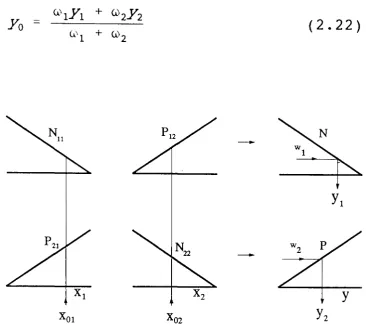
been described in section 2.3. 2(e). This type of fuzzy reasoning is illustrated in Figure
2-11.
(2.22)
[image:50.704.192.559.247.577.2]--y
Figure 2-11. Diagrammatic representation of fuzzy reasoning type 3.
(d) Fuzzy Reasoning of the Fourth Type - The Consequence of a Rule is a Function of
Input Variables.
Fuzzy reasoning of the fourth type employs a modified version of the state
evaluation function. In this mode of reasoning, the ith fuzzy control rule is of the form
here, we may consider both f1 and f2 as linear equations of the form
although these are not usual in many applications. If the input variables are Xo1 and Xo2, then the inferred value of the first and second rules will become
Thus, applying these two values, we can calculate the consequence result directly as
Finally, using the eGA defuzzification formula, a crisp control action is given by
Yo
=
WIf 1 (X0 1' X 0 2) + w2f 2(X01' X 0 2)WI + W 2 (2.23)
of input space partitioned. Figure 2-12. shows an example of the fuzzy rules used when
two input variables are involved, and Figure 2-13 shows the corresponding partitioning
of the input space. Note that, the break points of the membership functions for the input
variable
x,
space are 3, 9, 11 and 18; for x2 spaces are 4 and 13. The shaded area arethose membership function overlapping zones.
if X2 then y
---_.
Y1 = 1.0 Xl + 0.5X2 +1.0
Y4 = 0.2 Xl +0.lx2 +0.2
Y3 = 0.9 x , +0.7x2 +9.0 Y2 =-0.1 Xl + 4.0X2 +1.2
h
4 133 9
/1
3 9
~L
3 9 11 18 4 13--,,---,-L
11 18L
4 13
Figure 2-12. The fuzzy rules for reasoning of type 4.
Deciding on an appropriate method of partitioning is a serious problem from the fuzzy
system identification point of view[40,41].
13
-1
4
-3 9 11 18
2.4 Current uses of Fuzzy Techniques and other Non-linear methods in Control of the
pH Process
As mentioned in Chapter 1, control of the pH process is difficult due to the
non-linearity and time varying nature of the titration curve, and because of its strong
sensitivity to disturbances near the point of neutrality. For these reasons, over the years
several new technologies have been applied in an attempt to solve these problems. In
this section, several different approaches, including the use of the fuzzy logic are listed
chronologically and briefly discussed.
2.4.1 The Digital Parameter Adaptive Control Technique (1980)
Bergmann& Lachmann's paper[3] published in 1980, describes the application of
two digital parameter adaptive controllers to a pH process. The controllers use
combinations of recursive least squares (RLS) parameter estimation methods with a extended minimal variance controller and a deadbeat controller of increased order. These
two adaptive control algorithms have been applied to control a pH pilot plant.
Experimental results are promising. However, selecting appropiate parameters to
achieve good stability is very difficult.
2.4.2 Dynamic Modeling and Reaction Invariant Control of pH(1983)
In 1983, Gusstafsson and Waller presented a paper[5] on a general and systematic
approach to the derivation of dynamic models for fast acid-base reactions. The treatment
is based on a consistent use of chemical reaction invariants and variants, the former
describing the physical properties of the reactor system independent of chemical
reactions, the later describing the chemical reactions. For fast acid-base reactions the
The reaction rate vector is thus eliminated from the model. The reaction variant part of
the model then, use a static equation to relate pH to the reaction invariant state
variables. The model obtained provides a sound basis for the design of control loops for
a pH control process. A computer simulation example is given at the end of this paper.
2.4.3 An Experimental Study of a Class of Algorithms for Adaptive pH Control (1985)
This paper, which was published by Gustafsson in 1985[4], describes models suited
to the design of controllers of pH in fast acid-base reaction processes with varying
buffer concentrations. The set of models includes a non-linear model resulting in a
controller with linearized feedback of a reaction invariant state vector and linearized
models resulting in adaptive linear feedback of pH. Experiments showed that the
reaction invariant feedback control needs a
priori
knowledge of the reaction invariantdynamics of the process, which includes the time delay n and the model orders nA and
nB• These models can be obtained by on-line identification performed by a self-tuning
regulator. However, to ensure a correct result when identifying a process in closed-loop,
feedback polynomials of a high enough order and extra perturbing inputs are necessary.
In this paper the emphasis is put only on the adaptive properties of the controllers.
2.4.4 Non-linear State Feedback Synthesis for pH Control (1986)
Inthis paper, presented by Wright and Kravaris[7] , a novel non-linear state feedback design methodology is described. This is based on a non-linear transformation of the
output that linearizes the state/output map. A linear PID control law for the transformed
output generates a non-linear control law for the pH process. Computer simulations were
used to compare the performance of this non-linear control law to classical linear PID
approximately 10 controller actions, is clearly superior than the classical contro at all
sampling periods.
2.4.5 Non-linear Controller For a pH Process (1990)
Jayadeva and Rao, etal[42] synthesized a non-linear feedback-feedforward controller
in which a model reference non-linear controller design technique is applied to control
a pH process. The performance of this non-linear controller is evaluated by simulation
both for regulatory and servo problems. The simulation result is very good. This control
system is also shown to be robust to significant parameter variations and to small
disturbances.
2.4.6 Non-linear Control of pH Process Using the Strong acid Equivalents (1991)
A novel approach was developed by Wright and Kravaris[43] for the design of
nonlinear controllers for pH processes. It consists of defining an alternative equivalent
control objective which is linear in the states and using a linear nonadaptive control law
in terms of this new control objective. The new control objective is interpreted
physically as the strong acid equivalent of the system.
A minimal order realization of the full-order model has been rigorously derived, in
which the titration curve of the inlet stream appears explicitly. The strong acid
equivalent is the state in the reduced model which can be calculated on line from pH
measurements given a nominal titration curve of the process stream. However, this
requires the use of additional hardware, such as an automatic titrator or ion-selective
eletrodes to obtain a direct or indirect measurement of the strong acid equivalent value.
Computer simulations have been used to evaluate the performance of this new
![Figure 1-2 typical titration curves. (reproduced from[9])](https://thumb-us.123doks.com/thumbv2/123dok_us/9849761.486149/12.709.170.561.402.637/figure-typical-titration-curves-reproduced-from.webp)