DEVELOPING A RELEVANT AND EFFECTIVE ASSIGNMENT TOOL FOR PATIENTS DIAGNOSED WITH A PERSONALITY DISORDER: ASSIGNING PATIENTS TO A
SUPPORTIVE-STRUCTURING TREATMENT OR AN INSIGHT-PROVIDING TREATMENT
Dennis Sennef (s1126121)
University of Twente Master thesis
FACULTY OF BEHAVIOURAL SCIENCES Positive Psychology and Technology (PPT)
October, 2015
Examination Committee:
Abstract
In clinical practice, life-stories are often valued as a relevant source of information supporting the assignment process, but relevant research and systematic assignment methods are lacking.
The purpose of this study is to develop an assignment instrument to provide effective assignment to 1) treatment based on Dialectical Behavioural Therapy, or 2) treatment based
on Schema Focused Therapy in a clinical setting. This study is conducted in two parts; the first part presents and gathers expert knowledge on the topic, while the second part tests the reliability and validity of the instrument developed on the basis of this knowledge. In study 1,
possible distinctive characteristics of life-stories of the two patient groups are gathered through a focus group meeting consisting of eight clinicians, all employed at the same
expertise centrum for personality disorders in the Netherlands. In study 2, the developed instrument is tested on reliability and validity by nine clinicians operating in a Dutch expertise centrum for personality disorders and nine psychology students from the University of
Twente in the Netherlands. Results of study 1 reveal possible discriminants on 10 dimensions: Handwritten, Language proficiency, Structure, Upbringing, Education, Intimate relationships, Self-reliance, Self-control, Attribution and Insight. Results from study 2 indicate that the
instrument may be considered reliable. Validity testing showed that differences in language proficiency, self-reliance and self-control were related to whether patients were in the
supportive-structuring program or the insight-providing program. Differences in structure, upbringing, pedagogical neglect, education, attribution and insight, provide interesting results for further research. Results suggest that clinician expertise is highly beneficial to research
1. Introduction
1.1 Assignment to treatment modality
The effectiveness of psychotherapies in order to treat Personality Disorders (PDs) is gaining increasing attention in scientific literature (Svrakic, Draganic, Hill, Bayon Przybeck
and Cloninger, 2002; Verheul, 2009; Hadjipavlou & Ogrodniczuk, 2010). Currently, different effective treatments exist for PDs. An important question that arises is how to provide
adequate treatment assignment/recommendation for patients with different characteristics. Unfortunately, there is little research regarding what treatment is suitable for patients with different characteristics who are diagnosed with a PD.
It is widely found that people diagnosed with a PD are likely to suffer a great deal from it. In addition to the personal suffering of the patient, treatment for PDs are expensive,
and combined with government cuts in general healthcare budgets (Voskes, Theunissen & Widdershoven, 2011), mental health care is forced to adopt cost-effective psychological treatments and methods for assigning patients to the right treatment.
In the Netherlands, GGNet Scelta is a specialist organisation that provides treatment for patients struggling with personality problems. GGNet offers multiple treatment methods
for patients with personality problems, each tailored to the specific needs and characteristics of patients. At GGNet Scelta, two clinical programs are available for patients suffering from a PD. The first clinical treatment is based on Dialectical Behavioral Therapy, developed by
Marsha Linehan (Linehan, 1993). The second clinical treatment is based on Schema Focused Therapy, originally developed by Jeffrey Young (Young, 2003).
In order solve the problem of assigning patients to the adequate treatment program, patients are asked to write their life-stories alongside their application. Life-stories are read by the person responsible for their intake, i.e. a general health psychologist, clinical psychologist
the digital patient system. Patients’ assignment to one of the two treatments for those
suffering from a PD forms the focus of the present paper. This method of using the life-stories of patients for treatment assignment has been used extensively in the past, but is based on implicit expert knowledge. In this introduction we address PDs in general, the treatment of
PDs, similarities and differences between PD treatments, and research on life-stories related to psychological health.
1.2 Personality disorders
According to the fifth edition of the Diagnostic and Statistical Manual of Mental
Disorders (DSM-5), in brief, personality disorders “are based on enduring patterns of behavior, cognition, and inner experience, which are exhibited across many contexts and
deviate markedly from those accepted by the individual’s culture. These patterns are
associated with significant distress or disability, developed in childhood and are difficult to
change” (5th ed.; DSM-5; American Psychiatric Association, 2013). It is important that these
inner experiences and behaviour cannot be attributed to a different psychological disorder. Epidemiological studies published between 2004 and 2010 suggest that approximately
10% of the community meet the diagnostic criteria for at least one personality disorder (Oltmanns, Rodrigues, Weinstein & Gleason, 2014). According to the results of the
Epidemiologic Survey on Alcohol and Related Disorders conducted in the US, approximately
15% of the population meet the diagnostic criteria for at least one personality disorder (Grant et al., 2004). In a population of psychiatric patients, Andrea and Verheul (2009) found that the
prevalence of personality disorders is approximately 49%, with high comorbidity between personality disorders and symptom disorders.
Svrakic et al. (2002) state that a personality disorder is a chronic and debilitating
peak in the early twenties and then persist for decades. Symptoms cause personal suffering,
family dysfunction and social deviance, including criminality and addiction.
Aside from personal and social difficulties, suffering from a personality disorder is likely to cause high direct and indirect costs for society (van Asselt, Dirksen, Arntz, Severens,
2007). A study by Rendu, Moran Patel, Knapp and Mann (2002), found that healthcare and non-healthcare costs of patients with a personality disorder were significantly higher
compared to those without a personality disorder. Examples of these direct costs were psychiatric and general hospital costs, general practitioner costs, and medication costs, whereas indirect costs referred to forensic psychiatric institution costs, informal costs and
costs of the loss of productivity due to 1) absence of work, 2) disability and 3) suicide.
1.3 Treatment of personality disorders
As the previous sections have shown, it is important that patients receive effective treatment. Research on the effectiveness of PD treatment has gained increasing attention in
recent decades. Historically, it was suggested that psychotherapy was not effective for treating (PDs), but there is growing evidence that it may indeed be the treatment of choice (Budge,
Moore, Del Re, Wampold, Baardseth, & Nienhuis, 2013).
When evaluating recent scientific research focusing on the effectiveness of treatment of personality disorders, it is important to note that most research has focused on the treatment
of two personality disorders: Borderline Personality Disorder (BPD) and Antisocial Personality Disorder (ASPD). Treatment for patients with BPD has been examined most
often, and to a much lesser extent, as has treatment for ASPD (Bateman, Gunderson & Mulder 2015). The remaining 9 PDs: paranoid, schizoid, schizotypical, antisocial, histrionic, narcissistic, avoidant, dependent, obsessive-compulsive have been less frequently studied
Research suggests that there are various effective psychotherapies that can be used to
treat personality disorders. However, it is not clear which type of psychotherapy is most effective. According to Paris (2015), there is no evidence that one method of psychotherapy is more effective and preferable over another, and when two or more well-structured approaches
are compared, it is likely that no difference in effect will be found between treatments. Budge et al. (2013) performed a meta-analysis including 42 studies that examine the effects PD
treatments. This meta-analysis confirms the findings of Paris (2015). Treatments of
personality disorders all have a psychodynamic or cognitive-behavioural background, and that despite name differences, all effective treatments could be categorized into two approaches:
psychodynamic or cognitive-behavioral (Budge et al., 2013).
1.3.1 Dialectical Behavioural Therapy
Dialectical Behavioural Therapy (DGT) was the first effective treatment for BPD and was originally developed by Marsha Linehan for outpatient settings (Linehan, 1993). Until
now, DBT is still considered to be the leading evidence-based treatment for BPD (Paris, 2015). DGT is an adaptation of Cognitive Behavioural Therapy combined with interventions
derived from other approaches, such as behavioural therapy and mindfulness. In DGT, emotional dysregulation and impulsive behaviours are the most important treatment targets.
The first published randomized controlled trial (RCT) examining the effect of DGT
was performed in 1991. Significant differences in high-risk impulsive behaviour were found compared to treatment as usual (TAU) receiving outpatient counselling (Linehan, Armstrong,
therapy used by experts interested in BPD and experienced in the treatment of BPD and
suicidal behaviour. They found that DBT was more effective than the expert treatment. A study by Verheul, van den Bosch, Koeter, de Ridder Stijnen and van den Brink (2003) showed similar effects: DBT for BPD patients was superior to TAU in reducing high
risk-risk behaviours and also had better retention rates. TAU patients attended a maximum of two therapy sessions per month conducted by the original referral source. This study is an
important contribution to the existing research on DBT as it was the first study not to have been conducted by its developer, and was carried out outside of the USA (Verheul et al., 2003). A meta-analysis conducted in 2010 by Kliem, Kröger, and Kosfelder (2010) found that
DBT is more effective than traditional ways of treating BPD patients (TAU treatments), but no evidence was found that DBT is more effective than other borderline-specific treatments.
1.3.2 Schema focused therapy
In addition to the evidence based on DBT, another approach to treating BPD is
becoming more popular: schema focused therapy (SFT). Although this approach is examined less frequently compared to DBT, it is gaining promising evidence as an effective treatment
for BPD (Montgomery-Graham, 2015).
SFT is an integrative form of psychotherapy embedded with the techniques and insights of different approaches such as learning theory, cognitive theory, client-centered
theory, psychodynamic theory and attachment theory (van Genderen & Arntz, 2010). In SFT, Schemata refer to a person’s maladaptive beliefs about themselves, others and the world
According to Farrell, Shaw and Webber (2009) SFT is an effective treatment for BPD
that can lead to recovery and improved overall functioning. The authors rely on a RCT of Giesen-Bloo et al. (2006). Giesen-Bloo et al. (2006) performed a RCT comparing Schema Focused Therapy (SFT) with Transference-Focused Psychotherapy (TFP). SFT was favoured
over TFP on all measures; for example, they found a reduction in all BPD symptoms and general psychopathologic dysfunction, improved quality of life and changes in associated
personality features. In the study of Farrell et al. (2009), significant results between SFT and TFP emerged after a 12-month period, and extended to the end of the study (36 months).
1.4 Differences and similarities between DBT and SFT
As described above, it is clear that DBT and SFT can both be effective in treating
BPD. Both approaches share characteristics that contribute to effective treatment; for example they both use the same cognitive and behavioural principles (Montgomery-Graham, 2015). Furthermore, both treatments use some of the same techniques such as exposure,
reinforcement and skills training (Kelloggs & Young, 2006).
Another similarity between the two approaches is that both DBT and SFT recognise
that patients with BPD tend to have difficulties in mentalization, which means that they have difficulties in recognizing their own emotions and often do not know how to deal with these emotions (Paris, 2015). Two of the main diagnostic criteria for BPD are based on these
difficulties in mentalization. Both treatment approaches facilitate mentalization, although it is reached in different ways (Montgomery-Graham, 2015).
Although the two approaches have a lot in common, they also differ from one another. According to Montgomery-Graham (2015), STF and DBT differ regarding the
conceptualization and etiology of BPD. In DBT, unstable or reduced mentalizing capacity is a
conceptualized as a disturbance on a continuum of dissociative identity disorder, stressing the
importance of unintegrated schemas (Young, Klosko & Weishaar, 2003). With regard to etiology, DBT attributes importance to transactional influences between the individual’s biological disposition and the invalidating environment (Linehan, 2003). Contrastingly in
SFT, BPD is considered to be a constellation of maladaptive schemas developed in one’s early family environment, in combination with genetic influences (Young, 2005).
When examining the treatment structures of the two approaches, a difference can be found. DBT focuses on stability, stopping problematic behaviour, improving behavioural skills and increasing self-respect (Linehan, 2003). SFT however takes a psychotherapeutic
approach, focusing on bonding and emotional regulation, schema mode change and
development of autonomy in order to extend patients’ knowledge and their understanding of
themselves (Young 2005; Kellogg & Young, 2006)
1.5 Research on life-stories and mental health
Some researchers have suggested that examining life-stories may be helpful in
assigning patients to the proper treatment modality, by asking patients to describe themselves
and their lives (van Os, 2014). Van Os (2014) suggests that life-stories contain valuable information that may be useful for assigning treatment. In the following section we address some characteristics of life-stories related to psychological health.
Coherence in life-stories is hypothesized to relate to psychological well-being and psychological disorders (Habermas & Buck, 2000). Deficits in life-story coherence can
predict a lower level of psychological well-being and can lead to a higher probability of the presence of a specific psychological disorder.
Agency & Communion are two themes in life-stories that have also been related to
circumstances, and communion is the motive for attachment, love and friendship (Adler,
Chin, Kolisetty & Oltmanns, 2012). According to Westerhof (2008), the concepts of agency and communion appear in almost every life-story, and the presence of high agency and communion is considered to relate to psychological well-being. Adler et al. (2012) found that
adults with features of BPD score low on communion fulfilment and agency.
Overall, the life-stories of patients who suffer from a personality disorder can show
distinctive characteristics that may provide opportunities for the process of treatment
assignment. However, previous research does not provide a great deal of information for the present study.
1.6 Present study
Personality disorders and treatment of PDs are popular research topics in the field of psychology (Linehan et al., 1991; Giesen-Bloo et al., 2006; Kliem et al., 2010). Patients with personality disorders are prone to suffer from these and create high costs for society (van
Asselt et al., 2007). Currently, different effective methods for treating PDs exist, such as DBT and SFT, however little is known about treatment assignment.
There is some evidence that differences in life-stories are related to different states of psychological well-being; for example, differences in life-story coherence and differences in agency and communion are found to relate to different states of well-being (Habermas &
Buck, 2000; Adler et al., 2012; Westerhof, 2008). These concepts may be helpful in the process of treatment assignment.
In the field of practice at GGNet Scelta, life-stories are used in a non-systematic way as an addition in the process of treatment assignment. In order to make the use of life-stories in treatment assignment more systematic, it is important to identify the characteristics that
distinctive characteristics of life-stories from patients involved in two different clinical
treatments of personality disorders: a supportive-structuring treatment (based on DBT) and an insight-providing treatment (based on SFT). We suggest that these distinctive characteristics could help to develop an instrument for systematic evaluation of life-stories, facilitating the
process of treatment assigning.
This study is divided in two parts. The first study uses clinician expertise to create an
inventory of the different characteristics of life-stories from patients from both clinical treatments. The second study focuses on developing an instrument that enables treatment assignment to one of the two treatments. This instrument is tested on reliability and validity to
provide an insight into the possibilities of implementing this tool in the field of mental health care, especially for inpatient mental health care. The study aims to contribute to the process of
systematic life-story evaluation and treatment assignment. The main research questions are: 1) What life-story characteristics do clinicians use in the treatment assignment process for
assignment between a supportive-structuring treatment and an insight-providing treatment?
and, 2) Is the developed instrument reliable and valid?
2. Method
This paper consists of two related studies. Study 1 focuses on the distinctive characteristics of patient life-stories that are used by experts in assigning patients to two
clinical treatments offered by GGNet Scelta. This information was gathered using an e-mail survey, focus group, and member check. With the found discriminants, an instrument was
developed to aid treatment assignment by evaluating the life-stories of patients of both
treatments (see Appendix A). In study 2, this instrument was tested on reliability and validity.
2.1.1 Participants
All participantswere clinicians responsible for intakes and involved in the assignment of patients to the right treatment; this occurs in a meeting with other clinicians. All twelve clinicians responsible for intakes were invited by email to give their opinion about distinctive
characteristics between the life-stories of patients referred to two clinical treatments (e-mail survey). Eight responded to this request. The focus group consisted of seven clinicians, most
of whom also participated in the e-mail survey (general health psychologists,
psychotherapists, psychiatrists and clinical psychologists, and psychiatrists in education). The member check consisted of nice clinicians. Four of these had also participated in the focus
group, others had not.
2.1.2 Material & procedure
Prior to the focus group, clinicians were contacted via e-mail (e-mail survey) and asked to create an inventory of their own beliefs regarding the discriminants between patients
of the supportive-structuring treatment, and those of the insight-providing treatment. This information was gathered and used to form the basis of the organised focus group meeting of
clinicians.
In order to gather the relevant data for constructing a tool for effective assignment, clinicians were contacted via e-mail and invited to attend a group meeting. The purpose of the
meeting was to reach a mutual agreement regarding possible distinctive characteristics in patients’ life-stories. During the focus group meeting, clinicians discussed and reached a
mutual agreement regarding the discriminants identified in the e-mail survey.
The focus group was led by the researcher to ensure a structured approach. The researcher leading the focus group started each topic by asking the experts’ general opinions.
consensus between clinicians seemed to have been reached, the researcher ended each topic
asking whether anyone had anything else to suggest on that specific topic. The focus group meeting was recorded and transcribed by the researcher. The results of the identified
discriminants are discussed in the results section 3.1.
After carrying out and analysing the focus group, a member check was conducted. The question presented in the member check was: “These are the dimensions from the focus
group, and the added definitions and narrative examples that we intend to use in the
instrument. In your opinion, does it correspond correctly with the previous discussion?” The discussion was led until consensus was reached on the components that together formed the
instrument. The member check lasted approximately one hour and all content was recorded.
2.1.3 Analysis
Results of the e-mail survey were examined by a previous researcher (Zuidhof, 2013). This was done by coding the discriminants mentioned in the emails and recording their
frequency.
To enable analysis of the focus group data, the entire meeting was transcribed. The
focus group data was analysed by citing the pros and cons of each possible discriminant. The pros and cons of each discriminant were coded according to agreement between clinicians (consensus or no consensus). The researchers then evaluated this information in order to
determine which discriminants would be suitable for the assignment instrument.
After analysing the results of the focus group, a list of the emerging discriminants was
formed along with their appropriate definitions. In order to construct a first version of the assignment instrument, adequate narrative examples were added to the discriminants and their
A member check was then carried out by organising a meeting with the same
clinicians, and seeing whether or not they agreed with the list of discriminants. All
discriminants were discussed separately and adjusted where necessary. The member check was recorded to ensure the researcher did not miss any valuable information.
2.2. Study 2: Instrument development and testing
2.2.1 Participants
For the instrument development and testing, 10 clinicians were invited to take
part. In total, nine clinicians participated (Mean age = 38.78 years; SD =7.46, Mean working experience = 11.89 years; SD = 6.09). All clinicians were employed by the Dutch expertise
centrum for personality disorders (SCELTA Apeldoorn) and were involved in treatment assignment of patients. In addition to the clinicians, nine students (Mean age = 23.56 years; SD =2.40) participated. These students were recruited by e-mail based on their enrolment as
undergraduate psychology students. Some of the students were required to participate in order to earn credits for their bachelor’s study, while others participated on a voluntary basis. All
students gave written informed consent. Instrument testing was divided into three rounds of three clinicians/experts and three students.
2.2.2 Material & procedure
Reliability and validity testing of the first version assignment instrument devised in study 1 was carried out using life-stories of patients from both clinical programs. In order to
stories stopped once 20 patients had given their permission. For reliability testing, 10
life-stories were used. For validity testing, 20 life-life-stories were used. The life-life-stories used were written by patients diagnosed with a PD, including diagnoses other than BPD and ASPD. All life-stories were then rated on each dimension of the assignment instrument (researchers’
standard). This researchers’ standard was used for reliability and validity testing.
2.2.3 Reliability and validity testing
For reliability testing, participants were asked to score each five life-stories in a
specific order on paper using the constructed instrument. The assignment instrument was tested by nine clinicians and nine students. These 18 participants were divided over three
rounds (three clinicians and three students in each round). In each round, participants were asked to score all dimensions of the instrument for five life-stories. Some participants completed the scoring forms in their own time, due to high workload and scarcity of time.
Participants first had to read the whole life-story, followed by scoring the same life-story in all categories. Participants had the possibility to give some additional feedback on 1) scoring
of the categories for each story and 2) the overall experience of scoring the specific life-story. This procedure was repeated until all five life-stories were scored. At the end,
participants were asked about their overall experience of the whole experiment.
These rounds of reliability testing were intended to serve several purposes. The first purpose was to see whether or not the clinicians and students reached agreement using the
To examine the validity of the instrument, the researchers’ standard was compared
with scores on all dimensions, based on the actual assigned treatment for all of the 20 life-stories. This was done in order to examine the discriminative ability of each dimension of the instrument.
2.2.4 Analysis
Participants scored each dimension of the instrument. Each dimension had three categories: 1 (present), 2 (absent) or 9 (life-story provides insufficient information). For some dimensions the meaning of scores differed, but all dimensions included three possibilities to
score. Later in reliability testing, category 9 (life-story provides insufficient information) was removed (see results). For reliability analysis, Cohens kappa was used to examine the strength
of agreement between the participants’ and the researchers’ standard scoring across the dimensions of the same life-stories. According to Landis & Koch (1977), measures of Cohen’s kappa can be interpreted as follows: coefficients ranging from .0 to .20, .21 to .40,
.41 to .60, .61 to .80, and .81 to 1.00 indicate, respectively, a slight, fair, moderate, substantial and excellent agreement between raters.
For additional reliability analysis, an overview of the percentages of agreement was added (participants’ scores compared to the researchers’ standard), and specified for each dimension. This was done to facilitate the instrument adjustments, and was aided by the
additional participant feedback on each category.
For validity testing, Chi-square tests were performed on the scoring of 20 life-stories
3 Results
3.1.1 Results study 1: E-mail survey
The results of the e-mail survey from a previous unpublished study by Zuidhof (2013) and the results from the focus group and consensus reached in the present study are
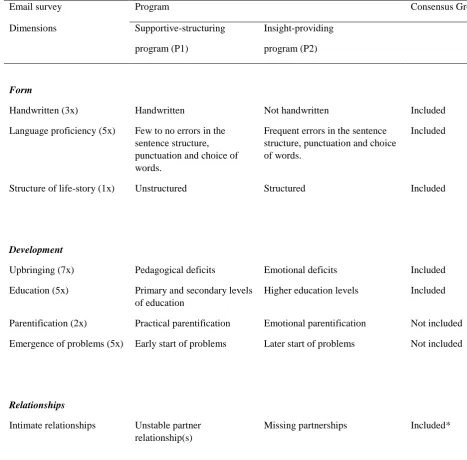
summarized in table 1.
In general, the experts expected deficits in: upbringing, such as a lack of trustworthy, stable, protective, loving and actively engaged parents in his/her life; traumas; and lack of
self-reliance to be present in the life-stories of patients admitted to both treatment modalities. In life-stories of patients assigned to the supportive-structuring program, experts expected:
early onset of problems; lower formal education (recognisable in recurring grammatical faults); externalizing problems by impulsive behaviour; lack of practical self-reliance; a strong sense of vulnerability due to early traumas; low introspection; and a strong cry-for-help
(as recognised in multiple suicide attempts). The life-stories of patients assigned to the SFT, insight-providing programme, were associated with: later onset of problems; lack of
emotional self-reliance; internalizing problems; identity problems; missing partnerships; and some introspection. Experts shared the opinion that multiplicity of specific problems, as well as quality of introspection would differentiate between the two groups of patients.
3.1.2 Study 1: Focus group
By analysing the focus group data, we identified 12 possible discriminants (see table 1), which could help in assigning patients to one of the two treatments. All discriminants identified earlier via e-mail are discussed below. The results of the e-mail survey formed the
discriminant were carefully considered. An overview of these pros and cons is presented
below. To facilitate reading of the quotes, P1 refers to the supportive-structuring treatment and P2 to the insight-providing treatment. For a short summary of the included discriminants after analysis of the focus group, see paragraph 3.11. Detailed results of the focus group are
[image:18.595.67.535.297.757.2]given in the following paragraphs.
Table 1. Dimensions emerging from the email survey (x-times mentioned) and the consensus reached in the focus group (n=8.)
Email survey Program Consensus Group
Dimensions Supportive-structuring program (P1)
Insight-providing program (P2)
Form
Handwritten (3x) Handwritten Not handwritten Included
Language proficiency (5x) Few to no errors in the sentence structure, punctuation and choice of words.
Frequent errors in the sentence structure, punctuation and choice of words.
Included
Structure of life-story (1x) Unstructured Structured Included
Development
Upbringing (7x) Pedagogical deficits Emotional deficits Included Education (5x) Primary and secondary levels
of education
Higher education levels Included
Parentification (2x) Practical parentification Emotional parentification Not included Emergence of problems (5x) Early start of problems Later start of problems Not included
Relationships
Intimate relationships Unstable partner relationship(s)
*Not mentioned in E-mail survey but emerged in focus group dialogue Skills
Self-reliance (14x) Little practical self-reliance Little emotional self-reliance Included
Self-control (8x) Impulsive Cautious Included
Attribution (8x) Externalising Internalising Included
Insight (20x) Less introspection More introspection Included
Specific Problems
Eating Disorders Bulimia Anorexia Not included*
Suicide attempts More suicide attempts Fewer suicide attempts Not included*
Identity problems (1x) - Identity problems Not included
3.1.2.1 Handwritten, language proficiency and structure
The clinicians reached consensus regarding the point that patients of the
supportive-structuring treatment more often have a handwritten life-story, make more errors in language usage, and write a less organized life-story than patients of the insight-providing program. Life-stories of the supportive-structuring treatment tended to have a ‘messier first
appearance’.
- Researcher: “handschrift? Zie je dat meer op P1 dan op P2?” - “Ja”
- “Ja, handschrift is ook vaak, ja ik weet niet of je bij P1 meer geschreven is dan..”
- “Enkele keer ja. Ik denk dat je bijna zou kunnen zeggen, als het handgeschreven is, is al meer aanwijzing voor P1”
(…)
- “Ik vind qua vorm ook de structuur bij P2 soms heel gestructureerd zeg maar eh.. en bij P1 wat minder gestructureerd”
- “Ja”
- Researcher: “Dat valt ook samen met impulsief geschreven misschien” - “Ja”
3.1.2.2 Upbringing (lack of emotional and pedagogical attachment)
Although more often than not patients who apply for clinical treatment have
attachment difficulties, in the focus group clinicians suggested that the nature of attachment
difficulties differs between the patients of the two treatments. A distinction was made between 1) the lack of emotional attachment and 2) the lack of pedagogical attachment.
Consensus was reached about this possible discriminant, concluding that patients of the supportive-structuring treatment tend to have a lack of pedagogical and emotional attachment. Patients of the insight-providing treatment tend to only have a lack of emotional attachment.
From the outset, it was suggested that patients of the supportive-structuring treatment overall have a general lack of attachment. Patients of the insight-providing treatment were
suggested to have a lack of emotional attachment. Later on, statements from the group were modified by other clinicians, as illustrated by the following quote: “Volgens mij is het zo P1: emotioneel en pedagogisch. Want, Alleen pedagogisch kan eigenlijk helemaal niet. Als je er
gewoon helemaal niet bent en je krijgt geen eten, ja laat staan dat je dan emotionele zorg
krijgt. En P2 is het relatief vaker emotioneel tekort; iemand is geparentificeerd, heeft al te
vroeg de verantwoordelijkheid moeten dragen, of heeft gewoon een beetje als behang
gefunctioneerd, is bijna niet gezien, maar dan met name emotioneel”.
The researcher then raised the question of how to recognize a lack of pedagogical attachment
and emotional attachment, and received the following (relevant) response:
“Nou heel rechtstreeks. Dat mensen schrijven dat ze niet met hun problemen terecht konden
bij ouders. Dat ze in feite ouders ván hun ouders waren hoor je wel, van P2 dan he? Weinig
aandacht van, weinig liefde” (lack of emotional attachment).
“P1: denk ik ook afwezigheid van ouders, dus moeder opgenomen in de psychiatrie, vader
“Ik moet letterlijk denken een patiënt die laatst een keer schreef: van ja de enige veilige plek
was onder me bed, bijvoorbeeld, ja dat is heel schrijnend, typerend voorbeeld van dat je
totaal geen veiligheid” (lack of pedagogical attachment).
However, it was mentioned that the distinction between a specific lack of pedagogical
attachment, and a lack of both pedagogical emotional attachment, is hard to determine using only objective measures, and therefore depends on interpretative ability. No counterarguments
were made by the clinicians, and consensus was reached.
3.1.2.3 Education
It was suggested, that patients of the insight-providing treatment tended to be more highly educated compared to patients of the supportive-structuring treatment. Consensus was
reached. It was stated that intelligence was not thought to be a distinctive characteristic, and that therefore there would be no difference in education measures between patients of the two groups. Not everyone agreed with this statement. Instead, patients of the insight-providing
treatment tended to complete higher education more often compared to patients of the supportive-structuring treatment. In summary, clinicians agreed that patients of the
insight-providing treatment seemed to be more highly educated in general.
- “En hier staat dat hoog opgeleid, ik weet niet of daar een onderscheid te maken is tussen dat wat ik me voor kan stellen het hoger opgeleid dat hier op P2 hoort, omdat het dan vaker lukt
om opleidingen af te maken, maar dat intelligentieniveau misschien niet zo als onderscheid is.
Ik kan me voorstellen dat mensen op P1 misschien net zo intelligent kunnen zijn, maar lukt
het daar veel minder om opleidingen af te ronden”.
(…)
- “Uhu”
- “Oke”
- “Dat je op P1 veel meer LWO tot aan MAVO ziet en dat je op P2 meer MAVO tot HBO eh” - “Hoe meer instabiliteit, hoe meer verstoring van doelgericht gedrag he. Dus je verwacht ook
een rommeliger opleiding, meer afbreken”
- “Ja”
- “Ja oke, maar je hebt ook wel uitzonderingen” - “Het gaat een beetje om de grote lijnen he”
Researcher: “Maar jullie zijn het er wel over eens dat het wel een indicatie kan zijn?”
- “Globaal”
- “Globaal wel ja”
- “ja”
3.1.2.4 Self-reliance
Data from the consensus meeting indicated that there were notable differences in
self-reliance between the two patient groups. According to the clinicians, patients of the supportive-structuring program seemed to be less independent compared to patients of the
insight-providing program. Independence was evidenced by things such as statements, personal details provided of an accomplished study, independence of parents and living independently from parents. No counterarguments were provided by the clinicians.
- “Wat je op P1 wel ziet is dat mensen eigenlijk nog veel afhankelijker vaak zijn van de ouders he, veel meer onthand zijn voor zichzelf te kunnen zorgen.
- Researcher: “ja”
- Researcher: “dat zijn er ook twee die er in staan de ene weinig zelfstandig en eh veel afhankelijkheid, die zou je samen kunnen nemen en bij P2 kreeg ik ook redelijk zelfstandig
terug”
- “ja”
(…)
- Researcher: “Dus dan hebben we de zelfstandigheid die verschilt en de nadruk op prestatie; goed leren en status en een hoge opleiding, is dat ook iets dat eh..”
- “Uhu, zoals het hier staat is het voor mij heel herkenbaar”
3.1.2.5 Self-control
In the focus group, consensus was reached on the point that patients of the
supportive-structuring program tended to be more impulsive and lack control over their emotions more often (acting out) than patients of the insight-providing treatment. Patients of the supportive-structuring treatment seemed to have more impulsive behaviours, while patients of the
insight-providing treatment tended to have severely high levels of self-control, and were therefore more inhibited in their behavioural expression in general compared to the
supportive-structuring program.
Regarding suicide attempts, clinicians stated that patients of the supportive-structuring treatment were more likely to attempt suicide. However, no clear consensus was reached.
Arguments were provided from both sides, which did not lead to consensus.
3.1.2.6 Personal insight into own difficulties and attribution
supportive-structuring program tended to have lower introspection. Thus, patients from the
supportive-structuring treatment are less able to connect different life-events, including the ability to consider their own participation in those life-events, compared to patients of the insight-providing treatment.
The second suggestion was regarding causal attribution. It was suggested that patients of the supportive-structuring program use more external attribution in explaining life-events.
However, according to clinicians, patients of the insight-providing treatment tend to use more internal attribution in explaining life-events. For example, if a patient from the supportive-structuring program describes having had troubles during puberty, they may attribute this to
father temperament dominating the home (example not derived from the focus groupdue to the lack of a sufficient example). However, a patient of the insight-providing program is
more likely to explain it in this way, “puberty was a hard time for me. Although my father dominated the house, I wasn’t that easy to handle. I could not deal with the feelings I was
experiencing during that time, which may have caused my father to act that way”. It was
suggested and mutually agreed that in general, more deeply stratified life-stories, and the ability and propensity for self-reflection (internal attribution), suited patients of the
insight-providing program better.
- “Dat is wel een verschil introspectie” - “En naar zichzelf kijken”
- “En verbanden kunnen leggen” - “Én verbanden kunnen leggen”
- “Ja”
- “En qua introspectie is P1 misschien wel iets meer externaliserend in het levensverhaal” - “Ja “
- “Ik dacht ook…”
- “en P2 wat meer internaliserend”
(…)
- “Trouwens deze, meer gelaagdheid in het verhaal. Dat is een héle belangrijke” - Researcher: “en waar zie je dat in terug, gelaagdheid?”
- “Dat je eh.. dat het minder blijft bij wat minder oppervlakkige beschrijvingen van klachten en problemen, bijvoorbeeld als je vraagt om eh.. hun ouders te beschrijven, dan krijg je bij
programma 1 meer antwoorden als ehm.. ja eh.. agressief of uh en programma 2 krijg je
meer lagen in de beschrijving van de persoonlijkheid. Dus die persoon krijgt wat meer kleur,
wat meer diepte”
- “Ja”
- “Introverte man, eh die hard werkt, maar”
- “Ja”
- “Ja”
3.1.2.7 Parentification
Differences in the presence of parentification, a role reversal of the patient as a child relative to their parents, causing the patient to consciously or unconsciously adopt a parent
role in the family, seemed to be a less precise indicator;
Firstly, if a patient mentions parentification explicity in his or her life-story, it is a good
indicator towards the insight-providing program:
- “Ik vind dat parentifcatie dat herken ik wel dat dat bij P2 veel meer voorkomt en ook die nadruk op prestatie die erin staat, daar ben ik wel mee eens
- “Ja”
- “ja”
- “Ja als iemand dat al schrijft weet je , dan is er al zoveel reflectief vermogen dat je al wat minder snel denkt aan P1, ja zo extreem is het eigenlijk he? Daar heb je het natuurlijk ook
over, wat kan iemand melden over de eigen geschiedenis “
- “Maar dat komt zo meteen nog bij de vorm denk ik he?” - Researcher: “Ja”
Secondly, clinicians argued that parentification was suitable as an indicator for both
programs, but that there is a qualitative difference in the nature of the parentification; patients of the supportive-structuring program tended to be more practically parentificated, fulfilling
the necessities of life for themselves and/or other relatives. Patients of the insight-providing program however, according to the clinicians, seemed to be more emotionally parentificated, emotionally caring for their parents.
- “Ik kan me voorstellen dat ze dan op P1 het koken over moeten nemen of zoiets van vader of moeder en broertjes en zusjes naar school moeten brengen en op P2 dat ze…”
- “Meer de emotionele parentificatie” - “Precies”
- “Ja, ja “lan - “Niet praktisch”
- “Emotionele zorg voor hun ouders, dus een andere vorm van parentificatie” - “Ja”
- “Ja”
natuurlijk ook voor P1 alleen daarin staan andere dingen vaak nog veel méér op de voorgrond”
This last statement from one of the clinicians makes it difficult to identify parentification
as a discriminant that can improve assignment to one of the two clinical programs. She states that both patient groups are in fact parentificated, but that patients of the insight-providing program have greater maturity. This distinction is difficult to clearly identify, therefore the
judgment may need to rely on the readers’ interpretation of the life-story; the clinicians however did reach consensus.
- Researcher: “Maar dat is wel heel belangrijk, want juist die nuance die hebben we
nodig, of die heb ik nu nodig om te kijken of we daar verschillen in zien. Zijn jullie er
allemaal over eens dat die praktische kant meer bij P1 gezien wordt en de emotionele
kant meer bij P2, van parentificatie?”
- “Heel globaal?”
- “Heel globaal”
- “Heel globaal ja?”
- “Of dat kinderen net met ouders moesten springen?(typfout? Nakijken)”
- “Letterlijk het leven redden van je ouders, met je lijf er voor gaan staan”
- “Ja”
- “Ja, oke”
3.1.2.8 Identity problems
treatment. It was discussed that patients of the supportive-structuring treatment do indeed
struggle with identity problems, but that these are less dominantly present in this group compared to the insight-providing treatment. However, no consensus was reached regarding whether, through clinician interpretation of a patient’s life-story, a difference could be found
in the way both groups describe identity struggles in their life-stories.
- “Hoe verwacht je dan dat identiteitsproblematiek, dat iemand opschrijft: ik heb identiteitsproblematiek?”
- “Nee, ik weet niet wie ik ben he”
(door elkaar gepraat)
- “(Niek) er zijn twee dingen: of letterlijk, of we interpreteren het zo - “Jaja”
- “Dat zijn twee dingen”
- “Als het om interpreteren gaat, dan zie je dat ook wel bij P1”
3.1.2.9 Trauma
In the consensus meeting, clinicians argued 1) whether or not patients of the
supportive-structuring treatment experienced more traumas in their lives and 2) whether or not this possible discriminant could be an indicator for one of the two clinical programs. Consensus was reached by the clinicians, stating that supportive-structuring borderline patients have
often suffered multiple traumas (bullying, sexual and physical abuse), which affects more areas of their lives compared to insight-providing patients. Patients of the insight-providing
- Researcher: “Bij P1 viel het op dat er meerdere traumata genoemd werden en bij P2 wat minder. Hoe kijken jullie daar tegenaan, is er bij P1 meer trauma dan bij P2?”
- “Denk ik wel”
- “Ja”
- “Meerdere gebieden”
- “Meervoudig”
- “Ja”
- “Meervoudig denk ik wel”
(…)
- Researcher: “Dus dan hebben we voor P2 dat pesten altijd voor komt”
- “Ja”
- “Researcher: In combinatie vaak met seksueel misbruik. En wat is dan nog voor P1?” - “Vaak fysiek mishandeling”
- “Meer denk ik ja”
(…)
- Researcher: “Zou je dan kunnen zeggen dat je in een levensverhaal van iemand van P1 dus meer trauma’s kunt vinden dan iemand van P2?”
- “Meer verschillende, op meer levensgebieden”
- “Dat het én op school én thuis in het gezin, bij de schoolleraar én misschien wel van school gestuurd worden”
- “Meer verschillende traumatiseringen en op meer levensgebieden”
- “Maar dat wil natuurlijk niet zeggen dat altijd, veel mensen schrijven daar niet over”
provide all the necessary information to make a reliable judgment to improve assignment to
one of the two clinical programs?”
3.1.2.10 Emergence of problems
Discussion of whether the start of problems could be a possible discriminant did not result in consensus. Via e-mail, it was suggested that the emergence of problems was earlier
in patients assigned to a supportive-structuring program; two clinicians agreed immediately. Later on, other clinicians stated that the emergence of problems might not be well suited to discriminate between the two clinical programs; they suggested that the main difference is
that patients of the insight-providing program tend to apply for mental healthcare later in their lives compared to patients of the supportive-structuring treatment. Consensus was reached
that the start of problems was not suited to operate as a possible discriminant:
- “Ja qua start denk ik ook niet dat er veel verschil is”
- “Qua start niet, maar het moment dat ze in beeld komen wel, denk ik” - “Dat heeft dus te maken met de aard van de problemen”
- “Ja “
3.1.2.11 Intimate Relationships
Regarding intimate relationships, one clinician suggested that patients of the
supportive-structuring program tend to have more intimate and turbulent relationships in their lives, which may be found in their written life-stories. It was suggested that patients of the insight-providing program were more likely to show an absence of intimate relationships. Consensus
- “Bijvoorbeeld bij relaties dat bij de een meer relatieproblemen beschreven worden terwijl bij P2 misschien meer beschreven wordt dat er geen relaties zijn, mensen dus de relatie dan niet
aangaan, zoiets”
- “Uhu”
- “Helemaal geen.. seksuele relaties aangaan” - “En ook dat denk ik dat met werk”
- “Meer destructieve relaties” - “Meer wisselende relaties, werk”
- Researcher: ” hoe zou je dat kenmerk omschrijven?”
- “Meer heftige, intieme relaties op P1 en meer ontbreken van intieme relaties op P2, denk ik”
- “Ja”
- “Ja”
3.1.2.12 Overview of discriminants found by consensus
The previous sections have identified possible discriminants that were suggested and discuss in detail the purpose of reaching consensus. In this paragraph an overview is provided
for all the possible discriminants that may distinguish between the life-stories of patients from the supportive-structuring program and those of the insight-providing treatment group. Thus, only the discriminants where consensus was reached are reported here. For a brief overview,
all found discriminants are presented in table 2. Explanation of the concepts mentioned can be found in previous sections.
(syntax, punctuation and word usage) in their life-stories compared to patients of the
insight-providing program. Thirdly, life-stories with an extremely structured appearance are assumed to provide an indication of the insight-providing program.
Fourthly, patients of the supportive-structuring program tend to lack pedagogical and
emotional attachment, and the fulfilment of pedagogical and emotional needs by their parents. Patients of the insight-providing program however seem to only lack emotional attachment
and fulfilment of emotional needs. Fifthly, patients of the supportive-structuring treatment appear to be less educated. It is not evident whether patients of the insight-providing treatment are in fact more intelligent, however they do tend to reach a higher level of education. Sixthly,
patients of the supportive-structuring treatment seem to lack practical and emotional self-reliance, whereas patients of the insight-providing treatment tend to be practically self-reliant
but lack emotional self-reliance. Seventhly, patients of the supportive-structuring program are more likely to act impulsively, while patients of the insight-providing program tend to be more inhibited (for example due to fear). Eighthly, patients of the supportive-structuring
program use more external attribution to life-events compared to patients of the insight-providing program. Patients of the insight-insight-providing program more often use internal
attribution to life-events. Ninthly, patients of the supportive-structuring program seem to lack higher introspection abilities compared to patients of the supportive-structuring treatment. Tenthly, it was suggested that patients of the supportive-structuring program tended to have
more intimate and turbulent relationships compared to the insight-providing program, where an absence of relationships is more likely to exist.
excluded by the researchers due to the expected difficulties in finding traumas mentioned in
life-stories of patients.
In addition to excluding trauma, researchers also excluded parentification as a discriminant. During the focus group, clinicians suggested that when a patients describes
parentification, i.e. the role reversal of parent and child, this tends be an indicator for the insight-providing program. However, it was also suggested that patients from both groups
show evidence of parentification in different ways. Patients of the insight-providing program tend to be more emotionally parentificated, whereas patients of the supportive-structuring program tend to be more practically parentificated; there is a qualitative distinction in
parentification between the patients of the two treatments. This discriminant was excluded because the researchers suggested that this discriminant has overlaps with other discriminants
such as upbringing, self-reliance and insight. It was suggested that adding this discriminant could lead to confusion and therefore might not contribute to later instrument development.
3.2. Results study 1: member check
Based on the recorded member check meeting, the coding of dimensions remained
unchanged, however some definitions were more broadly discussed and clarified. For example, self-control was initially defined as a difference between acting-in and acting-out behaviour. Discussion led to amending the description for self-control as, predominantly
cautious or predominantly impulsive. For the dimension of intimate relationships, discussion focused on the importance of intimacy with different interpersonal contacts, encompassing
self-reliance: “People often do not notice when I am not doing too well. I take good care of myself and continue to meet my commitments.” Consensus was reached over what adjustments were
needed in definitions and narrative examples.
3.3. Results study 2: Instrument testing- and development
3.3.1 First round of instrument testing
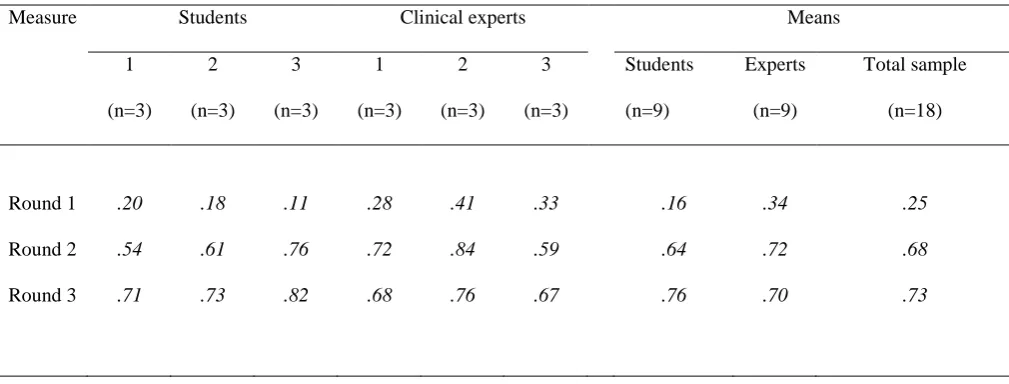
In order to analyse overall agreement, Cohen’s kappa coefficient was calculated, comparing the researchers’ standard to the participant data separately. Comparison of the
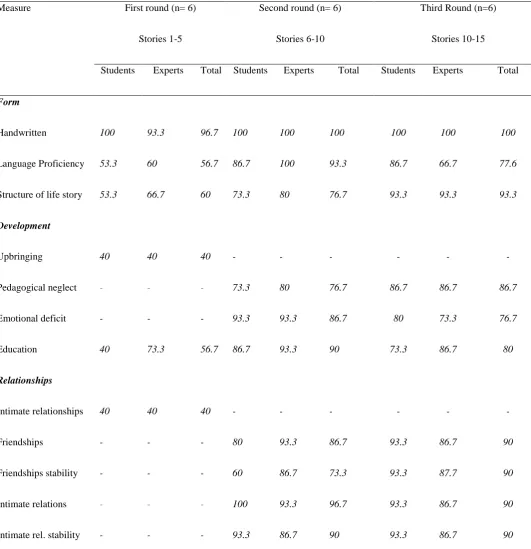
researchers’ standard and the student and clinician data are shown in table 2. Results of the overall agreement in percentages specified for each category are shown in table 3. This shows
which category is performing better than others, and which category requires adjustment in order to increase agreement over all the dimensions of the instrument. Discussion of the inter-rater reliability analysis combined with feedback on the scoring forms is summarized below.
The adjustment process will be discussed in order to provide a better understanding of the overall instrument and adjustment process.
As the results show, there is slight disagreement with the researchers’ standard in the first round. Cohen’s kappa coefficients (K) ranges from .11 to .20 for the student data, and for the clinicians, K ranges from .28 to .41, indicating a fair agreement with the researchers’
standard. Although results of the first round of testing were not desirable, they did provide possibilities for adjustment.
3.3.2 Instrument adjustments Round 1
coder. The results of the first round showed that participants chose option 9 (not deducible
from life-story), too often and easily. For the second round of instrument testing, the
importance and necessity of participants’ clinical judgment was highlighted in the instructions provided. When participants were unable to make a choice between the given options (in such
cases, information about the discriminant is necessary), participants had to score the absence of that given discriminant, and option 9 (not deducible from life-story) was removed.
In addition, results derived from participants’ feedback on the scoring forms showed that participants did not have a clear understanding of the two treatments (insight-providing treatment vs. supportive-structuring treatment). Often, the reasoning participants used to make
a choice between one of the two treatments did not match with the appropriate reasoning. Therefore, information about the treatments were rephrased and clarified in the instructions.
Another consideration is that patients’ original documents written before application
were drawn from the system database and re-anonymised. In the first round of instrument testing, transcribed versions of life-stories were used, which are not reliable for scoring the
handwritten, language, and structure dimensions.
Furthermore, in order to make the coding process easier and more reliable for
respondents, a different coding style was adopted. The dimensions ‘Education’, ‘Intimate relationships’ and ‘Self-reliance’ were diffused into more questions, increasing the usability
of the instrument.
Lastly, not all of the participants motivated their choices consistently; such
information is valuable to the adjustment process of the instrument. Often, a motivation was
also underscored the importance of the motivational aspect of the instrument at the beginning
of the experiment for the students, and at the handover of the experiment for the clinicians.
3.3.3 Second round of instrument testing
After gathering the data from the second round of instrument testing, again, Cohen’s kappa coefficients were calculated. Results show substantial increases in coefficients, ranging
from .54 to .76 for the student data, indicating a moderate to substantial agreement. Again, clinician data performed slightly better than that of the students. Coefficients of the clinicians range from .59 to .84, indicating a moderate to excellent agreement (see table 2).
The dimensions that reached a high overall agreement were: Emotional Deficit and Language Proficiency (both 93.3%), Emotional Self-reliance (96.7%) and Intimate
Relationships (96.7% and 90.0%). The dimensions that reached less overall agreement were: Self-control (60.0%), Attribution (66.7%), and Insight, Program and Structure (all 70.0%).
Although coefficient values did increase compared to round 1 of instrument testing,
respondent feedback provided valuable information for re-adjusting the instrument to increase reliability. The adjustments to the instrument after the second round of instrument testing are
discussed below.
3.3.4 Instrument adjustments Round 2
To increase the instrument’s reliability, a few modifications were made after
considering respondents’ feedback. The dimension pedagogical deficit was too often and
easily scored as present. To facilitate distinction, the definition was changed to pedagogical neglect. The definition ‘no pedagogical neglect’ was removed, as it is rare that upbringers do not make any pedagogical missteps at all. The definition of ‘no emotional deficit’ was also
to these relatively major changes, instrument instructions and dimension definitions were
sharpened. Lastly, some examples were removed from the definition list and others were added or adjusted.
3.3.5 Third round of instrument testing
After analysing Cohen’s kappa coefficients, results showed similar coefficients
for the student data compared to the second round of instrument testing, ranging from .71 to .82, indicating a substantial to excellent agreement. For the clinician data, there were similar coefficient values compared to the second round, ranging from .67 to .76, indicating a
substantial agreement (see table 2). Overall agreement was high for the dimensions: Handwritten (100.0%), Structure (93.3%) and Relationships (90.0% agreement on all 4
[image:38.595.72.577.524.716.2]scores). Overall agreement (see table 3) was lowest on the dimensions: Emotional Deficit, Insight and Program (all 73.3%).
Table 2. Inter-rater reliability analysis of the researchers’ standard compared to each of the
six participants (Cohen’s Kappa)
Measure Students Clinical experts Means
1 (n=3) 2 (n=3) 3 (n=3) 1 (n=3) 2 (n=3) 3 (n=3) Students (n=9) Experts (n=9) Total sample (n=18)
Round 1 .20 .18 .11 .28 .41 .33 .16 .34 .25
Round 2 .54 .61 .76 .72 .84 .59 .64 .72 .68
Table 3. Percentage of agreement for each dimension, calculated for the participant data
(students and experts) compared to the researchers’ standard, over the 3 rounds of instrument
testing
Measure First round (n= 6)
Stories 1-5
Second round (n= 6)
Stories 6-10
Third Round (n=6)
Stories 10-15
Students Experts Total Students Experts Total Students Experts Total
Form
Handwritten 100 93.3 96.7 100 100 100 100 100 100
Language Proficiency 53.3 60 56.7 86.7 100 93.3 86.7 66.7 77.6
Structure of life story 53.3 66.7 60 73.3 80 76.7 93.3 93.3 93.3
Development
Upbringing 40 40 40 - - - - - -
Pedagogical neglect - - - 73.3 80 76.7 86.7 86.7 86.7
Emotional deficit - - - 93.3 93.3 86.7 80 73.3 76.7
Education 40 73.3 56.7 86.7 93.3 90 73.3 86.7 80
Relationships
Intimate relationships 40 40 40 - - - - - -
Friendships - - - 80 93.3 86.7 93.3 86.7 90
Friendships stability - - - 60 86.7 73.3 93.3 87.7 90
Intimate relations - - - 100 93.3 96.7 93.3 86.7 90
Skills
Self-reliance 60.0 60.0 60.0 - - - - - -
Practical self-reliance - - - 53.3 86.7 66.7 93.3 86.7 90
Emotional self-reliance
- - - 93.3 100 96.7 100 100 100
Self-control 46.7 53.3 50 60 60 60 80 73.3 76.7
Attribution 40 40 40 80 53.3 66.7 60 66.7 63.3
Insight 46.7 60 53.3 73.3 66.7 70 80 66.7 73.3
3.4 Validity testing
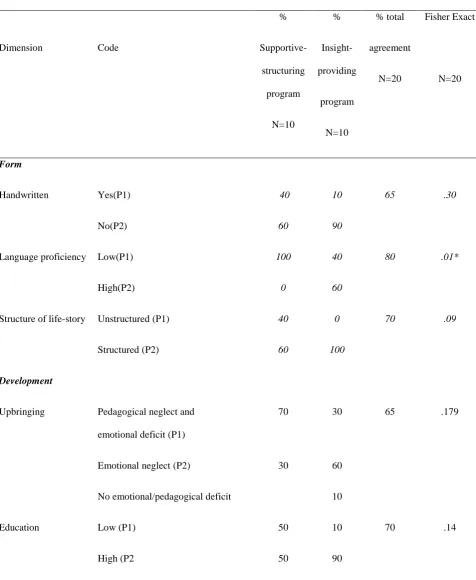
Results of validity testing are summarized in Table 4. In order to test the
validity of the instrument, Chi-square tests were performed to compare the researchers’ standard with the actual assigned treatment for patients of the two treatments (supportive-structuring treatment and insight-providing treatment), and to see if there was a relation
between these two standards. Chi-square tests were performed for each dimension of the instrument. Significant results on these tests indicate that different scores in the variables of
the instrument relate to assignment to one of the two treatments. Not all dimensions were expected to indicate an absolute distinction between the two treatments, as due to instrument adjustments, some dimensions were divided: Upbringing (pedagogical neglect, emotional
deficit), Self-reliance (practical and emotional self-reliance) and Intimate relationships (friendships and intimate partner relations). To calculate the distinctive ability of the divided
was violated in at least 80% of the cells, Fisher’s Exact Test was used for interpreting the
results.
Results show that researchers’ scores and the actual patient treatment group were related to each other for 3 out of the 10 tested dimensions (Language proficiency,
Self-reliance and Self-control).
In addition to the significant outcomes on 3 of the 10 tested dimensions, 5 of the 10
dimensions were not significant, but provided interesting results shown by p-values less than .20. The dimensions with p-values less than .20 were: Structure, Upbringing, Education, Attribution and Insight. The 2 dimensions out of 10 that did not seem to relate to the
researchers standard at all were: Handwritten and Intimate relationships.
Lastly, it was found that researchers were able to assign patients to the right treatment
Table 4 Fisher’s Exact Tests analysis of the percentage agreement per dimension between the developers’ score and the actual assigned treatment.
Dimension Code
%
Supportive-structuring program
N=10
%
Insight-providing
program
N=10
% total
agreement
N=20
Fisher Exact
N=20
Form
Handwritten Yes(P1) 40 10 65 .30
No(P2) 60 90
Language proficiency Low(P1) 100 40 80 .01*
High(P2) 0 60
Structure of life-story Unstructured (P1) 40 0 70 .09
Structured (P2) 60 100
Development
Upbringing Pedagogical neglect and emotional deficit (P1)
70 30 65 .179
Emotional neglect (P2) 30 60
No emotional/pedagogical deficit 10
Education Low (P1) 50 10 70 .14
Relationships
Intimate relationships Instable partnerships/absence of friendships (P1)
30 10 25 .678
Absence of intimate relationships/ presence stable friendships (P2)
20 20
Other unlinked codes (5 cat.) 50 70
Skills
Self-reliance Lack of practical and emotional self-reliance (P1)
70 10 80 .01*
Lack emotional self-reliance (P2) 30 90
Self-control Low (P1) 90 20 85 .005*
High (P2) 10 80
Attribution Externalizing (P1) 40 0 70 .09
Internalizing (P2) 60 100
Insight Low (P1) 90 50 70 .144
High (P2) 10 50
Conclusion
This study was conducted to develop an assignment instrument that aids assignment of patients to either a 1) supportive-structuring psychotherapeutic treatment (basic structure dialectical behavioural therapy or 2) an insight-providing psychotherapeutic treatment (basic
structure schema focused therapy), based on their life-stories. In order to design the instrument, expert opinion was solicited and used, as no relevant studies exist to date that
identify distinguishing characteristics of patients’ life-stories, who are suffering from a PD. Clinician expertise resulted in identifying discriminants that were expected to differentiate between patients of the two treatments. These discriminants formed the basis of the
instrument.
In the focus group, consensus was reached for 12 possible discriminative
dimensions. Two dimensions were excluded for different reasons. Instrument testing showed that clinicians and students were able to use the instrument as it was intended; high overall agreement between participants (students and clinicians) and the researchers’ standard was
reached. Out of the 10 discriminants tested, validity testing showed that only 3 actually showed a discriminative ability. The three discriminative dimensions that were found to relate
to one of the two possible treatments were Language proficiency, reliance and Self-control. It is worth noting that although only 3 of the 10 tested dimensions showed a discriminative ability, in most of life-stories, researchers were able to assign patients to the
right treatment modality by using the developed instrument. It would have been interesting to investigate whether researchers, other clinicians or students could have succeeded in
Discussion
This study confirms earlier suggestions that examining life-stories may be helpful in assigning patients to the proper treatment modality (van Os, 2014). Although BPD has widely
researched, other PDs are less frequently studied (Bateman et al., 2015); our research sample included life-stories of individuals with these less-studied PDs.
It is suggested that the two clinical programs, based on 1) DBT and 2) SFT have several similarities, such as the same behavioural and cognitive principles (Montgomery-Graham, 2015; Paris, 2015) and techniques (Kellogs & Young, 2006). Furthermore, both
approaches assume that BPD patients tend to have difficulties in mentalization (Paris, 2015). Our results both partly fit and give nuance to this assumption. It was found that emotional
self-reliance (which we consider to be related to mentalization) did not differ between patients of the two clinical programs, and that therefore patients of both clinical programs are not emotionally self-reliant. However, self-control did differ between treatment groups. We
suggest that emotional difficulties may be expressed in different ways for patients of the two clinical programs. We propose that patients of the supportive-structuring program tend to
express their emotional difficulties through impulsive behaviours, whereas patients of the insight-providing program express emotional difficulties through severely inhibited
behaviour. This is an interesting suggestion, however further research is necessary in order to
underpin and confirm these ideas.
In addition to potential differences in emotional expression, another interesting point
emerged from the life-story analysis, which is an interesting example for discussion. Adler et al.’s study (2012) suggests that BPD patients score low on communion fulfilment, which is the fulfilment of attachment, love and friendship. Our study does not confirm that BPD