Developing an Industry 4.0 framework:
Implications for the role of line managers
Author: Lucas Krüger
University of Twente P.O. Box 217, 7500AE EnschedeThe Netherlands
ABSTRACT
This paper explores the definition and components of Industry 4.0 as it seems to be a
topic of much uncertainty and diversity. It does so to understand the effect of Industry
4.0 on the role of line managers. The research focuses on the EU and the streams of
research that can be identified from the different member states. This paper discusses
international literature in form of a matrix and a framework. As not much literature
is available on the role of line managers in Industry 4.0, HR-expert interviews are
conducted to learn more about this topic. The framework shows us that literature can
be divided in four streams which discuss the technological, social, competitive and
structural effects of Industry 4.0. On basis of this knowledge the experts evaluated
the role of line managers as growing in complexity while it will experience support
by the new technologies. In specific, Industry 4.0 is predicted to support line
managers in tasks such as communication, leadership, giving feedback and
decision-making. The findings of this paper will help companies with the preparation for and
implementation of Industry 4.0. In addition to providing a clear definition and
components of Industry 4.0, findings about the future tasks of line managers can be
useful for recommending actions to companies concerning the training and teaching
of competencies.
Graduation Committee members:
Anna Bos-Nehles
Jeroen Meijerink
Milou Habraken
Keywords
Industry 4.0, Line managers, Industry of Europe, Document analysis, Expert interviews, Framework
Permission to make digital or hard copies of all or part of this work for personal or classroom use is granted without fee provided that copies are not made or distributed for profit or commercial advantage and that copies bear this notice and the full citation on the first page. To copy otherwise, or republish, to post on servers or to redistribute to lists, requires prior specific permission and/or a fee.
11th IBA Bachelor Thesis Conference, July 10th, 2018, Enschede, The Netherlands.
1.
INTRODUCTION
A few years ago, nobody would have expected this new organizational development to come. A big-data driven world, one in which the product communicates with the machines that produce it; a world in which robot-assisted production is part of an every-day business, a world that is wirelessly connected and that is fully automated (Li et al., 2017; Mayer-Schönberger & Cukier, 2014). Starting right now, we already see parts of this change in some organizations as it is challenging all our technological knowledge and standards, transforming them into a new unknown way. The described change is commonly identified as Industry 4.0. But what does the phenomenon of Industry 4.0 mean? How do line managers have to act in the new industry?
Before one can answer these questions, one first has to look at the history of previous industrial revolutions in Europe and their progress. This will influence our interpretation of the current industrial revolution and allow for predictions concerning the future of the European industry.
The first industrial revolution evolved in the 19th century. In this
revolution steam- and water powered engines began to take over the work from employees, leading to a big resistance of change (Drath & Horch, 2014). This mechanization “left private homes in favor of central factories, followed by an extreme increase in productivity“ (Drath & Horch, 2014, p.56). It took about a hundred years until the second industrial revolution took place. Drath and Horch (2014) describe it as “the development of continuous production lines based on both division of labor and the introduction of conveyor belts“ that “resulted in another productivity explosion“ (p. 56). This process is most known as the electrification of processes (Hermann et al., 2016). A result of this was the introduction of Ford’s famous assembly line. Its introduction is still seen as a milestone within the history of industrial revolution, as it had major impact on job-design, leadership and production capacity (Ford & Crowther, 1922). As can be seen from this, the second industrial revolution required employees to adjust their skills to the new situation. Complexity and number of tasks increased, as well as completely new knowledge on all hierarchical levels was needed, to perform within the new technology (Chandler, 1977; Goldin & Katz, 1998). The third industrial revolution which started in the 1970s with the introduction of home computers (Haddon, 1988) is a “type of drastic social changes lead by the computerized mechatronics technology“ (Kunii, 1997, p.1). This “programming paradigm still governs today’s modern automation system engineering and leads to highly flexible and efficient automation systems“ (Drath & Horch, 2014, p.56). Some researchers also name this revolution the “computer revolution“ (Frey & Osborne, 2013, p.265) due to the increase of jobs that get performed by computer and other technological systems. Another change occurred concerning the skills needed from employees, now shifting attention to high technological-educated workers (Goldin & Katz, 1995). The previous revolutions did not only time-, but also technology-wise build upon each other (von Tunzelmann, 2003), leading to another change within the industrial landscape. It is important to see the transition between those very different technologies, to realize the need and impact of Industry 4.0. Additionally, the differences with former industrial revolutions can show us the distinctive features of this new Industry.
1.1
Industry 4.0 – A Universal Definition
Before defining what exactly Industry 4.0 is, it must be clear what exactly an industry is. This is not only important for the context of further analysis, but also needed to see the extent of change Industry 4.0 brings. For this paper the term industry is
defined as a set of organizations who use Industry 4.0 to produce, service and compete on a national and international market. Based on this we can ask the question: What is so 4.0 on the future industry? What, based on what we know, does Industry 4.0 look like and what makes it different from its predecessors?
Industry 4.0 is, in its final state, the outcome of the fourth industrial revolution (Kagermann et al., 2013). While the first three industrial revolutions took together almost about 200 years to evolve (Drath & Horch, 2014), Industry 4.0 instead is “fast[ly] gaining ground and is carrying along with […] new enthusiasm […]” (Atzori, Iera & Morabito, 2017, p.135); it is fastly spreading (Lasi et al., 2014) around the globe. This speed makes it difficult for researchers to foresee what impacts Industry 4.0 will have on the global industry and how to control those (Brettel et al., 2014). Industry 4.0 is the term most commonly used in the Anglo-Saxon countries, even though other terms appear, such as Smart Industry (Dais, 2017), Industrie 4.0 (Bauernhansl et al., 2014) or Smart Factory (Ramsauer, 2013). All those terms contain different elements, depending on the author and the context they are written in. The context this paper focuses on are the different countries and member states of the EU. Throughout this paper different definitions, components and positions from these countries will be presented and compared. One view is that Industry 4.0 describes “the increasing digitization of the entire value chain and the resulting interconnection of people, objects and systems through real time data exchange“ (Hecklau, 2016, p.2). While this is a very broad definition, other authors, like Hermann et al. (2016), identify specific components Industry 4.0 is consisting out of. For the writers, those are “convergence of industrial production and information and communication technologies” (p. 3928). These aspects can also be found in other literature (Kolberg & Zühlke, 2015; Shrouf, Ordieres & Miragliotta, 2014). The components are then most commonly known as (1) The Internet of things (IoT) (2) Cyber-Physical systems(CPS), and (3) Smart factory. Another researcher that gave a definition for Industry 4.0 was Kagermann (2015). For him the current industrial revolution is “characterized by a paradigm shift from [a] centrally controlled to decentralized production process“ (p.23). We can find other formulations of that phenomenon in other papers (Almada-Lobo, 2016; Lasi et al., 2015; Rüßmann et al., 2015). There are researchers that define other parts of Industry 4.0: individualization, virtualization, hybridization and self-optimization (Aghassi et al., 2011) are just a few of them. All those areas seem to be strongly related to Industry 4.0 (Brettel et al., 2014), too.
Such a definition is important due to multiple reasons. The first is given by Hermann, Pentek & Otto (2016) who state that “although Industry 4.0 is currently a top priority for many companies, research centers, and universities, a generally accepted understanding of the term does not exist. As a result, discussing the topic on an academic level is difficult” (p.1). But only with a clear definition that is derived from academical research, practitioners can adjust their work-style in the right way. To make it clearer: A well formulated conceptualization is needed before operationalization can take place (Quaglia et al., 2015). However, academic research can deliver much more than conceptualization. It can “fit real-world problems and settings into scientific method” (Bolton & Stolcis, 2003, p. 627), and based on this can give “clear, immediate, and important implications for managers” (p. 628). To enable these processes, a universal definition is needed. A second reason is concerning the pressure increasing globalization puts on companies, forcing them to work closer together than ever (Levitt, 1993). An “increasing global competition on product quality and production costs” (Brettel et al., 2014, p.37) is therefore requiring all companies to combine their research power and technological knowledge. But how should one work together if they do not even share the same definition of the ground principle? A last reason why a common understanding of Industry 4.0 is needed, lays with the uncertainty this industrial revolution brings with it (Schmidt et al., 2015). It is known that the new Industry will come, but nobody knows exactly how or when. To take this uncertainty of managers and employees, this paper will give a definition that allows to better prepare for the upcoming situation. From all the above the first research question of this paper evolves:
R1 What is Industry 4.0 and what are its components?
1.2
Industry 4.0 and Line Management
It is predicted that Industry 4.0 will not only have an influence on the economy in general, but also on daily business (Lasi et al., 2014). Therefore, I decided to not only give a definition of the term, but apply it to the role of line managers within the new industry, as they will be the ones closest to the new technology and its influence on work and workforce.
While barely involved in strategic decision making, one can say that line managers are the ones implementing the HR practices (Cunningham & Hyman, 1999; Hall & Torrington, 1998; Thornhill & Saunders, 1998). They do so by bringing the theoretical concepts to practice in every-day business. Next to this, nearly all HR policies need the action and support of line managers as they are the ones having direct contact with employees, influencing the “perceptions not only of HR practices but of work climate, either positively or negatively” (Ulrich et al., 1995, p.5). Thus, their behavior in implementing HR policies is important when successfully building social exchange relationships (Bos-Nehles & Meijerink, 2018). The authors Gilbert, de Winne and Sels (2011) developed a framework in which they describe the three core tasks, every line manager is responsible for in his daily work. First, the enactment of HR policies, second the development of relationship oriented leadership behavior and, third the creation of employee affective commitment. All of this shows the importance of line managers within an organization.
We can currently see a couple of management trends concerning the future role of line managers. Even though nothing is proven yet, several authors made assumptions about leadership (like Keegan & Hartog, 2004), the role of teams (like Fisher, 1999), control mechanisms (like Hawkins et al., 2012), the
decision-making process (like Kwan et al., 2012), communication (like Welch & Jackson, 2007) and other management tools that will change in the new industry. Line managers will be directly affected by those changes, requiring them to adjust their management practices. If one takes a closer look at those, one can identify two major directions in the expectations for line managers. The first is the one that sees the role of line managers being supported by new technology, while the second one expects a substitution of line managers by this very technology. In the following I will present these to perspectives in more detail.
When it comes about supporting the work of line managers, communication technologies can be a big help (Kolberg & Zühlke, 2015). While in Industry 4.0, those technologies could allow bigger teams to evolve (Palazzeschi, Bucci & Fabio, 2018) they also require line managers to manage those in an efficient manner. This is, because so called virtual teams or network teams
are often working together from different locations or even time zones (Lipnack & Stamps, 1999). It would be the task of line managers to organize and efficiently structure the new form of teams. Next to this, line managers would have to efficiently manage all the knowledge and data such a network brings with it. The effect of communication technologies can also be extended towards recruitment and hiring, as in Industry 4.0 line managers are likely to have to search for new workforce not only outside the company but even in other countries. Additionally, employees from all over the world will be able to apply initiative for a job, meaning that the recruitment process (and so the skills of line managers) must be adjusted towards the globalization of the work-force market. As can be seen here, Industry 4.0 increases the number and complexity of tasks line managers must perform.
As can be seen, Industry 4.0 is also expected to have a crucial influence on the needed leadership style, the way line managers motivate their employees and the decision-making process. As mentioned by Andelfinger and Hänisch (2017) the leaders of tomorrow are likely to show significant different personality traits. The five central ones, according to the authors, will be disruption, innovation, courage, social- and emotionally competence and determination. As new technologies allow for more and more connection between people all around the world, a challenge for line managers could arise, namely the problem of how to manage increasing team-sizes as well as how to lead people from more and various cultural and social backgrounds (Wuchty, Jones & Uzzi, 2007). Also, the general number of (potential) employees is assumed to increase (Lorenz et al., 2015), meaning that line managers, in the future, would have to manage more employees at once. Here the new technological developments are seen from a more diversified perspective. While on the one hand the level of leadership decreases, it requires less involvement of line managers, but the team size increases which leads to the fact that line managers are still needed for organizational- and coordinating matters.
production of mass-customized products (Zawadzki & Zywicki, 2016), which would require supervision systems that are as efficient and fast as their corporate environment. This effect was also mentioned by Hales (2005) who found out that the role of line managers “has shifted from supervision to team leadership/co-ordination or business unit management” (p.1) and is expected continue doing so. From this we can see that new technology can actually take over easier tasks of line managers while leaving them with the more complex and inter-personal ones.
Another expected phenomenon that is often associated with line management in Industry 4.0, is the decentralization of decision making (Hermann, Pentek & Otto, 2016). This effect is assumed to lead to the forming of self-managing work teams. We can now already see a shift in companies to rely more and more on autonomous teams (Kirkman & Shapiro, 1997). Accordingly, it is expected that the number of self-managing teams will still increase. This new form of work teams “involves a shift focus from individual methods of performing work to group methods” (Manz & Sims Jr, 1987, p.106). On the long-term this would mean that there is a need for less managers, because supervision and directing tasks are performed by the teams themselves (TNO, 2017). The focus of line managers would be shifting towards coaching the team members to be more independent and work self-reliant, or as Manz and Sims Jr. (1987) call it “leading workers to lead themselves” (p.106).
As can be seen, multiple trends, about the future role of line managers, are identified. Many speculations are made about how their work might change and how this will influence the skills and knowledge line managers need to possess in the future. It currently seems possible that substitution as well as support of line managers is going to happen. It cannot yet be stated in how far these assumptions/examples are true, which creates uncertainty for line managers. There are two reasons why this report is attending to this uncertainty. The first reason arises from a scientific perspective. As can be seen from multiple search engines not much research has been conducted concerning the role of line managers in the future. In fact, only three search results appear, for the combination “Line manager” and “Industry 4.0” in Web of Science, and forty-three when using Google Scholar (status of 18/04/2018). However, as shown earlier, line managers are playing a key role in an organization’s success and should therefore be analyzed in more detail. A clear definition has not been given yet, but it is needed because other researchers can then build on the result of this analysis, going into further details, and also give concrete practical advice. The second reason comes from a practical point of view. As it is expected that Industry 4.0 will have a huge impact on technology as well as on whole production processes (Lasi et al., 2014), it seems worthy to look at those who will have to deal with the new Industry directly. This research can be used to inform and coach line-managers, concerning their future position and task within Industry 4.0. Based on this, training sessions can be developed that prepare line managers for the coming industry and that communicate new skills and competences. The goal of this research therefore must be the examination of the role that line managers are performing daily, within Industry 4.0. The derived second research question will be:
R2 What is the role of line management within Industry 4.0?
2.
METHODOLOGY
To find an answer to those questions, an explorative-qualitative research is conducted. It is explorative due to the limited information given about Industry 4.0 and its influence on line
managers. The focus of explorative research is “on the discovery of ideas and insights as opposed to collecting statistically accurate data. That is why exploratory research is best suited as […] it is most commonly used for further defining company issues, areas for potential growth, alternative courses of action, and prioritizing areas that require statistical research” (FluidSurveys Team, 2014). Stebbins (2001) adds to this by defining exploratory research as “a broad-ranging, purposive, systematic, prearranged undertaking designed to maximize the discovery of generalizations leading to description and understanding of an area of social […] life” (p.3.). One could say that exploratory research is necessary for this research, as one goal of it is to point to the necessity of finding a universal definition of components of Industry 4.0 - an area with potential growth. Next to this, exploratory research is most effective in laying the groundwork that will lead to future studies.
Qualitative research is conducted where literature is used “to understand what is going on in the field and to discover theoretical perspectives, including proper concepts to look at the social phenomenon of interest“ (Boeije, 2010, p.5) Reflecting on this, one can see that it is exactly what this report needs, as it tries to develop a universal framework for Industry 4.0. Qualitative research is also used in cases where theories, frameworks and, in general, data, is limited (Boeije, 2010). By trying to find out more about Industry 4.0 and its implications for line-managers this paper does not have much research at hand, that it could use. Qualitative research gets conducted by “means of semi-structured measuring instruments that are searched and tailored to the research subject and refined as the research progress” (Boeije, 2010, p.5). This research is doing so by adapting the interviews towards the limited knowledge of the experts, helping them out with a self-created framework about Industry 4.0. In qualitative research theory, there are no existing frameworks that can be used, meaning that the researcher cannot build his study around already existing knowledge, but instead has to come up with his own hypothesis (Boeije, 2010). For Industry 4.0, not much theory is developed, therefore requiring me to make use of qualitative research. In such, “inductive thinking is paramount, which means that a social phenomenon“ (here Industry 4.0) „is explored in order to find empirical patterns that can function as the beginning of theory” (Boeije, 2010, p.5). It should also be added that qualitative research is conducted, where the researcher believes that that individuals have the power to influence the construction of social reality (Dooley, 2001). In our case, this can be seen in the fact that one goal of this paper is to draw attention to Industry 4.0 and the chance to control it, if researchers and practitioners start to plan the future of the industry together.
To answer the research questions mentioned above, this paper is divided in two parts of research. The first one is answering the question (R1), about the components and definition of Industry 4.0, using comprehensive document analysis. The second one, that deals with the other question (R2), concerning the role of line managers, will be answered by conducting interviews with HR experts. In the following I am going into more detail about how and why the research is conducted.
as they are all part of the EU, which is important and will be mentioned in more detail later. Next to this, all these countries provide online information (in English) about their national research concerning Industry 4.0. The focus was laid on policy documents from the national research agencies as it was found that definitions highly differ between countries. So, to be able to compare definitions and components of Industry 4.0 in different countries it is necessary to look (only) at the data provided by governmental institutions. Additionally, the chosen countries function as a good representation of Europe, as they are various in culture, economy and politics. Other countries that are not considered here are either collaborating with one of the above-mentioned ones, are not conducting any research in the field, or are working on a similar definition. This research depends on the availability and reliability of the online documents the countries present, as academic papers are rare, and there are no other official sources that can be used. All in all, the conducted literature review is not structured, as findings and information will evolve during the research process itself. Just at the end of the process we will be able to reflect on what was found and can then formulate a clearer definition. The decision to focus on European countries has two reasons. The first one is that, as shown before, there is simply the necessity for a comprehensive definition within Europe, as every country is using different terms and identifying different complements of Industry 4.0. This is due to all the separated, national research projects (such
as Smart Industry in Sweden, Indústria 4.0 in Portugal or Made
Different in Belgium). Europe is consisting out of many countries
with diverse cultures, anyways, European countries are connected through the EU and other political institutions and regulations. Based on this, one can say that all countries are facing the same situations. When looking at Europe, all countries together, form a big picture of possible components for Industry 4.0, showing a lot of diversity. Analyzing Europe will allow me to give a holistic statement about the components of Industry 4.0, for many different countries at once. On the other side, a European focus still allows to compare the countries on cultural core values. Due to the EU, many laws and regulations are the same. This shared base makes it attractive to analyze Europe as it will make the document analysis more structured and reliable. The second reason is that Europe, and especially the EU, is one of the biggest players on the world market and belongs to the most developed areas when it comes to technology (Pomeranz, 2009). While there are of course also other countries in which technology gets developed, it is difficult to find such a concentration of technology-advancement on a comparably small geographical area. The country specific information is retrieved from a list of links, posted by the European Commission on its website about national initiatives that are actively researching Industry 4.0 and any other related topics (European Commission, n.d.). The linked websites are maintained by either the government or a consulting company, that is conducting research for the according government. The document analysis is conducted together with two fellow researchers (ten Bulte, 2018; Tekelenburg, 2018). To allow future researchers to better evaluate on this analysis, we created a matrix. The analysis was conducted by going over the website of the European government who provides links to the webpages of the national research agencies. To filter relevant information, the search function was used to look at relevant phrases like
‘Industry 4.0’, ‘Definition’, or ‘Components’. By doing so, the
documents were analyzed and relevant information was set into the matrix. Later on, the information was sorted in columns that evolved, like the country of origin of the analyzed document, what definition and components of Industry 4.0 it delivers, whether the author created his own definition or rephrased another one, and what implications the author predicts Industry
4.0 to have on line managers. The matrix was divided like this, as all the information is needed to be able to give a comprehensive definition. Therefore, the following results are received by inductive coding which “refers to approaches that primarily use detailed readings of raw data to derive concepts, themes, or a model through interpretations made from the raw data by an evaluator or researcher” (Thomas, 2006). This sort of analysis is used as I start with an area of study and then let the theory evolve from the data I found (Strauss & Corbin, 1998). In this case that means to learn about Industry 4.0 from the policy papers, and then concluding in a framework that includes all the components which are analyzed in the different countries of the EU. By showing the country of origin, one can see possible trends per definition throughout Europe (e.g. via geography or economy). The rest of the columns, are self-explaining as they are answering directly to the research questions. The matrix can be found in Appendix 1 – Literature Matrix. In total around 70 documents get analyzed of which 38 can be found in the matrix. The reason why some of the documents were not taken into further account, was that they either did not contribute enough new information, were not available in a language I speak or were simply so vague that they could not be used in formulating a clear picture of the countries definition of Industry 4.0. By using this matrix, I will be able to say what Industry 4.0 is and define which components form the basis of it, by creating a framework.
relevant topics. Industry 4.0 certainly is such a topic, as it is expected to have a huge impact on different parts of society. The network consists out of experts and researchers from ten Dutch and Belgian universities, who’s goal is the coordination of HRM research (HRM Network - Objectives, n.d.). I think that members of this network can add value to my study as they are also focused on finding holistic perspectives about HR related topics. As all members of the network are having an HR profession, the decision on whom to choose for the interviews, is based on past research, the general research focus and availability of the respondent. Based on the framework created under ‘Results I – Literature Matrix’, the chosen experts will assess potential roles line managers might play in the future. As the experts are mainly educated within the HR field of business, their evaluation is dependent on the picture of Industry 4.0, drawn in the first part of this paper. The interviews are scheduled for an hour and are recorded and later on transliterated. When analyzing the transliteration, I hope to find certain patterns in the answers of the respondents which I will then group and sort under a fitting heading. The transliteration itself will not be sent to the respondents, but they will receive a copy of this paper as soon as it is finished.
3.
RESULTS I – LITERATURE MATRIX
To receive more information about the definition and components of Industry 4.0, as well as the implications it might have on the role of line managers, a matrix was created. The matrix is a summary of all the literature that was found online from the webpages of the country specific research associations of the European Commission concerning Industry 4.0 (Appendix 1 – Literature Matrix). All in all, the matrix represents policy data from more than ten countries and many and various sources, making it a complex and detailed overview. Next to country specific information regarding the definition and components, one can find more material about the research focus and other important remarks.
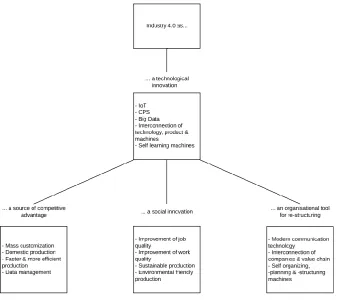
When looking at the matrix one can see how many different definitions, components and assumptions about influences of Industry 4.0 are existing. Definitions between, but also within countries, are varying in content, complexity and commonality. All definitions together show the complication of the topic and the possible impact it might have on many and various business areas. Still it can be said that most of the time, definitions stay weak and unclear, only giving vague statements about what might come, instead of clearly naming components of Industry 4.0. Next to this, no literature of other authors is being considered or used as comparison. This exacerbated my research a lot, making it difficult to conclude a valid definition. Despite all the unclearness and differences between the countries, several streams can be identified, helping to get a clearer picture about the components of Industry 4.0. To visualize the content of the matrix and streams, it was decided to create a framework that provides an overview of the different directions within Industry 4.0 (see Figure 1).
[image:6.595.128.467.465.765.2]The streams are different perspectives and evolve when analyzing the matrix. They are dealing with different foci and roles Industry 4.0 might perform in the future. The streams were identified by looking at repeating patterns in the definition- and component- column of the different countries. The definitions then got grouped and were given a holistic name, that summarized all the terms in an appropriate way. It was found that none of the countries only fitted one of the described streams. Instead, it showed that the more literature available per country, the more diverse the research areas became. Some countries are researching in all four directions, while other countries only focus on two of the streams. This shows that also the extent of research differs per country. Interestingly it was found that also within a country the research focus can vary. Countries that started earlier with looking into Industry 4.0 are more likely to cover a broad (technological) spectrum of the topic. Inspired by the work of Habraken & Bondarouk (2017), which described different enablers and characteristic features of the Dutch Smart
Industry, I developed the framework as you can find it here. My framework is structured in a hierarchical way. It starts with the term Industry 4.0 on the top. The four streams are then following on two more levels. On the second level of my framework one can find the stream of “Industry 4.0 as a technological innovation“. The reason for this is that when analyzing the literature, it was found that the idea of new technologies in the value-chain is the starting point for any research. One could say that the technological structure is the basis for the other (more advanced) streams, and therefore must be presented in a more outstanding way. This stream is then followed by the streams of “Industry 4.0 as competitive advantage“, “- social innovation“ and “-organizational tool for re-structuring“. Those three subordinate streams do not follow a special order, as we can find all of them, mentioned an equal amount in the literature. Please note that this form of hierarchy is not used to indicate that the last three streams are less important, but to show that they are playing a role later in the research process. In the boxes under the name/research focus of the stream, one can find components that came up in the literature. In the following I will describe the four streams of Industry 4.0, explain their impact, give example of countries per stream and explain how this contributes to a comprehensive definition.
3.1
The Four Streams of Industry 4.0
The first stream is solely focused on the new technologies that are part of, but also are the result of Industry 4.0. While one can certainly find starting points of other matters (such as social, environmental, or legal), literature in this stream is mainly working on a clear description of changes in the technology sector and focusses on giving advice to engineers and other people that will be directly involved in creating and designing the new industry. This stream therefore expects Industry 4.0 to be a pure technological innovation. In comparison to other streams, the focus of research lays on individual technological accomplishments. The countries most often associated with this stream are Austria, Germany and Denmark. The components frequently named in this stream are the Internet of Things (Pagegroup, 2018; Silkroad 4.0; 2017; UEL, n.d.), Cyber Physical systems (Lassnig et al., 2016; Ericsson, n.d.), Big Data (Deliége, 2017; Stentoft, Rajkumar & Madsen, 2017; Silkroad 4.0, 2017), as well as the creation of self-learning machines (Pagegroup, 2018; Danish Institute of Industry 4.0, n.d.; Federal Ministry for Economic Affairs and Energy, 2017). Additionally, we can see some other technical concepts such as the one of Virtual Reality (VR) (Federal Ministry of Economic Affairs and Energy, n.d.) or 3D (Stentoft, Rajkumar & Madsen, 2017), but they seem not to be part of the core of this stream. Next to this, throughout all literature a trend towards the interconnection of technology, machine and product can be identified; most often combined with the terms of IoT or CPS. Because all countries in the matrix are talking about technical features and build the rest of their research on these findings, this stream seems to be the most known and common one. It also is the one most talked about, as one can deduce from the matrix. This might be traced back to the technical origins of Industry 4.0, which build the basis for all other type of research, but also to the fact that forecasts about future technologies are easier to make than an analysis of its impacts on social, environmental or organizational matters.
The second stream focuses on a country’s own economy and the profit one can derive when applying Industry 4.0 to production. Further, Industry 4.0 is here seen as a source of competitive advantage. One could say that research in this stream focuses on generating economic value. The literature of this path is focusing on the effects of mass customization (Sirris & Agoria, 2016) and the way new technologies can improve production (Association
Industry 4.0 Austria, n.d.). One important effect of Industry 4.0, described in this stream, is the stop on moving jobs abroad by creating new, high qualifying jobs in the domestic countries (Silkroad 4.0, 2017; Sirris & Agoria, 2016). As the new technologies are allowing for a cheaper and more efficient domestic production, outsourcing jobs to other countries will get less attractive. The authors expect that by producing high value-adding products on a high scale, the number of sales can increase, and ultimately result in a higher profit. Globalization is a topic often discussed in the literature of this stream, most often connected with the problems it contains for employers and employees. Not surprising is that the countries in favor of this stream are those who’s economy is currently facing a crisis (Leon & Pavolini, 2014; Anna et al., 2015; Petmesidou & Guillen, 2017). The countries that showed clear tendencies towards this stream were Portugal, Lithuania and Italy. This can be seen in statements of the countries such as “repatriation of production from east Asian countries to Europe” (Silkroad 4.0, 2017) or “to help […] for an even more competitive ‘Made in Italy’” (Ministero dell’Economia e delle Finanze, n.d.). Nevertheless, one can find this competitive thinking also in other countries. Luxembourg, for example, talks about its “future competitiveness of industrial companies in the western world” (UEL, 2017). On the other hand, some literature identifies an increase in the will of people to work abroad (Pagegroup, 2018) and connects this with Industry 4.0 and globalization.
It seems as if all countries want to take the opportunity of Industry 4.0, and make it work in their favor. This shows once more the disruptive change the new industry might bring, and the chances connected to this. From this we can see that Industry 4.0 does not come without problems. It goes hand in hand with the increased pressure of globalization on the countries, forcing them to generate high economic value which turns the world’s industry into a place where every country must fight for surviving.
who just started their analysis and focus on the technical aspects of the first stream instead. This does not mean that social/environmental aspects are less important for researchers, but that a detailed description of the technological aspects of Industry 4.0 must be preliminary to those aspects.
The last and fourth stream is representing a non-popular thought about Industry 4.0, namely Industry 4.0 being an organizational tool for restructuring. As all the other ones, this stream looks at the effect Industry 4.0 might have on businesses but instead of focusing on profit, people, or the environment, literature in this stream looks at how exactly the new technologies will influence the structure and organization of a company. Communication technologies therefore play a crucial role (Keil et al., 2001). But also other technologies, such as selforganizing, planning and -structuring machines (Federal Ministry for Economic Affairs and Energy (2017), are taken into account. These new technologies are seen as having the potential of noteworthy influencing an organizations structure. One important difference to other streams is the focus on interconnection, not of technologies, but of companies and the value-chain (Danish Institute of Industry 4.0, n.d.). These interconnections, that are influenced by technological change, might force organizations to adjust and adapt their structure. Literature from this stream most of the time also includes implications for line managers, as the changes in structure and organization directly influence the work of line managers. This is most acknowledged by countries like Hungary and Luxembourg.
When comparing my findings with the research of Habraken & Bondarouk (2017), I can find many of my points back in the Dutch Smart Industry. Digitalization, connectivity, value chain participation and personalization are just a few points the researches have in common. Nevertheless, some of the points that seem to be a part of the core of the Dutch Smart Industry could not be found back in the literature. I especially could not find any proof for the impact of cyber security and other safety matters that the researchers found during expert interviews. Still some papers, like the one of Hermann, Pentek & Otto (2016), talk about this topic, but then describe it as a more separated technology, which is why I did not include it in my framework. We at least cannot find back this topic in the discussion around Industry 4.0 on a European level.
So, after all of this, what is Industry 4.0, and what are its components? The definition is based on the interpretations and components, identified in the matrix and framework. A comprehensive, European definition would, therefore look like the following:
Industry 4.0 is the production, service and work context in which new smart technologies and the overall digitalization of the value-chain are used. As such, Industry 4.0 is the end-state of changes in the national and international competitiveness of firms, by allowing them to re-structure their business in a social, technological and environmental responsible way.
3.2
Implications for Line Managers
As one can see from the matrix, not many implications for line managers are given in the international literature about Industry 4.0. This does not only fit our previous expectations but once more shows the necessity for such research.
The findings about the role of line managers in the new industry can also be structured into the four streams of Industry 4.0. However, some streams focus more on line managers than others. In the following I will discuss the different streams, starting with the one that contributes most.
The fourth stream of Industry 4.0, the one that sees it as an organizational re-structuring tool, delivers the most information when it comes about line managers. Literature of this stream did not only mention how new technology will change the structure of the organization, but also how exactly work for employees and line-managers will change. One example is the article of the German Federal Ministry of Economic Affairs and Energy (n.d.), who is considering the new communication technologies. The article concludes that a “convergence of office-floor and shop-floor communication” will occur, and that it is the task of line managers to coordinate the new ways of communication with the everyday-business of the firm. Another topic discussed in this stream is the type of leadership Industry 4.0 will require and what kind of behavior line managers should foster. The Union des Entreprises Luxembourgeoises (UEL) (n.d.), says that in Industry 4.0 it will be crucial to promote independent and creative work behavior among employees. This can either be done by training/workshops/coaching or by the creation of jobs that require employees to act in the requested way. All of this are tasks and responsibilities of line managers, which shows us the importance of line mangers in Industry 4.0.
All in all, we can summarize that, as expected, the policy documents about Industry 4.0 did not deliver much about the role of line managers. There were some hints to find about the social and organizational impact of Industry 4.0, for which line managers will play a crucial role but still this did not give us enough information to draft a possible role of line managers. Therefore, additional interviews with HR experts are conducted, in hope that they will contribute more to the second research question.
4.
RESULTS II – EXPERT INTERVIEWS
To solve this question and to get a better insight in the role of line managers, I decided to conduct expert interviews with members of the Dutch HRM Network. You can find the questions attached
(Appendix 2 – Interview questions). From the interviews, I got a
good insight in the possible role of line managers in Industry 4.0. Even though all interviewees focused on different aspects and tasks, it was possible to find some overlap in their answers. In the following I will present the major topics that got discussed during the interviews and I will reveal certain similarities and differences in the assessment of the role of line managers.
While listening to the interviews, certain roles of line managers got described. In general, it is expected that a shift from current HR tasks will take place, downwards the hierarchy to line managers. This leads to an HR department which fulfills solely strategic tasks on the one hand, and line managers who are responsible for the supervision and administration of the company on a daily basis, on the other hand. So, it can be said that the experts predict the role of line managers to increase in complexity and difficulty. Nevertheless, a discussion arose about how the new technologies are going to influence the work of line managers. The discussion turns around the question whether technology should be used to support line managers or to substitute them. This can also be found back in a practical context, where for example Airbus and Boeing are presenting the role of line managers in the future completely different. During the interview we heard experts from both sides of this spectrum, arguing about what will happen to line managers in the future.
One role that got described, is the one of line managers as decision makers. As described earlier, a current task of line managers is the support of the HR administration by bringing HR to practice and making decisions concerning the outcome of the business, while at the same time maintaining the well-being of the employees. In the future it seems that this decision making can be improved and supported by all the new matters of technology. In many interviews the term of HR analytics was named, especially in relation to big data. By getting new insights and more detailed data about their employees, the HR academics expect that decision making can be improved and made easier for line managers, as in Industry 4.0 it will be possible for them to reason their decisions not only on a guts-feeling way, but to proof it with valid data.
Next to this, another important role of line managers will be to play the communicator in a company. A line manager will therefore not only be responsible for communicating the HR strategy anymore but will also have to take their employees by the hand and show them the advantages the new technologies will bring. It is therefore important to also dive into the uncertainty employees might experience when getting in touch with the new technologies. This will be highly influenced by the new communication technologies that the respondents described. Those technologies will help to increase the frequency and amount of information that can be passed on between line managers and their employees. Still, all respondents point out the
importance of face-to-face communication, as none of the respondents can imagine that Industry 4.0 will work without any direct personal contact, let alone the replacement of face-to-face communication.
During the interviews it was additionally found that, due to the flattening of organizations, the relationship of employee and line manager will significantly change. Due to an increase in autonomy and the additional possibilities to supervise employees through data, some of the experts forecast a more distant relationship, while others suggest that due to an increase in self-managing teams and shared leadership, the relationship will actually move to a more equal and close-related tie. This is also often argued because of a possible increase in interdependency in tasks, caused by Industry 4.0. Nevertheless, there are experts that are saying that the relationship will not change at all. These are also the experts that do not see a strong correlation between Industry 4.0 and line managers. What all respondents could agree on was that it will remain the task of line managers to maintain the social relationships with their employees.
When interviewing the experts, I also heard a lot about the certain personality traits a line manager in the future should have. Most often the respondents named openness to innovation and a high interest in people-management as critical attributes. Still, you could see some differences between the answers. While some respondents focused on the empathy, others looked more into the organizational talent or the leadership skills. Thus, the personality of a line manager that is needed to perform well in Industry 4.0, has to be very various, complex, flexible and live up to many different expectations.
Anyways, during the interviews also certain challenges seem to evolve for the role of line managers in Industry 4.0. The biggest challenge that line managers will have to deal with, will be the upcoming labor shortage. As line managers will also get a stake in the recruitment process in the future they will have to fill vacancies with workforce that has the required knowledge and skills to fulfill the needed tasks. From the interviews I learned that for the future the experts foresee a mismatch between the skills organizations require and the skills which the educational system teaches the future employees. Therefore, it is predicted that organizations, and especially line managers, will play a major role in teaching and training employees. Still, the questions on how and what exactly to train is not clearly answered. When training the employees for and in Industry 4.0 it is likely that line managers can hark back to new technologies like virtual reality, simulators or 3D. Anyways, some respondents stated that those technologies are not new anymore and so are not linked to Industry 4.0. However, they did agree that those technologies will still be used in Industry 4.0 and will not be replaced by then.
Another challenge that came up during the interviews was the problem of the increased flexibilization of work. Here the opinions of the experts differ. While some still foresee an increase in flexibilization some others saw a “pendulum” coming back already, meaning that certain work styles such as home-office and 24/7 reachability, is already outdated and will decrease in Industry 4.0. Line managers therefore might have to cope with many different working styles in the future. It will be their task
“Nevertheless, the problem remains what kind of education
and what kind of training is needed” (Expert 6)
“Face-to-face communication will never be replaced, just
to coordinate them and to find a way that brings together all different types of needs of their employees within one organization. One example named more often was the individualization of rewards, by which line managers will have to adjust their payment and reward systems to the individual. Some experts also see that flexibilization is getting even more complicated due to the communication technologies of Industry 4.0 that for example allow virtual teams. One respondent even sees this as a paradox, as, due to technology, more and richer communication is becoming possible, while at the same time less communication is needed due to individualization of work.
One last challenge the respondents saw, and which especially seems to play a major role in the process of change, is culture. As pointed out most often by the respondents with a psychological- or social-research focus, culture is a subject that is difficult to change. As Industry 4.0 seems to relate to a high level of uncertainty, the resistance of culture to change gets even increased. From the interviews it can be concluded that it will be the role of line managers to “break-open“ the old culture and to create a new one that includes all the components of Industry 4.0. However, as mentioned by one respondent, it is not just done by implementing the new culture; it must be sustained and kept.
Please notice that for nearly all my conclusions also an opposite point of view was presented. In only a few of the topics all experts were of the same opinion, making it difficult to lead to holistic conclusions. The results, as presented here, are based on which opinion overweighed. Next to this, I also noticed some critic on the framework that was presented to the respondents and on which they were supposed to build their opinion. Some of the respondents, believed that some of the components of the framework were not really related to Industry 4.0. Even though the framework is built on a solid literature review it seems that still not all opinions on Industry 4.0 are covered in it. In general, it can be said that still much uncertainty concerning line managers in Industry 4.0 exists. It seems that nothing is fixed yet and that in the end the role of line managers could still go different ways. So, while some experts see the role of line managers gaining value in Industry 4.0 others do not see a big difference to the current state. This is why it is so difficult to train and prepare line managers in the needed way, as the opinions about which skills to train and how to do so are not unanimous. Nevertheless, the general forecast for line managers in Industry 4.0 is positively and gets often described as very important and indispensable. In the end, it seems that it all depends on the country, industry and company the line manager will have to perform in. This all allows me to conclude in an answer to my second research question. The role of line managers in Industry 4.0 can therefore be described as the following:
Line managers in Industry 4.0 will not only be responsible for leading and communicating the implementation of the new technological components within the production- but also within a social- and psychological context. Training, coaching and supporting his employees will be a line managers most important task. Further he will gain more administrative and analytical responsibilities which are ultimately increasing his decision-making power. The role of line managers will require proactive and anticipating behaviour as well as a high level of social and technological knowledge.
5.
DISCUSSION
5.1 Industry 4.0
Much can be learned from the findings of this research; for Industry 4.0 as well as for the role of line managers.
In the beginning of this paper I described Industry 4.0 as a mainly technological change. After conducting the literature review it gets clearer that Industry 4.0 is way more than just new technological accomplishments. Even though they are still forming the basis of European research, other areas, such as social, competitive or organisational, seem to play an important role in the future. Still, it can be said that the earlier identified components, such as IoT, CPS or Big Data, could be traced back in the literature. From this we can generally say that there are big differences within the research of Industry 4.0 between the states of the EU. Next to this, the general assumption that Industry 4.0 would have a high influence on production seems about to be right. Anyways, what was not part of earlier predictions is the influence of Industry 4.0 on other areas of life next to the production. Now one can see that the whole value-chain will be affected. As a reason for this the literature often names globalization, whose influence was already predicted earlier. I now know that it is difficult to give a holistic answer to the question what exactly Industry 4.0 is. This is the case, because nobody exactly knows how it will look like. Just like our respondents, people cannot predict the future but can only guess on basis of experience and knowledge. Therefore, the subject of Industry 4.0 will remain uncertain. Luckily, with the framework I created, it will at least be possible to sort literature into different categories. This will allow us to keep an overview which stream of Industry 4.0 seems to develop stronger, which weaker and which new streams might occur in the future, that cannot be predicted now. Also, things are less clear and more double-sided than expected earlier. From an academical perspective this paper can therefore deliver a lot of value. On the basis of my definition and framework it will be possible to compare different articles and to focus future research on what is important – namely giving practical advice to companies. Lots of time was spend on finding the right definition of Industry 4.0. Now it is time to do the next step and focus on more details and practical solutions. With the findings of this research companies are enabled to finally start preparing their production, employees and structure for the future. By combining the research power of ten different European countries, we learned that Industry 4.0 is not only led by engineers, who create the new technology, but also by users of it like individual employees. Companies can understand this paper as a wake-up call, to start getting proactive to Industry 4.0 in a structured and goal-oriented way. From my research companies can learn that many things Industry 4.0 has an influence on were not considered yet. After this research the whole extent of Industry 4.0 is finally clarified and can/should be used in practice.
5.2 Line Management in Industry 4.0
Also, for line managers this research delivered important insights. Most importantly, it was found that Industry 4.0 indeed will have a crucial influence on the role of line managers. Still, the opinions on what this will look like differ per expert and are highly dependent on the experts’ knowledge domain within HR. At the beginning of this research it was assumed that due to technological development line managers will either be supported or substituted. In this research it was found that it is more likely that line managers will find support in the new technological developments. This is, because HR will get more strategic in the future, what leaves more practical and administrative tasks to line managers. As foreseen, the new technologies will be part of the daily work of line managers. Still,
“Before you can learn something new you will have to
some adjustments must be made regarding certain expectations. Even though predicted differently, face-to-face communication will still be the main way to communicate. The respondents in the interviews do not think that new communication technologies will ever be able to reach the level of communication-richness personal contact offers. Next to this, there was no proof that the level of leadership will decrease. Even though the type of leadership might shift towards more shared leadership, we cannot expect leaderless organizations or the like to be happening in Industry 4.0. Connected to this was the assumption that decentralization of decision making will occur. As can be seen from my definition of the different roles of line managers, decision making will stay one of their major tasks, meaning that this prediction was false. All in all, we can therefore say that the role of line managers is crucial and will, at least in the experts’ opinion, not be substituted by technologies of Industry 4.0. Looking at all of this, something else was found, namely that the definitions, examples and ideas of the experts on Industry 4.0 are not new. Examples of this are the flattening of organizations, the increase in communication and data usage, less supervision and more charismatic leadership. Everybody who just is just a bit based in research of HRM can see that all findings of this research are nothing new and are really limited to already known theories. All the effects the experts identified are already taking place since a long time, such as the increase in shared leadership and self-managing teams (Barker, 1993). So, I can conclude that many of the given examples are actually not related to Industry 4.0 at all. We can see from this that HR experts nowadays are way too much focused on the present and current situation instead of thinking about the future. To do so out-of-the-box thinking is needed next to inspiration and innovative ideas. Looking at what was found from the interviews we can see that HR researchers are not talking about radical changes but instead focus on technical developments that are already taking place since years. Still, some of the named changes such as the direct feedback of machines or the possibility to select certain information of workers is a unique trait of this industrial revolution and is considered a current/new change. Here we see a good start for thinking about possible changes for line managers in Industry 4.0. Anyways, we can also say that many of the researchers are conscious of this problem. Especially from the HR researchers with a more technological research focus we heard a lot of critic on the positioning of HR towards the future.
This leads us to the implication this research leads to. The most obvious one is for HR researchers to start thinking about what HR in the future really could look like. This paper can be seen as a call to stop focussing on the old and known technologies and to start thinking about which new technologies might arise and how that will affect line managers and other workers. This research therefore allows future groundwork to dig deeper into this question. Further, as mentioned at the beginning of this paper, not much information about the role of line managers in Industry 4.0 was available. My research gives a list of roles that line managers will perform in the future. Upcoming research can use the findings of this paper to go into more depth in the single roles they perform. I also suggest to conduct a research that clearly investigates the question how Industry 4.0 will substitute and/or support line managers in detail. Also, this research can be used as a manual for line managers to get clear about their tasks and their responsibilities. Of course, there is also a practical advantage, namely that companies, now finally knowing what Industry 4.0 is, can train their line managers in an appropriate way. Companies can now see what skills they must educate their line managers in too achieve the best fit between organizational output and the well being of employees in the future. All in all, this paper identified that an increase in training is needed as the
role of line managers is about to get more complex and they so need to acquire more (varying) competencies. On the basis that I created, future groundwork but also companies themselves can come up with ideas on how to bring this knowledge to practice. It is now possible to develop training programs in which line managers get prepared for Industry 4.0, and in which they can develop the skills, described in this paper.
5.3
Limitations
Even though this research got conducted with the best care and attention, some limitations occur. The biggest one probably is the focus of this research on solely European countries. This allowed me to focus and to gather more specific data. Anyways, it also led to the fact that other major players on the world market got ignored. Even though the EU and its member states are playing an important role, also in developing technology and conducting research concerning Industry 4.0, other countries from, for example Asia or North-America, are not considered. It would be interesting in how much the definition/components of Industry 4.0 and the role of line managers differ in comparison with European standards. It is therefore important to conduct similar research like this for other geographical areas, as Industry 4.0 is a world-wide development and not only a local one. Same is valid for the expert interviews which were only conducted with members of the Dutch HRM Network. It must be expected that other HR experts with a different cultural- and knowledge-background can contribute other information and perspectives to this research, to expand it towards a more holistic, globally valid study. A last limitation I want to mention is caused by the fast-changing nature of Industry 4.0. Many of the components and effects identified in this paper could already be out-dated in a few years. This means that my study is just a snap-shot of the current situation. As mentioned before, Industry 4.0 seems to be a topic of high uncertainty, which is why I suggest to conduct this study again in some time to see further development and progress. Therefore, it could be necessary to adjust the framework as new components might arise and others might gain or lose significance, and so eventually influence the role of line managers.