Munich Personal RePEc Archive
Two disputes of methods, three
constructivisms, and three liberalisms
Yefimov, Vladimir
Independent Scholar
15 May 2014
Online at
https://mpra.ub.uni-muenchen.de/56499/
1
Two disputes of methods, three constructivisms, and three liberalisms
Vladimir Yefimov1
The paper proposes to reconsider radically the methodology and history of economics, whether present day mainstream or heterodox versions of it. The profession of economists must definitely abandon Cartesian dualism and adopt Vygotskian constructivism. In fact constructivist economics already existed in the past and was cognitivelyvery successful and sociallyvery useful. It was theeconomics of Gustav Schmoller’s historico-ethical school and the institutionalist economics of John R. Commons, traditions of which are totally ignored by the contemporary community of economists. The former tradition was based on Dilthey’s hermeneutics and the latter on Peirce’s pragmatism. It is worth to underline that hermeneutics and pragmatism are both predecessors of Vygotskian constructivism. During the last two decades a lot was written by economists on pragmatist, constructivist and discursive approaches to the methodology and history of economics, but those who wrote on these topics viewed them from the dualistic point of view.
My paper is an appeal to economists to reconsider Methodenstreit. The dispute of methodsbetween Schmoller and Menger can be considered as a repetition of a similar dispute taking place more than two hundred years earlier between Robert Boyle and Thomas Hobbes. Schmoller-Menger dispute started soon after the beginning of the institutionalisation of experimentally-oriented economics which happened with the creation in 1873 of the Verein für Sozialpolitik. Boyle-Hobbes dispute started in 1660, when the Royal Society of London
had been founded, the cradle of the institution of science. Schmoller was one of the creators of the Verein and Boyle was one of the founders of the Royal Society. The activities of both societies were similar in several respects: they represented efforts to collect data, working out of detailed reports and collective evaluation of obtained results. For Hobbes, as for Menger, the model of ‘science’ was geometry. Boyle and Schmoller privileged collecting and analysing data. Boyle did win the dispute, Schmoller did loose. It happened because of different attitudes of powerful groups in societies towards natural scientific experimental research and experimental social research. They were interested in the former and they saw much more danger than benefit for them in the latter. On the contrary they were interested in abstract theoretical constructions justifying the market vision of society2 and laissez-faire. This kind of constructions corresponded to deeply enrooted scholastic traditions of European universities to teach theology and linked with it philosophy. In the framework of these traditions mathematics was considered as a summit of the scientific approach.
On the one hand the adoption of constructivism by economists would turn their discipline into a science functionally close to natural sciences. On the other hand the Vygotskian constructivism, as a social and political philosophy, once accepted by economists, may lead them to become preachers of the communitarian liberalism with its emphasis on social responsibility, deliberative democracy, and discourse ethics.
1
E-mail : [email protected] 2
2
1. Constructivism vs. dualism
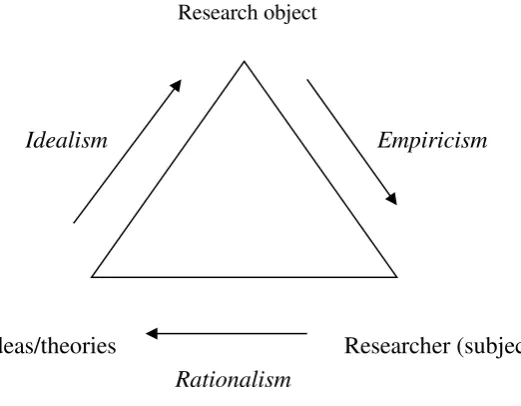
I think that it could hardly be contested that the present day economics, whether mainstream or heterodox, is impregnated with Cartesian dualism. The dualist vision of scientific research may be presented in the following way:
Research object
Idealism Empiricism
Ideas/theories Researcher (subject) Rationalism
[image:3.595.151.412.176.379.2]
Fig. 1.The dualist vision of scientific research
According to the dualistic tradition, mutually excluding doctrines were developed such as empiricism-rationalism and materialism-idealism. For a century and a half, economics claims to be a science having natural sciences as a model. It used in this claim the dualist vision of scientific research. This vision is based on the sharp separation of (research) object and subject (researcher), as well as on an individualistic character of the process of scientific research. Elements of this vision are: Research object, Researcher and Ideas/Theories. Empiricism considers the links between these elements in following way: Research object → Researcher → Ideas/Theories. Rationalism linked them differently: Researcher → Ideas/Theories → Research object. Comte’s positivism hesitated between these two visions of scientific research which allowed John S. Mill to announce political economy an abstract and only abstract science. Idealism saw the sequence of elements in a third way: Ideas/Theories → Research object → Researcher. Materialism turned the direction of arrows in the opposite way. In spite of all these differences, all these “isms” appealed to the same dualist vision of scientific research. Finally, the last characteristic, but apparently the most important feature of the Cartesian dualist vision of scientific research, was its individualism: the researcher was alone in his search of truth as a copy of reality. It is the dualist vision of scientific research which is at the basis of the so called “scientific method”. For mainstream economists this method is based on Karl Popper’s philosophy of science (Blaug, 1994) and for heterodox economists its foundations can be found in Roy Bhaskar’s critical realism (Fleetwood, 1999). The constructivism opposes to both of them.
3
constructivism and tried to apply it in their publications, considered the constructivism from the dualist point of view3. Bruno Latour and other specialists of Science Studies have shown that the dualist modernist vision of research never corresponded to the realities of scientific research: “We have never been modern” (Latour, 1993). They developed a new vision of scientific research, the elaboration of which has been based on historical and field studies of scientific practices in natural sciences (Latour and Woolgar, 1979 ; Latour, 1993 ; Knorr Cetina, 1981 ; 1999).
Experimental situation
Community of evaluators Ideas/theories
Fig. 2.The constructivist vision of scientific research
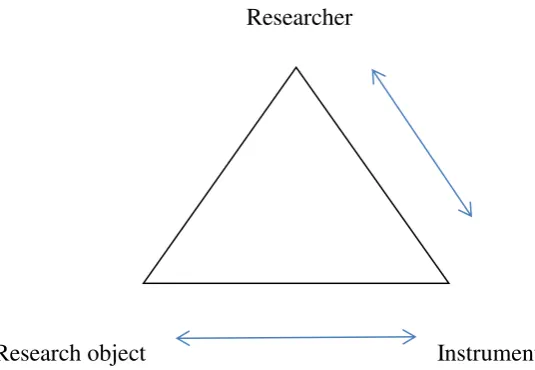
The constructivism rejects the dualist vision with all its dichotomies and “isms”. In this vision of scientific research the research object is not separated from the researcher, but make together with the researcher and her/his ‘instruments’ an experimental situation, and ideas and theories coming from observations/experiments are evaluated not by the individual researcher but by a community of evaluators consisting not only of members of the corresponding scientific community but of a larger community which includes administrators, politicians and concerned segments of the public. Evaluators can be divided in two categories:
witnesses and judges. The difference between them consists in their respective roles in the procedure of evaluation: the former only express their opinion about evaluated ideas/theories, but the latter, taking into consideration these opinions or not, make decisions concerning destiny of ideas/theories and future of experimental situation itself. Most of the members of scientific communities, except powerful members, belong to the category of witnesses. This vision does not challenge the objectivity of scientific research and does not lead to relativism. According to Latour, the specificity of scientific research does not consist in a special “scientific method”, but in the design of experimental situation in which the object has the possibility to resist, “to object” to the ideas of the researcher concerning it, “when things strike back” (Latour, 2000). Application of this model to economics leads to the constructivist institutional economics (Yefimov, 2011a; 2011b) resulting in the switch from primarily theoretical (a priori) type of research to experimental type of research, and from primarily
3
4
quantitative techniques to qualitative methods (Yefimov, 2003; 2010a). Analysis of historical data (basically texts: laws, political discourses, etc.), interviews, focus groups and action research should become the core of economics research. This mode of research can bring valuable results only if the research is organized in such a way that the research object can resist to the ideas issued by the researcher about it. It is this kind of resistance which has allowed to economists of the German Historico-ethical School headed by Gustav Schmoller and the Wisconsin Institutionalism of John Commons to come to the understanding of socio-economic-political processes in their countries, and elaborate on this basis propositions and legislative acts for the solution of the so-called “social question” at the turn of the 19th and 20th centuries.
The term “constructivist epistemologies” was initially introduced by Jean Piaget who was convinced that it is possible to know an object only by acting on it and by transforming it (Piaget, 1970, p. 85)4. These ‘acting’ and ‘transforming’ provoke ‘resistance’ of the ‘object’ which is the ‘source’ of any knowledge about it. The researcher performs these ‘acting’ and ‘transforming’ by mediation of certain instruments (see Fig. 3). In natural sciences these instruments include not only material instruments but also all sorts of conventional signs. The inevitable mediation of socially created conventional signs in the interaction between subject and object was underlined by another founder of constructivism, an opponent of Piaget, Lev Vygotsky. According to him “instead of acting in a direct, unmediated way in the social and physical world, our contact with the world is indirect or mediated by signs” (Wertsch, 2007, p. 178). These signs could take the form of “language; various systems for counting; mnemonic techniques; algebraic symbol systems; works of art; writing; schemes, diagrams, maps, and mechanical drawings” (Ibid.).
Researcher
[image:5.595.125.393.466.651.2]
Research object Instruments
Fig. 3.The subject-object interaction in experimental situation
The Figure 3 is a slightly modified Vygotsky’s basic triangular representation of mediation (Daniels, 2008, p.5). It could seem that this figure express the belief of Milton Friedman that “we cannot perceive ‘facts’ without a theory’, but it is not so. Many economists use the term
4
5
‘theory’ instead of the notion ‘vision’. Geoffrey Hodgson who is one of the very active writers with ‘institutionalist label’ confessed: “Contrary to many institutionalist writers, the epistemological position here is strongly anti-empiricist”5 (Hodgson, 1988, p. 24). In his book he criticised Friedman not for his dualist positivism but on the basis of this ‘strongly anti -empiricist’ position (Ibid., pp. 28 - 35). Let us discuss his ‘anti-empiricists’ arguments, which are indeed pro-Cartesian arguments: “The key criticism of empiricist epistemology … is that no observation can be independent of the conceptual framework, language and theoretical system of the observer. Consequently, no ‘objective’ facts can be known untainted by the preconceptions of the investigator” (Ibid., p. 35). I believe that Hodgson’s mistake is to consider “conceptual framework, language and theoretical system of the observer” almost as synonyms. Constructivist institutionalist investigator before engaging in a field study has his conceptual framework: she/he studies institutions (formal and informal rules) and beliefs linked with these rules. Nevertheless the statement “all facts are expressed in some form of language, and an aconceptual or atheoretical language is impossible” is a sophism because of the use of undefined here notions of ‘theory’ and ‘language’. ‘Theories’ and ‘languages’ in social studies can be of different levels. The statement is true if the notions of ‘language’ and ‘theory’ are used in the sense of categories shared in a certain socio-cultural linguistic environment (low level categories) which can be very large. For example, if the area under study was the Russian countryside, then knowledge of Russian language including technical agricultural terms would be sufficient to begin‘observation’, i.e. “getting close to the people involved in it, seeing it in a variety of situations they meet, noting their problems and observing how they handle them, being party of their conversations, and watching their life as it flows along” (Blumer, 1969, pp. 37).
At the same time the statement of Hodgson is false if the notions of ‘language’ and ‘theory’ are used in the sense of categories and models/theories/hypotheses shared by a certain community of scholars. For example, gathering data concerning preconceived quantitative variables used in a theory and escaping any other information, which could be collected in the field if it does not enter in this set of preconceived variables, will make investigator ‘blind’ to many possible insights. In the case of using low level categories shared by actors of the area under study the scholar has a possibility to make a discovery and to reconsider his pre-established image of the area under study by developing his own new categories (high level categories). In the case of using high level categories shared by members of a certain scientific community, a scholar, member of this community, is certainly dependant of the conceptual framework of the community. The potential validity of the institutinalist conceptual framework is based on the belief that social regularities come from socially shared rules and beliefs. But this conceptual framework is not a model or theory but a vision6. On the contrary, in case of the use of an a priori model or theory, the scholar is unable to discover in the field something outside of her/his a priori model/theory/hypothesis and what she/he can do only is to ‘test’ this a priori model/theory/hypothesis. Geoffrey Hodgson is right by saying that “we cannot ever gain a more accurate or adequate understanding of economic reality exclusively by observation and the gathering of data” because understanding of
5
According to Hodgson, empiricism “boils down to the view that sense data, or ‘experience’, are the ultimate source of all knowledge” (Hodgson, 1988, p. 24).It is a typically dualist statement.
6
economic reality can progress only through the construction of new or the correction of existing categories/concepts/theories on the basis of observation and gathering of data. I agree with professor Hodgson when, following the sociology of science, he said that “science is a social activity and its development involves the social generation, scrutinization and acceptance or rejection of theories, procedures and norms. Consequently, science can never be ‘neutral’ in the sense that it is entirely free of the biases and preoccupations of society and the scientific community” (Hodgson, 1988, p. 36).
Probably the Hodgson’s confusion between ‘theory’ and ‘language’ comes from the practice of experimental physics. According to Prigogine and Stengers natural scientists have some kind of experimental dialogue with Nature. This dialogue “corresponds to a highly specific procedure. Nature is cross-examined through experimentation, as if in a court of law, in the name of a priori principles, Nature’s answers are recorded with utmost accuracy, but relevance of those answers is assessed in terms of the very idealizations that guided the experiments. All the rest does not count as information, but is idle chatter, negligible secondary effects” (Prigogine and Stengers, 1985, p. 42). It means that this dialogue is going on using the language of a theory which “guides the experiment” (Ibid., p. 49). However unlike the Nature which can communicate with human being researcher only in language of researchers’ theories, the actors, active objects of socio-politico-economic research, are also human beings, who can communicate with researchers not in language of researchers’ theories but in English, French or Russian which can be understood by both sides. It means that economists who transfer the practice of dialogue with Nature in natural sciences to practice of dialogue with Human beings commit a mistake.
What Prigogine and Stengers are saying that quite often investigators of nature are forced to design their experiments as testing of some theories. Some methodologists of economics understand potential dangers of this kind of testing: “The first step in testing a scientific theory was to deduce certain empirical predictions from the theory and its initial conditions. The second step was to check these predictions against the observational evidence; if the empirical predictions turned out to be true, the theory was confirmed, and if these predictions turned out to be false, the theory was disconfirmed. In either case, it was not induction, but rather the deductive consequences of a scientific theory, that were relevant to its empirical support … Hypothetico-deductive method allowed scientific theories to be ‘based on’ empirical observations (deductively) without actually being ‘built up from’ those observations (inductively).” (Davis, Hands and Maki, 1998, p. 376) In this way the realism of research depends of a priori guessing of realistic theory. In case of simple systems, which were studied in classical physics, such guessing was probably possible. For more complex system such guessing becomes very improbable. Systems studied by economic science are never simple and that is why a priori theories do not have any chance to serve a basis for understanding of economic phenomena. No testing of this kind of theories would help: “Cut off from observation as a source of truth, the Cartesian mind puts great on ‘testing’ to reaffirm its realism. But testing is not a guarantee of correct ideas because, having lost its mooring in reality, the economic mind has created so many conundrums, puzzles and purely mental constructs that testing proves everything and nothing” (Mini, 1994, p. 41).
7
decades a lot was written by economists on these subjects but I think that those who wrote on these topics missed central characteristics of them. Economists did not take into consideration that the pragmatism, taking its origins from Charles Peirce, is a philosophy that underlines experimental character of scientific investigations and of human life in general, and that any change in habits and beliefs is the result of ongoing experiments, which make together our lives. Economists did not understand that the successor of pragmatism, the social constructivism, launched by the book of Berger and Luckmann (1991), is about construction of social reality, which is reality of rules (as typification of habitualized actions) and beliefs legitimizing these rules. These rules and beliefs are emerging and changing through social interactions. If we take off experimental, interactive and communal treatment of research and life in pragmatism and constructivism, then we lose the core of these teachings. Many economists, following J.S. Mill, continue to think that economics should inevitably be an abstract science because ‘controlled’ experiments in social sphere are impossible. But the notion of ‘controlled’ experiments is closely linked with the notion of causality which is inappropriate in this sphere7. The search for causality should be substituted by the search of rules and beliefs which justify them. It can be made only on the basis of discursive approach. The discursive approach is wrongly reduced in the community of economists to the rhetoric used in economic theories. On the contrary in the framework of constructivism, it is the discourses of actors which are considered. Such constructivist as Rom Harré claims that “the primary human reality is persons in conversations” (Harré, 1983, p. 58) and “there are only two human realities: physiology and discourse (conversation) – the former an individual phenomenon, the latter collective” (Ibid., p. 345). He insists on “the centrality of conversations in both social reality and the study of that reality (Van Langenhove, 2010, p. 65).
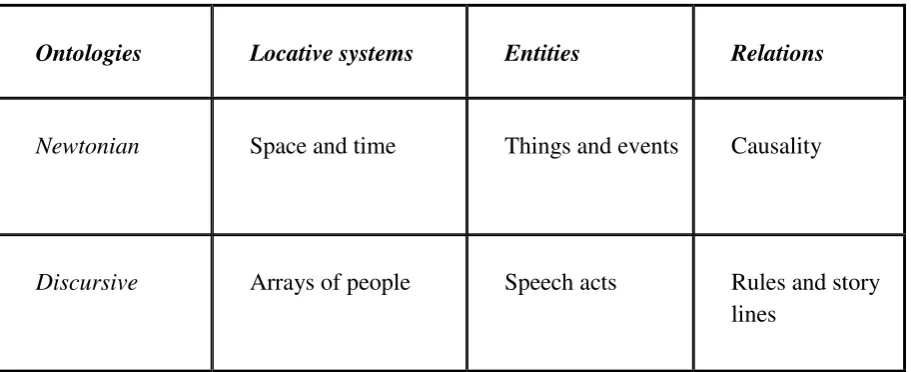
At present the absolute majority of economists and many social scientists do not pay attention to the fact that “people alone among animals can speak [and] people can give accounts of what they are doing, disambiguating their actions and justifying them by reference to rules, conventions and customs” (Ibid., p. 25). Because language is a major instrument in many human activities, then studying the uses of this instrument would be a way of studying these activities: “Through the mediation of language there is an unbroken continuum between thought and action” (Ibid., p. 12). Following the discursive approach, the researcher “is concerned predominantly with language in use as the accomplishment of acts or as attempts of their accomplishments” (Ibid., p. 58). The discursive approach is based on ontology totally different from that inherited from the Newtonian mechanics. What we have to investigate in social sciences - economics is (or has to be) a social science - are not things and events but discourses consisting of speech acts. Instead to look for causal relations, social scientists (including economists) have to try to reveal rules and supporting story lines (see Fig. 1). In order to do it “the experimenter or the observer has to enter into a discourse with the people being studied and to try to appreciate the shape of the subject’s cognitive world” (Harré and Gillett, 1994, p. 21). .
7
8
Ontologies Locative systems Entities Relations
Newtonian Space and time Things and events Causality
Discursive Arrays of people Speech acts Rules and story
[image:9.595.71.527.69.255.2]lines
Table 1. Two ontologies (Harré and Gillett, 1994, p. 29)
The researcher has “to know what a situation means to a person and not just what the situation is (say, according to a description in terms of its physical characteristics as these are seen by an observer) if we are to understand what that person is doing” (Ibid., p. 21). For this kind of research, it does not matter where and even when something was said but what really matters, it is who said that. Institutional or social knowledge is not universal; it relates to concerned communities. That is why the people to be contacted have to have the social knowledge linked with phenomena under study. In this sense ‘array of people’ means people from a certain appropriate community. For example, in order to study financial markets, it is necessary to contact financial professionals like traders and not graduate students of economics as it takes place in the so-called ‘experimental economics’. At the same time, ‘array of people’ means a sample from a target community. The choice of the people in the sample and its size made in the framework of discursive approach are done in a totally different way in comparison with the mechanistic approach. The researcher contacts people who are willing to share their social knowledge. The size of the sample (number of people contacted) is determined by the so-called ‘theoretical saturation’, when the researcher learns nothing new by additional people contacted from the target community.
9 2. On constructivist history of economics
Mark Blaug, the author of the popular textbooks on the history (1997) and methodology (1992) of economics declared in his article entitled “Why I am not a constructivist: confession of an unrepentant Popperian” that there is “the tension between the methodology of science and the history of science” and that “it is impossible to study the history of sciencewithout some notion, however crude, of the difference between science and non-science” (Blaug, 1994, p. 109). He developed his history of economics from the point of view of the rhetoric of popperian post-positivism. Those, who would like to try to study the history of economics from the constructivist point of view, should understand the main feature of its methodology, the role of resistance, which were indicated in the first section of this article, and the discursive nature of it (Yefimov, 2010b). Unfortunately, at present economists do not understand them. D. Wade Hands in his book (Hands, 2001) quoted one of the prominent constructivist scholars, Karin Knorr Cetina8, who underlined the crucial role of resistance of the research object to researcher inside the experimental situation, but did not notice that inside it the object of study and researcher with her/his instruments cannot be separated. He relates constructivism to relativism asking the question to what degree the constructivism “endorse the view that the objects and theories of science are completely constituted by human and social factors, leaving no role for objective nature in the determination of scientific beliefs?” (Ibid., pp. 176-177). Hands certainly sympathized to “an effort to salvage scientific rationality and normative epistemology from the threat of relativism and social constructivism” (Ibid., p. 367).
E. Roy Weintraub, in his historical studies (Weintraub, 1991; Düppe and Weintraub, 2013; 2014), does not pay any attention to the nature of resistance of the research object to economists. In fact, mathematical economists considered by him did not experience at all this kind of resistance. In addition Weintraub with his co-author Till Düppe limit the community of evaluators exclusively to members of the economists’ profession. Weintraub and Düppe rightly affirm that the Cowles Commission played a crucial role in the transformation of the profession of economists in the profession of mathematical economists9, but they cannot accept the conclusion of PhilipMirowski (2012) that after 1947 “Cowles [had to] attend to its political priorities”, because Cowles was connected by contracts and ideas to RAND, which was “a cold war (anti-communist) institution”, and in this way “Cowles was corrupted by the military-industrial complex”. The list of literature (References) of Weintraub’s and Düppe’s working paper (2013) contains the book by Amadae S.M. (2003) Rationalizing Capitalist
8
“All of us constructivists, I think, are what they call ontological realists: We believe in the existence of the
material world “out there,” and we believe in the fact that this material world offers resistance when we act upon it. It will resist; we can’t just do everything with it. So in that sense we are all realists. . . . Negotiating, for
example, when they can stop the measurement, at what point they’ve got enough data, and at what degree or position they can say, “Now it is real!” . . . This interpretative flexibility . . . prompts me to doubt that you can ever get at the real world as it really is. You can get resistances in the laboratory; but in order for these resistances to make sense, they have to be interpreted. The very moment you interpret them, you enter the realm
of the social world” (Callebaut, 1993, pp. 184–185).
9
10
Democracy. The Cold War Origins of Rational Choice Liberalism, but I did not find any quotation or reference of this book inside this working paper. It is quite natural because this book would confirm the Mirowski’s conclusion. After the presentation by Weintraub and Düppe of a chapter of their future book (2014) at the 2012 ESHET Conference, in which they emphasized that the first Bank of Sweden Prize in Memory of Alfred Nobel in 1969 was a clear sign of the success of the Cowles’ culture in economics, I asked Weintraub, whether they investigated the process of the creation of this prize and the process of attribution of prizes. The
answer was “no”. In fact this prize has nothing in common with the Nobel Prize and can be
characterized as an intellectual fraud10.
The crucial role in the communities of evaluators (see Fig. 2 above) of political and economic actors from outside of communities of economists at the period of creation of profession of economists in 19th century was quite well investigated by American historians Elizabeth Sage and Mary Furner. French political economists of the 19th century saw an important opportunity for professionalization of their discipline. In order to get “scientific status and power” the discipline “protected itself from unwanted knowledge”, “elevated particular types of knowledge and disqualified others” (Sage, 2009, p. 6). Unwanted knowledge primarily concerned the social question: “It was industrialists who offered the descriptions of la question sociale and proposals for its solution that economists in turn studied, promoted and grafted onto their science” (Ibid. p. 7). In order to do it they relied upon fictional “Adam Smith and Jean-Baptiste Say who they invented” (Ibid., p. 19) by ignoring in their teachings everything that contradicted the laissez-faire principle. The French government supported economists in this activity. The following quotation from a report dated 1864 of the French Minister of Education, Victor Duruy, to Emperor Napoleon III on the creation of the Department of Political Economy at Paris Faculty of Law shows governmental involvement in spreading ideas of economists as justifications of the existing social order: ‘Your Majesty once addressed these words to the national industry exhibitors: “Spread among your workers the sound doctrines of political economy”. You, Sir, also claimed that the duty of government is to propagate these necessary concepts, which, according to the English minister of that time, saved England from socialism. This necessity proclaimed by the Emperor fourteen years ago, the country recognizes today. Public opinion demands that unfortunate gap in our general educational system is filled, and several cities have already claimed the opening of political economy courses’ (Dumez, 1985, pp. 43 – 44).
The similar situation took place in the United States: «members of so-called clerical school of academic economists such as Francis Bowen, John Bascom, and Arthur Latham Perry worked closely with a group of wealthy and prominent men of affairs that included Amasa Walker, David Ames Wells, Edward Atkinson, Horace White, Gamaliel Bradford, Charles F. Dunbar, John Murray Forbes, and Joseph Ropes. Their common goal was the installation of laissez-faire as an American system of economics. Walker, Perry, Bascom, and Bowen wrote the standard economics texts of the 1860s and 1870s» (Furner, 1975, p. 37). As Mary Furner has shown, the most decisive factor in the evolution of American economics at the turn of the 19th and 20th centuries was a political one. She indicated that academic economists were subject to an increasing “external control (such as boards of trustees and
10
11
university administrators, or state legislatures in the case of public universities)” dissuading them from working in favour of social reforms. British economist Bob Coats indicates, that “it is easy to understand why the shift of emphasis from teaching of established truths to the advancement of knowledge and the investigation of current problems was liable to generate frictions between the social scientists and certain segments of their audience” (Coats, 1993, p.439). He explained these frictions in the following way: “The late nineteenth century was a time of disturbing economic, social, and political tensions, and the fact that the business community was generally getting a bad press when the economists were undertaking more thorough studies of their activities increased the likelihood that even the most objective and impartial enquiries would furnish ammunition for the innumerable critics of contemporary capitalism … Laissez-faire and conservative social Darwinism were still the ruling beliefs among members of the social and business elites, whereas many of the younger social scientists were reformers who regarded uninhibited individualism and unfettered competition as the cause of many, if not most, current economic and social evils … As might be expected, in some quarters such views were regarded as dangerously radical, and tensions mounted within the academic community as businessmen increasingly replaced clergymen on college and university boards of trustees” (Ibid., pp. 439 – 440).
French-American sociologist Marion Fourcade indicates: “The first American [economics] textbooks were written by clergymen, and a religious understanding of economic activity was pervasive. Capitalism and the laws of political economy were thought to be in harmony with the laws of god and consistent with the higher purpose of moral elevation” (Fourcade, 2009, p. 64). Later this type of economics was welcome by American businessmen who “increasingly replaced clergymen on college and university boards of trustees”: “University leaders (presidents and boards alike) often favoured [economics and other social sciences] as ‘secular substitutes for religion’ and saw in them a continuation of the old courses in moral philosophy” (Ibid., p. 66). Fourcade underlines that in the United States “during the wave of academic freedom cases that spanned from the 1890s to the 1910s, many economists came under sharp public attack for promoting views that offended powerful constituencies in matters as varied as the labour movement, free silver coinage, public utility franchises, or fiscal policy” (Ibid., p. 79). This type of political attacks “drove them to confine their scholarship to ‘safe’ intellectual grounds”. Neoclassical economics and especially in its mathematical form was ideal for serving such ground. That is the reason why it became an “attractive research strategy by American economists, especially by the younger generations who had to create a position for themselves” (Ibid., pp. 79 – 80).
12
the modernization movement where economic departments consciously redesigned their programs to ensure that the most up-to-date versions of neoclassical economic theory were taught using the appropriate mathematical tools. As a result, all that was taught in this post-war period was neoclassical economic theory while the descriptive-Institutional oriented approach became less emphasized and nearly disappeared” (Lee, 2009, p. 35). He describes it as a period when universities “administrators actively co-operated with the FBI and in many cases asked the FBI to vet potential hires, professors going up for tenure, and all tenured faculty and make recommendations about hiring and firing”, when some university “academic staff for a variety of reasons …were American Legion and FBI informants and collaborators while others feared reprisal by the university administration”, and finally when “many of the professional associations to which academics belonged either collaborated with the FBI, such as the American Anthropological Association and the American Economic Association (AEA)” (Ibid., p. 37). In order “to avoid the withdrawal of research funds or escape attacks, harassment, social ostracism, or the inevitable dismissal or denial of tenure, many progressive academics left academia voluntarily, took academic positions outside the United States, restricted and censored the content of their lectures (such as not teaching Keynesian economics or as not to appear pacifistic, atheistic, or unpatriotic) since classes were monitored by students and police informers, advised graduate students to do safe, conventional dissertations so as to avoid red-baiting from committee members, avoided talking to student groups about socialism, and/or at the least metaphorically voluntarily blowing their brains out by re-directing their own research and publications to safe, more conventional areas” (Ibid.). This kind of history of economics describes very well the heterogeneous composition of the community of evaluators where decisive influences concerning destiny of ideas/theories come from outside of community of academic economists. At the same time “A History of Heterodox Economics” by Frederic Lee shows also very well that heterodox economists deal with degenerated types of experimental situations where the research object cannot resist to the researcher because of its absence: all ideas/theories of heterodox economists come from their minds a priori without any real interaction between the researcher and the research object.
13
3. The Methodenstreit from the point of view of constructivist history of sciences
According to historians of science the first scientists were Galileo Galilei (1564 – 1642) and William Gilbert (1544 – 1603) (Gribbin, 2003, p. 68). Both used actively experimental method, which includes specially organised observation, for example on the basis of a constructed telescope. Galileo was convinced that the universe is a book which is written in the mathematical language, and the symbols of this language are geometrical figures like triangles and circles. Without the help of these symbols “it is impossible to comprehend a single word of it [the book of the universe]; without of which one wanders in vain through a dark labyrinth” (Burtt, 2003, p. 75). He strongly believed in the force of mathematical models which once constructed can be used to understand the reality. This belief had a religious basis: “God has made the world an immutable mathematical system, permitting by the mathematical method an absolute certainty of scientific knowledge” (Ibid., p. 82). Gilbert, who apparently did not share this belief, was the father of nonmathematical scientific current (Ibid., p. 163). Another scientist who tremendously contributed to the formation of rules of scientific research was Robert Boyle. Following Gilbert’s practice he championed the method of reasoned analysis of sensible facts, confirmed by exact experiment: “Experience is but an assistant to reason, since it doth indeed supply informations to the understanding but the understanding still remain the judge, and has the power or right to examine and make use of the testimonies that are presented to it” (Ibid., p. 170 – 171). Boyle was one of the organisers of the Royal Society of London for the Improvement of Natural Knowledge known as the Royal Society of London. It is his vision of scientific research which was institutionalised in the framework of associations of its practitioners, one of the first of which was the above mentioned Royal Society of London.
14
(Ibid.). The Royal Society was dominated by scholars-gentlemen. They considered “veracity to be underwritten by virtue. Gentlemen insisted upon the truthfulness of their relations as a mark of their condition and their honour. The acknowledgement of gentlemanly truthfulness was the acknowledgment of gentlemanly identity” (Shapin, 1994, p. 410). Objectivity of truth seeking by gentlemen in the process of evaluating testimony of experiments and scientific debate concerning them was favoured by gentlemen’ material independence: “Free action and integrity were seen as the condition for truth-telling, while constraint and need were recognised as the grounds of mendacity” (Ibid.).
As it is well known, histories are always written by winners. The winner in “the struggle over the soul of economics, institutionalist and neoclassical economists in America between the wars” (Yonay, 1998), were the latter and during several decades they produced absolutely distorting discourses concerning the German historico-ethical school and American institutionalism. Among multiple negative labels are non-scientific, atheoretical, inductive, unproductive, useless, normative. Economists produce texts. These texts can be of two types. The first type of texts concerns studies of "what is", that is of existing economic objects and phenomena, and the second represents reasoning about "what ought to be" in economic matters. If our understanding of science corresponds to the tradition created by the Royal Society of London for the Improvement of Natural Knowledge, then we cannot consider the latter type of texts as scientific. Nevertheless, the science practiced and preached by this Royal Society has never been value-free. Without any doubt they studied “what is” but such its prominent members as Robert Boyle and Isaac Newton were devout Christians and enthusiastic students of the Bible. Both of them wrote not only scientific but also theological texts. Their faith influences their research activity in the sense that it created for it very high motivation: to discover the design of the Creator.
Science can be considered as a social organism. The Royal Society at the beginning of its activity was a very small social organism. Now science is a huge global social organism with its formal and informal rules of recruitment, promotion, publication etc. These rules are an evolutionary result of ideological, political and financial influences from outside and inside of scientific communities and of beliefs shared by members of these communities. It is quite easy to understand why in the case of economics these rules lead the communities of economists to theological character of their discipline. It is important to understand why, in spite of all these influences, natural sciences continue to bring to mankind means to dominate the nature and influence in a spectacular way its material environment. Already Charles Peirce saw the research as a collective action of investigators. He had remarked a seemingly magic capacity of scientific communities by observing and by analysing something separately, gradually to converge on the results of investigation. The cause of this convergence is the same type of “resistance” of objects of study to different investigators.
"Nothing in words" as one of the main values and methodological principles of natural scientific communitiesreinforce the consideration of character of this “resistance” as the main argument in the discourse inside of scientific communities. As long as communities of economists share neither this value nor this methodological principle, economics will remain primarily secular theologies.
15
its object to keep correct doctrines before the attention of the people, to reiterate them perpetually, and to teach them to the young; having at the same time power to prevent contrary doctrines from being taught, advocated, or expressed. Let all possible causes of a change of mind be removed from men's apprehensions. Let them be kept ignorant, lest they should learn of some reason to think otherwise than they do. Let their passions be enlisted, so that they may regard private and unusual opinions with hatred and horror. Then, let all men who reject the established belief be terrified into silence” (Peirce, 1992, p. 117). It is exactly what Alfred Marshall has initiated as the institution of economics in England at the end of the 19th century and what later expanded throughout the world.
William Cunningham, an English advocate of German-type economics, provides the following testimony of the situation in the community of economists in England of that time: “Anyone who has refused to follow the economic fashion of recent years in England must have been greatly hampered in his efforts to pursue his own studies or guide those of others; boards of studies would exercise a galling control, and editors and publishers would view his writing with suspicion … There was no need for the English adherents of the realistic school of economists to complain when obstacles were placed in the way of their work, and avenues of publication were closed against them” (Cunningham, 1894, p. 327). In this paper, published in the USA, he discussed the attitude of Professor Marshall and his disciples towards the German-type economics: “In Germany … a veritable revolution has taken place in economic studies during the last fifty years … a revolution in the whole conception and character of economic studies: it has come to be concerned with the observation and study of the actual economic conditions of society in the past and in the present; not merely with the formulating of hypothetical principles, which the sciolist was only too apt to convert into ready made receipts for removing any of the ills of social life. It is not a little remarkable that while this revolution has taken place in Germany and to some extent in America, England should have been almost untouched by it” (Ibid., pp. 317 – 318). He also criticised the Mill’s methodology on which Marshallian economics was based: “The Germans began to devote themselves to the past, and thus opened up a field for discriminating observation and accumulation of facts. Mill took no pains about the past, and comparatively little with the details of contemporary experience. His eyes were fixed on the time to come … So far as its
matter is concerned, the work did not stimulate to observation and research. Nor did the character of the science as treated by Mill undergo any decided change: he regards it as a hypothetical science” (Ibid., p. 319). Now communities of academic economists continue to follow the Millian methodology.
16
as economic theorists, we hope that regularities will miraculously emerge from the formulas we write leisurely at our desks. Applied economists often feel the need for a model before they mine data for a pattern or regularity. Do we really need economic theory to find these regularities? Would it not be better to go in the opposite direction by observing the real world, whether through empirical or experimental data, to find unexpected regularities? Personally I doubt that we need pre conceived theories to find regularities.” (Rubinstein, 2006, p. 873) Finally what we learn from Knorr Cetina’ investigation, it is the challenge to the accepted view of a unified science even in the framework of natural sciences. Research procedures can sharply differ in different disciplines, but if they represent interacting with the “resisting” entities under study, they certainly can be classified as scientific research.
Born as a political/moral philosophy, British political economy has been presented by J.S. Mill as a science on the basis of its wrong discourse about science (1836) later developed in his “System of Logic” (1843). The marginalist revolution of Walras, Jevons and Menger followed Mill by accepting a priori method as their method. With the start in Great Britain at the end of the 19th century of the profession of economics as a profession of university teacher of this discipline, Marshall guided the process of institutionalisation of economics on the basis of marginalism and Mill’s methodology. He initialised in 1890 the creation of the British Economic Association (The Royal Economic Society), in order to strengthen the British institution of economics of which he was the designer. Formally it could look like the Royal Society initiated by Boyle but in reality it resembled much more a guild, i. e. an association of craftsmen in a particular trade. Institutionalisation of economics in Germany, also on the basis of profession of university teachers of economics, took nevertheless a totally different path. German Verein für Sozialpolitik can be rightly considered as a functional analogue for economics of the Royal Society of London for the Improvement of Natural Knowledge.
Founders of the Royal Society were convinced that the universe works in accordance with the laws of nature which God established for its order and control. One of the most influential of them, Robert Boyle, in his book (1690) explained that the study and dominion of nature is a duty given to man by God. The first scientists were very much motivated in their research activity because they thought that they were discovering the design of the Creator and in this way they approach the humanity to God. Community of researchers of the Royal Society did not earn their living by their investigating activity. All of them had independent sources of existence which had no connection with their research work. Thus the Royal Society cannot be considered as a guild. A century later, Johann Fichte, the second after Humboldt founder of the institution of research university, saw the motivation of researcher in a different way: “The true vocation of the scholar is the most widely extended survey of the
actual advancement of the human race in general, and the steadfast promotion of that
17
national unity and the political crisis of early capitalism created danger for this unity. This danger came from the existence of the so-called “social question”.
Germany was behind Britain and France in industrialisation and urbanisation. Schmoller and his colleagues were very much impressed by the studies of Fridrich Engels over the British conditions (Engels, 2009) and of Lorenz von Stein over the French conditions. They considered these studies as indicators of what could happen in Germany in the future: “Engels’s vivid descriptions of the commercial vibrancy and man-made hell produced as a consequence of industrial development, chaotic urbanisation, the litany of abuses and deprivations inflicted on the working class and their resultant moral and ethical degeneration, but also of the failure of charity, the ruthlessness of factory owners, and complacency of the British government in dealing with these problems caused a sensation in Germany” (Grimmer-Solem, 2003, p. 108 - 110). Lorenz von Stein came to the conclusion that “French society was driven with class-centred political conflict produced by increasing social inequality – a product of free market competition. Socialism and communism were thus simply an expression of justified proletarian aspirations to attain social equality”(Ibid., p.109). In his speech at the inaugural meeting of the Verein für Sozialpolitik Schmoller “warned of the threat from social revolution engendered by the division between employer and worker, propertied and propertyless classes, and suggested that popular economic beliefs concerning commercial freedom and economic individualism could well create even greater disorder, rather than the rosy future they imagined” (Tribe, 2002, p. 10) According to him “only the German state was in a position to reduce social tension and foster national unity, for it stood above selfish class interests, ‘legislating, guiding administration with a just hand, protecting the weak, raising the lower classes’” (Ibid.). Representatives of propertied classes denied the existence of the social question, but with national unification and formation of a national government new light had been shed on economic conditions: factory laws, factory inspection, corporative organizations, and courts of arbitration were all dismissed (Grimmer-Solem, 2003, p. 178). In order to collect and analyse data “the new organisation [Verein für Sozialpolitik] was conceived as a body to exclusively research the social question to provide scientifically derived, general, and above all, practical information on reform to appeal to the parties of the political middle, the public, legislators, and government officials, it was hoped, would then use this ‘scientific’ information as a basis for policy decisions, and thereby not blinded by the fog of ‘partisan economics’” (Ibid., p.179).
18
institutions that had emerged over time to constrain and mould individual behaviour into purposive action and social interaction” (Ibid., p. 160). Their “search for moral commonality to construct new laws and institutions naturally led to historical investigations of those things that formed a common moral sphere and ethically constrained and moulded economic action: customs, norms, conventions, rules, regulations, laws, organisations, corporate bodies and other institutions, and not least, the state” (Ibid., p. 160 - 161). For Schmoller and his colleagues, social reform was a process of piecemeal institutional adaptation (Ibid., p. 161). On the basis of his historical investigations Schmoller has come to the conclusion that “the state and its bureaucracy could defend the general interest and be forces for social improvement; institutions in the economy provided greater certainty and order to market relations and injected into these a set of moral-ethical norms” (Ibid., p. 168). In this way institutions were “the means to create for a modern industrial economy a new moral-ethical order” (Ibid).
Thanks to the Verein in the community of German economists, good professional practice became identified with empirical research. It guided and organised economic research by its agenda-setting standing committees of annual conferences. These conferences were not just meetings of members of the profession sharing with each other results of their research. These conferences were places of debate of commissioned studies. “In advance of conferences, Verein’s standing committee held meetings to nominate and vote on the subjects to be discussed at the conferences. Sets of questions were then raised and parameters set for research and fieldwork (or in the case of surveys, detailed questionnaires were drafted and sent out) by a commissioned expert, and increasingly, groups of experts. The results of these investigations and surveys would then be compiled into summary studies which were circulated before conferences … Following the conferences, commissioned studies were published in the Verein’s monograph series, the Schriften des Verein für Sozialpolitik … To get an idea of the scale of the Verein’s research, by 1914 it had published some 140 volumes of its Schriften of an average length of about 350 pages.”(Ibid., p. 69 -70). In many cases
Verein received financial support from government departments for the collection of data (Tribe, 2002, p. 12). Results of investigations of German economists affiliated to Verein were published in several academic journals like Schmoller’s Jahrbuch für Gesetzgebung, Verwaltung und Volkswirtschaft im Deutschen Reich (Annal for Legislation, Administration, and Political Economy in the German Empire) and Jahrbücher für Nationalökonomie und Statistik (Annals for Political Economy and Statistics), chief editors of which were Bruno Hildebrand and Johannes Conrad.
Recent historical findings concerning activities of Schmoller and his colleagues in the
19
predict that he will reach old age and be unable to work. If he falls into poverty, and be that only through prolonged illness, he will find himself totally helpless being on his own, and society currently does not accept any responsibility towards him beyond the usual provisions for the poor, even if he has been working all the time ever so diligently and faithfully. The ordinary provision for the poor, however, leaves a lot to be desired ...“. The governmental reform programme included Health Insurance, Accident Insurance (Workman’s Compensation), Disability Insurance, and an Old-age Retirement Pension, none of which were then currently in existence to any great degree. Bismarck opened debate on the subject on 17 November 1881 in the Imperial Message to the Reichstag, using the term practical
Christianity to describe his programme. Based on Bismarck’s message, the Reichstag filed three bills designed to deal with the concept of Accident Insurance, and one for Health Insurance. The subjects of Retirement Pension and Disability Insurance were placed aside for the time being. The law concerning them was adopted several years later.
Why constructivist institutionalism at the turn of the 19th and 20th centuries in Germany and the United States had been abandoned by communities of academic economists? An understanding of this phenomenon is the central task of this paper. The political economy of Adam Smith was a political/social/moral philosophy and not a science as it was practiced by first scientists Galileo and Gilbert and has been institutionalised in the framework of the Royal Society of London. Based on traditions of scientific research in natural experimental sciences and on the values of scholars formulated by Humboldt and Fichte, German professors of economics have developed an institution of economics with its central element Verein für Socialpolitik. This institution was oriented not for the self-protection of the community of economists but for the fulfilment of the mission: help to the state to solve the social question and to protect the new German nation from a national catastrophe. Two decades later the institutionalisation of economics in England took place. The process happened in an absolutely different institutional environment, not in a Humboldt’s research university, but in an almost medieval type of universities where curriculum was dominated by mathematics, classics and theology. The architect of the British institution of economics, Alfred Marshall followed in its design the established university spirit. In addition, the creation of the institution of economics like a secular theology was influenced by his lost of Christian faith, and his adoption of utilitarian ideology (Bentham). In this change of belief he followed the dominant cultural tendencies of his social environment. It has predetermined his professional choice not to be involved in hard and time-consuming empirical research of socio-economic realities but to start developing abstract a priori constructions. This choice has been supported by the distorted interpretation by John Stuart Mill of the process of knowledge acquisition. This interpretation gave to a priori constructions of political economists an aureole of science.
20
Marshallian economics attract much easier the affiliation of those who consider the discipline of economics more like a craft than like a vocation. The work of Schmollerian economists as researchers and teachers is much more difficult than that of Marshallian economists. Frequent surveys/fieldwork and constant adaptation of courses to changing realities are much more time and labour consuming than the desk work of “a priori theorists”. Very quickly the community of economists-craftsmen can become an inaccessible fortress for those who would like to practice economics as a vocation with primarily socially-oriented altruistic aspirations. The problem with Schmollerian economics in comparison with Marshallian economics is not only social but also economic and political. Surveys and fieldwork request strong financial and political support on behalf of the governments (local and/or central). The political support of Schmollerian types of scholars is necessary because their research activity can discover undesirable for owners/managers details of the functioning of their private enterprises. The resistance to Schmollerian economists can take place in the domain of surveys and field studies’ organisation and financing or in the domain of the recruitment and promotion of teachers/researchers controlled by university boards with businessmen as its members. All these factors probably played their role in the post-Schmoller’s economics in Germany.
The interwar economic and political crisis could not be of no influence on the German community of economists. The Verein für Sozialpolitik has been dissolved in 1936 with the arrival to power of Nazis. After World War II, the military presence of the USSR in Eastern Germany and of the USA in Western Germany have predetermined the reign of the Marxist-Leninist political economy in one part of Germany and of neoclassical economics in the other part. At least since the fall of the Berlin wall “neoclassical economics was and still is dominant in Germany … Until recently it was said that ‘Schmoller is forever condemned and castigated’ (Peukert, 2001a, p. 72). Nevertheless “it is surprising how many younger (German) scholars are interested in a reconstruction of institutionalism and historicism and how few survive the crowding out of the profession after their dissertation” (Ibid., p. 97).
21
knowledge” (Ibid., p. 100). On the contrary, the “the Royal Society advertises itself as a ‘union of eyes and hands’” (Ibid., p. 78). Hobbes thought that “the factual knowledge, it was true, had a valuable role to play in constituting our overall knowledge, but it was not of the sort to secure certainty and universal assent” (Ibid., p. 102).
Boyle did win the dispute, Schmoller did loose. In my opinion it happened for the following main reasons. The motto Nullius in Verba (demonstration by facts and not by words) has become the rule at the basis of the institution of natural sciences, the most important feature of the scientific culture. From the very beginning activity of researchers according to this rule did not contradict interests of powerful groups of the society, and later such groups were even very much interested in the existence of this rule because of profitable practical results. It did not occur in economics just because of the strong resistance of such groups to experimental social research. They saw much more danger than benefit for them in this type of research. On the contrary they were interested in abstract theoretical constructions justifying laissez-faire. This kind of constructions corresponded to deeply enrooted scholastic traditions of European universities to teach theology and linked with it philosophy. In the framework of these traditions the mathematics was considered as a summit of scientific approach. Powerful groups of society supported these traditions in the economics profession and made all possible to suppress newly born experimental current of economics. Can you imagine, in what world, from the point of view of technology, we would live now if Hobbes’ concept of science had overcome? The humanity remained at the technological level of the 17th century. Now imagine the world’s history of the 20th century if the Schmoller’s concept of economics would have overcome. I think that, in this case many human catastrophes could have been avoided.
4. Three constructivisms and three types of economics
In this section I will refer to ideas exposed in the first section of the paper as
22
“involves the establishment in our nature of a rule of action, or, say for short a habit … The
whole function of thought is to produce habits of action … To develop its meaning, we have, therefore, simply to determine what habits it involves” (Peirce, 1992, pp. 129, 131). For Peirce “belief is not a momentary mode of consciousness; it is a habit of mind essentially enduring for some time … Instead of saying that you want to know the ‘Truth’, you were simply to say that you want to attain a state of belief unassailable by doubt” (Peirce, 1905, p. 336). Based on the Peirce’s pragmatism, we can say that social reality is a reality of beliefs and habits. It means that this reality is socially constructed11 by the processes of institutionalisation12, legitimation13 and socialisation14 (Berger and Luckman, 1991).
Being constructed by humans the social reality is nevertheless perceived by them as an objective world, they objectivise and reify it: “Reification is the apprehension of human phenomena as if they were things, that is, in non-human or possibly suprahuman terms. Another way of saying this is that reification is the apprehension of the products of human activity as if they were something other than human products - such as facts of nature, results of cosmic laws, or manifestations of divine will. Reification implies that man is capable of forgetting his own authorship of the human world” (Ibid., p. 106). The present day mainstream and heterodox economists are caught in the trap of this reification. So critical realist economists call on to provide explanations in terms of hidden social structures. On the contrary, the constructivist Rom Harré wants “to pay to the means by which socially competent people are produced in the manner of Vygotsky’s psychological symbiosis, a mode of production that involves inter personal interaction without the reification of social structures” (Harré, 2009, p. 139). One type of such structures is referred to as institutions at the basis of which are rules and conventions. Harré claims that “people become members of a society … by their Vygotskian origins as they acquire competence in practices recognised as correct in their local culture, that is acquire grammars15, pick up schemata, scripts and so on, and are trained in good habits. Using these skills they do not produce structures, but a rich, interconnected mesh of meaningful exchanges. To collect up a set of rules and conventions as an institution is a harmless and useful classificatory device, so long as we do not slip into ascribing causal powers to it” (Ibid., p. 138). The study of institutions must be base on discursive approach because “conversations are normatively constrained, so the scientific presentation of our knowledge of the generators of the social world is in sets of rules, that is grammars, in Wittgenstein’s sense. Grammars represent the tacit schemata, “scripts”, narratives and so on that guide the agent in acting with others to continuously create a
11Late Douglass North accepted it: “All the building
blocks of the world we live in are a product of our human
mind. They do not exist outside us.” (North, 2003, p. 3)
12 “Institutionalization occurs whenever there is a reciprocal typification of habitualized
actions by types of
actors. Put differently, any such typification is an institution.” (Berger and Luckman, 1991, p.72)
13 “The institutional world requires legitimation, that is ways by which it can be ‘explained and justified.” (Berger and Luckman, 1991, p.79)
14
Socialisation may be defined as the comprehensive and consistent induction of an individual into the objective world of a society or a sector of it. It happens when the individual achieves a capacity of the immediate apprehension or interpretation of an objective event as expressing meaning. (Berger and Luckman, 1991, pp.149, 150)
15
23
credible social world, and to repair it when the flow of actions begins to disintegrate into mutually unintelligible fragments. The root process of social life is people as active agents making use of their shared knowledge of grammars to carry out collective projects with others” (Ibid., p. 140).
The characteristic of the dispute between Schmoller and Menger, as dispute concerning methods applied by economists, is not exact. It was primarily the dispute about the nature of social reality and social regularities, and the character of science that would be able to bring knowledge about these regularities. For Schmoller, social regularities inside a community come from the fact that members of this community follow certain complexes of rules of morals and law which form institutions. These complexes of morals and law are fixed orally in conversations and in written in texts. That is why the science that would be able to bring knowledge about social regularities should investigate conversations and texts where corresponding complexes of rules of morals and law are depicted. The institutionalist tradition coming from Schmoller is closely linked with discursive approach, which is based on a model of man where “the person is considered not only as agent but also as watcher, commentator and critic” (Harré and Secord, 1972, p. 91). It means that the rule as an element of an institution “’exists’ in and through the practice of citing it and invoking it in the course of training, in the course of enjoining others to follow it, and in the course of telling them they have not followed it, or not followed it correctly. All of these things are said to others and to oneself, and are heard being said by others” (Bloor, 1997, p. 33). That is why “the phenomenon of following a rule is not distinct from descriptions given of it” (Ibid., pp. 33 -34).