Munich Personal RePEc Archive
Non-linear effects of the U.S. Monetary
Policy in the Long Run
Olmos, Lorena and Sanso Frago, Marcos
Universidad de Zaragoza
2014
Online at
https://mpra.ub.uni-muenchen.de/57770/
Non-linear e¤ects of the U.S. Monetary Policy in
the Long Run
Lorena Olmos
University of Zaragoza
Marcos Sanso
yUniversity of Zaragoza
Abstract
We …nd non-linearities in the U.S. long-run relationships among trend in-‡ation, growth rate and …nancial frictions. Moreover, our results show that mismeasurements of the natural rate of interest deviate the trend in‡ation from its target, which is especially clear when monetary policy reacts preventively against in‡ation deviations. The long-run growth rate, the trend in‡ation and the natural rate of interest, speci…ed as time-varying, are jointly estimated over the period 1960:Q1-2013:Q2 by applying the Kalman …lter, following mainly Laubach and Williams (2003).
JEL code: C32; D52; E31; E52
Keywords: Kalman Filter, Trend In‡ation, Financial frictions, Growth
The authors acknowledge …nancial support from Ministerio de Ciencia e Innovación (Project ECO2009-13675) and Gobierno de Aragón (ADETRE research group).
1
Introduction
The existence of rigidities and frictions in the markets leads to non-neutral monetary
policies in the long run and non-linear e¤ects of some key variables according to
neokeynesian dynamic models with endogenous growth (Amano et al., 2009; Olmos
and Sanso, 2014a,b). These two features are especially clear when monetary policy
is conducted following some type of in‡ation targeting using the short-term interest
rate as the instrument or, in other words, following a Taylor rule (Taylor, 1993).
In this paper, we search for these nonlinearities for the case of the U.S. monetary
policy. In particular, we are interested in three non-linear e¤ects of the monetary
policy in the long run: the non-linear relationships between the trend in‡ation and
the growth rate, between the trend in‡ation and the external …nance premium and
between the growth rate and the error in the estimation of the natural rate of interest.
But the possibility of …nding this type of evidence is hindered by the problem of the
non-observable character of the long-term variables.
In fact, the relevance of the long-term variables is crucial for the performance
of the monetary policy carried out by central banks. Most speci…cations of Taylor
rules include one or more long-term variables, whose unobservability is an intrinsic
characteristic. The long-term variables which are usually incorporated into the
mon-etary policy rules are the natural interest rate, the in‡ation target and the potential
output1. As a result of the importance of these variables for the policy design, many
1
contributions have been made on their estimation. Nevertheless, this task is not
straightforward.
There are several approaches to estimating unobservable variables. The simplest
techniques are the univariate …lters such as that of Hodrick-Prescott, but these
meth-ods are only based on the statistical properties of the series and ignore the connections
with other variables. Equilibrium models can also be built in order to estimate
unob-served series as is done in, among others, Neiss and Nelson (2003), Smets and Wouters
(2003), Giammaroli and Valla (2004) and Andrés, López-Salido and Nelson (2009),
but the resulting estimates are based on subjective assumptions and are prone to be
more volatile (Edge et al., 2008). As an alternative to the foregoing methods, and
admitting that this routine has been the object of some criticism2, our approach is
based on the Kalman …lter applied to a semi-structural econometric model. This
pro-cedure has been implemented by many studies to estimate long-term values of several
economic variables. However, most of the papers that follow this technique do not
jointly estimate all the long-term variables involved in the monetary policy rules3
nor emphasize the long-term perspective. By contrast, our approach simultaneously
includes the natural rate of interest, the long-run growth rate and the steady-state
in‡ation in the estimation process in order to capture all the long-run interactions
we are interested in. 2
As discussed in Weber, Lemke and Worms (2008).
3
The …rst long-run variable we estimate is the natural rate of interest de…ned as
the long-run real rate of interest that ensures in‡ation stability and the reaching of
the potential output. The estimation of this variable has attracted the interest of
the literature since central banks conduct monetary policy through rules with this
rate as the intercept. Moreover, the gap between the natural rate of interest and
the actual real rate is very useful because it measures the monetary policy stance
and has predictive power for future in‡ation. Many empirical studies have tried
to assign a value to this rate, which initially was considered constant over time.
Afterwards, in a seminal paper, Laubach and Williams (2003) drop the assumption
of a …xed value4
and estimate the time-varying natural rate of interest (TVNRI)
for the U.S. by applying the Kalman …lter. The papers that have followed this
methodology are not few. Crespo-Cuaresma et al. (2004), Mésonnier and Renne
(2007) and Garnier and Wilhelmsen (2009) estimate the TVNRI for the euro zone,
Larsen and McKeown (2003) for the U.K., Manrique and Marques (2004) for the
U.S. and Germany, Basdevantet al. (2004) for New Zealand, Brzoza-Brzezina (2006)
for Poland and, recently, Bouis, et al. (2013) for Canada, the euro zone, Japan,
Sweden, Switzerland, the U.K. and the U.S. Combining Bayesian methods with the
Kalman …lter, Edge, Kiley and Laforte (2008) and Bjørnland, Leitemo and Maih
(2011) estimate the TVNRI for the U.S.5.
4
They argue that this rate changes in response to shifts in preferences and in the trend growth rate of output. Trehan and Wu (2007) compare the implications of considering the natural rate of interest to be …xed or variable.
5
We also focus on the implications generated by the potential error that central
banks could commit in the estimation of the natural rate of interest. This issue has
been theoretically studied by, among others, Orphanides and Van Norden (2002),
Orphanides and Williams (2002), Tristani (2009) and Olmos and Sanso (2014b). We
approximate the gap between the correct and the estimated TVNRI and compute its
e¤ects on long-term in‡ation dynamics.
Estimating the TVNRI requires the estimation of the long-run trend of the
poten-tial output because, in the theoretical dimension, both variables are closely related.
In addition, this estimation is necessary because monetary policy rules are speci…ed
in terms of output deviations from the steady state level. Therefore, potential output
and, consequently, its growth rate, is the second unobservable variable we estimate.
But the TVNRI and the potential output are not the only variables involved
in the long run that are relevant for monetary policy. Trend in‡ation is another
long-term variable that plays an important role in its design and in its outcomes6
.
Like the potential output, it serves as a reference in the deviation measure of the
in‡ation rate as long as it coincides with the in‡ation target of the monetary policy
rule. Moreover, as it is pointed out in Olmos and Sanso (2014b), the potential
incorrect estimation of the TVNRI generates a gap between the in‡ation target and
its steady-state value that sets o¤ distortions in the long-run equilibrium. Therefore,
by including this variable in the estimation process, an increase in the robustness of
the analysis is expected as well as an expansion of the range of conclusions. In this
6In this regard, Ascari (2004) and Cogley and Sbordone (2008), among others, analyze the
line, Leigh (2008) estimates the TVNRI for the U.S. through the Kalman …lter, but
all other unknown variables are overlooked. Moreover, a relevant topic we want to
study is the relationship between the long-run growth rate and the trend in‡ation.
Previous theoretical literature, such as Amano et al. (2009) and Olmos and Sanso
(2014a), shows the existence of a non-linear relationship between these two long-term
variables. And, despite the fact that the Kalman …lter provides a linear estimation,
we use the outcomes of the model to check the kind of connection between them
through a quadratic and a quantile regression.
Another issue we want to discuss is the role of …nancial frictions in the
determi-nation of the long-term main variables. Olmos and Sanso (2014a) show a connection
between …nancial frictions, the growth rate and the trend in‡ation in the long run
with some non-linear relationships. Ö¼günç and Batmaz (2011) follow the Laubach and
Williams (2003) procedure and include the risk premia for Turkey. They conclude
that the long-run evolution of this spread determines the natural rate of interest.
This link between …nancial frictions and the TVNRI is also studied empirically in
Archibald and Hunter (2001) for the New Zealand case.
Our database comprises time series for the U.S. during the period
1960:Q1-2013:Q2. The evolution of the estimates of the TVNRI, the long-run growth rate
of the economy and the steady-state in‡ation rate are in line with foregoing results.
Our estimates prove the negative e¤ect that …nancial frictions would cause on the
long-run growth rate, that potential misunderstandings of the TVNRI would deviate
long-run growth rate and the trend in‡ation is described as a nearly hump-shaped
curve.
The remainder of the paper is organized as follows. The second section describes
the methodology applied. In the third section, we present the estimation results,
carry out a quadratic and a quantile analysis of the relationships among the
long-run growth rate, the trend in‡ation and …nancial frictions, and study the e¤ects of
misunderstandings of the natural rate of interest. Finally, Section 4 summarizes the
main conclusions. The Kalman …lter procedure is detailed in the …rst appendix and
the state-space form of the model is explained in the second.
2
Estimation methodology for the unobservable
variables
To achieve the objectives stated in the previous section about the estimation of the
long-run unobservable variables, we extend the Laubach and Williams (2003)
semi-structural model by making some modi…cations. The core of the procedure, a
state-space model devoted to implementing the Kalman …lter, remains unchanged.
How-ever, we include a new state variable, the trend in‡ation. This extension complicates
the model but adds robustness to the whole estimation since it jointly estimates all
relevant variables in the long-term horizon. We also introduce some changes into the
model speci…cation in order to improve the consistency of the long-run implications
This empirical model is a small-scale simpli…cation of the New Keynesian
macro-economic model developed in Olmos and Sanso (2014a,b), where the main …ndings
we want to evaluate are the relationships among the long-run economic growth rate,
the trend in‡ation and …nancial frictions, as well as other relevant conclusions like the
e¤ects of potential errors in the estimation of the natural rate of interest. The
connec-tions established among these variables show the non-linear e¤ects of the monetary
policy in the long run.
The …rst equation of the model corresponds to the Phillips curve and describes
the evolution of the in‡ation rate ( t), an observable value. We de…ne the in‡ation
rate as the core consumer price index, which includes all items except food and
energy, and take the data from the Bureau of Labor Statistics. The quarterly series
is obtained as the monthly average value and then is seasonally adjusted with the
Tramo/Seats methodology. Once we have computed the quarterly in‡ation rate, the
data is annualized. We consider the in‡ation rate as a function of its own lags, the
output gap (zt), the trend in‡ation ( t) and a serially uncorrelated error term "t. In
this way, we ensure the consistency of the model in the long term because in‡ation
rate would equal its steady-state value, the trend in‡ation. The resulting equation is
the following:
t+1 = (L) t+ zzt+ (1 (L)) t+"t+1 (1)
where (L) is a lag-polynomial and z
is interpreted as the slope of the Phillips
The next relationship is a state equation equivalent to the reduced form of the IS
curve that explains the output gap, the percentage deviation of the real output from
its potential level. This variable depends on its own lags and on the measurement
error of the natural rate of interest, de…ned as the di¤erence between the ex-ante
real interest rate (Rt) and the natural rate of interest (Rnt). In turn, real interest
rate is gauged by subtracting the in‡ation expectations (Et t+1) from the short-term
nominal interest rate Rst
t , which is obtained from the Federal Reserve System
data-base. In‡ation expectations are computed by an 8-quarters forward-moving average
and nominal interest rate is equivalent to the federal funds e¤ective rate. Again, a
serially uncorrelated error term "z
t is included. This relationship is also consistent
with the long run because, in the absence of shocks and mismeasurement problems,
the output gap would be zero in the steady state:
zt+1 = z(L)zt+ r(Rt Rnt) +" z
t+1 (2)
where z(L) is a lag-polynomial. We assume, following Mésonnier and Renne
(2007), a de…nition of the natural interest rate based on standard optimal growth
models. However, the speci…cation is slightly di¤erent and follows Bouiset al. (2013),
where the natural rate of interest is related to the long-run growth rate (gt) corrected
by a parameter7
@ and augmented by , the inverse of the intertemporal elasticity
of substitution in consumption, also interpreted as the relative risk aversion. An
intercept %is also included, which represents the time preference of consumers:
7
In terms of the Ramsey model, parameter @could be interpreted as a measure of the e¤ects of
Rnt =%+ (gt @) (3)
The long-run growth rate, equivalent to the growth of the potential output yt, is
explained as a function of its …rst lag, …nancial frictions (ft) and the trend in‡ation.
Financial frictions are proxied by the spread between the average majority prime
rate charged by banks on short-term loans to business and the 3-month Treasury bill
rate, both series collected from the Federal Reserve System database. This external
…nance premium is a standard simple measure of the frictions present in the …nancial
markets. An intercept and a serially uncorrelated error term are also included. In
the steady state, the growth rate would depend on a …xed value @ and also on the
trend in‡ation, as is theoretically shown in Olmos and Sanso (2014a):
gt=@(1 g) + ggt 1+ ft+{ t 1+"g
t (4)
As can be seen, one main di¤erence between our speci…cation and those of Laubach
and Williams (2003) and Mésonnier and Renne (2007) is that growth of the potential
output is de…ned as a function of state and observed variables instead of a simple
AR(1) process. Moreover, our hypothesis regarding the order of integration of both
Rn
t and gt follows the approach of Mésonnier and Renne (2007) assuming highly
persistent but stationary variables driven by unobservable processes which capture
common low-frequency variations inRn
t and gt as well as idiosincratic ‡uctuations of
gt.
noted in equation (1), trend in‡ation would equal the in‡ation rate in the long run:
t+1 = t+ 1 Et t+1+"t+1 (5)
Finally, the last equation is the identity that de…nes the output gap as the
dif-ference between the output (yt), built as the log of the real chain-weighted GDP in
billions of chained 2009 dollars taken from the Bureau of Economic Analysis, and the
log of its potential level:
zt=yt yt (6)
Summing up, the unobservable variables that we jointly estimate are(yt; gt; Rnt; t),
whilst the observed variables are( t; Rtst; yt; ft). We should note that shocks "t; "zt; " g t; "t
are independently and normally distributed and their variances are 2
; 2
z;
2
g;
2
,
respectively.
Having introduced the equations of the semi-structural model, we have to
artic-ulate the state-space model. Appendix A1 is devoted to presenting the state-space
representation which consists of the measurement equation and the transition
equa-tion. Afterwards, we are able to implement the Kalman algorithm (Kalman, 1960).
The basic intuition behind this procedure follows two steps. In the …rst, the system
makes a prediction based on the information available at a speci…c point of time. In
the next period, the …lter corrects this prediction by uploading the new information.
The maximum likelihood method is used to estimate the conditionally unbiased and
Kalman …lter mechanism8.
3
Results for the U.S. economy
We now estimate the model speci…ed in the previous section. The quarterly data set
we have used refers to the United States in 1960:Q1-2013:Q2. It should be noted that
the Kalman …lter is very sensitive to the initial conditions. The technique we have
implemented to overcome this issue consists of several steps. Firstly, we carry out
a univariate estimation of each unobserved variable. To that end, we have applied
the Hodrick-Prescott …lter to the in‡ation rate, the real GDP and its growth rate
in order to obtain preliminary estimates of the trend in‡ation, the potential output
and the long-run growth rate, respectively. Secondly, we have estimated each
equa-tion including the series provided by the HP …lter with the purpose of assigning the
initial values to the parameters. This …rst estimation of the Kalman …lter generates
variances biased towards zero9
and, therefore, unsatisfactory results outside the
ac-ceptable values for the unobservable variables. Thus, we have to use the common
method of restricting some coe¢cients by calibrating the following parameters:
Following Bouis et al. (2013), one of the best candidates to gauge % is the
average of the actual real interest rate because it measures the trend value of
the natural rate of interest approximately. This approach is also used to set the
value of the intercept of the long-run growth rate equation@, equating it to the
8
Good references to understand this procedure are Harvey (1989) and Hamilton (1994).
9
sample average of the real output growth rates.
Due to the lack of consensus about the value of the parameter , we choose the
value 4.167, used in our theoretical model of reference, i.e. Olmos and Sanso
(2014a).
Finally, we calibrate 2
so that trend in‡ation accounts for 50% of the in‡ation
[image:14.612.191.424.272.609.2]rate ‡uctuations.
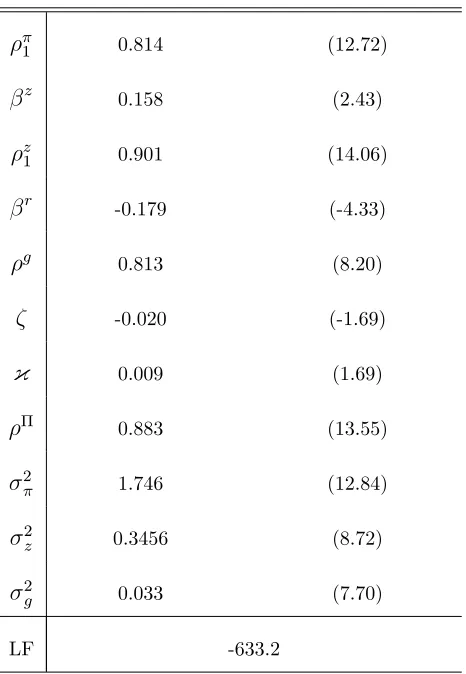
Table 1: Coe¢cient estimates
1 0.814 (12.72)
z
0.158 (2.43)
z
1 0.901 (14.06)
r
-0.179 (-4.33)
g 0.813 (8.20)
-0.020 (-1.69)
{ 0.009 (1.69)
0.883 (13.55)
2
1.746 (12.84)
2
z 0.3456 (8.72)
2
g 0.033 (7.70)
LF -633.2
z-Statistic in parenthesis. LF: Likelihood function.
We now explore the results of the model by analyzing the estimated coe¢cients
statistically signi…cant. Regarding the lags included for the in‡ation rate in (1), we
impose order 1 for the (L) lag-polynomial, whose coe¢cient is 1. Otherwise, the
coe¢cient associated with tin (1) loses weight and, consequently, the state estimates
become distorted. The signi…cativity criterion reveals that the lag-polynomial of the
output gap in (2) is of order 1. Both the slope of the Phillips curve z and the
coe¢cient r, which drives the output gap in accordance with ‡uctuations in the
di¤erence between the actual interest rate and its natural level, are higher than those
estimated by Laubach and Williams (2003) and Bouis et al. (2013)10
, but remain
within reasonable values. Financial frictions negatively a¤ect the long-run growth
rate, which can be seen from the negative value of . Trend in‡ation exerts the
opposite e¤ect because coe¢cient { has a positive sign, though the size is very low.
As the statistical signi…cance of these two linear e¤ects is at the limit of 10%, we go
deeper into this issue in the last part of the paper when we pose the question of the
non-linear e¤ects.
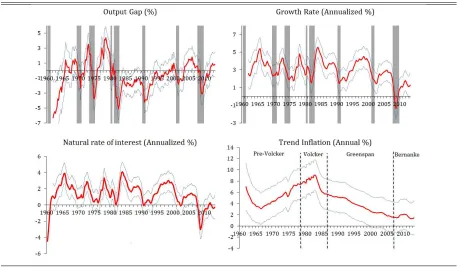
The estimation of the model with the features described above yields the evolution
of the unobserved variables displayed in Figure 1. We should clarify that these series
are two-sided estimates or smoothed estimates, that is, to compute them, the Kalman
algorithm has used the information of the full sample. In addition, we have discarded
the …rst few quarters because the estimates are outside the admissible range.
11
Figure 1: Estimates of the unobserved variables
Grey bars refer to the o¢cial recession dates provided by the National Bureau of Economic Research. Dashed lines represents the 90% con…dence interval.
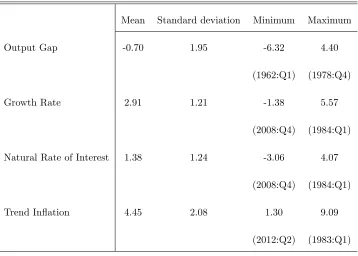
Table 2 displays the statistical properties of the unobserved variables. Output gap
shows an expected path in the range (-6%,5%) with eight slowdowns corresponding to
the o¢cial recession dates of the U.S. economy11
, which also can be appreciated in the
long-run growth rate trajectory. This …rst inference seems to verify the accuracy of
the estimates. The sharpest declines of the output gap are situated at the beginning
of the sample and in the early 1980s recession, whilst the long-run growth rate reaches
its minimum value in 2008 during the …nancial crisis. The trajectory of the natural
11
rate of interest is obviously analogous to the long-run growth rate evolution because
the former is de…ned as a linear combination of the latter. Values of the long-run
growth rate and the natural rate of interest in 2008:Q4 seem to be atypical since
the troughs of both series are anomalously low for long-term references. Finally, the
trend in‡ation rises sharply from the late sixties to 1980, during the Pre-Volcker
era. After reaching its peak in the middle of Volcker’s presidency of the Federal
Reserve System, the trend in‡ation has constantly decreased leading to the so-called
Volcker disin‡ation. From the late-nineties, under the leadership of Greenspan, the
trend in‡ation has stabilized around a value of approximately 2%, level at which it
[image:17.612.128.486.374.630.2]is assumed that FED locates its in‡ation rate target for the medium and long term.
Table 2: Statistical properties of the estimated series
Mean Standard deviation Minimum Maximum Output Gap -0.70 1.95 -6.32 4.40
(1962:Q1) (1978:Q4) Growth Rate 2.91 1.21 -1.38 5.57
(2008:Q4) (1984:Q1) Natural Rate of Interest 1.38 1.24 -3.06 4.07
(2008:Q4) (1984:Q1) Trend In‡ation 4.45 2.08 1.30 9.09
3.1
Searching for nonlinearities
We have seen, in Table 1, that the estimation of the coe¢cient { is near zero and
that its corresponding p-value is slightly lower than 10%, so the linear relationship
between the long-run growth rate and the trend in‡ation is very weak. The same
remark can be made about the relationship between the external …nance premium
and the growth rate. These are not two counterintuitive results in the light of the
…ndings of Olmos and Sanso (2014a), because these outcomes may not mean the
absence of a relationship between the trend in‡ation and the long-run growth rate
and between the latter and the external …nance premium, but perhaps the model
speci…cation used is veiling relevant bivariate movements. The theoretical results we
have proposed to test in this paper are the presence of nonlinearities between these
two pairs of variables but, unfortunately, in the model to which the Kalman …lter
is applied, non-linear speci…cations can not be included. Although the Extended
Kalman …lter can integrate such speci…cations, its operation is very complex, so we
have opted for a two-step analysis. The …rst, already done, is to obtain estimates
of the state variables. In the second, we use these estimates of the unobservable
long-run variables to test the hypothesis established in Olmos and Sanso (2014a), a
hump-shaped relationship between the long-run growth rate and the trend in‡ation,
on the one hand, and a U-shaped relationship between the trend in‡ation and the
external …nance premium, on the other.
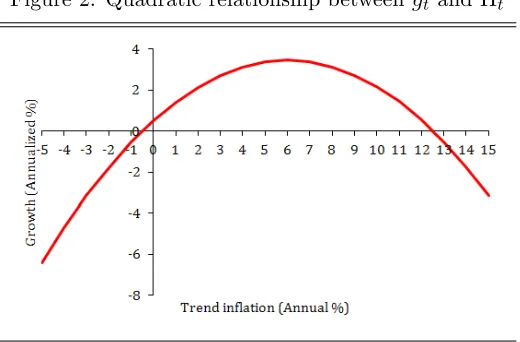
A simple way to look for non-linear relationships is to de…ne a quadratic equation.
^
gt= 0:52 + 0:98 ^t 0:08 ^2t + u^ g t
(1.42) (5.88) (-4.84)
(7)
where ^t and g^t are the trend in‡ation and the long-run growth rate series
esti-mated by the Kalman …lter,u^gt refers to the residuals and the t-ratios are presented
in parentheses. In line with the foregoing theoretical results, the coe¢cient values
show a hump-shaped relationship between ^gt and ^t plotted in Figure 2. This very
signi…cant non-linear relationship indicates that, for low levels of trend in‡ation, the
long-run growth rate increases until ^t = 6% and, after this value, the growth rate
decreases with the trend in‡ation, reaching zero when it is 12.7% and -0.5%. The
an-nualized maximum potential growth is near 4%. But this outcome varies depending
on the sample considered. If we contemplate a period of in‡ation stability, such as
the subsample beginning in 1994 during which the Federal Reserve has reacted
pre-emptively against deviations of in‡ation from its target, the level of trend in‡ation
[image:19.612.177.437.504.675.2]for which estimated growth is maximized drops markedly to ^t= 4%.
As in our previous exercise, we again perform this analysis to test for the link
between …nancial frictions and the trend in‡ation in the long run. Olmos and Sanso
(2014a) conclude that this connection has a U shape. Equation (8) presents the
estimated coe¢cients, where it can be seen that the U-shaped relationship found in
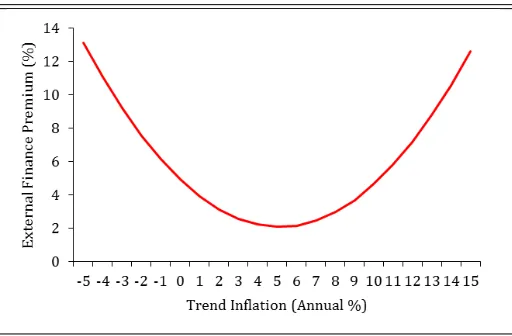
that paper, displayed in Figure 3, is corroborated. It should be noted that the level of
trend in‡ation for which estimated growth is maximized nearly matches the minimum
value of …nancial frictions.
ft= 4:90 1:11 ^t + 0:11 ^2t + u^ f t
(16.04) (-7.96) (7.69)
(8)
[image:20.612.179.435.425.593.2]where u^ft are the residuals.
Figure 3: Quadratic relationship betweenft and ^t
Another way of searching for the nonlinearties we are interested in is to take into
account that the state estimates have been obtained using a speci…c linear model.
in‡ation and …nancial frictions with the long-term growth rate, looking for possible
nonlinearities. In doing so, we again try to verify if the theoretical results obtained in
Olmos and Sanso (2014a) are validated. We take the sample 1962:Q1-2013:Q2 in order
to avoid the initial distorted observations of the state estimates. The methodology
we adopt is based on a quantile regression but, in contrast to the common practice of
ordering observations according to the endogenous variable, we arrange the quantiles
according to an exogenous variable, the trend in‡ation. Thus, the speci…cation of our
equation of interest, which relates the long-term growth rate, …nancial frictions and
the trend in‡ation, is the same12
as (4), although levels of the explanatory variable
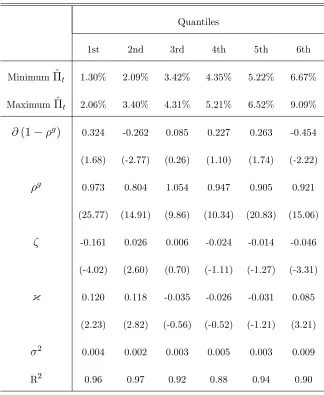
^t are distinguished. We opt for six quantiles because this is the largest number that
provides an acceptable number of observations in each quantile. Table 3 shows the
lower and the upper limit of each quantile, the estimated coe¢cients, the variance
and the coe¢cient of determination.
We expect a positive sign of { in the lower quantiles and a negative one in the
higher, what would resemble the inverted parabola obtained previously. For all the
quantiles except the last one and, consequently, for most of the sample, the
relation-ship can be described as an inverted U curve. However, when trend in‡ation is above
6.67% (last quantile), which occurs between 1973 and 1984, the estimated coe¢cient
is positive. Nevertheless, this scenario could be considered as an anomalous pattern
since, during those years, the two economic recoveries after strong downturns were
attached to a monetary policy that did not react severely to in‡ation deviations.
12We no longer include the trend in‡ation as a lag because that was a speci…c constraint of the
Table 3: Quantile regression
Quantiles
1st 2nd 3rd 4th 5th 6th Minimum ^t 1.30% 2.09% 3.42% 4.35% 5.22% 6.67%
Maximum ^t 2.06% 3.40% 4.31% 5.21% 6.52% 9.09% @(1 g) 0.324 -0.262 0.085 0.227 0.263 -0.454
(1.68) (-2.77) (0.26) (1.10) (1.74) (-2.22)
g 0.973 0.804 1.054 0.947 0.905 0.921
(25.77) (14.91) (9.86) (10.34) (20.83) (15.06) -0.161 0.026 0.006 -0.024 -0.014 -0.046 (-4.02) (2.60) (0.70) (-1.11) (-1.27) (-3.31)
{ 0.120 0.118 -0.035 -0.026 -0.031 0.085
(2.23) (2.82) (-0.56) (-0.52) (-1.21) (3.21)
2
0.004 0.002 0.003 0.005 0.003 0.009 R2
0.96 0.97 0.92 0.88 0.94 0.90 t-ratios are reported in parentheses.
With respect to the relationship between …nancial frictions and the long-run
growth rate, coe¢cient is statistically signi…cant at 5% only for the extreme lower
and higher values of the trend in‡ation, so the in‡uence is coherent with the
U-shaped relationship between the trend in‡ation and the external …nance premium.
For medium in‡ation rate levels, when the external …nance premium does not reach
not a¤ect, or positively a¤ect, the long-term growth rate. However, when the degree
of …nancial frictions increases, long-run growth could be negatively a¤ected by such
rigidities.
3.2
Long-run e¤ects of natural rate of interest
mismeasure-ments
In order to capture other non-neutral and non-linear e¤ects of the monetary policy
in the long run, we approximate the real-time gap between the estimated and the
correct value of the natural rate of interest as the di¤erence between the one-sided
(R^t, …ltered) and the two-sided (R^nt, smoothing) estimates following Mésonnier and
Renne (2007). This is a proxy of the mismeasurement gap since the former estimation
takes into account the information available at the time of the estimation, as central
banks do, and the latter uses the full sample information of the signal variables, which
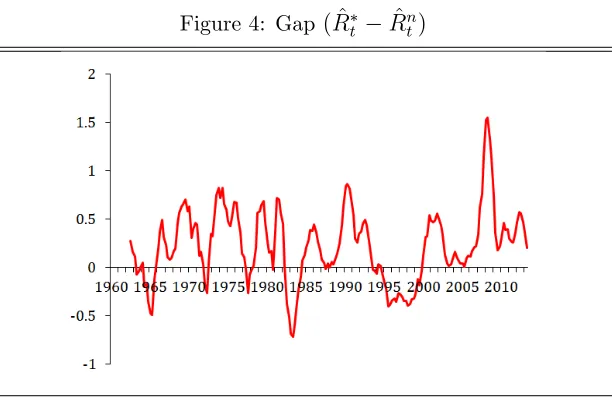
approaches the true value. In Figure 4, the evolution of the mismeasurement gap is
displayed.
This gap reaches a substantial size and, even if we do not consider the highest
deviations, the gap moves around values of( 0:5%;1%). When the mismeasurement
gap takes positive values, monetary policy tends to be more contractionary since the
intercept of the rule is higher than the endogenous value. Analogously, when the gap
is negative, monetary policy is more expansive. The average of the gap is near 0.25%
meaning that, on average, Federal Reserve implements a restrictive monetary policy
Figure 4: Gap( ^Rt R^nt)
Plot of the 2-quarter central moving average of the gap between the …ltered (R^t) and the smoothing (R^n
t) estimation of the TVNRI
We now explore the potential implications of the existence of this gap from the
long-run perspective. This exercise is based on the theoretical work developed in
Ol-mos and Sanso (2014b), where it is concluded that central banks’ misunderstandings
in the estimation of the natural rate of interest a¤ect the long-run equilibrium by
deviating the steady-state in‡ation rate from its target. When the natural rate of
interest estimated by the central bank is higher than the correct value, trend in‡ation
is below its target and vice versa. Accordingly, the relationship between the deviation
of the natural rate and the gap of the trend in‡ation is negative.
Firstly, in order to carry out this analysis, we have to transform the trend in‡ation
series to be comparable with the mismeasurement gap. Hence, we have to calculate
the deviations of the trend in‡ation from the estimated target, the latter proxied as
its statistical mean. However, the evolution of the estimated trend in‡ation exhibits a
of this variable by way of the Bai-Perron methodology, which allows for the presence of
structural changes (see Bai and Perron, 1998, 2003) throughout the sample
1962:Q1-2013:Q2. The application of this methodology leads us to observe the existence of 5
di¤erentiated periods in the evolution of the trend in‡ation with the following break
points: 1970:Q3, 1979:Q2, 1986:Q4 and 1995:Q2. The estimated annualized values for
the mean of the trend in‡ation in the …ve subperiods are 4.1%, 6.1%, 7.5%, 4.9% and
2.3%, respectively. Secondly, with these averages, we can compute the deviations of
the trend in‡ation from the estimated target and relate them to the mismeasurement
gap. In order to smooth both series, characterized by strong ‡uctuations, we construct
the 2-quarter central moving averages for the trend in‡ation and the mismeasurement
[image:25.612.89.540.425.604.2]gap.
Figure 5: Trend in‡ation deviations from its target and mismeasurement gap
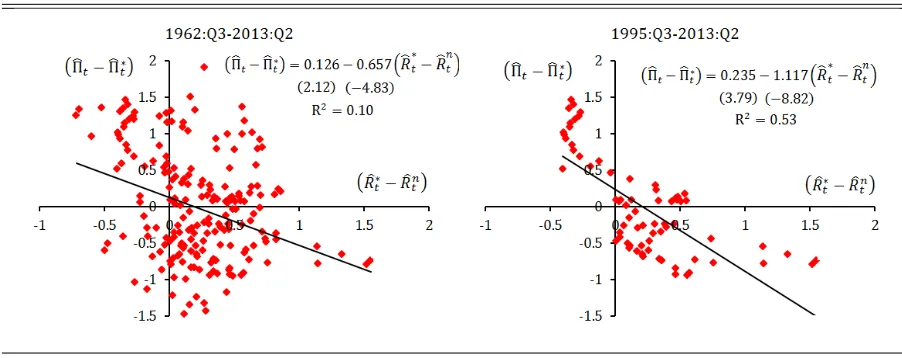
Scatter plot between the 2-quarter central moving average of (^t ^t) and (R^t R^ n t).
t-ratios in parentheses
^t is the estimated trend in‡ation and ^
t is the estimated target, and the
mismea-surement gap R^t R^n
t , whereR^t is the estimated intercept of the Taylor rule and
^
Rn
t is the estimated natural rate of interest.
This analysis reveals that the relationship is negative for the full sample as the
theoretical analysis predicts. However, if we divide the total sample into the speci…ed
periods detailed above, the results are not homogeneous. In the …nal period, which
is the largest one of the time intervals considered, the negative relationship is much
clearer than in the whole sample. These results lead us to think that, when
mone-tary policy was conducted through monemone-tary aggregates and the implicit or explicit
estimation of the natural rate of interest was not required, or monetary authorities
do not react against in‡ation deviations tightly enough, the mismeasurement gap
was not so relevant and was not so clearly transferred to the long-term in‡ation. So,
we can conclude that, with policies derived from Taylor rules whose priority is the
in‡ation stability, the natural rate of interest and its measurement become essential
for the monetary policy because measurement errors could in‡uence the long-term
equilibrium. These preliminary results seem to support this intuition and, therefore,
verify the negative relationship between the two gaps specially for the period in which
the Federal Reserve conducts monetary policy through in‡ation targeting rules which
4
Conclusions
In this paper, we analyze the long-run interactions of the U.S. unobservable
vari-ables included in the Taylor rules. Firstly, we look for the existence of nonlinearities
between the long-run growth rate, the trend in‡ation and …nancial frictions in the
long run. Through quadratic equations, we con…rm the existence of a hump-shaped
connection between the long-run growth rate and the trend in‡ation and a U-shaped
relationship between the latter and …nancial frictions. Then, by estimating a
quan-tile regression which distinguishes among levels of trend in‡ation, we corroborate
that hump-shaped connection if the trend in‡ation does not exceeds an upper
thresh-old. Moreover, especially for low and high levels of trend in‡ation, …nancial frictions
negatively a¤ect the long-run growth rate.
Furthermore, we approximate the gap between the real-time estimate and the
correct value of the natural rate of interest and study its e¤ects on the trend in‡ation
deviations from the target level. We prove that, for the whole sample, there is a
neg-ative relationship between the error in the estimation of the natural rate of interest
and the gap of the actual trend in‡ation and its target, as is concluded in the
theo-retical models developed in Olmos and Sanso (2014a,b). This negative relationship is
especially clear and signi…cant when monetary policy reacts aggressively against
in-‡ation deviations. In turn, deviations of the trend inin-‡ation from its target could also
a¤ect …nancial frictions and the long-run growth rate, since have been demonstrated
the interactions among these three key variables.
interest, the potential output and the trend in‡ation using U.S. data for the
1960:Q1-2013:Q2 period. Our procedure extends the methodology of Laubach and Williams
(2003), who implement the Kalman …lter to a semi-structural econometric model in
order to obtain the unobservable series, by including the trend in‡ation as a state
variable and …nancial frictions as an exogenous factor. The state estimates show
that the long-run growth rate and the natural rate of interest have experienced an
unprecedented decline during the …nancial crisis triggered in 2007, a pattern that is
not observed for the output gap. Meanwhile, the trend in‡ation has stabilized since
References
[1] Amano, R.; Moran, K; Murchison, S. and Rennison, A. (2009): "Trend
in‡a-tion, wage and price rigidities, and productivity growth," Journal of Monetary
Economics 56(3), pp. 353-364.
[2] Andrés, J.; López-Salido, D. and Nelson, E. (2009): "Money and the natural
rate of interest: Structural estimates for the United States and the euro area,"
Journal of Economic Dynamics and Control 33(3), pp. 758-776.
[3] Archibald, J. and Hunter, L. (2001): "What is the neutral real interest rate, and
how can we use it?,"Reserve Bank of New Zealand Bulletin 64(3), pp. 15-28.
[4] Bai, J. and Perron, P. (1998): "Estimating and testing linear models with
mul-tiple structural changes," Econometrica 66, pp. 47-78.
[5] Bai, J. and Perron, P. (2003): "Computation and analysis of multiple structural
change models," Journal of Applied Econometrics 18(1), pp. 1-22.
[6] Benati, L. and Vitale, G. (2007): "Joint estimation of the natural rate of interest,
the natural rate of unemployment, expected in‡ation, and potential output,"
Working Paper Series No. 0797, European Central Bank.
[7] Bjørnland, H. C.; Leitemo, K. and Maih, J. (2011): "Estimating the natural
rates in a simple New Keynesian framework," Empirical Economics 40(3), pp.
[8] Bouis, R.; Rawdanowicz, L.; Renne, J. P.; Watanabe, S. and Christensen, A.
K. (2013): "The e¤ectiveness of monetary policy since the onset of the
…nan-cial crisis," OECD Economics Department Working Papers No. 1081, OECD
Publishing.
[9] Brzoza-Brzezina, M. (2006): "The information content of the neutral rate of
interest," Economics of Transition 14(2), pp. 391-412.
[10] Crespo-Cuaresma, J.; Gnan, E. and Ritzberger-Gruenwald, D. (2004):
"Search-ing for the natural rate of interest: a euro area perspective,"Empirica 31(2-3),
pp. 185-204.
[11] Edge, R. M.; Laubach, T. and Williams, J. C. (2007): "Learning and shifts
in long-run productivity growth," Journal of Monetary Economics 54(8), pp.
2421-2438.
[12] Edge, R. M.; Kiley, M. T. and Laforte, J. P. (2008): "Natural rate measures in
an estimated DSGE model of the US economy,"Journal of Economic Dynamics
and Control 32(8), pp. 2512-2535.
[13] Garnier, J. and Wilhelmsen, B. R. (2009): "The natural rate of interest and the
output gap in the euro area: a joint estimation," Empirical Economics 36(2),
pp. 297-319.
[14] Giammarioli, N. and Valla, N. (2004): "The natural real interest rate and
[15] Hamilton, J. D. (1994): Time series analysis. Princeton: Princeton University
Press.
[16] Harvey, A. C. (1989): Forecasting, structural time series models and the Kalman
…lter. Cambridge: Cambridge University Press.
[17] Horváth, R. (2009): "The time-varying policy neutral rate in real-time: A
pre-dictor for future in‡ation?," Economic Modelling 26(1), pp. 71-81.
[18] Kalman, R. E. (1960): “A new approach to linear …ltering and prediction
prob-lems,” Journal of Basic Engineering 82(1), pp. 35-45.
[19] Larsen, J. D. and McKeown, J. (2003): "The informational content of empirical
measures of real interest rate and output gaps for the United Kingdom," in:
Bank for International Settlements Press and Communications (ed.), Monetary
policy in a changing environment, vol. 19, pp. 414-442.
[20] Laubach, T. and Williams, J. C. (2003): "Measuring the natural rate of interest,"
Review of Economics and Statistics 85(4), pp. 1063-1070.
[21] Leigh, D. (2008): "Estimating the Federal Reserve’s implicit in‡ation target: A
state space approach," Journal of Economic Dynamics and Control 32(6), pp.
2013-2030.
[22] Manrique, M. and Marqués, J. M. (2004): "Una aproximación empírica a la
evolución de la tasa natural de interés y el crecimiento potencial," Documento
[23] Mésonnier, J. S. and Renne, J. P. (2007): "A time-varying “natural”rate of
interest for the euro area," European Economic Review 51(7), pp. 1768-1784.
[24] Neiss, K. S. and Nelson, E. (2003): "The real-interest-rate gap as an in‡ation
indicator," Macroeconomic dynamics 7(02), pp. 239-262.
[25] Ö¼günç, F. and Batmaz, I. (2011): "Estimating the neutral real interest rate in
an emerging market economy,"Applied Economics 43(6), pp. 683-693.
[26] Olmos, L. and Sanso, M. (2014a) "Growth and Monetary Policy with Trend
In‡ation and Financial Frictions" MPRA Paper No. 54606, University Library
of Munich.
[27] Olmos, L. and Sanso, M. (2014b): "The Natural Rate of Interest with
Endoge-nous Growth, Financial Frictions and Trend In‡ation," mimeo
[28] Orphanides, A. and Van Norden, S. (2002): "The unreliability of output-gap
estimates in real time,"Review of Economics and Statistics 84(4), pp. 569-583.
[29] Orphanides, A. and Williams, J. C. (2002): "Robust monetary policy rules with
unknown natural rates,"Brookings Papers on Economic Activity 2002(2),
pp.63-145.
[30] Smets, F. and Wouters, R. (2003): "An estimated stochastic dynamic general
equilibrium model of the euro area," Journal of the European Economic
[31] Stock, J. (1994): “Unit roots, structural breaks and trends,” in: R. Engle and D.
McFadden (eds.),Handbook of Econometrics, vol. 4, pp. 2739-2841. Amsterdam:
Elsevier.
[32] Taylor, J. B. (1993): "Discretion versus Policy Rules in Practice," Carnegie
Rochester Conference Series on Public Policy 39, pp. 195-214.
[33] Trehan, B. and Wu, T. (2007): "Time-varying equilibrium real rates and
mon-etary policy analysis," Journal of Economic Dynamics and Control 31(5), pp.
1584-1609.
[34] Tristani, O. (2009): "Model misspeci…cation, the equilibrium natural interest
rate, and the equity premium," Journal of Money, Credit and Banking 41(7),
pp.1453-1479.
[35] Vitek, F. (2005): "An unobserved components model of the monetary
transmis-sion mechanism in a small open economy,"Macroeconomics0512019, EconWPA.
[36] Weber, A. A.; Lemke, W. and Worms, A. (2008): "How useful is the concept
of the natural real rate of interest for monetary policy?," Cambridge Journal of
A
1. State-space Form of the Model
To implement the Kalman …lter procedure, equations (1-6) have to be expressed in
the state-space form. This appendix describes the state-space model respecting the
notation in the main text.
The measurement equation describes how the observations are derived from the
internal state vectors:
2 6 4 yt t 3 7 5= 2 6 4
1 1 0 0 1
0 0 1 1 0
3 7 5 2 6 6 6 6 6 6 6 6 6 6 6 6 6 4 zt
zt 1
t t 1 gt 3 7 7 7 7 7 7 7 7 7 7 7 7 7 5 + 2 6 4 0 1 3 7
5 t 1+
2 6 4 0 "t 3 7 5 (A1.1)
where 1 is the …rst element of the (L)lag-polynomial. The representation of the
state equation indicates that the new state vector is modeled as a linear combination
of the previous state and an error process:
2 6 6 6 6 6 6 6 6 6 6 6 6 6 4 zt
zt 1
t t 1 gt 3 7 7 7 7 7 7 7 7 7 7 7 7 7 5 = 2 6 6 6 6 6 6 6 6 6 6 6 6 6 4 z 1 r 0
1 0 0
0 0
0 0 1
0 g {
3 7 7 7 7 7 7 7 7 7 7 7 7 7 5 2 6 6 6 6 6 4
zt 1
gt 1
t 1 3 7 7 7 7 7 5 + 2 6 6 6 6 6 6 6 6 6 6 6 6 6 4 r 0 0
0 0 0
0 0 1
0 0 0
0 0 3 7 7 7 7 7 7 7 7 7 7 7 7 7 5 2 6 6 6 6 6 4
Rt 1
ft t 3 7 7 7 7 7 5 + 2 6 6 6 6 6 6 6 6 6 6 6 6 6 4 r ( @ %) 0 0 0
@(1 g) 3 7 7 7 7 7 7 7 7 7 7 7 7 7 5 + 2 6 6 6 6 6 6 6 6 6 6 6 6 6 4 "z t 0 "t 0
A
2. The Kalman Filter
The Kalman …lter is a semi-structural method to estimate unobserved variables. It is
a suitable procedure because it provides a Minimum Mean Squared Error estimator
if the observed variables and the noises are jointly Gaussian. To show the operation
of the …lter, let us de…ne ot as an n 1 vector, where ot is an observable variable.
This time series is a function of an m 1 vector, ut, whose value and variance are
unobservable. In order to simulate the latent variable, we have to specify a model as
follows:
ot= 1;t+ 2;tut+"wt (A2.1)
ut+1 = 3;t+ 4;tut+"xt (A2.2)
where i;t are vectors and"ot; "ut are vectors of Gaussian noises. The …rst equation
(A2.1) is the measurement or observation equation whilst equation (A2.2) is the state
or transition equation. Disturbance errors "o
t; "ut are serially independent, with the
following variance structure:
t =var
"o t "u t
=
2
6 4
Ht Jt
Jt0 Bt 3
7
5 (9)
where Ht is an n n symmetric variance matrix, Bt is an m m symmetric
The smoothing procedure generates the estimates of the state variables u^t
ET (ut) with variance Vtu varT (ut) and estimates of the signal variables o^t
E(ot ju^t) = 1;t+ 2;tu^t. The one-step ahead prediction error is"ot ="otjt 1 ot otjt 1
and the prediction error variance is Vo
t = Vtojt 1 var "
o
tjt 1 = 2;tPtojt 1
0
2;t+Ht,
where Po
tjt 1 is the mean square error of the one-step ahead mean.
The Kalman …lter updates the one-step ahead estimate of the state mean and
variance with new information and computes the one-step ahead estimates of the
state and the associated mean square error matrix, the contemporaneous or …ltered
state mean and variance and the one-step ahead prediction, prediction error and