ISSN Online: 2165-3925 ISSN Print: 2165-3917
Color Visual Cryptography with Stacking Order
Dependence Using Interference Color
Toshiki Matsuzaki, Huangyi Qin, Kenji Harada
Department of Computer Science, Kitami Institute of Technology, Kitami, Japan
Abstract
Visual cryptography is an encryption method that shares a secret image through several encrypted images. General visual cryptography has no stack-ing order dependence, and only one image can be decoded regardless of stacking order of encrypted images. We previously reported a color visual cryptography using interference color (or polarization color) of retarder films. The interference color changes depending on the stacking order of retarder films. In this paper, we propose and develop a color visual cryptography that displays two images by changing stacking order of retarder films.
Keywords
Visual Cryptography, Polarizer, Interference Color, Birefringent Material
1. Introduction
In recent years, various optical encryption methods and devices have been pro-posed for information security [1]-[7]. Visual cryptography is an encryption method that shares a secret image through several encrypted images. The basic algorithm of visual cryptography was reported by Naor and Shamir [8] and Kafri and Keren [9]. This algorithm is considered to be very effective for encrypting image because it is impossible to estimate or determine the secret image from each separated key image. In conventional visual cryptography, each key image (share) is a random distribution of black-and-white subpixels. By copying shares to transparencies and stacking them, the secret image can be observed.
Many types of visual cryptography have been proposed [8]-[17]. Conventional visual cryptography is based on spatial coding that requires multiple subpixels to modulate light intensity. Therefore, image quality of the decoded image is re-duced. This problem is more serious in visual cryptography for color images. How to cite this paper:Matsuzaki, T., Qin,
H.Y. and Harad, K. (2017)Color Visual Cry- ptography with Stacking Order Dependence Using Interference Color. Open Journal of Applied Sciences, 7, 329-336.
https://doi.org/10.4236/ojapps.2017.77026
Received: May 24, 2017 Accepted: June 30, 2017 Published: July 3, 2017
Copyright © 2017 by authors and Scientific Research Publishing Inc. This work is licensed under the Creative Commons Attribution International License (CC BY 4.0).
http://creativecommons.org/licenses/by/4.0/
pixel in a secret image into a corresponding single pixel in shares [17] [18]. A visual encryption device using high-order retarder films was also reported by Kowa et al. [17]. These techniques enable the display of only a black-and-white binary image. Improved visual cryptography for gray-level images was reported by Blundo et al. [18]. We previously reported a color visual cryptography using high-order retarder films [19] [20]. This visual cryptography method has no stacking order dependence. A polarization encoding technique with stacking order dependence is reported by Imagawa et al. [21], but the decoded image can only be displayed as a gray-level image. In this paper, we propose a color visual cryptography device with stacking order dependence using interference color of high-order retarder films. Proposed visual cryptography does not reduce image quality of decoded images as the conventional polarization encoding technique. Also, it is possible to display two images in color that has been impossible in conventional polarization encoding technique. We describe the principles of the interference color display with stacking order dependence using polarization films in Section 2. In Section 3, we describe the design of the visual cryptography method with stacking order dependence.
2. Principles of Interference Color Display with Stacking
Order Dependence
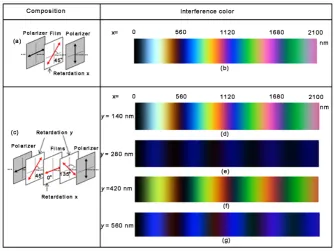
Figure 1. Optical composition and interference color. (a) General optical composition for displaying interference color; (b) Interference color chart of a general optical composi-tion; (c) Proposed optical composition for displaying interference color; (d) Interference color chart of the proposed optical composition when the retardation y is 140 nm; (e) In-terference color chart of the proposed optical composition when the retardation y is 280 nm; (f) Interference color chart of the proposed optical composition when the retardation y is 420 nm; (g) Interference color chart of the proposed optical composition when the retardation y is 560 nm.
(a)
[image:4.595.277.473.70.326.2](b)
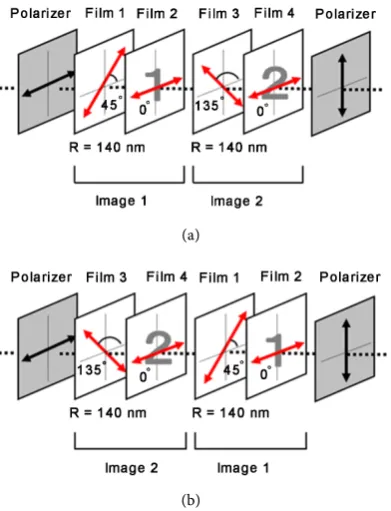
Figure 2. Composition of the interference color image with stacking order dependence. (a) Image 1 and 2; (b) Image 2 and 1.
Films 1 and 3 were fabricated using a λ/4 retarder film. The slow axes of these retarder films are set to 45˚, and 135˚, respectively. Film 2 and film 4 were fabri-cated by stacking retarder films. The slow axes of these retarder films were set to 0˚ and 90˚, respectively. The slow axes of 90˚ were used to compensate for the film retardation. The total phase retardations of the colors used in these images are 0, 140, 280, 420, 560, 840, and 1260 nm. A white backlight (KLV-7000, Ha-kuba) was used to view the image. Figure 3(a) and Figure 3(b) show the polari-zation color image with stacking order dependence.
3. Design of Visual Cryptography with Stacking Order
Dependence
(a) (b)
Figure 3. Polarization color image with stacking order dependence. (a) Image 1 and 2; (b) Image 2 and 1.
(a)
(b)
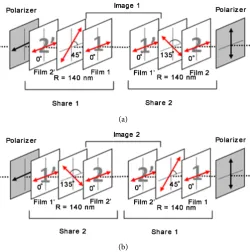
Figure 4. Composition of the polarization color visual cryptography with stacking order dependence. (a) Share 1 and 2; (b) Share 2 and 1.
Figure 4(a), the interference color changes according to the additional retarda-tion of films 1 and 1', as shown in Figure 1(d). No interference color changes by changing the retardation of films 2 and 2'. By changing the stacking order, as shown in Figure 4(b), the interference color changes according to the additional retardation of films 2 and 2' as shown in Figure 1(d). No interference color changes by changing the retardation of films 1 and 1'.
[image:5.595.249.500.253.506.2]interfe-(b)
(c)
(d)
Figure 5. Model of polarization color visual cryptography with stacking order depen-dence. (a) Phase retardation and interference color of film 1; (b) Phase retardation and interference color of film 1'; (c) Phase retardation and interference color of film 2; (d) Phase retardation and interference color of film 2'.
[image:6.595.208.539.67.447.2](a) (b)
[image:7.595.209.540.72.257.2](c) (d)
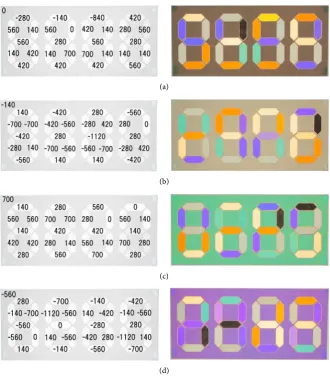
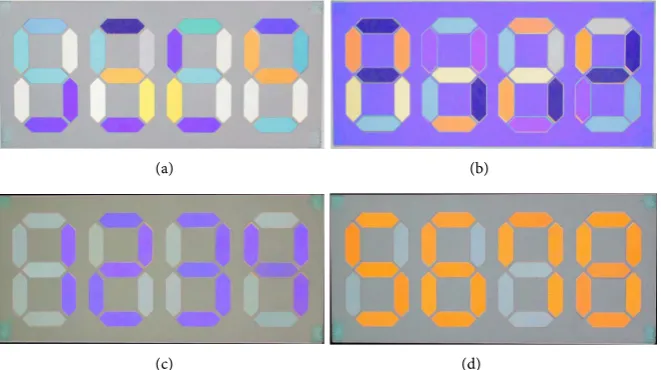
Figure 6. Polarization color visual cryptography with stacking order dependence. (a) Share 1; (b) Share 2; (c) Decoded image 1; (d) Decoded image 2.
shown in Figure 4(b), the interference color changes because of the additional retardation of films 2 and 2', as shown in Figure 6(d). The orange secret number “5678” is observed.
4. Conclusion
We produced a color visual encryption technique in which the display image changes depending to the stacking order of encrypted images. We calculated the interference color of the conventional and proposed method. A prototype of a color visual cryptography device with stacking order dependence using interfe-rence color was developed. We need no special optical systems to observe porta-ble encrypted images. This technique is very simple and can be applied in secu-rity and entertainment.
References
[1] Fukushima, S., Kurokawa, T. and Sakai, Y. (1991) Image Encipherment Based on Optical Parallel Processing Using Spatial Light Modulators. IEEE Photonics Tech-nology Letters, 3, 1133-1135. https://doi.org/10.1109/68.118031
[2] Javidi, B. and Horner, J.L. (1994) Optical Pattern Recognition for Validation and Security Verification. Optical Engineering, 33, 1752-1756.
https://doi.org/10.1117/12.170736
[3] Refregier, P. and Javidi, B. (1995) Optical Image Encryption Based on Input Plane and Fourier Plane Random Encoding. Optics Letters, 20, 767-769.
https://doi.org/10.1364/OL.20.000767
[4] Hayasaki, Y., Matsuba, Y., Nagaoka, A., Yamamoto, H. and Nishida, N. (2004) Hiding an Image with a Light-Scattering Medium and Use of a Contrast-Discrimination Method for Readout. Applied Optics, 43, 1552-1558.
https://doi.org/10.1364/AO.43.001552
[9] Kafri, O. and Keren, E. (1987) Encryption of Pictures and Shapes by Random Grids.
Optics Letters, 12, 377-379. https://doi.org/10.1364/OL.12.000377
[10] Shogenji, R. and Ohtsubo, J. (2009) Hiding Information Using a Checkered Pattern.
Optical Review, 16, 517-520. https://doi.org/10.1007/s10043-009-0101-9
[11] Machizaud, J., Chavel, P. and Fournel, T. (2011) Fourier-Based Automatic Alignment for Improved Visual Cryptography Schemes. Optics Express, 19, 22709-22722.
https://doi.org/10.1364/OE.19.022709
[12] Yamamoto, H., Hayasaki, Y. and Nishida, N. (2003) Securing Information Display by Use of Visual Cryptography. Optics Letters, 28, 1564-1566.
https://doi.org/10.1364/OL.28.001564
[13] Yamamoto, H., Hayasaki, Y. and Nishida, N. (2004) Secure Information Display with Limited Viewing Zone by Use of Multi-Color Visual Cryptography. Optics Express, 12, 1258-1270. https://doi.org/10.1364/OPEX.12.001258
[14] Koga, H., Iwamoto, M. and Yamamoto, H. (2001) An Analytic Construction of the Visual Secret Sharing Scheme for Color Images. IEICE Transactions on Fundamen-tals of Electronics Communications and Computer Sciences, E84-A, 262-272. [15] Hou, Y.C. (2003) Visual Cryptography for Color Images. Pattern Recognition, 36,
1619-1629. https://doi.org/10.1016/S0031-3203(02)00258-3
[16] Cimato, S., De Prisco, R. and De Santis, A. (2007) Colored Visual Cryptography without Color Darkening. Theoretical Computer Science, 374, 261-276.
https://doi.org/10.1016/j.tcs.2007.01.006
[17] Kowa, H., Murana, T., Iwami, K., Umeda, N., Tsukiji, M. and Takayanagi, A. (2011) Development of a Visual Encryption Device Using Higher-Order Birefringence.
Proceedings of Society of Photo-Optical Instrumentation Engineers, SPIE, San Di-ego, p 8.
[18] Blundo, C., De Santis, A. and Naor, M. (2000) Visual Cryptography for Grey Level Images.Information Processing Letters, 75, 255-259.
https://doi.org/10.1016/S0020-0190(00)00108-3
[19] Harada, K., Yamaguchi, T., Tsuchida, T. and Sakai, D. (2013) Visual Cryptography Using Interference Color of High-Order Retarder Films.Japanese Journal of Ap-plied Physics, 52, 6R. https://doi.org/10.7567/JJAP.52.062501
[20] Sugawara, S., Harada, K. and Sakai, D. (2013) High-Chroma Visual Cryptography Using Interference Color of High-Order Retarder Films. Optical Review, 22, 544- 552. https://doi.org/10.1007/s10043-015-0095-4
Submit or recommend next manuscript to SCIRP and we will provide best service for you:
Accepting pre-submission inquiries through Email, Facebook, LinkedIn, Twitter, etc. A wide selection of journals (inclusive of 9 subjects, more than 200 journals)
Providing 24-hour high-quality service User-friendly online submission system Fair and swift peer-review system
Efficient typesetting and proofreading procedure
Display of the result of downloads and visits, as well as the number of cited articles Maximum dissemination of your research work
Submit your manuscript at: http://papersubmission.scirp.org/