Synthesis, structures, and properties of two new
binuclear complexes based on carboxyl-substituted
nitronyl nitroxide: [M
2
(NITpBA)
4
(H
2
O)
2
] (M = Zn and Cu)
Jing Chen1,2*, You-Juan Zhang1, Kun-Tao Huang2, Qiang Huang2, Jun-Jie Wang1
1College of Chemistry and Chemical Engineering, Anyang Normal University, Anyang, China 2School of Chemical Engineering and Energy, Zhengzhou University,Zhengzhou, China
Email:*[email protected]
Received 13 March 2013; revised 14 April 2013; accepted 23 April 2013
Copyright © 2013 Jing Chen et al. This is an open access article distributed under the Creative Commons Attribution License, which permits unrestricted use, distribution, and reproduction in any medium, provided the original work is properly cited.
ABSTRACT
Two new binuclear complexes,
[M2(μ-NITpBA)4(H2O)2] (M = Zn 1 and Cu 2) [where NIpBA = 2-(4-carboxyl-phenyl)-4,4,5,5-tetramethyl-4,5- dihydro-1H-imidazol-1-oxyl-3-oxide], were stylized and characterized. Magnetic susceptibility measurements revealed antiferromagnetic exchange interactions in the two complexes.
Keywords:Binuclear Complex; Carboxyl-Substituted;
Nitronyl Nitroxide; Antiferromagnetic Exchange
1. INTRODUCTION
The past decade has triggered fast-growing interests in nitronyl nitroxide radicals (NITR) as building blocks in the engineering of molecular-based magnet. The reasons are mainly that they are the most stable paramagnetic ligands, even in combination with metal ions where they can also act as bridging ligands [1]. Carboxylate bridges mediate exchange interactions between coordinated metal centres [2,3]. Metal complexes with bridging car- boxylates as well as stable organic radical ligands are of considerable interest to the field of molecular magnetism [4]. In an effort to bring together the two areas of re- search, carboxyl-substituted nitronyl nitroxide, as an important anionic ligand, was deemed favorable for the realization in reactions with metal ions. To the best of our knowledge, to prepare transition metal complexes with nitronyl nitroxide-substituted carboxylate ligands, many investigations on the scope have been recently performed, but the related reports are very scarce [5,6]. The only structurally characterized transition metal compounds are 1D-chain systems in which two nitronyl
nitroxides NITpBA− are coordinated with two metal cen- ters via one NO-group and a monodentate carboxylate group [7,8]. Miller’s group even reported on copper (II) compounds with NITpBA− assumed to be in a bidentate- bridging mode, but did not provide structural information on the related radical-metal compounds [9]. Rentschle’s group examined the reaction of NITpBAH with different metal salts, bases, and terminal capping coligands fol- lowing with various methods but could not isolate any di- meric compounds. Ligand exchange reaction of NITpBAH with copper (II) acetate hydrate, however, leads to the de- sired system. Recrystallization from hot dimethylsulfox- ide/methanol (2:1) leads to formation of small green-blue crystals Cu2(μ-NITpBA)4/H2O/dmso [10].
With the purpose of obtaining materials with unusual molecular high nuclearity spin clusters, we were inter- ested in the preparation of carboxylate-bridged metal complexes with pendant organic radical substituents. In this paper, we present the simple synthesis and properties of two new metal–radical binuclear complexes [M2(μ-
NITpBA)4(H2O)2] (M = Zn 1 and Cu 2).
2. EXPERIMENTAL
2.1. General
All reagents used in the synthesis were of analytical grade without further purification. 2-(4-carboxyl-phenyl)- 4,4,5,5-tetramethyl-4,5-dihydro-1H-imidazol-1-oxyl-3-o xide was prepared by the literature method [11]. Ele- mental analyses (C, H, and N) were carried out with a Perkin Elmer 240 C elemental analyzer. IR spectra were recorded from 400 to 4000 cm−1 on an Avatar-360 spec-
trophotometer using KBr pellets. Variable-temperature magnetic susceptibilities were measured with a MPMS- 7SQUID magnetometer at a magnetic field of 2000 G. Diamagnetic corrections were made with Pascal’s con-
stants for all constituent atoms.
2.2. Synthesis of [M2(μ-NITpBA)4(H2O)2]
(M = Zn 1 and Cu 2)
2.2.1. [Zn2(μ-NITpBA)4(H2O)2] 1
NITpBAH (0.4 mmol, 0.1076 g) was dissolved in 4 mL 0.2 M NaOH. The complex 1 was synthesized by the addition of NITpBA− and ZnCl
2 (0.2 mmol, 0.0275 g) to
30 mL of methanol-water. The mixture was stirred for 2 h and then filtered. The resulting blue filtrate was kept at room temperature for slow evaporation. After a few days, dark blue crystals of compound 1 suitable for X-ray analysis were obtained. Anal. Found: C, 53.12; H, 5.30; N, 8.61% Cacl. for C56 H68 N8 O18 Zn2 (1): C, 52.83; H, 5.39; N, 8.81%. IR (KBr disk): 1612 cm−1 (
asCOO
v ),
1413 cm−1 ( ), 1355 cm−1 (NO).
sCOO
v
2.2.2. [Cu2(μ-NITpBA)4(H2O)2] 2
The complex 2 was prepared in a procedure similar to complex 1 except that ZnCl2 was replaced by CuCl2 Dark
blue crystals were obtained expectedly. Anal. Found: C,
52.53; H, 5.16; N, 8.74% Cacl. for C56 H68 N8 O18 Cu2 (2): C, 52.98; H, 5.40; N, 8.83%. IR (KBr disk): 1610 cm−1 (
asCOO
v ), 1407 cm−1 ( ), 1350 cm−1
(NO). s
COO
v
2.2.3. X-Ray Data Collection and Structure Determination
X-ray diffraction intensities were collected on a Bruker Smart CCD diffractometer equipped with a graphite- monochromated Mo Κα radiation ( = 0.71073 Å) by using a ω - φ scan technique at room temperature. Absor ption correction were applied using SADABS program [12]. The structures were solved by direct methods with SHELXS-97 program [13] and refined with SHELXS- 97[14] by full matrix least-squares technique on F2. All
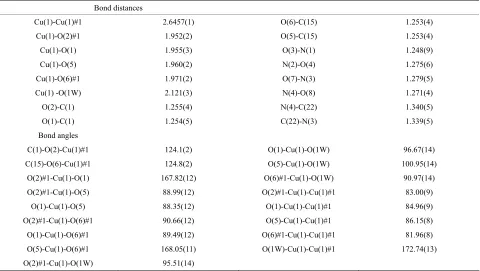
the non-hydrogen atoms were refined with anisotropic temperature para-meters. Hydrogen atoms of organic ligands were fixed in ideal positions. The relevant parameters of the crystal structures for complex 1 and 2 are listed in Table 1, and the selected bond lengths and
ond angles are given in Tables 2 and 3, respectively.
b
Table 1. Crystal data and structure refinement for the two complexes 1 and 2.
1 2
Formula C56 H68 N8 O18 Zn2 C56 H68 N8 O18 Cu2
Formula weight 1271.92 1268.26
Crystal system Monoclinic Monoclinic
Space group P2(1)/c P2(1)/c
Unit cell dimensions (Å, ˚)
a 10.415(2) 10.392(2)
b 12.770(3) 12.650(3)
c 22.987(5) 23.116(5)
98.02(3) 97.85(3)
Volume (Å3), Z 3027.3(11), 2 3010.5(10), 2
F(000) 1328 1324
range for data collection (˚) 1.83 to 28.40 1.84 to 28.40
Limiting indices
−13 h 13
−15 k 16
−30 l 30
−13 h 13
−16 k 16
−30 l 30
Reflections collected 51,237 52,552
Independent reflections 7419 [R(int) = 0.1174] 7505 [R(int) = 0.0545]
Completeness (%) 97.9 99.3
Goodness-of-fit on F2 1.021 1.014
Final R indices (I 2(I)) R1 = 0.0771, wR2 = 0.1852 R1 = 0.0594, wR2 = 0.1582
Table 2. Selected bond distances (Å) and angles (˚) for the complex 1.
Bond distances
Zn(1)-Zn(1)#1 2.9672(12) O(6)-C(15) 1.254(6)
Zn(1)-O(1W) 1.964(4) N(1)-O(3) 1.275(7)
Zn(1)-O(2)#1 2.025(3) N(2)-O(4) 1.298(16) Zn(1)-O(5) 2.025(4) O(8)-N(4) 1.288(5)
Zn(1)-O(1) 2.030(4) O(7)-N(3) 1.276(6) Zn(1)-O(6)#1 2.035(4) N(4)-C(22) 1.340(6)
O(1)-C(1) 1.246(7) C(22)-N(3) 1.354(6)
O(2)-C(1) 1.249(6) N(1)-C(8) 1.233(8)
O(5)-C(15) 1.244(6) C(8)-N(2) 1.447(13)
Bond angles
C(1)-O(2)-Zn(1)#1 130.0(4) O(2)#1-Zn(1)-O(6)#1 90.03(16)
C(15)-O(6)-Zn(1)#1 132.3(3) O(5)-Zn(1)-O(6)#1 158.99(16)
O(1W)-Zn(1)-O(2)#1 100.2(2) O(1)-Zn(1)-O(6)#1 87.75(17)
O(1W)-Zn(1)-O(5) 104.5(2) O(1W)-Zn(1)-Zn(1)#1 171.23(17)
O(2)#1-Zn(1)-O(5) 87.60(16) O(2)#1-Zn(1)-Zn(1)#1 77.48(12)
O(1W)-Zn(1)-O(1) 101.2(2) O(5)-Zn(1)-Zn(1)#1 83.94(11)
O(2)#1-Zn(1)-O(1) 158.59(17) O(1)-Zn(1)-Zn(1)#1 81.38(13)
O(5)-Zn(1)-O(1) 86.91(16) O(6)#1-Zn(1)-Zn(1)#1 75.16(11)
O(1W)-Zn(1)-O(6)#1 96.5(2) C(1)-O(1)-Zn(1) 124.4(4)
Symmetry codes: #1: x + 1, y, z + 2.
Table 3. Selected bond distances (Å) and angles (˚) for the complex 2.
Bond distances
Cu(1)-Cu(1)#1 2.6457(1) O(6)-C(15) 1.253(4) Cu(1)-O(2)#1 1.952(2) O(5)-C(15) 1.253(4)
Cu(1)-O(1) 1.955(3) O(3)-N(1) 1.248(9) Cu(1)-O(5) 1.960(2) N(2)-O(4) 1.275(6)
Cu(1)-O(6)#1 1.971(2) O(7)-N(3) 1.279(5)
Cu(1) -O(1W) 2.121(3) N(4)-O(8) 1.271(4)
O(2)-C(1) 1.255(4) N(4)-C(22) 1.340(5)
O(1)-C(1) 1.254(5) C(22)-N(3) 1.339(5)
Bond angles
C(1)-O(2)-Cu(1)#1 124.1(2) O(1)-Cu(1)-O(1W) 96.67(14) C(15)-O(6)-Cu(1)#1 124.8(2) O(5)-Cu(1)-O(1W) 100.95(14)
O(2)#1-Cu(1)-O(1) 167.82(12) O(6)#1-Cu(1)-O(1W) 90.97(14)
O(2)#1-Cu(1)-O(5) 88.99(12) O(2)#1-Cu(1)-Cu(1)#1 83.00(9)
O(1)-Cu(1)-O(5) 88.35(12) O(1)-Cu(1)-Cu(1)#1 84.96(9)
O(2)#1-Cu(1)-O(6)#1 90.66(12) O(5)-Cu(1)-Cu(1)#1 86.15(8)
O(1)-Cu(1)-O(6)#1 89.49(12) O(6)#1-Cu(1)-Cu(1)#1 81.96(8)
O(5)-Cu(1)-O(6)#1 168.05(11) O(1W)-Cu(1)-Cu(1)#1 172.74(13)
O(2)#1-Cu(1)-O(1W) 95.51(14)
[image:3.595.59.539.451.722.2]3. RESULTS AND DISCUSSION
3.1. Description of Crystal Structures
Crystal analysis show that compounds 1 and 2 are iso structural. They crystallize in the monoclinic system,
P21/c (No.14) space group, which are different from that
lecture [10] (triclinic system, space group P1). The
asymmetric unit consists of one-half of a dimeric metal ion bridged by O-carboxyl from four nitronyl nitroxide. The two halves are related to each other through a center of inversion located in the middle of the M-M axis. The coordination geometry of Zn (II) and Cu (II) lies at the center of the distorted octahedral geometry formed by five oxygen atoms, which come from four equivalent nitroxide ligand, one water molecule, and the M-M dis- tances of the neighboring metal atoms is [Zn1-Zn1(A) 2.9672 Å and Cu1-Cu1(A) 2.6457Å], which is rather short and may be regarded as the normal M-M bonding range[15,16]. Their molecular structures are depicted in
Figures1 and 2, respectively. Figure 1. View of the moiety of the complex 1
[Zn2(NITpBA)4(H2O)2]. All hydrogen atoms are omitted for
clarity.
In complex 1, the C1-O1 and C1-O2 bonds from the same carboxylate group are equal to 1.246 and 1.249 Å, respectively, whereas the distance of C15-O5 and C15- O6 are of 1.244 and 1.254 Å, respectively. The Ph-COO bonds of 1.5093 Å are close to that reported in the litera- ture [11]. The C-C bond lengths of the phenyl rings show no alternation and are located in the aromatic re- gion ranging from 1.361 to 1.394 Å. The Zn-Owater dis-
tance of 1.964 Å is shorter than that of Zn-O whose oxy- gen atoms are from Ph-COO−. Four oxygen atoms from Ph-COO− of the nitroxide ligand compose the equatorial plane. The O5-Zn1-O6A angle in the equatorial plane is 158.99˚, and the O1-Zn1-O2A angle is equal to 158.59˚. The O1W-Zn1-Zn1A angle in the axial position is 171.23˚. The Zn (II) center is displaced by 0.324 Å from the basal O4-plane toward the axial oxygen atom from H2O. The fragment O4-N2-C8-N1-O3 is non-planar, and
it forms a dihedral angle of 65.1˚ with the plane of the phenyl ring (C6-C5-C4). Conversely, the fragment O8- N4-C22-N3-O7 is nearly planar and forms a dihedral angle of 35.1˚ with the plane of the phenyl ring (C19- C18-C20). The IR spectrum shows the N-O stretching vibration of the NITpBA at 1355 cm−1 as well as the
antisymmetric vasCOO and the symmetric s
vCOO
stretching mode of the caroxyl group at 1612 and 1413 cm−1, respectively, in accordance with a bidentate-
bridging mode [10,17,18].
Figure 2. View of the moiety of the complex 2
[Cu2(NITpBA)4(H2O)2]. All hydrogen atoms are omitted for
clarity.
is 0.0009 Å. The fragment O4-N2-C8-N1-O3 is non- planar, where the mean deviation from the plane is 0.0676 Å, and forms a dihedral angle of 86.1˚ with the plane of the phenyl ring (C4-C5-C6). The fragment O8-N4-C22-N3-O7 is nearly planar, and the plane for ms a dihedral angle of 36.4˚ with the phenyl ring (C19-C18-C20). The product shows IR absorptions at 13 50, 1407 and 1610 cm−1, respectively.
In complex 2, the Cu1-Cu1A distance is 2.6457 Å,
which is a typical value for dimeric copper (II) carboxy- late adducts [19,20]. The Cu-Owater distance of 2.121 Å is
longer than that of Cu-O whose oxygen atoms come from Ph-COO−. The Cu (II) core is displaced by 0.205 Å from the basal O4-plane toward the axial oxygen atom of the solvent. Mean deviation from base O4-plan
3.2. Magnetic Properties
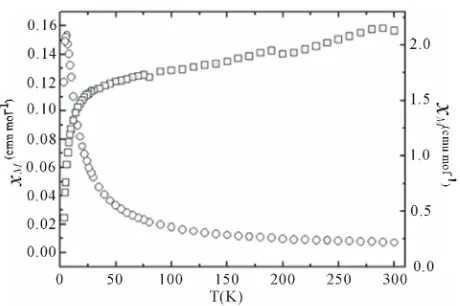
[image:4.595.310.540.357.549.2]χMT and χM for complex 1 and 2in order to analyze the
exchange coupling in this six-spin system. Temperature dependences of the molar magnetic susceptibility for two complexes were measured in a temperature range of 2 K to 300 K at a magnetic field of 2000 G. The results are given in Figures3 and 4, respectively.
For complex 1, the χMT at room temperature has a
value of 1.535 emu·K·mol−1, which is close to the
ex-pected value for uncoupled spins of S = 4/2 (1.5 emu· K·mol−1) for two zinc centers and four nitronyl nitroxide
radical-ligands. It was regarded as a tetra-radical system to evaluate the exchange coupling constants. The χMT
value decreases slowly and reaches 1.43 emu·K·mol−1 at
[image:5.595.57.287.550.703.2]100 K as the temperature is lowered, and subsequently decreases rapidly during further lowering of temperature. Based on the structural results, it undergoes a major magnetic interaction in the present system, in which the exchange interaction of NITpBA radicals through Zn (II) core exists [21]. The result indicates that a weak anti- ferromagnetic exchange interaction is predominant, which is agreement with literatures [22,23].
Figure 3. Temperature dependece of χM (○) and χMT () vs T for the complex 1
Figure 4. Temperature dependece of χM (○) and χMT () vs T for the complex 2
For complex 2, the χMT value at room temperature is
2.14 emu·K·mol−1, which is significantly lower than that
of the expected value for six uncoupled spins of S = 1/2 (2.25 emu·K·mol−1) for two copper centers and four
ni-tronyl nitroxide. The result indicates that a strong anti-ferromagnetic exchange interaction is predominant. The result is in accord with those reported [10,24].
4. CONCLUSION
Two new binuclear complexes formulae of [M2(μ-
NITpBA)4(H2O)2] (M = Zn 1 and Cu 2) [where NITpBA
=2-(4-carboxyl-phenyl)-4,4,5,5-tetramethyl-4,5-dihydro- 1H-imidazol-1-oxyl-3-oxide)] were synthesized and structurally characterized. The simple procedure of the NITpBAH with metal chloride yielded dimeric complex- es 1 and 2. The temperature dependences of the mag- netic susceptibility show dominant itram-olecular anti- ferromagnetic exchange interaction in complexes 1 and 2. According to the result of the complex 1, it demon- strates that the magnitude of the intramolecular magnetic exchange has little relationship with the crystal system and space group.
5. ACKNOWLEDGEMENTS
This work was supported by the National Natural Sci- ence Foundation of China (No. 21071006), the Natural Science Foundation of Henan Province (No. 102102 210457) and the Natural Science Foundation of the Henan Higher Education Institutions of China (No. 2010 B150001).
REFERENCES
[1] Caneschi, A., Gatteschi, D., Sessoli, R. and Rey, P. (1989) Toward molecular magnets:The metal-radical approach.
Accounts of Chemical Research, 22, 392-398.
doi:10.1021/ar00167a004
[2] Boskovic, C., Pink, M., Huffman, J.C., Hendrickson, D.N. and Christou, G. (2001) Single-molecule magnets: Ligand-induced core distortion and multiple Jahn-Teller isomerism in [Mn12O12(O2CMe)8(O2PPh2) 8(H2O)4].
Journal of the American Chemical Society, 123, 9914- 9915. doi:10.1021/ja016341+
[3] Aubin, S.M.J., Sun, Z., Eppley, H.J., Rumberger, E.M., Guzei, I.A., Folting, K., Gantzel, P.K., Rheingold, A.L., Christou, G. and Hendrickson, D.N. (2001) Single-mole- cule magnets: Jahn-Teller isomerism and the origin of two magnetization relaxation processes in Mn12 com- plexes. Inorganic Chemistry, 40, 2127-2146.
doi:10.1021/ic000911+
Chemical Physics Letters, 207, 551-554.
doi:10.1016/0009-2614(93)89046-K
[6] Ballester, G., Coronado, E., Galán-Mascarós, J.R., Gi- ménez-Saiz, C., Nuez, A. and Romero, F.M. (2001) A new approach for the synthesis of magnetic materials bas- ed on nitroxide free radicals and inorganic coordination polymers. Polyhedron, 20, 1659-1662.
[7] Schiødt, N.C., Fabrizi de Biani, F., Caneschi, A. and Gatteschi, D. (1996) Structure and magnetism of nickel (II) and manganese (II) complexes of a nitronyl nitroxide carboxylic acid. Inorganica Chimica Acta, 248, 139-146.
doi:10.1016/0020-1693(95)04996-7
[8] Zhao, Q.H., Li, L.C., Jiang, Z.H., Liao, D.Z., Yan, S.P. and Fang, R.B. (2004) Synthesis and structure of a novel one-dimensional chain compound formed by copper (II) and nitronyl nitroxide radical. Journal of Chemical Crys- tallography,34, 191-193.
doi:10.1023/B:JOCC.0000021563.00957.85
[9] Del Sesto, R.E., Arif, A.M. and Miller, J.S. (2000)Cop- per (II) benzoate nitroxide dimers and chains: Structure and magnetic studies. Inorganic Chemistry, 39, 4894- 4902. doi:10.1021/ic0007106
[10] Schatzschneider, U., Weyhermüller, T. and Rentschler, E. (2002) Copper complexes with mono- and bidentate- bridging nitronyl nitroxide-substituted benzoate ligands.
Inorganica Chimica Acta, 337, 122-130.
doi:10.1016/S0020-1693(02)01103-9
[11] Bätz, C., Amann, P., Deiseroth, H.J. and Dulog, L.(1994) Die oxidation zweier neuer 1,3-dihydroxyimidazolidine- darstellung und Struktur von Nitronylnitroxid-Radikalen.
Liebigs Annalen der Chemie, 7, 739-740.
doi:10.1002/jlac.199419940715
[12] Sheldrick, G.M. (1997) SHELXS97, program for the so- lution of crystal structure. University of Göttingen, Göt- tingen.
[13] Sheldrick, G.M. (1997) SHELXS97, program for the re- finement of crystal structure. University of Göttingen, Göttingen.
[14] Sheldrick, G.M. (1996) SADABS. University of Göttin- gen, Göttingen.
[15] Ohmura, T., Mori, W., Takei, T., Ikeda, T. and Maeda, A. (2005) Structure and magnetic behaviour of mononuclear and dinuclear Cu (II)/Zn (II) monocarboxylate-pyridine derivatives studied by crystal engineering. Materials
Science-Poland, 23, 729-732.
[16] Chui, S.S.Y.S., Lo, M.F., Chammant, J.P.H., Orpen, A.G. and Williams, I.D. (1999) A chemically functionalizable nanoporous material [Cu3(TMA)2(H2O)3]n. Science, 283,
1148-1150. doi:10.1126/science.283.5405.1148
[17] Deacon, G.B. and Phillips, R.J. (1980) Relationships be- tween the carbon-oxygen stretching frequencies of car-boxylato complexes and the type of carboxylate coordi- nation. Coordination Chemistry Reviews, 33, 227-250.
doi:10.1016/S0010-8545(00)80455-5
[18] Alcock, N.W., Tracy, V.M. and Waddington, T.C. (1976) Acetates and acetato-complexes. Part 2. Spectroscopic studies. Journal of the Chemical Society, Dalton Trans-actions, 21, 2243-2245. doi:10.1039/dt9760002243 [19] Lewis, J., Lin, Y., Royston, L. and Thompson, R. (1965)
The chemistry of polynuclear compounds. Part III. Magnetic properties of some carboxylic acid derivatives of copper (II). Journal of the Chemical Society, 17, 6464- 6477. doi:10.1039/jr9650006464
[20] Lippard, S.J. and Doedens, R.J. (2007) Structure and metal-metal interactions in copper (II) carboxylate com- plexes. Progress in Inorganic Chemistry, 21, 209-231. [21] Castro, I., Sletten, J., Calatayud, M.L., JuIve, M., Cano,
J., Lloret, F. and Caneschi, A. (1995) Synthesis and mag- netic properties of a tetranuclear copper (II) complex with a mu.-1,2,3,4-squarato coordination mode. Crystal struc- ture of u-1,2,3,4-squarato)tetrakis [(tris(2-aminoethyl)- amine)copper (II)] perchlorate. Inorganic Chemistry,34, 4903-4909. doi:10.1021/ic00123a027
[22] Gao, D.Z., Zhao, W.W., Chen, Y.W. and Sun, Y.Q. (2009) Synthesis, crystal structure and magnetic behavior of a new Zn (II) nitronyl nitroxide complex [Zn(NIT3Py)2Cl2].
Chinese Journal of Inorganic Chemistry, 25, 738-741. [23] Wang, S.P., Gao, D.Z., Liao, D.Z., Jiang. Z.H. and Yan,
S.P. (2006) Two novel diamagnetic-metal coordination polymers of nitronyl nitroxide radical incorporating iso- phthalate bridges. Transition Metal Chemistry, 31, 214- 219. doi:10.1007/s11243-005-6396-x
![Figure 1. View of the moiety of the complex 1 [Zn2(NITpBA)4(H2O)2]. All hydrogen atoms are omitted for clarity](https://thumb-us.123doks.com/thumbv2/123dok_us/7762536.713356/4.595.310.540.357.549/figure-view-moiety-complex-nitpba-hydrogen-omitted-clarity.webp)