PCR-based molecular markers linked to the leaf rust
resistance gene Lr19 in different bread wheat cultivars
I. M. Huseynova1, F. B. Guliyeva1, S. M. Rustamova1, Jalal A. Aliyev1,2 1Institute of Botany, ANAS, Baku, Azerbaijan
2Research Institute of Crop Husbandry, Ministry of Agriculture of Azerbaijan Republic, Baku, Azerbaijan
Email: [email protected]
Received 30 December 2012; revised 30 January 2013; accepted 5 February 2013
ABSTRACT
61 varieties of wheat collected in the gene fund of the Research Institute of Crop Husbandry were screened using SCAR-markers associated with the gene of re- sistance to brown leaf rust, Lr19. As a result of PCR analysis using SCS123 marker the 737 bp locus was detected in 48 genotypes. The expected fragment of the 688 bp was detected in 53 genotypes using the SCS253 marker. The results obtained using both markers indicate that the Lr19 gene is present on 7D chromosomes of 45 genotypes. The existence of the Lr19 gene has not been proven only for 5 from the 61 analyzed wheat genotypes.
Keywords:Wheat; Brown Leaf Rust; Lr19 Gene;
SCAR-Markers; PCR Analysis
1. INTRODUCTION
Wheat is the most cultivated cereal crop, giving almost 30% of global grain production and providing food for more than a half the Earth’s population. In Azerbaijan, wheat is strategically important crop for covering needs of the population in food products. Therefore, it is culti- vated annually in different regions of the republic at the area of over 580 thousands of hectares. The main factors limiting the yield of summer wheat in Azerbaijan are fungal, bacterial and viral diseases. One of the common and harmful diseases of cereal crops is brown leaf rust caused by basidium fungus Puccinia recondite f. sp. tritici [1-3].
Depending on the severity and duration of the infec- tion, yield losses can reach 40% - 50% [4]. Brown leaf rust still remains the most harmful wheat disease in the world, despite of the advances in studying the nature of plant resistance, structure and variability of pathogen population and the success of practical breeding for re- sistance. Genetic method, i.e. creation of varieties resis- tant to infection, is the most cost effective, environmen-
tally safe, and therefore, highly relevant method in the integrated system for protection of agricultural plants from these diseases [5,6].
are carried out with the use of RAPD, SSR, SCAR, STS, and AFLP markers.
Lr19 localized on the 7D chromosome is one of the few widely effective genes conferring resistance against brown leaf rust in wheat [8].Foreign Lr19 gene demon- strated efficacy against all pathotypes of leaf rust in South Africa [10], India [11], Europe [12] and Canada [13]. The Lr19 translocation is associated with deleteri- ous agronomic effects and as a result modified forms of the translocation have been derived by different re- searchers in an attempt to remove the genes responsible. It was reported that Lr19 was associated with increases in grain yield. Aerial biomass was also increased when Lr19 was introgressed, although differences were not associated with improved light interception (indirectly measured) or radiation use efficiency (RUE). The phy- siological basis of the increased biomass and the mecha- nisms causing increased number of grains per spike, in terms of dynamic of floret development, are not com- pletely understood [14].
Lr19 translocation originally produce by Sharma and Knott [15] when they transform leaf rust resistance genes 7e l1 chromosome of Thinopyrum ponticum a long arm of chromosome 7 D of common wheat [16]. Heurta- Espino and Singh [17] reported first virulence in Puccini a Triticinan to Lr-19 and it is an effective source of leaf rust resistance worldwide. The cut-of point of Lr19 trans- location is located in the middle of long arm of chromo- some 7D and find that the distal half of 7D was replaced by Thinopyrum Chromatinv [18]. During meiosis Thi- nopyrum segment 7DL does not pair with homologous wheat segment, complicating attempts to study linkage relationship or to recombine its genes [16,19,20].
Despite the virulence for the Lr19 gene, there are re- ports that in the last decade it has demonstrated high ef- ficacy in wheat cultivation areas [17,21]. High efficacy of the Lr19 gene in Asia, Australia and Europe indicates that this gene can be used in combination with other Lr genes for long-term resistance to leaf rust all over the world [22,23].
On this basis, the objective of this study was to deter- mine the presence of the Lr19 gene in different wheat genotypes using SCAR markers.
2. MATERIALS AND METHODS
61 bread wheat genotypes (Triticum aestivum L.) from the genefund of the Research Institute of Crop Hus- bandry served as a research objects. Plants were grown in field conditions. SCAR markers were used for the screening.
2.1. Extraction of Plant DNA
DNA extraction was carried out using the CTAB method
with some modifications [24]. Fresh plant tissue as a fragment of leaf was minced in liquid nitrogen and sus- pended in 1000 µl of CTAB extraction buffer (100 mM Tris-HCl, pH 8.0; 20 mM EDTA, pH 8.0; 1.4 mM NaCl; 40 mM -mercaptoethanol), pre-warmed in a water bath at 60˚C. Homogenization was completed by intense Vor- tex shaking. Then 400 ml of chloroform (99.8%) were added into each tube and the tubes were gently mixed. Next the tubes were placed in a water bath and incubated for 10 min at 60˚C. After incubation, the tubes were cen- trifuged in an Eppendorf type benchtop centrifuge (15,000 × g) for 10 min at room temperature. After cen- trifugation the supernatant was carefully selected (taking care not to capture sediment particles) and transferred to clean 1.5 ml tubes and 600 ml of cold isopropanol were added, then mixed well and left at room temperature for 3 - 5 minutes. At this stage we can observe the dispersed DNA precipitate. The tube contents were centrifuged at room temperature in the Eppendorf type benchtop cen- trifuge (15,000 × g) for 10 min.
The precipitate was washed several times with 70% ethanol, dried in a thermostat at 56˚C for 5 minutes and dissolved in TE buffer (10 mM Tris-HCl, pH 8; 1 mM EDTA). Samples were left in a refrigerator at 4˚C for the complete dissolution of the DNA in a buffer.
2.2. DNA Quantification
After dissolution of the DNA the quantity was deter- mined by optical density (OD) at λ = 260 using the UL- TROSPEC 3300 PRO spectrophotometer (“AMER- SHAM”, USA). Purity of the genomic DNA was deter- mined by the ratio of absorptions at A260/A280. Quality of the DNA was checked on the basis of performance of the extracted DNA samples in 0.8% agarose gel stained with 10 mg/mL of ethidium bromide in 1 × TBE (Tris base, Boric acid, EDTA) buffer. The gel was developed and photographed under ultraviolet light using “Gel Documentation System UVITEK” (UK).
2.3. DNA Amplification
Polymerase chain reaction was performed by Williams et al. [25] using SCAR markers. DNA amplification was performed in a 25 µl reaction mixture volume, contain- ing 10 × buffer, 20 ng of the genomic DNA, 0.2 µM primer, 200 µM of each of the following: dATP, dCTP, dGTP and dTTP, 2.5 mM МgCl2, and 0.2 units of
Taq-polymerase in the incubation buffer. Two SCAR primers—SCS123 and SCS253 (Eurofins mwg operon)— were used for the test (Table 1). PCR was performed in
Table 1. Nucleotide sequence of the SCAR primers used for the DNA amplification.
Primer description Gene Sequence 5’ → 3’ Annealing temperature Product size
F: SCS123 CCTGATCACCAATGACGATT
R: SCS123 Lr19 CCTGATCACCTTGCTACAGA 60 688
F: SCS253 GCTGGTTCCACAAAGCAAA
R: SCS253 Lr19 GGCTGGTTCCTTAGATAGGTG 63 737
72˚C; the final elongation cycle was performed at 72˚C for 10 min, then kept at 4˚C.
The reaction products were separated by electrophore- sis in a 1.2% agarose gel in the HR-2025-High Resolu- tion (“IBI SCIENTIFIC” US) horizontal electrophoresis system with addition of ethidium bromide and docu- mented using “Gel Documentation System UVITEK”. Dimensions of amplified fragments determined with re- spect to 1kb DNA marker. Statistical analysis included binary matrix compilation for each of the primers, in which “presence” (+) or “absence” (−) of fragments with equal molecular weight on the electrophoregram were noted.
3. RESULTS AND DISCUSSION
[image:3.595.272.534.99.399.2]DNA samples from wheat (Triticum aestivum L.) from genefund of Research Institute of Crop Husbandry were screened using two SCAR molecular markers bound to a known Lr19 gene of resistance to brown leaf rust. SCAR markers are polymorphic and amplified unique bands linked to the Lr19 gene [8]. This gives a possibility of using these markers in marker assisted breeding for Lr19 gene.
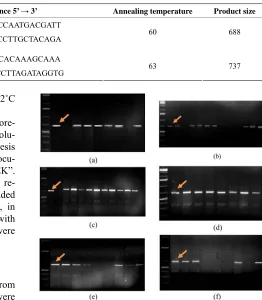
Figure 1. PCR-profiles of Triticum aestivum L. plants induced by SCS123F/R primer (5’CCTGATCACCAATGACGATT3’/ 5’CCTGATCACCTTGCTACAGA3’). Arrow indicates the 688 bp. 1st line on all figures is molecular weight marker: 100 bp. (a)
2nd line: Akinchi-84, 3rd: Pirshahin-1, 4th: Guneshli, 5th:
Dag-dash, 6th: FARAN Dole, 7th: Renan, 8th: Avreka, 9th: Pactole,
10th: 38 IBWSN (129 №); (b) 2nd line: 10 SAWVT (11 №), 3rd:
3rd FAWWON (117 №), 4th: 8th WWEERYT (32 №), 5th: 4th
RWVT-LRCA (89 №), 6th: 14th FAWWON (86 №), 7th: 8th
WON-SA (65 №), 8th: 9th WON-SA (27 №), 9th: 3 RBWYT
(521 №), 10th: 12th FAWWON №97 (130/21), 11th: 3 RBWYT
(536 №), 12th: 3 RBWYT (518 №), 13th: 39 IBWSN (113 №),
14th: 14 SAWYT (49 №); (c) 2nd line: 39 IBWSN (97 №), 3rd -
11st IWWYT-R (9816 №), 4th: S5, 5th: Mirbashir-128, 6th: Yegane, 7th: Zirve-80, 8th: Fatima, 9th: Aran, 10th: Azeri, 11th:
Murov, 12th: Murov-2, 13th: Saba, 14th: Tereggi; (d) 2nd line:
Beyaz, 3rd: Shafag, 4th: KSI-13, 5th: Pirshahin, 6th: Ugur, 7th:
Parzivan-1, 8th: Parzivan-2, 9th: Sheki-1; (e) 2nd line: 16th
FAWWON-IR (61), 3rd: 16th FAWWON-IR (46), 4th: 16th
FAWWON-IR (52), 5th: 29 ES WVT (7), 6th: 16th
FAW-WON-IR (90), 7th: 16th FAWWON-IR (47), 8th: 29 ES WVT
(26), 9th: 29 ES WVT (38), 10th: 29 ES WVT (30); (f) 2nd line:
16 SAWWVT (29), 3rd: 16 SAWWVT (34), 4th: Azamatli-95,
5th: Nurlu-99, 6th: Gyrmyzy gul-1, 7th: S1, 8th: Ruzi-84, 9th:
Tale-38, 10th: 3 RBWYT (510 №).
Figure 1 reflects the PCR profiles performed using
SCS123 F/R molecular marker (5’CCTGATCACCAA- TGACGATT3’/5’CCTGATCACCTTGCTACAGA3’). This marker must lead to the amplification of fragments of 688 bp in size. As a result of PCR test with this primer the locus of the 688 bp region was detected only in 48 genotypes. This is approximately 79% of all investigated genotypes.
Fragment linked to the SCS123F/R marker was not synthesized in the following genotypes—Pirshahin-1, Pactole, 8th WWEERYT (32 №), 3 RBWYT (521 №), 3 RBWYT (536 №), 11th IWWYT-R (9816 №), S5, 16th
FAWWON-IR (90), 16th FAWWON-IR (47), S1, Nurlu-
99 Kyrmyzygyul-1, 12th FAWWON № 97 (130/21). The second SCAR marker linked to the studied Lr19 gene of resistance to brown leaf rust was SCS253 F/R (5’ GCTGGTTCCACAAAGCAAA 3’/5’ GGCTGGTTCC- TTAGATAGGTG 3’). Amplification products with the use of this marker are detected in the 737 bp region. As can be seen from Figure 2, the expected fragment in the
737 bp region was synthesized in only in 53 of 61 geno- types, in other words, in approximately 87% of all inves-
Figure 2. PCR-profiles of Triticum aestivum L. plants induced by the SCS253F/R primer (5’GCTGGTTCCACAAAGCA- AA3’/5’ GGCTGGTTCCTTAGATAGGTG3’). Arrow indicates the 737 bp. 1st line on all figures is molecular weight marker -
100 bp. (a) 2nd line: Akinchi-84, 3rd: Pirshahin-1, 4th: Guneshli,
5th: Dagdash, 6th: FARAN Dole, 7th: Renan, 8th: Avreka, 9th:
Pactole, 10th: 38 IBWSN (129 №); (b) 2nd line: 10 SAWVT (11
№), 3rd: 3rd FAWWON (117 №), 4th: 8th WWEERYT (32 №),
5th: 4th RWVT-LRCA (89 №), 6th: 14th FAWWON (86 №), 7th:
8th WON-SA (65 №), 8th: 9th WON-SA (27 №), 9th: 3 RBWYT
(521 №), 10th: 3 RBWYT (510 №), 11th: 3 RBWYT (536 №),
12th: 3 RBWYT (518 №), 13th: 39 IBWSN (113 №), 14th: 14
SAWYT (49 №); (c) 2nd line: Beyaz, 3rd: Shafag, 4th: KSI-13,
5th: Pirshahin, 6th: Ugur, 7th: Parzivan-1, 8th: Parzivan-2, 9th:
Sheki-1;(d) 2nd line: 39 IBWSN (97 №), 3rd: 11st IWWYT-R
(9816 №), 4th: S5, 5th: Mirbashir-128, 6th: Yegane, 7th: Zirve-80,
8th: Fatima, 9th: Aran, 10th: Azeri, 11th: Murov, 12th: Murov-2,
13th: Saba, 14th: Tereggi; (e) 2nd line: 16th FAWWON-IR (61),
3rd: 16th FAWWON-IR (46), 4th: 16th FAWWON-IR (52), 5th:
16th FAWWON-IR (90), 6th: 16th FAWWON-IR (47), 7th: 29
ES WVT (7), 8th: 29 ES WVT (26), 9th: 29 ES WVT (38), 10th:
29 ES WVT (30); (f) 2nd line: 16 SAWWVT (29), 3rd: 16
SAWWVT (34), 4th: Nurlu-99, 5th: Azamatli-95, 6th: Tale-38,
7th: Ruzi-84, 8th: 12th FAWWON №97 (130/21), 9th: S1, 10th:
Gyrmyzy gul-1.
WON № 97 (130/21).
Comparative analysis of PCR profiles obtained with the use of both SCAR markers demonstrates (Table 2)
that the results are the same in 82% of genotypes: spe- cific amplification fragments were identified in 45 geno- types with the use of both SCS123F/R and SCS253F/R markers, which indicates that the Lr19 gene of resistance to brown leaf rust is present on 7D chromosomes of these genotypes. The existence of the Lr19 gene has not been proven in 5 of 61 genotypes used, because specific fragments amplified with any of the applied markers were not identified in these genotypes.
[image:4.595.311.535.108.716.2]The results obtained with different markers did not match in 18% of genotypes. After using the SCS123F/R marker, nine genotypes (Pirshahin-1, Pactole, 8th WW-
Table 2. Results of the PCR tests using SCAR markers SCS123F/R and SCS253F/R.*
№ Genotypes SCS123F/R SCS253F/R
1 Akinchi-84 + +
2 Pirshahin-1 − +
3 Guneshli + +
4 Dagdash + +
5 FARAN Dole + +
6 Renan + +
7 Avreka + +
8 Pactole − +
9 38 IBWSN (129 №) + +
10 10 SAWVT (11 №) + +
11 13th FAWWON (117 №) + +
12 8th WWEERYT (32 №) − +
13 4th RWVT-LRCA (89 №) + +
14 14th FAWWON (86 №) + +
15 8th WON-SA (65 №) + +
16 9th WON-SA (27 №) + +
17 3 RBWYT (521 №) − −
18 3 RBWYT (510 №) + +
19 3 RBWYT (536 №) − +
20 3 RBWYT (518 №) + +
21 39 IBWSN (113 №) + +
22 14 SAWYT (49 №) + +
23 39 IBWSN (97 №) − +
24 11th IWWYT-R (9816 №) − +
25 S5 + +
26 Mirbashir-128 + +
27 Yegane + +
28 Zirve-80 + −
29 Fatima + +
30 Aran + +
31 Azeri + +
32 Murov + +
33 Murov-2 + +
34 Saba + +
35 Tereggi + +
36 Beyaz + +
37 Shafag + +
38 KSI-13 + +
39 Pirshahin + +
40 Ugur + +
41 Parzivan-1 + +
42 Parzivan-2 + +
43 Sheki-1 + +
44 16th FAWWON-IR (61) + +
45 16th FAWWON-IR (46) + +
46 16th FAWWON-IR (52) + +
47 16th FAWWON-IR (90) − +
48 16th FAWWON-IR (47) − +
49 29 ES WVT (7) + +
50 29 ES WVT (26) + +
51 29 ES WVT (38) + +
52 29 ES WVT (30) + +
53 16 SAWWVT (29) + +
54 16 SAWWVT (34) + +
55 S1 − −
56 Nurlu-99 − +
57 Gyrmyzy gul-1 − −
58 Azamatli-95 + −
59 Tale-38 + −
60 Ruzi-84 + −
61 12nd FAWWON №97 (130/21) − −
EERYT (32 №), 3 RBWYT (536 №), 11th IWWYT-R
(9816 №), S5, 16th FAWWON-IR (90), 16th FAWWON-
IR (47), Nurlu-99) did not match, i.e. fragments in the 688 bp region specific for the SCS123F/R marker were not synthesized in these genotypes, on the contrary, the 737 bp fragments, linked with the SCS253F/R marker, were amplified. And this kind of mismatch was detected in three genotypes (Zirve-80, Azamatli-95, Ruzi-84) with the use of the SCS253F/R marker, in other words, ampli- fication products specific for the SCS253F/R marker were absent in these genotypes, on the contrary, synthe- sis of PCR profiles specific for the SCS123F/R marker has successfully been performed.
The absence of marker components with the Lr19 gene in these samples may be due to an incomplete link- age of the marker and the gene [26].
Attention is drawn to the fact that resistance and high sensitivity to brown leaf rust are observed among the genotypes in which amplification products have not been revealed, thus indicating the absence of the Lr19 gene.
Gyrmyzy gul-1 wheat genotype in field conditions also demonstrates high susceptibility to the brown rust pathogen and is completely affected by the Puccinia re- condite f. sp. tritici fungus. The genotypes called 3 RBWYT (521 №), S1 and Tale-38 in field conditions are estimated as moderately resistant to this disease. It is interesting that the 12th FAWWON № 97 (130/21)
geno-type actually demonstrates high resistance to this harmful disease, despite the absence of the Lr19 gene. Apparently, the resistance of this genotype may be caused by other Lr-genes.
The wheat cultivars are of different types and become susceptible to different types of rust because it has nar- row genetic bases for resistance. The evolution rates of pathogens are very fast and rapid. So, it is necessary to find out new and better sources for resistance. The ge- netic resistance is important to control many phytopa- thogenic epidemics. The wheat production has been de- pendent on the use and development of rust resistance genotypes having well characterized and diverse genes. It is also concluded that, in wheat certain and different combinations of genes give long lasting and better resis- tance for rust diseases than given by any individual genes [16,27].
This work requires the continuation of the study. How- ever, the material studied by us is a valuable source for wheat breeding for leaf rust resistance. Understanding the genetic regulation of resistance allows avoiding the possible use of the same donor gene in selection and de- veloping the programs of rational use of high-effective genes of resistance. The obtained results can be used in breeding and genetic programs on creation of forms re- sistant to leaf rust pathogen populations in Azerbaijan. Thus, information about the existence of effective Lr-
genes in adapted varieties that can be used as donors for resistance, and usage of these distinct genes or by pyra- miding of different resistance genes in the genotype can significantly improve the efficiency of breeding of resis- tant varieties [12], thus assisting to avoid the creation of varieties that are genetically homogeneous [3].
REFERENCES
[1] Singh, R.P., Huerto-Espino, J. and Rajaram, S. (2000) Achieving near-immunity to leaf and stripe rusts in wheat by combining slow rusting resistance genes. Acta Phyto-pathologica et Entomologica Hungarica,35, 133-139. [2] Oelke, L.M. and Kolmer, J.A. (2004) Characterization of
leaf rust resistance in hard red spring wheat cultivars. Plant Disease, 88, 1127-1133.
doi:10.1094/PDIS.2004.88.10.1127
[3] Mebrate, S.A., Oerke, E.C., Dehne, H.W. and Pillen, K. (2008) Mapping of the leaf rust resistance gene Lr38 on wheat chromosome arm 6DL using SSR markers. Eu- phytica, 162, 457-466. doi:10.1007/s10681-007-9615-z [4] McIntosh R.A., Wellings C.R. and Park R.F. (1995)
Wheat rusts: An atlas of resistance genes. CSIRO Publi-cations, Melbourne, 208. doi:10.1007/978-94-011-0083-0 [5] Marasas, C.N., Smale, M. and Singh, R.P. (2003) The
economic impact of productivity maintenance research: Breeding for leaf rust resistance in modern wheat. Agri-cultural Economics, 29, 253-263.
doi:10.1111/j.1574-0862.2003.tb00162.x
[6] Woxniak-Strzembicka, A. (2003) Wirulencja populacji Puccinia recondita f. sp. tritici w Polsce wlatach 1998-2001. Biuletyn Instytutu Hodowli i Aklimatyzacji Roslin, 230, 109-117.
[7] Vanzetti, L.S., Campos, P., Demichelis, M., Lombardo, L.A., Aurelia, P.R., Vaschetto, L.M., Bainotti, C.T. and Helguera, M. (2011) Identification of leaf rust resistance genes in selected Argentinean bread wheat cultivars by gene postulation and molecular markers. Electronic Jour- nal of Biotechnology, 14, 3.
doi:10.2225/vol14-issue3-fulltext-14
[8] Gupta, S.K., Charpe, A., Prabhu, K.V. and Haque, Q.M. (2006) Identification and validation of molecular markers linked to the leaf rust resistance gene Lr19 in wheat. Theoretical and Applied Genetics, 113, 1027-1036.
doi:10.1007/s00122-006-0362-7
[9] McIntosh, R.A., Dubcovsky, J., Rogers, W.J., Morris, C., Appels, R. and Xia, X.C. (2011) Catalogue of gene sym-bols for wheat: 2011 supplement.
http://www.shigen.nig.ac.jp/wheat/komugi/genes/macgen e/supplement2011.pdf
[10] Prins, R., Marais, G.F., Pretorius, Z.A., Janse, B.J.H. and Marais, A.S. (1997) A study of modified forms of the Lr19 translocation of common wheat. Theoretical and Applied Genetics, 95, 424-430.
doi:10.1007/s001220050579
Phytopa-thology, 51, 61-67.
[12] Mesterhazy, A., Bartos, P., Goyeau, H., Niks, R.E., Csosz, M., Andersen, O., Casulli, F., Ittu, M., Jones, E., Manis- terski, J., Manninger, K., Pasquini, M., Rubiales, D., Schachermayr, G., Strzembicka, A., Szunics, L., To- dorova, M., Unger, O., Vanco, B., Vida, G. and Walther, U. (2000) European virulence survey for leaf rust in wheat. Agronomie, 20, 793-804.
doi:10.1051/agro:2000104
[13] McCallum, B.D. and Seto-Goh, P. (2003) Physiologic specialization of wheat leaf rust (Puccinia triticina) in Canada in 2000. Canadian Journal of Plant Pathology, 25, 91-97. doi:10.1080/07060660309507053
[14] Miralles, D.J., Resnicoff, E. and Carretero, R. (2007) Yield Improvement associated with Lr19 translocation in wheat. In: Spiertz, J.H.J., Struik, P.C. and van Laar, H.H., Eds., Scale and Complexity in Plant Systems Research: Gene-Plant-Crop Relationships, Springer, Dordrecht, 171-178. doi:10.1007/1-4020-5906-X_14
[15] Sharma, D. and Knott, D.R. (1966) The transfer of leaf rust resistance from Agropyron to triticum by irradiation. Canadian Journal of Genetics and Cytology, 8, 137-143. [16] Sehgal, S.A., Tahir, R.A., Anwar, Z., Abbas, G., Kausar
Nawaz Shah, M. and Zaman Khan Khattak, J. (2012) Molecular genetic characterization of rust in wheat geno- types. Asian Journal of Agricultural Sciences, 4, 337-340. [17] Huerta-Espino, J. and Singh, R.P. (1994) First report of virulence for wheat leaf rust gene Lr19 in Mexico. Plant Disease, 78, 640. doi:10.1094/PD-78-0640C
[18] Knott, D.R. (1980) Mutation of a gene for yellow pig-ment link to Lr-19 in wheat. Canadian Journal of Genet-ics and Cytology, 22, 651-654.
[19] Kim, N.S., Amstrong, K. and Knott, D.R. (1993) Mo- lecular detection of lophopyrum chromatin in wheat lo-
phopyrum recombinants and their use in the physical mapping of chromosome 7D. Theoretical and Applied Genetics, 85, 561-567. doi:10.1007/BF00220914
[20] Marais, G.F. and Marais, A.S. (1990) The assignment of a thinopyrum disticum (thunb) love derived translocation to the long arm of wheat chromosome 7D using endopep-tidase polymorphism. Theoretical and Applied Genetics, 79, 182-186. doi:10.1007/BF00225949
[21] Sibikeev, S.N., Kruprov, V.A., Voronina, S.A. and Elesin V.A. (1996) First report of leaf rust pathotypes virulent on highly effective Lr-genes transferred from Agropyron species to bread wheat. Plant Breeding, 115, 276-278. doi:10.1111/j.1439-0523.1996.tb00917.x
[22] Roelfs, A.P. (1988) Genetic control of phenotypes in wheat stem rust. Annual Review of Phytopathology, 26, 351-367. doi:10.1146/annurev.py.26.090188.002031 [23] Pink, D. (2002) Strategies using genes for non-durable
disease resistance. Euphytica, 124, 227-236. doi:10.1023/A:1015638718242
[24] Murray, M.G. and Thompson, W.F. (1980) Rapid isola- tion of high molecular weight plant DNA. Nucleic Acids Research, 8, 4321-4325. doi:10.1093/nar/8.19.4321 [25] Williams, J.G., Kubelik, K.J., Livak, J.A. and Tingey,
S.V. (1990) DNA polymorphisms amplified by arbitrary primers are useful genetic markers. Nucleic Acids Re-search, 18, 6531-6535. doi:10.1093/nar/18.22.6531 [26] Tirishkin, L.G. (2006) Genetic control of the effective
juvenile brown rust resistance of collection Triticum aes-tivum L. wheat samples. Genetics, 42, 377-384.