PROFESSIONAL TRAINING NEEDS ASSESSMENT OF THE FACULTY OF THE COLLEGE OF
EDUCATION AND COLLEGE OF ARTS AND SCIENCES: INPUTS TO FACULTY IN
College of Education, Eastern Samar State University, Borongan City, Eastern Samar
ARTICLEINFO ABSTRACT
The study was conducted du
college of Education, in collaboration with the College of Arts and Sciences. The study aimed to discover the level of participation and the professional training needs of the COED and CAS Faculty in instruction, resea
the faculty of both colleges as representative sample. The findings of the study revealed that the respondents were highly involved in instruction activities, moderately involved
and highly involved in extension activities. The study was also able to find that the respondents were highly in need of professional in
The results of the study i
seriously in their mandated functions of instruction, research and extension. They manifest a high level of involvement in instruction and extension, and are moderately involved in research
These levels of involvement are echoed by their needs, which are reported to be high, especially those under research training needs.
Copyright©2019, Lorna D. Capito. This is an open access distribution, and reproduction in any medium, provided
INTRODUCTION
Higher Education Institutions (henceforth, HEI) regulated by the Commission on Higher Education are mandated by Law to undertake instruction, research and extension. These services are the pillars upon which a university of chartered college anchors itself. Excelling in these areas is the hallmark of HEI. Faculty members of HEIs are likewise enjoined to participate in these trifold functions. In fact, it is reflected in the ESSU Code that promotion determination of faculty are based on the candidates’ teaching ability, research competence and productivity, scholarly performance, commitment and dedication to service, academic interest and growth, personality traits and moral integrity (ESSU Code, 2006). Such qualifications may be harnessed through continuing in
training and development programs for the faculty of the university. With the continuous and dynamic changes in the frontiers of knowledge, teachers cannot afford
lest they become anachronistic of their own professional concern. Faculty members must therefore continuously improve in order to respond to the changing environment. Instruction is the lifeblood of a learning institution. It is the main purpose of the institution’s existence. To guarantee that a university is capable of delivering high quality instruction, it must ensure that it employs faculty members who are well equipped with the skills, attitudes, and technical know
ISSN: 0975-833X
Article History:
Received 04th February, 2019 Received in revised form 24th March, 2019 Accepted 15th April, 2019 Published online 30th May, 2019
Citation: Lorna D. Capito. 2019. “Professional training needs assessment of the faculty of the college of
faculty in-service training program development”, International
Key Words:
Professional Training Needs, Assessment, Instruction, Research, Extension.
*Corresponding author:
RESEARCH ARTICLE
PROFESSIONAL TRAINING NEEDS ASSESSMENT OF THE FACULTY OF THE COLLEGE OF
EDUCATION AND COLLEGE OF ARTS AND SCIENCES: INPUTS TO FACULTY IN
PROGRAM DEVELOPMENT
*
Lorna D. Capito
College of Education, Eastern Samar State University, Borongan City, Eastern Samar
ABSTRACT
The study was conducted during the first half of the calendar year 2016. It was spearheaded by the college of Education, in collaboration with the College of Arts and Sciences. The study aimed to discover the level of participation and the professional training needs of the COED and CAS Faculty in instruction, research, and extension. The study employed proportional sampling and took 75% of the faculty of both colleges as representative sample. The findings of the study revealed that the respondents were highly involved in instruction activities, moderately involved
and highly involved in extension activities. The study was also able to find that the respondents were highly in need of professional in-service training in the areas of instruction, research and extension. The results of the study implied that the COED and CAS faculty are taking their involvement seriously in their mandated functions of instruction, research and extension. They manifest a high level of involvement in instruction and extension, and are moderately involved in research
These levels of involvement are echoed by their needs, which are reported to be high, especially those under research training needs.
access article distributed under the Creative Commons Attribution License, the original work is properly cited.
Education Institutions (henceforth, HEI) regulated by the Commission on Higher Education are mandated by Law to undertake instruction, research and extension. These services are the pillars upon which a university of chartered college ling in these areas is the hallmark of an HEI. Faculty members of HEIs are likewise enjoined to participate in these trifold functions. In fact, it is reflected in the ESSU Code that promotion determination of faculty are ability, research competence and productivity, scholarly performance, commitment and dedication to service, academic interest and growth, personality traits and moral integrity (ESSU Code, 2006). Such qualifications may be harnessed through continuing in service training and development programs for the faculty of the With the continuous and dynamic changes in the wledge, teachers cannot afford to remain static lest they become anachronistic of their own professional culty members must therefore continuously improve in order to respond to the changing environment. Instruction is the lifeblood of a learning institution. It is the main purpose of the institution’s existence. To guarantee that a elivering high quality instruction, it must ensure that it employs faculty members who are well-equipped with the skills, attitudes, and technical know-how
necessary for the trade of instruction. Once employed, it is the responsibility of the institutio
characteristics so that the faculty may be able to answer to the call of the rapidly changing miasma of teaching and learning. In service training, defined by Collins Dictionary (2012) as a training given to employees during the cou
employment, is among the best answer to the challenge of continuing upgrade of quality of education provided by the university. Research is basic mandate of ESSU, in fact, the
university recognizes its responsibility towards the
development of the research capability of its academic and general staff which it purports to deliver through courses designed to enhance statistics computing skills and research information and management through the development of a research coaching/mentoring schema
Extension activities are likewise a mandated function for all faculty of the university. The university expects that all personnel of the university shall be involved in extension activities serving as catalyst for the development and improvement of the target communities (ESSU Coed). The endeavour may only be made possible if the personnel involved in the extension program are well
gritty of conducting extension services. Equipping personnel with these skills require that the university address their extension training needs.
International Journal of Current Research
Vol. 11, Issue, 05, pp.3737-3742, May, 2019
DOI: https://doi.org/10.24941/ijcr.35258.05.2019
Professional training needs assessment of the faculty of the college of education and college of arts and sciences: inputs to
International Journal of Current Research, 11, (05), 3737-3742.
PROFESSIONAL TRAINING NEEDS ASSESSMENT OF THE FACULTY OF THE COLLEGE OF
EDUCATION AND COLLEGE OF ARTS AND SCIENCES: INPUTS TO FACULTY IN-SERVICE TRAINING
College of Education, Eastern Samar State University, Borongan City, Eastern Samar
year 2016. It was spearheaded by the college of Education, in collaboration with the College of Arts and Sciences. The study aimed to discover the level of participation and the professional training needs of the COED and CAS Faculty rch, and extension. The study employed proportional sampling and took 75% of the faculty of both colleges as representative sample. The findings of the study revealed that the respondents were highly involved in instruction activities, moderately involved in research activities and highly involved in extension activities. The study was also able to find that the respondents were service training in the areas of instruction, research and extension. mplied that the COED and CAS faculty are taking their involvement seriously in their mandated functions of instruction, research and extension. They manifest a high level of involvement in instruction and extension, and are moderately involved in research activities. These levels of involvement are echoed by their needs, which are reported to be high, especially those
License, which permits unrestricted use,
necessary for the trade of instruction. Once employed, it is the responsibility of the institution to further hone these characteristics so that the faculty may be able to answer to the call of the rapidly changing miasma of teaching and learning. In service training, defined by Collins Dictionary (2012) as a training given to employees during the course of their employment, is among the best answer to the challenge of continuing upgrade of quality of education provided by the university. Research is basic mandate of ESSU, in fact, the
university recognizes its responsibility towards the
the research capability of its academic and general staff which it purports to deliver through courses designed to enhance statistics computing skills and research information and management through the development of a research coaching/mentoring schema (ESSU Coed, 2006). Extension activities are likewise a mandated function for all faculty of the university. The university expects that all personnel of the university shall be involved in extension activities serving as catalyst for the development and provement of the target communities (ESSU Coed). The endeavour may only be made possible if the personnel involved in the extension program are well-versed in the nitty-gritty of conducting extension services. Equipping personnel
that the university address their
OFCURRENTRESEARCH
Continuous faculty development through advance studies, trainings, seminars and workshops is one route to achieve academic excellence in the university. This study is significant for this will serve as basis in designing a faculty development program that is suited to the needs of the faculty. This is in line with the education and human resource development research of the university and its objective of producing globally competitive graduates by improving the quality and competence of the faculty. This study was conducted in order to determine the professional training needs of the university faculty and provide insights about how to address these needs through in service trainings.
Objectives of the Study: The study aimed to be able to realize
the following objectives.
Determine the involvement of the respondents in the following areas:
Instruction
Research
Extension
Determine the professional training needs of the respondents in the following areas:
Instruction
Research
Extension
Determine the problems met by the respondents in terms
of instruction, research and extension activities of the university.
Determine the actions taken by the respondents to address
the problems met in terms of instruction, research and extension activities of the university.
Review of Literature: The following articles are cited based
on their relevance to the study undertaken. Employee development activities help in the growth and development of employees, who are the true assets of an organization. Employees who give their heart and soul to the organization are also expecting something in return. Money could be one motivating factor but nothing like it if one prepares one’s employee not only his/her current job but also for future assignments as well. Employees need to grow with time. One cannot apply similar skills and techniques everywhere. Technology also becomes obsolete with time. An individual needs to keep himself/herself abreast with the latest developments to survive the fierce competition. Employee development is important for employees to enhance their skills and upgrade their existing knowledge in order to perform better. Employee development activities and trainings make an employee aware of the latest developments and what is happening around him/her. Employee development activities prepare individuals for adverse conditions and unforeseen situations. Every employee likes to acquire new skills and learning while at job. A sense of pride develops when they feel that their organization is investing time and resources to train them. In-house and outsourced trainings, conferences, seminars, and other such activities make employees better and reliable resources. Training indeed helps an employee to perform his/her level best, eventually benefitting the
organization and yielding higher profits. Employee
development creates a learning culture in the organization where every employee is motivated to learn new skills and
acquire new learning. It also helps an employee to do a self-analysis of himself/herself. He/she knows where he/she is lacking and what all new skills and learning will help him/her improve his/her performance and deliver better results, overcome the gap between their current stage and where they would like to see themselves five years down the line and make an employee self-dependent and capable of facing even the worst circumstances with a smile. Employee development also goes a long way in strengthening the relationship among employees. Individuals as a result of various trainings, open houses sessions, for a tend to interact with each other more and thus come closer. They do not hesitate to share knowledge, pass on relevant information and even train fellow workers
(http:// www.managementstudyguide.com/
employee-development-importance.htm).
It’s hard to think of an important aspect of management more neglected than development planning: helping employees shape the future direction of their careers. Yet for a variety of reasons, this valuable activity is often ignored or handled as bureaucratic exercise or an afterthought. Companies pay a high
price: the loss of top young client. Development planning
doesn’t have to be elaborate or costly. At its core it’s mostly a
matter of good managers taking the person-to-person time to
understand their employees recognizing their skills and needs
and guiding them to fill in the gaps. If it’s not, the payoff can be substantial in terms of long-term loyalty. If it’s not, the costs can be substantial in terms of long-term talent. (Lipman, 2013). Continuing professional development is important because it ensures that an employee continues to become competent in his profession. The ultimate result of well-planned continuing professional development is that it safeguards the public, the employer, the employee and the
employee’s career (http://continuing professional
development.org/why-is-cpd-important/).
Faculty development is vital for the future of any school. An effective faculty development policy will be linked to the school improvement plan. The profile of faculty development has been raised in recent years by reforms in schools’ workforces and the greater emphasis on continuing professional development. Along with the schools’ assessment of present and future skills requirements, the performance reviews form the basis of the overall staff development plan
(https://www.nationalcollege.org.uk/transfer
/open/csbm-managing-hr-in-schools/csbm-6hr-s3/csbm-6hr-s3-t3.html). Faculty members in higher education typically have been trained in their subject matter but not in pedagogy. With increased concerns over the rising cost of college, traditional institutions of higher education face scrutiny and external challenges to their stability. Higher education groups and the public at large have called into question the teaching skills and preparedness of faculty members often criticizing their lack of interest on teaching and preference for research. As a result, a growing number of institutions have developed means for supporting and enhancing teaching in campus. Despite studies that demonstrate the effectiveness of such programs faculty participation in professional development for teaching remains low(Pesce, 2015).
MATERIALS AND METHODS
campus. Sample selection was proportional. 75% of the respondents for each of both colleges were taken as study sample. The research instrument is attached as Appendix A. Statistical analysis included percentages, frequency and mean.
RESULTS AND DISCUSSION
The study found that the faculty of both colleges had a very high level of involvement in instruction, high level of involvement in research and high level of involvement in extension activities.
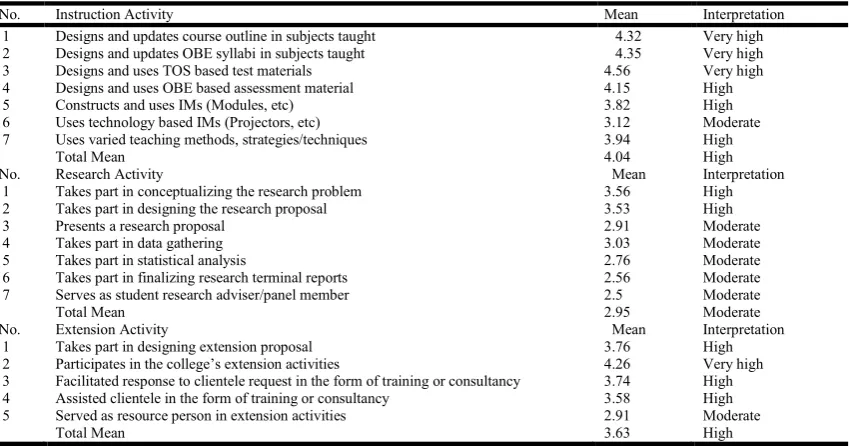
[image:3.595.90.515.212.435.2]The respondents were also found to have a high need for training in instruction, research and extension as shown in the tables below. presents the faculty involvement in the areas of instruction, research and extension. The table shows the various activities in instruction, research and extension that the university faculty is mandated to do, and upon which their performance are evaluated for the IPCR and NBC. These activities are expected of every faculty member of the university, and so far, as shown in Table 1, the COEd and CAS faculty are highly involved in instruction activities, moderately involved in research activities and highly involved in extension activities.
Table 1. COEd and CAS Faculty Involvement in Instruction, Research and Extension
No. Instruction Activity Mean Interpretation
1 Designs and updates course outline in subjects taught 4.32 Very high
2 Designs and updates OBE syllabi in subjects taught 4.35 Very high
3 Designs and uses TOS based test materials 4.56 Very high
4 Designs and uses OBE based assessment material 4.15 High
5 Constructs and uses IMs (Modules, etc) 3.82 High
6 Uses technology based IMs (Projectors, etc) 3.12 Moderate
7 Uses varied teaching methods, strategies/techniques 3.94 High
Total Mean 4.04 High
No. Research Activity Mean Interpretation
1 Takes part in conceptualizing the research problem 3.56 High
2 Takes part in designing the research proposal 3.53 High
3 Presents a research proposal 2.91 Moderate
4 Takes part in data gathering 3.03 Moderate
5 Takes part in statistical analysis 2.76 Moderate
6 Takes part in finalizing research terminal reports 2.56 Moderate
7 Serves as student research adviser/panel member 2.5 Moderate
Total Mean 2.95 Moderate
No. Extension Activity Mean Interpretation
1 Takes part in designing extension proposal 3.76 High
2 Participates in the college’s extension activities 4.26 Very high
3 Facilitated response to clientele request in the form of training or consultancy 3.74 High
4 Assisted clientele in the form of training or consultancy 3.58 High
5 Served as resource person in extension activities 2.91 Moderate
[image:3.595.92.525.465.680.2]Total Mean 3.63 High
Table 2. Respondents’ Training Needs in Instruction, Research and Extension
No. Instruction Activity Mean Interpretation
1 Designing and updating course outlines in subjects taught 3.57 High
2 Designing and updating OBE syllabus in subjects taught 3.6 High
3 Designing and using TOS based testing materials 3.71 High
4 Designing and using OBE based assessment strategies 3.69 High
5 Constructing and using IMs (Modules, etc) 3.89 High
6 Using technology-based IMs (Projectors, etc) 3.23 Moderate
7 Teaching methodologies/strategies/techniques 3.4 High
Total Mean 3.44 High
No. Research Activity
1 Research proposal design/University format 3.63 High
2 Research proposal conceptualization 3.66 High
3 Research methodologies 3.8 High
4 Selection of Statistics Tools for use in data analysis 3.71 High
5 Preparation of Research Terminal Report 3.69 High
6 Research dissemination and publication format 3.89 High
Total Mean 3.73 High
No. Extension Activity
1 Extension design preparation 3.34 Moderate
2 Extension activity proposal preparation 3.43 High
3 Linkaging and MOA preparation 3.57 High
4 Extension program packaging 3.63 High
5 Extension Needs Assessment Methodologies 3.71 High
Total Mean 3.54 High
Table 3. Problems met and the actions taken by the respondents in the three mandates
Area Problems Met Actions Taken
Instruction 1.Scarcity of Reference materials
2.Limited access on the use of LCD Projector 3.Subjects being taught are new
4.Construction of Instructional Module is delayed due to changing of assigned subject each semester
1.Resorted to internet which Is also oftentimes unavailable
2.Produced handouts for students 3.Brings own laptop
Research 1.Minimal exposure to research
2.Lack of incentive
3.Lack of technical knowledge about research
4.Lack of cooperation of research faculty/staff respondents 5.Slow processing of research papers from TWG
Links with other researchers
Table 2 shows the respondents’ training needs in instruction, research and extension. These needs were based on the basic activities in instruction, research and extension that faculty members are expected to take part of. This table presents the training needs of the COEd and CAS faculty in the areas of instruction, research and extension. It shows that the faculty members of both colleges believe that there is much need for the trainings stated in order for them to perform their mandates function to the best of their ability. Table 3 above presents the problems met and the actions taken by respondents in the three mandates. These have been ranked according to frequency. In this table the faculty struggles with the lack of faculties in the classroom which greatly impinge the effectiveness of instruction. Research concerns were likewise reported by the faculty, the most prominent concerns were minimal exposure to and lack of technical knowledge about research, lack of research incentives, lack of cooperation of faculty/staff research respondents, and the slow processing of research papers for approval by the technical working group who screens faculty members.
Conclusions and Recommendation
The study implies that the COEd and CAS faculty are taking their involvement seriously in their mandated functions of instruction, research and extension. They manifest a high level of involvement in instruction and extension, and are moderately in research activities. These levels of involvement are echoed by their needs, which are reported to be high, especially those under research training needs. Further implications suggest that the most common problems that the faculty meets regarding instruction is the lack of reference materials for teaching and students, followed by limited access to technology-based facilities, newness of subjects taught, and changing of assigned subjects per semester resulting to the delay of IM construction.
The lack of incentives, which includes financial support, minimal exposure to and technical knowledge of research, lack of cooperation from respondents and slow processing of papers by the TWG were pointed out as problems in research. The lack of time due to overload in subject assignment was pointed as a hindrance to extension involvement in faculty. The author strongly recommend that the university address the training needs as well as the problems that are commonly met by the faculty in order to promote the maximum level of involvement
of faculty in the three mandates of university. It is likewise
recommend that the study be magnifies in scope by including all the colleges of the main campus, and the external campuses if possible.
REFERENCES
Collins Dictionary 2012 ESSU Code 2006
http://continuingprofessionaldevelopment.org/why-is-cpd-important/
http://www.managementstudyguide.com/employee-development-importance.htm
https://www.nationalcollege.org.uk/transfer/opem/csbm-managing-hr-in-schools/csbm-6hr-s3/csbm-6hr-sr-t3.html Lipman, V. 2013. Why employee development is important,
neglected and can cost you talent. Retrieved from: http://www.forbes.com/sites/victorlipman/2013/01/29/why- development-planning-is-important-neglected-and-can-cost-you-young-talent/#2f50a9ed2ce0
Pesce, J.R. (2015). Professional Development for Teaching in Higher education: Faculty Perceptions and Attitudes.
Retrieved from:
http://dlib.bc.edu/islandora/object/bc-ir:104134
Appendix A. Research Instrument
FACULTY PROFESSIONAL TRAINING NEEDS ASSESSMENT
Name (Optional) ____________________________ College/Department __________________
Part II. Directions: Please evaluate your involvement in the following area by checking the appropriate column for your rating
based on your honest assessment of your involvement behaviour as defined in each criterion as follows.
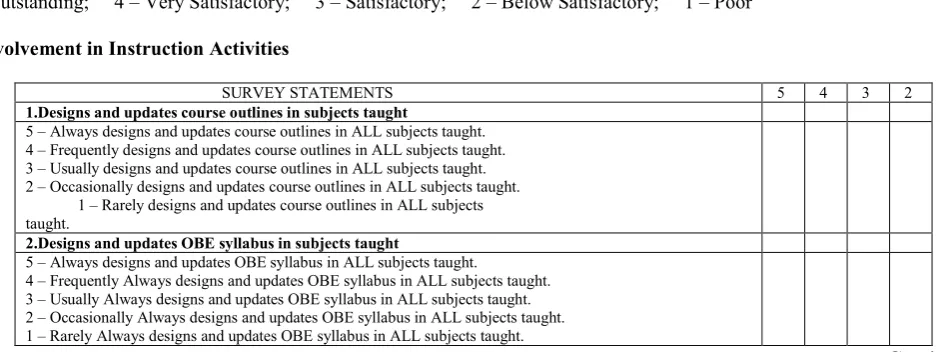
5 – Outstanding; 4 – Very Satisfactory; 3 – Satisfactory; 2 – Below Satisfactory; 1 – Poor
A.Involvement in Instruction Activities
SURVEY STATEMENTS 5 4 3 2
1.Designs and updates course outlines in subjects taught
5 – Always designs and updates course outlines in ALL subjects taught. 4 – Frequently designs and updates course outlines in ALL subjects taught. 3 – Usually designs and updates course outlines in ALL subjects taught. 2 – Occasionally designs and updates course outlines in ALL subjects taught. 1 – Rarely designs and updates course outlines in ALL subjects taught.
2.Designs and updates OBE syllabus in subjects taught
5 – Always designs and updates OBE syllabus in ALL subjects taught.
4 – Frequently Always designs and updates OBE syllabus in ALL subjects taught. 3 – Usually Always designs and updates OBE syllabus in ALL subjects taught. 2 – Occasionally Always designs and updates OBE syllabus in ALL subjects taught. 1 – Rarely Always designs and updates OBE syllabus in ALL subjects taught.
[image:4.595.70.543.592.768.2]3.Designs and uses TOS based testing materials
5 – Always designs and uses TOS-based testing materials. 4 – Frequently designs and uses TOS-based testing materials. 3 – Usually designs and uses TOS-based testing materials. 2 – Occasionally designs and uses TOS-based testing materials. 1 – Rarely designs and uses TOS-based testing material.
1.Designs and uses OBE based assessment strategies
5 – Always designs and uses OBE-based assessment strategies. 4 – Frequently designs and uses OBE-based assessment strategies. 3 – Usually designs and uses OBE-based assessment strategies. 2 – Occasionally designs and uses OBE-based assessment strategies. 1 – Rarely designs and uses OBE-based assessment strategies.
2.Constructs and uses IMs (Module, etc)
5 – Always constructs and uses IMs in conducting lessons. 4 – Frequently constructs and uses IMs in conducting lessons. 3 – Usually constructs and uses IMs in conducting lessons. 2 – Occasionally constructs and uses IMs in conducting lessons. 1 – Rarely constructs and uses IMs in conducting lessons.
3.Uses technology-based IMs (Projectors, etc)
5 – Always uses technology-based IMs (Projectors, etc). 4 – Frequently uses technology-based IMs (Projectors, etc). 3 – Usually uses technology-based IMs (Projectors, etc). 2 – Occasionally uses technology-based IMs (Projectors, etc). 1 – Rarely uses technology-based IMs (Projectors, etc).
4.Uses varied teaching methods/strategies/techniques
5 – Always uses varied teaching methods/strategies/techniques. 4 – Frequently uses varied teaching methods/strategies/techniques. 3 – Usually uses varied teaching methods/strategies/techniques. 2 – Occasionally uses varied teaching methods/strategies/techniques. 1 – Rarely uses varied teaching methods/strategies/techniques.
5.Others (Please specify)
B.Involvement in Research Activities
SURVEY STATEMENTS 5 4 3 2 1
1.Takes part in conceptualizing the research problem
5 – Always takes part in conceptualizing the research problem, initiates research conceptualizing.
4 – Frequently takes part in conceptualizing the research problem, volunteers collaborates with research conceptualizing. 3 – Usually takes part in conceptualizing the research problem, joins when invited to collaborate in research conceptualizing. 2 – Occasionally takes part in conceptualizing the research problem, selective in involvement in research conceptualizing. 1 – Rarely takes part in conceptualizing the research problem,
avoids involvement in research conceptualizing.
2.Takes part in designing the research proposal
5 – Always takes part in designing the research proposal, acts as principal proponent. 4 – Frequently takes part in designing the research proposal, acts as research collaborator. 3 – Usually takes part in designing the research proposal.
2 – Occasionally takes part in designing the research proposal, declines invitation to collaborate in research design. 1 – Rarely takes part in designing the research proposal, avoids involvement in research design.
3.Presents a research proposal
5 – Always presents a research proposal in agency In-house reviews.
4 – Frequently presents a research proposal in agency In-house reviews, presented in at least two reviews during the academic calendar.
3 – Usually presents a research proposal in agency In-house reviews, presented in at least one review during the academic calendar.
2 – Occasionally presents a research proposal in agency In-house reviews, presented at least twice during entire career. 1 – Rarely presents a research proposal in agency In-house reviews, presented at least once during entire career.
1.Takes part in data gathering for research
5 – Always takes part in data gathering for research, acts as data gathering head. 4 – Frequently takes part in data gathering for research, acts as enumerator. 3 – Usually takes part in data gathering for research.
2 – Occasionally takes part in data gathering for research, selective of data type or site. 1 – Rarely takes part in data gathering for research, avoids data gathering activities.
2.Takes part in statistical analysis
5 – Always takes part in data gathering for research, acts as head statistician of projects. 4 – Frequently takes part in data gathering for research, acts as associate statistician of projects. 3 – Usually takes part in data gathering for research, selective of statistical procedures to analyze.
2 – Occasionally takes part in data gathering for research, more likely to decline much involvement in statistical analysis. 1 – Rarely takes part in data gathering for research, avoids involvement in statistical analysis.
3.Takes part in finalizing research terminal reports
5 – Always takes part in finalizing research terminal reports, volunteers for such activities. 4 – Frequently takes part in finalizing research terminal reports and provides technical inputs. 3 – Usually takes part in finalizing research terminal reports.
2 – Occasionally takes part in finalizing research terminal reports, specifically in encoding and such mechanical level only. 1 – Rarely takes part in finalizing research terminal reports,
avoids such activities.
4.Serves as students research adviser/panel member
5 – Always serves as student research advisor/panel member. 4 – Frequently serves as student research advisor/panel member.
3 – Usually serves as student research advisor/panel member, selective in accepting such capacities. 2 – Occasionally serves as student research advisor/panel member.
1 – Rarely serves as student research advisor/panel member. Avoids invitation to serve in such capacities.
C.Involvement in Extension Activities
SURVEY STATEMENTS 5 4 3 2 1
1.Takes part in designing extension proposal 5 – Always takes part in designing extension proposal. 4 – Frequently takes part in designing extension proposal. 3 – Usually takes part in designing extension proposal. 2 – Occasionally takes part in designing extension proposal. 1 – Rarely takes part in designing extension proposal. 2.Participates in the college’s extension activities 5 – Always participates in the college’s extension activities. 4 – Frequently participates in the college’s extension activities. 3 – Usually participates in the college’s extension activities. 2 – Occasionally participates in the college’s extension activities. 1 – Rarely participates in the college’s extension activities.
3.Facilitates response to clientele request in the form of training or consultancy
5 – Always facilitates response to clientele request in the form of training or consultancy and assists in arranging trainings or consultancy.
4 – Frequently facilitates response to clientele request in the form of training or consultancy. 3 – Usually facilitates response to clientele request in the form of training or consultancy.
2 – Occasionally facilitates response to clientele request in the form of training or consultancy and sometimes neglects training or consultancy requests.
1 – Rarely facilitates response to clientele request in the form of training or consultancy. Avoids client request.
4.Assists clientele in the form of training or consultancy 5 – Always assists clientele in the form of training or consultancy. 4 – Frequently assists clientele in the form of training or consultancy. 3 – Usually assists clientele in the form of training or consultancy.
2 – Occasionally assists clientele in the form of training or consultancy and sometimes neglects training or consultancy requests.
1 – Rarely assists clientele in the form of training or consultancy. Ignores clients.
1.Serves as resource person in extension activities
5 – Always serves as resource person in extension activities, willing to act as extension facilitator. 4 - Frequently serves as resource person in extension activities.
3 – Usually serves as resource person in extension activities. 2 – Occasionally serves as resource person in extension activities. 1 – Rarely serves as resource person in extension activities. Declines invitation to serve as speaker in extension activities. 2.Others (Please specify)
Professional Training Needs
Directions: Please indicate your level of training need in the following instruction, research and extension activities of the
University by checking the appropriate column based on the following indicators:
Rating Adjectival Rating Description
5 Very highly needed There is a great and immediate need for the training in order to perform function very satisfactorily
4 Highly needed There is much need for the training in order to perform function very satisfactorily
3 Moderately needed There is considerable need for the training in order to perform function very satisfactorily
2 Slightly needed There is minimal need for the training in order to perform function very satisfactorily
1 No needed at all There is no need for the training in order to perform function very satisfactorily
Research 5 4 3 2 1
1.Research proposal design/University format 2.Research proposal conceptualization 3.Research Methodologies
4.Selection of Statistical Tools for use in data analysis 5.Preparation of Research Terminal Report
6.Research dissemination and publication format 7.Others (Please specify)
Extension 5 4 3 2 1
1.Extension Design preparation 2.Extension activity proposal preparation 3.Linkaging and MOA preparation 4.Extension program packaging
5.Extension Needs Assessment Methodologies 6.Others (Please specify)
AREA Problems met Action taken to resolve the problem
Instruction Research Extension