IMPACT OF THE TRANSFORMATIONAL
NURSES ON JOB SATISFACTION
*
Mrs. Maya Vadgaonkar, Dr. Prabha Dasila and Dr
MGM Institute of
ARTICLE INFO ABSTRACT
Transformation of transformational transformational satisfaction research non-probability comprised inclusion questionnaire Satisfaction Hospitals Hospital Hospital permission in both conducted building management taken for staff nurses taken. significant showing groups indicating
Copyright © 2018, Maya Vadgaonkar et al. This is an open
use, distribution, and reproduction in any medium, provided
INTRODUCTION
It is the matter of pride for nurses that the nursing has attained a distinct position in the search care. The concept of serving is fundamental. involves serving the organization or group within it. Leadership is special compared because of its unique responsibility for people followers of the leader - in whatever context to operate. Transformational leadership is viewed effective model of leadership because it importance of rewards, satisfies the higher followers.
*Corresponding author: Mrs. Maya Vadgaonkar,
MGM Institute of Health Sciences, Kamothe Navi,
ISSN: 0975-833X
Vol. 10, Issue,
Article History:
Received 20th August, 2018
Received in revised form 26th September, 2018 Accepted 25th October, 2018
Published online 29th November, 2018
Citation: Mrs. Maya Vadgaonkar, Dr. Prabha Dasila and Dr Gajanan Velhal
the head nurses on job satisfaction of the staff nurses
Key Words:
Job Satisfaction,
Leadership, Transformational Leadership, Performance.
RESEARCH ARTICLE
TRANSFORMATIONAL LEADERSHIP EDUCATIONAL PROGRAMME
SATISFACTION OF THE STAFF NURSES IN PUBLIC
Mrs. Maya Vadgaonkar, Dr. Prabha Dasila and Dr. Gajanan Velhal
of Health Sciences, Kamothe Navi, Mumbai 410209
ABSTRACT
Transformation leadership is on rise in western countries as well transformational leaders in various fields. The researcher transformational leadership educational programme of head satisfaction of staff nurses working in public hospitals of Mumbai. research has used quantitative , quasi- experimental pre-test,
post-probability purposive sampling technique and size was calculated comprised of 30 head nurses and 200 staff nurses from selected inclusion criteria of sample selection. The tools consisted of questionnaire for demographic data and for other observations , and Satisfaction Questionnaire for job satisfaction . The pilot study was Hospitals of Mumbai. The detail main study (study group) conducted Hospital Parel, Mumbai (K.E.M.) and ( control group ) Bai Yamunabai Hospital Mumbai (B.Y.L.Nair) Hospitals of Mumbai city.. After following permission from the institutions and permission from the respective
both the hospitals. The transformational leadership educational conducted with theory on all the four variables work-place management, building and conflict management. The “5 S” activities for effective management explained with audio visual aids, role plays, video clippings
for total 21 sessions,3hours per day. During one-month interaction nurses was observed , and after three months the performance
Results: Wilcoxon Signed Rank test of study group z
significant difference -11.6 < p value 0.00 at 0.05 level in study group showing the insignificant difference -1.04 >p value 0.297 at 0.05 groups the p value 0.000 that has high significance p< 0.001 at indicating improved job satisfaction of staff nurses among study group
open access article distributed under the Creative Commons Attribution provided the original work is properly cited.
nursing profession search quality in health fundamental. Good leadership group and the people to any other role people - i.e., the leadership is seen viewed as the most it recognizes the higher needs of the
Vadgaonkar,
Navi, Mumbai 410209.
It is divided into 4 areas
Idealized Influence
Inspirational Motivation
Intellectual Stimulation
Individualized Consideration
Head Nurse as a transformational effective ward manager /administrator. Nurse in the hospital organization “higher “Position. There are Staff who give bed side nursing care to the Head Nurse. Supportive are responsible through Head Nurses i.e. Dean.
International Journal of Current Research Vol. 10, Issue, 11, pp.75179-75186, November, 2018
DOI: https://doi.org/10.24941/ijcr.33036.11.2018
nkar, Dr. Prabha Dasila and Dr Gajanan Velhal. 2018.“Impact of the Transformational
in public hospitals.”, International Journal of Current Research, 10
PROGRAMME OF THE HEAD
PUBLIC HOSPITALS
Gajanan Velhal
410209
well as also in India. There are number researcher wants to see the impact of nurses on performance and job Mumbai. Methodology and Material: The -test, study, & control group design, calculated by power analysis. Each group selected public hospitals, fitting into the of structured and semi structured and standardized tool like Minnesota was conducted in one of the public conducted .in King Edward Memorial Yamunabai Laxman Nair Charitable following all the protocols of ethical respective hospitals,. The pre-test was taken educational interventional programme management, communication , team effective and efficient patient care clippings . Such interactive sessions interaction between the head nurses and performance and job satisfaction post-test stat values of job satisfaction the group whereas in control group was 0.05 level. While comparing the two at 0.05 level of significance level. group
ribution License, which permits unrestricted
Consideration
transformational leader identifies her role in /administrator. The place of the Head organization is the stepping stone to a Staff Nurses and student nurses care to the patients, are responsible Supportive staff and ward assistants who Nurses to the director of hospital OF CURRENT RESEARCH
Job satisfaction represents several related attitudes. Smith, Kendali, and Hulin have suggested that there are five job dimensions that represent the most important characteristics of a job about which people have affective responses. These are:
The Pay: The amount of financial remuneration that is received and the degree to which this is viewed as equitable vis-à-vis that of others in the organization.
Promotion opportunity: The chance of advancement in
hierarchy.
The work itself: The extent to which the job provides the individual with interesting tasks, opportunities for learning and the chance to accept responsibilities.
Supervision: The abilities of the supervisor to provide technical assistance and behavioural support.
Co-workers: The degree to which fellow co-workers are
technically proficient and socially supportive. Nurses are a pivotal part of the health care team and it is claimed that the profession can make a major contribution to shaping health policy. In quality management programmes a fundamental assumption is that nursing must be accountable to the patient for the care rendered by its practitioners (Swans burg and Swansburg 2002).
Operational Definitions
Impact: According to Oxford dictionary meaning of Impact is
to have a marked effect or Influence on someone or something. In this study impact means the effect of transformational leadership educational programme on, performance of staff nurses and job satisfaction of staff nurses.
Leadership skills: (Transformational Leadership Survey
Updated November 11, 2015. Created October 7, 2011.- originated by James V. Downton).
Charisma: This is the quality of role model true dedication, trust and respect to others.
Social: This is the quality of transformational leader, helping others to learn. Either it will be by coaching and mentoring them. It is the quality of creating the challenging environment to reach their followers to their full potentials. If they have difficulties during this, then helping them or guiding them.
Vision: This the skill where the leader has challenging visions and help the people to understand them so that they motivated to join it.
Transactional: This is the skill where the leader ensures others what she expect from them, if there is poor performance does occur the leader acts to ensure that it does not affect the morale of the team.
Delegation: This is the skill where the leader delegate the task and the authority to get the things accomplished.
Execution: In this is the skill the leader delegates the task and authority to the follower thinking of good care taker of the belongings of the organization’s resources.
She does the follow up to ensure that the things are going as per planned and not wasting time in fighting fires.
Components of Leadership (Bernard M. Bass. Bass extended
Burns’ ideas in 1985)
Idealized Influence: This is the quality of role model true dedication, trust and respect to others.
Inspirational Motivation: This is the second important
attribute of transformational leader to inspire the subordinates by talking to them enthusiastically, optimistically about the future, how to achieve it with confidence, communicating with them the vision of the future. It is also the quality of motivation to reach their followers to their full potentials.
Intellectual Stimulation: This the quality where the leader has challenging intellectual to help the subordinate to understand the different angles of the problems, the different ways of solving these problems, to find out different creative ways to complete the difficult tasks.
Individualized Considerations: This is the last important attribute of the transformational leadership, where the leader spends time in teaching, developing the strengths of the subordinates to get the things accomplished.
Transformational Leadership Education programme: (Burns, J.M, (1978).
Transformational Leadership: As per the Oxford dictionary meaning of transformational Leadership is, that it is the style of leadership where the leader is charged with identifying the needed change and executing the change in committed members of the group.
Educational Programme: As per oxford dictionary meaning educational program means it is a set of educational intended related measures, events, or activities with a particularlong-termaim of educating or enlightening a group of people.
In this study the transformational leadership educational intervention programme means a set of educational activities for the head nurses with regard to work-place management, communication, team building and conflict management.
Head nurse: As per the Oxford dictionary meaning a nurse who is head nurse or charged nurse is trained to care for the sick, primarily on managerial and administrative duties for their entire unit in a hospital. In this study head nurses means sister in charges who are working in medical and surgical units of the public hospitals.
Staff nurse: Astaff nurse is a hospital nurse whose rank is just below that of a sister or in charge nurse. In this study the staff nurses mean nurses who are working with the head nurses who are working in medical and surgical units of the public hospitals. and who have completed minimum 1 year of service.
In this study job satisfaction refers to the general attitudes of staff nurses towards their job, measured by using standardised Minnesota’s Satisfaction Questionnaire.
Public hospitals: Means the hospital owned by a government
and receives government funding. In this study public hospitals means the hospitals owned by Municipal Corporation of Greater Mumbai. (M.C.G.M.) Maharashtra.
Scope of the study
Individual Growth and Development: Transformational
leadership impacts individuals' self-growth. Abraham
Maslow's hierarchy of needs places self-actualization at the top of the needs pyramid and defines it as a person's full realization of his potential. Transformational leadership helps transform members of a group into individuals who transcend beyond self-actualization and their own self-interests for the sake of the group or organization.
Increases Performance: Satisfied employees tend to be more
productive, creative, and committed to their employers, and recent studies have shown a direct correlation between staff
satisfaction and patient satisfaction in health care
organizations. The traditional model of job satisfaction focuses on all the feelings that an individual has about his/her job. However, what makes a job satisfying or dissatisfying does not depend only on the nature of the job, but also on the expectations that individuals have of what their job should provide. The scope of the study confined to the one hospital where the transformational leadership educational programme is implemented to the head nurses.
Objectives of the study
To study the job satisfaction of the staff nurses before and
after the transformational leadership educational
programme of the head nurses.
To examine the relationship or impact of the
transformational leadership educational intervention
programme and job satisfaction of the staff nurses.
Hypothesis of the study
H0 :There is no significant difference in job satisfaction of staff
nurses after transformational leadership educational
programme of head nurses
H1 :There is significant difference in job satisfaction of staff
nurses after transformational leadership educational
programme of head nurses
Review of Literature: Purpose of review of literature is to provide researcher with an overview of existing evidence on the problem being addressed and develop an argument that demonstrate the need for the study.
Studies related to the Job Satisfaction of nurses: Yi Feng Yang 19 (2014) evaluated the influence of leadership style and employee trust in their leaders on job satisfaction. 341 employees (164 men, 177 women; M age=33.5yr., SD=5.1) from four large insurance companies in Taiwan completed the transformational leadership behavior inventory, the leadership trust scale and a short version of the Minnesota (Job) Satisfaction Questionnaire.
Study revealed that the effect of transformational leadership on job satisfaction was mediated by leadership trust. This study highlights the importance of leadership trust in leadership-satisfaction relationships and provides researcher with practical ways to enhance job satisfaction. Dan Weberg (2010) premeditated that transformational leadership is significantly related to increased satisfaction, and wellbeing of staff, decreased burnout, and overall stress in staff nurses. A significant amount of burnout and decline of nurses occurs in healthcare systems. Nursing leadership has a significant impact on these factors. The purpose of this study is to present an evidence review to determine the impact of transformational leadership on staff satisfaction and burnout.
Rafferty and Griffin (2004) distributed three thousand three hundred and seven surveys across an Australian public sector organization, and 1398 employees responded (response rate 42.2%). An important aim of the current study was to determine whether individuals differentiate between these sub dimensions when describing their leader’s behavior. They recognized a theoretical and empirical distinction between developmental and supportive leadership, and single
sub-dimension of transformational leadership, namely
individualized consideration. They established that
developmental leadership display significantly stronger relationships by means of job satisfaction, career certainty, affective commitment to the organization, and role breadth self-efficacy. The above review identified a set of more focused sub dimensions of transformational leadership including articulating a vision, inspirational communication, supportive leadership, intellectual stimulation, and personal recognition. When studying the effects of transformational leadership, researcher has focused on outcomes such as satisfaction, follower extra effort, and ratings of leader effectiveness.
increases the subordinates' job satisfaction increases. The study confirmed that transformational leadership is an important leadership style to increase subordinate job satisfaction. Tova Hendel, Miri Fish, Vered Galon (2005): Conducted a study among Israeli nurse managers in general hospitals. to “Identify conflict mode choices of head nurses in general hospitals and examine the relationship between leadership style, choice of
strategy in handling conflicts and demographic
characteristics”. The study explains that the Transformational Leadership style of the head nurses including their workplace management, teaming up while working, ends the conflicts among the subordinates and boosts the job satisfaction of their subordinates. Cummings et al. (2018) in the systematic review, “Leadership styles and outcome patterns for the nursing workforce and work environment” examined the correlations between leadership behaviors and nursing outcomes. A total of 50,941 titles and abstracts were screened Using content analysis. 121 outcomes were grouped into six categories: 1) staff satisfaction with job factors, 2) staff relationships with work, 3) staff health & wellbeing, 4) relations among staff, 5) organizational environment factors and 6) productivity & effectiveness. 52 studies reported that relational leadership styles were associated with higher nurse job satisfaction; whereas 16 studies established task-focused leadership styles associated with lower nurse job satisfaction. Similar trends were found for each category of outcomes. Thus, the leadership which is focused only on task completion is insufficient, but it should be related to leadership practices
considering employee retention work environment,
productivity within health care setting. Boamah et al. (2017) in study “Effect of transformational leadership on job satisfaction and patient safety outcomes. “Investigated the effects of nurse managers' transformational leadership behaviors on job satisfaction and patient safety outcomes.
The findings prop up the managers’ transformational leadership behaviors as a useful strategy in creating workplace conditions that promote better safety outcomes for patients and nurses. Morsiani et al. (2016) in their mixed method study “ How staff nurses perceive the impact of nurse managers' leadership style in terms of job satisfaction” : found out that ward nurse managers mostly adopted a transactional leadership style intended at monitoring errors and intervening to correct errors and punish, which had a negative impact on staff nurses' levels of job satisfaction. In contrast to the transformational leadership style, which is correlated with satisfaction was rarely practiced by nurse managers. In comparative study “ Impact of leadership styles adopted by head nurses on job satisfaction”: between governmental and private hospitals in Jordan , Abdelhafiz et al. (2016 ), explored that the level of job satisfaction among nursing staff was higher in public hospitals than in private hospitals in this study. A positive relationship was found between transformational leadership and job satisfaction (r = 0.374**). The overall transactional leadership score positively related with job satisfaction (r = 0.391**). Conversely, the overall correlation between passive-avoidant leadership and job satisfaction was negative (r = -0.240). In study , “Effect of Leadership Styles on Job Satisfaction Among Critical Care Nurses “M Alshahrani FMBaig LA(20 16)evaluated the effect of transformational and transactional leadership styles of head nurses on the job satisfaction of staff nurses in critical care units (CCU) of a tertiary care hospital. All nurse leaders demonstrated a combination of transactional (TA) and transformational (TF) style of leadership. Nurses working under leaders with a TF style demonstrated
significantly (p < 0.05) higher job satisfaction. The operating conditions were related negatively to the style of leadership. Pay, fringe benefits and nature of work were not related to the style of leadership. The nurses were moderately satisfied with their work and 23% of the variation in nurses' job satisfaction could be explained by the head nurses 6 leadership facets with positive effect of professional support, intellectual motivation, and management by correction and their laissez faire style. The study emphasized the importance of TF style of head nurses for increasing staff nurses' job provided more support and training for effective management of CCU. Saleh U, O'Connor T. et al (2018): In study “The impact of nurse managers' leadership styles on ward staff”, explored the nature of leadership styles used by the nursing management team, as perceived by nurses working at the bedside. The findings showed that the leadership style employed by nurse managers has a major impact on nurses' job satisfaction, turnover, and the quality of patient care they deliver.30
RESEARCH METHODOLOGY
Research Approach: Research approach adopted in this study
was quantitative approach as the Transformational Leadership impact parameters are quantifiable based on intervention given.
Research Design: The design used for the present study was quasi experimental design with two groups design, pre and post study group and pre-post control group design. One experimental group is at K.E.M. Hospital Mumbai and another control group is at B.Y.L. Nair Hospital Mumbai. There are 30 head nurses and 200 staff nurses in each group. Thus total 60 head nurses and 400 staff nurses. The intervention Programme consist of modules with learnable and developable the soft skills like work-place management, communication, team building and conflict management; it also includes understanding of the components of transformational leadership skills to enhance the effectiveness of the potential leaders’ impact on the performance and job satisfaction of the staff nurses.
Tool for Data collection: Measurement of the job satisfaction of the staff nurses pre-and post-educational programme of head nurses was done with the help of ‘Minnesota ‘Satisfaction questionnaire (MSQ).
Data Collection
Table 1. Distribution of job satisfaction score of the staff nurses in study and control group
N=200+200
Job Satisfaction
Study Group Control Group
Pre-Test Post Test Pre-Test Post Test
Not
Satisfied
Somewhat Satisfied
Satisfied Not
Satisfied
Somewhat Satisfied
Satisfied Not
Satisfied
Somewhat Satisfied
Satisfied Not
Satisfied
Somewhat Satisfied
Satisfied
3 128 69 0 13 187 10 122 68 4 129 67
1.50 % 64 % 34.50 % 0 6.50 % 93.50% 5% 61% 34% 2% 64.50 % 33.50 %
Table: The table depicts that there were only in Not satisfied, Somewhat Satisfied ,and Satisfied categories of responses were scored in study as well as control group. There were no responses in “Very Satisfied and Extremely Satisfied” categories in both groups. Maximum 187(93.50%) were reported satisfied in study group and 129(64.50%) were reported Somewhat satisfied in control group.
Table 2. Significance of difference in job satisfaction score of the staff nurses in study and control group
N =200 + 200
Job satisfaction of staff nurses
Median Study group Z p sig. at 0.05
Median Control group Z p
sig. at 0.05 Pre Post value value value Pre Post value value value
[image:5.595.34.551.295.539.2]
81 488 -11.6 0.00 Yes 64 66 8732 -1.04 0.297 No 66
Table 3. Comparison of Job satisfaction of staff nurses in study and control group.
N = 200+ 200
Job satisfaction of`` staff nurses Mean Rank Sum of ranks U value Z value p value Sig. at 0.05 levels Job
satisfaction
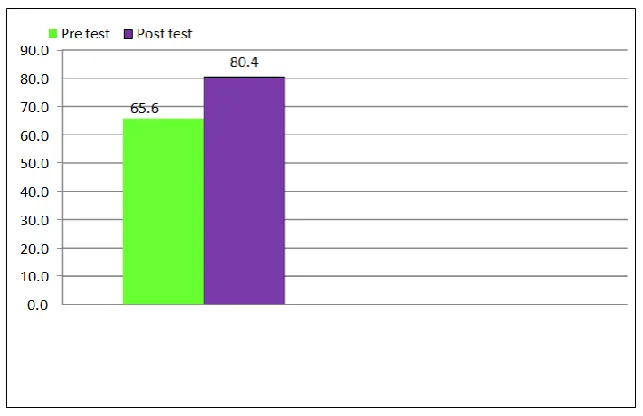
Study 80.4 56114
3985 -13.8 0.00
[image:5.595.138.460.565.773.2]Yes Control 65.6 24085
Fig. 1. Comparison of Mean Rank on Job satisfaction among staff nurses in study & control group
The process adopted and used in this research, has been broken down into specific steps. The various methods, strategies and exercises used at different stages are listed below and described in detailed later in the chapter:
The Work shops
The Presentation – on work-place management,
communication , team building and conflict management in their day to day patient care.
This presentation was in the form of power-point presentations, with A.V.aids, video clippings, management exercises, the “5 S” activities like- Sort, Systematize, Sweep, Standardize and Self-discipline (Sustain) for continuous (sustainability) improvement in day to day patient care activity. The 5 great world-famous Leaders - Florence Nightingale, Mahatma Gandhi, Dr. Babasaheb Ambedkar, Dr. A. P. J. Abdul Kalam , Mother Teresa were shown to group to know their well-known leadership style .
Exercises
Individual Exercises
Questions and answers during sessions.
Physical exercises (warm-up)
Application Questions /checklist
Reinforcement of exercises
Exercises in pairs: In communication, team building and conflict management
Role play: in pairs – presenting each other’s’ information in front of the group.
Role Play - 2 partners opposite each other palms up and down, lap touching, closing eyes for 10 mins. After 10 mins open the eyes, ask for opinion, repeat the procedure once, amazing response.
Small Group Exercises
Decision making
After showing video clippings asking groups to narrate the message.
Participatory learning exercises - Asking head nurses to narrate their experiences in front of the group about communication, team work and team building , conflict management in day to day working in hospital.
Home-work--- 6 groups of 5 head nurses in each group formed. Each group was given one aspect of quality patient services for presentation, i. e. a) effective, b) efficient, c) accessible d) acceptable/patient-centred, e) equitable, and f) safe.
Whole group exercises
Brainstorming on given situation: After three months of the
interventional programme the staff nurses were given the Structured questionnaire to assess their job satisfaction.
Statistical Tool used: The job satisfaction of the staff nurses after the transformational leadership educational programme of the head nurses assessed by tool 5 -Minnesota Satisfaction structured questionnaire (MSQ) in five-point Likert Scale 5=
Extremely satisfied, 4= Very satisfied, 3= Satisfied 2=Somewhat satisfied,1= Not satisfied The post-test done after 3 months during their duty periods. Assessment of the job satisfaction of staff nurses done by the researcher, during their duty hours. A structured questionnaire Minnesota Satisfaction Questionnaire (MSQ)in the form of Likert rating scale, administered to staff nurses to measure the job satisfaction.
The data is presented in tables
Distribution of job satisfaction score of the staff nurses in study and control group.
Significance of difference in job satisfaction score of the staff nurses in study and control group.
Comparison of Job satisfaction of staff nurses in study and control group.
Table 1 depict the job satisfaction of staff nurses within study and control group. There were no responses in “Very Satisfied and Extremely Satisfied” categories in both groups.In study group at pre-test level 3 staff nurses showed that they were not satisfied in their job. But in post-test the same staff nurses’ response was out of 3, all 3 staff nurses i.e.100%. of them shifted from not satisfied to satisfied category.Out of 128 somewhat satisfied responses at pre-test level 120 (93.75%) responses converted into satisfied category. Which suggest improvement after the intervention programme. Out of 69 satisfied responses 5(7.25%) get deteriorated into somewhat satisfied category and 64 (92.75 %) remained into satisfied category. In control group at pre-test level 10 staff nurses showed that they were not satisfied in their job, but in post-test the same staff nurses’ response was out of 10, 6(60%) showed somewhat satisfied responses and 4(40%) satisfied responses. Out of 122 somewhat satisfied responses at pre-test level 1(0.82%) deteriorated into not satisfied category 83(68.03%) remained into somewhat satisfied responses whereas 38(31.15%) converted into satisfied category. Out of 68 satisfied responses at pre-test level 3(4.41%) deteriorated into not satisfied category,40(58.82%) converted into somewhat satisfied category and 25(36.77%) remained into satisfied responses.
Significance of difference in job satisfaction score of the staff nurses in study and control group. The table 2 depict the median score and significance difference of job satisfaction of staff nurses. Overall the job satisfaction has improved from the total median score of 66 in pre-test to81 in post-test in study group after TLEP conducted for the head nurses. As compare the control group 64 to 66 in post-test in job satisfaction. Wilcoxon Signed Rank test of study group z stat values of job satisfaction the significant difference –- -11.6 < p value 0.00 at 0.05 level in study group whereas in control group was showing the insignificant difference -1.04 >p value 0.297 at 0.05 level. level indicating non improvement in job satisfaction of staff nurses. Hence the null hypothesis was rejected. Comparison of Job satisfaction of staff nurses in study and control group.
The Table 3 depict that the head nurses were showing
nurses. In overall the mean rank and sum of ranks of study group observations were greater than controlgroup, indicating improved job satisfaction of staff nurses among study group
Hence the null hypothesis was rejected. TableWhile assessing
the job satisfaction of the staff nurses the various aspects associated with, the job itself, the employer and employment policy, and the satisfaction of the employee were included in the questionnaire. This table depicts the comparison between study and control group of the post test results of the job satisfaction of the staff nurses before and after the
interventional transformational leadership educational
programme of the head nurses. Before calculating “z” value, hypothesis was tested using Mann-Whitney U test. The z table value for 0.05 level of significance was ±1.96
After conversion into Z stat, the calculated ‘z’ value -13.8 was found to be less than the Z tab score of ±1.96. The post-test comparison between groups is showing significant difference as the calculated z value is statistically less than table z value of ±1.96. Hence the null hypothesis is rejected . As the mean rank for study group 80.4 and for control group 65.6 and sum of ranks of study group was 56114 and control group was 24085. Thus, we can state that there is a significant improvement in the job satisfaction of the staff nurses of the study group than in the control group after the transformational leadership educational intervention programme of the head nurses.
Conclusion
Research has broken the myth of a few women being the leaders that the leaders are “born and not made”. Self -awareness, training and development can enhance the transformational leadership capabilities of the potential leaders and can have effectiveness and effective impact on their followers in developing the same abilities subsequently. The transformational leadership is a process to be practiced on an everyday practice for effective performance. This process will improve the patient care practices in entire health care set up, which is very much essential in today’s comprehensive patient care management for any leader.
It is established by this research that there is an improvement in the leadership styles of the head nurses as potential leaders and there was an excellent impact on the performance of the staff nurses in their day to day practices and which in turn resulted into their job satisfaction despite hectic scheduled work. Hence these potential leaders need to cultivate these soft skills. There are many factors that contribute to dissatisfaction in the work place. The leaders need to keep in mind the 6 major transformational leadership skills required, those are Charisma, Social, Vision, Transaction, Delegation and Execution, which will have greater impact on the performance and job satisfaction of staff nurses who will be at the bed side for patient care for 24 hrs and 365 days. The study indicates that the educational intervention programme of head nurses has helped the staff nurses too, to be effective transformational leaders thereby paving the way to break the “glass ceiling” that exists in organizations.
REFERENCES
A cross-sectional questionnaire survey: “The mediating effects of team and self-efficacy on the relationship between transformational leadership, and job satisfaction and
psychological well-being in healthcare professionals”: International Journal of Nursing Studies Volume 46, Issue 9, September 2009, Pages 1236-1244
Abdelhafiz IM., Alloubani AM. et al. 2015. “Impact of
leadership styles adopted by head nurses on job satisfaction”: Journal of Nursing Management. 2016 Apr; 24(3):384-92. doi: 10.1111/jonm.12333. Epub Aug 27 Alannah E. 2004. Rafferty and Mark Griffin: “ Dimensions of
transformational leadership: Conceptual and empirical extensions” The Leadership Quarterly Volume 15, Issue 3, June Pages 329–354.
Ali Mohammad Mosadegh Rad, Mohammad Hossein Yarmohammadian, 2006. “ A study of relationship between managers' leadership style and employees' job satisfaction” Leadership in Health Services, Vol. 19 Iss: 2, pp.11 – 28. Alshahrani M., Baig FM LA. 2016. “Effect of Leadership
Styles on Job Satisfaction Among Critical Care Nurses,”
Journal of College of Physicians and Surgeons Pakistan. May;26(5):366-70. doi: 2316.
Archinson, T. 2003. “Exposing the myth of employee satisfaction”. Health Care Executive,17 (3),page 20. Bekele Shibru, Prof. G.M Darshan, 2011. “To describe the
concepts of transformational leadership and its effect on subordinate job satisfaction”, Int., Journal of Bussiness.
Management. Eco. Res., Vol 2(5), 334-344 336
Boamah SA., Spence Laschinger HK. 2017. “Effect of
transformational leadership on job satisfaction and patient safety outcomes.” Nursing Outlook. 2018 Mar - Apr;66(2):180-189. doi: 10.1016/j.outlook.2017.10.004. Epub., Nov 23.
Bruce J. Avolio, William L. Gardner: “Authentic leadership development: Getting to the root of positive forms of leadership” Gallup Leadership Institute, College of Business Administration, University of Nebraska-Lincoln, NE, United States Quarterly 16 (2005) 315–338 .
Components of Leadership (Bernard M. Bass. Bass extended Burns’ ideas in 1985)
Cummings GG Tate Klee, 2018. Leadership styles and outcome patterns for the nursing workforce and work environment: A systematic review. International Journal of
Nursing Studies. May 3;85:19-60. Doi
10.1016/j.ijnurstu.2018.04.016.
Dan Weberg, 2010. “Transformational Leadership and Staff Retention: An Evidence Review with Implications for Healthcare Systems” Nursing Administration Quarterly: July/September - Volume 34 - Issue 3 - p 246–258
Giuliana, Annamario Bagnasco, 2017. “ How staff nurses perceive the impact of nurse managers’ leadership style in terms of job satisfaction”: a mixed method study, Nursing Management. Volume 25, Issue 2 March Pages 119–128.
Leadership skills (Transformational Leadership Survey
Updated November 11, 2015. Created October 7, 2011.- originated by James V. Downton)
Matthew Schieltz, “Why Transformational Leadership Is Important, A Study of Nurses' Job Satisfaction: The Relationship to Organizational Commitment, Perceived
Organizational Support, Transactional Leadership,
Transformational Leadership, and Level of Education. Morrison, Ruby S, Jones, LaDon, Fuller, Bryan: “The Relation
Between Leadership Style and Empowerment on Job Satisfaction of Nurses Journal of Nursing Administration: May 1997 Volume 27 - Issue 5 - pp 27-34.
terms of job satisfaction”: Journal of Nursing Management. 2017 Mar;25(2):119-128. doi: 10.1111/jonm.12448. Epub. Niti Singh Gallup, Venkat R. Krishnan: “Transformational
Leadership in India Developing and Validating a New Scale Using Grounded Theory Approach.”
Ping YiLin, Sara MacLennan, Nigel Hunt, Tom Cox, 2015. “ The influences of nursing transformational leadership style on the quality of nurses’ working lives in Taiwan: a cross-sectional quantitative study” Bio Medical Central Nursing 2015;14:33 Published online May 14
Prof. Darshan, Shibru, G.M. 2011. “To describe the concepts of transformational leadership and its effect on subordinate
job satisfaction”, International Journal. Bussiness.
Management. Eco. Res., Vol 2(5),334-344 336
Reda Abd El-Fatah SaidAhmed Abo Gad & Safaa Mohamed El-Demerdash: “An Educational Program about Nursing
Managers, Transformational Leadership, Conflict
management Styles and Decision-Making Effectiveness”. IOSR Journal of Nursing and Health Science (IOSR-JNHS) e-ISSN: 2320–1959.p- ISSN: 2320–1940 Volume 3, Issue 3 Ver. III (May-Jun. 2014), PP 42-56. Nursing Administration Department, Faculty of Nursing, Tanta University, Egypt.
Saleh, U., O'Connor, T. et al. 2018. “The impact of nurse managers' leadership styles on ward staff.” British Journal of Nursing. Feb 22;27(4):197-203. doi: 10.12968/ bjon. 2018.27.4.197
Sussane Braun et al. 2013. “Transformational leadership, job satisfaction, and team performance: A multilevel mediation model of trust”. Volume 24, Issue 1, February Pages 270– 283.
Swansburg R.C. & Swansburg R.J. 2002. “Introduction management and leadership for nurses , 2nd edition, Jones Bartlett publishers “S” by Allen Graves — Methodology Six –Sigma Lean Manufacturing, December 17, 2012 Tova Hendel Miri Fish, Vered Galon, 2005. “Leadership style
and choice of strategy in conflict management among Israeli nurse managers in general hospitals”, Nursing management Volume 13, Issue 2, March Pages 137–146 Transformational Leadership Education programme: (Burns,
J.M, (1978).
Yi-Feng Yang, 2014. “Studies of Transformational Leadership: Evaluating Two Alternative Models of Trust and Satisfaction”. Journal of Business Research, Vol 114, Issue 3.