doi:10.4236/jsip.2010.11003 Published Online November 2010 (http://www.SciRP.org/journal/jsip)
Robust
H
∞
Filtering for Lipschitz Nonlinear
Systems via Multiobjective Optimization
Masoud Abbaszadeh1,2, Horacio J. Marquez1
1Department of Electrical and Computer Engineering, University of Alberta, Edmonton, Canada; 2Department of Research and Development, Maplesoft, Waterloo, Canada.
Email: [email protected], [email protected]
Received October 27th, 2010; revised November 15th, 2010; accepted November 18th, 2010.
ABSTRACT
In this paper, a new method of H filtering for Lipschitz nonlinear systems is proposed in the form of an LMI
optimi-zation problem. The proposed filter has guaranteed decay rate (exponential convergence) and is robust against un-known exogenous disturbance. In addition, thanks to the linearity of the proposed LMIs in the admissible Lipschitz con-stant, it can be maximized via LMI optimization. This adds an extra important feature to the observer, robustness against nonlinear uncertainty. Explicit bound on the tolerable nonlinear uncertainty is derived. The new LMI formula-tion also allows optimizaformula-tions over the disturbance attenuaformula-tion level (H cost). Then, the admissible Lipschitz
con-stant and the disturbance attenuation level of the H filter are simultaneously optimized through LMI multiobjective
optimization.
Keywords: Lipschitz Nonlinear Systems, Optimal Filters, Nonlinear H Filtering, LMI Optimization
1. Introduction
The design of nonlinear state observers has been an area of constant research for the last three decades and as a result, a wide variety of design techniques for nonlinear observers exist in the literature. Despite important pro-gress, many outstanding problems still remain unsolved. A class of nonlinear systems of special attention is the so-called Lipschitz systems in which the mathematical model of the system satisfies a Lipschitz continuity dition. Many practical systems satisfy the Lipschitz con-dition, at least locally. Roughly speaking, in these sys-tems, the rate of growth of the trajectories is bounded by the rate of growth of the states. Observer design for Lipschitz systems was first considered by Thau in his seminal paper [1] where he obtained a sufficient condi-tion to ensure asymptotic stability of the observer. Thau’s condition provides a very useful analysis tool but does not address the fundamental design problem. Encouraged by Thau’s result, several authors studied observer design for Lipschitz systems [2-6]. All these methods share a common structure for the error dynamics of the nonlinear systems; namely the error dynamics can be represented as a linear system with a sector bounded nonlinearity in feedback. This type of problems are both theoretically
and numerically tractable because they can be formulated as convex optimization problems [7,8]. Raghavan for-mulated a procedure to tackle the design problem. His algorithm is based on solving an algebraic Riccati equa-tion to obtain the static observer gain [2]. Unfortunately, Raghavan’s algorithm often fails to succeed even when the usual observability assumptions are satisfied. Ragha-van showed that the observer design might still be tracta-ble using state transformations. Another shortcoming of his algorithm is that it does not provide insight into what conditions must be satisfied by the observer gain to en-sure stability. A rather complete solution of these prlems was later presented by Rajamani [3]. Rajamani tained necessary and sufficient conditions on the server matrix that ensure asymptotic stability of the ob-server error and formulated a design procedure, based on the use of a gradient based optimization method. He also discussed the equivalence between the stability condition and the minimization of the H norm of a system in
the standard form. However, he pointed out that the de-sign problem is not solvable as a standard H
optimiza-tion problem since the regularity assumpoptimiza-tions required in the Hframework are not satisfied. Using Riccati based
introduced in [3] is related to a modified H norm
minimization problem satisfying all of the regularity as-sumptions. It is worth mentioning that the H problem
in [3] is associated with the nominal stability of the ob-server error dynamics while no disturbance attenuation is considered. Moreover, in all of the above references, the system model is assumed to be perfectly known with no uncertainty or disturbance. In order to guarantee robust-ness against unknown exogenous disturbance, the nonlin-earHfiltering was introduced by De Souza et al. [9,10]
via the Riccati approach. In anHobserver, the -
induced gain from the norm-bounded exogenous distur-bance signals to the observer error is guaranteed to be below a prescribed level. On the other hand, the restric-tive regularity assumptions in the Riccati approach can be relaxed using linear matrix inequalities (LMIs). In this paper, we introduce a novel nonlinear H observer
design method for Lipschitz nonlinear systems based on the LMI framework. Our solution follows the same ap-proach as the original problem of Thau and proposes a natural way to tackle the problem, directly. Unlike the methods of [2,3,6], the proposed LMIs can be efficiently solved using commercially available software without any tuning parameters. In all aforementioned references, the Lipschitz constant of the system is assumed to be known and fixed. In this paper, the resulting LMIs are formulated such that to be linear in the Lipschitz constant of the nonlinear system. This adds an important extra feature to the observer, robustness against nonlinear un-certainty. Maximizing the admissible Lipschitz constant, the observer can tolerate some nonlinear uncertainty for which an explicit norm-wise bound is derived. In addi-tion to this robustness, we will extend our result such that the observer disturbance attenuation level (theHfeature
of the observer) can be optimized as well. Then, both the admissible Lipschitz constant and the disturbance at-tenuation level are optimized simultaneously through multiobjective convex optimization. The rest of the paper is organized as follows: Section 2, introduces the prob-lem and some background. In Section 3, the LMI formu-lation of the problem and our observer design algorithm are proposed. The observer guaranteed decay rate and robustness against nonlinear uncertainty are discussed. In Section 4, we expand the result of Section 3, to an H
nonlinear observer design method. Section 5, is devoted to the simulators optimization of the observer features through multiobjective optimization. In Section 6, the proposed observer performance is shown in some illus-trative examples.
2. Preliminaries and Problem Statement
Consider the following continuous-time nonlinear system
=
, n nx t Ax t x u A (1)
=
n py t Cx t C (2)
where xn,um,yp and
x u, containsnonlinearities of second order or higher. We assume that the system (1)-(2) is locally Lipschitz in a region
including the origin with respect to x, uniformly in u,
i.e.:
* *
1 2 1 2
1 2
, ,
,
x u x u x x
x k x k
(3)
where . is the induced 2-norm, u* is any admissible control signal and > 0 is called the Lipschitz constant. If the nonlinear function satisfies the Lipschitz con-tinuity condition globally in n, then the results will be
valid globally. Consider now an observer of the follow-ing form
ˆ = ˆ ˆ, ˆ .
x t Ax t x u L y Cx (4)
The observer error dynamics is given by
ˆe t x t x t (5)
=
,
ˆ, .e t A LC e t x u x u
The goal is to find a gain, L, such that:
1) In the absence of disturbance, the observer error dynamics is asymptotically stable i.e.:
= 0 limte t .2) In the presentence of unknown exogenous distur-bance, a disturbance attenuation level is guaranteed. (H performance).
The result is simple and yet efficient with no regularity assumption. The observer error dynamics is asymptoti-cally stable with guaranteed decay rate (the convergence is actually exponential as we will see). In addition, the observer is robust against nonlinear uncertainty and ex-ogenous disturbance. The dismissible Lipschitz constant which as will be shown, determines the robustness mar-gin against nonlinear uncertainty, and the disturbance attenuation level (the H cost), are optimized through
LMI optimization.
3. An Algorithm for Nonlinear Observer
Design
3.1. Maximizing the Admissible Lipschitz Constant
We want to maximizes the admissible Lipschitz constant of the nonlinear system (1-2) for which the observer error dynamics is asymptotically stable. The following theo-rem states the main result of this section.
Theorem 1. Consider the Lipschitz nonlinear system
(1-2) along with the observer (4). The observer error dynamics (6) is (globally) asymptotically stable with maximum admissible Lipschitz constant if there exist scalers > 0 and > 0 and matrices P> 0 and F such that the following LMI optimization problem has a solution.
min s.t.
<
T T T
A P PA C F FC I I (7) 1
2 > 0 1 2
I P
P I
(8)
once the problem is solved 1 =
L P F (9)
* max = 1
(10)
Proof: Suppose Q=I. The original problem as
dis-cussed in Section 2, can be written as
min max P s.t.
A LC
TP P T
A LC
=I (11)
1 2 . max P > 0 (12)
> 0
P (13) which is a nonlinear optimization problem, hard to solve if not impossible. We proceed by converting it into an LMI form. A sufficient condition for existence of a solu-tion for (11) is
> 0, (A LC P P A LC)T T( ) < I I.
(14)
The above can be written as <
T T T
A P PA C L P PLC I I (15) which is a bilinear matrix inequality. Defining the new variable
= =
T T T T
FPLL P L P F (16) it becomes
<
T T T
A P PA C F FC I I (17) In addition, since P is positive definite
P = max
P . So, from (12) we have
< 1 2P
(18)
which is equivalent to 2
1 > 0
2
T
I P P
(19) using Schur's complement lemma
1 2
> 0 1 2
I P
P I
(20)
defining = 1
, (8) is achieved.
Proposition 1. Suppose the actual Lipschitz constant
of the system is and the maximum admissible Lipschitz constant achieved by Theorem 2, is *. Then,
the observer designed based on Theorem 2, can tolerate any additive Lipschitz nonlinear uncertainty with Lipschitz constant less than or equal * .
Proof: Assume a nonlinear uncertainty as follows
x u, =
x u,
x u,
(21)
=
,x t Ax t x u (22)
where
x u1,
x u2,
x1 x2 . (23)
Based on Schwartz inequality, we have Equation (24). According to the Theorem 1,
x u, can be anyLipschitz nonlinear function with Lipschitz constant less than or equal to *,
*1, 2, 1 2
x u x u x x
(25)
so, there must be
* * .
(26) Remark 1. If one wants to design an observer for a
given system with known Lipschitz constant, then the LMI optimization problem can be reduced to an LMI feasibility problem (just satisfying the constraints) which is easier.
x u1,
x u2,
x u1,
x u2,
x u1,
x u2,
x1 x2 x1 x2 .
From Theorem 1, it is clear that the gain L obtained via solving the LMI optimization problem, can lead to stable error dynamics for every member in the class of the Lipschitz nonlinear functions with Lipschitz constant less than or equal to *. Thus, it neglects the structure of the given nonlinear function. It is possible to take advan-tage of the structure of the
x u, in addition to the fact that its Lipschitz constant is . According to Proposition 1, the margin of robustness against nonlinear uncertainty is * . The Lipschitz constant of the sys-tems can be reduced using appropriate coordinates trans-formations. The transformation matrices that are picked are problem specific and they reflect the structure of the given nonlinearity [2]. The robustness margin can then be modified through coordinates transformations. Find-ing the Lipschitz constant of a function is itself a global optimization problem, since the Lipschitz constant is the supremum of the magnitudes of directional derivatives of the function as shown in [11,12]. If the analytical form of the nonlinear function and its derivatives are known ex-plicitly, any appropriate global optimization method may be applied to find the Lipschitz constant. If only the function values can be evaluated, a stochastic random search and probability density function fitting method may be used [13].3.2. Guaranteed Decay Rate
The decay rate of the system (6) is defined to be the largest > 0 such that
exp = 0
lim
t t e t (27)
holds for all trajectories e. We can use the quadratic Lyapunov function V e
=e PeT to establish a lower bound on the decay rate of the (6). If
2
dV e t
V e t
dt for all trajectories, then
exp 2
0
V e t t V e , so that
exp
12 0e t t P e for all trajectories, where
P is the condition number of P and therefore the decay rate of the (6) is at least [8]. In fact, decay rate is a measure of observer speed of convergence.Theorem 2. Consider Lipschitz nonlinear system (1-2)
along with the observer (4). The observer error dynamics
(6) is (globally) asymptotically stable with maximum admissible Lipschitz constant and guaranteed decay rate
, if there exist a fixed scaler > 0, scalers > 0
and > 0 and matrices P> 0 and F such that the following LMI optimization problem has a solution.
min
. .
s t
2 <
T T T
A P PA P C F FC I I (28)
1
2 0
1 2
I P
P I
(29)
once the problem is solved
1
=
L P F (30) * max( ) = 1
(31)
Proof: Consider the following Lyapunov function
can-didate
= T
V t e t Pe t (32)
Then
=
ˆ
= 2 , ,
T T
T
T T
V t e t Pe t e t Pe t
e Qe e P x u x u
(33)
To have V t
2V t
it suffices (33) to be less than zero, where:
A LC
T P P T
A LC
2P=Q. (34)The rest of the proof is the same as the proof of Theo-rem 1.
4. Robust
H
Nonlinear Observer
In this section we extend the result of the previous sec-tion into a new nonlinear robust H observer design method. Consider the system
=
,
x t Ax t x u Bw t (35)
=
y t Cx t Dw t (36)
where w t
L2
0,
is an unknown exogenous dis-turbance. suppose that
=
z t He t (37)
stands for the controlled output for error state where H
is a known matrix. Our purpose is to design the observer parameter L such that the observer error dynamics is asymptotically stable and the following specified H
norm upper bound is simultaneously guaranteed.
.
z w (38)
The following theorem introduces a new method for nonlinear robust H observer design. we first present
definite matrix Pn n , we have
1
2x yT x Px y P yT T (39)
Theorem 3. Consider the Lipschitz nonlinear system
(35-36) with given Lipschitz constant , along with the observer (4). The observer error dynamics is (globally)
asymptotically stable with decay rate and minimum
2(we)
L gain, , if there exist fixed scaler > 0,
scalers > 1, > 0 and > 0 and matrices P> 0
and F such that the following LMI optimization prob-lem has a solution.
min
s.t.
2 <
T T T
A P PA P C F FC II (40)
2 2 1 2 > 0 1 2 H I P H P I (41) 1 1 2 < 0 2 TT T T
H H I PB FD
B P D F I
(42)
Once the problem is solved
1
=
L P F (43)
* min =
(44)
Proof: The observer error dynamics will be
=
,
ˆ,
e t A LC e t x u x u B LD w
(45) consider the following Lyapunov function candidate
= T
V t e t Pe t (46)
then
= ˆ= 2 , ,
T T
T
T T
T T T T T
V t e t Pe t e t Pe t
e Qe e P x u x u
e PB FD w w B P D F e
(47)
where, Q is as in (34). We select Q=I. If w= 0 the error dynamics is as Theorem 2, so the LMIs (7) and (8) which for Q=I will become
2 <
T T T
A P PA P C F FC II (48)
2 > 0 2 I P P I (49)
are sufficient for the asymptotic stability of the error dy-namics. Having > 1, (18) always implies (49).
Based on Rayleigh inequality
T T
max
e Qe Q e e (50)
Using Lemma 1 we can write
1
ˆ ˆ ˆ
2 ( , , , , , ,
ˆ ˆ = , , , , T T T T T
e P x u x u e Pe x u x u PP P x u x u
e Pe x u x u P x u x u
(51)
based on Rayleigh inequality we have
2
=
T T
max max
e Pe P e P e e (52)
, ˆ,
T
,
ˆ,
,
ˆ, 2 2
2 = 2 Tmax max max
x u x u P x u x u P x u x u P e P e e
(53)
therefore, from the above and (18),
ˆ
2
1 12 , , 1 .
2
T T T
max
e P x u x u P e e e e
(54) According to (50) and (54) and knowing that Q=I, we have
1 1 2
.2
T T T T T T
V t e e e PB FD w w B P D F e
(55)
Now, we define
0
= T T
J
z zw w dt (56)therefore
0
< T T
it follows that a sufficient condition for J0 is that
0,
, T T 0t z z w w V
(58)
but we have Equation (59).
Thus, a sufficient condition for J0 is that the above matrix which is the same as (42) be negative defi-nite. Then
0
T T
z zw w z w (60) Up until now, we have the LMIs (48), (20) and (42). If these LMIs are all feasible, then the problem is solvable and the observer synthesis is complete. However, (20) can be slightly modified to improve its feasibility. We proceed as follows:
Inequality (51) can be rewritten as follows
ˆ
2 T , , 2 T
max
e P x u x u P e e (61)
following the same steps, the matrix in (59) will become
[2 ]
< 0.
T
max
T T T
H H P I PB FD
B P D F I
(62)
The above matrix can not be used together with (48) and (49) because it includes P as one of the LMI vari-ables, thus resulting in a problem that is not linear in P. It can, however, give us another insight about max
P .According to the Schur's complement lemma, (62) is equivalent to
< 0
I
(63)
1
2 T < 0.
T
max
H H P I PB FD PB FD
(64) The third term in the above is always nonnegative, so it is necessary to have
[2 ] < 0
T
max
H H P I (65)
but as for any other symmetric matrix, for
H H
T , we have
T
T
T
min H H I H H max H H I
(66)
or according to the definition of singular values
2 H I H HT 2 H I
(67) therefore, a sufficient condition for (65) is
2 2 < 0
max
H P
(68) or
< 2
2 maxH
P
(69)
but (18) must be also satisfied. To have both (18) and (69), it is sufficient that
<1 2
2 max H P (70)which is equivalent to (41).
Remark 2. Similar to Remark 1, if one wants to design
an observer for a given system with known Lipschitz constant and with a prespecified , the LMI optimiza-tion problem is reduced to an LMI feasibility problem.
Remark 3. As an additional opportunity, we can first
maximize the admissible Lipschitz constant using Theo-rem 3, and then minimize for the maximized , using Theorem 3. In this case, according to Proposition 1, robustness against nonlinear uncertainty is also guaran-teed. In the next section, we will show that how and
can be simultaneously optimized using convex mul-tiobjective optimization. It is clear that if no decay rate is specified, then the term 2P will be eliminated from LMI (40) in Theorem 3.
5. Combined Performance using
Multiobjective Optimization
The LMIs proposed in Theorem 3 are linear in both ad-missible Lipschitz constant and disturbance attenuation level and as mentioned earlier, each can be optimized. A more realistic problem is to choose the observer gain matrix by combining these two performance measures. This leads to a Pareto multiobjective optimization in which the optimal point is a trade-off between two or more linearly combined optimality criterions. Having a fixed decay rate, the optimization is over (maximiza-tion) and (minimization), simultaneously. The
1 1 2 2 1 1 2 2 = .T T T T T T T T
T T
T T T T T T
T T T
z z w w V e H He w w Ve H He e e
H H I PB FD
e e
e PB FD w w B P D F e w w
w w
B P D F I
following theorem is in fact a generalization of the re-sults of [2-6, 15], and [9] (for systems of class (1-2)) in which the Lipschitz constant is assumed to be known and fixed and the result of [7] in which a special class of sec-tor nonlinearities is considered.
Theorem 4. Consider the Lipschitz nonlinear system
(35-36) along with the observer (4). The observer error dynamics is (globally) asymptotically stable with decay rate and simultaneously maximized admissible Lipschitz constant and minimized L2
we
gain,., if there exist fixed scalers 0 1 and > 0, scalers > 1, > 0, > 0 and > 0 and matrices
> 0
P and F such that the following LMI optimization problem has a solution
1
min
s.t.
2 <
T T T
A P PA P C F FC II (71)
2
2
1
2 > 0
1 2 H I P H P I (72)
1 2 22 0 < 0
0
T
T T T
H H I I PB FD
I I
B P D F I
(73)
Once the problem is solved, 1
=
L P F (74) * max( ) = 1
(75)
* min( ) =
(76)
Proof: The above is a scalarization of a multiobjective
optimization with two optimality criteria. Since each of these optimization problems is convex, the scalarized problem is also convex [16]. The rest of the proof is the same as the proof of Theorem 3 where the LMI (73) is obtained from the LMI (42) using the Schur’s comple-ment lemma.
6. Illustrative Examples
In this section the high performance of the proposed ob-server is shown via three design examples.
Example 1. Consider the following observable (A,C)
pair
0 1
= , = 0 1
1 1
A C
The result of the iterative algorithm proposed in [38] is *= 0.49
= 69.5523 11.5679T
L
while using our proposed method in Theorem 1, * = 1.1933
= 56.8334 21.9074T
L
which means that the admissible Lipschitz constant is improved by a factor of 2.42.
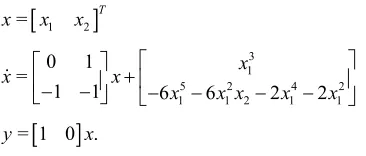
Example 2. The following system is the unforced
forth-order model of a flexible joint robotic arm as pre-sented in [2,4,5]. The reason we have chosen this exam-ple is that it is an important industrial application and has been widely used as a benchmark system to evaluate the performance of the observers designed for Lipschitz nonlinear systems.
0 1 0 0 0
48.6 1.25 48.6 0 0
=
0 0 0 1 0
19.5 0 19.5 0 3.33sin( 3)
x x x
1 0 0 0
= .
0 1 0 0
y x
The system is globally Lipschitz with Lipschitz con-stant = 3.33. Noticing the structure of that has a zero entry in three of its channels, Raghavan [2], pro-posed the coordinates transformation x Tx= , where
= 1,1, 4,0.1
T diag under which the transformed sys-tem has Lipschitz constant = 0.083. Using Theorem 2,
* = 0.4472
in the original coordinates and *= 2.4177 in the transformed coordinates. The observer gain L, is obtained in the transformed coordinates and computed in the original coordinates as L T L= 1 . Assuming
= 0.2
, B= 1 1 1 1
T, D= 0.1 0.25
T,4 4
= 0.5 ,
H I
and using Theorem 3 we get, *= 0.5753, = 2.0517,
= 0.0609
, and finally the observer gain will be
33.4865 129.9249 59.89713 108.2134
= .
38.5694 282.8603 102.1561 171.0910
T
L
[image:7.595.65.290.266.552.2]
Figure 1, shows the true and estimated values of states.
Figure 1. The true and estimated states of Example 2.
ditions for the system are x
0 = 0
1 0 2
T and those of the all observers are xˆ 0 = 1 0
0.5 0
T. As seen in Figure 1, the observer designed using theproposed LMI optimization method has the best conver-gence of the three. Note that in addition to the better convergence, the proposed observer is an H filter
with maximized disturbance attenuation level while the observers designed based on the methods of [2-6] can only guarantee stability of the observer error.
Example 3. In this example we show the usage of the
multiobjective optimization of Theorem 4 in the design of Hobservers. Consider the following system
1 2
= T
x x x
3 1
5 2 4 2
1 1 2 1 1
0 1
=
1 1 6 6 2 2
x
x x
x x x x x
= 1 0 .
y x
The systems is locally Lipschitz. Its Lipschitz constant is region-based. Suppose we consider the region as follows
2
1 2 1
= x x, x 0.25
in which the Lipschitz constant is
= 0.4167
. We choose= 0.5
H I ,B= 1 1
T,D= 0.2, = 0.05and solve the multiobjective optimization problem of Theorem 4 with = 0.9. We get
*= 0.5525
*= 1.1705
= 1.6260
4
= 2.2435 10
= 23.7025 13.7272 .T
L
The true and estimated values of states are shown in Figure 2. We have assumed that
0 =
0.2 1.45
Tx
ˆ 0 = 0.25 2T
x
= 0.15exp
sin .w t t t
For any w t
L2
0,
, disturbance rejec-tion ratio should be less than or equal 0.3371 (ob-tained for = 0). The actual disturbance rejection ratio of this simulation is 0.2302. If instead, = 0.5 then*= 0.4686
, = 1.4161, = 0.0067
= 329.9735 244.1398T
L
[image:8.595.58.241.533.611.2]Figure 2. The true and estimated states of Example 3 in the presence of disturbance.
[image:9.595.104.494.381.688.2]Figure 4. The optimal surface of *.
Figure 5. The optimal surface of* .
ment noise, sometimes, it is better to have an observer gain with smaller elements. There might also be practical difficulties in implementing high gains. We can control the Frobenius norm of L either by changing the feasi-bility radius of the LMI solver or by decreasing 1
min P
which is
1max P
, to decrease
L . The latter canbe done by replacing P> 0 with P>I in which
> 0
can be either a fixed scaler or an LMI variable. Using these tricks, an observer with the same decay ratio
= 0.5
[image:10.595.117.479.355.624.2]be achieved
* = 0.5314
, = 1.3973, = 0.0125
= 134.4040 90.0881T
L
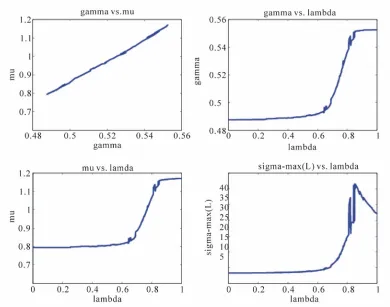
as seen, the price of this is bigger disturbance rejection ratio. The values of *, *, norm of the observer gain matrix, ( )L , and the optimal trade-off curve between
*
and * over the range of when the decay rate is fixed
= 0.05
are shown in Figure 3. As seen inthe figure, there is a trade of between the Lipschitz maximization (the robustness feature against nonlinear uncertainty) and the disturbance attenuation (the H
performance). We like to have a * as large as possible and a * as small as possible. The parameter that con-trols this trade off is the weight used in the cost function of the proposed Pareto convex optimization. Pareto multiobjective optimization leads to an optimal curve rather than a single point. The selection of particu-lar point on that curve is then based on the appropriate selection of based on the acceptable values for * and *.
The values of *, *, norm of the observer gain ma-trix, ( )L , and the optimal trade-off curve between * and * over the range of when the decay rate is fixed
= 0.05
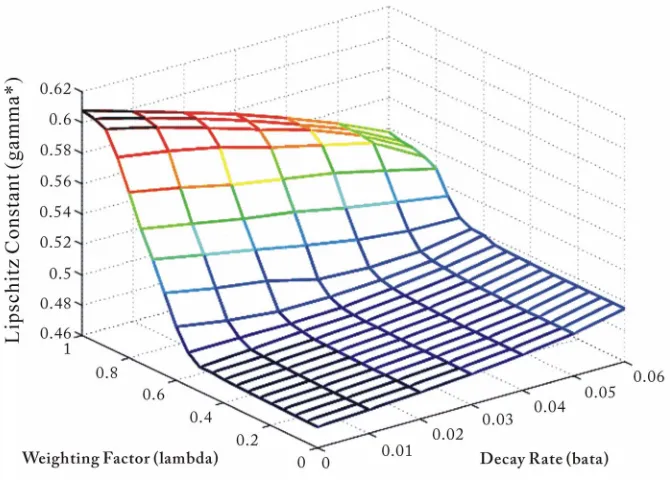
are shown in Figure 3. The optimalsurfaces of * and * over the range of when the decay rate is variable are shown in Figures 4,5,
respec-tively.
7. Conclusions
A new method of robust observer design for Lipschitz nonlinear systems proposed based on LMI optimization. The Lipschitz constant of the nonlinear system can be maximized so that the observer error dynamics not only be asymptotically stable but also the observer can toler-ate some additive nonlinear uncertainty. In addition, the result extended to a robust H nonlinear observer. The obtained observer has three features, simultaneously. Asymptotic stability, robustness against nonlinear uncer-tainty and minimized guaranteed H cost. Thanks to the linearity of the proposed LMIs in both admissible Lipschitz constant and the disturbance attenuation level, they can be simultaneously optimized through convex multiobjective optimization. The observer high perform-ance showed through design examples.
REFERENCES
[1] F. Thau, “Observing the State of Nonlinear Dynamic
Systems,” International Journal of Control, Vol. 17, No. 3, 1973, pp. 471-479.
[2] S. Raghavan and K. J. Hedrick, “Observer Design for a Class of Nonlinear Systems,” International Journal of Control, Vol. 59, No. 2, 1994, pp. 515-528.
[3] R. Rajamani, “Observers for Lipschitz Nonlinear Sys-tems,” IEEE Transactions on Automatic Control, Vol. 43, No. 3, 1998, pp. 397-401.
[4] R. Rajamani and Y. M. Cho, “Existence and Design of Observers for Nonlinear Systems: Relation to Distance to Unobservability,” International Journal of Control, Vol. 69, No. 5, 1998, pp. 717-731.
[5] C. Aboky, G. Sallet and I. C. Walda, “Observers for Lipschitz Non-Linear Systems,” International Journal of Control, Vol. 75, No. 3, 2002, pp. 534-537.
[6] A. Pertew, H. J. Marquez and Q. Zhao, “H∞ Observer Design for Lipschitz Nonlinear Systems,” IEEE Transac-tions on Automatic Control, Vol. 51, No. 7, 2006, pp. 1211-1216.
[7] A. Howell and J. K. Hedrick, “Nonlinear Observer De-sign via Convex Optimization,” Proceedings of the Ame- rican Control Conference, Vol. 3, 2002, pp. 2088-2093. [8] S. Boyd, L. E. Ghaoui, E. Feron and V. Balakrishnan,
“Linear Matrix Inequalities in System and Control The-ory,” Society for Industrial and Applied Mathematics, Philadelphia, 1994.
[9] C. E. de Souza, L. Xie and Y. Wang, “H∞Filtering for a Class of Uncertain Nonlinear Systems,” Systems and Control Letters, Vol. 20, No. 6, 1993, pp. 419-426. [10] Y. Wang, L. Xie and C. E. de Souza, “Robust control of a
class of uncertain nonlinear systems,” Systems and Con-trol Letters, Vol. 19, No. 2, 1992, pp. 139-149.
[11] H. Khalil, “Nonlinear Control Systems,” 3rd Edition, Prentice Hall, Upper Saddle River, New Jersey, 2002. [12] H. J. Marquez, “Nonlinear Control Systems: Analysis and
Design,” Wiley, New York, 2003.
[13] G. Wood and P. Zhang, “Estimation of the Lipschitz con-stant of a function,” Journal of Global Optimization, Vol. 8, No. 1, 1996, pp. 91-103.
[14] S. Xu, “Robust H∞Filtering for a Class of Discrete-Time Uncertain Nonlinear Systems with State Delay,” IEEE Transactions on Circuits and Systems I: Fundamental Theory and Applications, Vol. 49, No. 12, 2002, pp. 1853-1859.
[15] F. Zhu and Z. Han, “A Note on Observers for Lipschitz Nonlinear Systems,” IEEE Transactions on Automatic Control, Vol. 47, No. 10, 2002, pp. 1751-1754.
![Figure 1, shows the true and estimated values of states. The actual states are shown along with the estimates ob-tained using Raghavan's [2] and Aboky's [5] methods and our proposed LMI optimization method](https://thumb-us.123doks.com/thumbv2/123dok_us/8992848.396095/7.595.65.290.266.552/figure-estimated-estimates-raghavan-aboky-methods-proposed-optimization.webp)