Applied Mathematics, 2010, 1, 489-498
doi:10.4236/am.2010.16064 Published Online December 2010 (http://www.SciRP.org/journal/am)
Rotating Variable-Thickness Inhomogeneous Cylinders:
Part II—Viscoelastic Solutions and Applications
Ashraf M. Zenkour
Department of Mathematics, Faculty of Science, King AbdulAziz University, Jeddah, Saudi, Saudi Arabia Department of Mathematics, Faculty of Science, Kafrelsheikh University, Kafr el-Sheikh, Egypt
E-mail: [email protected]
Received June 2, 2010; revised October 12, 2010; accepted October 16, 2010
Abstract
Analytical solutions for the rotating variable-thickness inhomogeneous, orthotropic, hollow cylinders under plane strain assumption are developed in Part I of this paper. The extensions of these solutions to the viscoe- lastic case are discussed here. The method of effective moduli and Illyushin's approximation method are used for this purpose. The rotating fiber-reinforced viscoelastic homogeneous isotropic hollow cylinders with uni- form thickness are obtained as special cases of the studied problem. Numerical application examples are given for the dimensionless displacement of and stresses in the different cylinders. The influences of time, constitutive parameter and elastic properties on the stresses and displacement are investigated.
Keywords: Rotating, Viscoelastic Cylinder, Orthotropic, Variable Thickness and Density
1. Introduction
In recent years the subject of viscoelasticity has received considerable attention from analysts and experimentalists. The stress state of a viscoelastic hollow cylinder with the help of internal pressure and temperature field is analyzed in the literature [1,2]. A modified numerical method is introduced by Ting and Tuan [3] to study the effect of cyclic internal pressure on the stress and temperature distributions in a viscoelastic cylinder. Talybly [4] has investigated the state of stress and strain for a viscoelastic hollow cylinder fastened to an elastic shell under non- isothermal dynamic loading. Feng et al. [5] have obtained the solution for finite deformations of a viscoelastic solid cylinder subjected to extension and torsion. The thermo- mechanical behavior of a viscoelastic finite circular cylin- der under axial harmonic deformations is presented by Karnaukhov and Senchenkov [6].
The determination of stress and displacement fields is an important problem in design of engineering structures using fiber-reinforced composite materials. The analyti- cal solution for the rotating fiber-reinforced viscoelastic cylinders becomes very complex when the thickness along the radius of the cylinder is variable, even for simple cases. Methods for solving quasi-static viscoelastic pro- blems in composite structures have been developed by a number of authors [7-9]. Allam and Appleby [10] have
used the realization method of elastic solutions to solve the problem of bending of a viscoelastic plate reinforced by unidirectionally elastic fibers. In other work [11], they have used the method of effective moduli to determine the stress concentrations around a circular hole or circu- lar inclusion in a fiber-reinforced viscoelastic plate under uniform shear. Allam and Zenkour [12] have used the small parameter method as well as the method of effective moduli for the bending response of a fiber- reinforced viscoelastic arched bridge model with quadra- tic thickness variation and subjected to uniform loading. In [13], they have also obtained the stresses around filled and unfilled circular holes in a fiber-reinforced visco- elastic plate under bending. The same author [14] have developed closed form solutions for the rotating fiber- reinforced viscoelastic solid and annular disks with variable thickness by applying the generalization of Illyushin's approximation method. In addition, Allam et al. [15] have determined the stress concentrations around a triangular hole in a fiber-reinforced viscoelastic com- posite plate under uniform tension or pure bending. Also, Zenkour et al. [16] have presented the elastic and visco- elastic solutions to rotating functionally graded hollow and solid cylinders.
taken to be functions in the radial coordinate. The gove- rning second-order differential equation is derived and solved with the aid of some hypergeometric functions. The displacement and stresses for rotating fiberrein- forced viscoelastic inhomogeneous orthotropic hollow cylinder with variable thickness and density subjected to various boundary conditions are obtained. Special cases of the studied problem are established and numerical results are presented in graphical forms.
2. Rotation of Viscoelastic Cylinders
According to the elastic solution given in part I, we can use the method of effective moduli and Illyushin's appro- ximation method to solve the rotation problem of vari- able thickness and density viscoelastic hollow cylinder reinforced with unidirectionally elastic fibers.
For an orthotropic cylinder, the compliance parameters
ij
can be expressed in terms of the engineering cha- racteristics as [17]:
11 22 12 13 23 1 1 = , = , = = , = = , = = ,r z z rz zr
r r z zr r z rz
r zr r z z rz r z
z r zr z z r rz
E E E E E E E E (1) in which
= 1 r r zr rz z z 2 r z rz,
(2)
where Ei are Young's moduli and ij are Poisson's
rations which are related by the reciprocal relations:
= , = , = .
r r rz zr z z
r r z z
E E E E E E
(3)
Now, consider a hollow cylinder made of a composite material composed of two components. A viscoelastic material as a first component, reinforced by unidirec- tional elastic fibers as a second component. The first of these components plays the role of filler and may posses the properties of a linear viscoelastic material, and it is described by the modulus Ef and Poisson's ratio f.
The other component will be serve as the reinforcement and is an elastic material with modulus of elasticity E
and Poisson's ratio .
Under the above considerations and using the method of effective moduli [14,18], Young's moduli and Poisson's ratios, with r =r =rz =z=1 and
2
= =
zr z
, are given by [19]:
1 2
= = , = 1 ,
1
1
= , = 1
1 1
f
r z f
f
f f
f
f f
EE
E E E E E
E E
EE
E E E E
(4) where is the volume fraction of fiber reinforcement. Thus, it is obvious that the reciprocal relations given in Equation (3) are fulfilled.
Note that, the viscoelastic modulus Ef is given by:
9 = , 2 f K E
(5)
where K is the coefficient of volume compression (the bulk modulus) and it is assumed to be not relaxed, i.e.
=
K const., andis the dimensionless kernel of relaxa- tion function which is related to the corresponding Poi- sson's ratio by the formula:
1 2 = . 1 f f
(6)
Substituting from Equations (5) and (6) into Equation (4) yields 1 2 9 1 9 = = , = ,
2 1 1 9 2
1 1 9
2 2 1 1
= , =
2
9 1 9
1
2 2
r z
p p
E E E E E
p p p p (7) or in the simple form
2 1 2 1 1 1 1 1 2 1 9= = 1 , = 9 1 1 ,
2 1
3
9 1 1 1
2
= ,
9 1 1 9 1 1
3
= 1 1 ,
2
r z
Ep
E E g E E p g
p g g
p g p g
g (8) in which 1 2
1 1 1 9
= , = , = 1 ,
1 2 2 1
i i p g
(9)
where p=K E/ is the constitutive parameter.
With the help of Equations (1) and (8), one can rewrite the solutions given in Part I of this paper; see Equations (20) and (23)-(25); in the form:
2 2 2 2 ˆ = , , = , , ˆ ˆ = , , = , , rr rr zz zzu u r r
r r
(10)
A. M. ZENKOUR 491
2 3
2 0 2 2 2
0
ˆ
= b , = b .
E
(11)
It is to be noted that, in elastic composites, the radial displacement and stresses are functions of and r while in viscoelastic composites they are operator functions of the time t and r. According to Illyushin's approximation method [11,19,20], the function u can be represented in the form:
5
=1
( , ) = i i ,
i
u r
A r (12) where i( ) are some known kernels, constructed on the base of the kernel and may be chosen in the form:1 2 3 4 1 5 2
1
= 1, =, = = , =g , =g ,
(13) where , ( = 1, 2)
i
g i are given in Equation (9).
The coefficients A ri( ) are determined from the system of algebraic equations
5
=1
= , = 1, , 5 ,
ij j i
j
L A B i
(14)where
1 1
0 0
= , = , .
ij i j i i
L
d B
u r d (15) Now, let us consider the relaxation function in an exponential form
= 1 2 , tt c c e
(16)
where c1 and c2 are constants to be experimentally
determined. Laplace-Carson transform can be used to determine the functions ( ) t and ( )
i
g t . Denoting the transforms of ( )t and ( )
i
g t by ( )t and gi( )t , since the transform of ( )t is
2 1
( ) =s c sc ,
s
(17)
thus, we get
/
2 1 1 2
1 1 2
1 / 1
2 1 1 2
1 1 2
1
= 1 , = ,
1
= 1
1 1
c c c
c c c
i i i
i
i i
c
t e t
c c c
c
g t e
c c c
(18) Equation (12) for a viscoelastic composite may be re- corded to obtain explicit formula for the radial dis- placement as function of r and time t in the form:
2 2
1 2 0
2 2 2
3 0 4 0 1
2
5 0 2
( , ) = ( ) ( ) ( ) ( ) ( ) ( ) ( ) ( ) ( ) ( ) ( ) ( ) ( ) ( ). t t t t
u r t A r t A r t d
A r t d A r g t d
A r g t d
(19)Taking 2( ) =t 02H t( ), where H t( ) is the Heaviside's
unit step function given by
1 0,
( ) =
0 < 0.
if t H t if t
(20)
Then, Equation (19) takes the form
2
0 1 2 3 4 1 5 2
( , ) =
( ) ( ) ( ) ( ) ( ) .
u r t
A H t A t A t A g t A g t
(21)
where ( ), ( )t t and ( )
i
g t are given in Equations (16) and (18). Using the same technique once again to obtain the radial, circumferential and axial stresses for the rotating fiber-reinforced viscoelastic hollow cylinder with variable thickness and density by replacing only
( , )
u r t with ( , )r t and making the suitable changes in this case.
3. Applications
In this section, some numerical examples for the rotating fiber-reinforced viscoelastic inhomogeneous variable- thickness cylinder will be introduced. The results of the present problem will be given for three sets of geometric parameters k and n for the thickness profile. The nu- merical applications will be carried out for the radial displacement and stresses that being reported herein are in the following dimensionless forms:
2 2 2 2
0 0 0 0
= , = , = , = .
ˆ ˆ ˆ
rr zz
r r z
u
u
The effect of the elastic properties of the cylinder, constitutive and time parameters on the dimensionless radial displacement and stresses will be shown. The cal- culations will be carried out for the following values of parameters: = 0.3, =c1= 0.1,c2= 0.9 and = 0.5.
In addition, other parameters are taken (except otherwise stated) as:p= 0.2,k= 2.5,n= 0.8and m= 1. Also, the coefficient is still unknown and the time parameter
( t)
is given in terms of it.
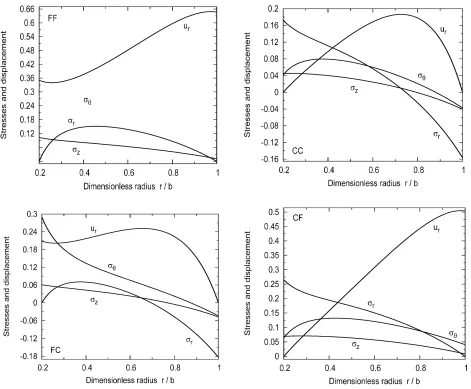
The distributions of the dimensionless stresses and displacement through the radial direction of the rotating fiber-reinforced viscoelastic inhomogeneous variable- thickness cylinder are plotted in Figures 1-3 according to the FF, CC, FC and CF boundary conditions, respectively. For all hollow cylinders, the dimensionless radial displacement ur is the largest in the same
position for small k, i.e. k= 0.6. For FF and CF hollow cylinders, the dimensionless stresses are the largest for small n. The minimum values of the dimen- sionless radial stress r at the outer surface of the CC
[image:4.595.61.532.82.471.2]
Figure 1. Dimensionless stresses and displacement for a variable-thickness viscoelastic hollow cylinder subjected to various boundary conditions (k = 0.6, n = 0.8, m = 0.5).
A. M. ZENKOUR 493
[image:5.595.70.530.79.264.2]
Figure 2. Dimensionless stresses and displacement for a variable-thickness viscoelastic hollow cylinder subjected to various boundary conditions (k = 2.5, n = 0.8, m = 0.5).
[image:5.595.67.530.307.691.2]
the dimensionless circumferential and axial z
stresses are smaller through the radial direction of the CC hollow cylinders when k= 0.6. The maximum value of
[image:6.595.317.530.144.686.2] at the inner surface for FC hollow cylinder are the smallest when k = 2.5 and n = 0.8. In addition, the di-
Figure 4. Distribution of dimensionless stresses and dis-placement through the radial direction of a FF variable- thickness viscoelastic hollow cylinder.
mensionless axial stresses are monotone decreasing in
r and it is smaller for n = 0.4 than for n = 0.8.
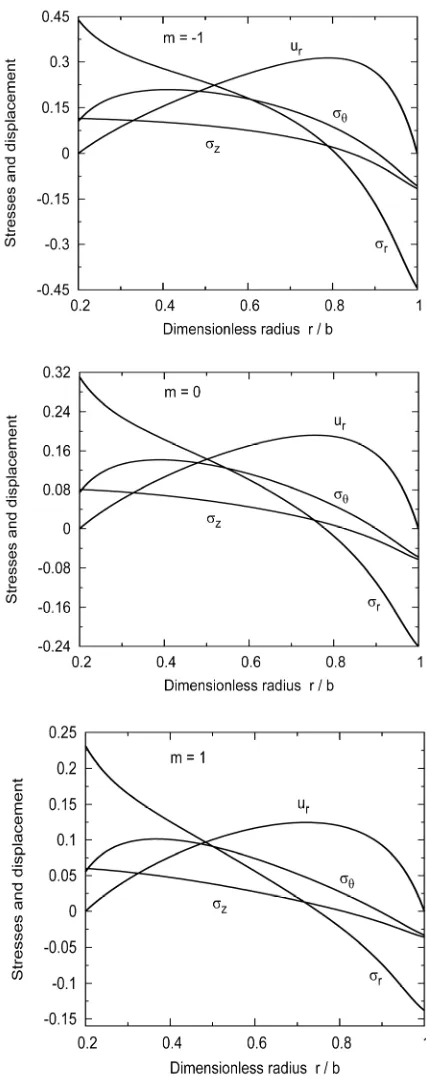
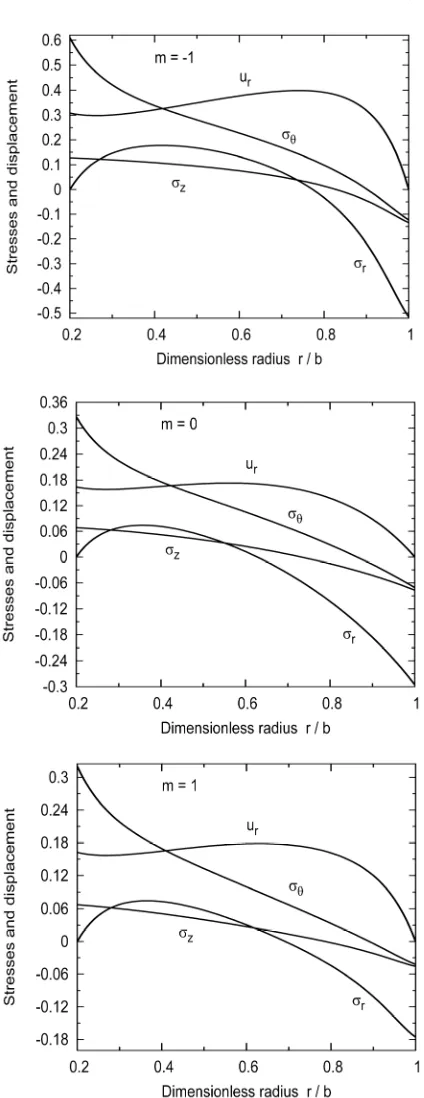
For a profile with geometric parameters k= 2.5 and = 0.8
[image:6.595.66.279.145.688.2]n , the dimensionless displacement and stresses are plotted in Figures 4-7 for the rotating fiber-reinforced
A. M. ZENKOUR 495
Figure 6. Distribution of dimensionless stresses and dis-placement through the radial direction of a FC variable- thickness viscoelastic hollow cylinder.
[image:7.595.317.529.76.621.2]viscoelastic inhomogeneous cylinder subjected to various boundary conditions with different values of the para- meter m. The stresses and displacement for m= 1 are the smallest when compared to the results for m= 0
Figure 7. Distribution of dimensionless stresses and dis-placement through the radial direction of a CF variable- thickness viscoelastic hollow cylinder.
and 1. For FF and FC hollow cylinders, the dimen- sionless radial displacement ur has changed concavity.
The dimensionless radial stress r increases firstly to
external surface to get zero value for FF boundary condition while it tends to a constant value for FC boun- dary condition. In both cases, the dimensionless circum- ferential stress has maximum value at the inner sur- face. Also, the dimensionless radial displacement ur
increases directly as the dimensionless radius r incr- eases for CF hollow cylinders while the highest values of it occur near the external surfaces of the CC hollow cylinders. The dimensionless radial stress r is mono-
tone decreasing in r for CC and CF hollow cylinders. In all figures, the dimensionless axial stress z decr-
eases from the inner to the outer surface. Also, the di- mensionless radial displacement for a profilek= 0.6,
= 0.8
n and m= 1is plotted in Figure 8 with various values of the constitutive parameter p. For CF and FF hollow cylinders, the dimensionless radial displacement
r
u and the concavity changed of it for FC hollow cy- linder increase with the decreasing of the constitutive parameter p. In addition, the maximum values of ur
decrease with the increase of p for CC hollow cylinder. Note that, the maximum values of
u
r occur at the sameposition, r = 0.72 for different values of p.
Finally, the influence of time parameter on the dimensionless displacement and stresses for variable thickness viscoelastic hollow cylinder subjected to FF, CC, FC and CF boundary conditions is plotted in Figure 9. This influence is studied at the position r = 0.5 with geometric parameters k= 0.6, = 0.8n and m= 1. For all hollow cylinders, the dimensionless radial displace- ment ur increases rapidly with increasing the time pa-
rameter to get a constant value for 55. Also for FF hollow cylinders, the dimensionless radial r and
circumferential stresses may be unchanged with time parameter 2.5 while the dimensionless axial stress z increases rapidly to still unchanged for 8.
For CC and FC hollow cylinders, the highest values of ,
r
and z occur at 3, 2.5 and 5, respectively,
then they are decreasing in the intervals 3 << 14, 2.5 < < 16 and 5 << 17 to still unchanged for
14, 16
and 17, respectively. Also for CF hollow cy- linder, the minimum value of the dimensionless radial stress happens at 2 then it is increasing slowly to app-
[image:8.595.69.530.340.701.2]
A. M. ZENKOUR 497
[image:9.595.73.524.77.412.2]
Figure 9. The effect of time parameter on (a) ur, (b) r, (c) and (d) z of a variable-thickness viscoelastic hollow cylinder at r= 0.5.
roach a constant value for 13. However, the dimen- sional circumferential and axial stresses increase to get their maximums at 3.5 and 7.5 , respectively, then decrease to still unchanged for 15 and 17.5 , respectively.
4. Conclusions
The rotation problem of a fiber-reinforced viscoelastic inhomogeneous variable-thickness hollow cylinder has been studied. The elastic problem is solved analytically by using the hypergeometric functions. The viscoelastic problem is solved using both the method of effective moduli and Illyushin's approximation method. Analytical solution for rotating fiber-reinforced viscoelastic inho- mogeneous anisotropic hollow cylinder of variable thi- ckness and density subjected to different boundary con- ditions are derived. The displacement and stresses for rotating fiber-reinforced viscoelastic homogeneous isotr- opic hollow cylinder with uniform thickness and density are obtained as special cases of the investigated problem. The effects due to many parameters on the radial dis-
placement and stresses are investigated.
5. References
[1] I. E. Troyanovskii and M. A. Koltunov, “Temperature Stresses in a Long Hollow Viscoelastic Cylinder with Variable Inner Boundary,” Mekhanika Polimerov, Vol. 5, No. 2, 1969, pp. 219-226.
[2] M. A. Koltunov and I. E. Troyanovskii, “State of Stress of a Hollow Viscoelastic Cylinder Whose Material Prop-erties Depend on Temperature,” Mechanics of Composite Materials, Vol. 6, No. 1, 1970, pp. 72-79.
[3] E. C. Ting and J. L. Tuan, “Effect of Cyclic Internal Pressure on the Temperature Distribution in a Viscoelas-tic Cylinder,” International Journal of Mechanical Sci- ences, Vol. 15, No. 11, 1973, pp. 861-871.
[4] L. Kh. Talybly, “Deformation of a Viscoelastic Cylinder Fastened to a Housing under Non-Isothermal Dynamic Loading,” Journal of Applied Mathematics and Mechan-ics, Vol. 54, No. 1, 1990, pp. 74-82.
[6] V. G. Karnaukhov and I. K. Senchenkov, “Thermome-Chanical Behavior of a Viscoelastic Finite Circular Cy-linder under Harmonic Deformations,” Journal of Engi-neering Mathematics, Vol. 46, No. 3-4, 2003, pp. 299-312.
[7] D. Bland, “The Linear Theory of Viscoelasticity,” Per-gamon Press, New York, 1960.
[8] D. Abolinsh, “Elasticity Tensor for Unidirectionally Reinforced Elastic Material,” Polymer Mechanics, Vol. 4, No. 1, 1965, pp. 25-59.
[9] A. A. Illyushin and B. E. Pobedria, “Foundations of Ma- thematical Theory of Thermo-Viscoelasticity,” in Russian, Nauka, Moscow, 1970.
[10] M. N. M. Allam and P. G. Appleby, “On the Plane De-formation of Fiber-Reinforced Viscoelastic Plates,” Ap-plied Mathematical Modelling, Vol. 9, No. 5, 1985, pp. 341-346.
[11] M. N. M. Allam and P. G. Appleby, “On the Stress Con-centrations around a Circular Hole in a Fiber-Reinforced Viscoelastic Plate,” Res Mechanica, Vol. 19, No. 2, 1986, pp. 113-126.
[12] M. N. M. Allam and A. M. Zenkour, “Bending Response of a Fiber-Reinforced Viscoelastic Arched Bridge Mod-el,” Applied Mathematical Modelling, Vol. 27, No. 3, 2003, pp. 233-248.
[13] A. M. Zenkour and M. N. M. Allam, “Stresses around Filled and Unfilled Circular Holes in a Fiber-Reinforced Viscoelastic Plate under Bending,” Mechanics of Ad-vanced Materials and Structures, Vol. 12, No. 6, 2005, pp. 379-389.
[14] A. M. Zenkour and M. N. M. Allam, “On the Rotating Fiber-Reinforced Viscoelastic Composite Solid and An-nular Disks of Variable Thickness,” International Journal for Computational Methods in Engineering Science and Mechanics, Vol. 7, No. 1, 2006, pp. 21-31.
[15] M. N. M. Allam, A. M. Zenkour and H. F. El-Mekawy, “Stress Concentrations in a Viscoelastic Composite Plate Weakened by a Triangular Hole,” Composite Structures, Vol. 79, No. 1, 2007, pp. 1-11.
[16] A. M. Zenkour, K. A. Elsibai and D. S. Mashat, “Elastic and Viscoelastic Solutions to Rotating Functionally Graded Hollow and Solid Cylinders,” Applied Mathe-matics and Mechanics - English Edition, Vol. 29,No. 12, 2008, pp. 1601-1616.
[17] A. E. Bogdanovich and C. M Pastore, “Mechanics of Textile and Laminated Composites with Applications to Structural Analysis,” Chapman and Hall, New York, 1996.
[18] B. E. Pobedria, “Structural Anisotropy in Viscoelastici-ty,” Mechanics of Composite Materials, Vol. 12, No. 4, 1976, pp. 557-561.
[19] A. M. Zenkour, “Thermal Effects on the Bending Re-sponse of Fiber-Reinforced Viscoelastic Composite Pla- tes using a Sinusoidal Shear Deformation Theory,” Acta Mechanica, Vol. 171, No. 3-4, 2004, pp. 171-187. [20] M. N. M. Allam and B. E. Pobedria, “On the Solution of