ISSN Online: 2156-8561 ISSN Print: 2156-8553
DOI: 10.4236/as.2019.105050 May 23, 2019 651 Agricultural Sciences
Influence of Bentonite and MB4 on the
Chemical Characteristics of an Oxisol
Gilvanise Alves Tito
1, Lúcia Helena Garófalo Chaves
1, Felipe Guedes Souza
1,
Antônio Ramos Cavalcante
1, Josely Dantas Fernandes
2, Ana Carolina Feitosa de Vasconcelos
11Department of Agricultural Engineering, Federal University of Campina Grande (DEAG/UFCG), Campina Grande, Brazil 2Center of Agricultural and Environmental Sciences, State University of Paraiba, Lagoa Seca, Brazil
Abstract
The growing concern with the quality of life and the environment, due to the degradation of natural resources and their contamination, mainly with agro-chemicals, led to the emergence of a sustainable or alternative agriculture. The objective of this study was to evaluate the effect of the addition of in-creasing doses of bentonite and MB4 on the availability of nutrients to the soil. The experiment consisted of a 4 × 4 factorial, bentonite doses (0, 30, 60 and 90 t∙ha−1) and MB4 doses (0, 3, 6 and 9 t∙ha−1) with three replications. The
soil mixtures with the treatments were conditioned in the plastic pots, incu-bated for 90 days in a greenhouse, and chemically analyzed. Data were sub-mitted to analysis of variance and comparison of means by the Tukey test. Increasing doses of bentonite and MB4 promoted an increase in the calcium (Ca), magnesium (Mg) in the soil sample either alone or the mixture of two factors, except for the mixture of the Ca Mg doses. Increasing doses of bento-nite increased the cation exchange capacity of the soil, favoring the availabili-ty of nutrients in the soil. The increasing doses of MB4 favored the increase of the pH values and, consequently, decreased the soil potential acidity values for the applied bentonite doses. On the other hand, these treatments de-creased the cation exchange capacity of the soil.
Keywords
Soil Conditioner, Nutrients, Rock Dust
1. Introduction
The soil can lose its nutrients through several processes: plant uptake, erosion, volatilization and leaching. Leaching is probably the most important process of How to cite this paper: Tito, G.A., Chaves,
L.H.G., Souza, F.G., Cavalcante, A.R., Fer-nandes, J.D. and de Vasconcelos, A.C.F. (2019) Influence of Bentonite and MB4 on the Chemical Characteristics of an Oxisol. Agricultural Sciences, 10, 651-664. https://doi.org/10.4236/as.2019.105050
Received: April 18, 2019 Accepted: May 20, 2019 Published: May 23, 2019
Copyright © 2019 by author(s) and Scientific Research Publishing Inc. This work is licensed under the Creative Commons Attribution International License (CC BY 4.0).
DOI: 10.4236/as.2019.105050 652 Agricultural Sciences nutrient loss in moist soils, but according to [1] is very difficult to avoid it.
The low productivity of crops cultivated in sandy soils is due to constant losses of the nutrients through the ease with which they allow the movement of nutrients from the superficial layers to deeper layers of the soil, far from the roots of the plants [2]. Therefore, the replacement of these nutrients, through elements and chemical compounds, is indispensable to the crop yields.
Considering the model of agricultural development adopted in Brazil, much of the demand for fertilizers for crops is supplied through the use of readily so-luble fertilizers by NPK formulations, associated or not with the use of macro and micronutrients, to ensure satisfactory yields. Many farmers also use organic fertilizers as a source of nutrients, sometimes associated with mineral fertilizers. In organic agriculture, ground natural rocks have been used as a source of nu-trients. The use of natural rocks in agriculture, as natural fertilizers, has grown greatly in recent years [3].
The minerals contained in the rocks are nutrient sources of slow release of to the soil and, depending on their mineralogical composition, can contribute with a varied and expressive amount of essential elements to the plants. The use of grounded rock silicate fertilizers is attractive as these types of fertilizers have the potential to supply soils with a large array of macro and micronutrients in com-parison to commercially available soluble fertilizers, which commonly only supply the main macronutrients N, P and K, but not nutrients such as Ca, Mg and micronutrients [4]. Grounded rocks are increasingly being used due to the need to recover impoverished, unbalanced soils that have lost much of the nu-trient reserve of their mineral constituents [5].
The effectiveness of rock powder as a source of nutrients to the soil is ques-tioned because of the low solubility and the need to be applied in large amounts to the soil to obtain positive responses [6]. This depends on factors such as the chemical and mineralogical composition of the rock, the granulometry of the material, the reaction time, and soil factors such as pH and biological activity [7].
In Brazil, there are still few references to the use of grounded rocks in agri-culture on a commercial scale. Mixtures of several grounded rocks have been commercialized, for example, by the company MIBASA of Arapiraca, State of Alagoas, whose main product is the MB4 rock meal. MB4 is a mixture of two rocks: biotitaxisto and serpentinite, in the ratio of 1:1 [8]. This product comes from the grinding of silicate rocks and has about 48% silica in its composition.
According to [9], MB4 has been tested in various soils and has proven to be an efficient recovering and improver of soils, because it has a wide variety of chem-ical elements, providing essential nutrients for plants.
DOI: 10.4236/as.2019.105050 653 Agricultural Sciences These are found in large deposits in the municipality of Boa Vista, Paraíba state, Brazil.
Chemical and mineralogical analyses showed that there are differences be-tween clays of different colors. Green and chocolate clays, for example, generally contain high smectite content and few impurities, such as ilite and kaolinite. These clays are also chemically different because they contain low silicon content and high aluminum content relative to other colors [11].
Both bentonite and MB4 were donated materials to be used in scientific re-search, so there was no cost to purchase them.
In this sense, the objective of this work was to evaluate the effect of the addi-tion of increasing doses of bentonite and MB4 on the availability of nutrients to the soil.
2. Materials and Methods
This experiment was carried out in a greenhouse at the Agricultural Engineering Department, Federal University of Campina Grande, Paraiba, Brazil, using soil samples collected in the superficial layer (0 - 20 cm) of Eutrophic Red Latosol [12]. These samples were air-dried, crushed, sieved through a 2 mm sieve and chemically characterized according to [13], presenting the following attributes: pH (H2O) = 5.5; Ca = 2.14 cmolc∙kg−1; Mg = 0.98 cmolc∙kg−1; Na = 0.12
cmolc∙kg−1; K = 0.18 cmolc∙kg−1; H+ Al = 6.25 cmolc∙kg−1; organic carbon = 8.13 g
kg−1; P = 8.0 mg kg−1 and CTC = 9.67 cmol c∙kg−1.
The bentonite clay samples were collected in the Primavera mine, Paraiba State, Brazil. These samples were air dried and sieved with 0.074 mm mesh in order to precede X-ray diffraction and X-ray florescence analysis. According to these analysis, bentonite samples presents picks of smectite clays, tridymite (a si-licate mineral and polymorph of high temperature of quartz), and quartz (low quantity), also presenting the following composition: SiO2 = 76.784%; Al2O3 =
13.339%; Fe2O3 = 6.035%; MgO = 2.225%; CaO = 0.759% and other oxides =
0.545%. The cation exchange capacity was also determined by the methylene blue method [14], resulting in 48 meq/100g of dry clay and specific area: 375 m2/g.
The MB4 rock powder used in the experiment came from MIBASA company, located in Alagoas state, Brazil. This powder is a mixture of two rocks: biotite shale and serpentinite, in the proportion of 1:1 [8]. According to [15], MB4 is a rock mixture composed of: 39.73% SiO2; 17.82% MgO; 7.10% Al2O3; 6.86%
Fe2O3; 5.90% CaO; 1.48% Na2O; 0.84% K2O; 0.18% of S; 0.075% P2O5; 0.074%
Mn; 0.029% Cu; 0.029% Co and 0.03% Zn.
The experiment followed a completely randomized design, in a 4 × 4 factorial scheme: four doses of bentonite (B0 = 0, B30 = 30, B60 = 60 and B90 = 90 t∙ha−1)
and four doses of MB4 (M0 = 0; M3 = 3; M6 = 6 and M9 = 9 t∙ha−1) with three
pre-DOI: 10.4236/as.2019.105050 654 Agricultural Sciences viously dried, sieved and mixed with the doses of bentonite and MB4 corres-ponding to the treatments.
The soil mixtures with the treatments were conditioned in the plastic buckets and placed in field capacity with water supply, remaining incubated for 90 days. The moisture of these mixtures was maintained close to the field capacity.
After incubation, soil samples from each experimental unit were collected, air dried, sieved in a 2 mm mesh and chemically characterized, according to the methods adopted by [13].
The results were submitted to analysis of variance, using the SISVAR program [16].
3. Results and Discussion
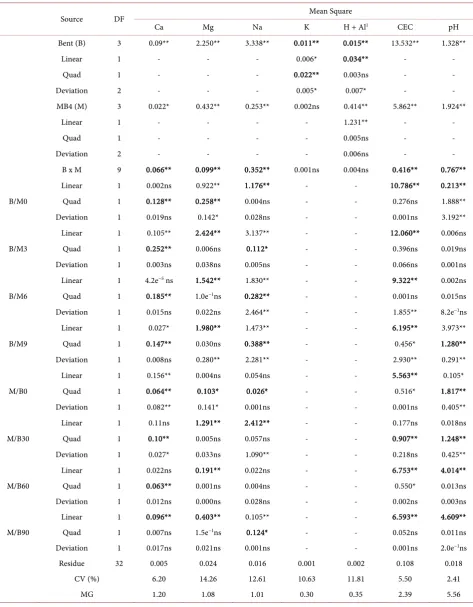
The analysis of variance showed that the interaction between the bentonite and MB4 factors was significant at p < 0.01 for all elements, except for potassium and H + Al, which did not present significant effects. Bentonite doses influenced all analyzed parameters (p < 0.01), while MB4 doses had a significant effect for all parameters except for potassium (Table 1).
In the treatments without MB4, represented by the curve M0 (Figure 1(a)), Ca is released by bentonite, and the results were better adjusted to the quadratic regression model, where its peak occurred in 1.3 cmolc∙kg−1, then decreasing
with increasing doses. However, even with this decrease, bentonite promoted an increase of 13.6% when the dose of 90 t∙ha−1 is compared to control. On the
oth-er hand, the M3, M6 and M9 t∙ha−1 curve of MB4, behaved inversely to the M0 (0
t∙ha−1) curve, whose initial values (0 t∙ha−1 of bentonite) were 1.43; 1.33 and 1.43
cmolc∙kg−1, respectively, greater than 1.058 cmolc∙kg−1 (M0); decreasing with the
increase of the doses of bentonite until the minimum point 0.96; 1.06 and 1.11 cmolc∙kg−1 for M3, M6 and M9, respectively.
The Ca contained in MB4 interacted with the bentonite providing a reduction of the available Ca (Figure 1(a)). This occurred, possibly, to the adsorption of Ca by bentonite. According to [17], this is due to the higher specific surface area of the bentonites and, consequently, higher cation adsorption capacity. Howev-er, from the minimum point, the levels of Ca available in the soil increased in the M3, M6 and M9 curves, probably because of the saturation of the clay exchange sites, i.e., it exceeded the maximum adsorption capacity of the bentonite.
Magnesium (Figure 1(b)) presented the opposite effect compared to Ca, i.e., increasing doses of bentonite without MB4 (M0) had lower Mg values than those with bentonite and MB4 (M3, M6 and M9). However, in the M0 curve it can be observed an increase of 158.9% in the available Mg in the soil, when comparing the 90 t∙ha−1 dose with the 0 t∙ha−1 dose of bentonite, showing that there was
DOI: 10.4236/as.2019.105050 655 Agricultural Sciences
Table 1. Analysis of variance of soil parameters: calcium (Ca), magnesium (Mg), sodium (Na), potassium (K), potential acidity (H + Al), cation exchange capacity (CEC) and pH after incubation with the treatments.
Source DF Mean Square
Ca Mg Na K H + Al1 CEC pH
Bent (B) 3 0.09** 2.250** 3.338** 0.011** 0.015** 13.532** 1.328**
Linear 1 - - - 0.006* 0.034** - -
Quad 1 - - - 0.022** 0.003ns - -
Deviation 2 - - - 0.005* 0.007* - -
MB4 (M) 3 0.022* 0.432** 0.253** 0.002ns 0.414** 5.862** 1.924**
Linear 1 - - - - 1.231** - -
Quad 1 - - - - 0.005ns - -
Deviation 2 - - - - 0.006ns - -
B x M 9 0.066** 0.099** 0.352** 0.001ns 0.004ns 0.416** 0.767**
Linear 1 0.002ns 0.922** 1.176** - - 10.786** 0.213**
B/M0 Quad 1 0.128** 0.258** 0.004ns - - 0.276ns 1.888**
Deviation 1 0.019ns 0.142* 0.028ns - - 0.001ns 3.192**
Linear 1 0.105** 2.424** 3.137** - - 12.060** 0.006ns
B/M3 Quad 1 0.252** 0.006ns 0.112* - - 0.396ns 0.019ns
Deviation 1 0.003ns 0.038ns 0.005ns - - 0.066ns 0.001ns
Linear 1 4.2e−5 ns 1.542** 1.830** - - 9.322** 0.002ns
B/M6 Quad 1 0.185** 1.0e−1ns 0.282** - - 0.001ns 0.015ns
Deviation 1 0.015ns 0.022ns 2.464** - - 1.855** 8.2e−1ns
Linear 1 0.027* 1.980** 1.473** - - 6.195** 3.973**
B/M9 Quad 1 0.147** 0.030ns 0.388** - - 0.456* 1.280**
Deviation 1 0.008ns 0.280** 2.281** - - 2.930** 0.291**
Linear 1 0.156** 0.004ns 0.054ns - - 5.563** 0.105*
M/B0 Quad 1 0.064** 0.103* 0.026* - - 0.516* 1.817**
Deviation 1 0.082** 0.141* 0.001ns - - 0.001ns 0.405**
Linear 1 0.11ns 1.291** 2.412** - - 0.177ns 0.018ns
M/B30 Quad 1 0.10** 0.005ns 0.057ns - - 0.907** 1.248**
Deviation 1 0.027* 0.033ns 1.090** - - 0.218ns 0.425**
Linear 1 0.022ns 0.191** 0.022ns - - 6.753** 4.014**
M/B60 Quad 1 0.063** 0.001ns 0.004ns - - 0.550* 0.013ns
Deviation 1 0.012ns 0.000ns 0.028ns - - 0.002ns 0.003ns
Linear 1 0.096** 0.403** 0.105** - - 6.593** 4.609**
M/B90 Quad 1 0.007ns 1.5e−1ns 0.124* - - 0.052ns 0.011ns
Deviation 1 0.017ns 0.021ns 0.001ns - - 0.001ns 2.0e−1ns
Residue 32 0.005 0.024 0.016 0.001 0.002 0.108 0.018
CV (%) 6.20 14.26 12.61 10.63 11.81 5.50 2.41
MG 1.20 1.08 1.01 0.30 0.35 2.39 5.56
DOI: 10.4236/as.2019.105050 656 Agricultural Sciences
Figure 1. Calcium (a), magnesium (b), sodium (c) and potassium (d) contents deter-mined in the soil after application and incubation of the treatments, increasing doses of bentonite (0, 30, 60, 90 t∙ha−1).
the curves M3, M6 and M9, respectively. Both bentonite and MB4 have MgO composition (2.22% and 7.10%, respectively) which was released into the soil as Mg2+. Nichele et al. [18], evaluating the potential of basalt powder as a source of
in-DOI: 10.4236/as.2019.105050 657 Agricultural Sciences creased sodium by 176.6% when comparing the 90 t∙ha−1 dose with the control
(Figure 1(c)). When the lower dose of MB4 (M3) is added, the Na values are lower when compared to M0, up to the 60 t∙ha−1 dose of bentonite, which may be
probably due to the adsorption power of the bentonite, increasing up to 90t∙ha−1,
probably by exceeding its cation adsorption capacity. On the other hand, with the incorporation of the doses 6 and 9 t∙ha−1 of MB4, there was an increase of
Na; however, the two curves were overlapped, showing that there was no differ-ence between these two treatments.
Potassium (K) was significant only with the effect of increasing doses of ben-tonite (Table 1), showing a better fit in the quadratic form (Figure 1(d)). A de-crease of potassium was observed when the dose of 30 t∙ha−1 of bentonite was
incorporated, until reaching the minimum point (0.268 cmolc∙kg−1),
corres-ponding to 52.32 t∙ha−1 of bentonite.
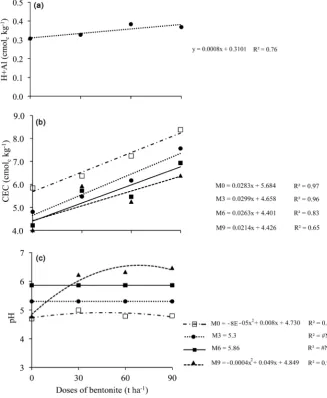
The potential acidity values were significant at p < 0.01 only for the isolated effect of increasing doses of bentonite and MB4 (Table 1). The incorporation of bentonite to the soil incubated for 90 days favored the linear increase of the po-tential acidity (Figure 2(a)), causing an increase of 23.2% when comparing the 90 t∙ha−1 dose of bentonite to control. This fact can be justified due to the high
content of Al2O3 (13.34%) presented in the bentonite composition used in this
study.
Although bentonite retains exchangeable cations, it is generally found that in-creasing doses of bentonite favored cation exchange capacity (CEC), especially without the presence of MB4 (M0) (Figure 2(a)), corroborating [19]. Clays have high micro porosity and greater specific surface, increasing the number of avail-able sites for the bonds, thus favoring a greater CEC. According to [17], fine soil aggregates and clay minerals have a greater capacity to retain heavy metals due to their larger surface area, corroborating [20]. It can be inferred that the bento-nite was favorable to the release of exchangeable cations to the soil, showing an increase of 44.8% when compared to the higher dose (90 t∙ha−1) in relation to the
control in the absence of MB4. When increasing doses of bentonite mixed with the doses of MB4 (Figure 2(b)), there was a decrease in CEC values in relation to the M0 curve, which may be due to competition from exchange sites. Howev-er, even with the reduction of CEC in the curves M3, M6 and M9, increasing doses of bentonite raised the CTC in 57.8; 53.8% and 43.5%, respectively, when comparing the 90 t h−1 dose of bentonite with the control.
DOI: 10.4236/as.2019.105050 658 Agricultural Sciences
Figure 2. Potential acidity (a), cation exchange capacity (CEC) (b) and pH (c) determined on soil after application and incubation of treatments, increasing doses of bentonite (0, 30, 60, 90 t∙ha−1).
neutralization occurred in 69.19 t∙ha−1 of bentonite, corresponding to a pH value
of 6.6.
According to the regression equation for Ca in the soil without bentonite (B0), there is an increasing quadratic behavior for the MB4 doses, ranging from 1.08 (0 t∙ha−1 MB4) to 1.39 (9 t∙ha−1 of MB4), corresponding to a 28.7% increase in the
DOI: 10.4236/as.2019.105050 659 Agricultural Sciences
Figure 3. Calcium (a), magnesium (b) and sodium (c) values determined on soil after ap-plication and incubation of treatments, increasing doses of MB4 (0, 3, 6, 9 t∙ha−1).
Toscani & Campos [23] working with grounded rock during one year, verified that Ca was the element that increased more sharply, varying from 1 to 2.6 cmolc/dm3. Von Wilpert and Lukes [24] observed positive effects of the use of
si-licate rock powder on forest soils in Germany, since increased Ca, K and pH levels were observed as a function of the application of 6 t∙ha−1 of rock dust. In the present
study, when mixing MB4 with bentonite (B30, B60 and B90), Ca values were lower than those shown in curve B0. Probably, Ca was retained in bentonite due to com-petition for the exchange sites, which is in accordance with [25] who claim that the levels and types of clay influence the reactions of adsorption/desorption.
Increasing doses of MB4 without bentonite (B0), increased Mg content in the soil only 2.3% when comparing to the highest MB4 dose (9 t∙ha−1) (Figure 3(b)),
Howev-DOI: 10.4236/as.2019.105050 660 Agricultural Sciences er, [3] evaluated the potential use of volcanic rock powder in a sandy soil and found increases in Ca, Mg, P and K in the soil. Similarly [26] observed increases in Mg levels in the soil with increasing doses of basalt powder, with no signifi-cant difference with the highest dose (10 t∙ha−1).
The addition of bentonite with the MB4 treatments caused a linear increase of the Mg content in soil (Figure 3(b)) due to the increasing doses of bentonite. There were increases of 175.0; 33.5 and 35.8% of Mg when comparing the doses 0 t∙ha−1 to 9 t∙ha−1 of MB4, respectively with treatments B30, B60 and B90.
The lowest values of Na were observed in the soil without bentonite (B0) (Figure 3(c)) and these values decreased as a function of the increasing doses of MB4, providing a reduction of 45% of the control in relation to the highest dose of MB4. Probably, the silt content in the soil (12.07%) and the silica content in MB4 (17.82%) have complexed part of the sodium present in the soil as sodium silicates. According to [27], basaltic rock dust provides the addition of negative colloids to the soil due to the presence of silica in which cations such as Na can be adsorbed. The opposite effect was observed with the incorporation of 30 t∙ha−1
of bentonite (B30), i.e., there was a linear increase of 201.6% in Na values com-paring the control to the highest dose. Probably it is due to the Na content present in the bentonite, around 6 cmolc∙kg−1 [19]. At the 90 t∙ha−1 dose (B90),
this increase was quadratic and the maximum point was 1.73 cmolc∙kg−1
de-creasing until the dose 9 t∙ha−1 of MB4, reaching 1.61 cmol
c∙kg−1, i.e., a reduction
of 7.15%.
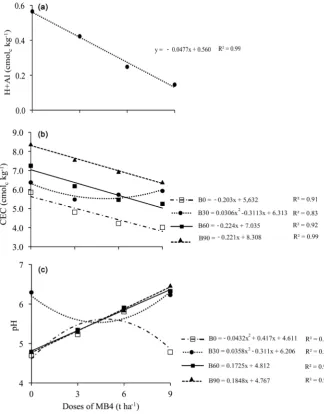
In relation to the increasing doses of MB4 (Figure 4(a)), it was verified a li-near reduction of 76.6% in H + Al comparing the higher dose with the control. This shows that MB4 did not release Al3+ exchangeable in the reaction of the
rock powder with the soil solution. Besides, MB4 present the liming potential with increasing application rates according to [28]. Melo et al. [21], in an incu-bation experiment with different doses of grounded basalt, observed that the ad-dition of these doses presented greater efficiency for the neutralization of the potential acidity.
Increasing doses of MB4 reduced CEC, especially in the absence of bentonite (B0). Possibly, this rock powder reacted in some way with the available cations in the soil solution were unavailable (Figure 4(b)). The opposite result was veri-fied by [29]; the incubation of 36 months in weathered soils treated with equiva-lent doses up to 300 t∙ha−1 of basalt powder indicated an increase in CEC.
Gill-man et al. [30] also observed an increase in CEC of seven soils of Queensland,
Australia, incubated with increasing doses of basalt powder (0, 1, 5, 25 and 50 t∙ha−1). It is interesting to note that CEC, like soil fertility, depends directly on
the chemical quality of the parent rock which, when milled, can release mineral nutrients to the soil.
DOI: 10.4236/as.2019.105050 661 Agricultural Sciences
Figure 4. Potential acidity (a), cation exchange capacity (CEC) (b) and pH (c) deter-mined on soil after application and incubation of treatments, increasing doses of MB4 (0, 3, 6, 9 t∙ha−1).
In relation to the effect of MB4 on soil pH (Figure 4(c)), it can be observed that without bentonite (B0) the pH followed a quadratic equation, with an in-crease in pH to the point of maximum neutralization of the acidity with 4.82 t∙ha−1 of MB4, equivalent to pH 5.62, representing an increase of around 22%,
decreasing again with 9 tha−1. However, even with this reduction, a 5.5% increase
DOI: 10.4236/as.2019.105050 662 Agricultural Sciences Although the use of grounded rocks as fertilizers is attractive, since they have the potential to supply soils with a large array of macro and micronutrients in comparison to commercially available soluble fertilizers, some disadvantages can be pointed out, such as the very slow solubility that can negatively affect the agronomic effectiveness of short term crops [4].
In this sense, it can be figured out that the incubation time of MB4 and bento-nite doses in the soil during the experimental period of the current study was not long enough to allow releasing expressive amount of nutrients in the soil. Therefore, it is recommended that further studies with MB4 and bentonite doses be conducted over a longer period of time in order to evaluate the release of nu-trients to the soil by these materials over time.
4. Conclusions
The increasing doses of bentonite increased the cation exchange capacity of the soil, favoring the availability of nutrients in the soil.
The increasing doses of MB4 favored the increase of the pH values and, con-sequently, decreased the soil potential acidity values for the applied bentonite doses. On the other hand, these treatments decreased the cation exchange capac-ity of the soil.
Acknowledgements
Special thanks to National Council for Scientific and Technological Develop-ment—CNPq, for granting the scholarship to the first author.
Conflicts of Interest
The authors declare no conflicts of interest regarding the publication of this pa-per.
References
[1] Van Raij, B. (1991) Fertilidade do solo e adubação. Ceres, Piracicaba, 343 p. [2] Czaban, J. and Siebielec, G. (2013) Effects of Bentonite on Sandy Soil Chemistry in a
Long-Term Plot Experiment (II). Effect on pH, CEC, and Macro- and Micronu-trients. Polish Journal Environmental Studies, 22, 1669-1676.
[3] Theodoro, S.H. and Leonardos, O.H. (2006) The Use of Rocks to Improve Family Agriculture in Brazil. Annals of the Brazilian Academy of Sciences, 78, 721-730.
https://doi.org/10.1590/S0001-37652006000400008
[4] Van Straaten, P. (2006) Farming with Rocks and Minerals: Challenges and Oppor-tunities. Anais da Academia Brasileira de Ciências, 78, 731-747.
https://doi.org/10.1590/S0001-37652006000400009
[5] Gama, H.B. (2003) Lama de serraria de granito na agricultura orgânica. Revista Agroecologia Hoje, 20, 24.
DOI: 10.4236/as.2019.105050 663 Agricultural Sciences
[7] Osterroht, M.V. (2003) Rochagem Para Quê? Revista Agroecologia Hoje, 20, 12-15. [8] Pontes, A.S.C., Araujo, F.P., Araujo, J.F., Mouco, M.A.C., Villas Boas, R.L. and
Fernandes, D.M. (2005) Emprego do pó de rocha MB-4 sobre a produção de coentro. Florianópolis, Brasil. 3th Congresso Brasileiro e 3th Seminário Estadual de Agroecologia, 2005, Florianópolis, 1-4.
[9] Miyasaka, S., Nagai, K. and Miyasaka, N.S. (2004) Agricultura Natural. Centro de Produções Técnicas-CPT, Viçosa, 214 p.
[10] Chaves, L.H.G., Azevedo, N.C. and Tito, G.A. (1999) Efeito da aplicação de bentonita nas propriedades químicas de um Regossolo Distrófico. Agropecuária Técnica, 20, 73-78.
[11] Gopinath, T.R., Cruz, V.C.A. and Freire, J.A. (2003) Estudo comparativo da composição química e as variedades de argilas bentoníticas da região de Boa Vista, Paraíba. Revista de Geologia, 16, 35-48.
[12] Empresa Brasileira de Pesquisa Agropecuária Embrapa (2006) Sistema brasileiro de classificação de solos. 2nd Edition, Embrapa-SPI, Rio de Janeiro.
[13] Empresa Brasileira de Pesquisa Agropecuária (2017) Manual de métodos de análise de solo. 3rd Edition, Revista e ampliada. Embrapa, Brasília, 565 p.
[14] Ferreira, H.C., Chen, T., Zandonadi, A.R. and Souza Santos, P. (1972) Correlações Lineares entre Áreas Específicas de Caulins Determinadas por Diversos Métodos: Aplicação a Alguns Caulins do Nordeste Brasileiro (Estados da Paraíba e Rio Grande do Norte). Cerâmica, 18, 333.
[15] Santos, K.S.R., Ramos, A.P.S., Sampaio, E.V.S.B. and Araújo, M.S.B. (2011) Capacidade de Fornecimento de P e K do Adubo da Independência e seus Componentes em Cultivos Sucessivos em Pote. Revista Brasileira de Geografia Física, 5, 1082-1096. https://doi.org/10.26848/rbgf.v4i5.232782
[16] Ferreira, D.F. (2011) Sisvar: A Computer Statistical Analysis System. Ciência e Agrotecnologia, 35, 1039-1042. https://doi.org/10.1590/S1413-70542011000600001
[17] Huang, B., Li, Z., Huang, J., Guo, L., Nie, X., Wang, Y., Zhang, Y. and Zeng, G. (2014) Adsorption Characteristics of Cu and Zn onto Various Size Fractions of Ag-gregates from Red Paddy Soil. Journal of Hazardous Materials, 264, 176-183.
https://doi.org/10.1016/j.jhazmat.2013.10.074
[18] Nichele, E.R. (2009) Utilização de pó de rochas no desenvolvimento e nutrição do feijoeiro comum (Phaseolus vulgaris). Revista de Ciências Agroveterinárias, 8, 111-121.
[19] Tito, G.A., Chaves, L.H.G., Guerra, H.O. and Azevedo, N.C. (1997) Aplicação de bentonita em um Regossolo Eutófico. II Efeitos sobre as propriedades químicas do solo. Revista Brasileira de Engenharia Agrícola e Ambiental, 1, 25-27.
https://doi.org/10.1590/1807-1929/agriambi.v1n1p25-27
[20] Li, Q., Du, H., Chen, W., Hao, J., Huang, Q., Cai, P. and Feng, X. (2018) Aging Shapes the Distribution of Copper in Soil Aggregate Size Fractions. Environmental Pollution, 233, 569-576. https://doi.org/10.1016/j.envpol.2017.10.091
[21] Melo, V.F., Uchôa, S.C.P., Dias, F.O. and Barbosa, G.F. (2012) Doses de basalto moído nas propriedades químicas de um Latossolo Amarelo distrófico da savana de Roraima. Acta Amazonica, 42,471-476.
https://doi.org/10.1590/S0044-59672012000400004
[22] Motta, A.C.V. and Feiden, A. (1992) Avaliação do P em LE submetido a diferentes doses de basalto. Agrárias, 12, 47-54.
DOI: 10.4236/as.2019.105050 664 Agricultural Sciences
como remineralizadores em solos intensamente intemperizados. Geociências, 36, 259-274.
[24] Von Wilpert, K. and Lukes, M. (2003) Ecochemical Effects of Phonolite Rock Powder, Dolomite and Potassium Sulphate in a Spruce Stand on an Acidified Gla-cial Loam. Nutrient Cycling in Agroecosystems, 65, 115-127.
https://doi.org/10.1023/A:1022103325310
[25] Bertol, O.J., Fey, E., Favaretto, N., Lavoranti, J. and Rizzi, N.E. (2010) Mobilidade de P, Cu e Zn em colunas de solo sob sistema de semeadura direta submetido às adubações mineral e orgânica. Revista Brasileira Ciência do Solo, 34, 1841-1850.
https://doi.org/10.1590/S0100-06832010000600008
[26] Silva, A.G., Barros, A.S. and Teixeira, I.R. (2007) Avaliação agronômica de cultivares de sorgo forrageiro no sudoeste do estado de Goiás em 2005. Revista Brasileira de Milho e Sorgo, 6, 116-127.
https://doi.org/10.18512/1980-6477/rbms.v6n1p116-127
[27] Camargo, C.K., Resende, J.T.V., Camargo, L.C.K., Figueiredo, A.S. T. and Zanin, D.S. (2012) Produtividade do morangueiro em função da adubação orgânica e com pó de basalto no plantio. Semina: Ciências Agrárias, 33, 2985-2994.
https://doi.org/10.5433/1679-0359.2012v33Supl1p2985
[28] Mendes, J.S., Chaves, L.H.G., Fernandes, J.D. and Chaves, I.B. (2015) Using MB-4 Rock Powder, Poultry Litter Biochar, Silicate and Calcium Carbonate to Amend Different Soil Types. Australian Journal of Crop Science, 9, 987-995.
[29] Gillman, G.P. (1980) The Effect of Crushed Basalt Scoria on the Cation Exchange Properties of a Highly Weathered Soil. Soil Science Society of America Journal, 44, 465-468. https://doi.org/10.2136/sssaj1980.03615995004400030005x
[30] Gillman, G.P., Buekkett, D.C. and Coventry, R.J. (2001) A Laboratory Study of Ap-plication of Basalt Dust to Highly Weathered Soils: Effects Ion Soil Cation Chemi-stry. Australian Journal of Soil Research, 39, 799-811.
https://doi.org/10.1071/SR00073