(
E
)-3-(3,5-Dimethoxyphenyl)-1-(2-meth-oxyphenyl)prop-2-en-1-one
Yoongho Limaand Dongsoo Kohb*
aDivision of Bioscience and Biotechnology, BMIC, Konkuk University, Seoul 143-701, Republic of Korea, andbDepartment of Applied Chemistry, Dongduk Women’s University, Seoul 136-714, Republic of Korea
Correspondence e-mail: [email protected]
Received 22 February 2013; accepted 5 March 2013
Key indicators: single-crystal X-ray study;T= 200 K; mean(C–C) = 0.003 A˚;
Rfactor = 0.043;wRfactor = 0.132; data-to-parameter ratio = 19.1.
In the title molecule, C18H18O4, the dihedral angle between the benzene rings is 52.52 (7). The C C bond of the central
enone group adopts a trans conformation. The relative conformation of the two double bonds in the enone group is s-transoid. In the crystal, molecules are linked by pairs of weak C—H O hydrogen bonds, forming inversion dimers.
Related literature
For the synthesis and biological properties of chalcone deri-vatives, see: Shinet al.(2012); Hwanget al.(2011). For related structures, see: Funet al.(2012); Leeet al.(2012); Prasathet al. (2010).
Experimental
Crystal data
C18H18O4 Mr= 298.32
a= 12.0925 (18) A˚
b= 8.4460 (12) A˚
c= 15.109 (2) A˚
= 92.340 (3)
V= 1541.9 (4) A˚3
MoKradiation
= 0.09 mm1
T= 200 K
0.240.140.10 mm
Data collection Bruker SMART CCD
diffractometer
11328 measured reflections
3865 independent reflections 1544 reflections withI> 2(I)
Rint= 0.053
Refinement
R[F2> 2(F2)] = 0.043
wR(F2) = 0.132
S= 0.81 3865 reflections
202 parameters
H-atom parameters constrained
max= 0.21 e A˚
3
min=0.27 e A˚
3
Table 1
Hydrogen-bond geometry (A˚ ,).
D—H A D—H H A D A D—H A
C2—H2 O1i
0.95 2.51 3.457 (3) 172
Symmetry code: (i)xþ1;y;zþ1.
Data collection:SMART(Bruker, 2000); cell refinement:SAINT
(Bruker, 2000); data reduction:SAINT; program(s) used to solve structure:SHELXS97(Sheldrick, 2008); program(s) used to refine structure: SHELXL97 (Sheldrick, 2008); molecular graphics:
PLATON (Spek, 2009); software used to prepare material for publication:SHELXTL(Sheldrick, 2008).
Supplementary data and figures for this paper are available from the IUCr electronic archives (Reference: LH5589).
References
Bruker (2000).SMARTandSAINT. Bruker AXS Inc., Madison, Wisconsin, USA.
Fun, H.-K., Chia, T. S., Samshuddin, S., Narayana, B. & Sarojini, B. K. (2012).
Acta Cryst.E68, o1560–o1561.
Hwang, D., Hyun, J., Jo, G., Koh, D. & Lim, Y. (2011).Magn. Reson. Chem.49, 41–45.
Lee, H.-J., Lim, Y. & Koh, D. (2012).Acta Cryst.E68, o3403.
Prasath, R., Sarveswari, S., Vijayakumar, V., Narasimhamurthy, T. & Tiekink, E. R. T. (2010).Acta Cryst.E66, o1110.
Sheldrick, G. M. (2008).Acta Cryst.A64, 112–122.
Shin, S. Y., Ahn, S., Park, M. J., Yoon, H., Kim, M., Ji, S. Y., Koh, D., Lee, Y. H. & Lim, Y. (2012).J. Korean Soc. Appl. Biol. Chem.55, 669–675. Spek, A. L. (2009).Acta Cryst.D65, 148–155.
Structure Reports
Online
supporting information
Acta Cryst. (2013). E69, o514 [doi:10.1107/S1600536813006302]
(
E
)-3-(3,5-Dimethoxyphenyl)-1-(2-methoxyphenyl)prop-2-en-1-one
Yoongho Lim and Dongsoo Koh
S1. Comment
Chalcones have an α,β-unsaturated carbonyl (enone) group which connects two aromatic rings at the 1,3-positions.
Typically, the conformation of enone system is s-cisoid, in which the C═C and C═O double bonds are cis with respect to
each other. Few examples of s-transoid conformations have been reported in the literature (Fun et al., 2012; Prasath et al.,
2010). As a part of our studies on the substituent effects of chalcones on structures and biological activities (Shin et al.,
2012; Hwang et al., 2011), the crystal structure of title compound has been determined.
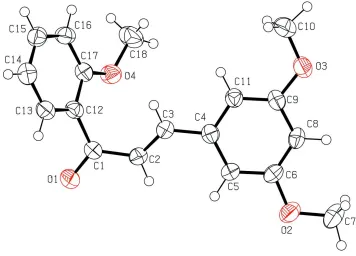
The molecular structure of the title compound is shown in Fig. 1. The relative conformation of two double bonds of the
central enone group is s-transoid. The trans configuration at the C1═C2 bond is reflected in the O1-C1-C2-C3 torsion
angle of -168.7 (2)° compared to the value of -1.1 (5)° in a structure with an s-cisoid configuration (Lee et al., 2012). The
dihedral angle between the benzene rings is 52.52 (7)°. Two methoxy groups at meta positions of the C4-C6/C8/C9/C11
ring are essentially co-planar with the ring [C8—C6—O2—C7 = -2.4 (3)° and C11—C9—O3—C10 = -1.2 (3)°].
However, the methoxy group at the ortho position of the C12-C17 ring is slightly twisted with respect to the benzene ring
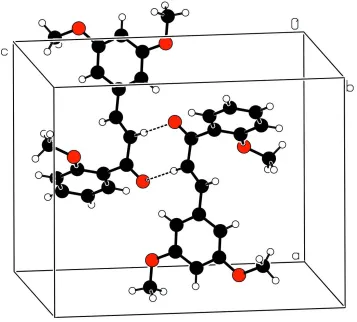
[C16—C17—O4—C18 = 21.6 (3)°]. In the crystal, molecules are linked by a pair of weak C—H···O hydrogen bonds to
form inversion dimers (Table 1, Fig. 2).
S2. Experimental
To a solution of 3,5-dimethoxybenzaldehyde (415 mg, 2.5 mmol) in 30 ml of ethanol was added 2-methoxyacetophenone
(300 mg, 2 mmol) and the temperature was adjusted to around 276 K in an ice-bath. To the cooled reaction mixture was
added 2 ml of 50% aqueous KOH solution, and the reaction mixture was stirred at room temperature for 5 h. This
mixture was poured into iced water (50 ml) was acidified (pH = 3) with 3 N HCl solution to give a precipitate. Filtration
and washing with water afforded crude solid of the title compound (560 mg, 94%). Recrystallization of the solid in
ethanol gave single crystals (mp: 353–355 K).
S3. Refinement
H atoms were placed in calculated positions and refined as riding with C—H = 0.95–0.98 Å, and Uiso(H) = 1.2 Ueq(C)
Figure 1
Figure 2
Part of the crystal structure showing an inversion dimer formed via a pair of weak intermolecular C—H···O hydrogen
bonds shown as dashed lines.
(E)-3-(3,5-Dimethoxyphenyl)-1-(2-methoxyphenyl)prop-2-en-1-one
Crystal data
C18H18O4
Mr = 298.32 Monoclinic, P21/c
Hall symbol: -P 2ybc a = 12.0925 (18) Å b = 8.4460 (12) Å c = 15.109 (2) Å β = 92.340 (3)° V = 1541.9 (4) Å3
Z = 4
F(000) = 632 Dx = 1.285 Mg m−3
Mo Kα radiation, λ = 0.71073 Å Cell parameters from 2539 reflections θ = 2.7–28.1°
µ = 0.09 mm−1
T = 200 K Block, colorless 0.24 × 0.14 × 0.10 mm
Data collection
Bruker SMART CCD diffractometer
Radiation source: fine-focus sealed tube Graphite monochromator
φ and ω scans
11328 measured reflections 3865 independent reflections
1544 reflections with I > 2σ(I) Rint = 0.053
θmax = 28.5°, θmin = 1.7°
Refinement on F2
Least-squares matrix: full R[F2 > 2σ(F2)] = 0.043
wR(F2) = 0.132
S = 0.81 3865 reflections 202 parameters 0 restraints
Primary atom site location: structure-invariant direct methods
Secondary atom site location: difference Fourier map
Hydrogen site location: inferred from neighbouring sites
H-atom parameters constrained w = 1/[σ2(F
o2) + (0.0575P)2]
where P = (Fo2 + 2Fc2)/3
(Δ/σ)max < 0.001
Δρmax = 0.21 e Å−3
Δρmin = −0.27 e Å−3
Special details
Geometry. All esds (except the esd in the dihedral angle between two l.s. planes) are estimated using the full covariance matrix. The cell esds are taken into account individually in the estimation of esds in distances, angles and torsion angles; correlations between esds in cell parameters are only used when they are defined by crystal symmetry. An approximate (isotropic) treatment of cell esds is used for estimating esds involving l.s. planes.
Refinement. Refinement of F2 against ALL reflections. The weighted R-factor wR and goodness of fit S are based on F2,
conventional R-factors R are based on F, with F set to zero for negative F2. The threshold expression of F2 > σ(F2) is used
only for calculating R-factors(gt) etc. and is not relevant to the choice of reflections for refinement. R-factors based on F2
are statistically about twice as large as those based on F, and R- factors based on ALL data will be even larger.
Fractional atomic coordinates and isotropic or equivalent isotropic displacement parameters (Å2)
x y z Uiso*/Ueq
C12 0.34924 (17) 0.3117 (2) 0.35221 (13) 0.0341 (5) C13 0.26908 (18) 0.4123 (2) 0.38312 (14) 0.0392 (5) H13 0.2521 0.4093 0.4439 0.047* C14 0.21334 (18) 0.5168 (2) 0.32693 (15) 0.0427 (6) H14 0.1595 0.5868 0.3490 0.051* C15 0.23697 (18) 0.5181 (2) 0.23841 (15) 0.0426 (6) H15 0.1986 0.5893 0.1994 0.051* C16 0.31528 (18) 0.4178 (2) 0.20554 (14) 0.0399 (6) H16 0.3303 0.4193 0.1443 0.048* C17 0.37188 (17) 0.3148 (2) 0.26260 (14) 0.0351 (5) O4 0.44767 (12) 0.20606 (17) 0.23581 (9) 0.0440 (4) C18 0.4977 (2) 0.2339 (3) 0.15387 (16) 0.0613 (8) H18A 0.4430 0.2171 0.1051 0.092* H18B 0.5597 0.1605 0.1477 0.092* H18C 0.5249 0.3431 0.1522 0.092*
Atomic displacement parameters (Å2)
U11 U22 U33 U12 U13 U23
C1 0.0341 (13) 0.0409 (13) 0.0364 (12) −0.0028 (10) 0.0042 (10) 0.0045 (10) O1 0.0405 (10) 0.0666 (11) 0.0637 (11) −0.0077 (8) 0.0019 (8) 0.0290 (9) C2 0.0336 (13) 0.0404 (13) 0.0357 (12) 0.0040 (10) 0.0005 (10) 0.0056 (10) C3 0.0343 (13) 0.0366 (12) 0.0369 (12) 0.0016 (9) 0.0009 (10) 0.0009 (10) C4 0.0357 (13) 0.0331 (11) 0.0371 (12) 0.0008 (10) 0.0051 (10) −0.0023 (10) C5 0.0377 (14) 0.0385 (12) 0.0350 (12) 0.0012 (10) −0.0012 (10) 0.0049 (10) C6 0.0405 (14) 0.0335 (12) 0.0388 (13) 0.0078 (10) −0.0064 (11) 0.0005 (10) O2 0.0446 (10) 0.0522 (10) 0.0517 (10) 0.0050 (8) −0.0108 (8) 0.0071 (8) C7 0.0429 (16) 0.0523 (15) 0.0717 (18) 0.0036 (12) −0.0198 (13) 0.0017 (13) C8 0.0283 (12) 0.0369 (12) 0.0497 (14) 0.0034 (10) −0.0019 (10) −0.0016 (11) C9 0.0355 (13) 0.0327 (12) 0.0460 (14) −0.0014 (10) 0.0087 (11) 0.0003 (10) O3 0.0360 (10) 0.0558 (10) 0.0642 (11) 0.0011 (8) 0.0085 (8) 0.0177 (9) C10 0.0510 (17) 0.0658 (17) 0.0600 (17) 0.0020 (13) 0.0098 (14) 0.0228 (14) C11 0.0307 (13) 0.0341 (12) 0.0428 (13) 0.0019 (9) 0.0014 (10) 0.0018 (10) C12 0.0317 (12) 0.0335 (11) 0.0374 (12) −0.0039 (9) 0.0030 (10) 0.0025 (10) C13 0.0375 (13) 0.0433 (13) 0.0370 (12) −0.0041 (10) 0.0044 (10) 0.0006 (11) C14 0.0348 (13) 0.0378 (13) 0.0555 (16) 0.0000 (10) 0.0036 (11) −0.0028 (12) C15 0.0350 (13) 0.0393 (13) 0.0530 (15) −0.0023 (10) −0.0050 (11) 0.0091 (11) C16 0.0413 (14) 0.0417 (13) 0.0364 (13) −0.0043 (11) 0.0002 (11) 0.0060 (11) C17 0.0318 (12) 0.0348 (12) 0.0389 (13) −0.0020 (10) 0.0040 (10) −0.0005 (10) O4 0.0471 (10) 0.0489 (9) 0.0363 (9) 0.0096 (7) 0.0061 (7) 0.0007 (7) C18 0.0630 (19) 0.0699 (17) 0.0529 (16) 0.0118 (14) 0.0248 (14) 0.0074 (14)
Geometric parameters (Å, º)
C3—C4 1.454 (3) C12—C13 1.384 (3) C3—H3 0.9500 C12—C17 1.392 (3) C4—C5 1.390 (3) C13—C14 1.381 (3) C4—C11 1.398 (3) C13—H13 0.9500 C5—C6 1.384 (3) C14—C15 1.379 (3) C5—H5 0.9500 C14—H14 0.9500 C6—O2 1.362 (2) C15—C16 1.378 (3) C6—C8 1.374 (3) C15—H15 0.9500 O2—C7 1.424 (3) C16—C17 1.386 (3) C7—H7A 0.9800 C16—H16 0.9500 C7—H7B 0.9800 C17—O4 1.370 (2) C7—H7C 0.9800 O4—C18 1.420 (2) C8—C9 1.396 (3) C18—H18A 0.9800 C8—H8 0.9500 C18—H18B 0.9800 C9—O3 1.361 (2) C18—H18C 0.9800 C9—C11 1.368 (3)
C11—C9—C8 120.6 (2) O4—C18—H18C 109.5 C9—O3—C10 117.80 (18) H18A—C18—H18C 109.5 O3—C10—H10A 109.5 H18B—C18—H18C 109.5
O1—C1—C2—C3 −168.7 (2) C5—C4—C11—C9 2.3 (3) C12—C1—C2—C3 7.7 (3) C3—C4—C11—C9 −175.44 (19) C1—C2—C3—C4 179.76 (19) O1—C1—C12—C13 54.6 (3) C2—C3—C4—C5 −16.2 (3) C2—C1—C12—C13 −121.9 (2) C2—C3—C4—C11 161.5 (2) O1—C1—C12—C17 −124.0 (2) C11—C4—C5—C6 0.2 (3) C2—C1—C12—C17 59.4 (3) C3—C4—C5—C6 177.85 (19) C17—C12—C13—C14 −1.3 (3) C4—C5—C6—O2 177.74 (18) C1—C12—C13—C14 −180.0 (2) C4—C5—C6—C8 −1.7 (3) C12—C13—C14—C15 1.2 (3) C8—C6—O2—C7 −2.4 (3) C13—C14—C15—C16 −0.3 (3) C5—C6—O2—C7 178.19 (18) C14—C15—C16—C17 −0.5 (3) O2—C6—C8—C9 −178.67 (19) C15—C16—C17—O4 177.12 (19) C5—C6—C8—C9 0.7 (3) C15—C16—C17—C12 0.5 (3) C6—C8—C9—O3 −178.56 (18) C13—C12—C17—O4 −176.49 (17) C6—C8—C9—C11 1.9 (3) C1—C12—C17—O4 2.1 (3) C11—C9—O3—C10 −1.2 (3) C13—C12—C17—C16 0.4 (3) C8—C9—O3—C10 179.24 (19) C1—C12—C17—C16 179.03 (19) O3—C9—C11—C4 177.11 (18) C16—C17—O4—C18 21.6 (3) C8—C9—C11—C4 −3.4 (3) C12—C17—O4—C18 −161.6 (2)
Hydrogen-bond geometry (Å, º)
D—H···A D—H H···A D···A D—H···A
C2—H2···O1i 0.95 2.51 3.457 (3) 172