Using of tiny encryption algorithm in CAN-Bus
communication
M. Jukl, J. Čupera
Department of Engineering and Automobile transport, Faculty of AgriSciences,
Mendel University in Brno, Brno, Czech Republic
Abstract
Jukl M., Čupera J. (2016): Using of tiny encryption algorithm in CAN-Bus communication. Res. Agr. Eng., 62: 50–55.
The rising costs of agriculture machine operation force manufacturers to look for solutions that simplify the machine operation to its users and increase user comfort. However, this trend requires farm machinery to be equipped with electronic systems. Electronic control units do not receive only the information from its own sensors. Modern electronic systems communicate with each other via the data bus. The most common data bus in modern agricultural technol-ogy is the CAN-Bus (Controller Area Network). The most common standard used in modern machinery is SAE J1939 standard, which is commonly used for engine control systems. CAN-Bus in modern agricultural technology provides a considerable simplification of the wiring harness of the tractor. Standardized bus also opens the possibility of im-plementation of Plug & Play additional devices in agricultural tractor. This article is focused on the application of the encryption algorithm Tiny on the CAN-Bus, which is realistically applied to recognition of implement. This article aims to verify the suitability of encryption of Tiny algorithm for the CAN-Bus of 250 kbit/s. As the experiment demonstrated Tiny algorithm is suitable for data encrypting on the CAN-Bus.
Keywords: Tiny algorithm; encryption; CAN-Bus; implement; cipher
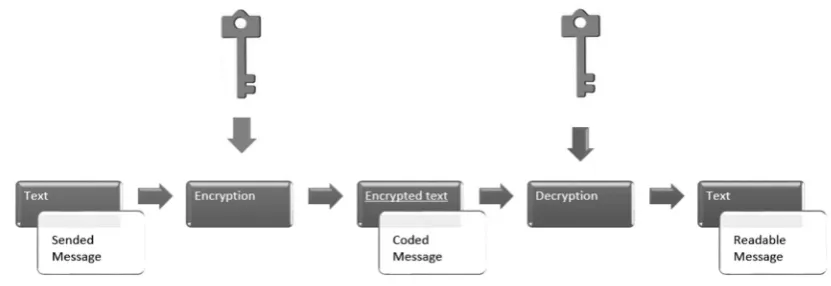
The main goal of any encryption system is to dis-guise the classified message to be unreadable to all unauthorized persons. Cryptographic systems most often come into practice by using of com-munication technologies (computer files sent over the internet). Encryption cannot protect sending files to get to the unauthorized person but prevents anyone to understand its contents. The informa-tion to be secured is usually known in specialized terminology as a plain text. The security process is called encryption. The rules for encryption of the plain text are called an encryption algorithm. The
operations of this algorithm are derived from the encryption key. The encryption keys together with the text of the message are the input information to the algorithm. If the recipient of the cryptogram wants to get the original message, he has to use a decryption algorithm. The decryption algorithm uses the decryption key to convert encrypted text to the original. (Piper, Murphy 2006). The en-cryption algorithm is schematically shown in Fig. 1. From cryptographic systems, that are known as a conventional or symmetrical, the decryption key may be easily derived from the encryption key. In
practice, both of these keys are identical in these systems. Due to such systems they are referred to as “secret-key systems” or “one-key systems”. The second type of cryptographic systems is asymmet-rical system. The derivation of the decryption key from this system is nearly impossible. Therefore asymmetric encryption system is often called as a “system with public-key”. One of the possible vari-ants of protection against unverified authorization is the application of encryption algorithm TEA. TEA means The Tiny Encryption Algorithm and was first published in 1994 by Roger Needham and David Wheeler from the Cambridge University. As it was mentioned in article by Grabowski and Keurian (2010), TEA was initially designed to be an extremely small algorithm when implemented in terms of the memory foot print required to store the algorithm. This was achieved by making the ba-sic operations very simple and weak. By repeating these simple operations many times better security is reached. As the basic operations are very simple, TEA is also regarded as a very high speed encryp-tion algorithm (Grabowski 2010).
The monitoring system, which was used in this experiment, exchanges data via CAN-Bus. The CAN-Bus (Controller Area Network) is the most common data bus in modern agricultural technol-ogy. The data bus serves to the electronic units to exchange the data from sensors and other control systems (Túró 2010). As it was mentioned in Túró (2011), the data bus is one of key components of modern vehicle systems. The experiment is expect-ed to verify the functionality of Tiny algorithm ap-plied in real conditions of such monitoring system. The specific applications will be targeted towards keeping the confidentiality of the implement iden-tifiers.
MATERIAL AND METHODS
To investigate the possibility of using Tiny data encryption algorithm on the CAN-Bus, the ex-periment with a Stellaris microcontroller was per-formed. For problem-free application of encryp-tion mechanism it was important to determine how long the process will take. This finding is es-pecially important due to other parameters such as e.g. transmission rate of the message.
Tiny Encryption Algorithm. The Tiny Encryp-tion Algorithm is a Feistel type cipher (Feistel 1973) that uses operations from mixed algebraic groups. A dual shift causes all bits of the data and key to be mixed repeatedly. The specification for TEA states a 128-bit key is to be divided into four 32-bit key words K = (K[0], K[1], K[2], K[3]) and the block size of each encryption is 64 bits, which is to be di-vided into two 32-bit words. At each iteration, the bits are further substituted and permuted via a sys-tem of logical operators (Yee-Tak Ma et al. 2011). Different multiples of a magic constant are used to prevent simple attack based on the symmetry of the rounds. The magic constant 2654435769 or 9E3779B916 is chosen to be 232/φ, where φ is the
golden ratio.
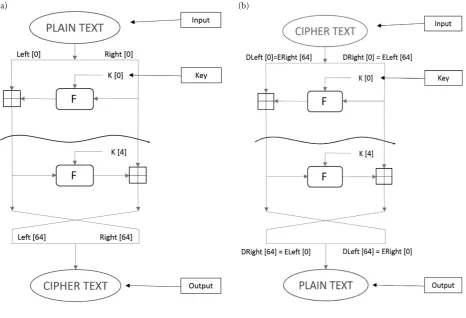
Encryption and decryption routine. The fol-lowing figure (Fig. 2a) shows the structure of the TEA encryption. The inputs to the encryption algorithm are a plaintext block and a key K. The plaintext block is split into two halves (Left [0], Right [0]). Each half is used to encrypt the other half over 64 rounds of processing and then com-bine to produce the cipher text block.
[image:2.595.94.510.97.240.2]al-Fig. 2. Encryption (a) and decryption routine (b)
[image:3.595.66.533.95.413.2](a) (b)
[image:3.595.65.405.459.759.2]gorithm and the keys K are used in the opposite sequence.
Mathematical description of the TEA. In this paragraph the encryption and decryption routines (Fig. 3) of the Tiny Encryption Algorithm in C lan-guage will be presented (Wheeler et al. 1994).
Instrumentation. The application of the en-cryption algorithm was performed on Stellaris LM3S8962 microcontroller by Texas Instruments (Dallas, USA). This device belongs into a group of devices that use ARM Cortex-M3 processors. Con-troller core is able to operate up to 50 MHz. This device is targeted for industrial applications, such as test and measurement equipment, network appli-ances and switches, etc. (Texas Instruments 2011).
Application of TEA in LabView. For the imple-mentation of the encryption algorithm to the Stel-laris microcontroller, proprietary software using a graphical programming environment LabView (G language) from the National Instruments (Aus-tin, USA) was created. The diagrams in Fig. 4 show the basic structures of the encryption algorithm TEA in graphical form in LabView. To translate the
software from G to C language, application ARM toolkit in LabView was used. The translation was carried out according to standard ANSI C.
RESULTS AND DISCUSSION
To verify if the Tiny encryption algorithm is suit-able for messages encrypting on the CAN-Bus, the experiment was performed with help of microcon-troller Stellaris (Texas Instruments, Dallas, USA). As it was mentioned above a limiting factor is the time during which the message is being encrypted. Input variable was a message of data length 8 byte (64-bit). For an objective determination of the duration of the encryption loop, a digital output of microcon-troller Stellaris was observed with an oscilloscope (Texas Instruments, Dallas, USA)(Fig. 5).
[image:4.595.65.532.96.234.2] [image:4.595.64.442.594.755.2]After each finished loop the digital output changed the voltage level from 3.3 V to 0 V and vice versa. When the cycle was measured, the encryption loop was carried out two times. The final message process-ing time is therefore one half of the measured period. Fig. 4. Principle of TEA in graphical form (a) and data encryption mechanism (b) (both LabView)
The measured signal from the oscilloscope is shown in the Fig 6. The first of the captured signals (Fig. 6a) is related to the time of two loops without encryption. The signal period was 28 μs. Since the loop was carried out two times, the processing time is 14 μs.
In the following oscillogram (Fig. 6b) there is cap-tured digital output signal while two messages were encrypted. The length of the period takes 334 μs. The processing time of one message before sending to the bus takes one half of the period which equals to 167 μs.
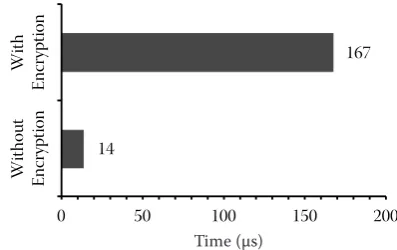
The time values are plotted in the graph in Fig. 7 and are also presented in Table 1. It is obvious that the time difference ∆T will be equal to the time needed to encrypt a message of 64 bits.
As it is stated in publication Bauer et al. (2013), the bus with baud rate of 250 kbit/s is able to transmit 1894 frames per second (frame length of 135 bits – a standard message with identifier of 11 bits). The message used in experiment had the length of 128 bits. As a control mechanism in this frame 12 stuff bits were added. The result of CRC will be 4 bits. It is also necessary to respect the 3 bits as an intermission (gap between messages). There are 147 bits in total. With these parameters one message takes approximately 580 μs.
Accord-ing to the results it can be assumed that the mes-sage encryption (data of 64 bits) takes about 150 μs. This shows that the processing of message includ-ing encryption routines do not exceed the maxi-mum time limit of 580 μs. The type of such encryp-tion can be used for this specific case (baud rate = 250 kbit/s).
CONCLUSION
[image:5.595.66.532.97.265.2] [image:5.595.317.516.312.437.2]As it was demonstrated according to the experi-ment, encryption of data in CAN-Bus messages by using the Tiny encryption algorithm is possible. The duration of encryption loop do not exceed the critical limit 580 μs at 250 kbit/s. The transfer of important data between tractor and implement is also used on machines where the operator must set up parameters such as a dose of fertilizer or seed, working width or the other exact parameters for adjustment of the machine. This bus is called ISO-Bus and allows using of data from the bus of Fig. 7. Digital output response time
Fig. 6. Time of two sent messages (a) without encryption and (b) with encryption
[image:5.595.63.292.313.392.2](a) (b)
Table 1. Calculated processing time (T)
½ of digital output period (μs)
T – without encryption 14
T – with encryption 167
∆T 153
14
167
0 50 100 150 200
Bauer F., Sedlák P., Čupera J., Polcar A., Fajman M., Šmerda T., Katrenčík J. (2013): Traktory a jejich využití. Prague, ProfiPress, s.r.o.
Feistel H. (1973): Cryptography and Computer Privacy. Sci-entific American, 228: 15–23.
Wheeler D., Needham R. (1994): TEA, a Tiny Encryption Algorithm. Available at www.movable-type.co.uk/scripts/ tea.pdf
Yee-Tak Ma E., Obimbo Ch. (2011): An evolutionary com-putation attack on one-round TEA. Procedia Computer Science, 6: 171–176.
Received for publication February 12, 2015 Accepted after corrections June 19, 2016
Corresponding author: