A permanently growing attention is paid to the production of cow milk as a raw material with de-fined optimal composition and properties. Such an effort arises from increasing requirements for the quality of milk products. The position of milk products in the market is maintained and improved by innovations as the competition of traditional higher-fat milk products with products containing cheaper fats of plant origin has become keener.
Nutritionists also started to call for changes in milk composition. The former, commonly respect-ed outstanding role of milk and milk products in human nutrition was somewhat impaired by data on the participation of saturated fatty acids, trans -unsaturated fatty acids and cholesterol in cardio-vascular diseases (e.g. Welch et al., 1997; Precht and Molkentin, 2000; Playne et al., 2003; Parodi, 2004), despite of the frequently reported positive role of polyunsaturated fatty acids and of proved possibilities to increase their proportion in milk fat (e.g. Offer et al., 1999; Jensen, 2002; Lock and Bauman, 2004).
Thus, the endeavours to optimise the milk fat composition have been interesting for farmers, dairy technologists and consumers. The inter-est of technologists has persisted since the start of the industrial production of butter until now (Chouinard et al., 1998; Bobe et al., 2003; Chen et al., 2004). It can be supposed that farmers will be interested in the optimisation of milk fat composi-tion if they are motivated in a similar manner like for the production of milk with improved quality parameters (Goddard, 2001).
Perdrix et al. (1996), Jahreis (2000) and Thomson et al.(2001) reported different methods of improv-ing the milk fat composition. The application of current knowledge of cattle genetics and controlled nutrition of milking cows were termed by Goddard (2001) as the prevailing methods.
The fatty acid synthesis in ruminants is largely affected by nutrition. Bauman and Griinari (2003) reported that about one half of milk fatty acids is synthesised de novo and fatty acids with chain over 16 carbons are formed mainly from blood lipids.
Fatty acids and composition of their important groups
in milk fat of Czech Pied cattle
M. Pešek, E. Samková, J. Špička
Faculty of Agriculture, University of South Bohemia, České Budějovice, Czech Republic
ABSTRACT: In 2003, 2004 and 2005 milk fat composition was determined three times in 55 dairy cows of Czech Pied cattle housed in a byre with stanchions and fed under conditions usual on Czech production farms. Fatty acids were determined by a gas chromatographic method, 26 acids out of the total 37 acids observed in chro-matograms were identified. The highest proportions were observed for palmitic acid (29.25 ± 2.98%), oleic acid (24.47 ± 3.27%), myristic acid (12.14 ± 1.80%) and stearic acid (8.91 ± 2.44%). The proportions of saturated, unsaturated and monounsaturated fatty acids were 64.71 ± 4.18, 31.96 ± 4.20 and 27.45 ± 3.42% of total acids, respectively. The total proportion of nutritionally undesirable lauric, myristic and palmitic acid was 45.26 ± 4.77%, while that of the desirable group of polyunsaturated fatty acids was 4.51 ± 1.09%. The observed relatively wide ranges of the individual groups of fatty acids indicate that it is possible to improve the milk fat composition in Czech Pied cows.
Keywords: Czech Pied cattle; milk fat; fatty acid proportion
The proportion of the individual fatty acids is also affected by biohydrogenation in the rumen (Avila et al., 2000). Ashes et al. (1997) observed that the usual relation between saturated and unsaturated acids changed when cows were fed fats preserved against the undesirable biohydrogenation. Changes in the milk fat composition due to different feed rations and feed additives were therefore widely studied (e.g. Jenkins, 1999; Delbecchi et al., 2001; Martin et al., 2002; Whitlock et al., 2003).
The application of genetic knowledge for the op-timisation of milk fat composition is possible on the basis of genetic variability and heritability of milk fat composition both between the breeds and within the breeds (Goddard, 2001).
The milk fat composition of all important breeds of dairy cattle has been studied frequently, mainly the inter-breed differences and responses of the dif-ferent breeds to changes in feed rations (Beaulieu and Palmquist, 1995; DePeters et al., 1995; Bitman et al., 1996; Townsend et al., 1997; Lawless et al., 1999; Drackley et al., 2001; Malacarne et al., 2001; White et al., 2001).
Even though some partial data on the milk fat composition in Czech Pied cattle and its crossbred cows were published (Komprda et al., 2001, 2005; Pešek et al., 2005), no systematic study using nu-merous files of analytical data has been carried out yet. The aim of our work was therefore to provide more data, especially on the composition of milk
fatty acids of the breed widely used in the Czech Republic.
MATERIAL AND METHODS
A design of milk sampling for the determination of fatty acids in milk fat reflects the current state of milk production on farms and of milk fat composi-tion in Czech Pied cattle. Raw milk is processed in dairies for products for human consumption.
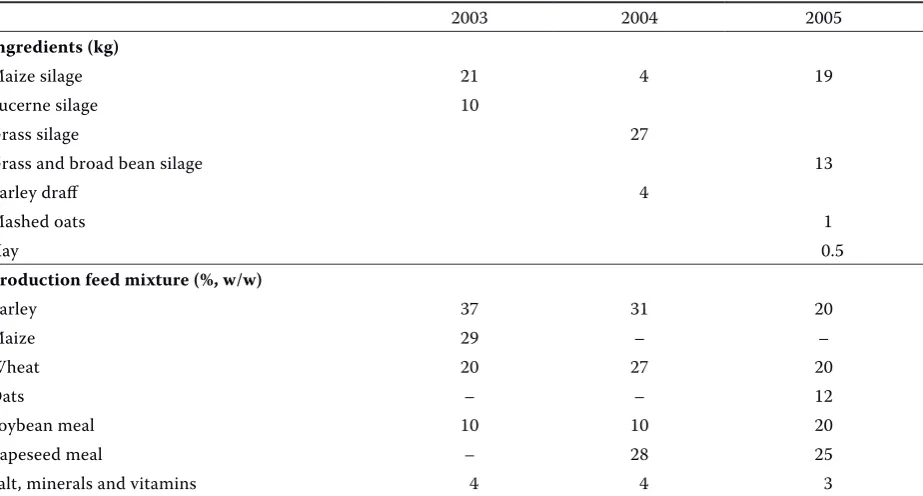
In May 2003, July 2004 and February 2005 milk was sampled from dairy cows fed three different feed rations (Table 1) during the regular testing of milk efficiency on a farm in Čejkovice-Dubné near České Budějovice. The selected cows of Czech Pied cattle were housed together in a byre with stanchions for 200 animals. The feed rations were calculated for the mean live weight of animals 600 kg.
The tested groups of cows (n = 55 in total) were put together for each sampling according to the lactation number and stage of lactation. The main characteristics are given in Table 2. Fat, protein and lactose contents were determined spectrophoto-metrically using a Milcoscan 4000 apparatus (Foss Electric).
The raw milk samples were immediately trans-ported to the laboratory, freeze-dried and fat was extracted with petroleum ether. Fat was
re-esteri-Table 1. Main ingredients of feed rations and composition of production feed mixtures in the particular years
2003 2004 2005
Ingredients (kg)
Maize silage 21 4 19
Lucerne silage 10
Grass silage 27
Grass and broad bean silage 13
Barley draff 4
Mashed oats 1
Hay 0.5
Production feed mixture (%, w/w)
Barley 37 31 20
Maize 29 – –
Wheat 20 27 20
Oats – – 12
Soybean meal 10 10 20
Rapeseed meal – 28 25
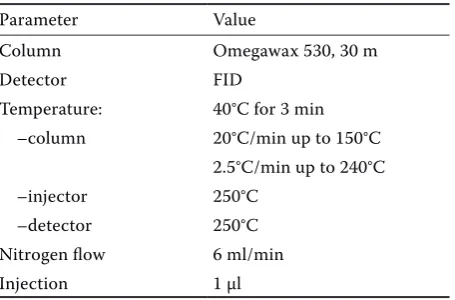
[image:2.595.69.531.507.755.2]fied to methyl esters of fatty acids by heating the petroleum ether extract with a methanolic solution of potassium hydroxide. Methyl esters of fatty acids were determined by gas chromatography (GLC) using a Varian 3300 apparatus (Varian Techtron, Australia). Parameters of the chromatographic de-termination are given in Table 3.
The acids were identified using their standards (Supelco, USA). 26 acids out of the total 37 acids observed in chromatograms were identified. The proportions of the individual acids were calculated from the ratio of their peak area to the total area of all the observed acids.
RESULTS AND DISCUSSION
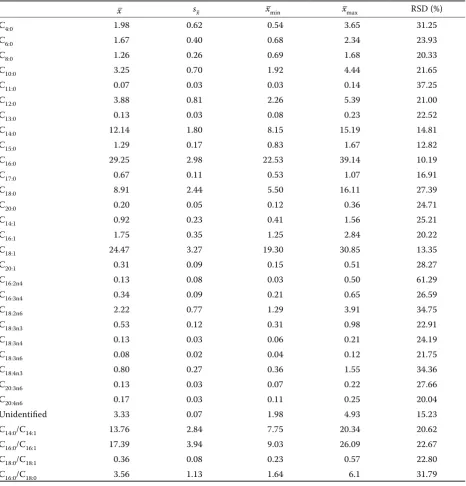
Mean contents of fatty acids determined in the milk fat samples during three consecutive years are given in Table 4. The results of fatty acid com-position in milk fat of Czech Pied cows are similar to the fat composition of important dairy breeds (Holstein, Jersey, Brown Swiss) reported by Morales et al. (2000), Delbecchi et al. (2001) and Kelsey et al.
(2003). Within the individual groups of fatty acids, acids present in the highest concentration are the same in all the mentioned breeds. Palmitic acid
(C16:0), myristic acid (C14:0) and stearic acid (C18:0) in the group of saturated fatty acids (SAFAs), oleic acid (C18:1) and palmitoleic acid (C16:1) among mo-nounsaturated acids (MUFAs), linoleic acid (C18:2n6) and α-linolenic acid (C18:3n3) in the group of poly-unsaturated fatty acids (PUFAs) were the acids oc-curring in the milk fat of Czech Pied cows in the highest concentrations (Table 4).
Significant differences in fatty acid composi-tion in milk fat of different breeds were reported. Beaulieu and Palmquist (1995) found significantly higher proportions of caprylic (C8:0), capric (C10:0), lauric (C12:0) and myristic acid (C14:0), while the proportions of palmitic (C16:0) and oleic acid (C18:1) were lower in milk fat of Jersey cows compared with Holstein cows. Moreover, Drackley et al. (2001) re-ported significant differences between the same breeds also in proportions of butyric (C4:0), myris-toleic (C14:1) and linolenic acid (C18:3). Comparing eight-cow groups of Czech Pied and Holstein cows, significant differences in proportions of capric, stearic and oleic acid were observed in our previous study (Pešek et al., 2005).
Compared to the cited literature data for Holstein and Jersey cows, a lower proportion of palmitic acid (29.25%) and a higher proportion of oleic acid (24.47%) were observed in our group of 55 Czech Pied cows. Kelsey et al. (2003) reported a lower propor-tion particularly of myristic acid (8.15 and 8.53% for Holstein and Brown Swiss cows, respectively), while the mean level of 12.14% was found in our group.
[image:3.595.64.534.106.182.2]However, to evaluate the inter-breed differenc-es, further important factors affecting the milk fat composition have to be taken into consideration, namely nutrition, season, lactation number and stage of lactation (e.g. Jahreis, 2000; Komprda et al., 2001; Whitlock et al., 2003). The data collected in Table 4 can be accepted as characteristic of the milk fat composition of Czech Pied cattle as they represent results from 55 cows, three consecutive years and all the above-mentioned factors were in-cluded in our study.
Table 3. Parameters of chromatographic analysis of fatty acids
Parameter Value
Column Omegawax 530, 30 m
Detector FID
Temperature: 40°C for 3 min
–column 20°C/min up to 150°C
2.5°C/min up to 240°C
–injector 250°C
–detector 250°C
Nitrogen flow 6 ml/min
[image:3.595.65.293.242.392.2]Injection 1 µl
Table 2. Milk yields and main parameters of the milk composition of tested cows
x sx xmin xmax RSD (%)1
Milk (kg/d) 18.64 5.66 6.60 36.80 30.37
Fat (%) 4.47 0.74 2.66 5.98 16.49
Protein (%) 3.41 0.32 2.79 4.42 9.41
Lactose (%) 4.94 0.15 4.50 5.30 3.03
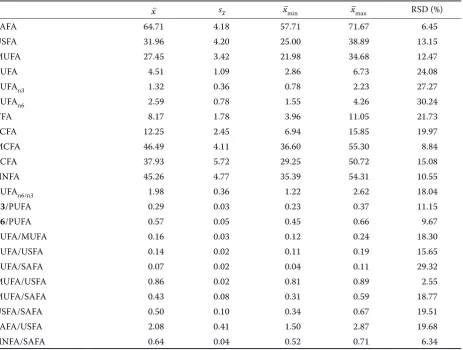
The mean contents of the main groups of deter-mined fatty acids together with some relations be-tween the groups are given in Table 5. The groups were evaluated mainly from two points of view: their effects on the health of milk and milk product con-sumers, and technological properties of milk fat. The usual interest in SAFAs, MUFAs and PUFAs was also aimed at further groups of fatty acids – vola-tile, short-, medium- and long-chain, trans- and
n-3 ones (Offer et al., 1999; Hillbrick and Augustin, 2002; Schroeder et al., 2003; Lock and Bauman, 2004) and also at conjugated linoleic acids (CLAs).
[image:4.595.65.532.118.605.2]In the group of SAFAs, lauric, myristic and pal-mitic acid was assessed as detrimental from the aspect of cardiovascular diseases (Jensen, 2002). These acids were designated in the following text and in Table 5 as “health-negative fatty acids” (HNFAs).
Table 4. Fatty acid composition (% of the total 37 fatty acids, w/w) of milk fat of Czech Pied cows (2003–2005,
n = 55)
x sx xmin xmax RSD (%)
C4:0 1.98 0.62 0.54 3.65 31.25
C6:0 1.67 0.40 0.68 2.34 23.93
C8:0 1.26 0.26 0.69 1.68 20.33
C10:0 3.25 0.70 1.92 4.44 21.65
C11:0 0.07 0.03 0.03 0.14 37.25
C12:0 3.88 0.81 2.26 5.39 21.00
C13:0 0.13 0.03 0.08 0.23 22.52
C14:0 12.14 1.80 8.15 15.19 14.81
C15:0 1.29 0.17 0.83 1.67 12.82
C16:0 29.25 2.98 22.53 39.14 10.19
C17:0 0.67 0.11 0.53 1.07 16.91
C18:0 8.91 2.44 5.50 16.11 27.39
C20:0 0.20 0.05 0.12 0.36 24.71
C14:1 0.92 0.23 0.41 1.56 25.21
C16:1 1.75 0.35 1.25 2.84 20.22
C18:1 24.47 3.27 19.30 30.85 13.35
C20:1 0.31 0.09 0.15 0.51 28.27
C16:2n4 0.13 0.08 0.03 0.50 61.29
C16:3n4 0.34 0.09 0.21 0.65 26.59
C18:2n6 2.22 0.77 1.29 3.91 34.75
C18:3n3 0.53 0.12 0.31 0.98 22.91
C18:3n4 0.13 0.03 0.06 0.21 24.19
C18:3n6 0.08 0.02 0.04 0.12 21.75
C18:4n3 0.80 0.27 0.36 1.55 34.36
C20:3n6 0.13 0.03 0.07 0.22 27.66
C20:4n6 0.17 0.03 0.11 0.25 20.04
Unidentified 3.33 0.07 1.98 4.93 15.23
C14:0/C14:1 13.76 2.84 7.75 20.34 20.62
C16:0/C16:1 17.39 3.94 9.03 26.09 22.67
C18:0/C18:1 0.36 0.08 0.23 0.57 22.80
C16:0/C18:0 3.56 1.13 1.64 6.1 31.79
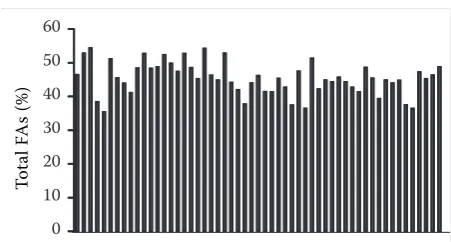
Different values of relative standard deviations of the mean proportions of SAFAs, MUFAs, PUFAs and VFAs were determined: 6.45, 12.47, 24.08 and 21.73%, respectively (Table 5). The proportions of PUFAs and VFAs ranged widely, while those of MUFAs and mainly of SAFAs fluctuated in a relatively narrow range. The different values of relative standard deviations of the individual groups of fatty acids shown in Figures 1–6 indicate what groups can be affected by an optimisation
process of the milk fat composition in Czech Pied cows.
[image:5.595.69.533.118.468.2]According to Fearon (2001), the optimisation of milk fat composition and of its technological properties is possible by using special feed addi-tives containing fats protected against their biohy-drogenation in the rumen. Such a method is more feasible and expeditious than genetic procedures. Goddard (2001) considered the optimisation only by the selection of a breed to be insufficient, as no
Table 5. Proportions (% of the total 37 fatty acids, w/w)of major groups of fatty acids in milk fat of Czech Pied
cattle and relations between the groups (2003–2005, n = 55)
x sx xmin xmax RSD (%)
SAFA 64.71 4.18 57.71 71.67 6.45
USFA 31.96 4.20 25.00 38.89 13.15
MUFA 27.45 3.42 21.98 34.68 12.47
PUFA 4.51 1.09 2.86 6.73 24.08
PUFAn3 1.32 0.36 0.78 2.23 27.27
PUFAn6 2.59 0.78 1.55 4.26 30.24
VFA 8.17 1.78 3.96 11.05 21.73
SCFA 12.25 2.45 6.94 15.85 19.97
MCFA 46.49 4.11 36.60 55.30 8.84
LCFA 37.93 5.72 29.25 50.72 15.08
HNFA 45.26 4.77 35.39 54.31 10.55
PUFAn6/n3 1.98 0.36 1.22 2.62 18.04
n3/PUFA 0.29 0.03 0.23 0.37 11.15
n6/PUFA 0.57 0.05 0.45 0.66 9.67
PUFA/MUFA 0.16 0.03 0.12 0.24 18.30
PUFA/USFA 0.14 0.02 0.11 0.19 15.65
PUFA/SAFA 0.07 0.02 0.04 0.11 29.32
MUFA/USFA 0.86 0.02 0.81 0.89 2.55
MUFA/SAFA 0.43 0.08 0.31 0.59 18.77
USFA/SAFA 0.50 0.10 0.34 0.67 19.51
SAFA/USFA 2.08 0.41 1.50 2.87 19.68
HNFA/SAFA 0.64 0.04 0.52 0.71 6.34
RSD (%) = relative standard deviation SAFA = saturated fatty acids
USFA = unsaturated fatty acids MUFA = monounsaturated fatty acids PUFA = polyunsaturated fatty acids VFA = volatile fatty acids (C4:0 – C10:0)
SCFA = short-chain fatty acids (C4 – C13) MCFA = middle-chain fatty acids (C14 – C17)
LCFA = long-chain fatty acids (C18 – C20)
breed is likely to be best in each parameter and different breeds will be best suited for different products.
Two groups of fatty acids should be taken into consideration from the human nutrition aspect. The desirable group of PUFAs with the mean pro-portion 4.51 ± 1.09% and range 2.86–6.73% and the undesirable group of HNFAs with the values 45.26 ± 4.77 and 35.39–54.31%, respectively.
The relatively high relative standard deviations of the PUFA and HNFA groups, 24.08 and 10.55%, respectively, together with the high content and proportion of the nutritionally undesirable HNFA group call for the use of programs to improve the
milk fat composition in Czech Pied cows. Data re-ported by Beaulieu and Palmquist (1995), Morales et al. (2000) and Drackley et al. (2001) showed the ranges of HNFA group 47.5–48.7% in milk fat of Holstein cows and 47.8–53.7% in Jersey cows. The mean proportion of Czech Pied cows 45.26% seems to be acceptable, however, we regard the improvement of milk fat composition as useful and promising. Published data of many research teams (e.g. Chouinard et al., 1998; Jenkins et al., 1999; AbuGhazaleh et al., 2002) proved a possibility of decreasing the proportion of the HNFA group considerably, by as much as 20% and even more within the group.
[image:6.595.312.526.87.189.2]0 20 40 60 80 % o f t ot al F A s 0 10 20 30 40 50 % o f t ot al F A s 0 10 20 30 40 % o f t ot al F A s 0 2 4 6 8 % o f t ot al F A s 0 10 20 30 40 50 60 % o f t ot al F A s 0 2 4 6 8 10 12 % o f t ot al F A s
[image:6.595.71.284.88.189.2]Figure 3. Variation of MUFAs proportion in the individual samples (n = 55)
[image:6.595.64.286.242.357.2]Figure 1. Variation of SAFAs proportion in the individual samples (n = 55)
Figure 2. Variation of USFAs proportion in the individual samples (n = 55)
[image:6.595.310.536.244.355.2]Figure 5. Variation of HNFAs proportion in the individual samples (n = 55)
Figure 4. Variation of PUFAs proportion in the individual samples (n = 55)
Figure 6. Variation of VFAs proportion in the individual samples (n = 55)
[image:6.595.64.290.401.522.2] [image:6.595.307.527.408.520.2]CONCLUSIONS
In 2003, 2004 and 2005 the milk fat composition was determined three times in 55 dairy cows of Czech Pied cattle housed in a byre with stanchions. Fatty acids were determined by a gas chromato-graphic method as methyl esters, 26 acids were identified out of the total 37 acids observed in chro-matograms. Among the individual fatty acids, the highest proportions were observed for palmitic acid (29.25 ± 2.98%), oleic acid (24.47 ± 3.27%), myr-istic acid (12.14 ± 1.80%) and stearic acid (8.91 ± 2.44%). The proportions of SAFAs, USFAs and MUFAs were 64.71 ± 4.18, 31.96 ± 4.20 and 27.45 ± 3.42% of total acids, respectively. The total pro-portion of nutritionally undesirable lauric, myristic and palmitic acid was 45.26 ± 4.77%, while that of the desirable PUFA group was 4.51 ± 1.09%. The observed relatively wide ranges of the individual groups of fatty acids indicate that it is possible to improve the milk fat composition of Czech Pied cows.
REFERENCES
AbuGhazaleh A.A., Schingoethe D.J., Hippen A.R., Kals-cheur K.F., Whitlock L.A. (2002): Fatty acid profiles of milk and rumen digesta from cows fed fish oil, extruded
soybeans or their blend. J. Dairy Sci., 85, 2266–2276.
Ashes J.A., Gulati S.K., Scott T.W. (1997): Potential to alter the content and composition of milk fat through
nutrition. J. Dairy Sci., 80, 2204–2212.
Avila C.D., DePeters E.J., Perez-Monti H., Taylor S.J., Zinn R.A. (2000): Influences of saturation ratio of sup-plemental dietary fat on digestion and milk yield in
dairy cows. J. Dairy Sci., 83, 1505–1519.
Bauman D.E., Griinari J.M. (2003): Nutritional regulation
of milk fat synthesis. Annu. Rev. Nutr., 23, 203–227.
Beaulieu A.D., Palmquist D. L. (1995): Differential effects of high-fat diets on fatty acid composition in milk of
Jersey and Holstein cows. J. Dairy Sci., 78, 1336–
1344.
Bitman J., Wood D.L., Miller R.H., Tyrrell H.F., Reynolds C.K. Baxter H.D. (1996): Comparison of milk and blood lipids in Jersey and Holstein cows fed total mixed ra-tions with or without whole cottonseed. J. Dairy Sci.,
79, 1596–1602.
Bobe G., Hammond E.G., Freeman A.E., Lindberg G.L., Beitz D.C. (2003): Texture of butter from cows with
different milk fatty acid compositions. J. Dairy Sci., 86,
3122–3127.
Delbecchi L., Ahnadi C.E., Kenelly J.J., Lacasse P. (2001): Milk fatty acid composition and mammary lipid me-tabolism in Holstein cows fed protected or unprotected
canola seeds. J. Dairy Sci., 84, 1375–1381.
DePeters E.J., Medrano J.F., Reed B.A. (1995): Fatty acid composition of milk fat from three breeds of dairy
cat-tle. Can. J. Anim. Sci., 75, 267–269.
Drackley J.K., Beaulieu A.D., Elliott J.P. (2001): Responses of milk fat composition to dietary fat or nonstructural carbohydrates in Holstein and Jersey cows. J. Dairy
Sci., 84, 1231–1237.
Fearon A.M. (2001): Optimising milk fat composition
and processing properties. Aust. J. Dairy Technol., 56,
104–108.
Goddard M. (2001): Genetics to improve milk quality.
Aust. J. Dairy Technol., 56, 166–170.
Hillbrick G., Augustin M.A. (2002): Milk fat character-istics and functionality: Opportunities for
improve-ment. Aust. J. Dairy Technol., 57, 45–51.
Chen S., Bobe G., Zimmerman S., Hammond E.G., Luh-man C.M., Boylston T.D., FreeLuh-man A.E., Beitz D.C. (2004): Physical and sensory properties of dairy prod-ucts from cows with various milk fatty acid
composi-tions. J. Agric. Food Chem., 52, 3422–3428.
Chouinard P.Y., Girard V., Brisson G.J. (1998): Fatty acid profile and physical properties of milk fat from cows fed calcium salts of fatty acids with varying
unsatura-tion. J. Dairy Sci., 81, 471–481.
Jahreis G. (2000): Änderung der Milchfettzusammenset-zung: Veränderung des Milchfettes und anderer Mil-chinhalts Stoffe hinsichtlich Anforderungen der
Humanernährung. DMZ, Lebensm. Milchwirt. 121,
992–996.
Jenkins T.C. (1999): Lactation performance and fatty acid composition of milk from Holstein cows fed 0 to 5%
oleamide. J. Dairy Sci., 82, 1525–1531.
Jensen R.G. (2002): The composition of bovine milk
lip-ids: January 1995 to December 2000. J. Dairy Sci., 85,
295–350.
Kelsey J.A., Corl B.A., Collier R.J., Bauman D.E. (2003): The effect of breed, parity, and stage of lactation on conjugated linoleic acid (CLA) in milk fat from dairy
cows. J. Dairy Sci., 86, 2588–2597.
Komprda T., Šustová K., Dvořák R., Tieffová P., Poul J. (2001): Changes fatty acid pattern, compositon and technological parameters of milk in dairy cows fed heat-treated rapeseed cakes in the first stage of
lacta-tion. Czech J. Anim. Sci., 46, 231–239.
Komprda T., Dvořák R., Fialová M., Šustová K., Pechová A. (2005): Fatty acid content in milk of dairy cows on a diet with high fat content derived from rapeseed.
Lawless F., Stanton C., L’Escop P., Devery R., Dillon P., Murphy J.J. (1999): Influence of breed on bovine milk cis-9, trans-11-conjugated linoleic acid content. Livest.
Prod. Sci., 62, 43–49.
Lock A.L., Bauman D.E. (2004): Modifying milk fat com-position of dairy cows to enhance fatty acids beneficial
to human health. Lipids, 39, 1197–1206.
Malacarne M., Summer A., Formaggioni P., Franceschi P., Mariani P. (2001): Composizione in acidi grassi del grasso del latte di quattro razze bovine allevate nella zona di produzione del Parmigiano-Reggiano. Annali della Facolta di Medicina Veterinaria, Universita di
Parma. 21, 249–259.
Martin B., Ferlay A., Pradel P., Rock E., Grolier P., Dupont D., Gruffat D., Besle J.M., Ballot N., Chilliard Y., Cou-lon J.B. (2002): Variabilité de la teneur des laits en con-stituants d’intérêt nutritionnel selon la nature des fourrages consommés par les vaches laitières. In: 9èmes Rencontres autour des Recherches sur les Ruminants. Paris, France, Institut National de la Recherche Agronomique, 347–350.
Morales M.S., Palmquist D.L., Weiss W.P. (2000): Milk fat composition of Holstein and Jersey cows with con-trol or depleted copper status and fed whole soyabeans
or tallow. J. Dairy Sci., 83, 2112–2119.
Offer N.W., Marsden M., Dixon J., Speake B.K., Thacker F.E. (1999): Effect of dietary fat supplements on levels of n-3 polyunsaturated fatty acids, trans acids and
con-jugated linoleic acid in bovine milk. Anim. Sci., 69,
613–625.
Parodi P.W. (2004): Milk fat in human nutrition Aust. J.
Dairy Technol., 59, 3–59.
Perdrix M.F., Sutter F., Wenk C. (1996): Facteurs de var-iation de la composition en acides gras de la matière
grasse du lait de vache. Rev. Suisse Agric., 28, 71–76.
Pešek M., Špička J., Samková E. (2005): Comparison of fatty acid composition in milk fat of Czech Pied cattle
and Holstein cattle. Czech J. Anim. Sci., 50, 122–128.
Playne M.J., Bennett L.E., Smithers G.V. (2003): Func-tional dairy foods and ingredients. Austral. J. Dairy
Technol., 58, 242–264.
Precht D., Molkentin J. (2000): Trans unsaturated fatty acids in bovine milk fat and dairy products. Eur. J.
Li-pid Sci. Technol., 102, 635–340.
Schroeder G.F., Delahoy J.E., Vidaurreta I., Bargo F., Gagl-iostro G.A., Muller L.D. (2003): Milk fatty acid com-position of cows fed a total mixed ration or pasture plus concentrates replacing corn with fat. J. Dairy Sci.,
86, 3237–3248.
Thomson N.A., Kay J.K., Auldist M.J., MacGibbon A.K.H. (2001): Management to modify milk fat. Aust. J. Dairy
Technol., 56, 151.
Townsend S.J., Siebert B.D., Pitchford W.S. (1997): Vari-ation in milk fat content and fatty acid composition of
Jersey and Friesian cattle. In: Proc. 12th Conference,
Breeding Responding to Client Needs, Dubbo, Aus-tralia, Part 1, 283–291.
Welch R.A.S., Burns D.J.W., Davis S.R., Popay A.I., Prosser C.G. (1997): Milk Composition, Production and Bio-technology. CAB International, Wallingford. ISBN 0-85199-161-0. 581 pp.
White S.L., Bertrand J.A., Wade M.R., Washburn S.P., Green J.T. Jr., Jenkins T.C. (2001): Comparison of fatty acid content of milk from Jersey and Holstein cows consuming pasture or total mixed ration. J. Dairy Sci.,
84, 2295–2301.
Whitlock L.A., Schingoethe D.J., Hippen A.R., Kalscheur K.F., AbuGhazaleh A.A. (2003): Milk production and composition from cows fed high oil or conventional
corn at two forage concentrations. J. Dairy Sci., 86,
2428–2437.
Received: 2005–11–14 Accepted after correction: 2006–01–05
Corresponding Author
Prof. ing. Milan Pešek, CSc., Faculty of Agriculture, University of South Bohemia in České Budějovice, Studentská 13, 370 05 České Budějovice, Czech Republic