JOURNAL OF FOREST SCIENCE, 56, 2010 (12): 600–608
A linkage among whole-stand model, individual-tree
model and diameter-distribution model
X. Zhang, Y. Lei
Research Institute of Forest Resource Information Techniques, Chinese Academy of Forestry, Beijing, China
ABSTRACT: Stand growth and yield models include whole-stand models, individual-tree models and
diameter-distri-bution models. In this study, the three models were linked by forecast combination and parameter recovery methods one after another. Individual-tree models combine with whole-stand models through forecast combination. Forecast combination method combines information from different models, disperses errors generated from different models, and then improves forecast accuracy. And then the forecast combination model was linked to diameter-distribution models via parameter recovery methods. During the moment estimation, two methods were used, arithmetic mean diameter and quadratic mean diameter method (A-Q method), and arithmetic mean diameter and diameter variance method (A-V method). Results showed that the forecast combination for predicting stand variables outperformed over the stand-level and tree-level models respectively; A-V method was superior to A-Q method on estimating Weibull parameters; these three different models could be linked very well via forecast combination and parameter recovery.
Keywords: forecast combination; linkage; parameter recovery; stand growth and yield model
Supported by the MOST, Projects No. 2006BAD23B02, No. 2005DIB5JI42, and No. CAFYBB2008008. In forest management, forest growth and yield
models play a very important role in studying for-est growth processes and predicting forfor-est growth. Forest growth and yield models can be classified into three broad categories: whole-stand models, individual-tree models, and diameter-distribu-tion models (Munro 1974). Whole-stand models are models that use the stand as a modelling unit (Curtis et al. 1981; Li et al. 1988; Tang et al. 1993; Wei 2006), whereas individual-tree models take the individual tree as a studied object (Zhang et al. 1997; Cao 2000; Cao et al. 2002; Zhang, Lei 2009). Diameter-distribution models, in contrast, use statistical probability functions, such as the Weibull function (Bailey, Dell 1973; Meng 1988; Liu et al. 2004; Newton et al. 2005), beta func-tion (Gorgoso-Várela et al. 2008) or SB funcfunc-tion (Wang, Rennolls 2005). There are strengths and weaknesses of each type of model. Whole-stand
models can predict stand variables directly, but they lack detailed tree-level information. On the other hand, individual-tree models provide more detailed information, and diameter-distribution models offer the stand diameter structure, but stand-level outputs from these two types of mod-els often suffer from an accumulation of errors and subsequently poor accuracy and precision (Meng 1996; Garcia 2001; Qin, Cao 2006).
individual-tree model was established by the disag-gregation method and forecast combination meth-od to improve accuracy and compatibility (Zhang et al. 1993; Ritchie, Hann 1997; Qin, Cao 2006; Yue et al. 2008). However, to our knowledge, no rigorous linkage among the three types of models has been documented so far. The objective of this study was to link three different models by the fore-cast combination method and parameter-recovery method one after another.
MATERIAL AND METHODS
[image:2.595.66.289.403.487.2]The data, provided by the Inventory Institute of Beijing Forestry, consisted of a systematic sample of permanent plots with a 5-year re-measurement interval. The plots, 0.067 ha each, were in Chinese pine (Pinus tabulaeformis) plantations situated on upland sites throughout northwestern Beijing. The data consisted of 156 measurements, with a 5-year re-measurement interval, obtained in the follow-ing years: 1986, 1991, 1996 and 2001. In this study, 106 plots were used in model development, and Table 1. Distributions of plots
Measurement time Fit data Validation data Total
1986–1991 27 12 39
1991–1996 37 17 54
1996–2001 42 21 63
Total 106 50 156
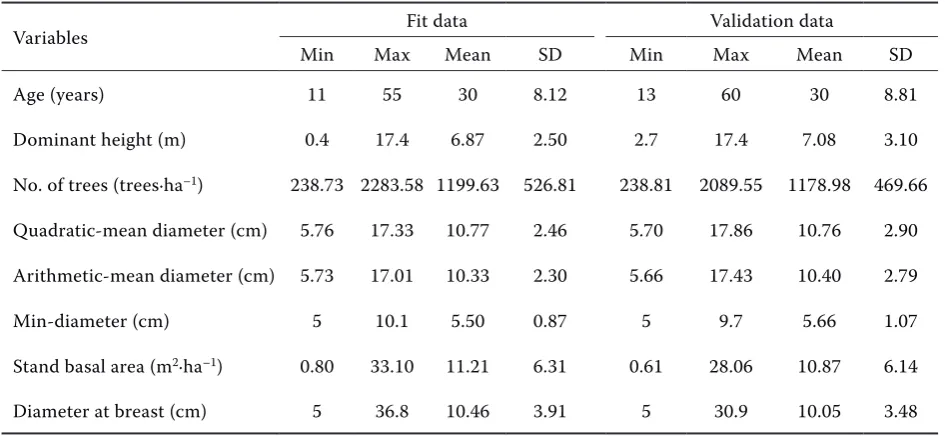
Table 2. Statistics of stand variables and tree variable
Variables Fit data Validation data
Min Max Mean SD Min Max Mean SD
Age (years) 11 55 30 8.12 13 60 30 8.81
Dominant height (m) 0.4 17.4 6.87 2.50 2.7 17.4 7.08 3.10
No. of trees (trees·ha–1) 238.73 2283.58 1199.63 526.81 238.81 2089.55 1178.98 469.66
Quadratic-mean diameter (cm) 5.76 17.33 10.77 2.46 5.70 17.86 10.76 2.90
Arithmetic-mean diameter (cm) 5.73 17.01 10.33 2.30 5.66 17.43 10.40 2.79
Min-diameter (cm) 5 10.1 5.50 0.87 5 9.7 5.66 1.07
Stand basal area (m2·ha–1) 0.80 33.10 11.21 6.31 0.61 28.06 10.87 6.14
Diameter at breast (cm) 5 36.8 10.46 3.91 5 30.9 10.05 3.48
SD – standard deviation
another 50 plots for validation. Table 1 shows the distribution of plots. Summary statistics for both data sets are presented in Table 2.
Cao (2002) developed a variable rate method to predict annual diameter growth and survival for an individual tree. This method was based on the fact that rates of survival and diameter growth vary from year to year. Stand-level growth and survival were also treated in a similar manner (Ochi, Cao 2003).
Because the quadratic mean diameter (Dg) is equal to or greater than the arithmetic mean diam-eter (Dm) (Curtis, Marshall 2000), the arithme-tic mean diameter was modelled using the equation (Diéguez-Aranda et al. 2006):
Dm = Dg – Exp(Xδ) (1)
where: X is the vector of stand variables (e.g. dominant height, stand age and stand density) and δ is the vector of parameters to be estimated.
The variable rate method was used in this study. Annual changes in dominant height, stand sur-vival, quadratic mean diameter, arithmetic mean diameter, diameter standard deviation, minimum diameter, stand basal area, diameter, and survival probability were described in recursive manner (Ochi, Cao 2003; Qin et al. 2007; Cao, Strub 2008). Table 3 lists the stand-level and tree-level growth equations.
Estimates of individual-tree diameters at age t+q were obtained by the tree diameter growth model (equation 13.h) and thenDˆggTT,DˆmmTT andDˆsdsd TT were
[image:2.595.63.536.521.739.2]Table 3. List of the recursive stand-level and tree-level growth equations.
Rt= (10,000 /Nt)0.5/H
t = the relative spacing at age At, q = length of growth period in years (in this case, q = 5), Ht= dominant height in m at age At, Nt = number of trees per ha at age At, Dgt = quadratic mean diameter in cm at age At, Dmt = arithmetic mean diameter in cm at age At, Bt = stand basal area in m2·ha–1 at age A
t, Dsdt = diameter standard deviation in cm at age At, Dmint = minimum diameter in cm at age At, Di,t = diameter of tree i at age At, pi,t+1 = probability that tree i is survived the period for age At to At+1, α1, α2, ..., μ4= parameters to be estimated
Year (t+1)
)] / )( / 1 ( ) ( ) /
[( 1 1 1 2 3
1 t t t t t t t
t Exp A A Ln H A A A H
H + = + + − + α +α +α (12.a)
)]} ( / )[ / 1 ( ) ( ) /
{( 1 1 1 2 3
1 t t t t t t t
t Exp A A Ln N A A A Ln N
N+ = + + − + β +β +β (12.b)
)] / )( / 1 ( ) ( ) /
[( 1 1 1 2 3
1 t t t t t t t
t Exp A A Ln Dg A A A H
Dg+ = + + − + χ +χ +χ (12.c)
] )
( / /
[ 1 2 3 4 5
1
1 t t t t t
t Dg Exp A Ln N H Dm
Dm+ = + − δ +δ +δ +δ +δ (12.d)
)]} ( / )[ / 1 ( ) ( ) /
{( 1 1 1 2 3
1 t t t t t t t
t Exp A A Ln B A A H Ln N
B+ = + + − + φ +φ +φ (12.e)
)]} ( ) ( )[ / 1 ( ) ( ) /
{( 1 1 1 2 3
1 t t t t t t t
t Exp A A Ln Dsd A A LnH Ln N
Dsd+ = + + − + γ +γ +γ (12.f)
)]} ( / / )[ / 1 ( ) min ( ) / {(
mint 1 Exp At At 1 Ln D t At At 1 1 2 At 3 Ln Nt
D + = + + − + κ +κ +κ (12.g)
)] ( / /
/
[ 1 2 1 3 4 5 ,
, 1
,t it t t t t it
i D Exp A A B Rs Ln D
D + = + λ +λ + +λ +λ +λ (12.h)
1 4 3 2 1 1
,t+ ={1+ [ + / t + t / ( t)+ / ( t)]}−
i Exp A D Ln Dg Ln N
P μ μ μ μ (12.i)
Year (t + q)
)] / )( / 1 ( ) ( ) /
[( + −1 + + −1 + −1 + 1 2 + −1 3 + −1
+q= t q t q t q + − t q t q + t q + t q
t Exp A A Ln H A A A H
H α α α (13.a)
)]} ( / )[ / 1 ( ) ( ) /
{( + −1 + + −1 + −1 + 1 2 + −1 3 + −1
+q= t q t q t q + − t q t q + t q + t q
t Exp A A Ln N A A A Ln N
N β β β (13.b)
)] / )( / 1 ( ) ( ) /
[( + −1 + + −1 + −1 + 1 2 + −1 3 + −1
+q= t q t q t q + − t q t q + t q + t q
t Exp A A Ln Dg A A A H
Dg χ χ χ (13.c)
)] )
( / /
[ 1 2 + −1 3 + −1 4 + −1 5 + −1 +
+q= t q− + t q + t q + t q + t q
t Dg Exp A Ln N H Dm
Dm δ δ δ δ δ (13.d)
)]} ( / )[ / 1 ( ) ( ) /
{( + −1 + + −1 + −1 + 1 2 + −1 3 + −1
+q= t q t q t q + − t q t q + t q + t q
t Exp A A Ln B A A H Ln N
B φ φ φ (13.e)
)]} ( ) ( )[ / 1 ( ) ( ) /
{( + −1 + + −1 + −1 + 1 2 + −1 3 + −1
+q = t q t q t q + − t q t q + t q + t q
t Exp A A Ln Dsd A A Ln H Ln N
Dsd γ γ γ (13.f)
)]} ( / / )[ / 1 ( ) min ( ) / {(
mint+q=Exp At+q−1 At+q Ln D t+q−1 + −At+q−1 At+q 1+ 2 At+q−1+ 3 Ln Nt+q−1
D κ κ κ (13.g)
)] (
/ /
/
[ 1 2 1 3 1 4 1 5 , 1
1 ,
,t+q= it+q− + + t+q− t+q+ t+q− + t+q− + it+q−
i D Exp A A B Rs Ln D
D λ λ λ λ λ (13.h)
1 1 4 1 1 3 1 2 1
,t+q ={1+ [ + / t+q− + t+q− / ( t+q− )+ / ( t+q− )]}−
i Exp A D Ln Dg Ln N
1–
Since cross-equation correlations existed among er-ror components of the above models, to eliminate the bias and inconsistency of the regression system (equa-tion a–h), the method of seemingly unrelated regres-sion (SUR) was used to simultaneously estimate the regression system (equation a–h). This method was widely used in econometrics (Johnson 1991) and in forest biometrics (Borders, Bailey 1986; Bor-ders 1989; Ochi, Cao 2003). The fitting procedure involved the use of option SUR of the SAS procedure model. Parameters of the tree survival equation were separately estimated by use of NLIN procedure.
Forecast combination
Forecast combination, introduced by Bates and Granger (1969), is a good method for improv-ing forecast accuracy (Newbold et al. 1987). The method combines information generated from dif-ferent models and disperses errors from these mod-els, thus improves consistency for outputs from different models. Yue et al. (2008) and Zhang et al. (2009) applied forecast combination to combine models from stand-level and tree-level. The fore-cast combination model is expressed as follows:
YC = ωYT + (1–ω)YS (2)
Thus, the variance of the forecast combination is as follows:
σC2 = ω2σ
T2 + (1–ω)2σS2 + 2ω(1–ω)σTS (3)
According to the method of calculating weights, a variance and covariance method was used broad-ly (Zhang et al. 2006; Yue et al. 2008):
2
2 2
2
S TS
T S TS
s
s
w
s
s
s
-=
+
-
(4) 22 2
1
2
T TS
T S TS
s
s
w
s
s
s
--
=
+
-
(5)where:
C
Y – combined estimates of stand variables,
T
Y – estimates of stand variables at tree-level,
S
Y – estimates of stand variables at stand-level,
w – weight factor,
2 T
σ – variance of stand variables at tree-level,
2 S
σ – variance of stand variables at stand-level, σTS – covariance of stand variables between the
tree-level and stand-tree-level.
Parameter-recovery method
The Weibull function has been extensively ap-plied in forestry because of its flexibility in describ-ing a wide range of unimodal distributions and the relative simplicity of parameter estimation (Bailey,
σ σ
σ σ σ
σ σ
σ σ σ
–
–
–
1–ω–
ω ω 1( ; , , ) c x( a)c exp[ (x a) ]c
f x a b c
b b b
-- -= - = Γ − − + Γ − = 0 ˆ 2 ˆ / ) ˆ ( 2 2 2
2 a aDm b1 g D a m D b ⎪⎩ ⎪ ⎨ ⎧ = Γ − − + Γ − = 0 ˆ 2 ˆ / ) ˆ ( 2 2 2
2 a aDm b1 g D a m D b 1
Dell 1973; Kangas, Maltamo 2000; Mabvuri-ra et al. 2002; Lei 2008). The Weibull probability density function is expressed as follows:
(a ≤x ≤ ∞) (6)
where:
x – diameter at breast height,
a – the location parameter,
b – the scale parameter,
c – the shape parameter.
Moment estimation is one of the methods about parameter recovery for estimating Weibull param-eters and has been used broadly (Liu et al. 2004; Lei 2008). Considering that the location parameter (a) must be smaller than the predicted minimum diameter (Dˆmin) in the stand, we set a=0.5Dˆmin since Frazier (1981) found that this resulted in minimum errors in terms of goodness of fit.
Two methods were used to recover b and c in the moment estimation. Method 1 is arithmetic mean diameter (Dmˆ ) and quadratic mean diameter (Dgˆ ) method (A-Q method) as follows (Liu et al. 2004):
(7)
where: Г1 = Г(1 + 1/c), Г2 = Г(1 + 2/c).
Method 2 is arithmetic mean diameter and di-ameter variance (Dˆ var) method (A-V method) (Diéguez-Aranda et al. 2006; Qin et al. 2007). A possible problem of method 1 is that
Dg
ˆ
might be too close to or too far fromDmˆ , and can even be smaller than Dmˆ if not properly constrained. The resulting Weibull parameters are sensitive to the difference betweenDmˆ and Dgˆ , resulting in un-stable estimators of b and c. The A-V method is ex-pressed as follows:(8)
Finally, the forecast combination combines stand variables from tree-level and stand-level models to predictˆ C
Dg ,Dmˆ C,Dsdˆ C,Dˆ minC and NˆC; and then Weibull
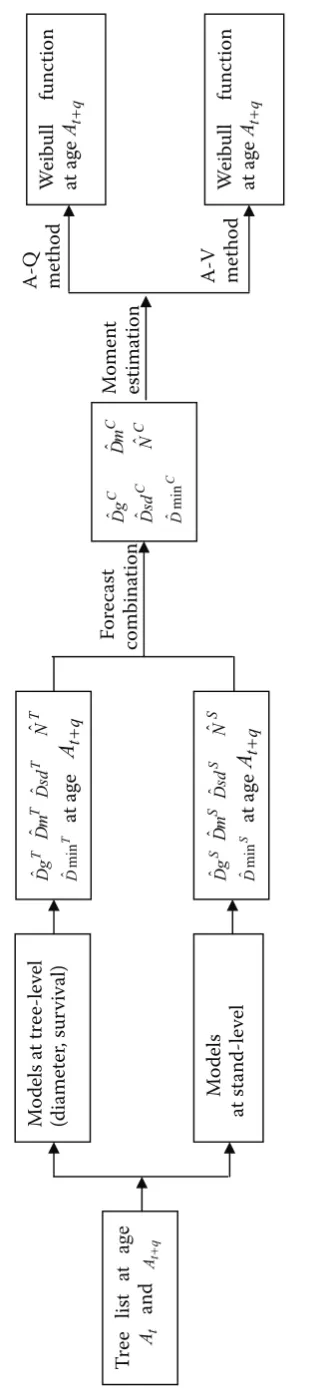
parameters b and c were estimated using the stand variables of the forecast combination models based on the two moment methods (equations 7 and 8). More detailed procedures of this study are shown in Fig. 1.
Model evaluation
Model evaluation was performed for both growth models and goodness of fit for the diameter distri-bution model. For growth models, the following evaluation statistics were calculated:
= Γ − Γ − Γ − = 0 ) ( var ˆ / ) ˆ ( 2 1 2 2 1 b D a m D b ⎪⎩ ⎪ ⎨ ⎧ = Γ − − + Γ − = 0 ˆ 2 ˆ / ) ˆ ( 2 2 2
For
ec
ast
co
mbina
tion
A-Q
met
ho
d
A-V
met
ho
d
M
omen
t
es
tim
at
io
n
Figure 1.
Flow chart
W
ei
bul
l
fu
nc
tion
at
age
q
t
A+
W
eibull f
unction
at
a
ge
q
t
A+
C
g
D
ˆ
C
m
D
ˆ
C
sd
D
ˆ
C
N
ˆ
C
D
mi
n
ˆ
Tr
ee
l
is
t
at age
t
A
and
q
t
A+
M
od
el
s a
t tr
ee
-le
ve
l
(d
ia
met
er
, sur
viv
al)
M
od
el
s
a
t s
ta
nd
-le
vel
T
g
D
ˆ
T
m
D
ˆ
T
sd
D
ˆ
T
N
ˆ
T
D
mi
n
ˆ
at
a
ge
q
t
A+
S
g
D
ˆ
S
m
D
ˆ
S
sd
D
ˆ
S
N
ˆ
S
D
mi
n
ˆ
at
a
ge
q
t
A+
Fig
. 1. Flow c
har
t
R-square
R
2= 1–
∑(yi–ŷi)2 / ∑ (yi–ŷi)2 (9) Log Likelihood
–2ln(L) = –2{∑piln(pi) + ∑(1–pi)ln(1–pi)} (10) and the evaluation of goodness of fit is error index (e), expressed as follows (Reynolds et al. 1988; Liu et al. 2004):
∑
−= m
j j j O P
e (11)
where:
yi – observed value at ageAt+qof stand variables
(arithmetic mean diameter, quadratic mean diameter, diameter standard deviation, mini-mum diameter or number of trees) or diameter of tree i,
ˆ
iy
,y
i – predicted value and average of yi, respectively, pi – probability of tree i survival,m – number of classes for each plot,
Pj, Oj – the predicted and observed number of trees per plot within each diameter class j, respectively.
RESULTS AND DISCUSSION
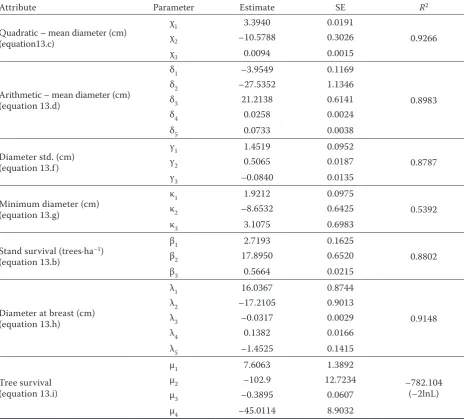
The estimates and standard deviation errors of parameters of the different growth models are pre-sented in Table 4. The estimates and standard de-viation errors showed that all the parameters were significant (P-value < 0.0001), and R2 values were
0.9266, 0.8983, 0.8787, 0.5392, 0.8802 and 0.9148 for the quadratic mean diameter model, arithmetic mean diameter model, diameter standard deviation model, minimum diameter model, stand survival model and diameter growth model at the stand lev-el, respectively. Log-likelihood of the tree survival model was –782.104.
Table 5 summarizes the gains in efficiency of stand variable models from tree-level, stand-level and forecast combination (e.g. Yue et al. 2008). For the data subset used for fitting the models, the efficiency for the combined quadratic mean diameter estima-tor was 100, as compared to 100.83, 104.38 for the tree-level and stand-level, and σC2 for the combined estimator was 0.3977 versus 0.4010, 0.4151; the ef-ficiency for the arithmetic mean diameter was 100, as compared to 97.99, 119.03, andσC2 was 0.4219 vs. 0.4134, 0.5022; the efficiency for the diameter standard deviation was 100, as compared to 105.11, 103.03, and 2
C
σ was 0.0958 versus 0.1007, 0.0987; the efficiency for the minimum diameter was 100,
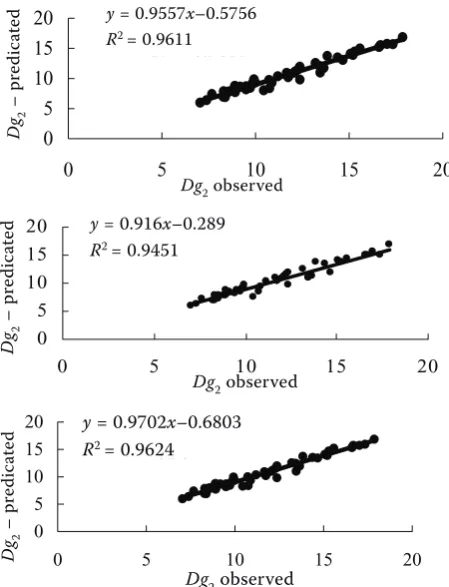
[image:5.595.332.496.57.758.2]as compared to 121.77, 101.57, and σC2 was 0.3749 versus 0.4565, 0.3808; the efficiency for the stand survival was 100, as compared to 111.91, 100.015, and σC2 was 26,494.03, versus 29,648.46, 26,535.09. Overall, except one, the combined estimators were better than those from tree-level and stand-level models for both fit and validation data. The only exception was the arithmetic mean diameter model for the fit data. Fig. 2 illustrates the relationships be-tween the observed quadratic mean diameter and predicted value by the three models for the valida-tion data. It is obvious that the forecast combinavalida-tion achieved the beneficial effect of the highest value R2
(taking quadratic mean diameter as an example). The combined predictions were based on the opti-mal weights which are derived by the variance-co-variance method (Newbold, Grander1974) of the
two respective level models. Therefore, these esti-mators performed minimum variance and high pre-cision (Bates, Grander 1969; Jeong, Kim 2009) in comparison with the single levels.
[image:6.595.65.530.86.505.2]Table 6 shows the average values and standard de-viations of error index (e) calculated by two different moment estimation methods. For the data subset used for fitting the models, the average error index value for A-Q method was 509.7407, as compared to 442.1898 for A-V method. SD was 285.1731 versus 254.4337. Obviously, the average error index value and SD of A-V method are much smaller than those of A-Q method for both fit and validation data, re-spectively. And in the fit data, Weibull parameters of all plots (106 plots) were estimated based on A-V method. But parameters of only 96 plots were esti-mated by A-Q method. It means that parameters of Table 4. Parameter estimates and model evaluation
Attribute Parameter Estimate SE R2
Quadratic – mean diameter (cm) (equation13.c)
χ1 3.3940 0.0191
0.9266
χ2 –10.5788 0.3026
χ3 0.0094 0.0015
Arithmetic – mean diameter (cm) (equation 13.d)
δ1 –3.9549 0.1169
0.8983
δ2 –27.5352 1.1346
δ3 21.2138 0.6141
δ4 0.0258 0.0024
δ5 0.0733 0.0038
Diameter std. (cm) (equation 13.f)
γ1 1.4519 0.0952
0.8787
γ2 0.5065 0.0187
γ3 –0.0840 0.0135
Minimum diameter (cm) (equation 13.g)
κ1 1.9212 0.0975
0.5392
κ2 –8.6532 0.6425
κ3 3.1075 0.6983
Stand survival (trees·ha–1)
(equation 13.b)
β1 2.7193 0.1625
0.8802
β2 17.8950 0.6520
β3 0.5664 0.0215
Diameter at breast (cm) (equation 13.h)
λ1 16.0367 0.8744
0.9148
λ2 –17.2105 0.9013
λ3 –0.0317 0.0029
λ4 0.1382 0.0166
λ5 –1.4525 0.1415
Tree survival (equation 13.i)
μ1 7.6063 1.3892
–782.104 (–2lnL)
μ2 –102.9 12.7234
μ3 –0.3895 0.0607
μ4 –45.0114 8.9032
606 J. FOR. SCI., 56, 2010 (12): 600–608
Table 5. Evaluation statistics from different models for fit data and validation data
Attributes σ2 Efficiency (%)
fit validation fit validation
Tr
ee-le
ve
l mo
de
l Quadratic mean diameter (cm) 0.4010 0.3340 100.83 103.50
Arithmetic mean diameter (cm) 0.4134 0.3407 97.99 101.73
Diameter standard deviation (cm) 0.1007 0.1252 105.11 101.95
Minimum diameter (cm) 0.4565 0.5454 121.77 100.31
Stand survival (trees·ha–1) 29,648.46 39,805.53 111.91 102.72
St and-le ve l mo de l
Quadratic mean diameter (cm) 0.4151 0.4789 104.38 148.40
Arithmetic mean diameter (cm) 0.5022 0.6070 119.03 181.25
Diameter standard deviation (cm) 0.0987 0.1305 103.03 106.27
Minimum diameter (cm) 0.3808 0.6929 101.57 127.44
Stand survival (trees·ha–1) 26,535.09 41,340.33 100.15 106.68
For ec ast combina tion mo de l
Quadratic mean diameter (cm) 0.3977 0.3227 100 100
Arithmetic mean diameter (cm) 0.4219 0.3349 100 100
Diameter standard deviation (cm) 0.0958 0.1228 100 100
Minimum diameter (cm) 0.3749 0.5437 100 100
Stand survival (trees·ha–1) 26,494.03 38,751.85 100 100
Efficiency at tree-level = 100σ2
T , /σ2C efficiency at stand-level = 100σ2S/σ2C , efficiency from forecast combination = 100σ2
C /σ2C , and Value in bold denotes the best statistic among models for each of the fit and validation data sets
the other 10 plots could not be estimated. It was be-cause Dgˆ Cwas smaller than ˆ C
Dm of those 10 plots. The formula for diameter variance is,
Dvar = E(D2)– E(D)2 andE D( )= Dm, E(D2)= DDgg22
E(x) is the expected value. And Dvar > 0, then
[image:7.595.64.289.412.706.2]Dg> Dm. WhenDgis closer toDm, Dvar ap-proaches 0, and distribution shrinks to a point at Dg. This kind of Weibull distribution does not ex-ist. So whenDgis closer toDmorDgis smaller thanDm,Weibull parameters could not be estimat-ed by A-Q method. It also verifiestimat-ed the fact that it was not suitable to use A-Q method for estimating Weibull parameters. So A-V method outperforms A-Q method in estimating Weibull parameters.
Fig. 2. Relationships between the observed quadratic mean diameter and the predicted value with three models for the validation data
y = 0.9557x - 0.5756 R2 = 0.9611
0 5 10 15 20
0 5 10 15 20
Dg2-observed
Dg 2 -p re di ct
ed y = 0.916x - 0.289R2 = 0.9451
0 5 10 15 20
0 5 10 15 20
Dg2-observed
Dg 2 -p red ict ed
y = 0.9702x - 0.6803 R2 = 0.9624
0 5 10 15 20
0 5 10 15 20
Dg2-observed
Dg 2 -p re di ct ed
a: Tree level model b: Stand-level model
c: Forecast combination model
Figure 2. Relationships between the observed quadratic mean diameter and
the predicted value with three models for the validation data
y = 0.9557x–0.5756
[image:7.595.304.532.645.737.2]R2 = 0.9611
Table 6. Error index based on A-Q method and A-V method
Attribute A-Q A-V
Fit data Mean 509.7407 442.1898
SD 285.1731 254.4337
Validation data Mean 533.5493 479.4961
SD 286.4376 240.311
SD – standard deviation
Dg2 observed
y = 0.9557x - 0.5756 R2 = 0.9611
0 5 10 15 20
0 5 10 15 20
Dg2-observed
Dg 2 -p re di ct
ed y = 0.916x - 0.289R2 = 0.9451
0 5 10 15 20
0 5 10 15 20
Dg2-observed
Dg 2 -p red ict ed
y = 0.9702x - 0.6803 R2 = 0.9624
0 5 10 15 20
0 5 10 15 20
Dg2-observed
Dg 2 -p re di ct ed
a: Tree level model b: Stand-level model
c: Forecast combination model
Figure 2. Relationships between the observed quadratic mean diameter and
the predicted value with three models for the validation data
y = 0.9702x–0.6803
R2 = 0.9624
Dg2 observed
Dg2 – pr edic at ed Dg2 – pr edic at ed
y = 0.9557x - 0.5756 R2 = 0.9611
0 5 10 15 20
0 5 10 15 20
Dg2-observed
Dg 2 -p re di ct
ed y = 0.916x - 0.289R2 = 0.9451
0 5 10 15 20
0 5 10 15 20
Dg2-observed
Dg 2 -p red ict ed
y = 0.9702x - 0.6803 R2 = 0.9624
0 5 10 15 20
0 5 10 15 20
Dg2-observed Dg 2 -p re di ct ed
a: Tree level model b: Stand-level model
c: Forecast combination model
Figure 2. Relationships between the observed quadratic mean diameter and
the predicted value with three models for the validation data
y = 0.916x–0.289
R2 = 0.9451
Dg2 observed
Dg2
– pr
edic
at
CONCLUSIONS
In this study, the forecast combination was used to link tree-level models and stand-level models. It efficiently utilizes information generated from dif-ferent models, reduces errors from a single mod-el, and improves accuracy and precision. It also ensures that stand variables from tree-level and stand-level models are consistent.
Forecast combination models and diameter dis-tribution models were linked through the parame-ter recovery method (moment estimation), and the two moment estimation methods were used in this study. It is much more suitable to estimate Weibull parameters on the basis of A-V method than A-Q method. And ifDmˆ is larger thanDgˆ or too close to
ˆ
Dg, Weibull parameters will not be estimated by A-Q method, but they will be estimated by A-V method. So A-V method is superior to A-Q meth-od for estimating Weibull parameters.
Whole-stand models, individual-tree models and diameter models can be linked together through the forecast combination method and the param-eter-recovery method one after another. Therefore, this study provided a framework for studying the integrated system of forest models.
Acknowledgements
The authors would like to thank the Inventory In-stitute of Beijing Forestry for its data and Dr. Quang V. Cao for providing his information and SAS code.
References
Bates J.M., Granger C.W.J. (1969): The combination of forecasts. Operation Research Quarterly, 20: 451–468. Bailey R.L., Dell T.R. (1973): Quantifying diameter
dis-tributions with the Weibull distribution. Forest Science,
19: 97–104.
Bailey R.L. (1980): Individual tree growth derived from diameter distribution models. Forest Science, 26: 626–632. Borders B.E., Bailey R.L. (1986): A compatible system of
growth and yield equations for Slash Pine fitted with restrict-ed three-stage least squares. Forest Science, 32: 185–201. Borders B.E. (1989): Systems of equations in forest stand
modeling. Forest Science, 35: 548–556.
Cao Q.V. (1997): A method to distribute mortality in di-ameter distribution models. Forest Science, 43: 435–442. Cao Q.V. (2000): Prediction of annual diameter growth and
survival for individual trees from periodic measurements. Forest Science, 46: 127–131.
Cao Q.V., Li.S.S., McDill M.E. (2002): Developing a system of annual tree growth equations for the loblolly pine– shortleaf pine type in Louisiana. Canadian Journal Forest Research, 32: 2051–2059.
Cao Q.V., Strub M. (2008): Evaluation of four methods to estimate parameters of an annual tree survival and diam-eter growth model. Forest Science, 6: 617–624.
Curtis R.O., Clendenen G.W, Renkama D.L. (1981): A New Stand Simulator for Coast Douglas-Fir: DFSIM User’ Guide. General Technical Report PNW–128. Portland, USDA Forest Service, Pacific Northwest Forest and Range Experiment Station.
Curtis R.O., Marshall D.D. (2000): Why quadratic mean diameter? West Journal of Applied Forest, 15: 137–139. Diéguez–Aranda U., Dorado F.C., Álboreca-Gonzáles
J.G., Alboreca A.R. (2006): Dynamic growth model for Scots pine (Pinus sylvestris L.) plantations in Galicia (north-western Spain). Ecological Modelling, 191: 225–242. Frazier J.R. (1981): Compatible Whole-Stand and Diameter
Distribution Models for Loblolly Pine Plantations. [Ph.D. Thesis.] Blackburg, Virginia Polytechnic Institute and State University, School of Forestry and Wildlife: 125.
Garcia O. (2001): On bridging the gap between tree–level and stand-level models. Available at http://web.unbc. ca/~garcia/publ/greenw.pdf (accessed on June 13, 2009) Gorgoso-Várela J.J., Rojo-Alboreca A., Afif-Khouri E.,
Barrio-Anta (2008): Modelling diameter distributions of birch (Betula alba L.) and pedunculate oak (Quercus robur L.) stands in northwest Spain with the Beta distribution. Investigation Agraria: Sistemas y recursos Forestales, 17: 271–281.
Hyink D.M., Moser J.W. (1983): A generalized framework for projecting forest yield and stand structure using diam-eter distribution. Forest Science, 29: 85–95.
Jeong D.I., Kim Y.O. (2009): Combining single–value stream-flow forecasts – A review and guidelines for selecting techniques. Journal of Hydrology, 377: 284–299.
Johnston J. (1991): Econometric Methods. McGraw-Hill, Singapore: 568.
Kangas, A., Maltamo M. (2000): Calibrating predicted diameter distribution with additional information. Forest Science. 46: 390–396.
Lei Y. (2008): Evaluation of three methods for estimating the Weibull distribution parameters of Chinese Pine (Pinus tabulaeformis). Journal of Forest Science, 54: 549–554. Li X.F., Tang S.Z., Wang S.L. (1998): The Establishment of
variable density yield table for Chinese plantation in Da-gangshan Experiment Bureau. Forest research, 4: 382–389. (in Chinese)
Lynch T.B., Moser J.W. (1986): A growth model for mixed species stands. Forest Science, 32: 697–706.
Mabvurira D., Maltamo M., Kangas A. (2002): Predict-ing and calibratPredict-ing diameter distributions of Eucalyptus grandis (Hill) Maiden plantations in Zimbabwe. New Forests, 23: 207–223.
Meng X.Y. (1988): A study of the relation between D and H- distributions by using the Weibull function. Journal of Beijing Forestry University, 10: 40–47. (in Chinese) Meng X.Y. (1996): Natural Resources Measurement. 2nd Ed.
Beijing: China Forestry Publishing House: 296. (in Chinese) Munro D.D. (1974): Forest growth models – a prognosis.
In: Fries J. (ed.): Growth Models of Tree and Stand Simu-lation. Royal College of Forestry, Research Note No. 30, Stockholm.
Newbold P., Granger C.W.J. (1974): Experience with forecast-ing univariate time series and the combination of forecasts. Journal of the Royal Statistical Society Series A, 137: 131–165. Newbold P., Zumwalt J.K., Kannas S. (1987): Combining
forecasts to improve earnings per share prediction: and examination of electric utilities. International Journal of Forecasting, 3: 229–238.
Newton P.F., Lei Y., Zhang S.Y. (2005): Stand–level diam-eter distribution yield model for black spruce plantations. Forest Ecology and Management, 209: 181–192.
Ochi Cao Q.V. (2003): A comparison of compatible and an-nual growth models. Forest Science, 49: 285–290. Qin J.H., Cao Q.V. (2006): Using disaggregation to link
individual-tree and whole-stand growth models. Canadian Journal of Forest Research, 36: 953–960.
Qin J.H., Cao Q.V., Blouin D.C. (2007): Projection of a diameter distribution through time. Canadian Journal of Forest Research, 37: 188–194.
Reynolds M.R., Burk T.E., Huang W.C. (1988): Goodness-of-fit tests and model selection procedures for diameter distribution models. Forest Science, 34: 373–399. Ritchie M.W., Hann D.W. (1997): Implications of
disag-gregation in forest growth and yield modeling. Forest Science, 43: 223–233.
Tang S.Z., Li X.F., Meng Z.H. (1993): The development of studies on stand growth models. Forest Research, 8: 672–679. (in Chinese)
Wang M.L., Rennolls K. (2005): Tree diameter distribu-tion modeling: introducing the logit-logistic distribudistribu-tion. Canadian Journal Forest Research, 35: 1305–1313. Wei Z.C. (2006): Application of stand models Larix olgensis
plantations. Journal of Northeast Forestry University, 34: 31–33. (in Chinese)
Yue C.F., Kohnle U., Hein S. (2008): Combining tree–and stand–level models: a new approach to growth prediction. Forest Science, 54: 553–566.
Zhang L., Moore J.A., Newberry J.D. (1993): Disaggre-gating stand volume growth to individual trees. Forest Science, 39: 295–308.
Zhang L., Packard K.C., Liu C. (2003): A comparison of estimation methods for fitting Weibull and Johnson’s SB distributions to mixed spruce–fir stands in northeastern North America. Canadian January Forest Research, 33: 1340–1347.
Zhang S., Amateis R.L., Burkhart H.E. (1997): Constrain-ing individual tree diameter increment and survival models for loblolly pine plantations. Forest Science, 43: 414–423. Zhang X.Q., LeiY.C. (2009): Comparison of annual individu-al–tree growth models based on variable rate and constant rate methods. Forest Research, 22: 824–828. (in Chinese) Zhang X.Q., LeiY.C., Chen X.M, Wang J Z. (2010): Predic-tion of stand basal area with forecast combinaPredic-tion. Journal of Beijing Forestry University. (in press)
Zhang Y., Ma C.S., Wei K. (2006): The study of estimation of weight coefficient in combination forecast models – the application of the least absolute Value model. Journal of Transportation Systems Engineering and Information Technology, 6: 125–129. (in Chinese)
Received for publication October 13, 2010 Accepted after corrections April 12, 2010
Corresponding author:
Prof. Doctor Yuancai Lei, Chinese Academy of Forestry, Research Institute Resource Information and Techniques, Beijing 100091, P. R. China