During harvesting of corn-inbred lines, we make efforts to preserve seed quality by proper receipt, drying and processing. It is known that the ma-nipulation of seed at these stages causes increased damage and reduction of germination energy and germination.
Reduction of seed vigour was evident from har-vest till the end of processing and conditioned by the percentage of damage, and various damaged spots (Burris 1990, Alyahya 1995, Ashok and Sinha 1998, Pucarić 1999). In view of this, the mode of harvesting, receipt, drying and seed processing of corn-inbred lines is a critical period in production of high-quality seed. Seed damage, particularly damages of crown and germ affect the process of germination, especially at lower temperatures. Seed damage means an undisturbed possibility of attack by pathogenic microorganisms in soil, such as Aspergillus spp., Pythium spp., and Penicillium spp. These microorganisms cause rotting of seed and germ. The consequence of this is a thinned stand, which brings about lower yields or the entire plot has to be resown (Spitel 1984, Levison and Levison 1998).
The damaged spots in corn seed at processing have had different intensities and depended on the structure of seed (dent, flint), the kernel shape (round or wedge-shaped), the seed placement on the cob (shallow or deeply placed kernels) and the thickness of pericarp (Spitel 1984, Pucarić 1999).
MATERIAL AND METHODS
The testing was carried out at the Department for Seed Production and Processing of Agricultural Institute Osijek in 2000 and 2001. About 1.5 kg of seed was taken in four replications and 100 seeds were enumerated from each one to determine the level of damage. In general, the seed of the line dent type was more damaged as compared to that of the line semi-flint type.
Seed of five corn inbred lines differing in form and type A type: shallow and round form of the dent type MO-17 (public line), Os6-2 (Agricultural Institute Osijek line); B type: deep and uniform of the semi-flint type B-73 (public line), Os84-28 and Os87-24 (Agricultural Institute Osijek lines) were tested for their quantity and damaged spots (crown, germ, back side and belly side) at processing in the Osijek Agricultural Institute for two years. For this purpose, we selected corn lines that differed in their kernel structure, shape, kernel placement and the length of vegetation.
In both years, the lines were harvested manu-ally. After harvest, during seed processing which followed reception, drying, husking and grading, we separated 25 samples from each line in each year of the investigation. We determined the seed damage and the spots. The above-mentioned characters were analysed in the laboratory of the Osijek Agricultural Institute by visual observation
Influence of corn (
Zea mays
L.) inbred lines seed processing
on their damage
B. Šimić, S. Popović, M. Tucak
Agricultural Institute, Osijek, Croatia
ABSTRACT
Manipulation of corn seed from harvest throughout processing to disinfections is associated with seed damage. Such damage causes lower germination and germination energy. Seed damage, especially in the embryo and crown, are factors that decrease germination, especially under low temperatures. Also, damaged seed is inclined to infections by soil pathogens (Aspergillus, Pythium, Penicillium), causing seed and germ ro�ing. In some cases, plant density is seriously reduced by infestations so that resowing is required. Seed of five corn-inbred lines differing in form and type (A: shallow and round form of the dent type MO-17, Os6-2; B: deep and uniform of the semi-flint type B-73, Os84-28 and Os87-24) were tested for their quantity and damaged spots (crown, germ, back side and belly side). Seed damage following the manipulations ranged as follows: from 3.8 to 7.2% (harvest), from 36.2 to 52.8% (husking) and from 38.4 to 54.0% (the end of processing). Also, damage of different parts of seed following their processing was as follows: from 17.8 to 29.2% (crown), from 4.1 to 6.7% (germ), from 6.3 to 9.8% (back side) and from 5.7 to 8.3% (belly side). High negative correlation (from r = –0.620 to r = –0.960) between damage of seed and seed quality (germination energy, germination) and high positive correlation between germination energy and germination were found over the investigated years and for both lines.
of seed under magnifying glass with light, which was placed on the table.
Seed damage was given in percentage in relation to the sample analysed. The spots of damage were classified into four groups and given in their per-centage, as well (Spitel 1984). By visual observation we established the following parameters: damage of the crown, damage of the germ, damage of the back side, and damage of the belly side.
The term damage of the crown included break-ing of entire or a part of the crown crack of its pericarp. Damage of the germ included split of the germ, its splitting off and crack of the pericarp around the germ. Damage of the back and belly side included cracks or injuries of pericarp on the back and belly side. Experimental data (seed damage, germination energy, germination) were subjected to related model of ANOVA. The means were tested by the LSD test at the level of P ≤ 0.05 and P ≤ 0.01. Coefficients of correlation analyses (Path coefficient analyses) were performed using the computerized statistical program MSTATC.
RESULTS AND DISCUSSION
Seed represents a living organism with specific responses that are evident in sowing, harvesting, processing and storage till the next sowing. In view of this, we have to treat it carefully to preserve its vigour, germination and to reduce seed damage to the minimum rate.
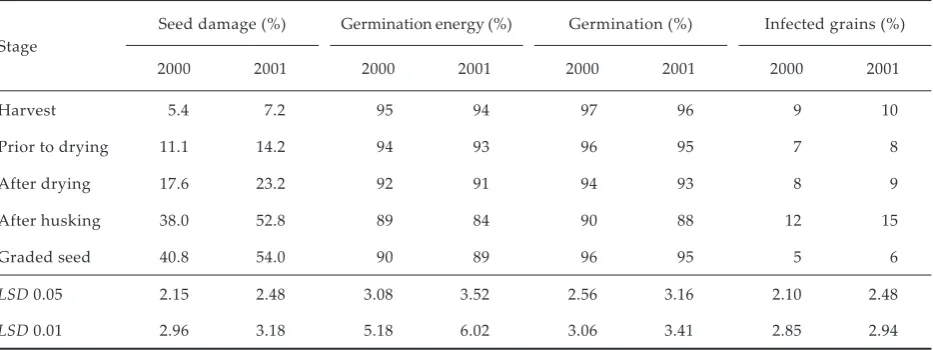
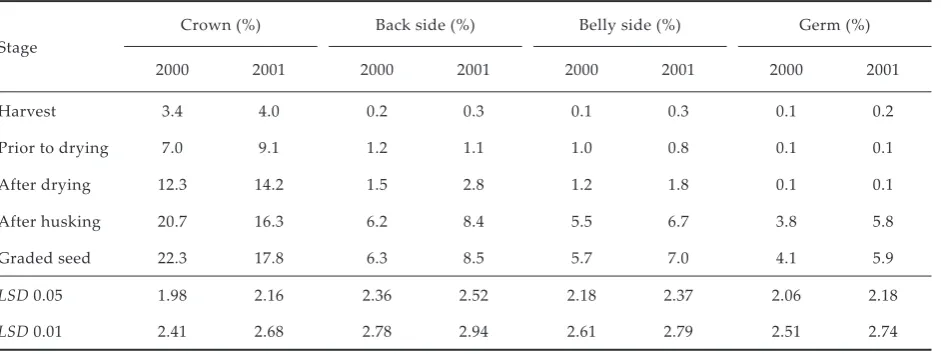
Therefore, it is required that we should cause as little damage at harvesting and processing as possible and preserve seed quality at the highest possible degree. Seed damage and seed quality data of the lines type A and type B are shown in Tables 1–4.
In both years of the investigation, seed damage in corn was increased after processing and varied from 38.4 to 54.0%. The line type A had a larger percentage of damage than line type B by 6.3 and 37.8% in 2000 and 2001, respectively.
[image:2.595.65.532.84.259.2]The largest percentage of seed damage in both lines as comparing any preceding stage, and dur-ing seed processdur-ing after huskdur-ing was observed. Table 1. Total average seed damage and seed quality in the corn line type A after harvest and during processing
Stage
Seed damage (%) Germination energy (%) Germination (%) Infected grains (%)
2000 2001 2000 2001 2000 2001 2000 2001
Harvest 5.4 7.2 95 94 97 96 9 10
Prior to drying 11.1 14.2 94 93 96 95 7 8
After drying 17.6 23.2 92 91 94 93 8 9
After husking 38.0 52.8 89 84 90 88 12 15
Graded seed 40.8 54.0 90 89 96 95 5 6
LSD 0.05 2.15 2.48 3.08 3.52 2.56 3.16 2.10 2.48
[image:2.595.65.538.591.767.2]LSD 0.01 2.96 3.18 5.18 6.02 3.06 3.41 2.85 2.94
Table 2. Seed damage in the corn line type A after harvest and during processing
Stage
Crown (%) Back side (%) Belly side (%) Germ (%)
2000 2001 2000 2001 2000 2001 2000 2001
Harvest 5.0 6.4 0.1 0.2 0.1 0.3 0.2 0.3
Prior to drying 8.0 11.7 1.8 1.0 1.0 1.2 0.3 0.3
After drying 14.0 18.2 2.0 2.2 1.0 1.8 0.6 1.0
After husking 21.0 28.5 7.8 9.6 5.2 8.2 4.0 6.5
Graded seed 22.9 29.2 8.0 9.8 5.8 8.3 4.1 6.7
LSD 0.05 2.51 2.65 2.35 2.49 2.18 2.26 2.21 2.37
The line type A had a larger percentage of seed damage after husking than the line type B (Tables 1 and 3).
Prior to and after drying, increasing of seed damage was evident, but it was lower than that observed after husking. Such increasing of seed damage is a consequence of transport, falling of the ear, collision of the ear against the ground made of concrete, collisions among the ears, the structure of the seed, its shape and effects of heat at drying (Svarc 1980, Burris 1990). At the stage of husking, the ear through the operations in various parts of the husker (reception box, sieve, drum) and suffers falling onto the corn sheller. This resulted in a considerable increase of seed damage, especially in the line type A. Grading of corn seed led to further damage and it was statistically significant.
The analyses of the spots damaged have shown that they occurred in all parts of kernels, but this was applicable to certain stages of processing only (Tables 2 and 4).
Damage of the crown has been evident at harvest till the moment of chemical treatment and varied from 17.8 to 29.2%, depending on the line and the year of the investigation. Such damage was a consequence of transport, genetic seed properties and drying. Damage of the crown was detected after husking, too. The line type A had a larger percentage of crown damage in both years of the investigation than the line type B (Tables 2 and 4). It is possible to provide an explanation by refer-ring to the structure, shape and genetic properties of the type lines tested (Spitel 1984, Burris 1990). Crown damaging caused by drying ranged from 5.1 to 5.5%, as a consequence of falling of kernels, the kernel structure, the thickness of pericarp and the kernel shape (Pucarić 1992).
[image:3.595.66.532.85.259.2]The damage of the germ, back and belly was negligible until the stage of husking. The ope-rations of active parts of corn sheller as well as falling of ears into it caused the damaging of the backside (6.3–9.8%), belly side (5.7–8.3%) and germ (4.1–6.7%).
Table 3. Total average seed damage and seed quality in the corn line type B after harvest and during processing
Stage
Seed damage (%) Germination energy (%) Germination (%) Infected grains (%)
2000 2001 2000 2001 2000 2001 2000 2001
Harvest 3.8 4.8 97 95 98 97 6 7
Prior to drying 9.3 11.1 96 95 97 95 5 5
After drying 15.1 18.9 94 94 95 94 5 6
After husking 36.2 37.2 90 89 90 90 8 11
Graded seed 38.4 39.2 95 93 97 95 3 4
LSD 0.05 2.22 2.56 2.47 2.89 2.15 2.62 2.11 3.36
LSD 0.01 3.01 3.92 3.26 3.91 2.86 2.97 2.73 4.07
Table 4. Seed damage in the corn line type B after harvest and during processing
Stage
Crown (%) Back side (%) Belly side (%) Germ (%)
2000 2001 2000 2001 2000 2001 2000 2001
Harvest 3.4 4.0 0.2 0.3 0.1 0.3 0.1 0.2
Prior to drying 7.0 9.1 1.2 1.1 1.0 0.8 0.1 0.1
After drying 12.3 14.2 1.5 2.8 1.2 1.8 0.1 0.1
After husking 20.7 16.3 6.2 8.4 5.5 6.7 3.8 5.8
Graded seed 22.3 17.8 6.3 8.5 5.7 7.0 4.1 5.9
LSD 0.05 1.98 2.16 2.36 2.52 2.18 2.37 2.06 2.18
[image:3.595.65.536.589.766.2]Seed spots of damages were different depend-ently on seed structure (genotype) and seed pro-ceeding phase. Statistically significant differences were found at the level of P ≤ 0.01.
Germination energy and germination during investigation varied dependently on type and seed structure of lines (genotype A, genotype B), seed processing phase and year of investigation. The lowest germination energy (84%) and germination (88%) for both of investigated lines and investiga-ted years were found after husking. The highest germination energy (97%) and germination (98%) and the lowest seed damage percentage was found after harvest (Tables 1 and 3). Differences of seed quality were statistically significant at the level P ≤ 0.01. Spitel (1984), Burris (1990) and Pucarić (1999) also reported about 9–21% of germinati-on energy and germinatigerminati-on decreasing caused by husking.
A percentage of infected seed statistically var-ied due to processing phase and type of inves-tigated lines. The highest percentage of infected seed was after husking (15%) and the lowest was after seed grading (3%) due to the fact that the most infected seed are usually seed of corncob top (Tables 1 and 3).
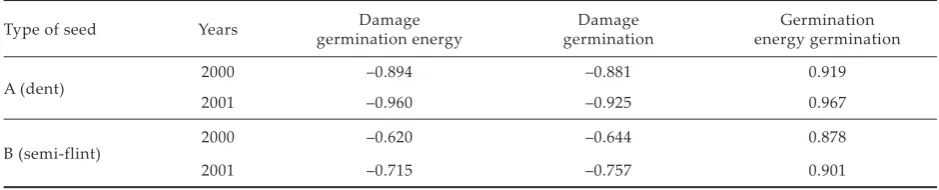
High negative correlation (from r = –0.620 to r = –0.960) was found between damage of seed and seed quality (germination energy, germi-nation) but high positive correlation (r = 0.878 to r = 0.967) between germination energy and germination (Table 5).
CONCLUSION
On the basis of testing seed damage and observing the spots of damage on shallow and round and kernels of the dent type in corn inbred line type A, as well as in corn inbred line type B with deep and wedge-shaped kernel of the semi-flint type, which was carried out in 2000 and 2001, after processing we can draw the following conclusions:
The seed damage was an important factor of seed quality and it increased during harvesting, receipt, drying, husking and grading. It varied from 38.4 to 54% in dependence of the year and line. The
largest percentage of seed damage in both lines and both years of the investigation was observed after husking and it ranged from 18.3 to 29.6%; the lowest percentage was observed at harvesting and ranged from 3.8 to 7.2%. The percentage of seed damage and damaged spots was affected by kernel shape, kernel structure, and depth and thickness of the pericarp. The line type A (MO-17, Os6-2), as compared to the line type B (B-73, Os84-28 and Os87-24), had a larger percentage of damage, rang-ing from 2.4 to 14.8%, due to the kernel structure (dent), kernel shape (round), and the depth of ker-nel placement onto the cob (shallow). The crown of the seed is the most sensitive part; the crown damage ranged from 17.8 to 29.2%; the damage of the back side was negligible till husking and after processing and it was found to range from 6.3 to 9.8%; the damage of the belly side ranged from 5.8 to 8.3%; the germ damage ranged from 4.1 to 6.7%. Germination energy and seed germination where 8–10% lower after husking than the after harvest. The largest percentage of infected grains was after husking and it ranged from 8 to 15%. Percentage of infected seed was highest after husking and varied from 8 to 15%. High negative correlation (from r = –0.620 to r = –0.960) was found between damage of seed and seed quality (germination energy, germination) and high positive correla-tion (r = 0.878 to r = 0.967) between germination energy and germination. Corn seed is a living organism, and it carries genetic traits of parents; during processing it is necessary to provide careful manipulation with ears and dried seed; any fall or ear collision means larger seed damage. This leads to an undisturbed entrance of micro-organ-isms from the soil into seed and the consequence is rotting of seed and germ. All these events cause stand thinning and decreasing yield of kernels.
REFERENCES
Alyahya S.A. (1995): Losses of corn in the storage. Arab Gulf J. Sci. Res., 13: 199–212.
[image:4.595.62.532.84.179.2]Ashok K., Sinha K.K. (1998): Aintha Aspergillus fauus infection and a flatoxin contamination in wheat and maize. Book Abstr. Majarashtra hybrid seeds Co. Ltd,
Table 5. Corelation coeficients (Path coeficients) of seed damages, germination energy and germination
Type of seed Years germination energyDamage germinationDamage energy germinationGermination
A (dent) 2000 –0.894 –0.881 0.919
2001 –0.960 –0.925 0.967
B (semi-flint) 2000 –0.620 –0.644 0.878
India, 7th Int. Wk. Conf. Stored product protection,
Bening.
Burris J.S. (1990): Production of high quality seed in sensitive genotypes such as B73. Seedcorn Newslett., 77: 26–28.
MSTATC: Director Crop and Soil Sciences Department, Michigan St. Univ. Version 2.00.
Levison H., Levison A. (1998): Control of stored food pests in the ancient orient and classical antiquity. J. Appl. Entomol. – Z. Angew. Entomol., 122: 137–142.
Pucarić A. (1992): Proizvodnja sjemena kukuruza. Inst. Oplemen. Proizv. Bilja, Zagreb: 81–89.
Pucarić A. (1999): Proizvodnja kukuruza. Hrvat. Zadr. Sv., Zagreb: 5–42.
Spitel A. (1984): Untersuchungen die Auswirkung dy-namischer Beanspruchung auf die Keimfahigkeit von Maissatgut. [Thesis.] Dortmund: 47–58.
Svarc A. (1980): Utjecaj vremena berbe i rezima susenja sjemenskog kukuruza na kvalitet sjemena. [Diserta-cija.] Zagreb: 49–82.
Received on April 8, 2003
ABSTRAKT
Vliv zpracování zrna inbredních linií kukuřice (Zea mays L.) na jeho poškození
Manipulace se zrnem kukuřice od sklizně přes jeho zpracování až do jeho moření je spojena s poškozením jednotli-vých zrn. Poškození snižuje klíčivost a energii klíčení. Poškození zrn zejména v oblasti embrya a primárního kořene patří mezi činitele, které snižují klíčivost zejména za nižších teplot. Poškozené zrno je rovněž náchylné k infekcím půdními patogeny (Aspergillus, Pythium, Penicillium), které způsobují hnilobu zrn a klíčků. Někdy dochází k tak silné redukci hustoty porostu v důsledku tohoto napadení, že je třeba provést nový výsev. Zrna pěti inbredních linií kukuřice, která byla rozdílného tvaru a typu (A: malý a kulatý tvar typu koňský zub MO-17, Os6-2; B: velký a rov-noměrný tvar typu polotvrdá kukuřice B-73, Os84-28 a Os87-24), jsme testovali na jejich množství a poškozená místa (primární kořen, klíček, dorzální a ventrální strana). Poškození zrn po manipulaci bylo následující: od 3,8 do 7,2 % (po sklizni), od 36,2 do 52,8 % (po odzrnění palice) a od 38,4 do 54 % (na konci zpracování). Poškození jednotlivých částí zrna po zpracování: od 17,8 do 29,2 % (primární kořen), od 4,1 do 6,7 % (klíček), od 6,3 do 9,8 % (dorzální stra-na) a od 5,7 do 8,3 % (ventrální strastra-na). U obou linií jsme během sledovaných let zjistili vysokou zápornou korelaci (od r = –0,620 do r = –0,960) mezi poškozením zrna a kvalitou osiva (energie klíčení, klíčivost) a vysokou kladnou korelaci mezi energií klíčení a klíčivostí.
Klíčová slova: linie kukuřice; zpracování zrn; stavba zrna; poškození zrna
Corresponding author: