CONTENT
Globalisation is now, after its first stage, charac-terised by the development of information technolo-gies, connected namely to the enormous growth of economy on the world level. In wider understanding, this global phenomenon puts the market, law and politics into such relationships, which, at the least, render the autonomy of individual states problematic, respectively relative.
However, globalisation does not only mean the es-calation of the economic over-reaching the individual countries borders, and the homogenisation of other cultures with the Euro-American culture, but also the gradual process of the relativisation and decentrali-sation of this civilidecentrali-sation through the contact with other cultures and their acceptance (Jessop 2003).
Against this relativisation, there are standing, how-ever, certain universal claims of the Euro-American culture, which cannot be regarded simply as an attempt to colonise the rest of the world by this culture and the manifestation of the so-called glocalisation (i.e. the combination of globalisation and localisation). Globalisation is then a more complex process, which brings about also an important and positive element of ascertaining human rights and democracy.
Global economy origins and is profiled as a certain continuation of the process, which was until late called internationalisation of the world economy,
and at present, it is regarded as a completely new phenomenon in different quality and intensity, i.e. as globalisation, production of different countries owing to the dynamics of the trade with goods and services, the flows of capital and technologies. There continues the process of transformation in which there emerge new forms of economy, and national products and technologies, while, on the other hand, national economies disappear.
The economy of individual states as well as the world economy as a whole is in the process of global restructuralisation of the economic, social and in-stitutional kind.
Globalisation increases the possibilities of pri-vate individuals and enterprises, but it decreases the possibilities of politicians in the traditional sphere. Globalisation then means that the markets, invest-ments and international relationships are still less determined by the national borders. All this is cause by the trans-national corporations (TNC), resp. multina-tional enterprises (MNE), foreign direct investments (FDI), common enterprises and common research and development or technological licences.
Globalisation is hindered, however, by the lasting existence of the strong element of state which comes forward after the institutions and social structures have stabilised. State as a used structure does not decline, but performs new, more complex activities in the more open and mutually interdependent world.
Globalisation – content, dynamics
Vladimír Jeníček
Faculty of International Relations, University of Economics, Prague,
Czech Republic
Abstract: The notion of international relationships is supplemented by other phenomena during the last time. One of them is globalisation, called on by technological, social and cultural changes, which have shortened the economic distance among countries. The improvement of transport and communication technologies has decreased transport costs of goods, people and information. Traditional governmental policies limiting the cross-border transactions were liberalised or re-moved what in consequence brought about the growth of international trade and foreign direct investments (FDI). Glo-balisation changes the properties of the world economy and influences the core of the successful economic approaches to development, what increases the need to secure the sustainability of economic development.
Key words: globalisation, theoretical issues, economic growth, dimension of globalisation
The notions of globalisation differ according to:
– Defining the main drawing force of interest rate and prices in stock exchange, information technologies revolution, liberalisation)
– New level of human society
– Process of convergence when, in the shrinking world, social, economic and political structures become still more similar (universalisation) – A complex, diversifying (even magnifying) process
(particularisation)
– International division of labour as such accompanied by the world trade liberalisation. Already the founder of modern economies Adam Smith has revealed in his cult work that the division of labour leads to the increase of labour productivity. Still better results can be reached also by the division of the produc-tion process into a higher number of partial steps. This process goes on for a long time on the world level already and it is just labelled as globalisation.
Production multiplication based on the division of the production process with the same utilisation of
labour and capital might be caused by many actors:
Better utilisation of the specific features of people, machinery or land, what enables the production specialisation? Other goods and services can then be acquired by trade. The time lost by the exchange is saved by the division of labour in production and the specific advantages of producing one product are
utilised by the specialisation of activities.
Learning of people during the production process. With the growing experience, specific activities can
be performed quicker and better. Learning by doing
applies both for individuals and the whole organisa-tions (Ghemawat 2003).
Specialisation through the division of production process into many, often repeated, individual activities
brings about the advantages of the large-scale
produc-tion. Machines specialised only on a given operation
in the production process can be afforded only if the activity is profitable. And that can be reached on such machines only in the frame of the large-scale produc-tion, since it is necessary to produce large quantities. These advantages can be reached not only in the industrial plant, but also in the whole national and world economy. On the world level, the advantages of the division of labour can be realised by the cross-border specialisation. The Adam Smith theorem on free trade says that free trade among countries brings about more advantages that protectionism. This is one of the base instructions given to the politicians by the economic theory, but in past, they have considered it only rather hesitantly. Nevertheless, the after-war period was an example of e production progress enabled by the international division of labour. The world GDP has increased five times during the last 50 years. International trade liberalisation was one of the most important, if not alone the most important resource of this growth and the connected increase of welfare.
Main demonstrations of globalisation:
– Concentration of the FDI leading to the rule of finances over production (Figure 1).
– Great importance of the knowledge and specialised systems.
– Growing number and impact of TNC. – Origin of the group of international traders. – Development of the trans-national economic
di-plomacy.
– Declining importance of national states in the traditional spheres.
[image:2.595.76.512.566.720.2]– Increasing dependence of states on the international trade and FDI – all can win in the process, but
Figure 1. FDI inflows, globally and by groups of economies, 1980–2009 (bill. USD)
Source: IMF World Investment Report, 2010, p. 2
2 200 2 000 1 800 1 600 1 400 1 200 1 000 800 600 400 200 0
cheap labour is faced by the minimum social and environmental standards, which, in the opposite way, increase the prices of products.
According to this understanding, there occurs the
concentration of the key services and productions in the centres of the developed market economies (DMEs). The above-average developing sectors have their world centres like London, Tokyo or New York. Opposed to globalisation, there is pushed through space the concentration typical by a higher ties to certain places. Globalisation is thus connected with
concentration to the big urban complexes, since the
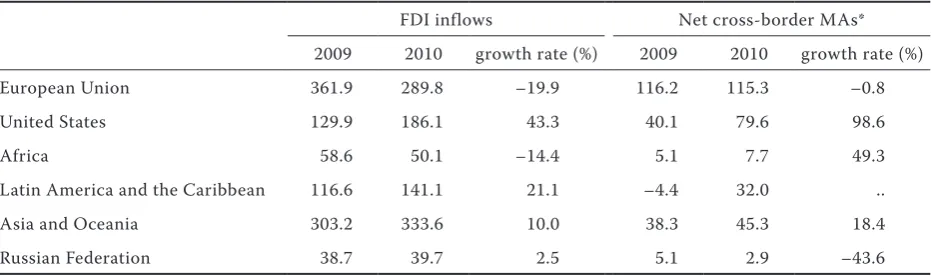
control of a city (as the concentration of economic power) means the control of power. This is in the hands of the persons with financial resources and top technologies (Tables 1 and 2).
Complexity means the presence of many complicated parts – be it as a developed well set structure or a badly interconnected structure with many friction levels. The globalised world is a whole of many levels and it is created in the frame of the already existing
com-plicated social, economic and political interrelations.
Many dimensions of divergence and convergence exist
simultaneously. We speak of the global allocation –
globalisation: “Think global, act local“. The wider is the field of activity, the more complex are the ongoing processes. The question is, whether the result will be the new contributing pluralism or sharpening of the conflicts and inequalities and thus a new world disorder (Keegan and Schlegelmilch 2001).
Powers of the globalisation process
[image:3.595.64.532.85.188.2]The powers of the globalisation process are un-derstood first as an economic phenomenon, but so-ciology understands globalisation also as a cultural (hegemonic) process, notwithstanding (or just be-cause of) its complexity. In the widest understanding, globalisation is regarded as the form of the process institutionalisation on two layers, which includes generalisation of the diverse and diversification of the general (Jeníček 2003).
Table 1. FDI inflows and cross border M&As 2009–2010 (billions of USD)
FDI inflows Net cross-border MAs*
2009 2010 growth rate (%) 2009 2010 growth rate (%)
World 1 114.1 1 122.0 0.7 249.7 341.4 36.7
Developed economies 565.9 526.6 –6.9 203.5 252.1 23.9
Developing economies 478.3 524.8 9.7 39.1 85.1 117.6
South-East Europe and the CIS 69.9 70.5 0.8 7.1 4.3 –39.8
*Net cross border M&As are sales of companies in the host economy to foreign transnational corporations (TNCs) excluding sales of foreign affiliates in the host economy
Source: UNCTAD (2011)
Table 2. FDI inflows and cross border M&As 2009–2010, by regions and major economies (billions of USD)
FDI inflows Net cross-border MAs*
2009 2010 growth rate (%) 2009 2010 growth rate (%)
European Union 361.9 289.8 –19.9 116.2 115.3 –0.8
United States 129.9 186.1 43.3 40.1 79.6 98.6
Africa 58.6 50.1 –14.4 5.1 7.7 49.3
Latin America and the Caribbean 116.6 141.1 21.1 –4.4 32.0 ..
Asia and Oceania 303.2 333.6 10.0 38.3 45.3 18.4
Russian Federation 38.7 39.7 2.5 5.1 2.9 –43.6
*Net cross border M&As are sales of companies in the host economy to foreign transnational corporations (TNCs) excluding sales of foreign affiliates in the host economy
[image:3.595.65.531.580.718.2]Still more doubtful is made the base of the area
as the physical and psychological space of the state, economy and society, since the change of the human life structure around the complicated presumed spaces of the post-modern world is increasing.
In politology and international relationships, this
is connected with leaving off the state as the main
actor. Globalisation is this based not only in the
pos-sibility of measuring the convergence of the
enter-prise forms or the social structure. Its feature is also evoking doubts of the meaning and importance of certain notions (e.g. state). Spreading the discussion itself changes ex ante the ideas and perceiving of the phenomenon. Thus, it creates the strategy and
tactics, which can afterwards change the structure
of the phenomenon itself.
The principal new feature of globalisation is that it contradicts the traditional notions in political science and international relationships, which were based at least since 1648 on the differentiation of the intra-national and international spheres. The formal legal structuring of the international sphere was based on treaties between the supreme states and the international law was created by compar-ing, convergence and overlapping of the systems of internal law and decision-making process, on which it is still based.
International system was thus described as self-supporting, when it originated from the historical melange of the voluntary associations of states. On one hand, it sustains the ability to avoid forceful conflicts and to prevent their spreading, on the other hand, the ability to re-distribute unequal resource
distribution among the states. It is the system archaic
on the international level (kept of similar units), but
hierarchic on the internal level (obligatory institutional rules and in-built social relationships among authori-ties, the internal policy issues from the authoritative allocation of values).
Globalisation is, however, a quite different notion. From the beginning, it issues from the intertwining of the internal and international policy. The complex
social, economic and political processes are overlap-ping, interconnecting and creating the borders of the
world policy. The notions of state andnation are a
time-limited, predictable social creation formed under the global conditions of the period of early capital-ism. The existence of multiple fixed points of balance means that the individual and common act done through the existing system of personal and political relationships decided which of the possibilities became the reality. Strengthening of the given institutional frame excluded other possibilities. State/nation was
the historical creation in which chance results were
rigidly fixed into the permanent institutional structure on the internal and international level.
Interdependence
It represents in the theory of international relation-ships the mutual politic and economic dependence of states without regard to the internal sensibility toward the occurrences in other states. The interde-pendence theory is thus still an international theory; therefore the term internationalisation is sometimes given priority before the term globalisation. The complex interdependence limits the traditional (state-centralistic) approach in two ways.
Interdependence leads to the internationalisation of internal policy creation in the frame of states and among them. E.g. economic policy is still more in-fluenced by what is happening elsewhere (the world interest rate convergence, the world trade growth and
the FDI). The sensibility and vulnerability increased at
the beginning of 21. Century is owing to the economic, technological and cultural changes, but the main social and political field of influence is still sustaining the traditional state centralist features. Notwithstanding the globalisation of enterprising, there still exist the national-socialist structures, ideologies (nationalism) and political institutions.
The international political field of influence
ori-gins by the interaction of the relevant states in
de-pendence of their relative position from the power
viewpoint. States as reasonable units are in this still
more dependent world incorporated into the process of building international organisations or regimes to the detriment of their national interests. The compli-cated (namely economic) interdependence creates the models of the common acts of the states and, among them, the international system, what leads to forming of the non-formal as well as formal structures and institutions which can become self-governing on the international level.
Interdependence thus sometimes leads to a new multilateralism based rather on the social and eco-nomic viewpoints of behaviour than on the legal or constitutional structures of the idealistic type. The theoretical orientations of international relationships – realism and institutionalism – are not in contra-diction with the mutually interdependent world any more, they represent a new synthesis. The state has to solve still more complex situations in
harmonis-ing the national and international viewpoints. The
traditional division between the national and inter-national level of analysis gradually merges together
The core of interdependence then lays in its
func-tioning on two levels. On the opposite, the theory
of globalisationconcentrates on different levels of
complexitymissed by interdependence. Therefore,
interdependence is not able to create a viable alterna-tive paradigm to the political science and international relationships.
Globalisation regards not only the impact of the mutual economic dependence on the internal politi-cal system and the mutual influence of states, but it re-creates the content of the political (social) science itself as a whole, so that it illuminates the historical power of states and forming of the present changing
world system. It regards both the change of
under-standing the system as such and the change of state itself in the frame of the mentioned system.
This double re-orientation evokes criticism in some parts. It is necessary to add, however, that globali-sation is not about the world without borders. This mistaken idea issues from the statement that unifying of financial markets, the ongoing growth of the world trade and FDI as well as the leading position of the TNC in production made world the one market for all intentions. The defendants of this statement do not agree, however, whether such a world is really competitive or a considerably monopolistic one.
The contradiction of globalisation or of the shift of the decisive economic, social and political activi-ties into the global measure is, besides forming one big economy or policy, also in division, fracturing and multiplying. Convergence and divergence are two sides of the same coin. This lack of the natural
simplicity has also its disadvantages – the basic
mis-understanding and distortion. Globalisation is not the only discussion, but a proved conception causing the growth of several different, mutually interconnected discussions. The significance of globalisation in all its different forms will surely be increased by the process of the outlined movements’ clarification.
The strength of globalisation as a process lays in its complexity. The time will show, whether the powers of convergence will create a complex, multiple world
based on liberal capitalism and liberal democracy, or
whether the powers of divergence and inequality will create a less stable world. The vision of the unstable world reaches from the apocalyptic one of the coming
anarchy, through the division of the world into the zones
of peace and zones of disquiet, up to the ongoing per-petual chaos. The future depends on taking important political decisions. The complex theory of globalisation describes both the content and the possible solutions.
Globalisation is by its nature complex and diverse at least in three main directions (even if mutually interconnected) – economic, social and political ones.
DYNAMICS
In the literature describing the theories of economic growth, there are obvious differences not only among the basically static characteristics, but also among the dynamic characteristics (economic growth, economic development). Many authors formulate them quite widely and call them, at the same time, in a narrowed way growth or economic growth, the other follow the opposite direction. There also exists difference between the theories of growth, regarding supposedly DMEs, and the theories of development, regarding supposedly developing economies “(UNCTAD 2004).
As the narrowest category, we can regard economic growth.
It can be defined as the growth of GDP or another appropriate aggregate and its components. Therefore, the research of economic growth concentrates of the factors and conditions influencing the growth of GDP and its components. Economic growth is measured mainly by the GDP or a similar aggregate growth rate as a whole.
An important factor influencing economic growth is the population growth. The higher is the population growth rate; the lower is the per capita GDP growth rate. Among the other main factors of economic growth, there are regarded capital accumulation, technological development, economic size, level of specialisation and the organisation of production and natural resources.
In the above-mentioned narrow understanding, economic growth does not include the changes in social, economic, or in many technological-economic parameters. These parameters are, however, extraor-dinarily important for the society development and therefore they form the content of a wider category – economic development. The simplest definition of economic development is economic growth and structural changes. Under structural changes, we understand the above-mentioned technological-economic and social technological-economic changes. It regards changes of the ownership relationships, distribution, employment, level of living etc. However, it also re-gards also the changes of economic policy, many of which are of technological-economic character and influence both the development of the production of goods and services and their distribution (e.g. the change of interest rate, taxation rules, devaluation etc.)
a careful attention also to the widest of the dynamic categories system that is to development. In this under-standing, development includes economic development and the changes of the non-economic sphere including institutions. Also non-economic factors and conditions are of important economic and social implications.
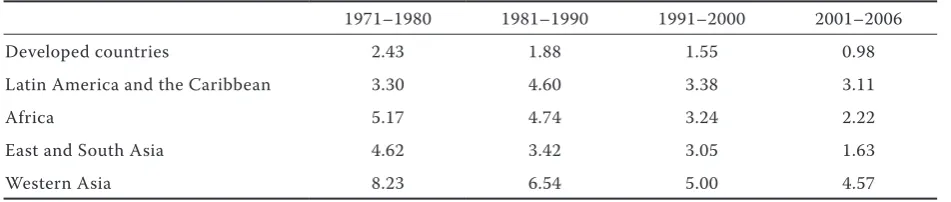
The often unsatisfactory economic growth, as well as the disappointment over the growth results of the Central and Eastern Europe evoke the repeated interest of the categories of economic growth and economic development and their mutual relationship discussed in the economic theory. The object of criti-cism becomes economic growth, the preference of which in the development strategies, economic policy and planes does not, as a rule, lead to the desirable results, namely in the social and social economic sphere. There even emerge the theses that economic growth did not lead to economic development in such cases, i.e. that it led to economic growth without economic development. These theses support the idea, according to which economic development is basically a positive phenomenon, while economic growth in itself need not, and often also does not; bring positive results (Table 3).
The growth concept, expressed in short by the thesis “economic growth solves all” was, and off course still is, regarded as wrong. However, so as not to come to the one-sided conclusions, it is useful to take a clear attitude to the problematic of the relationship between economic growth and economic development. As an appropriate attitude, we can regard the preceding ex-planation, underlining the more narrow understanding of economic growth, a wider concept of economic development and the widest concept of development.
To this attitude, there also corresponds the concept of sustainable development, which puts the utmost stress on environmental factors. Human activities have a negative impact on nature – they destabilise the natural environment and endanger the future life. To be able to sustain economic development, it is necessary to reach the simultaneous progress in several mutually influencing spheres.
The version of this concept identifies four such basic spheres: economic, human, environmental and technological (Yip 2003).
The accelerating economic changes are generally regarded as the main cause of economic growth. According to Freeman, technological changes can be divided into four categories. The lowest order is repre-sented by incrementing innovations consisting of the progressive modifications of products and processes on a small scale. A higher level corresponds to radical innovations, which already represent a discontinuity, which can change drastically the existing products and processes, but the usually isolated emergence of which has no wide impacts on the economic sys-tem. An exception is represented by their clusters leading to the origin of new branches or sectors of the industry and services (e.g. synthetic materials or semi-conductors). Still more important are the changes, which not only influence many parts of the economy, but which are also simultaneously able to generate completely new branches. Typical for the present time are information technologies, material, energy and space technologies. The fourth and highest category, the really revolutionary changes on the large scale, are the changes in the technological-economic paradigm, the consequence of which is the change of the production style (the structure of costs and production conditions), distribution and management (organisation) across the whole system. It regards the creative storms of destruction, the heart of the long waves theory of J.A. Schumpeter.
[image:6.595.62.538.650.751.2]The notion that the global economic development occurs in long waves lasting approximately 50 years is generally connected with the name of the Russian economist of the 20s N.D. Kondratiev, even if the original idea does not come from him. There were identified four finished K-waves. Each wave, which can be divided into four phases – prosperity, recession, depression and recovery – used to be connected with some especially important technological changes – the main technological revolutions. In the case of K1, it regarded namely the steam energy, textile industry
Table 3. Yearly per capita GDP growth differentiation
1971–1980 1981–1990 1991–2000 2001–2006
Developed countries 2.43 1.88 1.55 0.98
Latin America and the Caribbean 3.30 4.60 3.38 3.11
Africa 5.17 4.74 3.24 2.22
East and South Asia 4.62 3.42 3.05 1.63
Western Asia 8.23 6.54 5.00 4.57
(namely cotton) and iron production. In the following K2 wave, there dominated railways together with the production of iron and steel. The prosperity of K3 is most usually connected with the development of energetics, chemical and car industry. The core of the K4 should be in the first place seen in the field of electronics, synthetic materials and petrol-chemistry. Around especially important technological changes, other innovations are clustering – in production, distribution and organisation – what finally spreads into the whole economy. Such a diffusion of technolo-gies stimulates economic growth and employment. Technologies in themselves are not such an efficient reason of economic growth; necessary are also the favourable demographic, social, industrial, financial and other conditions. Each K-wave has its own spe-cific geography. In K1, the technological leadership belonged to Great Britain, France and Belgium, which in K2 were accompanied by Germany and the U.S. These two countries reached the top in the next K3, of the group represented by the previous leaders plus Switzerland and the Netherlands. In K4, the leading group was represented by the USA, Sweden and other industrial countries. Today, we are on the threshold of a new phase of the world economy development, on the verge of the next, fifth wave of the global eco-nomic development, often called the China, India, Brazil economy (Dicken 2003).
CONCLUSION
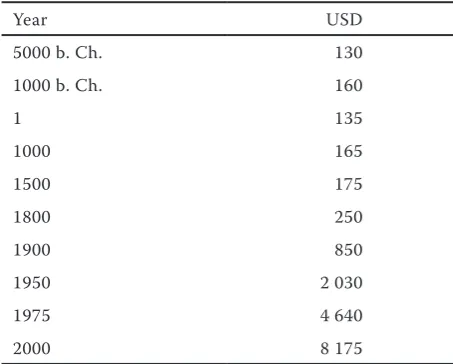
In the world historical development, there always prevailed economic growth over decline or stagna-tion of producstagna-tion (Table 4).
However, it went on unequally regarding both time and the territorial distribution. A considerable accel-eration and territorial spreading of economic growth occurred namely since the time of the Industrial
Revolution in the last third of the 19th century. This
modern economic growth was, compared to the past, typical by the relatively stable per capita production growth, accompanied by the population growth and usually also by considerable structural changes. The modern economic growth is a long-term process, which does not exclude the temporary decreases and thus fluctuation, but in general it shows a clearly increasing tendency. The quickly increasing popula-tion connected with this process is at a certain level replaced by slowing down of the population growth in some DMEs and gradually also reaching of the stationary state. Under the basic structural changes, we usually mean namely the shift of the core from industry to services and the structural changes in the sector of services. The modern economic growth is conditioned, from the historical viewpoint, by the unprecedented development of science and research and their technological application.
A negative point is the more or less free spreading of the extreme and xenophobic dogmas through the net. However, these cannot ever be fully eradicated by any – not even information – democracy.
The positives of globalisation
The supply of goods and services growths; pro-duction and consumers prices decrease; new job opportunities emerge; level of living increases; wider and more free access to information; extending pos-sibilities of communication.
Problems of globalisation
World economy is more apt abrupt collapses; dif-ferences between the rich North and poor South are enormous with the possibility of further deepening; poor countries, there is more hunger, diseases and wars than before; economic, environmental and political migration growths; in developed countries, the differ-ences between the lowest and highest incomes deepen; economic and political influence of supra-national companies increases; environment deteriorates.
The possible solution of the negative globalisation influences:
[image:7.595.63.290.567.749.2]Regulation of certain supra-national companies activities; limiting of the speculation capital flows; taxation of capital transfers and the consequent use of the resources e.g. for economic and social purposes in poor countries; the reorganisation of international financial organisations (the IMF, the Table 4. World per capita per year GDP
Year USD
5000 b. Ch. 130
1000 b. Ch. 160
1 135
1000 165
1500 175
1800 250
1900 850
1950 2 030
1975 4 640
2000 8 175
WB) and their substitution by the innovated structure and activities; more strict and in practice realised rules of the environment protection and economic growth harmonised with the principles of sustain-able development.
REFERENCES
Ghemawat P. (2003): Semiglobalization and Competi-tive Strategy. In: Cyberconference at Duke University, March 2003.
IMF World Investment Report (2010): Investing in a Low Carbon Economy. IMF, Washington.
International Monetary Fund (IMF). Available at www. imf.org
Jeníček V. (2003): World Economy Globalization. C.H. Beck, Prague.
Jessop B. (2003): Globalization: It’s about time too! Po-litical Science Series 85/2003. Institute for Advanced Studies, Vienna.
Keegan W.J., Schlegelmilch B.B. (2001): Global marketing management, a European perspective. Pearson Educa-tion, Washington.
King A., Schulz N. (2009): From Poverty to Prosperity: Intangible Assets, Hidden Liabilities and the Lasting Triumph over Scarcity. Encounter Books, New York. Organization for Economic Cooperation and Development
(OECD). Available at www.oecd.org
UNCTAD (2004): Development and Globalization. UNC-TAD, Washington.
UNCTAD (2011): Global and Regional FDI Trends in 2010. Global Investment Trends Monitor, No. 5, 17 January 2011.
World Bank (WB). Available at www.worldbank.org World Economic and Social Survey 2008 (2008). UN, New
York.
World Trade organization (WTO). Available at www.wto. org
Yip G.S. (2003): Total Global Strategy II. River Prentice Hall, Pearson Education, New York
Arrived on 11th July 2010
Contact address: