FORMULATION DEVELOPMENT AND
IN VITRO
EVALUATION OF
IMMEDIATE RELEASE TABLETS OF LERCANIDIPINE
CYCLODEXTRIN COMPLEXES
N. Ravi Sekhar*, Prasanna Kumar Desu1, B. Nagendra Babu1, P. Venkateswara Rao2,
B. Anitha1
*,1Departemnt of Pharmaceutics, St.Mary’s Group of Institutions Guntur, Chebrolu (V&M),
Guntur, Andhra Pradesh, India – 522212.
2Departemnt of Pharmaceutical Chemistry, St.Mary’s Group of Institutions Guntur, Chebrolu
(V&M), Guntur, Andhra Pradesh, India – 522212.
ABSTRACT
Lercanidipine is very slightly soluble in water and present study attempt
has been made to prepare and characterize inclusion complex of
Lercanidipine with β-Cyclodextrin. The inclusion complexes prepared
by different methods viz. Physical mixture, Kneading and Solvent
evaporation methods. The inclusion complex prepared by Kneading
method exhibited greatest enhancing in solubility and faster dissolution
(93.95% drug release in 60 min) of Lercanidipine. Further, the
inclusion complexes containing Lercanidipine: β-Cyclodextrin (1:2)
was formulated into immediate release tablets which are stable and
enhancing in solubility and faster dissolution. For the development of
Lercanidipine tablets, the excipients selected were Starlac as diluents,
Croscarmellose sodium and Sodium Starch Glycolate, crosprovidon as
super disintegrants. The formulation blend was evaluated for Precompression studies and
compressed tablets were evaluated for post compression studies and the results were found to
be within the limits.
KEYWORDS: Lercanidipine, β-Cyclodextrin, Crospovidone, Croscarmellose sodium,
Sodium starch glycolate.
Volume 6, Issue 15, 566-576. Research Article ISSN 2277– 7105
*Corresponding Author
N. Ravi Sekhar
Departemnt of
Pharmaceutics, St.Mary’s
Group of Institutions Guntur, Chebrolu (V&M), Guntur, Andhra Pradesh, India – 522212.
Article Received on 23 Sept. 2017,
Revised on 12 Oct. 2017, Accepted on 01 Nov. 2017
INTRODUCTION
Oral drug delivery is the simplest and easiest way of drug administration, because of the
greater stability, lesser bulk, accurate dosage, cheaper cost of production and easy process,
solid oral dosage forms have advantages over other dosage1 forms. Infact, all the poorly water
soluble drugs after oral administrations are not well absorbed. And thus leads to decreased
inherent efficiency of drugs. Therefore, the improvement of drug solubility thereby its oral
bio-availability remains one of most challenging aspects of drug development process
especially for oral drug delivery system.
Orally administered drugs completely absorb only when they show fair solubility in gastric
medium and such drugs shows good bioavailability. The solubility[2] and dissolution
properties of drugs play an important role in the process of formulation development.
Problem of solubility is a major challenge for formulation scientist which can be solved by
different technological approaches during the pharmaceutical product development work.
Solid dispersion, solvent deposition, micronization are some vital approaches routinely
employed to enhance the solubility[3] of poorly water soluble drugs. Each approach suffers
with some limitations and advantages. Among all, complexation technique has been
employed more precisely to improve the aqueous solubility, dissolution rate and
bioavailability of poorly water soluble drugs.[4]
Parkinson's disease[5] (PD) is also known as idiopathic or primary parkinsonism, hypo kinetic
rigid syndrome/HRS, or paralysis agitans is a progressive, neurodegenerative disorder of
the central nervous system. The motor symptoms of Parkinson's disease result from the death
of dopamine-generating cells in the substantianigra, a region of the midbrain. Most of the
cases the cause of this cell death is unknown. PD cannot yet be cured and sufferers get worse
over time as the normal bodily functions, including breathing, balance, movement and heart
function worsen, Later thinking and behavioral problems may arise with dementia commonly
occurring in the advanced stages of the disease, whereas depression is the most common
psychiatric symptom. Other symptoms include sensory, sleep and emotional problems.
Biperiden Hydrochloride is water insoluble compound coming under the chemical class of
Pipereden derivative and functions as Anti-cholinergic, mainly used in the management of all kind of Parkinson’s disease. It composed of three primary structures, a hetero bicyclic ring, a
phenyl ring and Pipereden ring. In The present work carriedout by enhancement of solubility
MATERIALS AND METHODS
MATERIALS
Lercanidipine was obtained as a gift sample from S.K health care Pvt. Ltd Hyderabad and
remaining excipients[7] β-Cyclodextrin, Sodium starch glycolate, Cross povidone, Sodium
starch glycolate, Cross povidone, Croscarmellose sodium, MCCPH101, Starlac, Magnesium
Stearate, Aerosil were obtained from Richer Pharmaceuticals Pvt Ltd, Hyderabad. All
materials used were of analytical grade.
METHOD
Preparation of Inclusion Complexes With β-Cyclodextrin
1) Physical mixture: Lercanidipine with β-CD in different molar ratios (i.e. 1:1M, 1:2M)
were mixed in a mortar for about one hour with constant triturating, passed through sieve No.
80 and stored in desiccators over fused calcium chloride.
2) Kneading method: Lercanidipine with β-CD in different molar ratios (i.e. 1:1M, 1:2M)
were taken. First cyclodextrin is added to the mortar, small quantity of 50% ethanol is added
while triturating to get slurry like consistency. Then slowly drug is incorporated into the
slurry and triturating is further continued for one hour. Slurry is then air dried for 24 h,
pulverized and passed through sieve No. 80 and stored in desiccators over fused calcium
chloride.
C) Solvent evaporation Method: Drug and cyclodextrin in different molar ratio are
dissolved in a common solvent to get a clear solution. Mixed the both solutions than the clear
solution was kept for stirring on a magnetic stirrer till all the solvent got evaporated. The
mass obtained was dried at 50°C and further sieved No. 80 or 100 sieve.
Table 1: Lercanidipine, β-Cyclodextrin Complexes.
Method Drug to Carrier Drug to Carrier ratio Formulation Code
Physical Mixture
Lercanidipine: β-CD 1:1 LP1 Lercanidipine: β-CD 1:2 LP2
Kneading Method
Lercanidipine: β-CD 1:1 LK1 Lercanidipine: β-CD 1:2 LK2
Solvent Evaporation method
Evaluation of Lercanidipine Inclusion Complexes
a) Drug Content Estimation
Inclusion complexes prepared by physical mixture, kneading and solvent evaporation
methods were assayed for Lercanidipine content by dissolving a specific amount of the
complexes (Drug Equivalent to 2mg) in methanol and analyzing for the Lercanidipine content
spectrophotometrically at observed wavelength on a spectrophotometer.
b) Dissolution Characteristics
In vitro dissolution studies for Pure drug and its inclusion complexes:- In vitro drug
release studies for the pure Lercanidipine and prepared inclusion complexes were conducted
in USP II paddle type dissolution apparatus in 500ml of medium at 37 ± 0.50C and at 50 rpm
speed. The dissolution studies were carried out in 0.1N HCl. At every interval 5 ml of sample
was withdrawn from the dissolution medium and replaced with fresh medium to maintain the
volume constant. After filtration and appropriate dilution, the sample solutions were analyzed
at observed wavelegth by a UV – visible spectrophotometer. The amount of drug present in
the samples was calculated.
Compression of Lercanidipine-Β-Cyclodextrin Inclusion Complexes into Immediate
Release Tablets by Direct Compression Method
After elucidation of best inclusion complex of drug with β-cyclodextrin which shows the
most satisfactory invitro dissolution criteria and better solubility criteria, the particular
complex was formulated as Immediate Release Tablets of Lercanidipine β-cyclodextrin
Inclusion Complex by mixing it with selected excipients. In this present study, the best
superdisintegrant among sodium starch glycolate (SSG), Crospovidone (CP) and
croscarmellose sodium (CCS) were also screened out. Starlac selected as diluent,
MCCPH101 as binder, talc as glidant and Magnesium stearate selected as lubricant. The
prepared inclusion complex of drug and excipients were passed through sieve (#60) and
mixed thoroughly. The drug and excipients mixture was finally compressed after lubricating
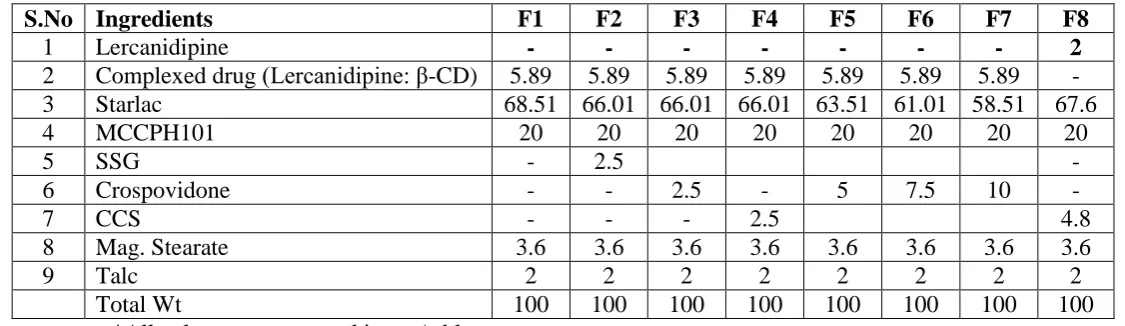
Table 2: Formulation of Lercanidipine Inclusion Complexes Tablets.
S.No Ingredients F1 F2 F3 F4 F5 F6 F7 F8
1 Lercanidipine - - - - - - - 2
2 Complexed drug (Lercanidipine: β-CD) 5.89 5.89 5.89 5.89 5.89 5.89 5.89 - 3 Starlac 68.51 66.01 66.01 66.01 63.51 61.01 58.51 67.6 4 MCCPH101 20 20 20 20 20 20 20 20
5 SSG - 2.5 -
6 Crospovidone - - 2.5 - 5 7.5 10 -
7 CCS - - - 2.5 4.8
8 Mag. Stearate 3.6 3.6 3.6 3.6 3.6 3.6 3.6 3.6 9 Talc 2 2 2 2 2 2 2 2
Total Wt 100 100 100 100 100 100 100 100 *All values are expressed in mg/tablet.
Evaluation of post compression characteristics of tablets
A. Weight variation test
Twenty tablets were selected randomly, weighed individually and average weight was
calculated. Not more than two of the individual weights was deviated from the average
weight by more than the percentage shown in the table and should deviate by more than twice
that percentage.
B. Hardness test
The tablet crushing strength, which is the force required to break the tablet by compression in
the diametric direction was measured in triplicate using Monsanto tablet hardness tester. The
tablet was held between the edges of the fixed and movable part of the instrument. The scale
was adjusted by sliding, so that the zero on the scale coincides with the pointer. The
adjustable knob was moved slowly till the tablet breaks. The hardness was measured in
kg/cm2.
C. Thickness
The thickness of prepared tablets was measured, by placing the tablet between the hands of
vernier calipers and the thickness of the tablet is read from the vernier scale.
D. Friability
Friability is the measure of tablet strength. About 10 tablets were carefully dedusted and
weighed. The tablets were placed in friability test apparatus and rotated 100 times at 25 rpm
for 4mins. The tablets were removed, dedusted and weighed. The percent friability was
Drug content uniformity
From each batch 20 randomly selected tablets were weighed accurately and powdered in a
clean and dry glass mortar with pestle. Powder equivalent to 2 mg of drug was transferred
into 20 mL volumetric flask containing methanol gives 100 µg/ml solution(Stock-1). from the
stock-1 4 µg/ml solution was prepared by taking 0.4 ml of stock-1 and make up to 10ml with
methanol. The absorbance of 0.4 µg/ml solution was measured at 258 nm, using methanol as
a blank.
E. Wetting time
Wetting time of tablet was determined using a simple procedure. A piece of double folded
tissue paper was placed in a petri plate containing 6 ml of water and 2 drops of eosin. The
tablet was placed on the paper and the time for complete wetting of upper surface of the
tablet was measured in seconds.
F. Disintegration Time
The disintegrator as per USP uses 6 glass tubes that are 3 inches long, open at the top and
held against a 10-mesh screen at the bottom end of the basket rack assembly. The
disintegration time was determined by the tablet is placed in each tube and the basket rack is
positioned 0.1N HCl at 37 ± 20C, such that the tablets remain 2.5cm below the surface of the
liquid on their upward movement and descend not closer than 2.5cm from the bottom of the
beaker. A standard motor device is used to move the basket assembly containing the tables up
and down through a distance of 5 to 6 cm at a frequency of 28 to 32 cycles per minute. Then
the time was measured, when all the particles passed through the 10-mesh.
G. Dissolution studies
In vitro drug release studies for the prepared Lercanidipinetablets were conducted in USP II
paddle type dissolution apparatus in 500ml of medium at 37 ± 0.50C and at 50 rpm speed.
The dissolution studies were carried out in 0.1N HCl. At every interval 5 ml of sample was
withdrawn from the dissolution medium and replaced with fresh medium to maintain the
volume constant. After filtration and appropriate dilution, the sample solutions were analyzed
at 240 nm by a UV–visible spectrophotometer. The amount of drug present in the samples
RESULTS AND DISCUSSION
In the present work inclusion complexes of Lercanidipine were prepared with β-cyclodextrin
by physical mixture, kneading method and Solvent evaporation method. The complexes were
prepared in different molar ratios of drug and cyclodextrin namely 1:1 and 1:2. Prepared
complexes were evaluated for in vitro drug release studies All the prepared inclusion
complexes were white and fine without any stickiness. The drug content of the inclusion
complexes was quite uniform as can be observed from the Table 7.4. The percent drug
content of the complexes was found to be in the range of 98.35% to 102.493%. with low
values of standard deviations.
Table 3: Drug content of complexes.
S.No Complexation
method
Drug: cyclodextrin Ratio
Complex Code
Amount of drug present in 2mg Equivalent powder
%Drug content
1 Physical Mixture
Method
1:1 LP1 2.02 101 1:2 LP2 1.967 98.35
2 Kneading Method 1:1 LK1 2.044 102.2
1:2 LK2 1.988 99.4
3 Solvent Evaporation
Method
1:1 LS1 2.002 101.1 1:2 LS2 2.04 102
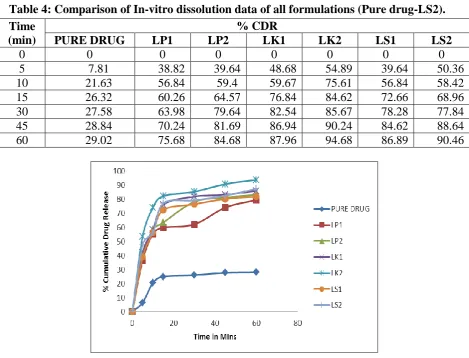
The dissolution rate of Lercanidipine from various inclusion complexes was found to be
79.6106 to 93.9549% in 60 minutes, when compared to pure drug which exhibited only
28.0821% of drug in 60 minutes. The dissolution data of various complexes prepared by
various methods were fitted into mathematical models such as zero order and first order
models to assess the kinetics. Dissolution data for inclusion complexes obeyed first order
kinetic model.
Inclusion complexes of Lercanidipine prepared with β-CD exhibited release of 75.68%,
84.68%, 87.96%, 94.68%, 86.89% and 90.46% from LP1, LP2, LK1, LK2, LS1 and LS2
respectively in 60 minutes, using 0.1N HCL as dissolution media. A marked improvement in
dissolution rates of Lercanidipine were observed with LK2 prepared by Kneading method.
Table 4: Comparison of In-vitro dissolution data of all formulations (Pure drug-LS2).
Figure 1: Dissolution Rate Data Profile graph of Lercanidipine and its complexes.
The Lercanidipine Tablets prepared by direct compression method containing LK2 inclusion
complexes(drug: β-cyclodextrin ratio is 1:2 and the complex was prepared by Kneading
method) were evaluated for their physical characteristics like size, shape, thickness and
[image:8.595.43.559.580.702.2]appearance and from this data all series of Tablets prepared were found to be good.
Table 5: Results of Post-compression parameters.
Formulation code F1 F2 F3 F4 F5 F6 F7 F8
Hardness (avg ±S.D) 3.46 3.23 3.26 3.3 3.33 3.23 3.23 3.26
Thickness (avg ±S.D) 2.5 2.5 2.51 2.52 2.54 2.51 2.503 2.513
Friability 0.497 0.231 0.264 0.069 0.231 0.296 0.231 0.264
Weight variation 100.55 100.15 99.95 99.8 100.3 99.8 100.15 99.95
Wetting Time (Sec) 38 24 28 29 18 10 22 28
Disintegration time 43 27 32 33 19 16 15 20
% Drug content 101.35 99.78 99.89 101.54 100.62 100.62 99.97 99.8
Values are mean ± SD, n=3.
Time (min)
% CDR
PURE DRUG LP1 LP2 LK1 LK2 LS1 LS2
0 0 0 0 0 0 0 0
The hardness of the Lercanidipine tablets is 3.23±0.00577 to 3.46±0.0577 kg/cm2. The
disintegration time of Tablets is in between 16 to 43 sec. the friability percentage and weight
variation and wetting time of all the Tablets were found within the standard limits.
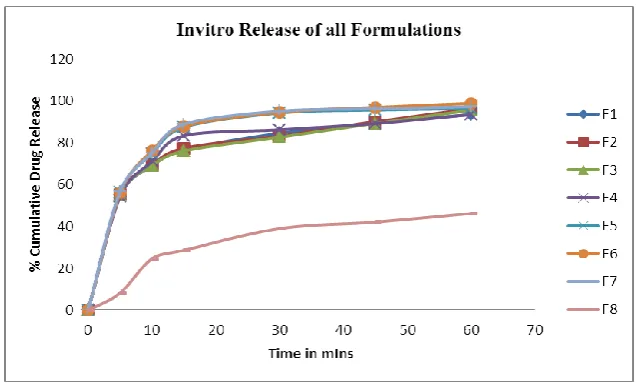
Table. No.6: In-vitro Dissolution Studies of all Formulations.
The dissolution of Lercanidipine Tablets prepared with LK2 complex and super disintegrants
was higher when compared with Lercanidipine Tablets prepared without super disintegrants.
Disintegration time and wetting time of Lercanidipine Tablets and it was found that the
presence of CCS shown better results when compared with Crospovidone and SSG. The
increased concentration of CCS showed improved dissolution criteria along with faster
disintegration and wetting time. Formulation F6 containing 4.8% of SSG (when compared
with total Tablet weight) showed 98.78% drug release in 60minutes. Further increasing in the
SSG concentration (7%) decreased the amount of drug release when compared with the F6
[image:9.595.138.458.494.685.2]formulation.
Figure 2: Zero order release Plots for all formulations.
Time (Min) F1 F2 F3 F4 F5 F6 F7 F8
The dissolution data of Lercanidipine Tablets were fitted into mathematical models such as
zero order and firs order models to assess the release kinetics. The dissolution data for all 8
formulations (F1 to F8) follows first order release kinetics.
CONCLUSION
The present work has been undertaken with an overall objective of studying the complexation of Lercanidipine with β-cyclodextrin to evaluate the feasibility of enhancing it solubility,
dissolution rate, bioavailability and therapeutic efficacy. The feasibility of formulating the
cyclodextrin complexes into tablets with enhanced dissolution rate characteristics was also
investigated.
ACKNOWLWDGEMENT
Author was very thankful to Pharmatrain, Hyderabad for providing the gift sample and S.D.
Fine Chemicals, Mumbai for providing the polymers for carryout my research work. Author
was very thankful to Co -Authors for giving esteemed guidance to entire research work.
REFERENCES
1. Patil J S, Kadam D V, Marapur S C, et al. Inclusion complex system; A novel technique
to improve the solubility and bioavailability of poorly soluble drugs: A Review. Int. J.
Pharm. Sci., 2010; 2: 29-34.
2. Loftsson Thorsteinn, Marcus E Brewster. Pharmaceutical applications of cyclodextrins.
Journal of Pharmaceutical Sciences, 1996; 85(10): 1017-1026.
3. Marcus E Brewstera, Thorsteinn Loftsson. Cyclodextrin as pharmaceutical solubilizers.
Adv. Drug Delivery Reviews. 2007; 59: 645-666.
4. K.P.R. Chowdary and G Kamalakara Reddy. Complexes of Nifedipine with β-and
hydroxypropyl β-cyclodextrins in the design of Nifedipine SR tablets. Indian Journal of
Pharmaceutical Sciences, Mar-Apr. 2002; 142-146.
5. Sanoferjan AM, Nanjundaswamy NG. Mahesh S and Narasimhamurty S. Formulation
and evaluation of β-cyclodextrin complexes of tenoxicam. Ind. J. of Pharm. Sci., March
2000; 62(2): 119-121.
6. Prasanna Kumar Desu, P. Malleswara Rao, A. M. S. Sudhakar Babu, K. Navya Sree, N. S. V. Teja Rameswarapu, K. L. N. Mallikharjuna Rao “Formulation Development And
Invitro Evaluation Of Immediate Release Tablets Of Biperiden Hcl Cyclodextrin Complexes”, International Journal of Research in Pharmaceutical and Nano Sciences,
7. Chowdary KPR, Vijaya Srinivas. Effect of polyvinyl pyrrolidone on complexation and
dissolution rate of β and HPβ-CD complexes of celecoxib. Ind. J. Pharm. Sci. Sept-oct.
2006; 631-634.
8. Muller BW, Albers E. Effect of hydrotropic substances on the complexation of sparingly
soluble drugs with cyclodextrin derivatives and the influence of cyclodextrin
complexation on the pharmacokinetics of the drugs. J Pharm Sci., 1991; 80: 599Y604.
9. Pasam Venkateswara Rao and Prasanna Kumar Desu, “Formulation Development and Invitro Evaluation of Immediate release tablets of Neverapine Cyclodextrine Complexes”
The Pharma Invotation: TPI, 2016; 5(6): 110-114.
10.Tayade NG, Nagarsenker MS. Preparation, characterization and evaluation of HPβ-CD
inclusion complexes of antimalarial drug. Scientific abstract 54th IPC Pune, Sept. 2002;
156.
11.Brahmaiah.B, Prasanna Kumar Desu, Sreekanth Nama, S.Satish Babu, Formulation and
evaluation of extended release mucoadhesive microspheres of simvastatin, International
Journal of Pharmaceutical and biomedical Research, ISSN No. 0976-0350, March 2013;