SYNTHESIS, CHARACTERIZATION, ANTI MICROBIAL AND
ANTIOXIDANT ACTIVITY OF CHALCONES FROM 3-METHOXY
ACETOPHENONE
P. S. Raghu*
University College of Pharmaceutical Sciences, Sri Krishnadevaraya University, A.P.
515003.
ABSTRACT
Chalcones were important starting materials for the synthesis of
various classes of five, six and seven member heterocyclic compounds.
In the present work Chalcones were synthesized by base catalysed
Claisen–Schmidt condensation, of 3-mehoxy acetophenone with
appropriate aldehydes followed by dehydration. Six Chalcones were
synthesized and structures were confirmed by spectral evidence. The
compounds were tested for anti microbial activity and antioxidant
activity using diffusion method by measuring the Zone of the
inhibition and DPPH measuring by measuring the percentage of
inhibition. In that compound B3 shows potent activity than compare
with other compoundswith Staphylococcus aureus zone of inhibition
16, 22 mm at 500 µg/ml, 1mg/ml, with Pseudomonas aeruginosa zone of inhibition 14, 22
mm at 500 µg/ml, 1mg/ml, with Escherichia coli the zone of inhibition 14, 26 mm at 500
µg/ml, 1mg/ml. compounds B3 shows potent activity than other compounds at concentration
of 51. 24± 0.27 μM.
KEYWORDS: Chalcones, Claisen–Schmidt condensation, anti microbial, anti oxidant,
DPPH Reagent.
INTRODUCTION
Heterocyclic systems are one of the most important classes of organic compounds present in
nature or synthesized in laboratory. These compounds possess array of biological activities
and are employed in treatment of a commonly occurring diseases. This has been the
backbone for medicinal chemists to keep perpetuating interest to synthesize some novel
Volume 6, Issue 6, 1724-1731. Research Article ISSN 2277–7105
*Corresponding Author Dr. P. S. Raghu
University College of
Pharmaceutical Sciences, Sri
Krishnadevaraya University,
A.P. 515003.
Article Received on 20 April 2017,
Revised on 10 May 2017, Accepted on 30 June 2017
derivatives of possible high biological activity.[1] In recent years, Chalcones have found a wide range of applications in the pharmacological activities such as, potential cytotoxic
agents, antiviral, anesthetics, mydriatics, antimicrobial, antimitotic, antitumor, cytotoxicity,
and antipyretic properties.[2,3] They undergo a variety of chemical reactions and are found to be useful in the synthesis of variety of heterocyclic compounds like isoxazoles, quinolinones,
thiadiazines, benzofuranones, benzodiazepine, tetrahydro-2-chromens flavones etc
chemically it is an important bio-molecule for synthesis of various molecules like flavones
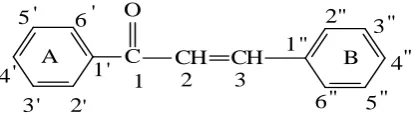
and isoflavones. 6 5 4 3 2 6 5 4 2
1' C CH CH ' ' ' ' 3' 1" " " " " " O 2 3 1
[image:2.595.195.403.253.310.2]A B
Figure. 1: General structure of chalcone.
Experimental Work
MATERIALS AND METHODS
3- Methoxy Acetophenone, various aromatic aldehydes, alcoholic potassium hydroxide, conc.
HCl, DMSO, DPPH reagent. all the reagents were purchased analytical grade. Melting points
were determined on a capillary melting point apparatus and are uncorrected. 1H NMR spectra were recorded in the indicated solvent on Bruker WM 400 MHz spectrometer with TMS as
internal standard. Infrared spectra were recorded in KBr on Perkin-Elmer AC-1
spectrophotometer. Column chromatography was performed on silica gel (Merck, 60-120
mesh).
General method of preparation[4]: A mixture of 3- methoxy acetophenone(0.001moles) and
aryl aldehydes(0.001moles) were dissolved in methanol(20ml) and to it 3millimoles of
15%KOH was added. The mixture was kept for 24hours and it was acidified with 1:1 HCl
and water, then it was filtered through vacuum by washing with water.
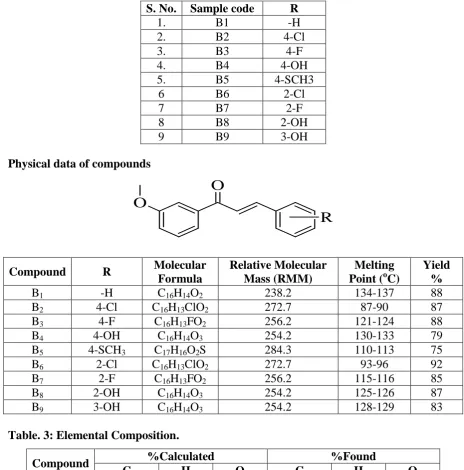
Physical data of compounds
O
O
R
Compound R Molecular
Formula
Relative Molecular Mass (RMM)
Melting Point (oC)
Yield %
B1 -H C16H14O2 238.2 134-137 88
B2 4-Cl C16H13ClO2 272.7 87-90 87
B3 4-F C16H13FO2 256.2 121-124 88
B4 4-OH C16H14O3 254.2 130-133 79
B5 4-SCH3 C17H16O2S 284.3 110-113 75
B6 2-Cl C16H13ClO2 272.7 93-96 92
B7 2-F C16H13FO2 256.2 115-116 85
B8 2-OH C16H14O3 254.2 125-126 87
[image:3.595.64.529.74.545.2]B9 3-OH C16H14O3 254.2 128-129 83
Table. 3: Elemental Composition.
Compound %Calculated %Found
C H O C H O
B1 80.6 5.92 13.4 79.8 5.88 13.34
B2 70.4 4.8 11.7 70.38 4.79 11.65
B3 74.9 5.1 12.4 74.85 5.08 12.38
B4 75.5 5.55 18.8 75.48 4.48 18.79
B5 71.8 5.6 11.2 71.79 5.55 11.18
B6 70.4 4.8 11.7 70.38 4.75 11.65
B7 74.9 5.1 12.4 74.85 5.05 12.38
B8 75.5 5.5 18.8 75.4 5.4 18.7
B9 75.5 5.5 18.8 75.45 5.45 18.75
S. No. Sample code R
1. B1 -H
2. B2 4-Cl
3. B3 4-F
4. B4 4-OH
5. B5 4-SCH3
6 B6 2-Cl
7 B7 2-F
8 B8 2-OH
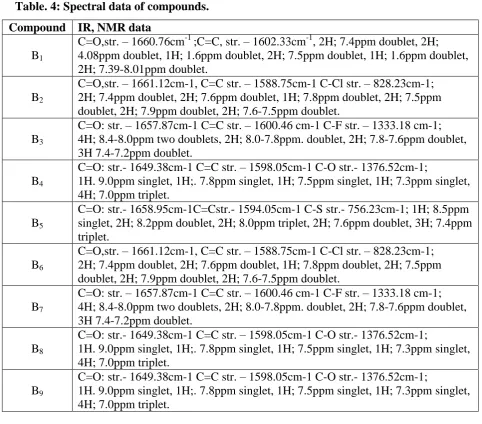
Table. 4: Spectral data of compounds.
Compound IR, NMR data
B1
C=O,str. – 1660.76cm-1 ;C=C, str. – 1602.33cm-1, 2H; 7.4ppm doublet, 2H; 4.08ppm doublet, 1H; 1.6ppm doublet, 2H; 7.5ppm doublet, 1H; 1.6ppm doublet, 2H; 7.39-8.01ppm doublet.
B2
C=O,str. – 1661.12cm-1, C=C str. – 1588.75cm-1 C-Cl str. – 828.23cm-1; 2H; 7.4ppm doublet, 2H; 7.6ppm doublet, 1H; 7.8ppm doublet, 2H; 7.5ppm doublet, 2H; 7.9ppm doublet, 2H; 7.6-7.5ppm doublet.
B3
C=O: str. – 1657.87cm-1 C=C str. – 1600.46 cm-1 C-F str. – 1333.18 cm-1; 4H; 8.4-8.0ppm two doublets, 2H; 8.0-7.8ppm. doublet, 2H; 7.8-7.6ppm doublet, 3H 7.4-7.2ppm doublet.
B4
C=O: str.- 1649.38cm-1 C=C str. – 1598.05cm-1 C-O str.- 1376.52cm-1;
1H. 9.0ppm singlet, 1H;. 7.8ppm singlet, 1H; 7.5ppm singlet, 1H; 7.3ppm singlet, 4H; 7.0ppm triplet.
B5
C=O: str.- 1658.95cm-1C=Cstr.- 1594.05cm-1 C-S str.- 756.23cm-1; 1H; 8.5ppm singlet, 2H; 8.2ppm doublet, 2H; 8.0ppm triplet, 2H; 7.6ppm doublet, 3H; 7.4ppm triplet.
B6
C=O,str. – 1661.12cm-1, C=C str. – 1588.75cm-1 C-Cl str. – 828.23cm-1; 2H; 7.4ppm doublet, 2H; 7.6ppm doublet, 1H; 7.8ppm doublet, 2H; 7.5ppm doublet, 2H; 7.9ppm doublet, 2H; 7.6-7.5ppm doublet.
B7
C=O: str. – 1657.87cm-1 C=C str. – 1600.46 cm-1 C-F str. – 1333.18 cm-1; 4H; 8.4-8.0ppm two doublets, 2H; 8.0-7.8ppm. doublet, 2H; 7.8-7.6ppm doublet, 3H 7.4-7.2ppm doublet.
B8
C=O: str.- 1649.38cm-1 C=C str. – 1598.05cm-1 C-O str.- 1376.52cm-1;
1H. 9.0ppm singlet, 1H;. 7.8ppm singlet, 1H; 7.5ppm singlet, 1H; 7.3ppm singlet, 4H; 7.0ppm triplet.
B9
C=O: str.- 1649.38cm-1 C=C str. – 1598.05cm-1 C-O str.- 1376.52cm-1;
1H. 9.0ppm singlet, 1H;. 7.8ppm singlet, 1H; 7.5ppm singlet, 1H; 7.3ppm singlet, 4H; 7.0ppm triplet.
Biological evolution of compounds
Based on the literature, chalcones were reported to possess antimicrobial activity, anti
oxidant, anti inflammatory, analgesic, anti cancerous, etc. Therefore the present work
performs the anti microbial, anti oxidant activities.
Antibacterial activity[5,6]
The antibacterial activity was tested by determining inhibitory concentration by diffusion disc
technique. The bacterial strains were obtained from National Chemical Laboratories (NCL),
Pune and Microbial Type Culture Collection (MTCC), Chandigarh. The strains used for the
present study were Staphylococcus aureus (NCIM 2079), Bacillus subtilis (NCIM 2063),
Procedure: The antimicrobial activity of the compounds was assessed by disc diffusion
method Nutrient agar medium was prepared and sterilized by an autoclave. In an aseptic
room, they were poured into a petridishes to a uniform depth of 4 mm and then allowed to
solidify at room temperature. After solidification, the test organisms, Staphylococcus aureus,
Bacillus subtilis, Escherichia coli were spread over the media with the help of a sterile swab
socked in bacterium and is used for antibacterial study. The synthesized compounds were
dissolved in dimethyl sulfoxide (DMSO) to produce a concentration of 500 μg/disc, 1
mg/disc and used for the study. Streptomycin 5 μg/disc was used as the standard. Then the
sterile filter paper discs (6mm) having a capacity to hold 10 μl of solution were immersed in
definite concentration of compounds and placed over the solidified agar in such a way that
there is no overlapping of the zone of inhibition. Plates were kept at room temperature for
half an hour for the diffusion of the sample into the agar media. The organism inoculated
petridishes were incubated at 37 °C for 24 hours. After the incubation period is over, the zone
of inhibition produced by the samples and standard were measured. All tests were performed
in triplicate.
Anti oxidant activity evolution by DPPH radical scavenging method[7,10]
DPPH is a stable free radical that can accept anelectron or hydrogen radical to become a
stable diamagnetic molecule. Due to its oddelectron, the methanolic solution of DPPH shows
a strong absorption band at 517 nm. DPPH radical reacts with various electron donating
molecules (reducing agents or antioxidants). When electrons become paired off, bleaching of
the DPPH solution is the result. This results in the formation of the colourless
2,2'-diphenyl-1-picryl hydrazine. Reduction of the DPPH radicals can be estimated quantitatively by
measuring the decrease in absorbance at 517 nm.
Procedure: Equal volumes of 100 μM 2,2'-diphenyl-1-picrylhydrazyl (DPPH) in methanol
was added to different concentrations of test compounds (0 – 200 μM/ml) in methanol, mixed
well and kept in dark for 20 min. The absorbance at 517 nm was measured using the
spectrophotometer UV-1650, Shimadzu.[6] Plotting the percentage DPPH• scavenging against concentration gave the standard curve and the percentage scavenging was calculated from the
following equation,
DPPH scavenging effect (%) or Percent inhibition =
Where A0 was the Absorbance of control reaction
RESULT
S. No Compound DPPH Screening (μM)
1 B1 NA
2 B2 66.24± 0.22
3 B3 51.24± 0.27
4 B4 115± 0.33
5 B5 101.22± 0.33
6 B6 61.27± 034
7 B7 85.34± 0.33
8 B8 94.54± 0.24
9 B9 111.22± 033
10 Ascorbic acid 48.63 ± 0.18
DISCUSSION
The above synthesized compounds anti microbial evolution were performed by using
Diffusion method by the calculation of Zone of inhibition against the test organisms, the
compounds shows that compound B3 shows maximum activity than compare with other
compounds, with Staphylococcus aureus zone of inhibition 16,22 mm at 500 µg/ml, 1mg/ml,
with Pseudomonas aeruginosa zone of inhibition 14,22 mm at 500 µg/ml, 1mg/ml, with
Escherichia coli the zone of inhibition 14,26 mm at 500 µg/ml, 1mg/ml. the compound B2
shows activity against Staphylococcus aureus zone of inhibition 14,20 mm at 500 µg/ml,
1mg/ml, with Pseudomonas aeruginosa zone of inhibition 14,22 mm at 500 µg/ml, 1mg/ml,
with Escherichia coli the zone of inhibition 15,24 mm at 500 µg/ml, 1mg/ml. compound B4
moderately shows results against the Staphylococcus aureus zone of inhibition 12,16 mm at
500 µg/ml, 1mg/ml, with Pseudomonas aeruginosa zone of inhibition 12.20 mm at 500
µg/ml, 1mg/ml, with Escherichia coli the zone of inhibition 16,22 mm at 500 µg/ml, 1mg/ml.
Compound Staphylococcus
aureus
Pseudomonas
aeruginosa Escherichia coli
Zone of inhibition (mm)
500µg/ml 1mg/ml 500µg/ml 1mg/ml 500µg/ml 1mg/ml
B1 12 18 12 16 14 18
B2 14 20 14 22 15 24
B3 16 22 14 22 14 26
B4 12 16 12 20 16 22
B5 12 16 14 18 12 18
B6 14 20 14 20 14 20
B7 16 19 14 20 14 22
B8 12 16 12 16 12 16
B9 11 15 12 16 12 16
Streptomycin 16 20 18 22 20 26
The above anti oxidant activity of synthesized compounds were evolved using DPPH assay
method. In the compounds B3 shows potent activity than other compounds at concentration
of 51.24 μM and the latter compounds B6, B2, B7, B8 shows activity. here compound B1
shows no activity.
CONCLUSION
The above results we concluding the compound B3 was showing the better anti microbial
activity against both gram positive and gram negative the organism. The reason is due that
compound contain more electron with drawing group than that of other compounds. we
concluding the compound B3 is may be best fit molecule against microbes, a having the
anti-oxidant activity it may became an lead to discover anti microbial molecule, good anti anti-oxidant
molecule.
ACKNOWLEDGEMENT
Dr P.S. Raghu gratefully thankful to the Sri Krishnadevaraya University authorities,
especially the Honble Vice Chancellor Dr. K Rajagopal, Rector Dr. Lajapathi Rai and the
Registrar Prof. Sudhakar Babu for providing constant encouragement and support during the
performance of the research work and preparation of the manuscript.
REFERENCES
1. Raj. K. Bansal; Heterocyclic chemistry; 4th edition, 1-4, 258.
2. Chetana B. Patil, S. K. Mahajan, Suvarna A. Katti, Chalcone: A Versatile Molecule, J.
pharm. Sci and Res., 2009; 1(3): 11-22.
3. M.R.Jayapal et al, Anhydrous K2CO3 as Catalyst for the synthesis of Chalcones under
Microwave Irradiation. J. Pharm. Sci. & Res., 2010; 2: 644-647.
4. CH.M.M. Prasada Rao, Rahaman S.A, Rajendra Prasad Yejella., synthesis of novel
1-(2,4'-difluorophenyl)-3-(4"-aryl)-2-propen-1-ones and their pharmacological activities
World Journal of Pharmacy and Pharmaceutical Sciences, 2014; 3(11): 576-578.
5. R. Udaya Kumar and V. Hazeena Begum, antimicrobial studies of some selected
medicinal plants, Anc Sci Life., 2002; 21(4): 230–239.
6. Ch. M. M. Prasada Rao., S. A. Rahaman, Y. Rajendra Prasad, Design and Synthesis of
1-(3’,5’-bis trifluoromethyl phenyl)-3-(substituted phenyl)-2-propene-1-one as potent anti
fungal and antibacterial agents. Der Pharma Chemica, 2012; 4(5): 1997-2002.
7. R. S. Narl and M. N. Rao, “Scavenging of free-radicals and inhibition of lipid
8. Braca A, De Tommasi N, Di Bari L, Pizza C, Politi M, et al. Antioxidant principles from
Bauhinia tarapotensis. J Nat Prod, 2001; 64: 892-895.
9. Sivakumar, P.M., Prabhakar, P.K. & Doble, M. Synthesis, antioxidant evaluation and
quantitative structure–activity relationship studies of chalcones. Med Chem Res., 2011;
20: 482.
10. Siham Abdelrahmane Lahsasni, Faeza Hamad Al Korbi and Nabilah Abdel-Aziz Aljaber
et al. Synthesis, characterization and evaluation of antioxidant activities of some novel