EVALUATION OF RESISTANCE TO CARBAPENEM BY DISC
DIFFUSION METHOD AND SUSCEPTIBILITY TO
POLYMYXIN-B
USING E-STRIP IN ENTEROBACTERIACEAE
Tabrez Ahmad1, Harelimana Jean Marie Vianney2, Mucumbitsi Joseph3, Abdulhamid
Tahir Hamid*1, Shafiu Muhammad Tahir1 and Nawiyyu Musa2
1
School of Biotechnology Maharaj Vinayak Global University Jaipur Rajasthan India.
2
Department of Advanced Zoology and Biotechnology Loyola College Chennai.
3
Department of Microbiology NIMS University Jaipur Rajasthan India.
ABSTRACT
Although this family of enterobacteriaceae includes more than 70
genera, the health-care associate, most commonly found in this current
study were Escherichia coli, Klebsiella species, Enterobacter,
Salmonella, Enterobacter and Proteus species. Isolates were inoculated
in Muller Hinton Agar, antibiotic and polymyxin-B E-strip were
applied and incubated at 37 degrees Celsius the inhibition zone size
were read after overnight of incubation and compared to antimicrobial
chart of NCCLs. The present study showed that in 119 isolates samples
10(8%) of them showed Expended Spectrum Beta lactamase
production which cause resistance to 3rd generation cepharosporin
antibiotics, and all 10 isolates were from Escherichia. Coli strain, none
of Klebsiella, Proteus, Citrobacter, Salmonella or Enterobacter species showed ESBLs
production. The present study also showed that in 119 isolated Enterobacteriaceae samples
25(21%) of them showed resistance to carbapenem antibiotics, within 25 carbapenem
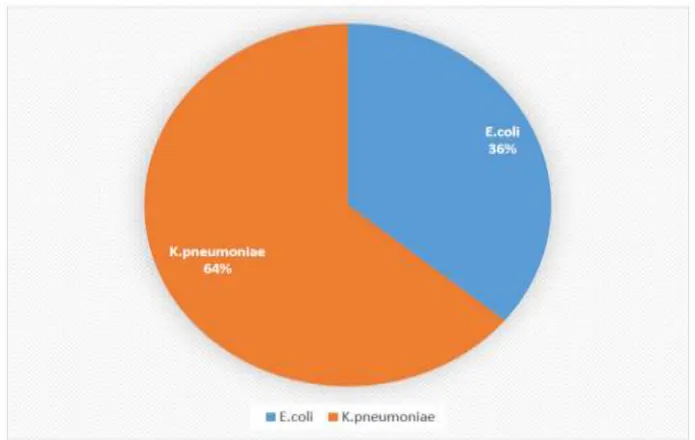
resistant Enterobacteriaceae isolates, 9(36%) were E. coli whereas 16(64%) were Klebsiella.
The present study also showed that all carbapebem resistant Enterobacteriaceae isolates were
susceptible to polymyxin-B antibiotic. Given the fact that the prevalence of CRE was
increasing during the past decades, it is urgent for us to establish regional surveillance
worldwide, carry out more effective antibiotic stewardship and infection control measures to
prevent further spread of carbapenem resistance in Enterobacteriaceae. Health departments
Volume 6, Issue 8, 2411-2425. Research Article ISSN 2277– 7105
Article Received on 20 June 2017,
Revised on 10 July 2017, Accepted on 30 July 2017
DOI: 10.20959/wjpr20178-9189
*Corresponding Author
Abdulhamid Tahir
Hamid
School of Biotechnology
Maharaj Vinayak Global
University Jaipur
should be well positioned to play a leading role in prevention, efforts by assisting with
surveillance, situational awareness, and coordinating prevention efforts.
KEYWORD: Evaluation, Resistance, Carbapenem, Disc Diffusion Method, Susceptibility,
Polymyxin-B, E-Strip, Enterobactericiae.
1. INTRODUCTION
The Enterobacteriaceae is a heterogeneous group of gram negative rods, non-spore, non-acid
fast which do not retain crystal violet dye in the gram staining method, Enterobacteriaceae
family is an important cause of urinary tract infections (UTIs), bloodstream infections, and
hospital acquired pneumonias and various intra-abdominal infections. They exhibit general
morphological and biochemical similarities. This group more than 70 genera such as
Escherichia Coli, Salmonella, Shigella, Klebsiella, Proteus, Enterobacter (Ananthanaraya
and Paniker, 2013).
Jayoung et al, 2010 found that among 347 Enterobacteriaceae, 28.2% were ESBL producers
and 1/347 was carbapenem resistant, Claudia et al., 2012 studied that among 120 isolates,
42% K. pneumoniae 40% E. coli resistant to polymyxin-B.
There is a registered increase in ESBLS-producing E-coli, from 1.1% to 10.4% in the
European Center for Disease Control (ECDC), which showed eight and two fold increases in
the percentage of ESBL-producing E. coli and K. pneumoniae isolates respectively
(Bochichio et al., 2006).
The current study was conducted to isolate Enterobacteriaceae and to evaluate the prevalence
of their resistance and pathogenicity in inpatient and outpatient, the study showed that among
119 isolates (10)8% was ESBL producers which made them to resist 3rd group of
cephalosporins drug, (25)21% was carbapenem resistant Enterobacteriaceae which allowed
them to resist carbapenem drugs, in addition Klebsiella showed high resistance to
carbapenem drugs 64% whereas E. coli showed resistance of 36% to carbapenem, it is quiet
surprise to found that carbapenem resistant Enterobacteriaceae are still increasing day by day.
Although antimicrobial development efforts remain a cornerstone of CRE response efforts,
interventions aimed at preventing the transmission of infections with these organisms are also
resistance is still uncommon, can decrease the impact of these organisms as we await
additional treatment options.
Preventing the spread is important before CRE gains a foothold in more hospitals or in the
community. This requires active case detection and contact precautions for colonized or
infected patients as well as cohosting of patients and staff; appropriate antibiotic use in all
settings; and communication about infections when patients transfer. Since,
Enterobacteriaceae are a large family of gram-negative bacilli that are normal inhabitants of
the gastrointestinal tract of humans and other animals and these organisms are a common
cause of community-acquired and health-care–acquired infections greater care should be
made.
As per World Health Organisation (WHO), 2010, despite some serious efforts, mainly
from industrialized countries, a definite solution to the problem still seems to be far off.
Several parts of the world are already endemic for carbapenamese encoding genes while the
situation in others including the central Balkans and many African and Asian countries is not
well documented. Until a reliable alternative to carbapenem drugs is found or the presence of
carbapenamese effectively overcome, the rationalization of antibiotic use in humans, the
application of strict infection control measures whenever carbapenem resistance is detected
and the active surveillance for the presence of carbapenamese encoding genes are of the
outmost importance.
AIM
To evaluate the resistance to carbapenem by disk diffusion method and susceptibility to
polymyxin -B using E-strip in enterobacteriaceae.
OBJECTIVES
To determine resistance of Enterobacteriaceae to 3rd generation cephalosporins (ESBL). To determine the percentage of Enterobacteriaceae resistant to carbapenem (CRE). To determine the susceptibility of Carbapenem Resistant Enterobacteriaceae (CRE) to
2. MATERIALS AND METHODS
Place of Research
The study was conducted in the Department of Microbiology, Nims Hospital, Rajasthan a
300 bedded tertiary care hospital.
SOURCE OF SAMPLES AND STUDY GROUP
In this project isolates belonging to Enterobacteriaceae were collected.
All samples were taken from inpatients and outpatient of both sex and of any ages.
The samples include all exudative samples, respiratory samples, urine, blood,
endotracheal fluid, sputum, wound swab and pus.
All the samples yielding Escherichia coli, Klebsiella pneumonia, Klebsiella oxytoca,
Citrobacter, Salmonella, Proteus samples were taken into consideration.
METHODOLOGY
Antibiotic Sensitivity test
Penicillin and third generation of cephalosporin antibiotics were used for long time to kill or
to treat Enterobacteriaceae, but now days some bacteria get resistant to these groups of
antibiotics, for this reason carbapenems are used to treat infectious caused by these multidrug
resistant bacteria.
This bacterium gets resistant to beta lactam antibiotics due to expression of beta lactamase
enzyme (ESBL).
The big issue is that now days some microorganisms can produce extended spectrum beta
lactamase (ESBL) and carbapenamese enzymes which help them to resist carbapenems
antibiotics which was considered as senior killer for this multidrug resistant bacteria.
Muller Hinton Agar
Muller Hinton agar is considered to be the best for routine susceptibility testing of bacteria
for the following raisons.
1. It is non-differential or non-selective medium; this means most of all microorganisms can
grow on it.
2. It has low sulphonamide, trimethoprim and tetracycline inhibitors.
3. It has starch which is known to absorb toxin released from bacteria, so that they cannot
4. It has loose agar, this allows for better diffusion which will leads to a true zone of
inhibition.
PROCEDURE
1. The E-strip package was removed from the freezer (-20°C) at least 30 minutes before use.
2. 4 individual colonies were transferred to a tube of saline.
3. Compared turbidity to that in the 0.5 McFarland standards. Turbidity was adjusted to
match the standard.
4. Sterile cotton swab was dipped into the inoculum and pulled out slightly, the swab was
rotated several times against the inside of the tube above the fluid level to remove excess
liquid. The entire surface of the agar plate was streaked over by rotating the plate
approximately 60 degrees.
5. Left the lid of the plate ajar for 5 minutes to allow any excess moisture to be absorbed
before applying strips.
6. E-test package was cut along the broken line. Strip was applied to agar surface using
forceps.
7. The strip with the „E end‟ was placed at the edge of the plate and with the scale visible
(i.e. facing upward).
8. Incubate Plates at 37°C for 18-24 hrs.
NOTE
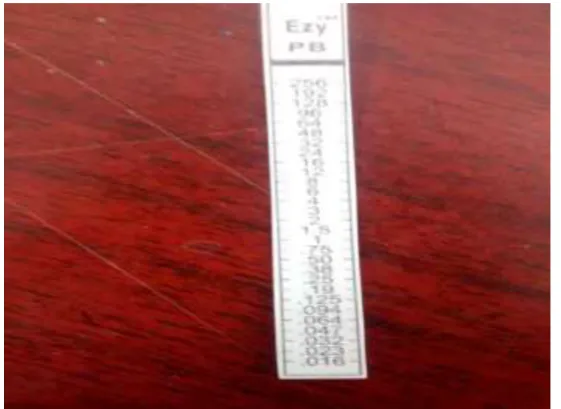
1. Read MIC at the point where the ellipse intersects the scale. If a MIC value between
twofold dilutions is seen, read the MIC value at completed inhibition of all growth.
2. If the intersect differs on either side of the strip, read the MIC as the greater value, Ignore
[image:5.595.150.445.588.747.2]any growth at the edge of the strip.
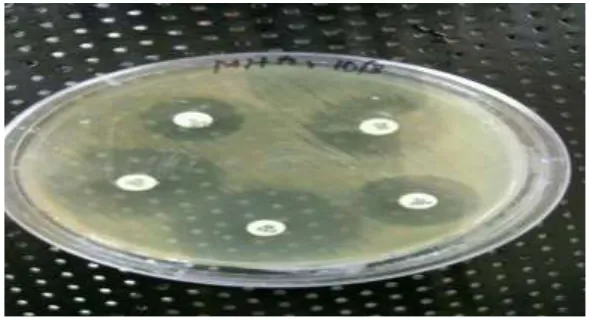
Fig 2: Mha Plates Showing Resistance.
Fig 3: Sensitive plate to Polymyxin -B, Colistin and Tigecycline.
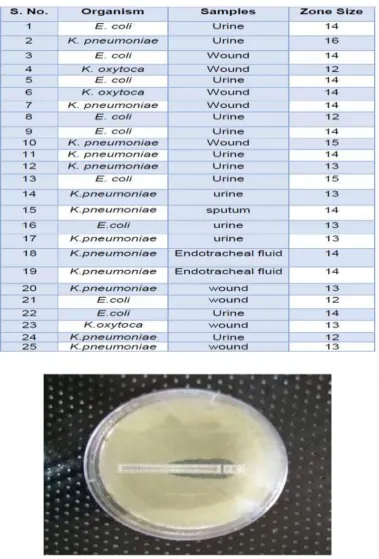
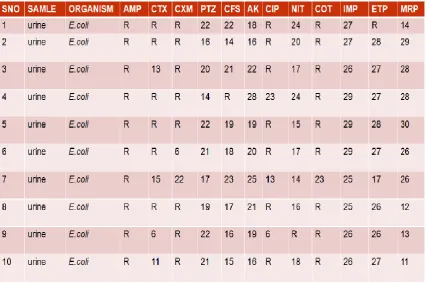
[image:6.595.159.440.536.740.2]Table 1: Shows Readings of Zone of Inhibition.
Fig 5: MHA showing minimum inhibitory concentration.
3. RESULTS
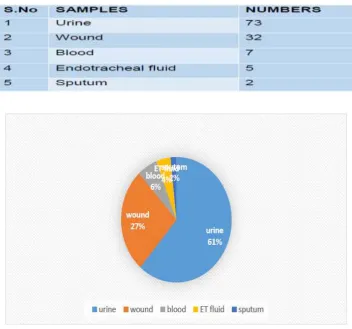
Among of 119 isolated samples 73 (61%) were urine samples, 32(27%) samples were wound
swab samples, 5(4%) were endotracheal fluid samples, 7(6%) were blood samples and 2(2%)
Among of 119 isolated samples 57(48%) was found to be E. coli, 37(31%) were Klebsiella,
8(7%) Enterobacter, 4(3%) Salmonella, 7(6%) Citrobacter, 6(5%) Proteus.
According to NCCLs guidelines isolates resistant to third generation cephalosporins and are
susceptible to the respective drug combination with clavulanic acid are considered as ESBLs
producers Enterobacteriaceae.
During the study, among of 119 isolates 10(8%) of them showed ESBLs production. All 110
isolates were E-coli (ESBLs), and they were also 100% resistant to ampicillin, 99% resistant
to cotrimaxazole, ciprofloxacin, cephotaxime and cefuroxime.
Among of 119 isolated samples 25(21%) of them showed resistance to carbapebem
antibiotics. Within 25 isolates of carbapebem resistant Enterobacteriaceae 9(36%) were E.
coli whereas 16(64%) were Klebsiella.
Resistance of Klebsiella species in this project showed that they were resistant to Imipenem
25%, Meropenem 100% and 99% to Ertapenem. Among of 57 E-coli isolates, 9(16%) of
them showed resistance to carbapebem, 15% resistance to Imipenem, 26% Ertapenem and
30% to Meropenem. 4(80%) of them were resistant 100% to Ertapenem and Meropenem and
99% resistant.
SENSITIVITY TEST OF CRE TO POLYMYXIN-B RESULT
Antibiotic sensitivity test was done for the microorganisms which showed resistance to
carbapenem drugs by use of disc diffusion method. According to NCCL guideline all
carbapenem resistant Enterobacteriaceae in this study showed susceptibility to polymyxin-B.
According to NCCLs guideline MIC less than 2.0μg/ml is interpreted as sensitive whereas MIC greater than 2.0μg/ml is interpreted as resistant. Minimum inhibitory concentration
among 25CRE isolates in this study showed that 22 CRE isolates were sensitive to
Polymyxin -B and only 3 isolated CRE resisted to Polymyxin-B, where all resisted isolates
Table 1: Numbers of Isolated Samples
[image:9.595.131.473.475.640.2]Figure 1: Percentages of isolates samples
Figure 2: Percentage of isolated organisms.
Table 3: Spectrum Beta Lactamase Producers.
Figure 4: Carbapenem resistant organism.
Table 6: Resistance of E. coli to Carbapenem
MINIMUM INHIBITORY CONCENTRATION TEST RESULT
Table 7: Minimum Inhibitory Concentration Readings.
4. DISCUSSION
Enterobacteriaceae is a family of bacteria that commonly cause infections in health-care
settings as well as in the community. Among Enterobacteriaceae resistance to broad-spectrum
[image:12.595.169.431.341.676.2](CRE) have been recognized in health-care settings as a cause of difficult-to-treat infections
associated with high mortality. Jayoung et al, 2010 found that among 347
Enterobacteriaceae, 28.2% were ESBL producers and 1/347 was carbapenem resistant,
Claudia et al., 2012 studied that among 120 isolates, 42% K. pneumoniae 40% E. coli
resistant to polymyxin-B.
There is a registered increase in ESBLS-producing E-coli, from 1.1% to 10.4% in the
European Center for Disease Control (ECDC), which showed eight and two fold increases in
the percentage of ESBL-producing E. coli and K. pneumoniae isolates respectively
(Bochichio et al., 2006).
The current study was conducted to isolate Enterobacteriaceae and to evaluate the prevalence
of their resistance and pathogenicity in inpatient and outpatient, the study showed that among
119 isolates (10)8% was ESBL producers which made them to resist 3rd group of
cephalosporins drug, (25)21% was carbapenem resistant Enterobacteriaceae which allowed
them to resist carbapenem drugs, in addition Klebsiella showed high resistance to
carbapenem drugs 64% whereas E. coli showed resistance of 36% to carbapenem, it is quiet
surprise to found that carbapenem resistant Enterobacteriaceae are still increasing day by day.
CONCLUSION
In the present study “Evaluation of resistance to carbapenem by disk diffusion method and
susceptibility to Polymyxin–B using E-strip in Enterobactericiae” was carried out in Nims
Hospital, Rajasthan. According to the present study carbapenem can be used to treat infection
caused by extended spectrum beta lactamase producers whereas polymyxin-B can be used as
drug of choice for carbapenamese producers or carbapebem resistant Enterobacteriaceae.
REFERENCE
1. Alice Y. Guh, MD, MPH, Sandra N. Bulens, MPH, Yi Mu, PhD, Jesse T. Jacob, MD,
Jessica Reno, MPH, Janine Scott, MPH; Lucy E. Wilson, MD, Elisabeth Vaeth, MPH;
Ruth Lynfield, MD; Kristin M. Shaw, MPH; Paula M. Snippes, Vagnone, MT(ASCP); Wendy M, “Epidemiology of Carbapenem- Resistant Enterobacteriaceae in 7 US Communities” American society for microbiology QR177.M37, 2013; 9: 201-222.
2. Ananthanarayan and Paniker‟s “A textbook of microbiology”, universities press
3. Claudia M. D. de Maio Carrilho, Larissa Marques de Oliveira, Juliana Gaudereto, Jamile
S. Perozin, Mariana Ragassi Urba, Carlos H. Camargo, Cintia M. C. Grion, Anna Sara S. Levin6 and Silvia F, “A prospective study of treatment of carbapenem-resistant Enterobacteriaceae infections and risk factors associated with outcome‟‟, BMC infectious
disease, 10, 2012; 16: 629.
4. Collins and Lyne, „Microbiology methods published by British library cataloguing‟‟, 8th
edition, 2014; 512-530. Darshan P. Godkar, Praful B. Godkar “A textbook of medical laboratory technology” 3rd edition, 741-745, Bhalani publishing house, Mumbai, India.
5. Dolunay G ulmez, Neil Woodford, Marie-France I. Palepou, Shazad Mushtaq Gokhan
Metan, Yusuf Yakupogullari, Sesin Kocagoz, Omrum Uzung, Gulsen Hascelik, David M.
“Carbapenem-resistant Escherichia coli and Klebsiella pneumonia isolates from Turkey
with OXA-48-like carbapenamese and outer membrane protein loss‟‟, international
journal of antimicrobial agents, 2008; 31: 523-526.
6. Satish Gupte “textbook of medical microbiology” 9th edition, 2006; 78-89 Jaypee brother‟s medical publishers(p) LTD EMC House23/23B INDIA.
7. Simona Bratu, MD; David Landman, MD; Robin Haag, RN; Rose Recco, MD; Antonella
Eramo, RN; Maqsood Alam, MD; John Quale, MD “Rapid Spread of
Carbapenem-Resistant Klebsiella pneumoniae in New York City” American Medical Association
Journal, 2009; 165: 1430-1435.
8. Simona Bratu, Pooja Tolaney, Usha Karumudi, John Quale, Mohamad Mooty, Satyen Nichani and David Landman “Carbapenamese-producing Klebsiella pneumoniae in Brooklyn” American society for microbiology, 2005; 56: 128–132.
9. Wang-Huei Sheng, a Robert E. Badal, b Po-Ren Hsueh “Distribution of
Extended-Spectrum Lactamases, Amp C Lactamases, and Carbapenamese among
Enterobacteriaceae Isolates Causing Intra-Abdominal Infections in the Asia-Pacific
Region‟‟ American Society for microbiology 10:1128/ACC00971-12, 2013; 29.81-29.88.
10.WHO “Manual for the Laboratory Identification and Antimicrobial Susceptibility Testing
of Bacterial Pathogens of Public Health Importance” 1211 Geneva 27 (2013).
11.Xuan Wang, Gongxiang Chen, Xiaoyan Wu, Liangping Wang, Jiachang Cai, Edward W. Chan, Sheng, Cheng, and Rong Zhang, “Increased prevalence of carbapenem resistant
Enterobacteriaceae in hospital setting due to cross-species transmission of the blaNDM-1
element and clonal spread of progenitor resistant strains” frontiers in microbiology.00595,
12.Yanling Xu, Bing Gu, Mao Huan, Haiyan Liu1, Ting Xu2, Wenying Xia, Tong Wang,