FORMULATION AND OPTIMIZATION OF SUSTAINED RELEASE
TABLET OF PREGABALIN
Millin R. Gohel*, Hitesh N. Jain and Umesh M. Upadhyay
Sigma Institute of Pharmacy, Bakrol, Ajwa-Nimeta Road, Dist: Vadodara 390019.
ABSTRCT
The aim of the current study was to formulate and optimize sustained
release matrix tablet of pregabalin in order to achieve the prolonged
therapeutic action by releasing the drug over an extended period of
time after a single dose administration which would help to improve
the patient compliance. The matrix tablets were prepared using direct
compression technique. Optimization was done by using 32 Factorial
design using design expert. Matrix polymers of Polyox family like
PEO WSR 303, PEO WSR 301 were used to make the sustained
release tablet. Matrix tablets were evaluated for various physical
parameters like hardness, friability, weight variation, drug content and
In vitro dissolution study. After the evaluation the results obtained were found satisfactory
which clearly shows that the C8 matrix formulation containing polymers of the Polyox family
(i.e PEO WSR 303 AND PEO WSR 301) has able to sustained the release of drug up to 24
hours. Thus it will ultimately help to increase the patient compliance as the dosing frequency
of pregabalin is thrice a day which will reduce to once a day.
KEYWORDS: Pregabalin, PEO WSR 303, PEO WSR 301, sustained release.
INTRODUCTION[1-5]
Greater attention has been focused on development of sustained or controlled release drug
delivery systems with concomitant recognition of the therapeutic advantages of controlled
drug delivery. Controlled drug delivery systems have been introduced to overwhelm the
drawback of fluctuating drug levels associated with conventional dosage forms. A sustained
release system delivers the active agent at slower rate than the conventional dosage form but
the release is substantially affected by external environment. Their are various ways to
Volume 5, Issue 5, 1186-1195. Research Article ISSN 2277– 7105
*Corresponding Author
Millin R. Gohel
Sigma Institute of Pharmacy, Bakrol, Ajwa-Nimeta Road, Dist: Vadodara 390019. Article Received on 09 March 2016,
Revised on 28 March 2016, Accepted on 19 April 2016
sustained the release of drug out of which the most convenient way is sustained released
matrix formulation.
Pregabalin is a structural analogue of gabapentin which is used in many treatments but
especially it is used for neurologic pain. It is administered 150 mg in three divided dose per
day. Thus it is a suitable candidate for making a sustained release tablet. Polyethylene oxide
which are also known as Polyox are the hydrophilic polymer. These are available in various
grades. Out of these PEO WSR 303, PEO WSR 301 are used for current work.
MATERIALS AND METHOD
Pregabalin was obtained as a gift sample from DANA Pharmaceuticals Pvt.Ltd, Ambarnath,
India and all other excipients used were of analytical grade
METHODS
FORMULATION[6-12]
The matrix tablets of Pregabalin were prepared by using 32 factorial design. All the
ingredients were accurately weighed and passed through mesh 60#.In order to mix the
ingredients thoroughly drug & polymer were blended geometrically in a mortar and pestle for
15 minutes then magnesium Stearate, MCC, talc and PVP K30 were mixed one by one. After
thoroughly mixing the ingredients, the powder blend was passed through 44# sieve and
compressed on rotary tablet punching machine.
Table 1: Formulation table
Materials (mg) C1 C2 C3 C4 C5 C6 C7 C8 C9
Pregabalin 150 150 150 150 150 150 150 150 150
Polyox WSR 303 60 60 60 80 80 80 100 100 100
Polyox WSR 301 60 80 100 60 80 100 60 80 100
MCC 98 78 58 78 58 38 58 38 18
PVP K30 20 20 20 20 20 20 20 20 20
Magnesium Stearate 8 8 8 8 8 8 8 8 8
Talc 4 4 4 4 4 4 4 4 4
Tablet Weight(mg) 400 400 400 400 400 400 400 400 400 EVALUATION PARAMETERS[13-18]
Pre compression parameters
All the formulations were evaluated for their pre compression parameters like bulk density,
Post compression parameters Hardness
The hardness of the tablets was determined using Monsanto hardness tester in terms of
kg/cm2. Average hardness of three tablets was taken to study the reproducibility.
Friability
Six tablets from each were exposed to Roche friability test apparatus for 100 rotations and
percentage loss in weight was measured against initial weight
% Friability (F) = {1-(W/W0)} X 100
Where, W0= Initial weight of tablet
W = Weight of tablets after the test
Uniformity of weight
20 tablets were selected at random from each formulated batch to check the uniformity of
weight using electronic balance. Average weight and maximum percent deviation (Positive
and negative) were determined.
Drug Content
Ten Tablets were weighed and average weight was calculated. All the 10 tablets were
crushed in a mortar. The powder equivalent to 10 mg was accurately weighed, dissolved in
0.1 N HCl & made up to 100ml of 0.1 N HCl. The volumetric flask was then shaken for
approximately 20 minutes. The solution was filtered and 1 ml of filtrate was diluted to 10ml
using 0.1 N HCl. Absorbance was measured at 210 nm using 0.1 N HCl as a blank. The
amount of drug present in one tablet was calculated.
In-Vitro Drug Release Study
The test was performed on the prepared pregabalin tablets using the USP dissolution
apparatus II. Six individual tablets from each formula were tested. Test was performed in 900
ml of 0.1 N HCl for two hours and then in phosphate buffer 6.8. In all studies, the
temperature of the dissolution medium was maintained at 37+ 0.50C.The Aliquots of 5 ml
RESULT AND DISCUSSION
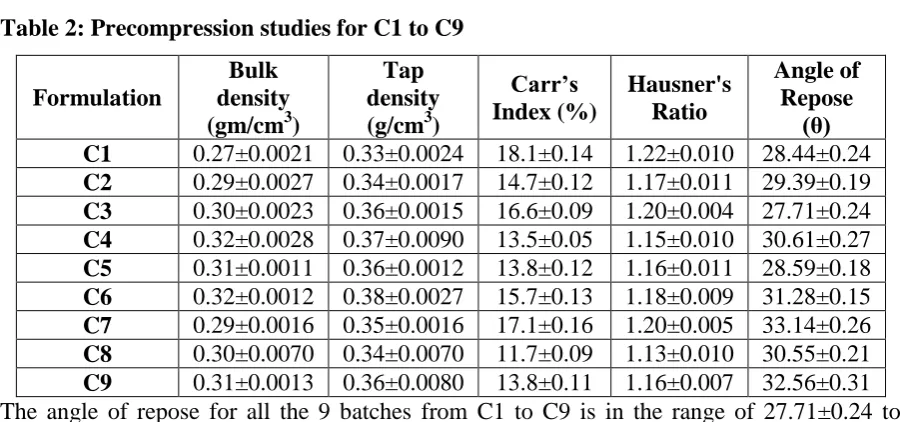
Table 2: Precompression studies for C1 to C9 Formulation
Bulk density (gm/cm3)
Tap density (g/cm3)
Carr’s Index (%)
Hausner's Ratio
Angle of Repose
(θ)
C1 0.27±0.0021 0.33±0.0024 18.1±0.14 1.22±0.010 28.44±0.24
C2 0.29±0.0027 0.34±0.0017 14.7±0.12 1.17±0.011 29.39±0.19
C3 0.30±0.0023 0.36±0.0015 16.6±0.09 1.20±0.004 27.71±0.24
C4 0.32±0.0028 0.37±0.0090 13.5±0.05 1.15±0.010 30.61±0.27
C5 0.31±0.0011 0.36±0.0012 13.8±0.12 1.16±0.011 28.59±0.18
C6 0.32±0.0012 0.38±0.0027 15.7±0.13 1.18±0.009 31.28±0.15
C7 0.29±0.0016 0.35±0.0016 17.1±0.16 1.20±0.005 33.14±0.26
C8 0.30±0.0070 0.34±0.0070 11.7±0.09 1.13±0.010 30.55±0.21
C9 0.31±0.0013 0.36±0.0080 13.8±0.11 1.16±0.007 32.56±0.31
The angle of repose for all the 9 batches from C1 to C9 is in the range of 27.71±0.24 to
33.14±0.26 and the Carr's index was found within the range of 11.7±0.09% to 18.1±0.14%,
while all the batches he Hausner's ratio in the range of 1.13±0.010 to 1.22±0.010.
Thus as per the readings obtained it shows that the powder mixture of all the batches shows a
moderate to good flow property.
Post Compression Parameters
Table 3: Post compression Parameters of C1 to C9 Form.
Hardness (kg/cm2) Mean (n=3)
Weight variation (mg) (n=20)
% Friability (n=6)
Drug Content (%) (n = 10)
C1 5.6±0.011 396.85±1.1 0.41 99.33±0.47
C2 5.8±0.024 401.22±1.4 0.37 97.47±0.57
C3 6.0±0.018 397.79±2.0 0.24 98.85±0.64
C4 5.7±0.015 399.82±2.2 0.28 98.46±0.29
C5 6.1±0.008 401.36±1.7 0.48 97.47±0.50
C6 5.6±0.042 397.98±3.1 0.50 97.43±0.58
C7 5.9±0.025 402.18±2.6 0.49 100.86±0.44
C8 6.5±0.053 400.27±1.3 0.47 99.11±0.54
C9 6.3±0.034 398.64±2.4 0.43 97.51±0.54
After compression of the batches with combination of polymers all the 9 batches shows an
acceptable range of hardness, friability that is 5.6 to 6.5 kg/cm2 hardness and for friability is
0.24 to 0.50 %.
The Uniformity of weight of tablet ranges from 396.85±1.1 to 402.18±2.6 with an acceptable
standard deviation.
[image:4.595.110.485.447.631.2]In Vitro Dissolution Studies
Fig. 1: A Plot of % CDR Vs time of batch for C1 to C3
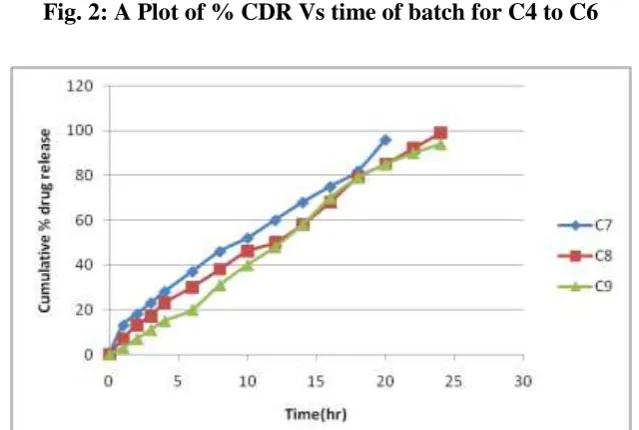
[image:5.595.147.454.92.275.2]Fig. 2: A Plot of % CDR Vs time of batch for C4 to C6
[image:5.595.137.457.512.727.2]After the formulation of the batches with combination of polymers they are incorporated to
the in vitro dissolution studies and are tested upto 24 hours. All the batches are able to
sustained the release of drug for minimum upto 16 hours and maximum upto 24 hours. The
batch C1, C2 and C3 was able to release the drug upto 18, 16, 16 hours and the percent of
drug release was 99%, 97%, 98%. In these batches the concentration of PEO303 was kept
fixed 50 mg and the concentration of the PEO301 was kept in increasing order 50, 60 and 70
mg. Thus it shows that with increase in concentration of PEO301 which is less viscous
polymer the time of drug release decreases. The other formulations that is C4 to C6 PEO303
was taken 60mg and for batches C7 to C9 was taken 70mg and again the concentration of
PEO301 was taken in increasing order that is 50, 60 and 70mg. From all the above batches
C7 was able to release 100% drug but the time of sustaining the drug was upto 20 hours.
While the formulation C8 and C9 was able to release drug upto 24 hours but C8 gives 99%
drug release and C9 gives 97% drug release. Thus C8 was chosen as an optimized batch and
further studies were carried out on it.
Surface Response Data
A. Response 1 : % CDR at 12th hr (Hours)
Analysis of Variance Table(Partial Sum of Squares III )
Table 4 : ANOVA For Response surface Quadretic Full Model
Source Sum of
Squares Df
Mean
square F value
p-value prob>F
Model 1879.56 5 375.91 957.08 < 0.0001 Significant
A -polyox WSR 303(%) 1702.86 1 1702.86 4335.52 < 0.0001 Significant
B - polyox WSR 301(%) 33.28 1 33.28 84.72 0.0027 Significant
AB 3.78 1 3.78 9.63 0.0532
A2 127.68 1 127.68 325.08 0.0004 Significant
B2 11.96 1 11.96 30.44 0.0117 Significant
Residual 1.18 3 0.39
Core total 1880.73 8
The Model F-value of 957.08 implies the model is significant. There is only a 0.01% chance
that a model F-value this large could occur due to noise. Values of "Probe > F" less than
0.0500 indicate model terms are significant. In this case A, B, AB, A2 are significant model
terms. Values greater than 0.1000 indicate the model terms are not significant.
Final Equation in terms of coded Factors.
Final Equation in Terms of Actual Factors:
12 hrs) = +78.06 -16.85* Polyox WSR 303+2.35* Polyox WSR 301-0.97* Polyox WSR 303*
Polyox WSR 301-7.99* Polyox WSR 3032+2.44* Polyox WSR 3012
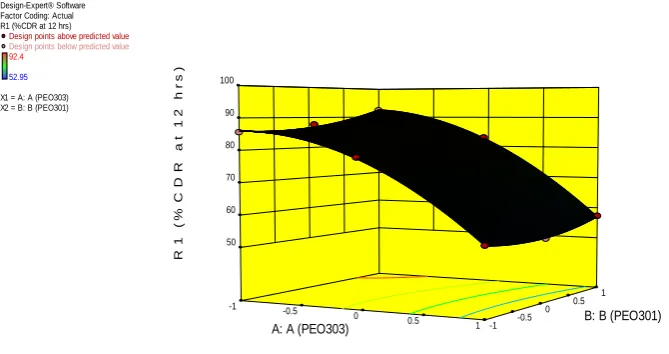
Design-Expert® Software Factor Coding: Actual R1 (%CDR at 12 hrs)
Design Points 92.4
52.95
X1 = A: A (PEO303) X2 = B: B (PEO301)
-1 -0.5 0 0.5 1
-1 -0.5 0 0.5 1
R1 (%CDR at 12 hrs)
A: A (PEO303)
B : B ( P E O 3 0 1 ) 60 70 80 90
Fig. 4: Contour plot showing the effect of Polyox WSR 303 & Polyox WSR 301 on % CDR at 12th hr (Hours)
As seen from the, contour plot of the % CDR at 12th hour revealed that there was
corresponding decrease in % CDR with increase in the concentration of Polyox WSR 303(A).
Moreover it was revealed that increase in concentration of Polyox WSR 301(B) also led to
decrease in %CDR. Thus combination of both in suitable concentration might decrease the
rate of release of drug of the Sustained release tablets.
Design-Expert® Software Factor Coding: Actual R1 (%CDR at 12 hrs)
Design points above predicted value
Design points below predicted value
92.4
52.95
X1 = A: A (PEO303) X2 = B: B (PEO301)
-1 -0.5 0 0.5
1 -1 -0.5
0 0.5 1 50 60 70 80 90 100 R 1 ( % C D R a t 1 2 h r s )
[image:7.595.148.433.147.330.2]A: A (PEO303) B: B (PEO301)
[image:7.595.133.468.521.698.2]B. Response 2 : % CDR at 16th hour
[image:8.595.56.543.94.279.2]Analysis of Variance Table(Partial Sum of Squares III )
Table 5 : ANOVA For Response surface Quadretic Full Model (% CDR at 16th hour)
Source Sum of
Squares Df Mean square F value
p-value prob>F
Model 1380.00 5 276.00 58.04 0.0035 Significant
A -polyox WSR 303(%) 1289.79 1 1289.79 271.24 0.0005 Significant
B -polyox WSR 301(%) 16.43 1 16.43 3.46 0.1600
AB 2.82 1 2.82 0.59 0.4972
A2 56.36 1 56.36 11.85 0.0412 Significant
B2 14.60 1 14.60 3.07 0.1780
Residual 14.27 3 4.76
Core total 1394.26 8
The Model F-value of 58.04 implies the model is significant. There is only a 0.35 % chance
that a model F-value this large could occur due to noise. Values of "Probe > F" less than
0.0500 indicate model terms are significant. In this case A, B, AB, A2 are significant model
terms. Values greater than 0.1000 indicate the model terms are not significant.
Final Equation in terms of coded Factors:
% CDR at 16th hour = +87.10-14.66*A+1.66* B-0.84* A*B-5.31*A2+2.70* B2
Final Equation in Terms of Actual Factors:
% CDR at 16th hour = +87.10-14.66*Polyox WSR 303+1.66* Polyox WSR 301-0.84*
Polyox WSR 303* Polyox WSR 301-5.31* Polyox WSR 3032+2.70* Polyox WSR 3012
Design-Expert® Software Factor Coding: Actual R2 (%CDR at 16 hrs)
Design Points 100
65.92
X1 = A: A (PEO303) X2 = B: B (PEO301)
-1 -0.5 0 0.5 1
-1 -0.5 0 0.5 1
R2 (%CDR at 16 hrs)
A: A (PEO303)
B
:
B
(
P
E
O
3
0
1
)
70 80
90 100
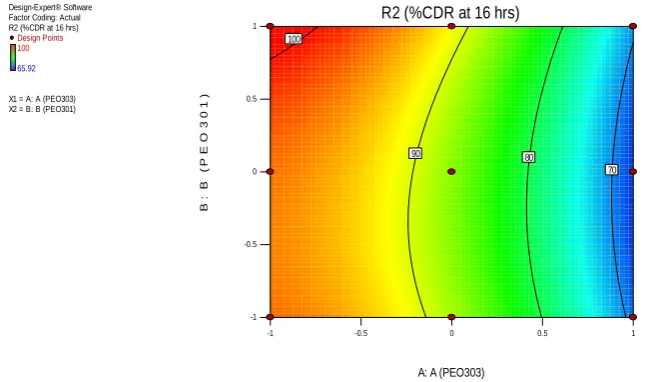
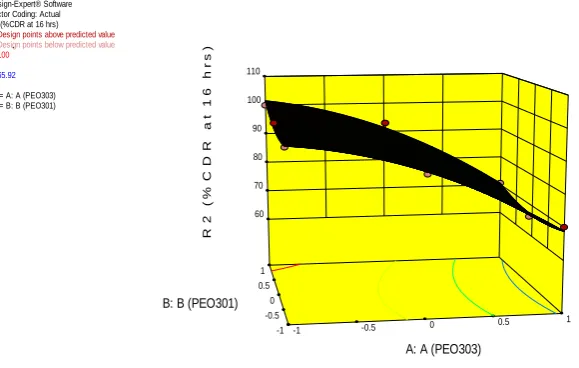
[image:8.595.128.453.526.717.2]As seen from the figure contour plot of % CDR at 12th hour revealed that there was
corresponding decrease in % CDR at 16th hour with increase in the concentration of Polyox
WSR303 & Polyox WSR301. Thus combination of both in suitable Concentration might
sustain the % CDR of the sustained release tablet for 24 hours.
Design-Expert® Software Factor Coding: Actual R2 (%CDR at 16 hrs)
Design points above predicted value
Design points below predicted value
100
65.92
X1 = A: A (PEO303) X2 = B: B (PEO301)
-1 -0.5
0 0.5
1
-1 -0.5 0 0.5 1
60 70 80 90 100 110
R
2
(
%
C
D
R
a
t
1
6
h
r
s
)
[image:9.595.138.428.164.348.2]A: A (PEO303) B: B (PEO301)
Fig. 7: Response surface plot (3D) showing the effect of Polyox WSR 303 & Polyox WSR 303 on % CDR at 16th hour
CONCLUSION
In the present study the attempt was made to formulate the sustained release matrix tablet of
pregabalin using polymer of Polyox family i.e. PEO WSR 303 and PEO WSR 301. The
tablets were formulated using the direct compression technique and the compressed tablets
were evaluated for hardness, friability, drug content and in-vitro drug release study. All the
tablets formed give the satisfactory results for hardness, friability, weight variation test and
drug content. But only C8 batch give the satisfactory results for the drug release upto 24 hrs.
Therefore it is proved that the Polyox polymer is capable of sustaining the release of the drug
for 24 hrs and due to which the tablet dosing can be reduce.
REFERENCES
1. Chaturvedi S, Singh S. (Floating drug delivery systems: an approach to increase the gastric
residence time.-A Review). Asian J Pharm Clin Res, 2013; 6: 1-9.
2. Siepmann J, Peppas N. (Modeling of drug release from delivery systems based on
hydroxypropyl methylcellulose). Adv Drug Deli Rev, 2001; 48: 139-157.
3. Wilson CG, Washington N. In Physiological Pharmaceutical; 2nd ed., UK; Ellis Horwood
4. Shaikh R, Woolfson A. (Mucoadhesive Drug Delivery System). J Pharm Bio Sci, 2011; 3:
89-100.
5. Jain N. In Progress in controlled and novel drug delivery systems; 1st ed., New Delhi;
CBS Publishers and Distributors.
6. Jaswanth B, Sinha V. (Natural and Synthetic Hydrophillic Matricess for Development of
Pregabalin Extended Release Tablet). Int J Pharm Pharm Sci, 2013; 4(3): 1-8.
7. Bose A, Wong T, Singh N. (Formulation Development and Optimization of Sustained
Release Matrix Tablet of Itopride HCl by Response Surface Methodology and Its
Evaluation of Release Kinetics). Sau Pharm J, 2013; 21:201-213.
8. Gupta C, Kishore G, Ratna J, (Development and Evaluation of Aceclofenac Matrix
Tablets Using Polyethylene oxides as Sustained Release Polymers). J Pharm Res, 2013;
6: 249-254.
9. Tehseen N, Rao V, Mohd A. (Design and Characterization of Twice Daily Mini Tablet
Formulation of Pregabalin). Int J Pharm Pharm Sci, 2013; 3(1): 168-175.
10.Le S, Weixiang Z, Xiaohong L, Jin S. (Preparation and Evaluation of Sustained-release
Azithromycin Tablets In Vitro and In Vivo). Asian J Pharm Sci, 2014; 9: 155-161.
11.Seda K, Dogan G, Ozlem C. (Visible-light-induced Synthesis of pH-Responsive
Composite Hydrogels for Controlled Delivery of The Anticonvulsant Drug Pregabalin).
Acta Biomaterialia, 2014; 1-11.
12.Reddy R, Potti L, Mogili R, Rao P, Chandrasekher M. (Formulation and Evaluation of
Pregabalin Sustain Release Tablets). Int J Pharm Prac Drug Res, 2014; 4(2): 80-85.
13.Aulton ME. The Science of Dosage form Design. 2nd ed., Toronto; Churchill
Livingstone., 2002.
14.Jishnu V, Gilhotra R. (Formulation and Evaluation of Cephalexin Extended Release
Matrix Tablets Using 32 Factorial Design). J Young Pharm, 2014; 3: 259-266.
15.Karna N, Sharma P. (Design, development and evaluation of Lornoxicam sustained
release tablet using 32 factorial design).J Pharma Res., 2012; 5: 4471-4476.
16.Lachman L, Lieberman HA. The Theory and Practice of Industrial Pharmacy. 3rd ed.,
Mumbai; Varghese Publishing House., 1987; 297.
17.Lachman L, Lieberman HA. The Theory and Practice of Industrial Pharmacy. 3rd ed.,
Mumbai; Varghese Publishing House., 1987; 88.
18.Lachman L, Lieberman HA. The Theory and Practice of Industrial Pharmacy. 3rd ed.,