DYNAMIC DISSOLUTION AND STABILITY STUDY OF EFAVIRENZ
TABLET TO CHECK THE SUITABILITY OF THE UV METHOD FOR
TABLET DISSOLUTION STUDY OF THIS SINGLE COMPONENT
FORMULATION.
Ajit.K.Nangare1*, Abhishek.K.Shinde2, Karan.K.Pawa3, Amit N Chavan4
1*
Asst Prof Department of Pharmaceutical Chemistry, Padmashri Dr.Vithalrao Vikhe Patil Foundation’s College of Pharmacy, Vilad Ghat, Ahmednagar, (MS), India, 414111. 2Department of Pharmaceutical Chemistry, Padmashri Dr.Vithalrao Vikhe Patil Foundation’s
College of Pharmacy, Vilad Ghat, Ahmednagar, (MS), India, 414111. 3
Department of Pharmaceutical Chemistry, Padmashri Dr.Vithalrao Vikhe Patil Foundation’s
College of Pharmacy, Vilad Ghat, Ahmednagar, (MS), India, 414111. 4
Padmashri Dr.Vithalrao Vikhe Patil Foundation’s College of Pharmacy, Vilad Ghat,
Ahmednagar, (MS), India, 414111.
ABSTRACT
Efavirenz is one of a new class of anti –viral drugs called
non-nucleoside reverse transcriptase inhibitor (NNRTI). It offers the unique
therapeutic prospect of treatment & management of disease and so
used extensively as a single component formulation. Recently it is
under clinical trials in combination with other anti-viral agents. There
are no official methods reported for estimation of efavirenz. Literature
survey has indicated that there are few spectrophotometric methods for
its estimation in human plasma and urine. Objective of this study is to
check the suitability of the UV method for tablet dissolution study of
this single component formulation and also stability study of efavirenz
in 0.1m HCl is studied in this study. Percentage drug release at 60 min
is maximum as per the cumulative dissolution calculations.
KEYWORDS: Efavirenz, Anti-Viral, Dissolution study, Zero order spectrum method, Stability study.
Volume 4, Issue 5, 1715-1722. Research Article ISSN 2277– 7105
Article Received on 28 Feb 2015,
Revised on 19 March 2015, Accepted on 11 April 2015
*Correspondence for
Author
Ajit. K. Nangare
Asst Prof Department of
Pharmaceutical Chemistry,
Padmashri Dr.Vithalrao Vikhe Patil Foundation’s
College of Pharmacy, Vilad
Ghat, Ahmednagar, (MS),
INTRODUCTION
Efavirenz (EFZ) is a non-nucleoside reverse transcriptase inhibitor (NNRTI). These drugs act by inhibiting HIV’s reverse transcriptase enzyme, but in a different way from the nucleoside
analogue drugs like AZT (zidovudine, Retrovi), abacavir (Ziagen), d4T (stavudinne, Zerif),
3TC (lamivudine, Epivir), ddc (Calcitabine, Hivid) and ddI (didanosine, Videx / VidexEC).
Similar to zidovudine, EFZ inhibits the activity of viral RNA – directed DNA polymerase
(i.e. reverse transcriptase). Antiviral activity of EFZ is dependent on intracellular conversion
to the active triphosphorylated form. The rate of EFZ phosphorylation varies, depending on
cell type. It is believed that inhibition of reverse transcriptase interferes with the generation of
DNA copies of viral RNA, which, in turn, are necessary for synthesis of new virions.
Intracellular enzymes subsequently eliminate the HIV particle that previously had been
uncoated and left unprotected, during entry into the host cell. Thus, reverse transcriptase
inhibitors are visustatic and do not eliminate HIV from the body. Even though human DNA
polymerase is less susceptible to the pharmacologic effect of triphosphorylated Efavirenz, this action may nevertheless account for some of the drug’s toxicity. Chemically efavirenz is
known as 8-chloro
–5-(2-cyclopropylethynyl)-5-(trifluoromethyl)-4-oxa-2-azabicyclo[4.4.0]deca- 7,9,11-trien-3-one.
Efavirenz
Efavirenz was previously determined by Spectrophotometry[1-3], HPTLC [4], HPLC [5-7], and
LCMS.[8] However no such simple, sensitive and précised spectrophotometric method is yet
reported for this drug in any official literature. In our previous study we have developed an
simple, precise, accurate, sensitive, rapid and economic UV Spectrophotometric method of
EFZ in bulk and Pharmaceutical formulations.[9] Objective of this study is to check the
suitability of the UV method for tablet dissolution study of this single component formulation
Introduction to dissolution
Dissolution is the process by which a solid of only fair solubility characteristics enters into
solution. The earliest reference to dissolution is probably in the 1897 by Noyes and Whitney,
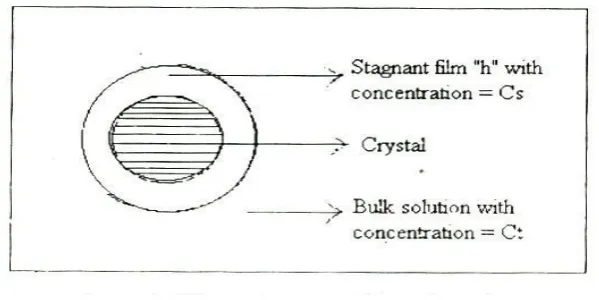
"The Rate of Solution of Solid Substances in Their Own Solution". The authors suggested
that the rate of dissolution of solid substances is determined by rate of diffusion of a very thin
layer of saturated solution that forms instantaneously around a solid particle. They developed
a mathematical relationship that correlates the dissolution rate to solubility gradient of the
solid. Their equation is still the basic formula upon which most of modern mathematical
treatments of dissolution phenomenon revolves. To examine their data quantitatively, Noyes
and Whitney developed an equation based on Pick's second law, to describe the dissolution
[image:3.595.149.449.318.468.2]phenomenon.
Figure 1: Diffusion layer model (film theory)
The Noyes and Whitney equation states that
dc /dt =K (Cs-Q)
Where,
dc/dt = The Dissolution rate of the drug.
K. = Proportionality Constant (also called the dissolution constant).
Cs = Saturation concentration (maximum solubility).
Ct = Concentration at time t.
Cs - Ct) = Concentration gradient.
Sink Condition
A mechanism exists by which the dissolution medium is replenished constantly with fresh
solvent at a specified rate so that the concentration of solute never reaches more than 10% to
said to be conducted under sink condition, meaning under no influence of the concentration
gradient.
,
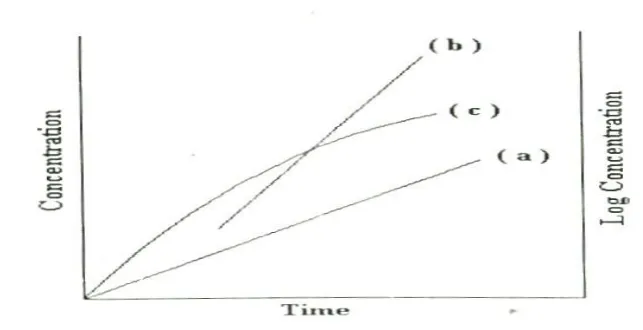
[image:4.595.128.450.122.287.2]Figure 2 represents plots of data that would be expected under sink and non sink condition
Figure 2
(a) Linear (dissolution rate under non sink condition)
(b) Semi-log first order kinetic plot of (dissolution rate under non sink condition)
(c) Linear zero-order kinetic plot (dissolution rate under sink condition)
Factor related to the physicochemical properties of the drug
The important factors correlating the dissolution rate with the physicochemical properties of
the drug include.
Effect of solubility on dissolution
The physicochemical properties of the drug substances play a prime role in controlling its
dissolution from the dosage form. According to Noyes and Whitney, the aqueous solubility of
the drug is the major factor that determines its dissolution rate. Actually some studies showed
that drug solubility data could be used as a rough predictor of the possibility of any future
problems with bioavailability, a factor that should be taken into consideration in the
formulation design.
Effect of particle size on dissolution:
According to Noyes and Whitney, a direct relationship exists between the surface area of the
drug and its dissolution rate. Because the surface area increases with decrease in particle size,
has been highlighted by the superior dissolution rate observed after micronization of a certain
sparingly soluble drugs as opposed to the regularly milled form. Micronization increases the
surface area exposed to the dissolution medium and hence improves the rate of dissolution.
Effect of the crystalline state of the drugs on dissolution
The solid phase characteristics of drugs - such as amorphicity, crystallinity, state-of hydration
and polymorphic structure have been shown to have a significant influence on the dissolution
rate.
MATERIALS AND METHODS
Instrumentation specifications of dissolution test systems.
Make and model: VEEGO, VDA-6D
Number of Test Stations: Six (6) Nos.
Number of Vessels: 7 Nos.
Stirrer Speed Range: 25 to 200 RPM.
Vessel Capacity: One (1) Litre
Temperature Range: 3°C above Ambient Temperature to 40°C, Adjustable to 0.1° C.
Stirrer Speed Accuracy: Better than ± 1 RPM.
Timer Range: 1 minute to 24 hours.
Power Supply: 230 Volts, 50 Hz.
Power Consumption: 1300 VA (Max.).
The commercially available tablets, Sustiva (Label claim: Efavirenz- 600mg) was procured
from local Market.
Dissolution study of EFZ from tablet by Zero Order spectrum method:
Release kinetics of EFZ from tablets was studied by conducting dissolution tests. Dissolution
test were perform using USP type II dissolution apparatus & 900 ml 0.1 N HCl. As tablet is
of conventional formulation, time selected for dissolution was 2 hour. Quantity of dissolution
medium was taken such that maximum release of drug should be 100% in pipetted sample.
With 0.1 N HCl results were satisfactory. Temperature of dissolution media was set at 37
0.5oC with paddle revolving at 100 rpm. 10 ml of sample solution was withdrawn at interval
of 10 min & from that 10ml sample, withdrawn 1ml of sample & dilute it with methanol &
makeup the volume upto 10 ml for whole of dissolution study of 2 hour. To maintain sink
same temperature (37 0.5 oC). Withdrawn 10 ml sample solution contain of EFZ at 100%
resulting solution were analyze by zero order spectrum method of UV-Visible
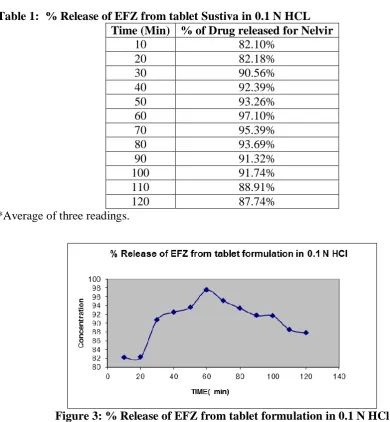
spectrophotometry. Dissolution studies perform in triplicates. Percentage drug release at 60
[image:6.595.75.466.161.584.2]min is maximum as per the cumulative dissolution calculations.
Table 1: % Release of EFZ from tablet Sustiva in 0.1 N HCL Time (Min) % of Drug released for Nelvir
10 82.10%
20 82.18%
30 90.56%
40 92.39%
50 93.26%
60 97.10%
70 95.39%
80 93.69%
90 91.32%
100 91.74%
110 88.91%
120 87.74%
*Average of three readings.
Figure 3: % Release of EFZ from tablet formulation in 0.1 N HCl
Stability study of EFZ tablet
Stability study of efavirenz tablet was done by checking its absorbance in uv zero order
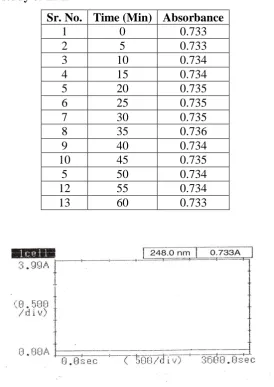
Table 2: Stability study of EFZ
Figure 4: Zero order spectrum of EFZ tablet in 0.1N HCl
RESULTS AND DISSCUSSION
Withdrawn 10 ml sample solution contain of EFZ at 100% resulting solution were analyze by
zero order spectrum method of UV-Visible spectrophotometry. Dissolution studies perform
in triplicates. Percentage drug release at 60 min is maximum as per the cumulative
dissolution calculations. Stability study indicate that according to uv zero order spectrum the
absorbance of EFZ tablet is constant from 0 to 60 min, recorded at each 5 min interval and
also the zero order spectrum graph shown in figure 4 is proof for stability of EFZ tablet.
CONCLUSION
According to the dissolution study performed and depending upon the zero order spectra of
EFZ the drug can be estimated by simple, easy and precise uv spectroscopy method and the
dissolution study of EFZ tablet can be performed by this method and it is concluded that this
Sr. No. Time (Min) Absorbance
1 0 0.733
2 5 0.733
3 10 0.734
4 15 0.734
5 20 0.735
6 25 0.735
7 30 0.735
8 35 0.736
9 40 0.734
10 45 0.735
5 50 0.734
12 55 0.734
method can be used by the industries and academic institutions for their drug estimation,
which is rapid as well as novel.
REFERENCES
1. Sandhya B N, Manikanta A K, Mahesh K N, Vijay K P, Satish J and Prakash V.(
RP-HPLC method for simultaneous estimation of lamivudine, didanosine and efavirenz in
pharmaceutical dosage forms), Der Pharmacia Lettre, 2013; 5(3): 148-155.
2. Tests for HPLC (Source: www.separatedbyexperience.com/glossary/)
3. Manikanta K A, Sandhya B, Mahesh N, (Development and validation of UV
Spectrophotometric method for simultaneous estimation of Lamivudine and Efavirenz in
the Pharmaceutical dosage form), Journal of Advanced Pharmacy Education and
Research, 2012; 2(4): 210-14.
4. Sindhura D, Nanda K A. (Analytical Method Development and Validation for the
Simultaneous Estimation of Lamivudine, Zidovudine And Efavirenz By Rp-Hplc in Bulk
and Pharmaceutical Dosage Forms), Indian Journal of Research in Pharmacy and
Biotechnology., 2013; 6(2): 583-588.
5. Murugan S, Pranabesh S, Subhashis D, Niranjan M, (Development And Validation of
First Order Derivative UV Spectrophotometric Method for the Estimation of Tenofovir
Disoproxil Fumarate, Lamivudine and Efavirenz in Bulk and Tablet Dosage Form),
International Journal of Pharmaceutical Research and Analysis, 2013; 3(1): 29-32.
6. Hiremath S N and Charushila H. Bhirud. (Development and validation of
stabilityindicating TLC densitometric determination of efavirenz in bulk and
pharmaceutical dosage form), Der Pharmacia Lettre, 2014; 6(3): 176-183.
7. Peter ED. Thin-Layer Chromatography: A modern practical approach. Thomas Graham
House, Science Park, Milton Road, Cambridge, UK: The Royal Society of Chemistry,
2005.
8. www.pharmainfo.net.
9. Ajit K. Nangare*, Karan K. Pawa and Abhishek K. Shinde.(Zero and first order
derivative UVspectrophotometric methods for determination of efavirenz in