Student-driven module: promoting independent learning
NORTCLIFFE, Anne <http://orcid.org/0000-0001-6972-6051>
Available from Sheffield Hallam University Research Archive (SHURA) at:
http://shura.shu.ac.uk/14540/
This document is the author deposited version. You are advised to consult the
publisher's version if you wish to cite from it.
Published version
NORTCLIFFE, Anne (2005). Student-driven module: promoting independent
learning. International Journal of Electrical Engineering Education, 42 (3), 247-266.
Copyright and re-use policy
See
http://shura.shu.ac.uk/information.html
Sheffield Hallam University Research Archive
STUDENT DRIVEN MODULE: TO PROMOTE INDEPENDENT LEARNING
ANNE NORTCLIFFE
School of Engineering, Sheffield Hallam University, Sheffield, S1 1WB,
UK.E-mail:[email protected]
Programming courses by their nature can be very dry. The question is can a student driven course
provide an opportunity for a higher level of learning. This paper intends to present the results and
analysis of such an innovative approach and the student's reactions to taking responsibility for a
module in network programming..
Keywords: student supplemental instruction, peer assessment, curriculum development
INTRODUCTION
Programming courses are often dry in contents and delivery, even when the subject matter is of interest to the students, for example web programming. The consequences of which is that students become bored and level learning seriously impaired, Ref. 1, and therefore the traditional approach of chalk and talk offers limited learning experience. Consequently is this approach appropriate for such subjects that are dry by nature. Maybe an “uncovering” approach to planning a lecture course maybe more appropriate, as allow the students to “uncover” the information for themselves Ref. 2, oppose to the academic covering all the material. Such an method would discourage the students' perception that the academic is the fountain of all knowledge and fostered by academics despite heavy workloads, Ref. 3. Therefore any innovation should provide light relief to course design and delivery, but also actively promote the learning goals of higher education.
order not to burden the students or academic, particularly in terms of marking Ref 6. The opening for reflection can be resolved using pre- and post course tests, Ref. 5, but this involves high proportion of work for the academic and student which also can inhibit learning, Ref. 1 and encourage strategic learning, Ref. 7. However, some sort of assessment process is required as a primary factor in motivating student learning Ref. 8. Therefore some form assessment needs to be adopted in the approach.
Allowing students to take responsibility for their learning and course design, delivery in the past has fostered “uncovering” style of learning, high student motivation, excellent attendance and even in the academics absence, Ref 3. Some learning theorists, Ref 9, have suggested that supplemental instruction that is, teaching others a subject; helps promote higher level of learning. A student teaching model of instructing all the students in an engineering class to prepare material for each week’s topic and selecting one student each week to present the material in theory resulted in the students in achieving greater depth of understanding of the subject, Ref 10. However this model is unsuitable for today'’s large volume degree courses, in terms of workload, timescales and marking, Ref. 5 and course-work intense degree courses as over assessment of students inhibits learning, Ref. 1.
However reducing the numbers of assessments, the students were found to study less and more narrowly, received less feedback and less timely feedback to act upon, Ref. 11. Therefore any new method incorporating assessment procedure should provide the means to motivate the students to study, assess the students without overburdening both parties (students and academic) and yield plenty of quality timely feedback.
framework to which a person can build upon to improve their learning, i.e. acknowledges what two components a persons has got right and what two aspects need improving. In the case of using peer assessment in summative assessment there is a need to explain clearly the assessment criteria, to encourage the students to use a feedback sandwich and to clarify and justify their comments with their marks, in order to prevent Ref. 15, Ref. 18 experiences of failed peer-assessment. This paper demonstrates how formative peer assessment can be effectively harnessed to provide informative feedback to the students presenting the lecture.
LEARNING THEORY
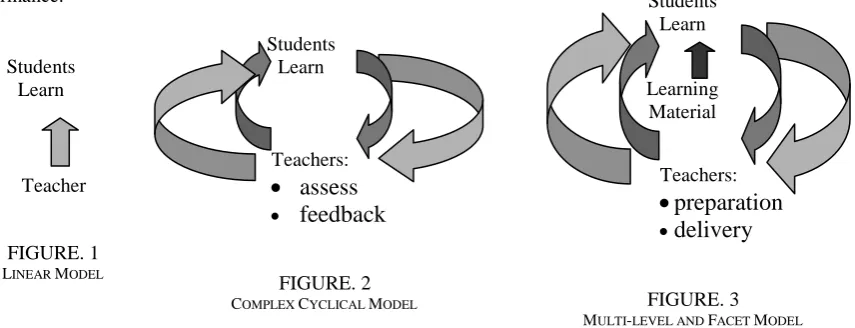
Traditional methods of teaching and assessment promote a linear model of learning, Fig. 1, whereby the student receives no feedback. Previously it has been suggested, Ref. 19, that peer assessment can promote a more complex cyclical model of learning as groups of students are involved in multiple roles and processes (learning, assessment, (summative and formative feedback), see Fig. 2, and the learning is three fold from each of these roles and processes. Formative peer assessment element can be further enhanced if the students are encouraged to utilise a feedback sandwich, as provides the constructive framework to which to communicate effectively the feedback to their peers, i.e. what their peers got right and what they got wrong, Ref. 20. A feedback sandwich presents the students with a springboard from which they can improve their learning performance.
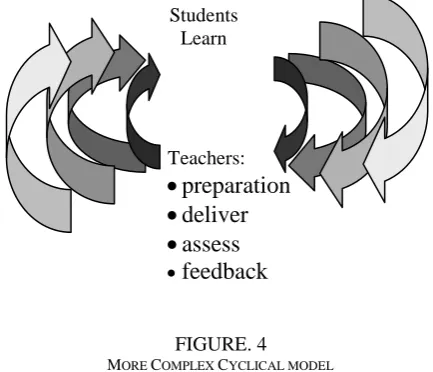
In terms of improving learning through teaching it has been suggested, Ref. 19, that students who participate in supplementary instruction produces a multi-level and faceted model of learning, see Fig. 3. Students gain an initial linear understanding from ascertaining the resources. Further learn from the preparation of the lecture as promotes reflective practice and knowledge dissemination and delivery further re-enforces the learning. Combine this with peer and academic feedback and assessment an even more complex cyclical model of learning is possible, (see Fig. 4). Where peers feedback takes the form of formative peer assessment (feedback sandwich) and information conveyed/asked in the question and answer session. Both these methods
Students Learn
Teacher
FIGURE. 1 LINEAR MODEL
Students Learn
Teachers:
•
assess
[image:4.595.93.521.441.605.2]•
feedback
FIGURE. 2 COMPLEX CYCLICAL MODEL
Teachers:
•
preparation
•
delivery
Students Learn
Learning Material
FIGURE. 3
of feedback provide an opportunity for active learning. Essentially any engagement between the teacher and the audience promotes active learning, Ref. 21. In the case of the question and answer session it encourages both parties to establish a more cyclic method learning between ascertaining and interpreting the data and reviewing their interpretation of the data.
STRATEGY
In theory supplementary teaching, if introduced in the right context in relation to the courses aims and goals, can provide a more relaxed framework for the students to reflect upon their level of understanding of a course’s contents. Peer learning tasks promote high level of learning, the more complex the tasks the greater the level of learning, Ref. 22. In the case of supplementary teaching the groups of students are required to critical analysis data, problem solve and make decisions, all complex learning tasks, therefore supplementary instruction will encourage high-level cognitive processing. However, for the audience the level learning possible can be poor, as shown in practice, Ref. 18, as student presentations were boring and lack the ingredients of good teaching. This in part maybe due to the fact the students were constrained by the assessment brief, and encouraged students to deliver a traditional style lecture. Previous successful experiences in supplementary teaching in terms of learning have been achieved by encouraging the students to present their solution to a problem, Ref. 23. Therefore the solution may lie in the assessment brief, i.e. it should define a problem that requires to be solved and encourages the students to explain their solution to the class. Also, in fulfillment of UK Universities' QAA (quality academic assurance) responsibilities there is a need for interlacing the course rationale, aims and learning outcomes into the framework of the exercise to ensure that all validated course aims and learning outcomes are met in the module design and delivery.
[image:5.595.173.390.155.341.2]Therefore the proposed strategy was thus, in the first lecture the students were informed by handout that they are the employees of an organization, as illustrated in Fig. 5. The students were addressed by the academic
FIGURE. 4
MORE COMPLEX CYCLICAL MODEL Students
Learn
Teachers:
•
preparation
•
deliver
•
assess
acting as the managing director who explains in more detail the following: one that the organization has lost their web engineers to another organization and two due to financial constraints they will not be replaced, in conclusion it has been decided that they are to become the new web engineers for the organization.
The students are issued further with a flyer, as shown in Fig. 6, which defines their new job roles at E-phonica. The managing director then goes on to further to explains in more detail: that he/she recognizes that there is too much information for each individual to ascertain within the time-scales and therefore different groups of 6-7 personnel will research a topic and present their endeavors in an hour lecture. The students were split into predefined groups, asked to discuss and identify three topics that need to be covered in the course. Each group in turn was asked to identify a key topic that requires to be addressed, in order to establish a list of 10 topics that need to be addressed in 2 x 1 hr lectures to be held every alternate week over a 10-week period.
The students were finally asked to finalize the order in which the topics should be taught, under the guidance of the director. The audience was asked for two groups to volunteer to prepare and teach the first two topics on the concluded list and subsequently deliver in a fortnight. In the following subsequent weeks volunteers were sort every two weeks to teach the next couple of topics on the list.
The lecture component of the course was further supported with computing laboratories and e-learning facilities (blackboard). Both these facilities provided the opportunity, for the academic to resolve any issues arising from the lectures, i.e. clarify any information and facilitate learning. However the e-learning facilities also provided the opportunity for:
Role Play
For the first half of the lecture you are graduate employees of E-phonica. E-phonica is a large phone manufacturer and retailer who sell direct to the public via a limited number of warehouses, call centers and Internet both on PC and WAP interfaces. The company wishes to exploit the blue-tooth phone technology for marketing their phones and the future http capable phones. The internet arm of the business is responsible for much of their core business, and has revolutionized how the organization does business, but due to collapse of manufacturing prices worldwide, mobile phone market and rising cost of oil, increasing wage bill and raise of cost living all have reduced the profit margin of the organization and constrained cash flow.
The organization has seen the collapse of Motorola and many other competitors. This organization continues to survive due to its ability to exploit new markets and technologies and importantly due to the organization’s ability and its staff to adapt with to the ever-changing world around them.
You are gathered here today to participate in an important exercise, which holds the key to the future of the organization, their willingness to contribute will assist in ensuring the company’s future and success.
The managing director of E-phonica will address you for this duration.
• groups of students preparing lectures to communicate more effectively
• the students to continue the question and answer sessions initiated in the lectures on-line • the students/academic to have on-line discussions of on topics in relate to the module • the lecturing students to define their sources of references
• the academic to provide summary of information for each topic after each lecture
STRATEGY RATIONALE
The role of the academic during this exercise is to be a facilitator oppose to teacher, to encourage the students to question their perceptions and, where necessary, provide guidance. In addition the academic
E-Phonica
The future web engineers the graduate employees of E-phonica
The perceived newrole of graduate employees of E-phonica as web engineers, to:
• develop a strategy for managing the physical Internet site and creating site and maintaining a site that has the capability for establishing a complete and full-featured presence. Issues such as secure site / real time communications / server selection / installation and maintenance must be addressed. • to be aware of these issues and have practical knowledge of up to date network languages so that
they can plan, implement and evaluate effective Internet applications for business.
• have knowledge of a variety of disparate languages and tools, which are ever changing and improving. For example be able to describe the concepts of HTML, XML, Java, ActiveX, Perl, Common Gateway Interface (CGI), and JavaScript. Thus providing the basis for understanding and competence with future and “yet-to-be-developed” network programming languages.
The aims of the next ten weeks is to ensure that that every graduate employees of E-phonica; • develops a practical understanding of building an Internet site, from registering domain names to
HTML and Web authoring; file and image management and development of custom scripts to enhance interactivity.
• ascertain an underlying technological competence to both understand and use network programming. • introduce an awareness of the need for secure sites / real time communications / installation and
maintenance policies.
Typical learningoutcomes should be that every graduate employees of E-phonica can: • Build an internet site and analyse its performance
• Demonstrate an appreciation of secure site and real time communication issues.
• Critically evaluate installation and maintenance policies and be aware of how to use cookies to store information on local machines.
• Describe the underlying concepts behind current network programming languages such as Java and Perl.
completes the module with a final lecture that summaries the topics previously discussed over the last 10-week period and is also intended to provide an opportunity for reflection and resolve any outstanding issues.
The rationale for this exercise was prompted by successful results of Powell's (1962) experiment Ref. 3, however under current regulations and QAA procedures, Powell's (1962) student driven course classroom experiment, Ref. 3, could not take place. In the case in point at Sheffield Hallam University the course requires unit description and unit guide to be issued to all students at the beginning of every module. Therefore in order to satisfy today's QAA procedure the exercise has to incorporate the necessary paperwork within the framework of exercise. In this case the second handout, Fig. 6, defines in the disguise of the web engineers' roles, aims and learning outcomes the same aims and learning outcomes of those in the validated unit description. Also, the handouts and academic address are designed to ensure that the students are essentially under the pretext that they are designing the course; the reality is they are being guided and supervised by their academic to derive a course content that satisfies the unit description. The resultant student derived list of topics and order were added to the unit guide and issued to students as soon as possible.
The supplementary instruction assessment requires to be moderated just like any other piece of course-work in accordance to the QAA procedures. A number of the lectures were videoed for the moderator to watch and comment upon in addition to moderating the corresponding hand-outs to the videoed lectures. Also, the video and copies of the lecture notes with academic and moderators comments were retained in the unit file, thus fulfilling any external examiners request to view any moderated pieces of course-work.
RESULT S
Results of Module Design
Prior to the exercise the academic’s perceived topics that would fulfill the course content from details outlined in the unit description were as follows, Introduction to creating web site with personal URL, Web communication protocols, Web authoring, Web installation, Web Maintenance, Web interaction with user, Web security and real-time, Interfacing with other business systems, Network programming languages, Hardware resources and Web providers and support.
result of participating in this role play exercise was as follows: Lec 1: History of Web/How to create a Web Site, Lec 2: Critique/ Web Analysis, Lec 3: Assessment of the requirements of Web Sites, Lec 4: Cost: Who does it?, Lec 5: Web Servers; hardware and software, Lec 6: Security; why and how, Lec 7-9: Web based languages; HTML, XML, WML, JavaScript, Java, Perl, CGI, and Lec 10: Maintenance.
Though the headings of the student list are different to those perceived by the academic, the meanings of the heading are essentially the same or similar. The meaning of both are concerned with topics that define what is a web site, what a web site typically consists of and why, how to create and maintain web site. However the timetabling order derived by the student is a truer reflection of a web site project, i.e. feasibility study (Lec 4), definition of user requirements (Lec 2 and 3), design software and hardware (Lec 5-9), development (Lec 7-9) and maintenance (Lec 10).
However, upon reflection of the course development and results of delivery of the course the order of the topics and contents the course could be further enhanced to reflect a truer order and contents of web site project lifecycle, i.e. broken down into sections that represent feasibility study, requirement gathering and analysis, design, development and maintenance of the web site lifecycle. Therefore improved course content and the basis of the future academic perceived course content would be: Lec 1: History of Web site and what are web sites? (oppose to How to create a Web Site which overlaps to much with subsequent lectures), Lec 2: Cost: Who does it?, Lec 3: Web Site Requirements and how to critique/analyze web sites (as the previous lecture 2 and 3 were similar in content as sites all have same generic usability requirements, with different contents requirements), Lec 4: Web Servers; hardware and software, Lec 5: Hardware security issues (as observation of the students' lecture on the subject security now warrants to be split into two 1 hr lectures as the subject matter has grown considerable in resent years with higher profile security breaches ever occurring there is an increase need to protect e-facilities further to prevent such security breaches, both in terms hardware and software), Lec 6: Software security, Lec 7-9: Web based languages, Lec 10: Maintenance.
In the future the students would be guided to derive a similar course content that reflects both the contents required to produce/maintain a web site, but generate a timetable of topics that truly reflects the lifecycle of a web site project.
Supplementary Teaching and Peer Assessment
)) /
) ((
1 (
* AvePS PS MaxPS
G
I = − −
where
I is individual mark
G is group mark for the assessment of both lecture and handout
PS is an individual total peer and self assessment of contribution to task mark Max PS is the maximum achievable peer and self-assessment mark
AvePS is the group’s average individual total peer and self-assessment mark
The average PS/MaxPS value for each group varied from 0.5 to 0.9, within each group varied no more than ±0.2 the group's average PS/MaxPS value. The average class individual mark, I, was 56.6%, the moderator and
I agreed this was a true reflection of the quality and ability of the class during this assessment. The class mark reflects the quality of the lectures presented and the consistent abilities of a number of student to supplementary teach, as previously participated in a study of first year BSc students supplementary teaching, Ref. 13. All the groups of students demonstrated a clear ability to research a and explain a topic in detail. After each lecture a lively question and answer session followed clarifying points and assist in summarizing information, if time was short these sessions continued on-line using the e-learning facilities.
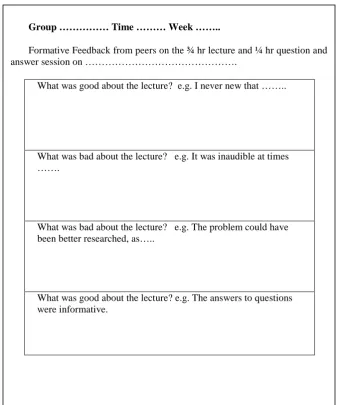
In addition to the groups’ summative peer assessment, at the end of each lecture, the student teachers received formative peer assessment from their peers, this was achieved by asking the audience to complete a feedback sandwich form, as shown in Fig. 7, these forms were collected, photocopied and issued to the students normally within two days. This feedback proved to be highly valued as in the majority cases provided the students with a constructive critique of their supplementary exercise, and reliable verifiable and valid source of feedback, as students commenting on similar issues. Also, the feedback proved to be timely as enabled the students’ act upon information within the course timescales. As students concerns are about the timing and the extent of feedback, failure on these criteria doesn’t provide them with the opportunity to reflect, develop and progress in their learning, Ref. 24.
of volunteers to develop and deliver the next sessions. In fact groups of students eyed up the topic they were most interested in and bid in advance (several weeks) if they could have that topic. As an exercise allowing the students gain independence of learning in area they were interested in a broad-based syllabus was a positive attribute of the exercise. As in previous years where the course has been academically taught different groups of students have typically commented that they wish the course had gone into depth about X, while others have wished for more on Y, with time, broad-based syllabus and new topics constraints it was not possible to satisfy all the students specific learning requirements. This exercise of supplementary teaching enables the students to volunteer as a group for their preferred topic of interest and learn it in depth.
However one discerning feature that occurred as the module progressed as students completed their supplementary teaching session they then ceased to attend the lecture course element of the module, and
Group ……… Time ……… Week ……..
Formative Feedback from peers on the ¾ hr lecture and ¼ hr question and answer session on ……….
What was good about the lecture? e.g. I never new that ……..
What was bad about the lecture? e.g. It was inaudible at times …….
What was bad about the lecture? e.g. The problem could have been better researched, as…..
[image:11.595.132.471.252.658.2]What was good about the lecture? e.g. The answers to questions were informative.
FIGURE 7
therefore failed to support their fellow peers during their exercise. The reason for the increasing poor attendance was that it coincided with escalating student work-loads, as other academics on different modules issued assessment briefs. Also, the another reason why the students ceased to attend was that they had identified an alternative resource for the same information, i.e. the e-learning facilities as contained electronic copies of lecture handouts, academic summaries of the lectures/topic and on-line question and answer sessions.
Also, in partial fulfillment of this module the students were required to complete a phase test at the end of the module to ascertain the student's level of learning and knowledge retention of every topic taught in the course. The phase test took the form of 50 e-multiple choice question test on the e-facilities (blackboard), each question consisted of 4 possible answers and typical 1 in every 5 questions were on a topic covered in the course. Each student was randomly presented with 25 multiply choice questions out of the possible 50 questions, so in theory in a class size of 73 no two students had the same set of 25 questions. The class average mark for the phase test was 61% and standard deviation of 12. These results highlight that the students ascertained a deep level of learning of module. However, multi-choice questions do produce higher success rate than other examination formats, as students find it easier to recognise a complex answer than construct one, Ref. 25. Also, previous studies, Ref. 26, indicate that a student’s multi-choice result does not necessarily correctly align with their understanding as a quarter questions are guessed correctly. Nonetheless, multi-choice examinations are ideal for assessing student’s factual knowledge of subject, Ref. 25, as in the case here ascertains what proportion of information the students have retained.
It should be noted, that despite the excellent phase test results, the level of learning in this case cannot be conclusively aligned with the information learnt from attending the lecture, as previously stated level of attendance decreased significantly throughout the semester. The level of learning must have been ascertained from wide variety of resources provided within the course i.e. student lectures, lecture-notes and e-information.
Further analysis of the phase test results however does prove the hypothesis that student supplemental instruction does provide an opportunity to achieve a higher level of learning, as the class average mark on an average of 2 questions relevant to a group’s lecture was 67% and standard deviation of 37 (large deviation due to the small number of questions to which the analysis was applied). Where as the class median of 61% and standard deviation of 13 was achieved for multi-choice questions not relevant to topics the students taught.
REFLECTION IN PRACTICE
The reflections of the students on designing the module are illustrated in Table 1. The feedback response rate was typically 64.4% per question. The feedback from students on the whole was positive, generally agreed that the exercise of designing the module plan was a success, it encouraged them to be actively in charge of their learning, and were not on the whole are not adverse to the doing the process again. On the basis of this feedback the method should be adopted again for this module and considered for other modules.
Observations made during the first lecture was that on the whole the students accepted the scenario, made sensible topic suggestions and rational decisions to the course structure, but some had their reservations, however it was the more mature students who were more willing to adopt this approach.
TABLE I
THE STUDENT’S REFLECTION ON DESIGNING THE MODULE
QUESTION STR
ONGL Y AGR E E AGR E E DI S AGR E E S T R ONGL Y DI S AGR E E DON’ T KNOW M AYB E C AN B E NE UT R AL
Did it empower you? 2 17 13 3 10 8 2
Did it give you a sense of being in charge of your learning? 2 18 13 3 10 6 2 Did it give you a sense of being in charge of defining what you wanted to learn? 1 20 13 4 8 7 1 Did you find it stressful? 2 14 20 2 6 8 2 Would you like to do it again? 1 14 14 5 10 7 1
Did you enjoy it? 1 16 18 4 9 6 1
Do you perceive the class derived an appropriate syllabus for the course? 0 24 7 5 8 7 0 Would you like to repeat designing a course content in other modules? 3 17 12 3 11 6 3 1 Do you feel it encouraged you to becoming more active participant member of the
module, oppose to being passive (only receiving and being lead by the others and the academic)?
3 21 6 5 8 10 3
Was it helpful? 0 23 10 5 9 6 0
Do you feel students should not design modules? 6 11 11 5 8 11 6 1
Supplementary Teaching
additional support, whether this in the form continuing the lecture, promoting question and answer session both in the lecture and on-line, providing summaries of the lectures on-line and delivering final summary lecture on the course content. Which is consistent with early feedback in the course from student year representative meeting, Ref. 27:
“The unit contents are fine. It was commented by the tutor that that the student seminars would help
students to learn information relevant to the topic and allow students to be confident in presenting technical
materials. It was recommended that after the students' seminars the main points are highlighted by the tutor.“
[image:14.595.79.517.369.723.2]Importantly these results show that the students like to volunteer for a topic, as they tackle a subject on their terms and something they are interested in. On numerous occasions during the module, students volunteered several weeks in advance (more than two weeks normally allocated) for a particular subject in order to ensure they got their preferred choice of topic.
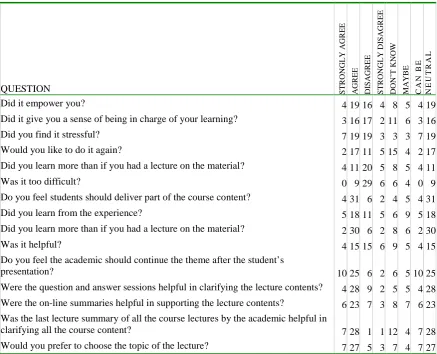
TABLE 2
The Student’s Reflection on Teaching
QUESTION STR
ONGL Y AGR E E AGR E E DI S AGR E E S T R ONGL Y DI S AGR E E DON’ T KNOW M AYB E C AN B E NE UT R AL
Did it empower you? 4 19 16 4 8 5 4 19
Did it give you a sense of being in charge of your learning? 3 16 17 2 11 6 3 16 Did you find it stressful? 7 19 19 3 3 3 7 19 Would you like to do it again? 2 17 11 5 15 4 2 17 Did you learn more than if you had a lecture on the material? 4 11 20 5 8 5 4 11
Was it too difficult? 0 9 29 6 6 4 0 9
Do you feel students should deliver part of the course content? 4 31 6 2 4 5 4 31 Did you learn from the experience? 5 18 11 5 6 9 5 18 Did you learn more than if you had a lecture on the material? 2 30 6 2 8 6 2 30
Was it helpful? 4 15 15 6 9 5 4 15
Do you feel the academic should continue the theme after the student’s
presentation? 10 25 6 2 6 5 10 25
Were the question and answer sessions helpful in clarifying the lecture contents? 4 28 9 2 5 5 4 28 Were the on-line summaries helpful in supporting the lecture contents? 6 23 7 3 8 7 6 23 Was the last lecture summary of all the course lectures by the academic helpful in
In conclusion the feedback from the students on the whole is positive about supplementary instruction by their peers.
Peer Assessment
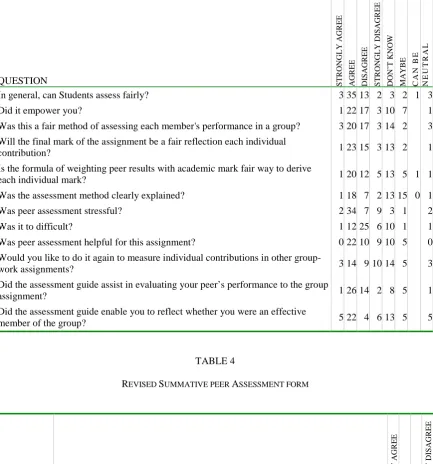
The reflections of the students on summative peer assessment are illustrated in Table 3. The feedback response rate was typically 72.8% per question. The questionnaire results illustrate that the majority of the students were positive about the summative assessment, in that it is fair and appropriate method assessment for this exercise and they are not averse to doing it again. Importantly the students believe that it did provide them with an opportunity to reflect on their own performance within the group.
However the comments made by the students still allay usual fears of peer assessment:
“It is very difficult to fairly assess those you have worked with. We are all human and emotion can often
get in the way of expressing the truth”
“Depends on the individuals some are too immature”
“Peers tend to favor people they know over the people they don’t and be more lenient on people they know”
“If used again could do with more limited choices, e.g. 1 to 3 with each described, as people awarded
different levels of marks all the way through, therefore making some people marking weighed more”
The student comments re-enforce need to ensure the groups randomly mixed, if possible bringing a group of strangers together. Ideally encourage the students to mix socially prior to embarking on the task, so that relationships can be established on a non-competitive/academic level. Also it is important for the academic to clearly explain to the students the purpose of the peer and self-assessment, that is it is an opportunity to truly reflect upon each individuals performance (terms of effort and contribution) to the group assignment. Also reassure the students that a proportion of the work will be moderated, all erroneous peer assessment will be discarded upon discussion with the course moderator and groups with inconsistent peer assessment results will be interviewed to ascertain a truer picture of the group dynamics and individual performances.
TABLE 3
THE STUDENT’S REFLECTION ON THE PEER ASSESSMENT
QUESTION STR
ONGL Y AGR E E AGR E E DI S AGR E E S T R ONGL Y DI S AGR E E DON’ T KNOW M AYB E C AN B E NE UT R AL
In general, can Students assess fairly? 3 35 13 2 3 2 1 3
Did it empower you? 1 22 17 3 10 7 1
Was this a fair method of assessing each member's performance in a group? 3 20 17 3 14 2 3 Will the final mark of the assignment be a fair reflection each individual
contribution? 1 23 15 3 13 2 1
Is the formula of weighting peer results with academic mark fair way to derive
each individual mark? 1 20 12 5 13 5 1 1
Was the assessment method clearly explained? 1 18 7 2 13 15 0 1 Was peer assessment stressful? 2 34 7 9 3 1 2
Was it to difficult? 1 12 25 6 10 1 1
Was peer assessment helpful for this assignment? 0 22 10 9 10 5 0 Would you like to do it again to measure individual contributions in other
group-work assignments? 3 14 9 10 14 5 3
Did the assessment guide assist in evaluating your peer’s performance to the group
assignment? 1 26 14 2 8 5 1
Did the assessment guide enable you to reflect whether you were an effective
[image:16.595.79.518.528.730.2]member of the group? 5 22 4 6 13 5 5
TABLE 4
REVISED SUMMATIVE PEER ASSESSMENT FORM
QUESTION STR
ONGL Y AGR E E AGR E E DI S AGR E E S T R ONGL Y DI S AGR E E Problem Identification
CONCLUSION
Prior to analysis of the questionnaires the exercise was perceived as flawed and not a success, this was concluded from information received in the student representative meeting and feedback from the more vocal members of the course. However the questionnaire results illustrate that the more vocal students who didn’t like the approach were in the minority. In conclusion student driven module’s plan and supplementary instruction should be applied again to this module and other modules, in conjunction with other methods of learning in assist the audience’s learning and retention. In particular the use of e-learning facilities provided an effective alternative learning resource for all the students.
The exercise illustrated that students can effectively and rationally drive a module within the right framework that is to provide/develop a solution to a problem. The resulting module design meets their learning needs and courses requisites in the form of the learning outcomes of the module. Students are willing to adopt the problem-solving framework, i.e. in this case company’s reorganization scenario and continue with the scenario throughout the module time span.
Supplementary instruction is only effective if supported with an effective question and answer session in the lecture or on-line, academic e-summaries and a final summary lecture by an academic.
Peer summative and formative assessment provided an effective means of providing timely and detailed feedback to the student lecturers and opportunity for the students to reflect upon their lecture. In future the process of summative peer assessment could be further enhanced by asking the students not to grade themselves and their peers, but define whether one and another had completed the required component or not and to what level. This approach would provide the opportunity for the students to truly reflect upon each individual’s performance rather than focusing on deriving individual marks, as was the case in this experiment.
It is also worth noting from the student feedback and observations made during this experiment, the random mixing of the groups between degree courses, ethnicity certainly removed cliques and friends. This approach encouraged a strong work ethic amongst the students, as were more willing to demonstrate to strangers that they were hard working than to their friends. As previous observations in other modules using group work, consisting of students friends resulted in a farce. The random mixing of students would be further enhanced if the students were encouraged prior to being assigned a supplementary instruction exercise to mix socially in order to establish relationships on non-competitive and academic level.
key skills. The role of the academic throughout the module was facilitator as opposed to teacher, was there to question their perceptions and provide guidance where necessary. However there is need to reassure student fears of peer assessment and adopt reference Ref. 13 strategy for best peer assessment practice. Also, there is a need to remind students that they will not necessarily get on with everyone in the group, but they need to appreciate each other and overcome their differences in order to get the job done, as in the commercial sector.
A future improvement to module in order to improve attendance would be to incorporate a more patchwork text approach, where by link all the module assignments within the module design and instruction framework to produce a related portfolio, for example;
1. company’s lecture to meet the teaching requirements to produce the organization’s web engineers 2. e-summary of a topic to also meet the organization’s educational needs
3. research, design and maintain a component section of the company’s web site 4. company’s phase test assessment of each individual’s learning
As patchwork texts promote personal journeys of exploration and discovery, Ref. 28, which is consistent with ethos of supplementary instruction.
REFERENCES
1. P. Ramsden, ‘Learning to teach in Higher Education’ (Routledge: London and New York, 1992)
2. H. Fry, S. Ketteridge & S. Marshall, ‘Handbook for teaching in Higher Education enhancing academic practise’, (Kogan Page: London, 2001)
3. J. J. Powell, ‘Reducing Teacher Control’, in D. Boud (ed), Developing Student Autonomy in Learning, (Kogan Page: London, 1998), pp. 109-118
4. D. A. Kolb, ‘Experiential Learning’, (Prentice-Hall: New Jersey, 1984)
5. R. Rockland ‘Utilization of pre and post assessment testing for reinforcing learning processing in ECET courses’, in Proc. International conference on Engineering Education Norway, 2001, pp. 6E7-13-6E715
6. N. Parker, ‘Student learning as information behavior: exploring Assessment Task Processes’, Information Research, 6, (2001), 2
8. N. Entwistle, ‘Contrasting Perspectives on Learning’, in Marton, F., Hounsell, D. & Entwistle, N. (eds), The Experience of Learning, 2nd ed. (Edinburgh: Scottish Academic Press, 1997)
9. J. Wallace, ‘Supporting and guiding students’, in Fry, H., Ketteridge, S. & Marshall, S. (eds), Handbook for teaching in Higher Education enhancing academic practise, (Kogan Page: London , , 2001), pp. 182
10. M. A. Mooney & P. J. Mooney, ‘A student teaching-based instructional Model’, Int. J. Eng. Educ., 17, (2001), 1, pp. 10-16
11. J. Mills, ‘Improving the effectiveness of formative assessment in Science’, (Sheffield Hallam University Learning Teaching and Assessment Conference: Sheffield, UK, 2003)
12. W. Sher, ‘Case Study:- Peer Assessment’, http://cebe.cf.ac.uk/innovations/case-studies/csexemplar.pdf, (2001)
13. A. Nortcliffe, S. Featherstone, R. Garrick, R. & G. Swift, ‘Student engineers: lecturing, teaching and assessing’ in Proc. Int. Conf. on Engineering Education Manchester, 18-21 Aug. 2002 (International Network for Engineering Education and Research, UK, 2002)
14. C. Mindham , ‘Peer assessment: Report of a project involving group presentations and assessment by peers’ in S. Brown (ed.), Peer Assessment in Practise, (Staff Education Development Association (SEDA), Scotland, 1998)
15. A. Conant, ‘Every Student a Teacher: Peer Assessment’,
http://www.umcs.maine.edu/~orono/collaborative/spring/every.html, (1997)
16. N. Falchikov, ‘Involving students in feedback and assessment: a report from the Assessment Strategies in Scottish Higher Education (ASSHE) Project’, in S. Brown (ed.), Peer Assessment in Practise,(Staff Education Development Association (SEDA), Scotland, 1998)
17. C. Watkins, ‘Feedback Between Teachers’, in S. Askwew (ed.), Feedback for Learning, (Routledge, London, 2000), pp. 34-44
19. A. L. Nortcliffe, S. Featherstone, R. Garrick and G. Swift, ‘Supplemental Instruction a Higher Level Learning?’, in W Aung, M. W. H. Hoffmann, N. W. Jern, R. W. King and L. M. S. Ruiz, (ed.), Engineering Education and Research – 2002: A Chronicle of Worldwide Innovations, (International Network for Engineering Education and Research, USA, 2003) , 30
20. A. Dohrenwend, ‘Serving up the feedback Sandwich’, Family Practice Management, November/December, (2002), pp. 43-46
21. P. Ramsden, ‘Current challenges to quality in higher education’, Innovative Higher Education, 18, (1994), 3, pp. 177-187
22. A. King, ‘Structuring peer interaction to promote high level cognitive processing’, Theory in Practice, 41, (2002), 1, pp. 33-40
23. S Donohoe, M. Parker, S. Turpin-Brooks, and P. Murray, ‘Deep Learning in Engineering Analysis - A Reflective Practitioner Approach’, in Proc. Int. Conf. on Engineering Education Manchester, 18-21 Aug. 2002 (International Network for Engineering Education and Research, UK, 2002)
24. A. Mutch, ‘Exploring the practice of feedback to students’, Active Learning in Higher Education, 4, (2003), 1, pp. 24-38
25. R. Caygill, and L. Eley, ‘Evidence abut the effects of assessment task format on student achievement’, in Proc. Conf. of the British Educational Research Association, 13-15 Sept. 2001, (Leeds University, 2001), http://www.leeds.ac.uk/educol/documents/00001841.html
26. M. A. Clements and N. F. Ellerton, ‘Assessing the effectiveness of pencil and paper tests for school of mathematics’, Proc. 18th Nat. Conf. of the Mathematics Education Research Group of Australia, (University of the Northern Territory, Darwin, 1995)
27. R. Saatchi, ‘Minutes of Staff/Student 2nd year HND/BSc CNE, CN and BNE Degree Course Committee Meeting’, personal communication, (2002)