http://wrap.warwick.ac.uk/
Original citation:Hansen, Stephen and McMahon, Michael F. (2013) Estimating bayesian decision problems with heterogeneous priors. Working Paper. Coventry, UK: Department of Economics, University of Warwick. (CAGE Online Working Paper Series).
Permanent WRAP url:
http://wrap.warwick.ac.uk/59197
Copyright and reuse:
The Warwick Research Archive Portal (WRAP) makes this work of researchers of the University of Warwick available open access under the following conditions. Copyright © and all moral rights to the version of the paper presented here belong to the individual author(s) and/or other copyright owners. To the extent reasonable and practicable the material made available in WRAP has been checked for eligibility before being made available.
Copies of full items can be used for personal research or study, educational, or not-for-profit purposes without prior permission or charge. Provided that the authors, title and full bibliographic details are credited, a hyperlink and/or URL is given for the original metadata page and the content is not changed in any way.
A note on versions:
The version presented here is a working paper or pre-print that may be later published elsewhere. If a published version is known of, the above WRAP url will contain details on finding it.
WORKING PAPER SERIES
Centre for Competitive Advantage in the Global Economy
Department of Economics
March 2013 No.127
Estimating Bayesian Decision Problems with
Heterogeneous Priors
Stephen Hansen and Michael McMahon
Estimating Bayesian Decision Problems with
Heterogeneous Priors
∗
Stephen Hansen
Universitat Pompeu Fabra
Barcelona GSE
[email protected]
Michael McMahon
University of Warwick
CAGE, CEP (LSE), and CAMA (ANU)
[email protected]
March 1, 2013
Abstract
In many areas of economics there is a growing interest in how expertise and preferences drive individual and group decision making under uncertainty. Increas-ingly, we wish to estimate such models to quantify which of these drive decision making. In this paper we propose a new channel through which we can empiri-cally identify expertise and preference parameters by using variation in decisions over heterogeneous priors. Relative to existing estimation approaches, our “Prior-Based Identification” extends the possible environments which can be estimated, and also substantially improves the accuracy and precision of estimates in those environments which can be estimated using existing methods.
Keywords: Bayesian decision making; expertise; preferences; estimation.
JEL Codes: D72, D81, C13
∗We would like to thank, without implicating, Greg Crawford and Carlos Velasco Rivera for
1
Introduction
How individuals and groups of individuals make decisions under uncertainty is important
in many areas of economics and political economy, and there are several areas in which
theoretical models emphasize that decision makers differ both in terms of their knowledge
of an underlying state of the world and their preferences.1 Increasingly, we would like
to bring such models to the data in order to estimate the decision-making parameters
and understand, quantitatively, the role played by different factors in decision making in different contexts. Important recent work by Iaryczower and Shum (2012) - MIMS2
hereafter - provides a two-step methodology to estimate decision parameters for groups
of contemporaneously-serving experts that relies on how decisions vary across states of
the world drawn from a given prior distribution (“State-Based Identification”). Our
contribution in this paper is to highlight another important channel through which an
econometrician can empirically identify the decision-making parameters in a Bayesian
decision problem: by using variation in decision-making behavior over heterogeneous
priors (“Prior-Based Identification”).3
We first present a binary choice model of Bayesian decision making in order to il-lustrate how decision makers with different preferences and/or expertise have different
probabilities of choosing one decision (instead of the other). Let the choices be between
option 0 and option 1. Our identification can informally be understood by considering
that becoming more inclined toward choosing option 1 (a change in preferences toward
1) will cause the probability of choosing 1 to increase for all values of the prior belief (a
“shift” in their probability of choosing 1), while decision makers with more expertise will
have a lower probability of choosing 1 when the prior favors that choice, but a higher
probability of choosing 1 when the prior favors option 0. This “rotation” is driven by
the fact that decision makers with more expertise rely more on their own view rather
than the prior. It is this distinction between “shifts” and “rotations” which facilitates Prior-Based Identification.
This new channel of identification has two implications that we explore in this paper.
The first is that preference and expertise parameters are identifiable without the need for
contemporaneous correlation in decisions. This opens up to empirical testing a broader
set of decision-making environments than that recognized by MIMS. For example, we
1For example, see the literatures on the career concerns of experts (Sorensen and Ottaviani 2000);
committee decision making (Gerling, Gruner, Kiel, and Schulte 2005); politicians’ behavior (Besley 2006); and social learning (Banerjee 1992, Bikhchandani, Hirshleifer, and Welch 1992).
2Standing for Matias Iaryczower and Matt Shum to avoid potential confusion generated by simply
using IS.
3Another related paper is Li (2012) which proposes a way of separately identifying preferences from
show using Monte Carlo simulations that we can estimate the parameters of a single
decision maker serving over time using noisy measures of the prior.4
The second implication is to show that the specification of MIMS to estimate
decision-making parameters for individuals within groups is incomplete as it does not allow
dif-ferent individuals to react difdif-ferently to changes in the common prior. We argue
theo-retically that this omission should be particularly problematic when decision makers are
more heterogeneous in terms of their expertise. We then show, again using Monte Carlo
simulations, that adopting a more flexible specification that allows for both sources of
identification substantially improves the accuracy of individual estimates when there is
non-negligible expertise heterogeneity. Of particular note is that estimated differences between individuals in terms of preferences, and especially expertise, are inflated by the
failure to account for Prior-Based Identification; the bias using the less flexible
specifica-tion is in the range of 60-90% for reasonable differences in expertise.
To confirm the relevance of the Monte Carlo simulation exercises, we analyze the
Supreme Court data used in MIMS and compare the results obtained using our proposed
specification with the original MIMS specification. In line with the predictions from our
Monte Carlo analysis, using our proposed specification reduces, in some cases markedly,
the dispersion of the distribution of the estimated individual parameters. While we
do not claim, nor attempt, to overturn MIMS’ key result that private signals play an important role in decision making, our results suggest that researchers interested in the
level of decision-making parameters, or comparisons between members, would be better
served by using both State- and Prior-Based Identification.5 In a closely-related paper
(Hansen, McMahon, and Velasco 2013), we, together with a co-author, make use of the
identification channel described in this paper to explore the extent and implications of
heterogeneity in preferences and expertise for policymakers on the Bank of England’s
Monetary Policy Committee (MPC).
2
Theory
In this section, we present the theory underlying the Bayesian decision-making model we
(and MIMS) consider and discuss two alternative ways of identifying preference
param-eters separately from those of of expertise; one is the identification proposed in MIMS
4This is in contrast to MIMS who claim that “if there were only one decision maker, for example, it
would not be possible to disentangle the independent effects of ideology and information.”
5For example, Iaryczower, Lewis, and Shum (2013) compare the expertise of elected and appointed
judges using State-Based Identification and the MIMS estimator, whereas our results suggest the es-timates from an alternative specification incorporating Prior-Based Identification would allow a more accurate comparison.
while the other is our proposal. We discuss how the channel of identification that we
propose differs and when it is likely to be important.
2.1
Single decision maker
Consider a single decision maker DM who must take some binary decision dt∈ {0,1} at
timet. Her utilityu(dt |ωt) fromdt depends on a binary, unobserved state variableωt∈
{0,1}drawn from a prior distribution with Pr [ωt = 1 ] =qt. We assume that DM always
prefers to match the decision to the state; i.e., that u(dt =ωt |ωt)−u(dt 6=ωt|ωt)>0
for ω∈ {0,1}.
Before choosing dt, DM observes a signal st ∼ N(ωt, σ2). σ is an inverse measure of
expertise in the sense that when DM has a lowerσ, stprovides a more informative signal
of the unknown state. DM chooses dt = 1 only if she is sufficiently convinced of ωt = 1.
Formally, conditional onst, DM chooses dt= 1 if and only if
Pr [ωt= 1 |st]
Pr [ωt= 0 |st]
≥ u(0|0)−u(1|0) u(1|1)−u(0|1) ≡
1−θ
θ . (1)
When DM views the wrong decision in state 0 as relatively worse than the wrong decision
in state 1, she requires more evidence that the state is 1 in order to choose dt= 1. The
parametrization in terms ofθ is a common convention in the theoretical voting literature
that we adopt for our empirical exercise. We shall refer to θ as DM’s preferences.
Applying Bayes’ Rule and manipulating the normal density gives the relationship
ln
Pr [ωt= 1 |st]
Pr [ωt= 0 |st]
= ln
qt
1−qt
+2st−1
2σ2 . (2)
An examination of (2) reveals a key relationship between signal precision and posterior
beliefs: when DM has more expertise (a lowerσ), she puts more weight on her signal and
less weight on the priorqtin forming her posterior distribution over states. So, intuitively
speaking, the prior is less influential in determining her decision. In the limit as σ →0,
qt is irrelevant for determining dt, while as σ→ ∞, qt alone determines it.
To make these arguments more formally, note that (1) and (2) imply that DM adopts
a threshold decision-making rule in which she chooses dt= 1 high whenever
st≥
1 2−σ
2
ln
θ 1−θ
+ ln
qt
1−qt
So, the probability she chooses dt = 1 in stateωt is
P(qt, ωt, θ, σ)≡Pr [dt = 1|qt, ωt, θ, σ] = 1−Φ
s∗t(θ, σ, qt)−ωt
σ
. (4)
The following limit arguments are useful for understanding how variation in the prior
probability generates differential responses in P(qt, ωt, θ, σ) depending on the DM’s
un-derlying preference and expertise parameters.
Proposition 1
1. limσ→0Pr [dt= 1|ωt, θ, σ, qt] =1(ωt).
2. limσ→∞Pr [dt= 1 |ωt, θ, σ, qt] =1(qt ≥1−θ).
3. limθ→0Pr [dt= 1 |ωt, θ, σ, qt] = 0 ∀qt ∈(0,1).
4. limθ→1Pr [dt= 1 |ωt, θ, σ, qt] = 1 ∀qt ∈(0,1).
This proposition, proven by simply taking limits ofP(qt, ωt, θ, σ), illustrates that large
differences in expertise can generate very different responses to changes in the prior. In
either state, asσ gets sufficiently small, Pr [dt = 1|ωt, θ, σ, qt] is essentially unresponsive
to the prior: DM always “knows” the state and simply chooses the decision to match it (from part 1 of the proposition). In contrast, as σ gets sufficiently high, small changes
in the prior can generate very large changes in decision making. In both states, when
the prior moves from just below 1−θ to just above it, the probability of choosingdt= 1
high jumps from close to 0 to almost 1 (from part 2 of the proposition). On the other
hand, large θ differences do not manifest themselves in terms of different responses to
changes in prior (from parts3 and4 of the proposition). As preferences become extreme
on either end of the (0,1) interval, decision-making behavior becomes unresponsive to
changes in the prior, because DM always selects whatever decision corresponds to her
extreme preferences.
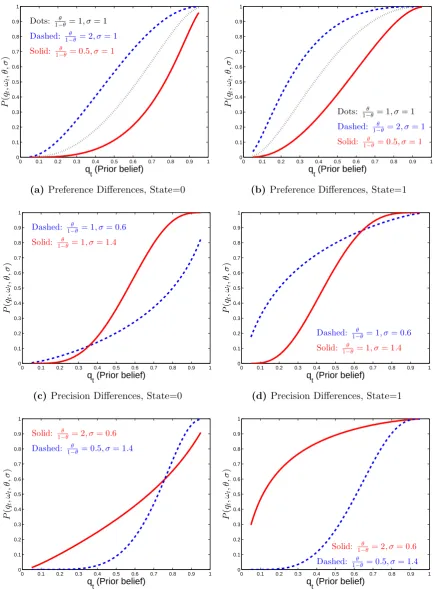
These limit arguments suggest that a useful way of distinguishing the effects of changes
in the parameters is to think about changes in θ as shifting P, while changes inσ cause
P to rotate.6 Of course, P is non-linear and its range is (0,1) on q
t ∈ (0,1) and so
these statements are only heuristically true. Nevertheless, as we show in figure 1, they
are by and large correct for reasonable parameter values and non-extreme values for
the prior; each sub-figure shows P plotted over qt ∈ (0.01,0.99) with the first (second)
column capturing P conditional on the state being 0 (1), and each row shows different
6Whenσ changes in the interior of the parameter space, one can formally show that there exists a q∗(ω
t, θ, σ) in the neighborhood of whichP flattens when σdecreases.
combinations of parameter values. The first (second) row illustrates the situation in which
decision makers differ only by preferences (expertise); the final row shows a situation in
which both preferences and expertise differ.
These observations lead to our first claim:
Claim 1 Different behavioral responses to changes in the prior, qt, can be used to
em-pirically distinguish preferences, θ, from expertise, σ.
We show using Monte Carlo simulations in section 3 that this claim holds.
2.2
Several decision makers
While so far we have focused on a single decision maker, in many applications of
inter-est N ≥ 2 decision makers (who we will hereafter index by i, and each of whom are characterized by θi and σi) must take binary decisions dit, and all of their utilities are
affected by the realization of the same state variable ωt. For example, one might have
panel data on the buy/hold (or sell/hold) recommendations of equity analysts, and wish
to estimate the expertise of each analyst separately from his or her inclination towards
one alternative.
With such data MIMS argue that θi and σi are separately identifiable for a given
prior via unconditional correlation in decisions. Those with high expertise have observed
decisions that are highly correlated and on average in line with the prior, while those
with less have observed variability in their decisions but are in the minority relatively frequently. Moreover, a large bias is identified via low variability in decisions, which tend
to conform to the bias.
MIMS also argue that one should control for period-t characteristics when applying
their identification strategy. Within this decision-making model, though, the only reason
that the characteristics of a certain time period are relevant is if different periods have
different associated values of the prior qt. And, as we have discussed, whenever different
periods have different priors, one can exploit members’ differential responses to changes
in those priors to better identify whether they differ in terms of preferences or
exper-tise. While the estimator that MIMS construct (and which we discuss below in section 3) indeed incorporates period-t controls, it does not allow different members to react
differently to changes in those controls, thus shutting down the prior-based identification
channel.
One would expect the failure to account for differential responses to changes in the
prior to be particularly problematic when members differ in terms of expertise. As
0 0.1 0.2 0.3 0.4 0.5 0.6 0.7 0.8 0.9 1 0 0.1 0.2 0.3 0.4 0.5 0.6 0.7 0.8 0.9 1 q
t (Prior belief)
P ( qt , ωt , θ , σ ) Dots: θ
1−θ= 1,
σ= 1
Dashed: θ 1−θ= 2,
σ= 1
Solid: θ 1−θ= 0.5,
σ= 1
(a)Preference Differences, State=0
0 0.1 0.2 0.3 0.4 0.5 0.6 0.7 0.8 0.9 1 0 0.1 0.2 0.3 0.4 0.5 0.6 0.7 0.8 0.9 1 q
t (Prior belief)
P ( qt , ωt , θ , σ ) Dots: θ
1−θ= 1,
σ= 1
Dashed: θ 1−θ= 2,
σ= 1
Solid: θ 1−θ= 0.5,
σ= 1
(b)Preference Differences, State=1
0 0.1 0.2 0.3 0.4 0.5 0.6 0.7 0.8 0.9 1 0 0.1 0.2 0.3 0.4 0.5 0.6 0.7 0.8 0.9 1 q
t (Prior belief)
P ( qt , ωt , θ , σ ) Dashed: θ
1−θ= 1, σ= 0.6
Solid: θ 1−θ = 1,
σ= 1.4
(c)Precision Differences, State=0
0 0.1 0.2 0.3 0.4 0.5 0.6 0.7 0.8 0.9 1 0 0.1 0.2 0.3 0.4 0.5 0.6 0.7 0.8 0.9 1 q
t (Prior belief)
P ( qt , ωt , θ , σ ) Dashed: θ
1−θ= 1, σ= 0.6
Solid: θ 1−θ= 1,
σ= 1.4
(d) Precision Differences, State=1
0 0.1 0.2 0.3 0.4 0.5 0.6 0.7 0.8 0.9 1 0 0.1 0.2 0.3 0.4 0.5 0.6 0.7 0.8 0.9 1 q
t (Prior belief)
P ( qt , ωt , θ , σ ) Solid: θ 1−θ = 2,
σ= 0.6 Dashed: θ
1−θ= 0.5, σ= 1.4
(e) Preference and Precision Differences, State=0
0 0.1 0.2 0.3 0.4 0.5 0.6 0.7 0.8 0.9 1 0 0.1 0.2 0.3 0.4 0.5 0.6 0.7 0.8 0.9 1 q
t (Prior belief)
P ( qt , ωt , θ , σ ) Solid: θ 1−θ= 2,
σ= 0.6 Dashed: θ
1−θ= 0.5, σ= 1.4
[image:9.595.80.515.80.670.2](f ) Preference and Precision Differences, State=1
Figure 1: Distinguishing Preferences versus Precisions
the most extreme possible (say σA→0 and σB → ∞), memberA is totally unresponsive
to the prior while member B has a near infinitely high response to changes in prior
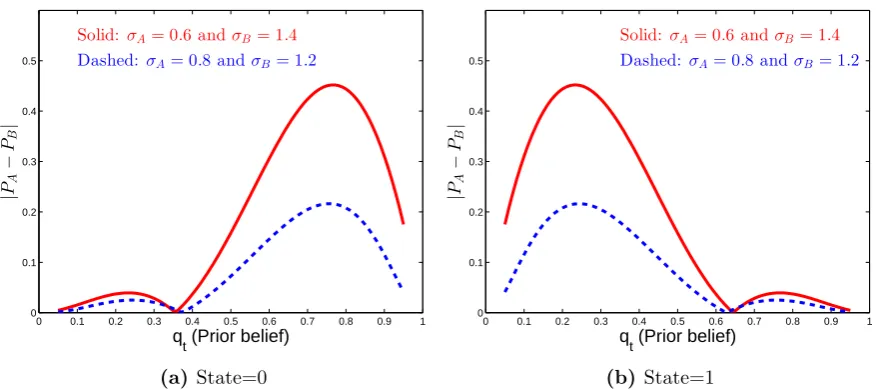
around 1−θ. In terms of less extreme differences, figure 2 shows how differences in the
probability of choosing dt = 1 grow faster over intermediate values of the prior when
differences in σ grow. These observations lead to our second claim:
Claim 2 Controlling for member-specific reactions to changes in qt is more important
for identification of θ and σ differences the larger are σ differences.
In section 3 below, we show that this claim is true.
0 0.1 0.2 0.3 0.4 0.5 0.6 0.7 0.8 0.9 1 0
0.1 0.2 0.3 0.4 0.5
q
t (Prior belief)
|
PA
−
PB
|
Solid: σA= 0.6 andσB= 1.4
Dashed: σA= 0.8 andσB= 1.2
(a) State=0
0 0.1 0.2 0.3 0.4 0.5 0.6 0.7 0.8 0.9 1 0
0.1 0.2 0.3 0.4 0.5
q
t (Prior belief)
|
PA
−
PB
|
Solid:σA= 0.6 andσB= 1.4
Dashed: σA= 0.8 andσB= 1.2
[image:10.595.79.518.245.440.2](b) State=1
Figure 2: Differences in the Probability of Voting High by State
Notes: These figures show the difference in the theoretical probability that different types of member choose the high decision as a function of the prior belief. In both casesθA =
θB = 0.5. The different curves represent different differences in the expertise parameter between the members being considered to show how different members react differently to changing priors depending on the gap in their expertise.
We emphasize that we do not challenge the basic identification argument of MIMS,
but simply wish to point out that it holds for a fixed prior and exploits differences across
states; instead our idea relies on holding fixed a state and exploits differences in the prior.
Of course, in actual time-serious data one cannot usually perfectly identify the prior nor
the state, so an ideal estimation approach would allow for both sources of identification.
To do so, we propose an alternative specification of MIMS’ estimator in section 4, which
we have applied in Hansen, McMahon, and Velasco (2013).
Before proceeding, it is important to discuss another natural model in which several
Indeed, although their estimator has broader applicability, this is precisely the model
that MIMS use to motivate their work. The model we have developed so far is directly
applicable to committee voting models if members votesincerely; that is, they behave as
if they get utility from matching their vote to the state. In this case, each member votes
high (dit = 1) whenever sit ≥s∗it(θi, σi, qt), as described in (3).
However, if they behave as if they get utility from the committee decision, regardless
of what they voted for, and are fully rational, they vote strategically and condition their
vote on the probability of changing the decision, or, in the language of jury models, on
being pivotal. Although the strategic model is more consistent with economic rationality,
the complexity of computing the probability of being pivotal in heterogeneous committees of even modest size under majority is daunting.7 Rather than undergo such elaborate
reasoning, committee members may simply follow the rule of voting for whichever
al-ternative they feel most is most likely to match the state. Also, committee designers
sometimes explicitly encourage members to behave sincerely, such as the Bank of
Eng-land, which tells members of its Monetary Policy Committee to “vote to set interest rates
at the level they believe is consistent with meeting the inflation target.” For this reason,
we feel comfortable interpreting our results as relevant for committee voting in addition
to other applications.8
3
A New Econometric Methodology to Estimate
In-dependent Decision Data
We begin with an analysis of the case in which there is only variation in the prior that
allows us to identify the decision parameters. This is a particularly interesting starting
point because it allows us to isolate the effect of our Prior-Based Identification from
State-Based Identification. To do this, we focus on estimating the case of a single independent decision maker who acts repeatedly over time; for example, consider a Governor of a
central bank who is in sole-charge of making interest-rate decisions such as at the Reserve
Bank of New Zealand. This approach also allows us to compare multiple decision makers
operating independently at potentially different points in time.
7For example, in a nine person committee, each member is pivotal in 70 different events—the number
of ways the eight other members can split evenly between voting for 0 and 1. Additionally, within each of these events, the voter must compute the ratios of the probabilities of having arrived at that event in states 1 and 0.
8We have also run all simulations under a strategic-voting scenario and generally found the results,
including the baseline MIMS specification, so much noisier than for the sincere case that comparing across specifications was difficult. As such, we don’t present the results here but they are available on request.
Being able to estimate in such an environment requires one to find good (though not
perfect) proxies for the prior because it is not possible to separately estimate the prior
qt (or, econometrically speaking, the mixing probability). Using data to proxy for the
prior probability (bqt), we can directly estimate the parameters from the model-implied
likelihood function LDM
t over the timet decision.
LDMt =qt
1−Φ
s∗t(·)−1 σ
dt
Φ
s∗t(·)−1 σ
1−dt
+
(1−qt)
1−Φ
s∗t(·)−1 σi
dt
Φ
s∗t(·) σ
1−dt (5)
In order to test this approach, we carry out the following Monte Carlo exercise:
1. Consider a single DM characterized by σ and θ
2. For each of 200 decisions, qt is drawn from U[0.2,0.8] (independent across periods)
3. ωt is drawn from a Bernoulli distribution with Pr [ωt= 1 ] =qt
4. dt is drawn from a Bernoulli distribution with Pr [dt= 1 ] = 1−Φ s∗
t−ωt σ
where
Φ is the normal cdf and s∗t is DM’s “critical” threshold defined in (3).
5. Generate a proxy ˆqt=qt+εt where εt∈U[−x, x] forx∈ {0,0.05,0.1}
6. Plug in dt and ˆqt into (5); maximize the corresponding log-likelihood over σ and θ;
store values
7. Repeat 1,000 times.
We also explore a simulation with multiple independent decision makers. That is, we
modify the above procedure to allow the first 100 decisions to be made by decision maker A, and the second 100 decisions to be made by B; A and B differ in both their preference
and expertise parameters. We modify the log-likelihood by allowing the parameters to
vary depending on the decision maker we are analyzing.
The results of these simulations are reported in table 1. Although decisions are
in-dependent across time and do not exploit State-Based Identification, we generally get
reliable estimates if our proxy is sufficiently correlated with the true prior. For example,
when bqt has ±0.05 noise, which we regard as a good proxy, the biases are in the range of
3%-7%. This shows that in order to implement this estimator, it is simply necessary to
find data that correlates well with the the probability of the high state having been real-ized. For example, if studying the behavior of an independent central banker, it would be
favoring higher (rather than lower) interest rates. Our results also show that as the level
of noise increases (decreases) the performance of our estimator deteriorates (improves).
Moreover, for the multiple decision maker case, our approach correctly ranks the different
decision-makers’ parameters for the vast majority of cases.
4
Incorporating Prior-Based Identification into MIMS’s
Estimator
In the case of multiple decision makers within a given time-period, one must allow for
the correlation of decisions withintand so the periodt likelihood of observing the vector
of decisions dt becomes:
LM Dt =qt Y
i
1−Φ
s∗it(·)−1 σi
dit
Φ
s∗it(·)−1 σi
1−dit
+
(1−qt) Y
i
1−Φ
s∗it(·)−1 σi
dit
Φ
s∗it(·) σi
1−dit (6)
MIMS rewrite (6) as
qt Y
i
(κ1it)dit(1−κ1it)1−dit+ (1−qt) Y
i
(κ0it)dit(1−κ0it)
1−dit (7)
where κ1it ≡ 1−Φ s∗
it(·)−1
σi
and κ0it ≡ 1−Φ s∗
it(·) σi
are the probabilities of deciding
dit = 1 in states 1 and 0. They then model qt and the κ terms as functions of observed
covariates (potentially time-varying individual characteristicsXitand time characteristics
Zt) as follows:
qt =
exp (α·Zt)
1 + exp (α·Zt)
(8)
and
κ0it =
exp (β0·Xit+β1·Zt)
1 + exp (β0 ·Xit+β1·Zt)
κ1it =
κ0it+ exp (γ0·Xit+γ1·Zt)
1 + exp (γ0·Xit+γ1·Zt)
. (No PBI)
The reduced form specification in (No PBI) imposes the restriction that all members,
regardless of their underlying heterogeneity, respond to changes in the time specific vari-ables that capture the prior in the same way. As we point out in section 2 above, members
with different signal precisions will react differently to changes in the prior. But in this
specification there is no Prior-Based Identification, hence the No PBI label.
In order to capture this potentially important channel of identification, we adopt the
following more flexible functional forms for theκ terms that include interactions between
time and individual characteristics:9
κ0it=
exp (β0·Xit+β1 ·Zt+β2·Xit·Zt)
1 + exp (β0·Xit+β1·Zt+β2·Xit·Zt)
κ1it=
κ0it+ exp (γ0·Xit+γ1·Zt+γ2·Xit·Zt)
1 + exp (γ0·Xit+γ1·Zt+γ2·Xit·Zt)
. (PBI)
This specification incorporates PBI via theγ2 coefficients that allow responses to changes
inZt to vary depending on Xit.
Under either specification, the estimation of the structural parameters follows a
two-step procedure:
1. Estimate the α, β, andγ parameters via the mixture model using maximum
likeli-hood estimation and obtain fitted values bqt,κb0it, andκb1it.
2. Use the fitted values to recover the structural parameters from the theoretical
de-cision making probabilities. An estimate of period-t expertise comes via
b
σit =
1 Φ−1(1−
b
κ0it)−Φ−1(1−bκ1it)
(9)
and of period-t preferences via
b
s∗it= Φ
−1(1−
b
κ0it)
Φ−1(1− b
κ0it) + Φ−1(bκ1it)
(10)
along with bqt and (3) above.
The second stage yields an estimate of preference and precision parameters for each
decision maker for each unique value of qbt. We consider the median values of these
estimates, θbi and b
σi, to be the point estimates.10
4.1
Monte Carlo tests of No PBI versus PBI
In order to test the extent to which our Prior-Based Identification matters for the
esti-mation of the multiple decision-maker environment, we again proceed using Monte Carlo
analysis. Specifically, we:
9We do not claim this is the only possible way of incorporating Prior-Based Identification into the
estimation of Bayesian decision problems. It may be the case that more elaborate functional form specifications would outperform our proposal, but we leave this for future research.
10For further details on this two-step procedure, see MIMS and Hansen, McMahon, and Velasco (2013).
1. Generate a group of 9 decision makers each making 150 decisions in consecutive
time periods.
(a) 5 members are type A with preferences θA and expertise σA; 4 members are
type B with preferences θB and expertiseσB
(b) In order to explore the relationship between the importance of Prior-Based
Identification and heterogeneity in expertise in light of claim 2 above, we use
various parameter values that are “reasonable” in the sense of being in line
with estimates in MIMS and Hansen, McMahon, and Velasco (2013). For most
of the text we examineθA= 23 andθB = 13, andσA= 1−xandσB = 1 +xfor
x ∈ {0,0.05,0.1, . . . ,0.5}. This means that our baseline comparisons are for
eleven unique sets of parameters. As a robustness exercise we keep the same
values for σ but take θA= 13 and θB= 23.
2. For each unique set ofθandσvalues, we run 1,000 simulations. For each simulation, we generate theoretical decision data according to the following procedure:11
(a) In each period t, qt is drawn from U[0.2,0.8] (independent across periods)
(b) ωt is drawn from a Bernoulli distribution with Pr [ωt= 1 ] =qt
(c) dit is drawn from a Bernoulli distribution with Pr [dit= 1 ] = 1−Φ s∗
it−ωt σi
where Φ is the normal cdf ands∗t is DM’s “critical” threshold defined in (3).
3. Given these data, we construct Zt = (1, qt) and Xit = (1, DA), where DA is a
dummy variable that indicates membership of group A (and thus not actually time-varying). We use these data to estimate two separate specifications of the first-stage
regressions given by (No PBI) and (PBI).
4. After we obtain estimates of first-stage coefficients, we use structural equations to
back out θbx and b
σj forj ∈ {A, B} as described above.
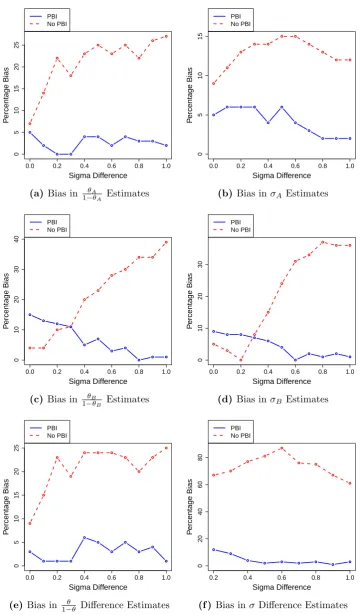
Figure 3, which shows the the percentage bias for each value of the expertise difference,
summarizes the main results of the simulation exercise.12 When expertise differences are
small, the results confirm that PBI does not outperform state-based identification alone;
the estimates of the parameter levels and differences are estimated reasonably accurately
in both cases. However, as σA−σB increases, the estimates that do not allow for PBI
11All estimation is done in R via maximum likelihood using the BFGS algorithm. All code is available
on request.
12In the online appendix, we present a table which shows the true value, the point estimate and the
deteriorate quickly, especially in the estimates of the differences between groups, while our
proposed specification actually improves in accuracy. For example, when σA−σB = 0.8,
our PBI specification estimates θA
1−θA −
θB
1−θB and σA−σB to 3% accuracy,
13 whereas the
No PBI specification displays biases of 20% and 70% respectively.
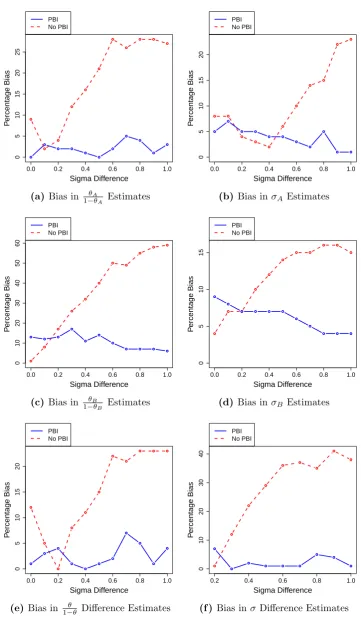
Figure 4 shows that this main result is unaffected by our decision to make the type
A decision makers more expert. If instead we maintain the assumption thatθA> θB but
make A less expert, we change the direction of the bias in the levels estimates of θ, but
the over-estimation of the difference remains as expertise differences grow.14
Finally, we plot the complete distribution of the simulation results for the cases of
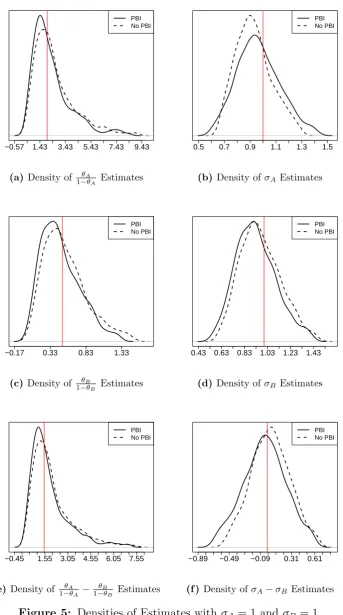
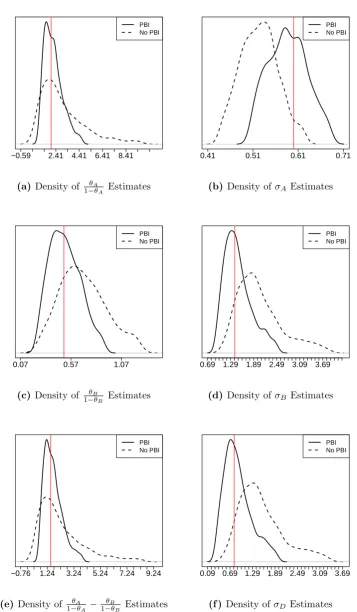
σA = 1 and σB = 1 (figure 5), and σA = 0.6 and σB = 1.4 (figure 6).15 With no σ
differences, the results are almost identical and PBI may even do slightly worse for some
parameters. But even at relatively modest expertise differences, the results show that
not only does the PBI specification ensure that the results stay anchored around the true
parameters, but also that the distribution around the estimates is less dispersed too. This
further supports our argument that this is an important channel of identification.
4.2
Re-estimation of US Supreme Court Justice Characteristics
In order to test our procedure on real data, we conclude this section by re-estimating the
structural parameters for the US Supreme Court voting data that MIMS consider. Their
dataset contains the vote of every justice (31 in total) on every case from 1953-2008.
dit = 1 corresponds to a vote for the plaintiff in a legal case, and dit = 0 to a vote for
the defendant. They run separate regressions on four subsets of cases according to the
issue at stake (business, basic rights, criminal, federalism).16 We focus on the results for
economics and basic rights cases, the two subsets MIMS treat as their baseline cases.
The first specification we run on the data is (No PBI), taking Xit and Zt as the same
sets of variables that MIMS use; that is, we follow the approach and data of MIMS.17 The
second is to run a modified version of (PBI) in which we interact what appears to us to
be the relevant subset of individual and meeting characteristics for influencing justices’
prior beliefs.18
13In the tables we report estimates of θ
1−θ so that biases and expertise are presented on the same on the same rangeR+.
14In the online appendix we present the table of these alternative results. 15The online appendix contains the complete distirubtions for all the cases. 16They exclude the small fraction of cases without nine votes
17There are two reasons that we cannot simply take results straight from MIMS. First, when we
estimate the first-stage coefficients taking their reported estimates as starting values, we obtain new estimates that reduce the value of the log-likelihood. Second, they do not report the median value of the structural parameters across all values of the fitted priors.
18We do not interact the mean value ofother justices’ Segal-Cover ideology or quality scores—covariates
● ● ● ● ● ● ● ● ● ● ●
0.0 0.2 0.4 0.6 0.8 1.0
0 5 10 15 20 25 Sigma Difference P ercentage Bias ● ● ● ● ● ● ● ● ● ● ● PBI No PBI
(a) Bias in θA
1−θA Estimates
● ● ● ● ● ● ● ● ● ● ●
0.0 0.2 0.4 0.6 0.8 1.0
0 5 10 15 Sigma Difference P
ercentage Bias ●
● ● ● ● ● ● ● ● ● ● PBI No PBI
(b) Bias inσA Estimates
● ● ● ● ● ● ● ● ● ● ●
0.0 0.2 0.4 0.6 0.8 1.0
0 10 20 30 40 Sigma Difference P ercentage Bias ● ● ● ● ● ● ● ● ● ● ● PBI No PBI
(c) Bias in θB
1−θB Estimates
● ● ● ● ● ● ● ● ● ● ●
0.0 0.2 0.4 0.6 0.8 1.0
0 10 20 30 Sigma Difference P ercentage Bias ● ● ● ● ● ● ● ● ● ● ● PBI No PBI
(d) Bias inσB Estimates
● ● ● ● ● ● ● ● ● ● ●
0.0 0.2 0.4 0.6 0.8 1.0
0 5 10 15 20 25 Sigma Difference P ercentage Bias ● ● ● ● ● ● ● ● ● ● ● PBI No PBI
(e) Bias in θ
1−θ Difference Estimates
● ● ● ● ● ● ● ● ●
0.2 0.4 0.6 0.8 1.0
0 20 40 60 80 Sigma Difference P ercentage Bias ● ● ● ● ● ● ● ● ● PBI No PBI
[image:18.595.116.478.76.692.2](f ) Bias inσDifference Estimates
Figure 3: Biases of Estimates (Percent)
● ● ● ● ● ● ● ● ● ● ●
0.0 0.2 0.4 0.6 0.8 1.0
0 5 10 15 20 25 Sigma Difference P ercentage Bias ● ● ● ● ● ● ● ● ● ● ● PBI No PBI
(a) Bias in θA
1−θA Estimates
● ● ● ● ● ● ● ● ● ● ●
0.0 0.2 0.4 0.6 0.8 1.0
0 5 10 15 20 Sigma Difference P ercentage Bias ● ● ● ● ● ● ● ● ● ● ● PBI No PBI
(b) Bias inσA Estimates
● ● ● ● ● ● ● ● ● ● ●
0.0 0.2 0.4 0.6 0.8 1.0
0 10 20 30 40 50 60 Sigma Difference P ercentage Bias ● ● ● ● ● ● ● ● ● ● ● PBI No PBI
(c) Bias in θB
1−θB Estimates
● ● ● ● ● ● ● ● ● ● ●
0.0 0.2 0.4 0.6 0.8 1.0
0 5 10 15 Sigma Difference P ercentage Bias ● ● ● ● ● ● ● ● ● ● ● PBI No PBI
(d) Bias inσB Estimates
● ● ● ● ● ● ● ● ● ● ●
0.0 0.2 0.4 0.6 0.8 1.0
0 5 10 15 20 Sigma Difference P ercentage Bias ● ● ● ● ● ● ● ● ● ● ● PBI No PBI
(e) Bias in θ
1−θ Difference Estimates
● ● ● ● ● ● ● ● ●
0.2 0.4 0.6 0.8 1.0
0 10 20 30 40 Sigma Difference P ercentage Bias ● ● ● ● ● ● ● ● ● PBI No PBI
[image:19.595.115.477.73.694.2](f ) Bias inσDifference Estimates
Figure 4: Biases of Estimates - Reversed θ
Notes: These figures plot the estimated values as a percentage of the true value (percentage of bias) for the alternative case of θA = 23 and θB = 13 for different values (along the horizontal axis) of the expertise difference (now σA increases while σB falls). The first column reports the results for θA
1−θA (row 1),
θB
1−θB (row 2) and the difference between these
−0.57 1.43 3.43 5.43 7.43 9.43 PBI No PBI
(a)Density of θA
1−θA Estimates
0.5 0.7 0.9 1.1 1.3 1.5
PBI No PBI
(b)Density ofσAEstimates
−0.17 0.33 0.83 1.33
PBI No PBI
(c)Density of θB
1−θB Estimates
0.43 0.63 0.83 1.03 1.23 1.43
PBI No PBI
(d) Density ofσB Estimates
−0.45 1.55 3.05 4.55 6.05 7.55
PBI No PBI
(e) Density of θA 1−θA −
θB
1−θB Estimates
−0.89 −0.49 −0.09 0.31 0.61
PBI No PBI
[image:20.595.129.473.92.708.2](f ) Density ofσA−σB Estimates
Figure 5: Densities of Estimates with σA= 1 and σB= 1
Notes: These figures plot the complete distribution of the simulation results for the case of
σA = 1 and σB = 1. The first column reports the results for 1−θAθ
A (row 1),
θB
1−θB (row 2)
−0.59 2.41 4.41 6.41 8.41 PBI No PBI
(a) Density of θA
1−θA Estimates
0.41 0.51 0.61 0.71
PBI No PBI
(b) Density ofσA Estimates
0.07 0.57 1.07
PBI No PBI
(c) Density of θB
1−θB Estimates
0.69 1.29 1.89 2.49 3.09 3.69
PBI No PBI
(d)Density ofσB Estimates
−0.76 1.24 3.24 5.24 7.24 9.24
PBI No PBI
(e) Density of θA 1−θA −
θB
1−θB Estimates
0.09 0.69 1.29 1.89 2.49 3.09 3.69
PBI No PBI
[image:21.595.120.478.86.699.2](f ) Density ofσD Estimates
Figure 6: Densities of Estimates withσA= 0.6 and σB= 1.4
Notes: These figures plot the complete distribution of the simulation results for the case of
Histogram of Estimated Priors: Business Cases
Estimated Priors
Frequency
0.3 0.4 0.5 0.6 0.7 0.8 0.9
0
5
10
15
Histogram of Estimated Priors: Rights Cases
Estimated Priors
Frequency
0.4 0.5 0.6 0.7 0.8 0.9
0
5
10
15
[image:22.595.98.491.110.284.2]20
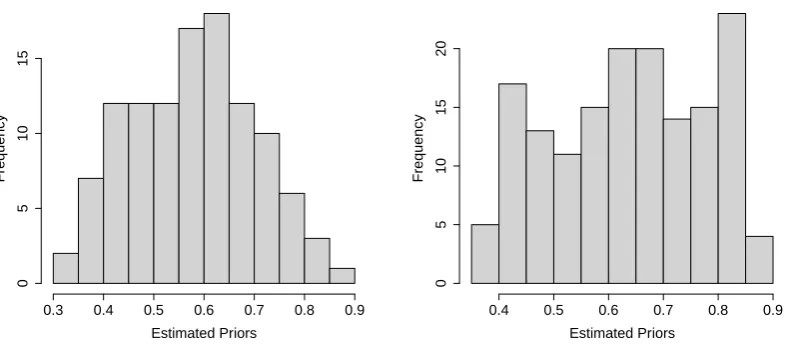
Figure 7: Histograms of Estimated Priors
Notes: This figure plots, for business cases (left figure) and rights cases (right figure), histograms of the estimated priorsqtfrom the (No PBI) specification.
The first point of interest is that there is a large range of estimated priors in the voting
data. Figure 7 plots histograms of the estimated priors from the (No PBI) specification
(the results for the (PBI) specification are very similar), and shows they range from
around 0.3 to around 0.9, with a fairly dispersed distribution. This variation in the prior indicates that allowing for PBI is potentially important in this dataset.
Our two specifications each produce 31 estimates (corresponding to the number of
justices) ofθ19andσfor business and rights cases. Table 2 displays a number of summary
statistics related to the distributions of these estimates. The main message from our
simulation exercises is that not using PBI tends to inflate estimated differences between
decision makers. As the table shows, PBI reduces justice heterogeneity both in terms of
variances and ranges. For rights case this reduction is particularly notable: the variance
with PBI is around 1/6 the value of the variance without. This illustrates that PBI can
have substantial effects in real world datasets.
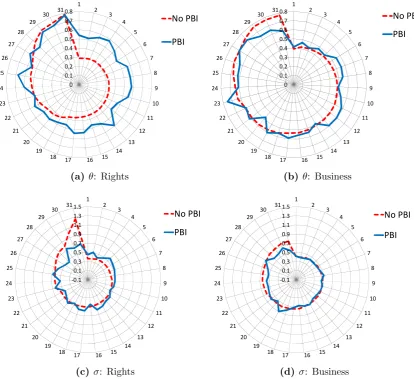
In order to compare the distributions of PBI and No PBI estimates more directly, the radar charts in figure 8 are helpful. Justices are ordered lowest to highest moving
clockwise based their No PBI estimates. Within this disc we plot both sets of estimates.
A distribution with less heterogeneity produces a more circular plot; the PBI estimates,
withinXit—with anyZt variables, nor chief justice dummies—covariates withinZt—with anyXit vari-ables. They are included withinXit andZtwithout interactions in theκandqterms.
19Here we return to reportingθ rather than θ
particularly for rights cases, display less heterogeneity (are more circular). 0 0.1 0.2 0.3 0.4 0.5 0.6 0.7
0.8 1 2 3
4 5 6 7 8 9 10 11 12 13 14 15 16 17 18 19 20 21 22 23 24 25 26 27 28 29 30 31 No PBI PBI
(a) θ: Rights
0 0.1 0.2 0.3 0.4 0.5 0.6 0.7
0.8 1 2 3
4 5 6 7 8 9 10 11 12 13 14 15 16 17 18 19 20 21 22 23 24 25 26 27 28 29 30 31 No PBI PBI
(b)θ: Business
-0.1 0.1 0.3 0.5 0.7 0.9 1.1 1.3
1.5 1 2 3 4 5 6 7 8 9 10 11 12 13 14 15 16 17 18 19 20 21 22 23 24 25 26 27 28 29 30 31 No PBI PBI
(c) σ: Rights
-0.1 0.1 0.3 0.5 0.7 0.9 1.1 1.3
1.5 1 2 3
4 5 6 7 8 9 10 11 12 13 14 15 16 17 18 19 20 21 22 23 24 25 26 27 28 29 30 31 No PBI PBI
[image:24.595.87.502.111.490.2](d) σ: Business
Figure 8: Radar Plots of Supreme Court Data Re-estimation Exercise
Notes: These figures show, forθ (row 1) andσ(row 2), the estimate of each Justice’s pa-rameter using MIMS specification (No PBI) along with the equivalent papa-rameter estimated under the more flexible specification (PBI). In each case, the Justices are ordered lowest to highest moving clockwise based their No PBI estimates. Column 1 refers to Rights Cases and column 2 to Business Cases.
5
Conclusion
Given the high level of interest within economics in how individuals and groups of
in-dividuals make decisions under uncertainty, it is important that we can can empirically
theories. We have provided an important channel through which it is possible to
empir-ically identify the decision-making parameters in standard Bayesian decision problems;
our approach relies on variation in decision-making behavior over heterogeneous priors
and differs from the most important existing contribution, which relies on comparing a
group of decision makers across different states for a fixed prior.
While there are likely still a number of steps that can be taken within this growing
empirical literature, our proposed identification strategy can be viewed as an important
contribution in two dimensions. First, unlike the existing method, our approach can be
used to estimate decision-making parameters of single decision makers, and of decision
makers serving at different points in time or taking independent decisions. Second, we show that where there is greater heterogeneity of expertise amongst decision makers
operating contemporaneously, ignoring our proposed channel of identification becomes
increasingly costly in terms of accuracy of estimated parameters. Fortunately, there are
relatively straightforward ways of augmenting existing approaches and we show that as
expertise heterogeneity grows, our proposed specification is increasingly accurate relative
to the existing methods.
References
Banerjee, A. V. (1992): “A Simple Model of Herd Behavior,” The Quarterly Journal
of Economics, 107(3), 797–817.
Besley, T. (2006): Principled Agents?: The Political Economy of Good Government, The Lindahl Lectures. OUP Oxford.
Bikhchandani, S., D. Hirshleifer, and I. Welch (1992): “A Theory of Fads, Fashion, Custom, and Cultural Change in Informational Cascades,”Journal of Political
Economy, 100(5), 992–1026.
Gerling, K., H. P. Gruner, A. Kiel, and E. Schulte (2005): “Information ac-quisition and decision making in committees: A survey,”European Journal of Political
Economy, 21(3), 563–597.
Hansen, S., M. McMahon, and C. Velasco (2013): “How Experts Decide: Prefer-ences or Private Assessments on a Monetary Policy Committee?,” manuscript.
Iaryczower, M., G. Lewis, and M. Shum (2013): “To Elect or to Appoint? Bias, Information, and Responsiveness of Bureaucrats and Politicians,” Journal of Public
Economics, forthcoming.
Iaryczower, M., and M. Shum(2012): “The Value of Information in the Court: Get It Right, Keep It Tight,” American Economic Review, 102(1), 202–37.
Li, D. (2012): “Information, Bias, and Efficiency in Expert Evaluation: Evidence from the NIH,” unpublished manuscript, Kellogg School of Management, Northwestern
Uni-versity.