http://wrap.warwick.ac.uk
Original citation:
Fu, Songling, He, Ligang, Huang, Chenlin, Liao, Xiangke and Li, Kenli. (2014)
Performance optimization for managing massive numbers of small files in distributed file
systems. IEEE Transactions on Parallel and Distributed Systems . ISSN 1045-9219
Permanent WRAP url:
http://wrap.warwick.ac.uk/65275
Copyright and reuse:
The Warwick Research Archive Portal (WRAP) makes this work by researchers of the
University of Warwick available open access under the following conditions. Copyright ©
and all moral rights to the version of the paper presented here belong to the individual
author(s) and/or other copyright owners. To the extent reasonable and practicable the
material made available in WRAP has been checked for eligibility before being made
available.
Copies of full items can be used for personal research or study, educational, or not-for
profit purposes without prior permission or charge. Provided that the authors, title and
full bibliographic details are credited, a hyperlink and/or URL is given for the original
metadata page and the content is not changed in any way.
Publisher’s statement:
“© 2014 IEEE. Personal use of this material is permitted. Permission from IEEE must be
obtained for all other uses, in any current or future media, including reprinting
/republishing this material for advertising or promotional purposes, creating new
collective works, for resale or redistribution to servers or lists, or reuse of any
copyrighted component of this work in other works.”
A note on versions:
The version presented here may differ from the published version or, version of record, if
you wish to cite this item you are advised to consult the publisher’s version. Please see
the ‘permanent WRAP url’ above for details on accessing the published version and note
that access may require a subscription.
Performance Optimization for Managing Massive
Numbers of Small Files in Distributed File
Systems
Songling Fu, Ligang He, Chenlin Huang, Xiangke Liao, Kenli Li
Abstract—The processing of massive numbers of small files is a challenge in the design of distributed file systems. Currently, the combined-block-storage approach is prevalent. However, the approach employs the traditional file systems such as ExtFS and may cause inefficiency when accessing small files randomly located in the disk. This paper focuses on optimizing the performance of data servers in accessing massive numbers of small files. We present a Flat Lightweight File System (iFlatLFS) to manage small files, which is based on a simple metadata scheme and a flat storage architecture. iFlatLFS is designed to substitute the traditional file system on data servers and can be deployed underneath distributed file systems that store massive numbers of small files. iFlatLFS can greatly simplify the original data access procedure. The new metadata proposed in this paper occupies only a fraction of the metadata size based on traditional file systems. We have implemented iFlatLFS in CentOS 5.5 and integrated it into an open source Distributed File System (DFS), called Taobao FileSystem (TFS), which is developed by a top B2C service provider, Alibaba, in China and is managing over 28.6 billion small photos. We have conducted extensive experiments to verify the performance of iFlatLFS. The results show that when the file size ranges from 1KB to 64KB, iFlatLFS is faster than Ext4 by 48% and 54% on average for random read and write in the DFS environment, respectively. Moreover, after iFlatLFS is integrated into TFS, iFlatLFS-based TFS is faster than the existing Ext4-based TFS by 45% and 49% on average for random read access and hybrid access (the mix of read and write accesses), respectively.
Index Terms—Distributed File System; Data Server; Small File; Performance Optimization
—————————— ——————————
1 INTRODUCTION
ith the extreme popularity of social networks (e.g., Face-book [22]) and e-commerce sites (e.g., Amazon [23] and Taobao [24]), new challenges are raised to efficiently store and access massive numbers of small files, such as user messages and merchandise photos. The small files in such scenarios have their special characteristics. Typically, these small files are sel-dom modified and their sizes range from several KBs to tens of KBs [1-3]. For example, it is shown in [9] that the Taobao File System (TFS) used by Taobao, which is the No.1 e-commerce site in China, manages about 28.6 billion photos and the aver-age photo size is 17.45KB. This is different from the case of big files. For example, Reference [4] shows that the files processed by some Google applications have the size of multiple GBs.
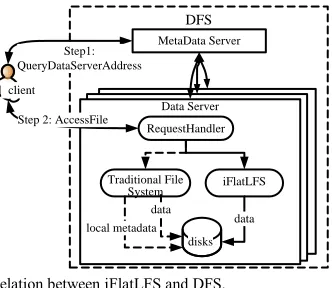
Distributed File System (DFS) is a method of storing and ac-cessing files based on a client/server architecture, as shown in Fig. 1. In a DFS, all files are replicated and stored in many data servers, while the metadata are stored in the metadata server. A client (note that a client in this context is not a user, but an appli-cation server which interacts with DFS and provides the services to the users) must look up a file by the metadata server in a DFS, not by a file path, which is a typical way of looking up a file in traditional file systems. As shown in Fig. 1, a client accesses a file stored in a DFS by two phases: 1) querying the metadata
server to get the IP address of the data server which stores the target file; 2) connecting the data server to fetch the file data.
In traditional DFS, such as GFS [4] and HDFS [5], the di-vided-block-storage approach is designed to handle big files, each of which is divided into multiple fixed-size (typically 64MB) data blocks. Each data block is stored as a regular file in multiple data servers. There is at least one metadata object in the metadata server and one regular file on the data server for each file. When the files in the systems are mainly small files, the number of stored files increases sharply, resulting in a huge amount of metadata on the metadata server and the low perfor-mance in accessing files on data servers [6], [7], [8]. Therefore, it is a popular research topic in the design of DFS to improve the performance of processing massive small files.
Currently, combined-block-storage is a prevalent approach to processing massive small files and has been implemented in both Haystack [3] by Facebook and TFS [9] by the Alibaba Group. The fundamental idea of combined-block-storage is to combine small files into large data blocks to reduce the magni-tude of metadata on the metadata server. The Combined-block-storage approach adopts traditional file systems, such as Ext4 [10] and XFS [18], to store data blocks as regular files on the data servers. However, traditional file systems often have very low performance when handling massive small files [11], [12].
Since the accesses to the hotspot data are commonly filtered by the multi-level cache techniques in commercial systems, such as CDN [14], the data requests arriving at the actual data servers situated behind multiple levels of caches are most likely to access the non-hotspot data that are randomly distributed in the disk. Therefore, there is no need to cache the accessed data into the memory on data servers. This is why improving I/O
xxxx-xxxx/0x/$xx.00 © 200x IEEE Published by the IEEE Computer Society
————————————————
Songling Fu is with the School of Computer Science, National University of
Defense Technology, Changsha, China. E-mail: [email protected].
Ligang He is with the Department of Computer Science, University of
Warwick, Coventry, UK, E-mail: [email protected].
Chenlin Huang is with the School of Computer Science, National University
of Defense Technology, Changsha, China. E-mail: [email protected].
Xiangke Liao is with the School of Computer Science, National University
of Defense Technology, Changsha, China. E-mail: [email protected] .
Kenli Li is with the School of Information Science and Engineering, Hunan
University, Changsha, China. E-mail: [email protected]
performance of data servers becomes a critical issue.
The steps involved in a data access can be broadly divided into the steps of determining the location of the data through the metadata and the steps of accessing the physical data. The for-mer can be regarded as the I/O overhead. It makes accessing big files very different from accessing small files, because when accessing small files, the time associated with the I/O overhead outweighs the time spent in accessing physical data. Therefore, when optimizing the performance of accessing small files, the major efforts often focus on reducing the I/O overhead.
Previous research work has presented the approaches to im-proving the performance of DFS by optimizing data manage-ment on data servers. Haystack [3], which is a HTTP-based photo server developed by Facebook, presents an index cache technique to eliminate the disk I/O operations when locating small photo files. It also adopts XFS to speed up accessing pho-tos. In TFS [9], Alibaba proposes a naming technique and a disk-pre-allocating technique to simplify metadata management and decrease the number of I/O requests during file accesses.
However, there is still room to further improve the perfor-mance of these existing DFSes. For example, XFS can only deliver about 85% of the raw throughput on data servers in-stalling Haystack [3], while the Ext4 file system delivers about 50% in TFS as shown in Section 5.
[image:3.567.68.234.419.563.2]This paper focuses on optimizing the performance of data servers in accessing massive numbers of small files. We devel-oped a Flat Lightweight File System called iFlatLFS. iFlatLFS is able to access raw disks directly, optimize the metadata man-agement and accelerate the data-accessing procedure on data servers. iFlatLFS is designed as an efficient alternative to the underlying traditional file systems, as shown in Fig. 1.
Fig. 1 The relation between iFlatLFS and DFS.
The traditional file systems can offer many benefits in gen-eral. However, in the systems we are targeting, there are mas-sive numbers of rarely-modified small files. Under this circum-stance, some operations and functionalities in traditional file systems are unnecessary or cause excessive overheads. The design of iFlatLFS carefully weighs the efficiency and the gen-erality of the measures adopted in traditional file systems. The efficiency of iFlatLFS is achieved by removing or re-designing the measures that are not suitable in our targeted systems from the performance perspective, although these measures are adopted in traditional files systems for sake of generality in application. For example, namespace management is re-designed in iFlatLFS, so that iFlatLFS performs little more than space management, relying on the upper distributed file system (In this paper, the DFS components sitting above the local file system, such as Request handler and Metadata server in Fig. 1,
are called the upper DFS) to handle all naming issues.
Although iFlatLFS can substitute the traditional file systems, the process for a DFS client to access a file remains unchanged. The main difference between iFlatLFS and traditional file sys-tems is that iFlatLFS accesses the data directly from disks while traditional file systems access the data through the hierarchical file tree. In iFlatLFS, a simple metadata scheme is designed, in which the metadata occupies much smaller space. As a result, the metadata can be entirely cached in memory and consequent-ly the operation of fetching the metadata from the disks is elim-inated during the file access. Moreover, a flat storage architec-ture is developed in iFlatLFS to store small files in raw disks. With this new flat storage architecture and the simple metadata scheme, the original complex process of accessing files in tradi-tional file systems is greatly simplified and the amount of metadata is significantly reduced. Performance evaluation has been carried out to verify effectiveness and advantages of iFlatLFS. The evaluation results show that an iFlatLFS-based data server can achieve near optimal performance.
The rest of this paper is organized as follows. Section 2 dis-cusses related. Section 3 analyzes the file access model on data servers. Section 4 presents the design details of iFlatLFS, in-cluding fundamental ideas, data management, file access, metadata consistency, and the implementation. Section 5 evalu-ates the performance of the developed file system and analyzes experimental results. Section 6 proposes a hybrid storage sys-tem. Finally, Section 7 concludes this paper.
2 RELATED WORK
DFS has been widely studied in recent years [4], [5], [25], [26-28]. GPFS [25] and PVFS [26] are designed for managing the files in clusters. TokuFS [27] is implemented using Fractal Tree indexes, which are primarily used in databases. BlueSky [28] acts as a proxy of multiple cloud storage providers to offer stor-age service for enterprise users. GFS [4] and HDFS [5], are designed mainly for streaming access of large files.
Some studies [1], [3], [9], [32], [33] show that small files occupy a big fraction of the entile files in current distributed systems. For example, Reference [3] shows that the photos in facebook have the average size of 64+KB.
Three main optimization approaches have been developed to support small files in DFSes: 1) reducing data block sizes; 2) combining small files into bigger ones; 3) storing small files by groups, not by data blocks.
Google’s next generation of DFS, GFS2 [15], is an example of taking the first optimization approach. Zhang et al. [30] also proposed an approach which changes the block size and adopts an efficient indexing mechanism. GFS2 improves the ability of handling small files mainly by reducing the data block size from 64MB to 1MB. In order to meet the requirements of Inter-net applications, the data blocks must be reduced further to the size of the KB order. In this type of DFS systems, there will be over 1G data block files and 150GB inode data on a data server of 10TB storage capacity. Although the existing proposals in [29] and [31] can be used to impove the performance of the metadata server, it is difficult for data servers to handle such massive numbers of data block files.
The second approach, i.e., the approach of combining small files into bigger ones, falls into two categories: i) developing
DFS
Data Server
Traditional File System Step1: QueryDataServerAddress
Step 2: AccessFile
iFlatLFS RequestHandler
MetaData Server
local metadata data
dedicated tools, such as Hadoop Archive [16], Sequence File [17], for handling small files based on existing DFSes, and ii) designing new DFSes, such as Haystack [3] and TFS [9], with special optimization considerations for small files. Hadoop Ar-chives, Haystack and TFS are discussed below in more detail.
Hadoop Archives (HAR) builds a layered file system on top of HDFS, and packs the small files into relatively big HDFS files to alleviate the pressure caused by too many files on the metadata server’s memory. Sequence File is similar to HAR. It uses the file name as the key, and the file content as the value. Reading files in a HAR or Sequence File is slower than reading files in HDFS because of additional index operations.
Haystack and TFS are the same type of DFS, which are de-signed for the storage of massive small photos in their own companies: Facebook and Alibaba. They employ the combined-block-storage technique, which combines small photos with different sizes into data block files with a fixed size, and builds an index file for each data block file. The index file stores the logical addresses of all photos. In order to further improve per-formance of data servers, some other measures have also been taken. Haystack caches all index data into the memory and adopts XFS [18] on data servers, which can perform random seeks quickly within a large file. TFS codes a file's logical ad-dress into its file name to decrease one lookup operation. All these approaches can simplify the metadata lookup process and reduce the number of disk operations to some degree. However, both Haystack and TFS employ traditional file systems on data servers. The additional data locating operations are needed to lookup photos’ physical address in disks before the actual file access can start, which can cause low performance of data serv-ers. According to Facebook’s benchmarking performance [3], Haystack can deliver only 85% of the raw throughput of the device while incurring 17% higher latency.
FastDFS [19] is an exemplar DFS which adopts the third ap-proach, i.e., storing small files by groups. It is an open source high performance DFS, and can meet the requirements of photo sharing sites and video sharing sites. In FastDFS, files are orga-nized in groups, and each file exists in only one group (i.e., there are no common files between different groups). For each file, the file name exposed to clients is composed of its corre-sponding group name, relative path and its actual file name on the data server. The shortcoming of FastDFS is that it is diffi-cult to handle massive numbers of KB-sized small files because the number of files is too large.
Additionally, some other techniques have also been devel-oped recently to improve the performance of traditional file systems on a single server. For example, both Ext4 [10] and XFS [18] introduce the concept of extent in order to reduce metadata. This approach is only effective for big files. ReiserFS [35] employs EOTTL (extents on the twig level) and Ligquid items. The former is a fully balanced storage tree, which guar-antees that all paths to the objects are of equal length, while the latter is a special format of records in the storage tree and can solve the problem of internal fragmentation. ReiserFS can op-timize the performance of handling small files.
As discussed above, designing new DFSes (e.g., Haystack and TFS) is a category of the second optimization approach to support small files. These DFSes develop the combined-block-storage technique on top of traditional file systems. Our work aims to further optimize such DFSes. A lightweight file system,
called iFlatLFS, is developed in this paper to substitute the tra-ditional file system in the DFS (to differentiate with iFlatLFS, the DFS is called the upper DFS in the rest of this paper).
3 ANALYSING DATA ACCESS FOR SMALL FILES
3.1 Data accessing in DFS
As discussed in the introduction section, a client accesses a file stored in a DFS by the following two phases.
1) Querying the metadata server to get the IP address of the data server that stores the file. This phase has 3 steps:
1. 𝑇𝐶𝑙𝑖𝑒𝑛𝑡𝑄𝑢𝑒𝑟𝑦𝑀𝐷𝑆: The client sends a message to the
metadata server to query the ID of the data block which store the file data, and the IP addresses of the data servers which store the data block;
2. 𝑇𝑀𝐷𝑆𝑄𝑢𝑒𝑟𝑦𝑀𝐷: The metadata server queries locally the
ID of the data block and the IP addresses of the data servers. In the case where the client writes a new file, the metadata server will allocate an old data block which has free space or create a new data block; 3. 𝑇𝑀𝐷𝑆𝑅𝑒𝑡𝑢𝑟𝑛𝑀𝐷: The metadata server returns the ID of
the data block and the corresponding IP addresses of the data servers to the client.
2) Selecting and connecting a data server to fetch the file data. This phase also includes 3 steps:
4. 𝑇𝐶𝑙𝑖𝑒𝑛𝑡𝐴𝑐𝑐𝑒𝑠𝑠𝐷𝑆: The client sends a message to the data
server. In the case where the client writes a new file in-to the DFS, the message contains the file data;
5. 𝑇𝐷𝑆𝐴𝑐𝑐𝑒𝑠𝑠𝐷𝑎𝑡𝑎: The data server reads (or writes) the file
data from (or into) the data block in the local disks; 6. 𝑇𝐷𝑆𝑅𝑒𝑡𝑢𝑟𝑛𝑅𝑒𝑠𝑢𝑙𝑡: The data server returns the result to the
client. In the case where the client reads a file from the DFS, the result contains the file data.
Therefore, the total time of accessing a file from a DFS can be expressed as in (1).
𝑇𝐷𝐹𝑆 = 𝑇𝐶𝑙𝑖𝑒𝑛𝑡𝑄𝑢𝑒𝑟𝑦𝑀𝐷𝑆+ 𝑇𝑀𝐷𝑆𝑄𝑢𝑒𝑟𝑦𝑀𝐷+ 𝑇𝑀𝐷𝑆𝑅𝑒𝑡𝑢𝑟𝑛𝑀𝐷 + 𝑇𝐶𝑙𝑖𝑒𝑛𝑡𝐴𝑐𝑐𝑒𝑠𝑠𝐷𝑆+ 𝑇𝐷𝑆𝐴𝑐𝑐𝑒𝑠𝑠𝐷𝑎𝑡𝑎
+ 𝑇𝐷𝑆𝑅𝑒𝑡𝑢𝑟𝑛𝑅𝑒𝑠𝑢𝑙𝑡 (1)
We observe the following three key points from (1).
1) In a DFS, the metadata server manages the namespace of all files, which is usually organized into a hierar-chical tree. The namespace is stored as a regular file, and will be loaded into the memory entirely when the server boots. The metadata server can obtain the re-quired metadata by in-memory operations. So Step 2 (𝑇𝑀𝐷𝑆𝑄𝑢𝑒𝑟𝑦𝑀𝐷) only takes little time, which can be
ne-glected comparing with over-network or I/O operations. 2) On the contrary, the file data are stored as regular files in a data server. As the discussed in Section 1, when the data requests arrive at the actual data servers, which are situated behind multiple levels of caches in DFS, it is most likely that these requests are accessing the non-hotspot data. Therefore, the file data to be accessed are typically not in the memory, but in the disk. The data server has to retrieve the file data by one or more disk I/O operations. Therefore, Step 5 (𝑇𝐷𝑆𝐴𝑐𝑐𝑒𝑠𝑠𝐷𝑎𝑡𝑎)
typi-cally takes much more time than Step 2.
disk I/Os, such as SATA disks and SAS disks. For ex-ample, the TianHe-2 supercomputer [43, 44, 45], which is developed by the National University of Defense Technology in China and is ranked No. 1 in the latest Top500 Supercomputer list, is equipped with one of the two interconnecting networks: Infiniband network or the high-speed NIC-based (network interface chip) net-work. The bandwidth delivered by the former in the su-percomputer is about 7GB/s, while that delivered by the latter is about 20GB/s. But the tested bandwidths of SATA disk and SAS disk in the supercomputer are about 70MB/s and 100MB/s, respectively. Therefore, compared with Steps 1, 3, 4 and 6, it is far more likely that Step 5 becomes the bottleneck in the workflow of steps for accessing the file data in DFS.
The above analysis shows that reducing the time spent by Step 5, i.e., the local data accessing in data servers, is critical in order to optimize the performance of accessing the file data in the DFS. This motivates our work to optimize the accessing of small files in data servers. Next, we will analyze the steps and the performance of local data accessing in a data server.
3.2 Analytical model of read operations in a data server
The traditional file systems, which access files through a hierar-chical file tree, are commonly adopted on data servers to man-age file data and metadata in disks. Small files are combined into data blocks of fixed size. Each data block is stored as a regular file, called a data block file. For each data block file, an index file is built to store the logical offset addresses of all small files in this data block file.
In traditional file systems such as ExtFS, all files are orga-nized into a hierarchical tree. A file is divided into disk blocks, which may not be stored in the continous physical locations in the disk. A file has an inode, which uses the address pointers to link the scattered disk blocks of a file together, so that the file has a continous logical address in the file system. Each disk block of a file has a typical size of 1KB. In ExtFS, therefore, every 1KB data needs an address pointer, whose size is 8 Bytes. In all address pointers of the disk blocks, the first 12 pointers are stored in the file inode structure, and others are stored in disk blocks called address blocks. In ExtFS, an application ac-cesses the file data by their logical addresses, not by their phys-ical addresses (i.e., the pointers of the disk blocks). Thus during the file access, there is an extra data lookup operation of retriev-ing physical addresses, which may be located in the inode or in some address block depending on the logical address.
In DFS environments, read operations dominate, compared with writes [3], [9]. In this section, we analyze the performance of reading small files on a data server (the write performance will be discussed in Section 4.3 when we discuss data con-sistency). Section 3.2.1 and Section 3.2.2 present the analytical models without and with considering the effects of memory caches, respectively.
3.2.1 Models without considering cache effects
As shown in Fig. 2, the process of file read on data servers in-cludes 7 steps, which can be organized into 2 phases as follows. Phase 1: Reading local metadata to retrieve the logical ad-dress of the target file data in the corresponding data block file. This phase includes 3 steps:
1. 𝑇1:𝑅𝑒𝑎𝑑𝐼𝐹𝐼𝑛𝑜𝑑𝑒: Reading the inode of index file;
2. 𝑇2:𝑅𝑒𝑎𝑑𝐼𝐹𝐷𝑎𝑡𝑎: Reading index data from the index file;
3. 𝑇𝑄𝑢𝑒𝑟𝑦𝐿𝐴: Querying the corresponding index item from
the index data to get the logical address of the file. Phase 2: Reading file data. This phase includes 4 steps:
4. 𝑇3:𝑅𝑒𝑎𝑑𝐷𝐵𝐹𝐼𝑛𝑜𝑑𝑒:Reading the inode of the data block file;
5. 𝑇4:𝑅𝑒𝑎𝑑𝐴𝑑𝑑𝑟𝑒𝑠𝑠𝐵𝑙𝑜𝑐𝑘: Reading the corresponding address
block from the disk if the logical address is beyond the size of 12 disk blocks;
6. 𝑇𝑄𝑢𝑒𝑟𝑦𝑃𝐴: Querying the physical address of the target
file data from the inode or the address block;
[image:5.567.308.512.178.268.2]7. 𝑇5:𝐴𝑐𝑐𝑒𝑠𝑠𝐷𝑎𝑡𝑎: Accessing file data using a disk operation.
Fig. 2 File access model in DFS based on traditional file systems
It can be seen from above that the data management model in traditional file systems is very complex. The metadata need-ed for file access on data servers include the inodes of index files, the inodes of data block files, the index data and all ad-dress blocks of data block files. Consequently, the metadata can be huge. For example, when Ext4 is used, 92.8GB of metadata is needed to store 10TB data with the average file size of 16KB. The total time of reading a file on a data server can be ex-pressed in (2).
𝑇𝑜𝑟𝑖𝑔𝑖𝑛𝑎𝑙= 𝑇1:𝑅𝑒𝑎𝑑𝐼𝐹𝐼𝑛𝑜𝑑𝑒+ 𝑇2:𝑅𝑒𝑎𝑑𝐼𝐹𝐷𝑎𝑡𝑎+ 𝑇𝑄𝑢𝑒𝑟𝑦𝐿𝐴 + 𝑇3:𝑅𝑒𝑎𝑑𝐷𝐵𝐹𝐼𝑛𝑜𝑑𝑒+ 𝑇4:𝑅𝑒𝑎𝑑𝐴𝑑𝑑𝑟𝑒𝑠𝑠𝐵𝑙𝑜𝑐𝑘 + 𝑇𝑄𝑢𝑒𝑟𝑦𝑃𝐴 + 𝑇5:𝐴𝑐𝑐𝑒𝑠𝑠𝐷𝑎𝑡𝑎 (2)
Each variable 𝑇𝑖 in the right side of (2), except 𝑇𝑄𝑢𝑒𝑟𝑦𝐿𝐴 and 𝑇𝑄𝑢𝑒𝑟𝑦𝑃𝐴, represents the time of a disk operation. There are total
5 disk operations during a file read, although only 𝑇5:𝐴𝑐𝑐𝑒𝑠𝑠𝐷𝑎𝑡𝑎
is the time which is used to read the actual data being requested. Because the time of a disk I/O operation is far heavier than that of a memory operation, Equation (2) can be simplified as (3). 𝑇𝑜𝑟𝑖𝑔𝑖𝑛𝑎𝑙≈ 𝑇1:𝑅𝑒𝑎𝑑𝐼𝐹𝐼𝑛𝑜𝑑𝑒+ 𝑇2:𝑅𝑒𝑎𝑑𝐼𝐹𝐷𝑎𝑡𝑎+ 𝑇3:𝑅𝑒𝑎𝑑𝐷𝐵𝐹𝐼𝑛𝑜𝑑𝑒
+ 𝑇4:𝑅𝑒𝑎𝑑𝐴𝑑𝑑𝑟𝑒𝑠𝑠𝐵𝑙𝑜𝑐𝑘 + 𝑇5:𝐴𝑐𝑐𝑒𝑠𝑠𝐷𝑎𝑡𝑎 (3)
It can be seen from the above analysis that although data servers only store data for the upper DFS, its complex hierar-chical file management model incurs heavy overhead.
3.2.2 Models with the cache effect
The effects of the memory cache are not considered in the anal-ysis model presented in Section 3.2.1. In fact, the memory cache acts as an important role while designing the performance optimization approaches.
If any performance optimization approaches used in Hay-stack and TFS (as discussed in the related work section) are applied, Equation (3) can be further simplified. For example, in TFS, the index files are accessed using the mmap operation while the direct I/O operation is used for accessing data block files. In the mmap operation, the index file is mapped to memory, and the index data are transparently loaded from disk into memory. An application can then access the index file in the same way as it accesses the memory. Further, the direct I/O operation can bypass the cache of the Ext4 file system, there-fore greatly saving the main memory. The saved main memory can be used to cache the inodes and the index data. Thus the
Phase 1: RetrieveLogicAddress
1:ReadIFInode 2:ReadIFData 3:QueryLA
4:ReadDBFInode 5:ReadAddressBlock 6:QueryPA
7:AccessData
DFS
Index File DataBlockFileDataBlockFile Phase 2: AccessData
DataBlockFile
data access time in TFS can be further simplified as (4), where
T2:ReadIFData can be regarded as zero if the required index data
have been in memory cache.
𝑇𝑜𝑟𝑖𝑔𝑖𝑛𝑎𝑙_𝑇𝐹𝑆≈ 𝑇2:𝑅𝑒𝑎𝑑𝐼𝐹𝐷𝑎𝑡𝑎+ 𝑇4:𝑅𝑒𝑎𝑑𝐴𝑑𝑑𝑟𝑒𝑠𝑠𝐵𝑙𝑜𝑐𝑘
+ 𝑇5:𝐴𝑐𝑐𝑒𝑠𝑠𝐷𝑎𝑡𝑎 (4)
3.3 Performance benchmarking in a data server
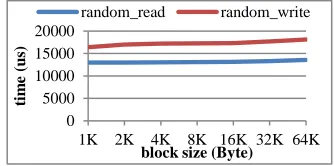
We tested the performances of random read and write for small files with different sizes on CentOS 5.5 (the kernel is 2.6.18). 10GB data are stored into 160 files, each with the size of 64MB. In the test, a file is selected randomly, and a logical ad-dress is selected randomly from this file. The test then begins to read or write data ranging from 1 KB to 64 KB in size at the selected logical address. For each size, the same test is per-formed 1000 times. The results are shown in Fig. 3, where the y-axis is the time of the data access (i.e., overhead).
The result shows that for the same disk operation (read or write), the overhead of accessing small files of different sizes is almost the same, and that the response time is almost independ-ent of file size. This is because the disk seek time is far longer than data transferring time for small files. These results indicate that if the number of disk operations can be reduced when ac-cessing small files, the data acac-cessing performance can be im-proved. Ideally, each file access needs only one disk operation if all data locating operations are performed in memory.
[image:6.567.71.238.388.471.2]Based on the above models and the benchmarking results, this paper aims to develop a flat file system (called iFlatLFS) to reduce I/O overhead for accessing small files.
Fig. 3 Random read and write performance in Ext4
4
IFLATLFSThe design of iFlatLFS is mainly oriented towards optimizing performance of accessing massive small files which are seldom modified. We assume that all files are stored using the com-bined-block-storage approach in DFSes, that is, small files will not be broken into pieces, but are combined into huge data blocks and stored into data servers. We also assume that there is no need to cache the accessed data into the main memory of the data server. This assumption is reasonable because the data requests are filtered by multiple levels of caches, as discussed in the introduction section. Therefore, the data requests that finally arrive at the data server are most likely to access the non-hotspot data that are randomly distributed in the disk space. iFlatLFS aims to substitute the traditional files systems on data servers in the our targeted systems, namely, the systems in which there are massive numbers of rarely-modified small files.
4.1 The design of data management
4.1.1 The fundamental idea
The fundamental idea of iFlatLFS is to improve the perfor-mance of file access on data servers by optimizing local
metadata management and accelerating the data-accessing pro-cedure. Instead of using the file-based local metadata ment as in traditional file systems, a simple metadata manage-ment mechanism (discussed in Fig. 5) is designed in iFlatLFS. It combines file metadata, such as file ID, file type, creation time, checksum etc., into the file header and stores it together with the file data. As a result, the size of the metadata for a sin-gle file is cut down to 12 Bytes, and it is possible to load the entire metadata into the memory when the data server boots. For example, using the metadata management mechanism de-veloped in this work, 10TB data will only need about 7.5GB of metadata when the average file size is 16KB. By doing so, all metadata operations can be performed in memory. Consequent-ly, the overhead involved in locating the file data can be greatly reduced without the need of performing disk I/O operations.
There are many fasincating functionalities in traditional file systems. However, many of these funcationalities are not neces-sary or even hurt the performance of the file system deployed in the data servers in the DFS context. These unnecessary funca-tionalities mainly include:
1) Hierarchical file structure: Data server is to DFS what hard disk is to operating system. Since DFS manages the namespace of the data in the metadata server, data servers can simply act as the storage facility for DFS and there is no need for the file system in a data server to include complicated data management model. Therefore, in order to speed up data ac-cessing, the complex file management designs in traditional file systems, such as hierarchical file structure and inode, are abol-ished in iFlatFLS. Instead, one disk partition is used to store all small files and their metadata for each data block. The files are directly accessed from the disk partitions in a flat fashion by means of physical address and data size in metadata.
2) Data prefetching: Since iFlatLFS handles small files, data prefetching in the traditional file systems has a negligible posi-tive impact on the performance. So this function is unnecessary. 3) Data caching: As discussed in Section 1, the accesses to the hotspot data are commonly filtered by the multi-level cache techniques in DFS, the data requests arriving at the data servers are most likely to access the non-hotspot data. Therefore, data caching is unnecessary.
4.1.2 The flat storage architecture
In order to optimize the management of massive numbers of small files, a flat storage architecture is designed in iFlatLFS. The data management is also greatly simplified with smaller metadata and fewer data blocks.
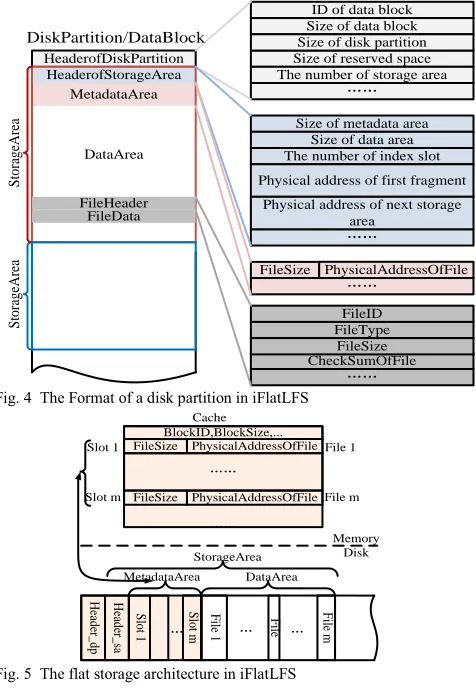
In iFlatLFS, each disk partition consists of a header followed by a series of storage areas, each of which contains a header, a metadata area and a data area. The layout of a disk partition is shown in Fig. 4. For each data block, all files and their metadata are stored directly into a fix-sized super big disk partition, whose size is typically set as the greatest common divisor of all disk sizes, but can be as big as possible in theory.
Fig. 5 shows the flat storage architecture developed in this work. Each data area holds a vast amount of small files, which are stored in sequence. Each file consists of a header and its data. Each metadata area consists of a sequence of index slots. Each slot represents a small file stored in the corresponding data area. When a small file is created a corresponding index item is built and stored into an index slot. To reduce the metada-0
5000 10000 15000 20000
1K 2K 4K 8K 16K 32K 64K
ti
m
e
(u
s)
ta as much as possible, each index item includes only 2 fields: the file size (4 Bytes) and the file physical address (8 Bytes) in disk. Other metadata, such as file identifier, file type, file size, checksum of file data, are stored in the file header. The index slot id will be coded into the file identifier as the file’s logical address and returned to the upper DFS.
[image:7.567.33.271.247.596.2]The disk space of the metadata area and the data area should be determined dynamically according to the DFS parameters such as data block size and average file size. The data block size can be determined by the hardware configuration of data servers, and the average file size can be derived through the statistical means or historical data [4], [9]. The metadata area cannot be changed after the disk space has been allocated. Once the metadata area runs out of its disk space, the free space of the data area will be automatically re-allocated as a new storage area and linked to the last storage area.
Fig. 4 The Format of a disk partition in iFlatLFS
Fig. 5 The flat storage architecture in iFlatLFS
4.1.3 Managing reserved space
The physical damage of disk sections will reduce the storage space. Also, if there are too many fragments in disk partitions, then the effective storage space is also shrinked. In order to handle the shrinking of storage space, iFlatLFS introduces re-served space for each disk partition. The size of rere-served space can be set by administrators, typically 1~10% of the whole par-tition space. In principle, new files will not be stored in the disk partition after its data areas run out of their disk space. Howev-er, if the files are generated because of upgrading the old files to bigger sizes or recovering the lost files due to physical disk failure, they are allowed to be stored in the reserved space. When the total faulty disk space is bigger than the reserved
space, the disk partition will be abandoned and the correspond-ing data block be stored in another disk partition.
4.1.4 Fragmentation management
[image:7.567.337.482.361.417.2]Fragments may be generated in each disk partition when delet-ing or modifydelet-ing files. iFlatLFS designed a strategy for frag-mentation management, which is illustrated in Fig. 6. A special flag and the fragment size are stored in the fragment header. All fragments form a list of unused disk space, whose head (i.e., FirstFrag in Fig. 6) is stored in the metadata header. Normally, when a new file is generated, it is appended to the correspond-ing disk partition, and the partition pointer, which points to the first physical address of the available disk space, moves for-ward by the size of the file accordingly. After the partition pointer reaches the end of the disk partition, iFlatLFS must find a fragment available to store the target file. Although the con-cept of reserved space is introduced in iFlatLFS, there is no disk space physically allocated for the reserved space. iFlatLFS views all fragments as a part of the reserved space. Thus, the fragments are not used unless the total disk space of all frag-ments is bigger than the pre-set size of the reserved space. If there are too many fragments in a disk partition, iFlatLFS can copy these scattered files into another new disk partition, and the original partition will be assigned to another data block. The benefit of this fragment management strategy is to simplify the complexity of disk space management.
Fig. 6 The fragment management in iFlatLFS
4.2 File access
[image:7.567.300.485.470.536.2]We now present how to access the small files. The file access model in a DFS with iFlatLFS is shown in Fig. 7.
Fig. 7 The file access model of DFS with iFlatLFS
iFlatLFS is transparent for the clients of upper DFSes. Com-pared with the original file access model, the only difference is the process of the file access on the local data server. All metadata (i.e., the MetadataArea as shown in Fig. 5) are loaded and cached in memory from disk when the data server boots, so that all metadata operations can be performed in memory.
The whole process of file access includes 2 phases.
Phase 1: Querying the physical disk address of the target file from the metadata cache (i.e., the metadata loaded into the main memory). No disk operation is needed. The time overhead of this phase is
de-noted as 𝑇′𝑄𝑢𝑒𝑟𝑦𝑃ℎ𝑦𝑠𝑖𝑐𝑎𝑙𝐴𝑑𝑑𝑟𝑒𝑠𝑠.
Phase 2: Accessing the file data directly from the corre-sponding disk partition by one disk operation. Its
time is denoted as 𝑇′1:𝐴𝑐𝑐𝑒𝑠𝑠𝐷𝑎𝑡𝑎.
(5) shows the total time for file access in iFlatLFS.
𝑇𝑖𝐹𝑙𝑎𝑡𝐿𝐹𝑆= 𝑇′𝑄𝑢𝑒𝑟𝑦𝑃ℎ𝑦𝑠𝑖𝑐𝑎𝑙𝐴𝑑𝑑𝑟𝑒𝑠𝑠+ 𝑇′1:𝐴𝑐𝑐𝑒𝑠𝑠𝐷𝑎𝑡𝑎 (5)
Based on the same reason of simplifying (2), Equation (5) can be simplified as (6).
HeaderofDiskPartition HeaderofStorageArea
MetadataArea
DataArea
S
to
ra
ge
A
re
a
ID of data block Size of data block Size of reserved space The number of storage area
……
Size of metadata area Size of data area The number of index slot Physical address of first fragment
……
Size of disk partition
Physical address of next storage area
S
to
ra
ge
A
re
a
FileID CheckSumOfFile
……
FileType FileSize
FileSize PhysicalAddressOfFile
…… DiskPartition/DataBlock
FileHeader FileData
F
ile
1
F
ile
Cache
StorageArea
S
lo
t m
……
FileSize
……
S
lo
t 1 …
H
ea
de
r_
sa
BlockID,BlockSize,... PhysicalAddressOfFile
PhysicalAddressOfFile
… …
F
ile
m
Slot 1
FileSize Slot m
MetadataArea DataArea File 1
File m
H
ea
de
r_
dp
Memory Disk
F
ra
g
1
DataArea IndexArea
……
F
irs
tF
ra
g
F
ra
g
2
F
ra
g
3
Phase 1: RetrievePhysicalAddress
Phase 2: AccessData Metadata Cache
DFS
𝑇𝑖𝐹𝑙𝑎𝑡𝐿𝐹𝑆≈ 𝑇′1:𝐴𝑐𝑐𝑒𝑠𝑠𝐷𝑎𝑡𝑎 (6)
The time of data access from disks with iFlatLFS is equal to that in a traditional file system, (7) holds.
𝑇′1:𝐴𝑐𝑐𝑒𝑠𝑠𝐷𝑎𝑡𝑎≈ 𝑇5:𝐴𝑐𝑐𝑒𝑠𝑠𝐷𝑎𝑡𝑎 (7)
Thus, Inequality (8) holds.
𝑇𝑖𝐹𝑙𝑎𝑡𝐿𝐹𝑆≈ 𝑇′1:𝐴𝑐𝑐𝑒𝑠𝑠𝐷𝑎𝑡𝑎≈ 𝑇5:𝐴𝑐𝑐𝑒𝑠𝑠𝐷𝑎𝑡𝑎
< 𝑇1:𝑅𝑒𝑎𝑑𝐼𝐹𝐼𝑛𝑜𝑑𝑒+ 𝑇2:𝑅𝑒𝑎𝑑𝐼𝐹𝐷𝑎𝑡𝑎+ 𝑇3:𝑅𝑒𝑎𝑑𝐷𝐵𝐹𝐼𝑛𝑜𝑑𝑒
+𝑇4:𝑅𝑒𝑎𝑑𝐴𝑑𝑑𝑟𝑒𝑠𝑠𝐵𝑙𝑜𝑐𝑘 + 𝑇5:𝐴𝑐𝑐𝑒𝑠𝑠𝐷𝑎𝑡𝑎
= 𝑇𝑜𝑟𝑖𝑔𝑖𝑛𝑎𝑙 (8)
Inequality (8) shows that the performance of DFSes based on iFlatLFS is higher than that based on traditional file systems. Additionally, by comparing (4) and (7), we can draw the same conclusion that 𝑇𝑖𝐹𝑙𝑎𝑡𝐿𝐹𝑆 is smaller than 𝑇𝑜𝑟𝑖𝑔𝑖𝑛𝑎𝑙_𝑇𝐹𝑆 with the
cache effect considered.
In summary, any file can be accessed once its physical ad-dress is found from the metadata cache on a data server in-stalling iFlatLFS. iFlatLFS needs only one disk operation to access each small file. However, when a small file is accessed with a traditional file system, the following steps need to be performed. Firstly, an index file must be read, and the corre-sponding index item must be found. Then the physical address of the file is retrieved from the disk. Finally, the disk operation is performed to access the file. Therefore, in a traditional file system, 5 operations are typically required to access a file.
4.3 Metadata consistency
After all metadata in disks are cached into the memory, there will be two copies of metadata in the system: one is in the disks and the other in the memory. Usually, the applications only access the memory to retrieve the metadata. It is a technical challenge to maintain the consistency of the two copies of metadata, especially when the unexpected server failures occur.
All current major traditional file systems are either jour-naling file systems (such as Ext4, XFS, ReiserFS) or Copy-on-Write file systems (such as ZFS, Btrfs). Metadata or data con-sistency is protected in these file systems. However, many good functionalities in the traditional file systems for maintaining consistency are far beyond what the DFSes need. Only the Write through and write back policies are sufficient for a DFS.
In iFlatLFS, two metadata consistency policies have been implemented: 1) Strong Consistency (write through) policy and 2) Weak Consistency (write back) policy. In the strong con-sistency policy, a write operation is atomic. After receiving new data from applications, iFlatLFS first writes these data and their metadata into disks, then updates the metadata into memory, and lastly returns a value to the application. All read operations on metadata are still executed in memory. In weak consistency, the new data and the corresponding metadata are both stored in memory temporarily, and a value is returned to the application. iFlatLFS only periodically writes the dirty data and metadata back into the disks to prevent data loss caused by the unex-pected server failures. In case of the server failures, those dirty data which have not been written into the disks are lost.
When there are only read operations, no metadata consisten-cy operations are required. Consistenconsisten-cy has to be considered only when writes are performed. We established the analytical model in the above three scenarios to compare the performance of the DFS based on traditional file systems, iFlatLFS under the strong consistency policy and iFlatLFS under weak consistency.
4.3.1 Modeling write operations for traditional file systems Journaling functionality has a marked negative impact on the write efficiency in traditional file systems. For example, by default, Ext4 first writes the data to the disk, then writes its related metadata to the journal, and finally checkpoints the metadata to the disk. Therefore, in the following modeling pro-cess, we do not consider the journaling effect. If the journaling functionality is considered, the worse performance is expected.
𝑇𝑜𝑤 denotes the time of a write operation in a DFS based on
the traditional file systems. The analytical model of 𝑇𝑜𝑤can be
represented in (9).
𝑇𝑜𝑤= 𝑇1:𝑅𝑒𝑎𝑑𝐼𝐹𝐼𝑛𝑜𝑑𝑒+ 𝑇2:𝑊𝑟𝑖𝑡𝑒𝐼𝐹𝐼𝑛𝑜𝑑𝑒+ 𝑇3:𝑅𝑒𝑎𝑑𝐷𝐵𝐹𝐼𝑛𝑜𝑑𝑒 + 𝑇4:𝑊𝑟𝑖𝑡𝑒𝐴𝑑𝑑𝑟𝑒𝑠𝑠𝐵𝑙𝑜𝑐𝑘+ 𝑇5:𝑊𝑟𝑖𝑡𝑒𝐷𝑖𝑠𝑘𝐵𝑙𝑜𝑐𝑘(9)
In (9), 𝑇1:𝑅𝑒𝑎𝑑𝐼𝐹𝐼𝑛𝑜𝑑𝑒 is the time spent in reading the inode of
the index file, 𝑇2:𝑊𝑟𝑖𝑡𝑒𝐼𝐹𝐼𝑛𝑜𝑑𝑒 is the time in writing the
corre-sponding metadata into the index file, 𝑇3:𝑅𝑒𝑎𝑑𝐷𝐵𝐹𝐼𝑛𝑜𝑑𝑒 is the
time in reading the inode of the data block file, 𝑇4:𝑊𝑟𝑖𝑡𝑒𝐴𝑑𝑑𝑟𝑒𝑠𝑠𝐵𝑙𝑜𝑐𝑘 is the time in writing the file address into
the address block of the disk, 𝑇5:𝑊𝑟𝑖𝑡𝑒𝐷𝑖𝑠𝑘𝐵𝑙𝑜𝑐𝑘 is the time in
writing the file data into the disk.
Equation (9) does not consider the memory cache effect. If the cache effect is taken into account, Equation (9) can be fur-ther simplified. For example, the time of a write operation in TFS can be modeled using (10).
𝑇𝑜𝑤𝑇𝐹𝑆≈ 𝑇2:𝑊𝑟𝑖𝑡𝑒𝐼𝐹𝐼𝑛𝑜𝑑𝑒+ 𝑇4:𝑊𝑟𝑖𝑡𝑒𝐴𝑑𝑑𝑟𝑒𝑠𝑠𝐵𝑙𝑜𝑐𝑘
+ 𝑇5:𝑊𝑟𝑖𝑡𝑒𝐷𝑖𝑠𝑘𝐵𝑙𝑜𝑐𝑘 (10)
4.3.2 Modelling write operations for iFlatLFS under the metadata consistency policy
𝑇𝑖𝑤 denotes the time of a write operation in an iFlatLFS-based
DFS when the strong metadata consistency is applied. Equation (11) represents the model of 𝑇𝑖𝑤, where 𝑇′1:𝑊𝑟𝑖𝑡𝑒𝑀𝑒𝑡𝑎𝑑𝑎𝑡𝑎 is the
time spent in writing the file metadata into the disk, and 𝑇′2:𝑊𝑟𝑖𝑡𝑒𝐷𝑎𝑡𝑎 is the time in writing the file data into the disk.
𝑇𝑖𝑤 = 𝑇′1:𝑊𝑟𝑖𝑡𝑒𝑀𝑒𝑡𝑎𝑑𝑎𝑡𝑎+ 𝑇′2:𝑊𝑟𝑖𝑡𝑒𝐷𝑎𝑡𝑎 (11)
By comparing 𝑇𝑜𝑤 and 𝑇𝑖𝑤, Inequality (12) holds, which
in-dicates that a write operation in an iFlatLFS-based DFS with the strong metadata consistency policy is faster than that in a traditional file system without considering the cache effect. Even if the cache effect is taken into account, we can draw the same conclusion. For example, In TFS, by comparing 𝑇𝑜𝑤_𝑇𝐹𝑆
and 𝑇𝑖𝑤, Inequality (13) holds. 𝑇𝑖𝑤 = 𝑇′1:𝑊𝑟𝑖𝑡𝑒𝑀𝑒𝑡𝑎𝑑𝑎𝑡𝑎+ 𝑇′2:𝑊𝑟𝑖𝑡𝑒𝐷𝑎𝑡𝑎
≈ 𝑇4:𝑊𝑟𝑖𝑡𝑒𝐴𝑑𝑑𝑟𝑒𝑠𝑠𝐵𝑙𝑜𝑐𝑘+ 𝑇5:𝑊𝑟𝑖𝑡𝑒𝐷𝑖𝑠𝑘𝐵𝑙𝑜𝑐𝑘
< 𝑇1:𝑅𝑒𝑎𝑑𝐼𝐹𝐼𝑛𝑜𝑑𝑒+ 𝑇2:𝑊𝑟𝑖𝑡𝑒𝐼𝐹𝐼𝑛𝑜𝑑𝑒+ 𝑇3:𝑅𝑒𝑎𝑑𝐷𝐵𝐹𝐼𝑛𝑜𝑑𝑒
+𝑇4:𝑊𝑟𝑖𝑡𝑒𝐴𝑑𝑑𝑟𝑒𝑠𝑠𝐵𝑙𝑜𝑐𝑘+ 𝑇5:𝑊𝑟𝑖𝑡𝑒𝐷𝑖𝑠𝑘𝐵𝑙𝑜𝑐𝑘
= 𝑇𝑜𝑤 (12)
𝑇𝑖𝑤 = 𝑇′1:𝑊𝑟𝑖𝑡𝑒𝑀𝑒𝑡𝑎𝑑𝑎𝑡𝑎+ 𝑇′2:𝑊𝑟𝑖𝑡𝑒𝐷𝑎𝑡𝑎
≈ 𝑇4:𝑊𝑟𝑖𝑡𝑒𝐴𝑑𝑑𝑟𝑒𝑠𝑠𝐵𝑙𝑜𝑐𝑘+ 𝑇5:𝑊𝑟𝑖𝑡𝑒𝐷𝑖𝑠𝑘𝐵𝑙𝑜𝑐𝑘
< 𝑇2:𝑊𝑟𝑖𝑡𝑒𝐼𝐹𝐼𝑛𝑜𝑑𝑒+ 𝑇4:𝑊𝑟𝑖𝑡𝑒𝐴𝑑𝑑𝑟𝑒𝑠𝑠𝐵𝑙𝑜𝑐𝑘+ 𝑇5:𝑊𝑟𝑖𝑡𝑒𝐷𝑖𝑠𝑘𝐵𝑙𝑜𝑐𝑘
= 𝑇𝑜𝑤_𝑇𝐹𝑆 (13)
operation, much metadata are written together which may give the system the opportunity to combine small I/O writes into a bigger write and therefore reduce I/O overhead. From the above discussions, we can conclude that the weak consistency policy incurs less overhead than the strong policy.
In summary, according to (8), (12), (13) and the analysis about the overhead of weak consistency, we can conclude that no matter which consistency policy is used, the iFlatLFS-based DFS can always deliver better performance than the DFS based on traditional file systems for both read and write.
4.4 Size of metadata
In the Ext4-based TFS, the size of a data block file is 64 MB. A data block file has a index file, which stores the index data of all small files in the data block. The index data of each small file occupy 20 Bytes. In Ext4, both the index file and the data block file have an inode of 256 Bytes, and an address pointer of 8 Bytes is required for each 1KB data in the data block files. Suppose the total file size is x TB and the average file size is y KB. Then the total number of small files is (x/y) G.
Based on the above discussions, we can use (14), (15) (16) and (17) to calculate the total number of the data block files (denoted by 𝑁𝑢𝑚𝑑𝑏𝑓) and the total number of the index files
(𝑁𝑢𝑚𝑖𝑓), the size of total inodes (𝑆𝑖𝑧𝑒𝑖𝑛𝑜𝑑𝑒), the size of total
index data (𝑆𝑖𝑧𝑒𝑖𝑓), and the size of total address data in the data
block files (𝑆𝑖𝑧𝑒𝑎𝑑𝑑𝑟𝑒𝑠𝑠).
𝑁𝑢𝑚𝑑𝑏𝑓= 𝑁𝑢𝑚𝑖𝑓 = 𝑥𝑇𝐵/64𝑀𝐵 = 16𝐾 × 𝑥 (14)
𝑆𝑖𝑧𝑒𝑖𝑛𝑜𝑑𝑒= 256𝐵 × (𝑁𝑢𝑚𝑖𝑓+ 𝑁𝑢𝑚𝑑𝑏𝑓) = 8𝑀𝐵 × 𝑥 (15)
𝑆𝑖𝑧𝑒𝑖𝑓= 𝑁𝑢𝑚𝑖𝑓× ((64𝑀𝐵/𝑦𝐾𝐵) × 20𝐵)
= 20𝐺𝐵 × 𝑥/𝑦 (16) 𝑆𝑖𝑧𝑒𝑎𝑑𝑑𝑟𝑒𝑠𝑠= 𝑁𝑢𝑚𝑑𝑏𝑓× ((64𝑀𝐵/1𝐾𝐵) × 8𝐵)
= 8𝐺𝐵 × 𝑥 (17)
Consequently, the total metadata size
(denoted by 𝑆𝑖𝑧𝑒𝑚𝑒𝑡𝑎𝑑𝑎𝑡𝑎𝑜𝑓𝑒𝑥𝑡4) can be calculated by (18).
𝑆𝑖𝑧𝑒𝑚𝑒𝑡𝑎𝑑𝑎𝑡𝑎𝑜𝑓𝑒𝑥𝑡4= 𝑆𝑖𝑧𝑒𝑖𝑛𝑜𝑑𝑒+ 𝑆𝑖𝑧𝑒𝑖𝑓+ 𝑆𝑖𝑧𝑒𝑎𝑑𝑑𝑟𝑒𝑠𝑠
= 8𝑀𝐵 × 𝑥 + 20𝐺𝐵 × 𝑥/𝑦 + 8𝐺𝐵 × 𝑥 (18) As we have presented in Section 4.1.2, an index item in iFlatLFS occupies 12 Bytes. Then, the total metadata size in the iFlatLFS-based TFS can be calculated by (19).
𝑆𝑖𝑧𝑒𝑚𝑒𝑡𝑎𝑑𝑎𝑡𝑎𝑜𝑓𝑖𝐹𝑙𝑎𝑡𝐿𝐹𝑆 = (𝑥𝑇𝐵/𝑦𝐾𝐵) × 12𝐵
≈ 12𝐺𝐵 × 𝑥/𝑦 (19) As can be seen from (18) and (19), the total metadata size in the Ext4-based TFS mainly depends on the total file size and the total number of files, while the total metadata size in the iFlatLFS-based TFS only depends on the total number of files.
Moreover, from (18) and (19), we can calculate the ratio of the size of metadata in iFlatLFS to that in Ext4, i.e.,
𝑆𝑖𝑧𝑒𝑚𝑒𝑡𝑎𝑑𝑎𝑡𝑎𝑜𝑓𝑖𝐹𝑙𝑎𝑡𝐿𝐹𝑆/𝑆𝑖𝑧𝑒𝑚𝑒𝑡𝑎𝑑𝑎𝑡𝑎𝑜𝑓𝑒𝑥𝑡4
≈ 12/(20 + 8 × 𝑦) (20) Equation (20) shows that the metadata size in iFlatLFS is a fraction of that in Ext4. For example, when the average file size is 16KB, 𝑆𝑖𝑧𝑒𝑚𝑒𝑡𝑎𝑑𝑎𝑡𝑎𝑜𝑓𝑖𝐹𝑙𝑎𝑡𝐿𝐹𝑆/𝑆𝑖𝑧𝑒𝑚𝑒𝑡𝑎𝑑𝑎𝑡𝑎𝑜𝑓𝑒𝑥𝑡4≈ 8%.
Because the ratio of the metadata size to the file data size is so small in iFlatLFS, iFlatLFS is able to support storing a large volume of data. For example, in a data server with 10TB, the same as that of Haystack deployed by Facebook [3], only 7.5GB main memory are needed for caching the metadata.
4.5 Implementation
A prototype of iFlatLFS has been implemented in CentOS
re-lease 5.5 (kernel is 2.6.18-308.8.1.el5.plusxen x86-64). Because Haystack is not open source, we selected the open source pro-ject TFS [9] designed by the Alibaba Group [20] as the upper DFS. The Alibaba Group is a top e-business service provider in China. According to Alibaba’s report in 2010, TFS has managed about 28.6 billion photos, whose average size is 17.45KB [9].
In this implementation, the disks must be partitioned manu-ally and several configuration parameters must be determined in advance, such as data block size, the involved disk partitions and their sizes, average file size. The average file size can be derived by statistical means or historical data, while others pa-rameters can be determined by the hardware configuration of the data server. The average file size relates to the application scenarios, while the data block size can be determined using (21), where 𝑆𝑖𝑧𝑒𝐷𝑖𝑠𝑘𝑃𝑎𝑟𝑡𝑖𝑡𝑖𝑜𝑛 is the size of disk partition, which
can be determined in the way discussed in Section 4.1.2; 𝑆𝑖𝑧𝑒𝑀𝑒𝑡𝑎𝐷𝑎𝑡𝑎 is the size of the total metadata of this data block;
SizeMetaData is calculated by (19); 𝑆𝑖𝑧𝑒𝑅𝑒𝑠𝑒𝑟𝑣𝑒𝑑𝑆𝑝𝑎𝑐𝑒 is the size of
reserved space, which is set by the administrators empirically (typically 5% of 𝑆𝑖𝑧𝑒𝐷𝑖𝑠𝑘𝑃𝑎𝑟𝑡𝑖𝑡𝑖𝑜𝑛).
𝑆𝑖𝑧𝑒𝐷𝑎𝑡𝑎𝐵𝑙𝑜𝑐𝑘= 𝑆𝑖𝑧𝑒𝐷𝑖𝑠𝑘𝑃𝑎𝑟𝑡𝑖𝑡𝑖𝑜𝑛− 𝑆𝑖𝑧𝑒𝑅𝑒𝑠𝑒𝑟𝑣𝑒𝑑𝑆𝑝𝑎𝑐𝑒
−𝑆𝑖𝑧𝑒𝑀𝑒𝑡𝑎𝐷𝑎𝑡𝑎 (21)
The principle of setting 𝑆𝑖𝑧𝑒𝑅𝑒𝑠𝑒𝑟𝑣𝑒𝑑𝑆𝑝𝑎𝑐𝑒 is to gain the
expe-rience about the level of fragmentation (i.e., total size of the fragmented disk spaces) in the disk partition. If the level of fragmentation is greater than the size of reserved space, it will cause the data to be written into the fragmented disk space when other spaces including the reserved space are full, which will hurt the disk accessing performance. On the contrary, if the reserved space is bigger than the fragmented disk space, the data accessing performance will not be negatively affected, but the disk utilization will become lower. Therefore, setting 𝑆𝑖𝑧𝑒𝑅𝑒𝑠𝑒𝑟𝑣𝑒𝑑𝑆𝑝𝑎𝑐𝑒 needs to strike the balance between disk
ac-cessing performance and disk utilization.
We extended an existing dedicated formatting tool, named stfs, to allocate the disk space for the metadata area and the data area according to these parameters. Finally, the disk partition headers and storage area headers are written into the disk.
The size of the disk partition header is 1 KB, so is the stor-age area header. Additionally, we use a bitmap to represent the states of all index slots in the metadata area. Each bit in the bitmap represents the state of one index slot. If a bit is “1”, then the index slot is occupied by a file. If the bit is “0”, the index slot is free. In order to prevent the data failure, iFlatLFS gener-ates a copy of these headers and bitmap, and stores them into the disk. iFlatLFS verifies mutual integrity automatically when the data are loaded into cache.
As shown in Section 4.2, the file access in iFlatLFS consists of two phases: querying physical address and accessing data. Due to space limitation, the detailed outlines of the two phases are included in the supplementary file of this paper.
5 PERFORMANCE EVALUATION
files in local machines.
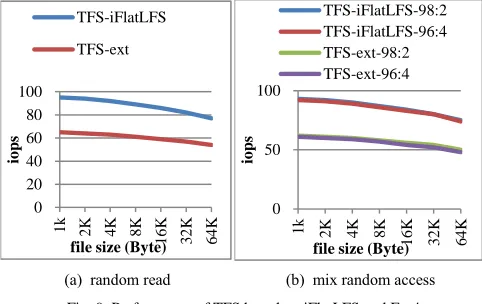
We have implemented iFlatLFS into TFS [9] because Hay-stack is not open source. We compared the performance be-tween the iFlatLFS-based TFS and the original implementation of TFS, which is based on Ext4.
In the experiments, we used the production workload traces observed in Facebook [3]. The testing cases in this paper in-clude random read and mix random access. As discussed in [3], [9], the production workload in the real world is typically dom-inated by read. The experiments used the same ratios of random read to write as set in [3] and the file size to be read or written ranges from 1 KB to 64 KB with the average of 16KB.
5.1 Performance of iFlatLFS
Firstly, we evaluate the performance of iFlatLFS in a typical DFS environment on a Dell PC, which has a 2.33GHz Intel Q8200 processor with 4 cores and 4MB L2 cache, 4GB of memory and a 500GB SATA disk. The partition size in all file systems is 128GB. The CentOS release 5.5 with kernel 2.6.18-308.8.1.el5.plusxen for x86-64 was installed. To support Ext4, XFS and ReiserFS, we also installed the e4fsprogs package of version 1.41.12-2.el5, the xfsprogs package of version 2.9.4-1.el5 and the reiserfs-utils package of version 3.6.19-2.4.1.
Based on the above platform, we used the open source mul-tithreaded disk I/O program named Randomio [21] to establish a baseline for the maximum read/write performance (regarded as the optimal performance that a file system can achieve), which is also how the baseline performance is established in reference [3]. We then tested and compared the performance achieved by Randomio, iFlatLFS, Ext4, XFS and ReiserFS. In the experiments, the file size ranged from 1 KB to 64 KB.
Since the objective of the experiments is to evaluate how well the file systems (i.e., iFlatLFS, ext, xfs and ReiserFS) work in the context of DFS, the data storage layout in the data servers and the accessing patterns to these stored data were generated in the experiments to mimic the real DFS context. In Ext4 and ReiserFS, 2048 data block files, each with the size of 64 MB, were, while in the iFlatLFS and XFS, a total of 8 data partitions with the size of 16G, each of which corresponds to a data block, were created. Therefore, the entire system has the storage of 128GB. Note that XFS is used in Haystack devel-oped by Facebook for handling photos. Haystack is not re-leased. So we configure XFS to mimic the DFS context only according to the information available in the literature [3].
We then wrote 80GB of small-size data (ranging from 1KB to 64KB) into these data block files in Ext4 and ReiserFS, and also into the data partitions in iFlatLFS and XFS. The experi-ments were then conducted for both the existing file systems and iFlatLFS in the following 3 steps: 1) selecting a data block randomly, and also selecting a random offset on the data block; 2) reading or writing the data from the offset of the selected data block; 3) repeating step 1 and step 2 for 1000 times. As in TFS [9], the number of I/O operations performed per second (iops) is used as the metric to measure I/O performance, which can be regarded as the throughput of a file system.
Fig. 8a shows the performance in terms of iops when there are only read operations. As can be seen from Fig. 8a, iFlatLFS can significantly outperform other file systems in all cases (by 48% on average in case of Ext4), and the performance achieved by iFlatLFS is very close to the baseline performance obtained
by randomio. These results suggest that iFlatLFS is able to
achieve near-optimal I/O performance. A closer observation from Fig. 8a also shows that as the file size increases, the per-formance advantage of iFlatLFS over other file systems de-creases. This is because iFlatLFS optimizes I/O performance by reducing the I/O overhead such as the overhead of looking up metadata and data addresses. When the file size increases, the proportion of overhead in the whole duration of an I/O opera-tion decreases, and consequently the advantage of iFlatLFS becomes less prominent.
[image:10.567.293.535.177.325.2](a) random read (b) mix random access
Fig. 8 Performance of Randomio, iFlatLFS, Ext4, XFS, ReiserFS Another interesting observation is that Reiserfs obtains the worst performance, even worse than Ext4. The reason for this is explained as follows. Reiserfs can indeed optimize the perfor-mance of accessing small files in local computers. However, when Reiserfs is used as the file system on the data servers of a DFS, the files that Reiserfs receives from the upper DFS are the data blocks formed by the combined-block approach. Such a data block is relatively big (e.g., it is 64MB in TFS), which means that the files received and stored by Reiserfs are actually big. ReiserFS is engineered so that it can handle small files efficiently, but does not have good performance when handling big files. This is why Reiserf exihibits poor performance in the figure. This result suggests that although Reiserfs can optimize the performance in accessing small files in local computers, it does not show good performance in the context of DFS. This result once again shows the necessity of our work.
It can be seen from Fig. 10a that XFS used in Haystack de-livers the higher performance than Ex4 and ReiserFS. This re-sult is expected because XFS is configured in the experiments in the similar way as it is used in Haystack. However, the per-formance of XFS is still worse than that of iFlatLFS, which can deliver the near-optimal performance. This is because XFS is still designed following the principles of the traditional file systems, for example, using the hierarchical data management model. However, iFlatLFS is completely re-designed (e.g., us-ing the flat data storage structure) to minimize the overhead for accessing massive small files in DFS. Consequently, the data addressing overhead in XFS is higher.
Fig. 8b shows the performance of iops when there is a mix-ture of reads and writes. In the legend of Fig. 8b, the suffix of 98:2 represents the random access mixing 98% reads and 2% writes, while the suffix of 96:4 represents the mix of 96% reads and 4% writes. It can be seen from Fig. 8b that in all cases, iFlatLFS can achieve near-optimal performance and significant-ly outperforms other file systems (by 54% on average in case of Ext4). These results are consistent with those observed in Fig.
0 20 40 60 80 100 120 140
1k 2K 4K 8K
1
6
K
3
2
K
6
4
K
io
p
s
file size (Byte) randomio iFlatLFS
ext xfs
reiserfs
0 20 40 60 80 100 120 140
1k 2K 4K 8K 16K 32K 64K
io
p
s