Original citation:
Cullen, Mairi Ann, Cullen, Stephen Michael and Lindsay, Geoff (2017) A better start
implementation evaluation workstream Report 2 - learning from the grant set up phase.
University of Warwick: Warwick Consortium.
Permanent WRAP URL:
http://wrap.warwick.ac.uk/89947
Copyright and reuse:
The Warwick Research Archive Portal (WRAP) makes this work by researchers of the
University of Warwick available open access under the following conditions. Copyright ©
and all moral rights to the version of the paper presented here belong to the individual
author(s) and/or other copyright owners. To the extent reasonable and practicable the
material made available in WRAP has been checked for eligibility before being made
available.
Copies of full items can be used for personal research or study, educational, or not-for-profit
purposes without prior permission or charge. Provided that the authors, title and full
bibliographic details are credited, a hyperlink and/or URL is given for the original metadata
page and the content is not changed in any way.
A note on versions:
The version presented in WRAP is the published version or, version of record, and may be
cited as it appears here.
Acknowledgements
The authors would like to thank the people in the five A Better Start areas (Blackpool, Bradford, Lambeth, Nottingham and Southend) who gave so generously of their time to interviewed. Without their participation, there would have been no report. We extend our thanks also to the administrative staff in these five areas who helped to organise the logistics of the interview dates, times and locations.
We would also like to thank our research secretaries in CEDAR who transcribed the interviews so expertly.
This report is an output of the Warwick Consortium A Better Start Evaluation, funded by Big Lottery Fund. The views expressed are therefore those of the authors and not necessarily those of the Big Lottery Fund.
Table of Contents
Executive Summary
... iv
1. Introduction
... 1
1.1
A Better Start ... 1
1.2
The evaluation of A Better Start ... 1
1.3
The focus of this report ... 2
1.4
Data collection and analysis ... 3
1.5
Reporting learning from the data collected ... 4
2
Organisational structures: governance
... 7
2.1
Introduction: legacy from the bid development stage ... 7
2.2
Developing governance during the grant set-up phase ... 8
2.3
Accountability ... 8
2.3.1
Financial accountability
... 8
2.3.2
Sustainability accountability
... 9
2.3.3
Levering a shift in statutory spending towards prevention
... 10
2.3.4
Working together to deliver better, more accessible
services for families
... 12
2.4
Parents and community representation in the
governance structures ... 14
2.4.1
Refining where the A Better Start wards’ communities
were to be represented in the governance structures
... 14
2.4.2
Approaches to the decision-making role of community
representatives
... 16
2.5
Governance structures as building capacity for
A Better
Start
... 17
3
Organisational structures: area teams
... 18
3.1
Introduction ... 18
3.2
Recruitment and support of core team ... 19
3.2.1
What attracted new staff to A Better Start roles?
... 19
3.3
Induction ... 20
3.3.2
Variation over time
... 21
3.4
Creating implementation teams ... 23
3.4.1
The leadership of the Directors and Programme
Managers
... 23
3.4.2
Creating a core team
... 23
4
Planning services
... 26
4.1
Introduction ... 26
4.2
Year 1 planning and priorities ... 26
4.2.1
Year 1 priorities for directors and programme managers
... 26
4.2.2
Year 1 priorities for strand leads
... 28
4.2.3
Year 1 priorities for community-focused team members
... 29
4.2.4
Year 1 priorities for business support roles
... 29
4.3
Addressing foreseen challenges ... 30
4.3.1
Predicted potential challenges and ways to address
these
... 30
4.3.2
Local area strengths
... 33
5
Monitoring systems
... 35
5.1
Introduction ... 35
5.2
IT systems and data management ... 35
5.2.1
IT systems for monitoring data
... 35
5.2.2
IT systems for cost benefit analysis
... 36
5.3
Service design for portfolio projects ... 36
5.4
Local evaluation ... 37
6
Looking ahead 10 years
... 39
6.1
Confidence in the local partnership ... 39
6.2
The next steps ... 40
6.2.1
Supportive feedback loops
... 40
6.2.2
Learning from experience
... 40
References
... 41
Appendix 1: The Warwick Consortium evaluation
... 42
List of tables
Table 1: Interviewees by role category (N = 33) ... 4
Table 2: How funding is leveraged ... 11
Table 3: 13
Table 4: Community representation in governance at time of
these interviews ... 15
Table 5: Steps 7, 8 and 9 of the Quality Implementation
Framework ... 18
Table 6: Examples of why an
A Better Start
job was attractive ... 19
Table 7: Induction: composite list of what was found useful ... 21
Table 8: Induction in one area: developments over time ... 22
Table 9: Creating a core team ... 25
Table 10: Examples of Year 1 priorities ... 27
Table 11: Year 1 priorities ... 28
Table 12: Composite list of Year 1 priorities within illustrative
remit (learning development) ... 29
Table 13: Business support priorities during Year 1 ... 30
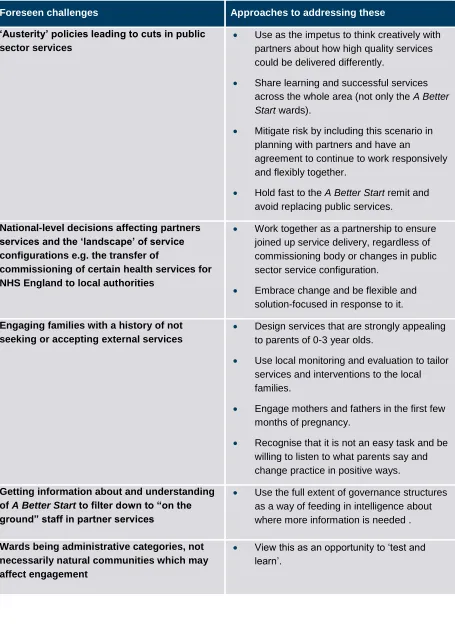
Table 14: Composite list of challenges and approaches to
addressing these ... 31
Table 15: Step 11 of the Quality Implementation Framework ... 35
Table 16: Summary of steps in the Social Research Unit's service
design process ... 37
Executive Summary
The Big Lottery Fund has committed to invest £215 million over 10 years (2015 to 2025) in A Better
Start which aims ‘to deliver a step change in the use of preventative approaches for babies and
children from pregnancy to three years of age. It is being implemented in five selected areas of England: Blackpool, Bradford, Lambeth, Nottingham, and Southend. Each A Better Start area comprises specific wards with a population of 30,000 to 70,000 people where there is evidence of deprivation and high levels of need among children.
This is the second report of the implementation evaluation of A Better Start. Report 1 focused on the evaluation of the bid development phase, which led to the five areas being selected to be part of A
Better Start. In this Report 2 we focus on the grant set up phase, drawing upon interviews undertaken
with 33 interviewees in different roles within the five areas, carried out between April and September 2015.
An early version of the key learning themes from this stage of the evaluation was presented to a knowledge exchange workshop organised by the Warwick Consortium’s partner ECORYS in December 2015, attended by representatives from each A Better Start area, and an initial report was presented to the Big Lottery Fund. The present report comprises a refinement of this earlier report, presented with a view to learning from the evaluation that has longer term usefulness, rather than the immediate purpose of informing the Big Lottery Fund and sites to issues that required early consideration.
The evaluation addresses two phases of the Quality Implementation Framework1 which provides the conceptual basis for the implementation evaluation. This report addresses the latter part of Phase 1 and Phase 2 of the framework (steps 5 to 12). We examine
Organisational structure: governance, including:
- Development of governance structures;
- Accountability for finance and sustainability;
- Parents and community representation;
- Governance structures as building capacity for A Better Start.
Organisational structures: area teams, including :
- Recruitment and support of the core area teams;
- Induction;
- Creating implementation teams.
Planning services, including:
1
- Priorities for staff with different leadership roles;
- Addressing unforeseen challenges.
Developing monitoring systems
- IT systems and data management.
- Monitoring data.
- Cost benefit analysis.
- Local evaluation.
Looking ahead 10 years.
1.
Introduction
1.1
A Better Start
The Big Lottery Fund has committed investment of £215 million over 10 years (from 2015 to 2025) in the ‘Fulfilling Lives: A Better Start’ programme, referred to throughout this report as A Better Start.A
Better Start aims to, ‘deliver a step change in the use of preventative approaches for babies and
children from pregnancy to three years of age’2
. It is designed to enable different models of effective preventative services to be implemented and tested out locally in the five selected areas: Blackpool, Bradford, Lambeth, Nottingham and Southend. The five A Better Start areas are each made up of
specific wardswith a population of 30000-70000 people where there is evidence of deprivation and high levels of need amongchildren, as measured by data on child poverty, low birth weight births, child development at age 5, and obese children at Year 6.
A Better Start focuses on pregnancy and the first three years of life. In particular, it aims to create
population-level improvements in the life chances of childrenthrough the investment being spent on the design and delivery of preventative interventions implemented collaboratively across health and other public services and the voluntary, community and social enterprise (VCSE) sector. It is directed at creating improvements in three outcome domains: social and emotional development, diet and nutrition, and communication and language development. The fourth desired outcome is long term systems change in the way that local health, other public services and the VCSE sector work together to improve outcomes for children. By ‘systems change’ the Big Lottery Fund3
means changes in organisational culture, policies and procedures within individual organisations, or across organisations, that enhance or streamline access and reduce or eliminate barriers to the services needed by a target population. In relation to A Better Start, it means achieving three outcomes in and across services and agencies working with children and families:
A shift towards prevention in culture and spending.
The coproduction and delivery of less bureaucratic, more joined-up services that are led by needs and demand and that focus on prevention.
Effective work with the whole familyto improve outcomes for children.
1.2
The evaluation of A Better Start
The Big Lottery Fund appointed the Warwick Consortium to undertake the evaluation and learning contract for A Better Start. The Consortium is led by Professor Jane Barlow, University of Warwick4, and comprises a team from the Universities of Warwick, Oxford, Imperial, King’s College London (KCL), Glasgow, and Durham; Ipsos MORI; Bryson Purdon Social Research; and ECORYS.
2
From Expression of Interest guidance notes, 2012
3 Taken from the Big Lottery Fund document, ‘A Better Start definitions, version 1, June 2016’. 4
The aim of the research is to evaluate the impact and cost effectiveness of A Better Start and to understand the systems change that was delivered. The evaluation of A Better Start comprises a combined (mixed) methods design including impact, cost effectiveness and process components.
The impact study comprises a cohort study in the five A Better Start areas and 15 matched comparison sites, beginning in pregnancy in 2017 and ending in 2024 when the children are age 7 years.
The implementation evaluation comprises the collection of process data from the sites, including a profiling of the structure and services being provided at baseline and yearly thereafter; and data regarding the participating families and the services they receive.
In addition, a third strand of the evaluation comprises learning and dissemination.
1.3 The focus of this report
This is the second in a series of reports aimed at sharing findings from the implementation evaluation
of A Better Start. The first report introduced the A Better Start programme and its evaluation, looked
at the evaluation of the bid development phase(January 2013 – June 2014)5, and drew out learning from that phase, using the ‘Quality Implementation Framework’6
(QIF) as a tool.
This second report also focuses on learning messages - those arising out of the grant set-up phase (September 2015 – March 2016). The ‘grant set-up phase’ is the term used by the Big Lottery Fund to define the period of preparation required to ensure that all necessary plans and agreements are in place to allow the release of Big Lottery Funding to an accountable body. The Big Lottery Fund’s aim was to have all five sites at this stage by end of March 20157. The plan was that the next Big Lottery Fund phase, two years of implementation and embedding, would begin from April 2015, later to be followed by a full delivery phase from April 2017. However, the Big Lottery Fund knew that the timings on these phases would, in reality, vary from site to site depending on how each A Better Start
site developed.
The implementation evaluation of the grant-set-up phase was guided by three research questions:
1. What services, organisational structures and monitoring systems were in place at the beginning of the programme?
2. What planning procedures were undertaken in order to set up and implement the programme?
3. What was the nature of the relationship between the A Better Start areas and the external support made available to them during the grant set-up phase.
5
Cullen, M A, Cullen, S and Lindsay, G (2017) A Better Start Implementation Evaluation Workstream Report 1: Learning from the Bid Development Phase.
6
Meyers, Durlak and Wandersman, 2012. See Appendix 2.
7
Research question 1 was interpreted in two ways: (i) in relation to each A Better Start area’s own
services, structures and monitoring systems and (ii) in relation to the services, structures and monitoring systems in the geographic areas with which the A Better Start work would interact. However, during our visits to the sites, we found that (ii) was in process by the relevant people in each
A Better Start team and was described to us as a valuable relationship and knowledge-building
exercise for that stage of development of work in each area. We therefore made the decision that it was preferable for the sites to do this work without what could be construed as an added complication of us also getting involved. Instead, we agreed to seek permission to have access to this knowledge at a later date. This aspect of the evaluation is not, therefore, included in this report but will be reported on in due course.
1.4
Data collection and analysis
This report is based on data collected through 31 semi-structured interviews with 33 A Better Start
personnel from across the five A Better Start areas, carried out between 16 April and 30 September, 2015. The intention had been to conduct all of the interviews over April to July 2015. This happened in four of the five sites; in the fifth site, the delay into September in achieving interviews related to the elongation of the grant set-up phase in that site (for example, the later than expected appointment of a Director and signing-off of the partnership agreement).
In advance of the interviews, each site was asked to send their link researcher a copy of that area’s A
Better Start governance structure diagram and a list of the names and roles of those appointed as A
Better Start team members.
The interviews were conducted using a semi-structured interview schedule focused on looking back
over the grant set up phase (September 2014 to March 2015), describing and discussing progress
[at date of interview] during Year 1 of the implementation and embedding phase (April 2015 – March 2016) and looking forwards to predictions of what would support the 10-year programme locally and what could threaten its success if not mitigated against. There were six main section headings:
About the interviewee’s role.
Grant set-up phase: changes from bid and work priorities.
Governance structures.
Data and IT systems.
Year 1: First portfolio projects and role-specific work priorities.
The future: strengths and threats over the 10-year timeframe.
The interviewees’ job titles varied widely. In Table 1, these are categorised to indicate the range of roles represented in the sample, whilst protecting the anonymity of those with unique job titles. For the same reason, throughout the report, the role one rung below A Better Start area Director is referred to as the ‘programme manager’, regardless of the actual title used in any single site.
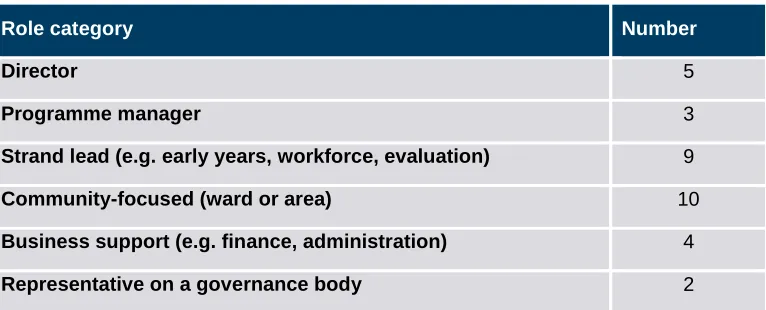
Table 1: Interviewees by role category (N = 33)
Role category Number
Director 5
Programme manager 3
Strand lead (e.g. early years, workforce, evaluation) 9
Community-focused (ward or area) 10
Business support (e.g. finance, administration) 4
Representative on a governance body 2
Source: Implementation evaluation
The interviews were carried out face-to-face or by telephone, depending on the preference of the interviewees. The interviews were recorded (with informed consent), fully transcribed and analysed thematically. That is, the interview transcriptions were coded individually against pre-determined themes from the interview schedule (deductive analysis), and emergent themes raised by the interviewees (inductive analysis). The development of the thematic coding system was a recursive (iterative) process shared by two researchers. Testing of the coding revealed a very high inter-rater reliability (99 of 100 units of text were coded to the same theme or sub-theme by both researchers independently). Typically, the interviews lasted between 40 and 75 minutes. The transcriptions amounted to 643 pages of typescript.
1.5
Reporting learning from the data collected
To protect the anonymity of the interviewees, each was allocated a randomly generated unique number that had no association with area. In this report, these are used where quotations have been included. Similarly, the five A Better Start areas were also allocated a random number between 1 and 5. These are used when it is necessary to distinguish between different areas.
On 9 November 2015, key learning themes derived from analysis of the data described in Section 1.4 were included in a Knowledge Exchange Workshop, organised by Warwick Consortium partner, ECORYS. The event was attended by representatives from each A Better Site area, the Big Lottery Fund and Warwick Consortium. Subsequently, in December 2015, a draft report based on six main learning themes arising from the data was submitted to the Big Lottery Fund. The six themes were:
Maintaining the A Better Start vision.
Building the workforce and workforce development.
The meaning of ‘system change’.
Long term threats to A Better Start.
Leadership and organisation.The themes had been identified as highlighting specific issues where formative feedback was deemed to be to the immediate benefit of the overall programme. That draft report informed, alongside other sources, the development by the Big Lottery Fund of a ‘Shared learning and development
programme’of capacity-building activity for the five sites. However, it was agreed that a revised and extended version of the report would be more useful for dissemination; hence this present report.
In this revised and extended report, the same issues are included but these are presented in a different way, with a view to longer term usefulness, rather than the more immediate purpose of alerting the Big Lottery Fund and the sites to issues we believed required early consideration.
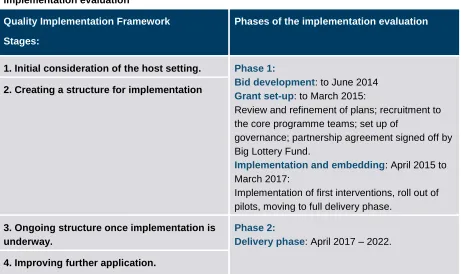
In this report, the chapter headings refer to aspects of our first two research questions (organisational structures, monitoring systems, planning, and services) and each, where relevant, includes data relevant to our third research question concerning external support. As in Report 1, we also draw upon the Quality Implementation Framework (Meyers, Durlak and Wandersman, 2012) to help in understanding the data. That is, once the thematic analysis was completed, we then related the findings to the Quality Implementation Framework; we did not ‘impose’ the Framework on the data during thematic analysis. The Quality Implementation Framework comprises a synthesis of 25 other implementation frameworks. The Quality Implementation Framework has four phases and 14 steps (see Appendix 2). The data presented in this report relate to the following steps of the Quality Implementation Framework:
- Capacity-building strategies (part of Phase 1 of the Framework):
- Step 5 Obtaining explicit buy-in from critical stakeholders and fostering a supportive community/organisation climate (Chapter 2).
- Step 6 Building general/organisational capacity (Chapter 2)
- Step 7 Staff recruitment/maintenance (Chapter 3).
- Step 8 Effective pre-innovation staff training (Chapter 3).
- Creating a structure for implementation (Phase 2 of the Framework).
- Step 9 Creating implementation teams (Chapter 3).
- Step 10 Developing an implementation plan (Chapter 4).
- Step 11 Technical assistance, coaching, and supervision (Chapter 5).
- Step 12 Process evaluations (Chapter 6).
In the final chapter (Chapter 7), we report interviewees’ views about what they see as strengths of A
Better Start that bode well to see it safely through its life-course to sustainability as the new ‘normal’
way of working and delivering services, as well as the potential threats they thought needed to be recognised and addressed. We also refer to A Better Start developments that happened subsequently to the work reported in Chapters 2-6. These can be seen as relating to the final two steps of the Quality Implementation Framework:
Improving future applications (Phase 4).
2
Organisational structures: governance
2.1
Introduction: legacy from the bid development stage
As part of the successful bids submitted to the Big Lottery Fund, each of the five areas had included a proposed structure for governance arrangements. These governance structures grew out of the links and relationships made during the bid development phase. They can be viewed as a representation of how each of the five A Better Start partnerships, led by a VCSE organisation, intended to work collaboratively to ensure:
Financial accountabilityfor how the Big Lottery Fund money is spent, including:
Monitoring what preventative interventions are provided for families and the take-up of that provision.
Monitoring the quality of interventions delivered.
Outcome accountability – that is, for ensuring that:
Expected beneficial impacts on improving children’s social and emotional development, health and nutrition, and communication and language development are achieved.
Sustainability accountability – that is, for ensuring that:
Money from statutory agencies in health and in the local authorities is forthcoming.
Ensure the long-term impact of the Big Lottery Funding on child wellbeing through the A Better
Start-influenced changes made to service systems8.
According to guidance9 issued to the areas during the bid-development phase, the area partnership
(often called the partnership board by interviewees) was the core component of the governance structures, being the decision-making body. It could be a new structure or an adapted version of an existing planning or decision-making body. In addition, one of the key responsibilities of the area partnership was described as: “[ensuring] that […] people from the local community feel ownership over and share accountability for the strategy that is developed”. “A significant number of” community representatives, “ideally residents”, were suggested as area partnership members or, in addition to the area partnership, areas could set up a community partnershipinvolving:
“key stakeholders from the local community, including representatives of parents who will be benefitting from the services and practitioners who will be helping to deliver it on the ground. […] The aim is for half the community partnership to be local residents.” (SRU Governance paper).
8
These bullet points are based on text from the paper, Governance, by the Social Research Unit (Dartington) as part of their Better Evidence for a Better Start (BEBS) work, commissioned by the Big Lottery fund during the development phase of A Better Start.
9
During the grant set-up phase, the governance structures proposed in the successful bids, informed by this basic structure, were refined and/or developed, in discussions between the five sites and the Big Lottery Fund - and through what was reported as hard work on the ground. One quotation illustrates this point:
“[The Big Lottery Fund] were involved in conversations along the way. They spoke to senior leaders. They spoke to the [area partnership] board. They spoke to us as lead organisation. They wanted to see a done deal. […] [That deal] with directors across the area required far more of a coaching leadership. ‘You can lead a horse to water but you can’t make them drink out of the same trough’ sort of situation. I spent a significant amount of physical and mental energies on [governance systems].” (I.12)
2.2
Developing governance during the grant set-up phase
During the set-up phase, interviewees reported, the five areas had to convince the Big Lottery Fund that their proposed governance structures demonstrated clear lines of accountability; where decisions would be taken and by whom; how the local community would be represented and to what extent these community representatives would have decision-making power; and how the A Better Start
governance would relate to existing structures of planning and decision-making in the area. In our view, the set-up phase work around refining and developing governance structures involved a
revisiting of Step 5 of the Quality Implementation Framework: obtaining explicit buy-in from critical stakeholders and fostering a supportive community/organisational climate, and its associated first two questions:
“Do we have genuine and explicit buy-in for this innovation [i.e. A Better Start] from:
Leadership with decision-making power in the organisation/community?
From front-line staff who will deliver the innovation [i.e. A Better Start]?
The local community?
Have we effectively dealt with important concerns, questions, or resistance to this innovation [i.e. A
Better Start]? What possible barriers to implementation need to be lessened or removed?
2.3
Accountability
During set-up, interviewees spoke about governance work related to the three types of accountability: financial accountability to the Big Lottery Fund; accountability to the partner organisations and the community to deliver better outcomes for local children and families; and accountability to ‘lever’ a shift in statutory service spending towards pregnancy and the first three years of life, thus ensuring sustainability of the A Better Start focus on prevention through improved child wellbeing.
2.3.1 Financial accountability
other money was spent by the statutory agencies in the area. Interviewees from all five areas reported a sense that ensuring financial accountability functions was a priority for the Big Lottery Fund during the grant set-up phase and all accepted that, given the size of investment being made, this was understandable. One quotation illustrates this shared view:
“This is a very large financial investment and I can understand why governance would be the most important part of [the grant set-up] phase.” (I.4)
From the interviews, it was clear that the Big Lottery Fund role was perceived as insisting that the lead VCSE organisation was the formal accountable body for the investment. However, it was also clear that the investment was in the partnership, not the lead body. This meant that the distinct rolesof the lead body’s board and of the area partnership board had to be clarified and agreed: “We
had a lot of conversation about the [lead body] board and the partnership board and the relationship between the two.” (I.7)
The A Better Start grant set-up phase coincided with a period of public service funding cuts. This was
viewed as an issue for A Better Start which had secure funding from the VCSE sector (the Big Lottery Fund). The governance structures had to be strong enough to guard against A Better Start
money being used to replace cuts in public services.For example, in one area, the local statutory services partners were described as being faced with making large cuts in public sector early intervention services. Although aware of “the guiding principle” that “the [A Better Start] programme mustn’t compensate for savings”, a local authority interviewee explained that she and a colleague drew up a savings plan knowing that the A Better Start services would “add strength” to early intervention services in the most deprived areas. This could be regarded as verging on the A Better Start money ‘compensating for’ cuts in public services except that the influence of being a partner in A
Better Start also had another effect, which was to encourage a focus on delivering services differently
(for example, by decommissioning some services and delivering them instead through children’s centres) so that, although there might be less public sector money, it did not necessarily mean that families would lose out. This example illustrates the importance of the area partnership board being able to ensure robust financial accountability for the Big Lottery Fund money, with the final accountability lying with the lead organisation.
Interviews indicated that the Big Lottery Fund encouraged site Directors to learn from each other and facilitated the relevant links – for example, sharing with other sites that one site had written terms of reference for the lead body board and for the area partnership board that defined their respective roles around financial decision-making and accountability. Other site Directors were then able to learn from that template and used it to develop a version that fitted their local area.
2.3.2 Sustainability accountability
The Social Research Unit’s Better Evidence for a Better Start (BEBS) Governance paper had been clear that the area partnership was to be the decision-making body for A Better Start in each area. Some interviewees indicated that, during the grant set-up phase, the ownership of decision-making
changes planned to be created by A Better Start would become embedded and sustainablein the long term.
For example, in one area with a particularly large area partnership board, an additional smaller group was created of “6 or 7 people, mainly statutory organisations”, plus a local councillor representing ward members and one parent and one voluntary sector representative “who can get together quicker than [the area partnership]” (I.9). The decision-making issue was that, while the intention was that the large area partnership board would “drive the programme” (I.9), there was a need to ensure that the smaller group was not, “creating something which takes away the decision-making power of the wider partnership” (I.16).
In each of the five areas this type of executive groupwas added in to the original concept of one partnership board with or without an additional community partnership group. In each case, a community representative was included on this smaller ‘executive’ group of mainly statutory organisation directors, something that one interviewee spoke about as an “important” way of preventing getting “wrapped up in our normal service conversation” (I.7). These executive groups reported to the area partnership board.
There seemed to be both a ‘top-down’ and a ‘bottom-up’ rationale for creating these executive groups.
The ‘top down’ rationale is illustrated by an interviewee who reported that during the grant set-up phase, the Big Lottery Fund was looking for the “top strategic leaders” (I.23) to be pulled in to the governance structures. One area chose to augment the existing local Health and Wellbeing Board to fulfil this function. In other areas, new groups were created to achieve this. To enable the lead person from each A Better Start area to “sit around the table with other directors of service”, the Big Lottery
was reported to have insisted that each area called their leader the ‘Director’, even when there was some local opposition to this (for example, one argument against it was that ‘Director’ meant something quite different in the VCSE sector to which the lead organisations belonged). Overall, interviewees supported this move – for example, one said:
“I think the appointment to the Director post has been good. I think that’s given us a strong leadership message […] I think to have [name] given that more strategic role is good in terms of how sure her role will be [in relation to] the local authority and public health; that’s really strong now.” (I.44)
The ‘bottom up’ rationale is illustrated by an interviewee who reported simply formalising regular meetings that had been happening in any case with local senior leaders and calling this the executive group.
2.3.3 Levering a shift in statutory spending towards prevention
Although financial accountability ultimately rested with the lead body, a key element of the A Better
Start approach was to insist that, over the life of the Big Lottery Fund investment, statutory services
a ‘bank’ alongside the A Better Start money but, over the bid development period and in to the grant set-up phase, slightly different approaches developed (Table 2).
Table 2: How funding is leveraged
Approaches to leverage funding
The lead body would hold a ring-fenced bank account, including the sum of ‘leverage’ money agreed during the bid development phase from two key partners (local authority and health) over
the first three years.
A bank accountfor the Lottery money and the leverage money had been created and reporting to the Partnership Board had been established. Leverage was on a formula basis, working up to an eventual 2% shift in public sector spending to prevention. Public sector partners were invoiced and paid in the money.
No pooled funds; instead, joint commissioning arrangementshad been agreed with public sector partners.
The local authority was hosting the bank on behalf of the lead body and had agreed to align
the Early Years’ budget and the Public Health 0-3s budget with the aims of A Better Start.
Each bullet point refers to a different area; one bullet may cover more than one area
Source: Grant set-up phase interviews, April –Sept 2015
Two quotations illustrate in a little more depth than in Table 2 two different approaches to the commitment to ‘lever’ change in public sector spending in order to build in sustainability from the start. In the first illustration, the partners had understood that the ‘leverage’ meant “real cash” and by time of interview (in 2015) had a bank account for the Lottery money and the leverage money and had established reporting to the Partnership Board. Leverage was on a formula basis, working up to the “2% shift that we’d had from SRU evidence. […] In the first year, partners committed 0.5% of the budget they are currently spending in our area of 0-19s (i.e. 0-3 years)”. Partners were invoiced and they paid over the money (I.7). As a contrast, in another area, one interviewee (I.23) explained that the context of local public sector budget cuts meant, “There’s no extra money. All statutory agencies for the next five years are going to take huge amounts of knocks”. Instead, in this area, the local authority was hosting the bank on behalf of the lead body and had agreed to “align the Early Years’ budget and the Public Health 0-3s budget”. This was viewed as the partnership, “coming together to have the best outcomes for our children and families”. Rather than, “having separate pots of money everywhere [it was] bringing it collectively together”. Creating this bank was not viewed as a problem and was deemed to be working well.
All five areas were aware of the impact of public sector budget cutson their partnership colleagues and, in this context, the willingness of partner organisation to “share resources with a well-funded organisation [A Better Start]” was seen as illustrating the importance public sector partners placed on
A Better Start:
when there’s that going on is, I think, quite something to pull off. It shows the importance that they put on A Better Start.” (I.7)
This is important because, as one interviewee put it, systems change was closely related to, “decision-making on how other money in the [local area as a whole] is spent” (I.12).
2.3.4 Working together to deliver better, more accessible services for families
Systems change as defined by the Big Lottery Fund for A Better Start is about more than shifting statutory services spending towards prevention; it is also about improving access to services by the target population; and working together, across sector divides, to create less bureaucratic more joined up services that work with the whole family to improve outcomes for children10. As one person explained, workforce development plans were, “really linked to systems change”. This desire for a different way of working was a driver behind the creation of the executive groupsfeeding in to the area partnership boards (Table 3).
10 Wording in this sentence based on the definition of ‘systems change’ in the Big Lottery Fund
Table 3: System leaders involved in governance to facilitate systems change
Summary of system leaders opinions on system change
In this area, the members of the executive group were described as being,
“In time, the ones who, if there is an issue at any of the statutory partners
represented, they will unblockthose organisational issues. They’ll be the ones that
influenceall the strategic local boards, like the Health and Wellbeing Board, the Safeguarding Board, those statutory partner bodies. They are the ones who can influence those, who can make sure [A Better Start] is joined up.”
In this area, the executive group was described as crucial to:
“Culture change, getting everybody really engaged and working in a different way”
Each member of that group was asked, “to be responsible for different elements of A Better
Start” by leading a specific theme group.
In this area, the executive group was described as being,
“A small group of people in strategic positions to implement things. […] They’re
the group that actually make it happen, strategically […] that can implement these changes.”
In this area, the executive group remit was described as being to, “unblock blockages and other things”; another person from this area argued that:
“We need to ensure that strategic leads support the development ofthe systems change and understandthat and how that will work across the [whole area]not just in the A Better Start area.”
In this area, rather than create an executive group for the governance of A Better Start, the A
Better Start Director sat on the local authority’s senior leadership team where decisions were
made.
This was viewed as giving the director, “easy access to decision-makers within the local authority, rather than being sat outside it” (I.42).
The argument was that:
“It is only the statutory partners who can systems change. […] We want to
ensure that in 10 years’ time this is our way of working; this isn’t just a ‘one-off’
thing.”
Each bullet point is about a different area
Source: Grant set-up interviews, April – Sept, 2015
One interviewee used the image of A Better Start being “woven into” the fabric of the area:
“We’re thinking about sustainability right from the very beginning. We’re not setting up stand-alone stuff unless there’s no way around that.” (I.42).
2.4
Parents and community representation in the governance structures
Early in the grant set-up phase (September 2014), a two-day conference was held for the A Better
Start areas and other partners in Blackpool. At this event, Andrew Morris, who had been heavily
involved in the development of A Better Start at the Big Lottery Fund, included in his speech to delegates the advice:
“Don’t get rid of the voices of the children, the families and the community in the bureaucracy of governance.” (Andrew Morris, September 2014, Blackpool. Quoted from notes taken during the speech.)
It was clear from the interviews that all five areas worked hard during the grant set-up phase to develop their approach to parent and community representation as members of the area partnership and/or the community partnership, as well as ensuring parent and community voice in other groups feeding in information, advice, and expertise. In our view, this work related to the remaining questions associated with Step 5 of the Quality Implementation Framework:
“Can we identify and recruit innovation [i.e. A Better Start] champion/s?”
“Are there one or more individuals who can inspire and lead others to implement the innovation [i.e. A
Better Start] and its associated practices?”
“How can the organisation/community assist the champion/s in the effort to foster and maintain buy-in for change?”
2.4.1 Refining where the A Better Start wards’ communities were to be represented
in the governance structures
In all five areas, part of the grant set-up phase work was to refine where community representation, including by resident parents, was to fit within the governance structures. One issue discussed was
the definition of ‘community’. As noted in Report 111, the SRU’s Better Evidence for a Better Start
documentation and the Big Lottery Fund definition of community in relation to A Better Start did not match exactly. In our interviews, some made points about the distinction between a beneficiary, as being someone who lived in the ward/s identified as the A Better Start area, versus that of a
community representative for governance and other roles (for example as local parent champions) who, it was suggested, need not necessarily live in the ward/s so long as they had “excellent linksin the community” (I.75). Table 4 illustrates how community representation on the governance structures looked at time of interview (April to September 2015).
11
Cullen, M.A., Cullen, S., & Lindsay, G. (2016). A Better Start implementation evaluation report 1:
Table 4: Community representation in governance at time of these interviews
Community representations
The area partnership board had one parent representative from each ward-level group. The ward-level groups were made up of parents living in the ward and professionals working in the area. The plan was that, in time, the Chair of the area partnership board would be a community representative (at time of interview, the Chair was Director of Children’s Services). The executive group included a community representative but, in time, the planwas that that place would be given to the community representative chairing the area partnership board. The intention was that there would be a community representative on the sub-committee dealing with finance but, at time of interview (summer 2015, i.e. during Year 1) no-one had shown interest in that role.
In spring 2015 (time of interview) a local councillor represented the ward members on the executive group and work was about to start on finding a parent representative and a voluntary sector representative too. The area partnership board had parent representatives on it, with plans to increase this to 12, expecting that at least 6 would attend any one meeting.
There was a community partnership group of 12-15 people, mostly representatives of services across statutory and other public services, and the voluntary sector, which also included at least three parents. A parent representative from those on the community partnership group was a member of the executive group. Because there was a separate community partnership group, the area partnership boarddid not include community representation.
The community partnership group was made up exclusively of parents living in the A Better Start
area. The parent Chair of the community partnership group attended the executive group.Each of the thematic sub-groups included at least one parent representative. Because there was a separate community partnership group, the area partnership boarddid not include community representation.
Each bullet represents a different area.
Source: Grant set-up interviews, April – Sept 2015
The opportunity to be a local parent representative, included in the governance of A Better Start
alongside senior professionals, was valued by one such person interviewed:
“As Chair of [the community partnership group], I then have the opportunity to sit on the executive board of A Better Start which is a fantastic opportunity. I value it no end because I’ve got literally contact with top people. […] Genuinely, from the bottom of my heart, I feel very privileged to be able to sit on such a board because, let’s face it, it’s the highest you can go and I’m putting [the community group] view across.” (I.41).
On the other hand, an interviewee from another area that also had a separate community partnership structure argued that having a small number of community representatives ought not to be viewed as enough in terms of listening to the voice of local people, especially local parents:
“We have to be careful how we’re listening to the voice of all the parents, not just the two or three parents that might sit on the board of anything! (I. 23)
development phase to the more formal, structured, slimmed down community partnership group of just 12-15 representatives was not greatly welcomed by this interviewee for this reason: “For me, it feels like we’re missing what we had so I think we’ve still got a bit of work to do on that”.
2.4.2 Approaches to the decision-making role of community representatives
In some of the five areas, the grant set-up period had included thinking further about the relative weight in decision-making that was to be given to community representatives sitting on governance boards. For example, in one area, where parent representatives were voting members on the area partnership board, the grant-set-up phase included thinking through exactly how this would work: “We had to look at how that is going to work, at how many are there going to be and what their vote share is going to be” (I.12); and also how best to explain to other parents the influence of these representatives:
“We’re trying to make our governance structures clear for parents because we want them to understand that what happens in these [ward] partnerships does have a direct influence on the decisions that are made on the [area partnership] board.” (I. 60)
One interviewee highlighted what was seen as a potential issue related to the decision-making influence of parent representatives on the area partnership board. In that area, parents made up 40% of that body, and the remaining members were descried as “the usual people […] all from different organisations”. This person noted a potential tension between sustaining the A Better Start vision and parent decision-making, arguing that the parents had a potential block vote that could, in the face of divided views amongst other representatives from different organisations, be a de facto ‘majority’:
“What is interesting is that ‘the usual people’ are all from different organisations so, if the parents vote together, they’ll have the majority [sic] of the vote, so it will be quite interesting. There lies the rub, a little, because Big Lottery want to make sure that the decisions that were taken are based on the strategy we submitted, their priorities and appropriateness […] Actually, we’ve got the job as a programme, and a responsibility as a programme, to assure the Big Lottery that the parents will be supported and developed to the point that they can start making strategic decisions.’ (I.12)
This is an interesting insight in that it suggests the potential for tension over strategy and intervention choices between parents and the A Better Start vision. Here, the solution to this potential for tension was seen to lie in, “supporting and developing” the parents in the A Better Start approach. On the other hand, it was explained that it was unlikely that the area partnership would make any early decisions by voting rather than by reaching a consensus through discussion. (The training and support of parents taking on representative roles is discussed in Chapter 4, as part of the picture we gained of priorities for Year 1 of the embedding and implementation phase.)
meetings to have that experience. Subsequently, a formal recruitment process was planned but this interim taster approach was a starting point.
2.5
Governance structures as building capacity for
A Better Start
Step 6 of the Quality Implementation Framework is building general/organisational capacity. Its associated question is:
“What infrastructure, skills and motivation of the organisation/community need enhancement in order to ensure the innovation will be implemented with quality?”
This is explained further:
“Of note is that this type of capacity does not directly assist with the implementation of the innovation, but instead enables the organisation to function better in a number of activities (e.g. improved communication within the organisation, and/or with other agencies;
enhanced partnershipsandlinkageswith other agencies and/or community stakeholders).”
Over and above the governance core of the area partnership board and, in two areas, a community partnership board, each area also developed other groupslinking in to these. These groups were, or were planned to be, an important way of information, advice and expertise being channelled in to the governance of A Better Start in each area. In one area, for example, these groups included a steering group of providersfrom all the services that A Better Start hoped to influence (for instance, children’s centres, housing, libraries, midwives, health visitors) - “all the people […] that will help us implement the programme” (I.60). This provider steering group was also open to every member of the
A Better Start team. The same area also drew on the expertise of members of existing local
structures, such as the local Children’s Partnership and the Health and Wellbeing Board. In other areas, additional groups acted as conduits for enriching A Better Start with the expertise, information and advice of academics, practitioners, and community organisations and individuals. In this way, the core governance structures had access to these capacity-building links.
Finally, there was acknowledgment in all five areas that A Better Start was a ‘test and learn’ initiative
3
Organisational structures: area teams
3.1
Introduction
From our interviews, it was clear that each area’s core team contained a mix of those who had previously been involved in the bid development phase and those who had not previously been involved in A Better Start. Those involved in the bid development from Expression of Interest Stage had 18 months of A Better Start knowledge under their belts by the beginning of the Grant set-up phase in July 2014; those involved from Stage 2 onwards (August 2013), had almost a year’s experience by that point. It was also clear that appointments in each area were made over a period of time, rather than all at once. In our view, both of these facts could be expected to make the induction of new staff and the creation of a sense of a unified team somewhat challenging. This challenge is reflected in the Quality Implementation Framework by the fact that three separate steps within it relate to work around staff recruitment (Step 7), staff training (Step 8) and creating implementation teams (Step 9)– these steps are set out in more detail in Table 5.
Table 5: Steps 7, 8 and 9 of the Quality Implementation Framework
Quality Implementation Framework
Phase 1: Initial considerations regarding the host setting.
Capacity building strategies.
Step 7: Staff recruitment (see Section 3.1) “Who will implement the innovation?
Who will support the practitioners to implement the innovation?”
Step 8: Effective pre-innovation staff training (see Section 3.2)
“Can we provide sufficient training to teach the why, what, when, where and how regarding the intended innovation?
How can we ensure that the training covers the theory, philosophy, values of the innovation, and the skill-based competencies needed for practitioners to achieve self-efficacy, proficiency, and correct application of the innovation?”
Phase 2: Creating a structure for implementation
Structural features for implementation.
Step 9: Creating implementation teams (see Section 3.3)
“Who will have organisational responsibility for implementation?
Can we develop a support team of qualified staff to work with front-line workers who are delivering the innovation?”
Can we specify the roles, processes and responsibilities of these team members?
3.2
Recruitment and support of core team
3.2.1 What attracted new staff to A Better Start roles?
Interviewees among the core teams appointed in each area, who were new to A Better Start, were asked about what had attracted them to the role. Essentially, what was reported was a dovetailing of personal circumstances, skillsets and previous work and/or life experience with the vision for A Better
Start. This was a powerfully attractive cocktail: words such as “exciting”, “excitement”, “unique”,
“something really positive”, “innovative” were frequently used in describing the attraction of the roles (Table 6).
Table 6: Examples of why an
A Better Start
job was attractive
Reasons A Better Start Job was desirable
Fitted with personal circumstances (illustrative examples):
A return from maternity leave.
Needed a new job.
Desire to shift focus towards community-orientated work.
Offered opportunity to develop career in desired direction.
Offered opportunity to work part-time.
Offered opportunity to have a long-term/permanent job.
Built on skills sets and previous experience (illustrative examples):
Previous work with lead organisation.
Previous work with local authority or other lead partner.
Previous work in the local area.
Previous work in other communities.
The ‘hook’ of the A Better Start vision (illustrative examples from different roles and areas):
“It’s really exciting. You really feel you’re part of something unique”.
Attracted by ABS being about, “putting more power back into the hands of communities so that they could shape more accurately what they felt was more fitting to what their needs were”. “The concept for me was really exciting […] It also had a strong sense of moral purpose in the
role in terms of making a once-in-a-generation change and breaking cycles of poor outcomes linked to the wider poverty issues that [this area’s] got.”.
systems, community empowerment or engagement as they referred to it”. “Because of the ethos of the programme of helping children”.
“Massively appealed” because, “it is a ten year look at improving life chances for children”. “The excitement” of a new project that would be building on previous work in the area rather than
ignoring that – “we’re building on top of what’s gone on before and trying to make things better for the children and families”.
“What attracted me is that it’s a once in a lifetime opportunity to get it right for our children. [Previously] people worked in silos and we’re still not narrowing that gap. […] For me, this really gives us the opportunity to use A Better Start as a catalyst to drive system changes. […]
[because] the money is coming through the voluntary sector, it’s pushing people to work in a completely different way than what they’ve ever done before”.
Source: Interviews April to Sept 2015
3.3
Induction
In our view, the quality of the induction processes for new members of A Better Start teams are likely to be central to the transmission of both the mechanics and the vision of the programme in each area. Our Grant set-up phase interviews with new12 staff appointed to the A Better Start core teams indicated that their experiences of induction varied markedlyby areaand by time of appointment.
3.3.1 Variation by area
In Area 1, the new staff interviewed reported a sense of their being hierarchical layers of A Better
Start staff with no regular meetings of the operational lead level and a sense of a lack of
communication from layers above to that operational level. This contrasted with Area 5, where new staff interviewed described an emphasis on allowing time and space for reflective practice and regular team meetings of three different types, alongside a sense of a flat organisation, with clear leadership but no real sense of hierarchy. In Area 1, the lack of induction, of staff meetings and the poor communication was linked to reports of frustration and upset; in Area 5, the regular team meetings, the emphasis on reflective practice and the ‘flat’ management style were linked to reports of enthusiasm and excitement, and a really supportive environment. In Area 4, only one new member of staff was interviewed; this person reported benefitting from a planned induction. Table 7 provides a composite picture across the five areas of what was valued about induction processes.
12
Table 7: Induction: composite list of what was found useful
Induction: composite list of what was found useful
Induction pack
“On my first day, I was given an induction pack.”
I was given a folder with my first two weeks planned out for me.” For example, meetings to attend, people to meet, things that had to be done as a new employee of the voluntary sector lead organisation such as online safeguarding training.
Away Days
“Where we talked through our values, our beliefs, what was important, how we’d be working.” “Having a bit of time as a team to reflectwhere we are, what we’re doing, how we’re doing it
and how we can work better together.” Recognises that “because so much of what we do is
collaborative as a team and collaborative with externals and parents” that [...] there’s quite a lot of work and planning that we need to alignand get right [...] we all need to be saying the same things.”
“You get to know a bit about what we each do and how everybody’s role fits in with everybody else’s and how we are all working towards the same goal. […] It’s helping us understand things quicker and, because it’s every month, it’s reinforcing what we’ve already learnt because it touches on what we’ve already learnt..”
Regular staff meetings
“New staff have a weekly one with [Director], and we have the regular staff meetings where we share everything.”
“We have regular weekly meetings plus fortnightly planning sessions. I think, personally, if these programmes are going to work, you have to have time to think. You have to have time to
challenge.”/ “Our meetings are very effective. They work well. [...] I think we would be lost without them ...”
Office layout
In the office, we’ve set it up differently […] so we have a big creative space at the bottom to encourage all staff to work differently, to work together, to be collaborative, to be discussing.” “We are in very close contact in the office and share a great deal with one another.”
“being one big team based in one office and that we all interact with one another, I suppose it’s all part of the induction, you know, getting to know one another.”
Attending one or more of the 2-day events for the 5 areas
“Two and a bit days just purely dedicated to induction rather than the day to day business.”
Where more than one quote is given under a main bullet point, these are from different areas.
Source: Grant set-up interviews, April – Sept 2015, all 5 sites
3.3.2 Variation over time
structured induction but, once in place this was reported as having been valued and useful. In Area 3, those interviewed who were appointed during Grant set-up phase reported that there was no formal induction process; team days and weekly meetings began in early summer 2015 (i.e. during Year 1 of Embedding and implementation phase).
Table 8: Induction in one area: developments over time
Induction in one area: developments over time
Earlier appointment (illustrative
examples)
One interviewee said her induction was experienced as not structured enough. She recognised that this was partly because A Better Start was new - “It’s a new project for a new organisation” [meaning A Better Start] –
and so, “in terms of induction, there is no HR department, there’s no Payroll department …” She reported having had, “A few weeks reading through [the bid and other documents] but thinking,” ‘I don’t really know where I’m going or what my role is’. It was really uncertain and you had to find out a lot yourself and, you know, when you don’t ask the right person, you don’t get the right answer, do you?” She reported that others were supportive and willing to sit down and tell her things but, overall, she felt her induction had been, “a bit too free”. Also that the practical, factual systems information wasn’t shared –e.g. how expenses were claimed and where timesheets went.
Later appointments (illustrative
examples)
“We had a very good, appropriate induction which was well-timed and appropriately paced. […] We had one away day in particular which I remember where we pretty much went through the whole journey of how the bid was written.”
“I don’t feel like I’ve joined a movie half-way through. I got a good catch-up because bits that I missed, somebody filled me in on.”
“It’s been a strong induction over a lengthy period of time rather than this is your induction for your first two weeks and then get on with it. It’s a planned induction and it’s planned over a period of time. As the project develops and grows, the induction continues.”
Plan for subsequent appointments
“We’ve been developing an induction planto make sure that [the next phase of recruited people] feel fully [included]. [...] shadowing people, being introduced to people, lots of documents to read and not expecting them to start doing things straight away. Allowing them, and affording them, the
time to familiarise themselves with the programme. We’re all buddying up with somebodyso that they can come along with us and we’ll look after
them for the first few months and make sure that’s all in place. [...] We have got a plan in place to make sure that they feel they have enough support to be able to then start work. “