184
©IJRASET: All Rights are Reserved
A Study on the Structural Analysis and Design of
Pre-Engineered Buildings for Different Geometries
Santosh S. Patil 1, Sujay Deshpande 2
1
Post-Graduate Student, 2Assistant Professor, Department of Civil Engineering, KLS Gogte Institute of Technology , Belagavi- 590008
Abstract: In recent years, the introduction of Pre Engineered Building (PEB) design of structures has helped in optimizing design. The construction of PEB in the place of Conventional Steel Building design concept resulted in many advantages as the members are designed as per bending moment diagram and thus reducing the material requirement. This methodology is versatile not only due to its quality pre-designing and prefabrication, but also due to its light weight and economical construction. This concept has many advantages over the conventional concept of steel buildings with roof trusses.
In this study, three models of industrial structures of PEBs are analyzed and designed according to the Indian standards. The models are considered having different geometries and a parametric study is carried out to access the performance of the models in terms of self-weight, cost of construction and time of construction.
Keywords: Structural Analysis and Design,Pre Engineered Building (PEBs), Conventional Steel Buildings (CSBs), Self-Weight of the structure, Cost of construction, Time of construction
I. INTRODUCTION
From 20th century onwards, steel buildings are being used in all kinds of applications and their demand is increasing. The use of steel buildings became more popular when people got to know about its various advantages. These structures are used for both residential and commercial purposes. Pre-fabricated buildings came into existence in 1960’s. It has floor, ceiling frame etc. which were put together to make the structure. As a result, this made construction easier.
In present world, steel is bringing elegance, artistry and is functioning in endless ways contributing to new solutions for the construction of formidable structures, which were once unthinkable. Steel offers speedy construction right from the start. Due to its important characteristics like ductility, flexibility etc, steel is been widely used in the construction industry. It bends under the application of heavy loads rather than undergoing crushing and crumbling. Due to its strength, less rate, stability, flexibility and recyclability, it makes a great choice to use steel in construction. It is also seen that steel has some reserve strength in them. The conventional steel buildings are stable.
Various types of steel structures are available like arch buildings, clear span buildings, straight wall buildings. For agriculture purposes, the arch buildings are used as they are very strong and durable. The straight wall buildings are less strong, than arch buildings but have more space inside. The clear span buildings are mainly used for the storage of aircrafts.
There are mainly two categories in steel buildings-
Usually hot-rolled structural members are used in these buildings. Here the members are fabricated in factories and then transported to the site. The changes can be made during the erection by welding and cutting process. Normally trusses are used in this system. These are produced in the plant, itself. Here according to the requirements of the customer the manufacturing of the members is done. The components are made in completely ready condition for transportation. These are then sent to the site and then the erection process starts. The manufacturing process doesn’t take place at the site. PEBs are normally constructed for office, shop fronts, ware houses etc. Here the extra amount of steel is avoided because the sections are tapered according to the bending moment diagram.
A. Features of PEBs
185
©IJRASET: All Rights are Reserved
B. Advantages of PEBs
1) Reduced time of construction: These buildings are normally delivered in few weeks after the drawings are approved. It reduces the construction time by around 30%.
2) Economical: Due to its unique design approach, there is a lot of saving in design cost, manufacturing cost and also in erection cost.
3) Freedom in Expansion: These buildings can be comfortably expanded in length by the addition of extra bays. Also it can be expanded in breadth and height taking into account future expansion.
4) Longer span: They can be easily constructed up to 60m clear span.
5) Control in quality: The building components are produced at the factory under proper conditions and hence good quality is guaranteed.
6) Less Maintenance: Good quality paint is used for claddings and steel which suits the environmental conditions. As a result they are durable and require less maintenance.
7) Architectural-Versatility: These buildings are provided with many types of coverings, curved eaves and are also designed with pre cast concrete wall panels, block walls etc.
8) Available from Single Source: The entire building components are received from a single manufacturer. Therefore the conformity of the members is assured.
C. Applications of PEBs
The main applications of PEBs are summarized below: 1) Aircraft hangars
2) Industrial sheds
3) Offices
4) etrol bunks
5) Railway stations
6) Schools
D. Technical Parameters of PEBs
The basic parameters which make PEBs are-
1) Span of the structure: The distance between the end columns is called the span of building. It depends on the customer’s requirement. It varies from 10m to 150m. No changes can be done in span length.
2) Length of the structure: It is the total length which extends from front end to rear end of the structure.
3) Height of the structure: It is the distance from the bottom end of columns base plate up to the top of eave strut.
4) Slope of the roof: It is the inclination of the roof with respect to horizontal. Usually for tropical countries like India, it is kept as 1/10 and 1/20. In snowy regions it is kept as 1/30 to 1/60.
5) Bay Spacing: It is the distance between two-adjacent frames of the building. The distance between the centre lines of adjacent interior frame columns is called interior bay length. The maximum spacing which can be provided is 10m.
186
[image:3.612.115.508.78.362.2]©IJRASET: All Rights are Reserved
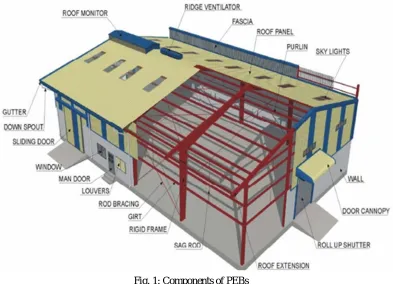
Fig. 1: Components of PEBs
II. LITERATUREREVIEW
A. N. C. Dubey and Swati Wakchaure (2016) have shown that by using pre-engineered-structure in construction, there are various advantages because according to the bending moment diagram, the designing of members is done. As a result, the steel is reduced. They have analyzed and studied according to IS 800-2007 and IS 800-1984 & the comparison of pre-engineered -structure with conventional steel-structure is done. They have also compared the weight of both the structures. From their studies they concluded that conventional steel-structure is 30% heavier than pre-engineered-structure and as a result the size of foundation is reduced of pre-engineered-structure.
B. Milind Darade and Milind Bhojkar (2014) have studied that the cost can be minimized by utilizing optimum cross-section of steel. Also they have shown the various application of PEB. They showed that for low rise building, PEB is found to be more economical than CSB. From their studies they concluded that CSB is 26% heavier than PEB and also PEB is 30% economical. C. Shilpa Kewate and Neha Kolate (2015) have studied the importance of having long span and structures having column free area
in industrial structures and pre-engineered-building are the ones which can fulfill such requirement. Other advantage of pre-engineered-building is its economy.
Here they have compared the analysis and design of pre-engineered-building and conventional steel-building. From their research they found that conventional steel-building is 23% heavier than pre-engineered-building and also the steel wastage of pre-engineered-building is less, thereby reducing the cost of construction. Also that the pre-engineered-building is 18% economical than conventional steel-building. They also concluded that conventional steel-building are used for clear spans up to 90m but pre-engineered-building is used for greater than 90m.
III.OBJECTIVESANDMETHODOLOGY
A. OBJECTIVES
The objectives of the present study are as given below-
1) To carry out structural analysis and design of PEB models by considering different spans. 2) To compare the results of the above parametric study using the following-
3) Self-weight of the structure 4) Cost of construction
187
©IJRASET: All Rights are Reserved
B. Methodology
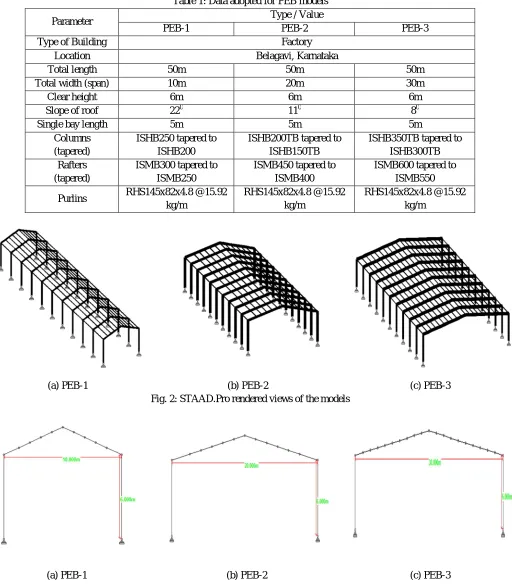
Three PEB models were created using STAAD.Pro software and analyzed for gravity loads and wind loads. The data adopted for the study are presented in Table 1. The STAAD.Pro rendered views of the models are presented in Fig. 2 and the elevation views of the models are presented in Fig. 3.
Table 1: Data adopted for PEB models
Parameter Type / Value
PEB-1 PEB-2 PEB-3
Type of Building Factory
Location Belagavi, Karnataka
Total length 50m 50m 50m
Total width (span) 10m 20m 30m
Clear height 6m 6m 6m
Slope of roof 220 110 80
Single bay length 5m 5m 5m
Columns (tapered)
ISHB250 tapered to ISHB200
ISHB200TB tapered to ISHB150TB
ISHB350TB tapered to ISHB300TB Rafters
(tapered)
ISMB300 tapered to ISMB250
ISMB450 tapered to ISMB400
ISMB600 tapered to ISMB550
Purlins RHS145x82x4.8 @15.92
kg/m
RHS145x82x4.8 @15.92 kg/m
RHS145x82x4.8 @15.92 kg/m
(a) PEB-1 (b) PEB-2 (c) PEB-3
Fig. 2: STAAD.Pro rendered views of the models
[image:4.612.56.568.141.725.2](a) PEB-1 (b) PEB-2 (c) PEB-3
188
©IJRASET: All Rights are Reserved
C. Loads and Load Combinations
1) Dead Load (DL): It is carried by the entire structure and includes the self weight, weight of permanent non-structural element, cupboards, floor finishes etc. The dead load can be determined from the weights of materials and also from the dimensions given in working drawing. It is determined from IS 875 (Part 1)-1987.
2) Live Load (LL): The objects in the building which can be shifted like desks, cupboards, machines etc. produce an imposed load on building. It doesn’t remain constant and varies with time. It is determined from IS 875 (Part 2)-1987.
3) Wind Load (WL): It has been considered to be having a considerable effect on the building. A structure constructed by heavy masonry will not be much affected by wind, whereas in case of steel structures, due to light weight materials, the wind has a dominant effect on it which in turn affects the durability. It is determined from IS 875 (Part 3)-1987. The loads considered for the design of the buildings are as follows-
4) Dead Load
5) Live Load
6) Wind load 00 (pressure) 7) Wind load 00 (suction) 8) Wind load 900 (pressure) 9) Wind load 900 (suction)
10) 1.5 (DL+LL)
11) 1.5 (DL+ Wind load 00 (pressure) ) 12) 1.5 (DL+ Wind load 00 (suction) ) 13) 1.5 (DL+ Wind load 900 (pressure) ) 14) 1.5 (DL+ Wind load 900 (suction) )
(a) PEBs subjected to Dead Load and Live Load (b) PEBs subjected to Wind Load
Fig. 3: Loads applied on PEB models in STAAD.Pro
IV.RESULTSANDDISCUSSIONS
Each of the three models was modelled and analyzed using STAAD.Pro and designed using validated MS-Excel sheets. Later, the results obtained were compared by using various parameters and the performance of the models was evaluated.
Following are the three parameters considered for the comparison of the results-
A. Self weight of the Structure
B. Cost of Construction
C. Time of Construction
189
[image:6.612.68.543.83.382.2]©IJRASET: All Rights are Reserved
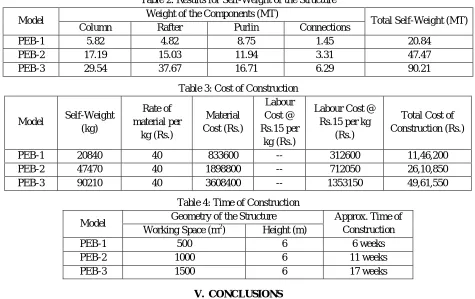
Table 2: Results for Self-Weight of the Structure
Model Weight of the Components (MT) Total Self-Weight (MT)
Column Rafter Purlin Connections
PEB-1 5.82 4.82 8.75 1.45 20.84
PEB-2 17.19 15.03 11.94 3.31 47.47
PEB-3 29.54 37.67 16.71 6.29 90.21
Table 3: Cost of Construction
Model Self-Weight
(kg) Rate of material per kg (Rs.) Material Cost (Rs.) Labour Cost @ Rs.15 per kg (Rs.)
Labour Cost @ Rs.15 per kg
(Rs.)
Total Cost of Construction (Rs.)
PEB-1 20840 40 833600 -- 312600 11,46,200
PEB-2 47470 40 1898800 -- 712050 26,10,850
PEB-3 90210 40 3608400 -- 1353150 49,61,550
Table 4: Time of Construction
Model Geometry of the Structure Approx. Time of
Construction
Working Space (m2) Height (m)
PEB-1 500 6 6 weeks
PEB-2 1000 6 11 weeks
PEB-3 1500 6 17 weeks
V. CONCLUSIONS
Each of the three models was modeled and analyzed using STAAD.Pro and designed using validated MS-Excel sheets. Later, the results obtained were compared by using various parameters and the performance of the models was evaluated. Following are the conclusions made from the study-
A. The study of Self-Weight of the models showed that the Self-Weight for PEB structures is relatively lesser than conventional steel structures, for the same geometry. With reduction in Self-Weight, the loads and hence the forces on the PEB structures will be relatively lesser, which decreases the effective sizes of the structural members.
B. The study of Cost of Construction of the models showed that PEB structures are economical compared to the conventional steel structures, for the same geometry. This is because the effective sizes of the structural members in PEB structures are lesser. Hence, the quantity of steel required for PEB structures will be lower than conventional steel structures.
C. PEB structures are preferable for bigger sized structures up to a certain optimum span. For smaller sized structures, the use of PEB technology won’t affect the overall performance and cost. So, conventional steel building technology can be adopted for smaller sized structures whereas PEB technology can be adopted for bigger sized structures up to a certain optimum span. D. The study of Time of Construction of the models showed that PEB structures can be constructed in a relatively lesser time
compared to the conventional steel structures, for the same geometry. On an average, the PEB structures can be constructed in about 30% lesser time than conventional steel structures.
To conclude “Pre-Engineered Building Construction gives the end users a much more economical and better solution for long span structures where large column free areas are needed”.
VI.FUTURESCOPE
A. This study can be extended to include various other geometries. B. Seismic Analysis can be carried out on the models.
REFERENCES
[1] Swati Wakchaure and N. C. Dubey (2016), “Design and Comparative Study of Pre-Engineered Building”, Volume 4, Issue 2, International Journal of Engineering Development and Research, IJEDR1602370
190
©IJRASET: All Rights are Reserved
[3] Neha Kolate and Shilpa Kewate (2015), “Economizing Steel Building using Pre Engineered steel sections”, International Journal of Scientific & Engineering Research, Volume 6, Issue 12, ISSN 2229-5518
[4] IS-800:2007, “General Construction of Steel- Code of Practice”, Bureau of Indian Standards, New Delhi
[5] IS: 875(Part 1)-1987, “Code of Practice for Design Codes (Other than Earth Quake) for Buildings and Structures”, Bureau of Indian Standards, New Delhi [6] IS: 875(Part 2)-1987, “Code of Practice for Design Codes (Other than Earth Quake) for Buildings and Structures”, Bureau of Indian Standards, New Delhi [7] IS: 875(Part 3)-1987, “Code of Practice for Design Codes (Other than Earth Quake) for Buildings and Structures”, Bureau of Indian Standards, New Delhi [8] SP-6(1) (1964), “Handbook for Structural Engineers- Structural Steel Sections”, Bureau of Indian Standards, New Delhi