Abstract— In this paper, an impact-assessment on critical aspects of driveability and functionality for three selected car systems prior and subsequent to incorporation of MEMS in automobiles was conducted. The three selected systems based on their importance are ignition, brake and safety systems. The analyses showed that driveability improved with increase in years of make and was synonymous with period of introduction of MEMS. The analysis on functionality showed that the introduction of MEMS reduced the frequency of repairs from every other day to monthly repairs. The cross-analysis of years of make of cars and average cost of maintenance per month shows that MEMS incorporated cars required higher maintenance cost.
Index Terms—Automobiles, Driveability, Impact-Analysis, MEMS,
I. INTRODUCTION
HE aim of this study is to assess the impact of MEMS systems on driveability and automobile performance. Driveability describes the complex and subjective feelings of a driver as he interacts with the vehicle. The study focuses more on assessing the car functionality whereas, only critical aspects of driveability are considered. Specifically the study involves a survey and assessment of MEMS application on automobile systems and components. Previous works [1] – [8], [12] related to this study were reviewed and applied to this research. A set of survey quarries was designed for different categories of car users. The questionnaires were designed to obtain a reasonable comparison between MEMS incorporated vehicles and those with limited MEMS components. Three selected car systems, namely, ABS, on-board computer and air bag featured on the questionnaires to distinguish between MEMS incorporated vehicles and those without MEMS.
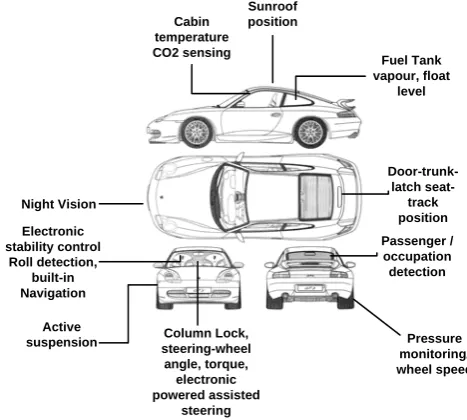
II. APPLICATIONOFMEMSINAUTOMOBILES In this section, discussion is on the incorporation of MEMS in the different parts of the automobile. In particularly, focus is on three prominent systems the safety, break and ignition systems. Shown in Figure 1 are some automotive applications of MEMS devices. More so, in the recent times, there have been increasing applications of
Manuscript submitted January 29, 2013; revised February 18, 2013.. O. E. Simolowo is a Senior Lecturer in the Department of Mechanical Engineering University of Ibadan Nigeria (phone: +2348059541882; e-mail: esimmar@ yahoo.com).
D.P.Olaoye was a Masters student at the department of Mechanical Engineering University of Ibadan Nigeria.
MEMS in different sectors such as military, medicine, and industry [13], [14], [15], [9], and [10]. Considering the introduction of MEMS components in the car systems, crankshaft sensors and camshaft sensors have replaced the distributors. Other MEMS sensors in the car are speed sensors found at each wheel, Antilock Breaking System (ABS) actuators which control brake system pressure, warning Lamp alerts which alert driver to system conditions, and throttle position sensors.
Pressure monitoring/ wheel speed Night Vision
Active suspension
Sunroof position Cabin
temperature CO2 sensing
Column Lock, steering-wheel angle, torque, electronic powered assisted
steering
Fuel Tank vapour, float
level
Electronic stability control
Roll detection, built-in Navigation
[image:1.595.320.554.303.513.2]Door-trunk-latch seat-track position Passenger / occupation detection
Fig. 1. Automotive Applications of MEMS Components
The airbag is a vehicle safety device that is an occupant restraint system consisting of a flexible envelope designed to inflate rapidly during an automobile collision. The airbag propellant is Sodium azide, a rapidly burning fuel that puts off extreme amounts of nitrogen gas. Equation (1) provides a good approximation of the relationship between the pressure and volume of the airbag, and the amount of N2 it
contains. nRT
PV (1) In equation (1), P is the pressure in atmosphere, V is the
volume in litres, n is the number of moles of gas, R is the gas constant in L*atm / mol*K (R = 0.08205 L*atm / mol*K), T is the temperature in Kelvin. The antilock breaking system (ABS) is integrated with conventional breaking system. It uses a computer controlled actuator unit between the break master cylinder and the wheel cylinder to control the break system hydraulics pressure. The non-correspondence between the wheel speed and vehicle speed is called “slip” and the magnitude of the slip is expressed by
Impact Assessment of MEMS Application on
Automobile Driveability and Functionality
Simolowo O. Emmanuel, Member, IAENG, and Olaoye D. Peter
the slip ratio (Sr) which is defined as equation (2). Vs and
Ws are vehicle and wheel speed respectively.
% 100 ) ( ) ( s s s r V W V
S (2)
Equation (3) is used to evaluate the plant of an ABS control loop shown in Fig. 2 [11].
Fig. 2. ABS Control Loop
T
b
J
(3)
J
=moment of inertial of tire about the axis of rotation,
=angular acceleration of the tire,
=angular velocity of the tire,b
=rotational damping of the tire (bearings). The Laplace form of eq. (3) are given as eq. (4), (5) and (6)(4)
)
(
)
(
]
[
Js
b
s
T
s
(5))
(
1
)
(
)
(
b
Js
s
T
s
C
(6)The actuator can be modeled as a servo system. The servo system has the transfer function shown in Eq. (7)
)
(
)
(
)
(
sb
Js
s
K
s
R
s
C
act
(7)The sensor used for the ABS application converts the velocity of the rotating wheel into a voltage. This application can be modeled as a tachometer. Equation 8 is the transfer function of a tachometer.
s
K
s
s
E
tach
(
)
)
(
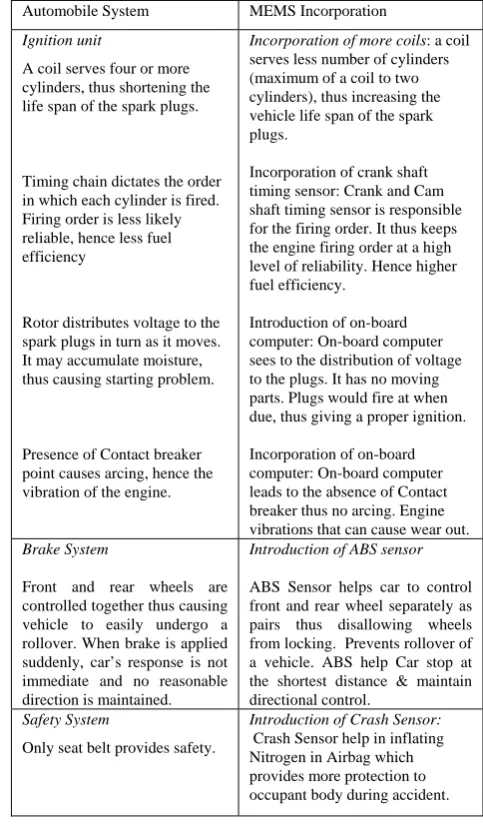
(8)An important application of MEMS in the ignition system is the Distributor Less Ignition System (DLIS). It is made up of the Engine Control Unit (ECU), Ignition Control Unit (ICU) and Magnetic Devices such as crankshaft and camshaft positioning sensors. The distributor less ignition System uses several electronic sensors instead of a distributor. Discussed in Table 1 are some of MEMS applications in the area of the three car systems considered in this research.
III. RESEARCHPROCEDURE
[image:2.595.312.554.245.663.2]A hundred car users were covered in the survey. Some of the queries captured by the survey include (i) number of cars owned by user (old or recent MEMS incorporated cars) (ii) year of make (iii) type of used car prior to purchase (local or overseas) (iv) incorporation of On-board Computer Ignition System (OCIS) (v) incorporation of Airbag mechanism (vi) incorporation of ABS mechanism (vii) mechanism most preferred in car (viii) mechanism most disliked in cars (ix) most problematic mechanism. (x) major car faults taken for repairs (xi) frequency of visit to auto-technicians (xii) average cost of maintenance per month.
TABLE I INCORPORATION OF MEMS IN AUTOMOBILE SYSTEMS
IV. RESULTANDDISCUSSION
The sequence of the presentation of the results in this section is in accordance with the research objectives proposed in section III. The discussion here in, begins with the general analyses of surveyed automobile users and type of used cars. The driveability and functionality assessment results are also presented and the section is concluded with Maintenance-cost analysis.
Automobile System MEMS Incorporation
Ignition unit
A coil serves four or more cylinders, thus shortening the life span of the spark plugs.
Timing chain dictates the order in which each cylinder is fired. Firing order is less likely reliable, hence less fuel efficiency
Rotor distributes voltage to the spark plugs in turn as it moves. It may accumulate moisture, thus causing starting problem.
Presence of Contact breaker point causes arcing, hence the vibration of the engine.
Incorporation of more coils: a coil serves less number of cylinders (maximum of a coil to two cylinders), thus increasing the vehicle life span of the spark plugs.
Incorporation of crank shaft timing sensor: Crank and Cam shaft timing sensor is responsible for the firing order. It thus keeps the engine firing order at a high level of reliability. Hence higher fuel efficiency.
Introduction of on-board computer: On-board computer sees to the distribution of voltage to the plugs. It has no moving parts. Plugs would fire at when due, thus giving a proper ignition.
Incorporation of on-board computer: On-board computer leads to the absence of Contact breaker thus no arcing. Engine vibrations that can cause wear out.
Brake System
Front and rear wheels are controlled together thus causing vehicle to easily undergo a rollover. When brake is applied suddenly, car’s response is not immediate and no reasonable direction is maintained.
Introduction of ABS sensor
ABS Sensor helps car to control front and rear wheel separately as pairs thus disallowing wheels from locking. Prevents rollover of a vehicle. ABS help Car stop at the shortest distance & maintain directional control.
Safety System
Only seat belt provides safety.
Introduction of Crash Sensor:
Crash Sensor help in inflating Nitrogen in Airbag which provides more protection to occupant body during accident.
)
(
)
(
)]
0
(
)
(
[
s
s
b
s
T
s
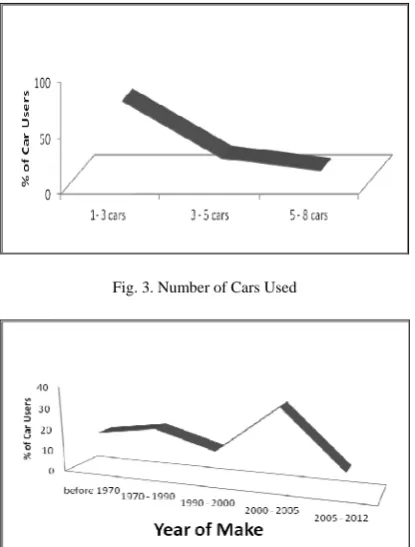
Fig. 3. Number of Cars Used
Fig. 4. Years of Car Manufacture
Figure 3 shows the response of the car owners and the number of car they have used or those used at present. It reveals that about 71% of the respondents owned at most 3 cars, 20% of respondents owned between 3 to 5 cars and the rest 9% owned between 5 to 8 cars. As shown in Figure 4, about 36% of respondents indicated that the years of make of their cars were between 2000 and 2005
[image:3.595.318.534.220.370.2]Fig. 5. Quality of Used Cars
[image:3.595.319.534.298.485.2]Fig. 6 : OCIS in Cars
Figure 5 shows that 40% of the surveyed population had fairly used foreign cars, only 25% indicated that they were using new cars, while the rest 35% purchased cars fairly used locally before purchase. Figure 6 shows a trend of cars with on-board computer ignition system (OICS). Majority of cars (depending on the car brand) made between years 1960 – 2000 do not have OCIS. The percentages of cars with OICS increases with the year of car make and vise versa. This is an indication of the period of MEMS incorporation into the ignition system of automobiles. Most of the analyses (Figures 6 – 12) show that the highest model of cars owned by majority of the car users are those made between years 2000 - 2005.
Fig. 7. Aibags Mechanism in Cars
Fig. 8. ABS in Cars
The trend of cars with airbags shown in Figure 7 is the same as that of cars with OICS in Figure 6. However, Figure 7 further reveals that less than 2% of cars made between years 2000 and above are without airbags. MEMS incorporation into the breaking system as shown in Figure 8 became significant in cars made in years 1998 and above. Before then a relatively higher percentage of cars (16% – 20%) were without ABS.
[image:3.595.60.280.459.747.2] [image:3.595.319.534.634.768.2]Fig. 10. Most Disliked Systems
Driveability Analysis
[image:4.595.313.541.273.635.2]In Figure 9, the driveability analyses shows that most of the car owners preferred the braking system with the highest users (17%) for cars made between years 2000 – 2005. This is followed by the Ignition systems. The trend continues with the safety system the least preferred. The level of preference also increases with increase in year of car make for all systems. Most distinctly, from Figures 9 and 10, drivability improves with newer cars with MEMS component particularly 2000-2012 cars. Figure 10 shows that most of the car owners disliked the ignition systems, followed by braking system. About 32% car owners (collectively for all years of car makes) indicated that there was nothing they dislike on their cars whereas out of 40% users of old model cars 6% strongly dislike the braking system, 21% indicated that it was ignition systems they dislike most and 10% of them agreed that they like every mechanisms of their cars
[image:4.595.64.277.455.592.2]Fig. 11. Problematic Car Systems
Fig. 12. Major Faults
Functionality Analysis
The trend in Figure 11 shows that the most problematic system before and after the incorporation of MEMS components is the ignition system. This correlates with the results of the driveabiliy analyses. About 58% of all car owners (1970 – 2012 models) indicated that what gave most problems were Ignition systems, followed by 32% which indicated that what gave most problem was Braking system of their cars. Only 2% indicated that what gave most problems on their cars had to do with the safety system. Figure 12 show that about 71% (collectively for 1970 – 2012 models) of the car owners indicated that the major fault on their cars was ignition system, followed by 25% which indicated that the major fault of their cars was brake system. Only 1% indicated that the major fault of their cars was safety system in their cars.
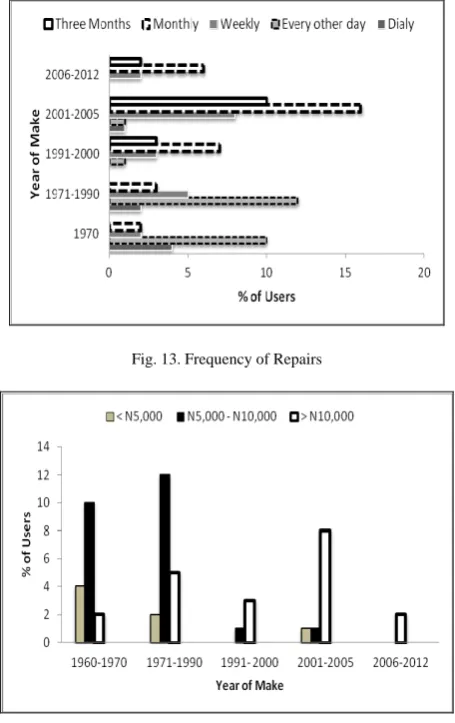
Fig. 13. Frequency of Repairs
Fig. 14. Maintenance Cost
[image:4.595.63.277.458.756.2]V. CONCLUSIONSANDRECOMMENDATIONS An assessment of selected car systems before and after MEMS incorporation was conducted. Findings obtained from this work have shown that there has been improvement on some aspect of driveability and functionality of automobile systems with the introduction of MEMS in the recent years. The trend presented by the study showed that driveability improved with introduction of MEMS. Whereas the effect of MEMS on systems functionality depends on the type of system, the cost of maintenance increased with introduction of MEMS components. It is recommended that further research work be directed towards the use of MEMS as it applies to other systems. To compliment the findings obtained in this work other cities should be accessed.
REFERENCES
[1] R. H. Bishop, Mechatronics: An introduction. CRC Press, K, 2006 [2] B. David, G. Randy, And R. Charles, “Micromirrors Relieve Communication, Bottlenecks, Photonics Spectra”, vol. 34, no. 1,
pp. 167-169, 2000.
[3] L. D. Devoe and P. A. PISANO, “Surface micromachined piezoelectric accelerometers,” Journal of Microelectromechanical
Systems, vol. 10, no. 2, pp. 180 -186, 2001.
[4] M. A. Fonseca, J. Kroh, and M. G. Allen, “Role Of MEMS In Endo- Vascular Pressure Sensor, Wireless Sensor For Biomedical Application,” Solid State Sensor Actuator and Microsystem
Workshop, 2006.
[5] H. A. James and T. Steven, “Selecting a process paradigm for an emergent disruptive technology: Evidence from the emerging microsystems technology base, 1997.
[6] J. James and Nutaro, Building software for simulation: theory and
algorithms, with applications in C++, Wiley, USA, 2010.
[7] C. Karnopp, L. D. Margolis, C. Ronald, Rosenberg, System
Dynamics: Modeling and Simulation of Mechatronic Systems, 4th
Edition, Wiley, USA, 2006.
[8] T. Koji, S. Hirofumi, N. Kunihito, K. Tanemesa, Asano, “Vaporization and nucleation on microheater in microchannel with nozzle,” (2001).
[9] M. Lemkin, N. Ortiz, B. Wongkomet, Boser, and J. Smith, “A axis surface micromachined sigma-delta accelerometer,” in 1997
Proc. ISSCCConf. pp. 202-203.
[10] M. MEHREGANY, and S. ROY, Introduction to MEMS,
Micro-engineering Aerospace Systems, Aerospace Press, AIAA, Inc., El
Segundo, California, 2000.
[11] Nader, S. ABS Breaking System. Available online 2012.
old.me.gatech.edu/nader.sadegh/ME3015/Projects/Terek.pdf [12] Onwubolu and C. Godfrey, Mechatronics: Principles and
Applications. Butterworth-Heinemann, UK, (2005).
[13] M. Shaika, Cementing the relationship between DCS and PLC, A review of emerging trend in plant control system, siemen energy
and automation. 2009.
[14] W. C. Tang, and A. P. Lee Military Application of
Micro-electromechanical System, the industry physicist, America Institute
of physics, New York, 2001.
[15] X. Wang, Q. Meng, H. Yu, Z. Yuan, and X. Xu, “Distributed control for cement production of vertical shaft Klin” International
journal of information and system science, vol. 1, no. 3 – 4, pp.