Experimental Study on Partial Replacement of
Cement by Corn Cob Ash and Coarse Aggregate by
Sea Shell
S.Manigandan1, G.S. Saravanakumar2
1 , 2
Assistant Professor, Department of Civil Engineering, CK College of Engineering and Technology, Cuddalore, Tamilnadu, India
Abstract: This paper describes the performance of partial replacement of cement with Corn Cob Ash and sea shell as coarse aggregate replacement in concrete. The CCA mainly consist of aluminium oxide and silica oxide and sea shell contains 95% of calcium carbonate which gives better compressive strength than conventional concrete. In this proposed work Corn Cob Ash with specified ratio of about 5%, 7%, 10% & 15% is replaced for cement and 10%, 15%, 20%, 25% of sea shell for partial replacement of coarse aggregate is used. The mechanical properties of concrete such as compressive strength, tensile strength and workability has been evaluated. The optimum percentage of combined percentage was found to be 10% of CCA and 20% of SS. The project result reveals that 10% of CCA and 20% of SS enhance the strength of concrete compared to other replacements. Appropriate utilization of these two materials as a partial replacement for cement and coarse aggregate can lead to the reduction of maize disposal and sea shell that is originating from the fishery industries, also it provides a way for low cost concrete.
Keywords: Corn Cob Ash(CCA), Sea Shell, low cost, concrete, compressive strength, tensile strength, workability.
I. INTRODUCTION
Concrete is majorly used thing in the world next to water and food and also it is one of the chief building material in the field of civil engineering. It acts as an important engineering material in the construction of structural elements such as beam, column, foundation, slab, wall, staircases, dams, retaining wall and so on. Its basic requirements include cement, fine aggregate, coarse aggregate and water.
Thus it creates the major factor that affects the overall cost, strength and durability of concrete production due to the depletion of materials.
Thus a detailed analysis is needed so as to develop or improve the required strength to withstand the loads. The concrete is mostly applied to the construction for its tremendous technical performance and low cost. But due to the demand of these basic building materials the cost of concrete is increasing rapidly which is one of the major drawback in this vast world. On the other side there are huge amount of wastes that have been disposed or dumped in our country.
The recent research by the Waste management says that in India nearly 950 million tonnes of solid wastes are disposed annually which include both biodegradable and non- biodegradable.
As a civil engineer we are responsible to clear such issues and to create a pollutant free India. Researchers all over the world today are concentrating on ways of consuming either industrial or agricultural or marine waste, as a basis of raw materials for production such because to reduce the cost of the concrete along with the light weight concrete and to minimize the disposed solid wastes which are very injurious to our human health. This project emphasis on the locally existing waste to be used as aggregates and cement. One such discarded is the seashells obtained from coastal areas, freshwater lakes, and riverine areas and other is the Corn Cob Ash (CCA) which is one of the agricultural waste being disposed in large content. The use of these materials as the additional material in concrete would reduce the dumping problem now faced by the industrial plants, agricultural areas, marine industries and at the same time achieving the required strength of concrete. This will not only offer new material for construction but also help the safeguarding of the environment.
II. SCOPE AND OBJECTIVES
A. General
1) To study the compressive strength of conventional cube and partially replaced cubes by 5%, 7%, 10%, 15% of Corn Cob Ash
(CCA) and 10%, 15%, 20%, 25% of sea shell.
B. Objectives
1) To deliver low cost housing delivery.
2) Consumption of abundant local raw materials. [CCA & Sea shell]
3) Balance both the cost of concrete and waste disposal problems.
4) To check the physical properties of ingredient materials.
5) To reduce the environmental impact and avert the world’s ecological balance.
6) To evaluate the mechanical properties by use of CCA and Sea shell in concrete.
C. Scope
Study the effect of using sea shell as partial coarse aggregate & CCA as partial cement replacement towards workability, compressive strength of concrete.The eventual scope of this works to know the performance or behaviour of partially replaced concrete mix compared to the conventional concrete.
III. MATERIALS
A. Cement
The commonly available Ordinary Portland Cement is categorized into three grades namely 33, 43, 53 grades reliant on the strength of the cement at 28 days. The cement preferred for this study is Ordinary Portland Cement of grade 53 confirming to IS12269-1987.
SI.NO TEST RESULTS
1 Fineness of cement 3%
2 Normal consistency of cement 33%
3 Specific gravity of cement 3.16
4 Initial setting time of cement 33 mins
[image:2.612.189.425.311.406.2]5 Final setting time of cement 535 mins
Table 3.1 Preliminary test on cement
B. Fine Aggregate
The aggregates used areof 20mmsize and the grain size of sand used is of zone 3. Natural river sand with fraction passing through 1.18mm sieve and retained on 150μm sieve wasused and tested as per IS: 2386-1983.
SI.NO TEST RESULTS
1 Fineness modulus 3.44
2 Specific gravity of fine aggregate 2.6
[image:2.612.174.441.468.544.2]3 Water absorption of fine aggregate 1.23
Table 3.2 Preliminary test on fine aggregate
C. Coarse Aggregate
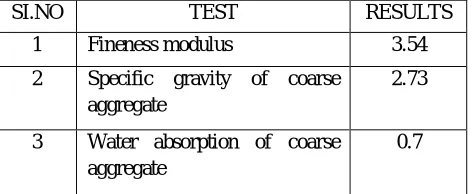
Coarse aggregate shall consist ofnaturally occurring materials such as gravel, or resulting from the crushing of parent rock, to include natural rock, slag’s, expanded clays and shale’s (light weight aggregates) and other approved inert materials with similar characteristics, having hard, strong, durable particles, confirming to the specific requirements.
SI.NO TEST RESULTS
1 Fineness modulus 3.54
2 Specific gravity of coarse
aggregate
2.73
3 Water absorption of coarse
aggregate
0.7
[image:2.612.190.426.621.718.2]D. Sea Shell
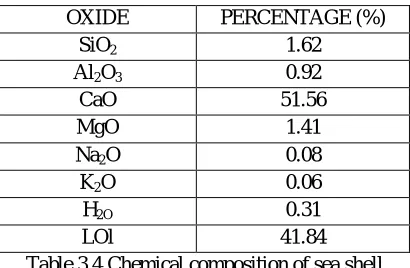
Seashell is a hard, protective layer, a calcareous exoskeleton which encloses, supports and protects the spineless parts of an animal (molluscs). The shell is part of the body of the animal. Empty seashells are often found washed up on beaches by beachcombers. Seashell consists of three layers outer, intermediate and inner layer. Outer layer is made up of calcite material whereas inner layer is otherwise known as nacre which is made up of calcium carbonate. Since 95% of calcium carbonate present in seashell, it has the strength nearly equal to coarse aggregate.
OXIDE PERCENTAGE (%)
SiO2 1.62
Al2O3 0.92
CaO 51.56
MgO 1.41
Na2O 0.08
K2O 0.06
H2O 0.31
[image:3.612.204.409.164.298.2]LOl 41.84
Table 3.4 Chemical composition of sea shell
The specific gravity of sea shell determined is about 2.67.
E. CORN COB ASH
The maize used for this study were acquired from the nearby areas in cuddalore and converted as ash by,
1) They were obtained and dried for 1 week.
2) The gathered samples were then burnt safely into ash in an open place with a metal container.(As the burning of maize content is low, it was burnt in an open place instead of burning it in a furnace, also that it consumes more time and it will not be cost effective in the rural areas.)
3) The buried corn cob was then grounded distinctly after cooling using mortal and pestle.
[image:3.612.160.442.460.649.2]4) The obtained ashes were then sieved separately with the Indian Standard sieve of 90μm for bringing it equal to the properties of cement.
Fig 3.1 Sea shell and Corn cob ash
SI.NO TEST RESULTS
1 Specific gravity of CCA 2.61
2 Fineness test 77.7%
Table 3.4 Preliminary test on CCA
F. Super plasticizer
Super plasticizers, also known as high range water reducers, are chemical admixtures used where well-dispersed particle suspension is required.
1) Water reducing agent.
2) To produce pumpable concrete.
3) To produce ultimate strength, high grade concrete M40 & above by substantial reduction in water resulting in low permeability and high early strength.
4) To produce high workability concrete requiring little or no vibration during placing.
IV. EXPERIMENTAL OBSERVATION
A. Design Mix
1) Water cement ratio – 0.45
2) Mix ratio – 1:1.83:3.4
Based on the preliminary test value, the design mix is prepared as per IS: 10262-2009 with the w/c ratio of 0.45 &super plasticizer of 11% ,we got the mix proportion of 1:1.83:3.4 for M30 grade of concrete.
B. Workability Test
Workability is one of the physical parameters of the concrete which upsets the strength and durability as well as cost of labour and appearance of the finished product the concrete is set to be workable when it is easily placed and compacted homogenously.
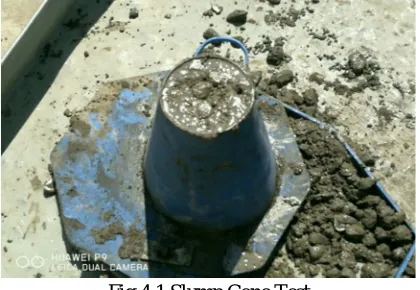
[image:4.612.202.412.381.526.2]1) Slump Cone Test: Slump test is the most frequently usedsystem of measuring consistency of concrete. It is used accessibly as a control test and gives an indication of the uniformity of concrete. More results on workability and quality of concrete can be obtained by observing the manner in which concrete slumps are obtained. The apparatus for conducting the slump test essentially consists of a metallic mould in the form of frustum of a cone having the internal dimensions of bottom diameter 20cm, top diameter 10cm and a height of 30cm. The mix is prepared and placed in a spotless slump cone mould and tamped by dividing as three layers of about 25 stokes each layer and the top of the cone is levelled off. Then the mould is lifted up vertically and the physical appearance of slump is analysed to get the workability of the preferred cement concrete.
Fig 4.1 Slump Cone Test
C. Casting Of Cubes And Cylinder
1) Batching of materials such as cement, sand, gravel, sea shell, CCA and their additives are weighed according to their respective ratios
2) After batching, cement and CCA are mixed earlier to form a identical colour.
3) Sand is then added into the mix which is mixed by hand with the aid of a shovel.
4) Coarse aggregate is then added which consists of both gravel and seashell, then mixed until it becomes a dry mix.
5) When a uniform mixture is obtained water is now poured to its required amount along with the super plasticizer and mixed well to form a full mixture.
6) When a complete mixture is obtained it is then placed in their respective moulds and dried.
7) Remoulding of the cubes was carried out between 18 to 24 hours after casting with care.
8) The hardened concrete was then transferred immediately into the curing tank.
9) It is then cured at normal temperature.
10) The cubes were removed at the end of 7 days, 14 days and 28 days from the day of casting and dried at room temperature for
Fig 4.2 Conventional Cubes
D. Compressive Strength Of Concrete Cubes
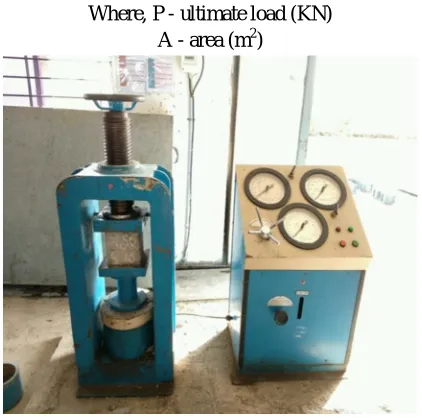
A Compression test is to decide the behaviour or response of a material while it receivea compressive load by measuring major variables, such as strain, stress and deformation. By testing a material in compression the compressive strength, yield strength, ultimate strength, elastic limit and the elastic modulus among other parameters may all be determined.
Due to the compressive force, the cube of size 150 X 150 X 150 mm is subjected to a large magnitude of compressive strength near the loading region. The compressive strength was computed by the standard stress formula,
P/A
Where, P - ultimate load (KN) A - area (m2)
Fig 4.3 Compressive Strength Test
E. Tensile Strength Of Cylinder
The tensile strength of concrete is one of the basic and chief properties. Splitting tensile strength on concrete is a method to determine the tensile strength of concrete (i.e)., a measure of the ability of material to resist a force that tends to pull it apart.
A cylindrical mould of 150mm diameter and 300mm height is subjected to a axial load on the specimen surface until it fails. The split tensile strength was computed by using formula,
T = 2P/ πLD
Where,
[image:5.612.201.412.363.572.2]V. RESULTS AND DISCUSSION
A. Slump Test
The slump value to determine the workability of conventional concrete along with various partially replaced concrete mixtures is measured and discussed for water cement ratio of 0.45. (in mm):
CONCRETE TYPE SLUMP VALUE
Conventional concrete (CC) 75
5% of CCA & 10% of SS 75
7% of CCA & 15% of SS 74.5
10% of CCA & 20% of SS 72.5
15% of CCA & 25% of SS 72
Table 5.1 Results of various slump values obtained
The slump value obtained are within the permissiblelimit as per IS code 456 and appropriate for construction purpose and also has a good workability.
B. Compressive Strength
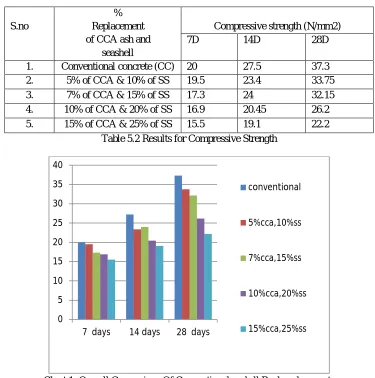
The total 45 numbers of cube (9 Nos. of Conventional concrete & 9 Nos. of cube for each 5% of CCA & 10% of SS, 7% of CCA & 15% of SS, 10% of CCA & 20% of SS, and 15% of CCA & 25% of SS replacements) are tested in a Compression testing machine &
S.no
% Replacement of CCA ash and
seashell
Compressive strength (N/mm2)
7D 14D 28D
1. Conventional concrete (CC) 20 27.5 37.3
2. 5% of CCA & 10% of SS 19.5 23.4 33.75
3. 7% of CCA & 15% of SS 17.3 24 32.15
4. 10% of CCA & 20% of SS 16.9 20.45 26.2
[image:6.612.117.492.344.722.2]5. 15% of CCA & 25% of SS 15.5 19.1 22.2
Table 5.2 Results for Compressive Strength
Chart 1: Overall Comparison Of Conventional and all Replaced concrete 0
5 10 15 20 25 30 35 40
7 days 14 days 28 days
conventional
5%cca,10%ss
7%cca,15%ss
10%cca,20%ss
C. Split Tensile Strength
For each test that was conducted, the total number of 30 cylinders were prepared of size 150x300mm.The specimens were casted by using mixture as that used for cube casting and cured for 28 days at normal temperature to determine the split tensile strength of concrete.
S.no
% Replacement of CCA ash and
seashell
Tensile strength (N/mm2)
1. Conventional concrete (CC) 3.54
2. 5% of CCA & 10% of SS 3.4
3. 7% of CCA & 15% of SS 3.33
4. 10% of CCA & 20% of SS 3.04
5. 15% of CCA & 25% of SS 2.97
Table 5.2 Results for Compressive Strength
VI. CONCLUSION
A. In this project we tried to replace the cement and coarse aggregate partially by corn cob ash (5%,7%,10%&15%) and seashell (10%,15%, 20%, & 25%) respectively to increase the strength of concrete.
B. The mechanical behavior of concrete with partial replacement of cement by corn cob ash and sea shell as coarse aggregate were investigated and presented.
C. CCA can be used to partially replace cement in the production of concrete to a maximum of 10%, because replacement beyond
this reduced the concrete strength beyond the control.
D. 95% of calcium carbonate present in seashell; it has the strength nearly equal to coarse aggregate.
E. Integration of too much of sea shell produces harsher mix which causes difficulties to produce dense concrete thus disrupt the strength performance. The workability reduces as the seashells are replaced due to their rough texture.
F. So we conclude that the cement and coarse aggregate replaced with corn cob ash at 7% and sea shell at 15% in concrete is suitable for construction. Moreover it reduces the construction cost by reducing the cost of cement and coarse aggregate and it also reduces the environmental pollution due to corn cob ash and seashell.
REFERENCE
[1] Vignesh.S,A Partial Replacement for Coarse Aggregate by Seashell and Cement By Flyash In Concrete, National Conference on Research Advances in Communication,Computation, Electrical Science and Structures(NCRACCESS-2015)
[2] R. Yamuna Bharathi, S. Subhashini, T.Manvitha, S. Herald Lessly, Experimental Study On Partial Replacement Of Coarse Aggregate By Seashell & Partial Replacement Of Cement By Flyash,International Journal of Latest Research in Engineering and Technology (IJLRET), Volume 2,Issue 3,March 2016 [3] ]P.Sasikumar, C.Suriyakumar, P.Yuvaraj, A Partial Replacement for Coarse Aggregate by Sea Shell and Cement by Lime in Concrete,IJIR,Vol-2, Issue-5, 2016 [4] K. A. Mujedu, S. A. Adebara, The Use of Corn Cob Ash and Saw Dust Ash as Cement Replacement in Concrete Works, IJES,Vol-3,Issue 4 , 2014
[5] Monita Olivia, AnnisaArifanditaMifshella, LitaDarmayanti, Mechanical properties of seashell concrete, Procedia Engineering 125 ( 2015)
[6] N.Devendran, [2017] “Experimental Study on Strengthening of Concrete by Replacing Seashell”, International Journal of Computational Engineering Research (IJCER), Volume, 07 Issue, 07.
[7] AhangbaAugustine.S,Partial Replacement Of Cement With Corn Cob Ash, ISSN – 2455-0620 Volume - 2, Issue - 7 , July-2016 [8] IS:456-2000, “Plain reinforced concrete – code of practice, Bureau of Indian standards”, New Delhi, India.
[9] IS: 383-1970, “Specification for coarse and fine aggregates from natural sources for concrete (second revision), Bureau of Indian standards”, New Delhi, India.
[10] IS: 10262-2009, “Recommended guidelines for concrete mix design, Bureau of Indian standards”, New Delhi, India. [11] IS: 516-1959, “Indian standard method of tests for strength of concrete, Bureau of Indian standards”, New Delhi, India.