Abstract—In this paper, a controller is proposed for a n-link robot manipulator to achieve the high-precision position tracking based on a recurrent wavelet fuzzy cerebellar model articulation controller (RWFCMAC) which is applied to imitate an ideal controller due to it incorporates the advantages of the wavelet decomposition property, dynamic response with a fuzzy CMAC fast learning ability and an adaptive single-input fuzzy compensator (ASIFC) is designed to attenuate the effect of the approximation error caused by the RWFCMAC approximator. The online tuning laws of RWFCMAC and ASIFC parameters are derived according to gradient descent method and lyapunov function so that the stability of the system can be guaranteed. Finally, through the simulation results demonstrate the effectiveness of the proposed control scheme for novel three-link De-Icing robot manipulator with unknown dynamic functions.
Index Terms—Wavelet, Cerebellar model articulation controller (CMAC), De-icing robot manipulator, single-input fuzzy compensator.
I. INTRODUCTION
ce coating in power networks imposes heavy load upon transmission lines and could result in trip, disconnection, power-tower collapse and power interruption, which has posed a serious challenge to many state grids. Adopting robot deicing has advantages avoiding risk of casualties, electricity supply being cut off and transfer load. The deicing robot can be used for line inspection when there is no need for deicing. The prospective will be more expansive in the future. In general, De-Icing robot manipulators have to face various uncertainties in their dynamics, such as friction and external disturbance. It is difficult to establish exactly mathematical model for the design of a model-based control system. In order to deal with this problem, the braches of current control theories are broad including classical control: neural networks (NNs) control [1–3], adaptive fuzzy logic control (FLCs) [4–6] or adaptive fuzzy-neural networks (FNNs) [7–9]. They are classified as adaptive intelligent control based on conventional adaptive control techniques where fuzzy systems or neural networks are utilized to approximate a nonlinear function of the dynamical systems. However, many adaptive approaches are
This work was supported by the National Natural Science Foundation of China (61175075; 60835004), the National High Technology Research and Development Program of China (863 Program) (2007AA04Z244; 2008AA04Z214).
rejected as being overly computationally intensive because of the real-time parameter identification and required control design.
Fuzzy logic (FLCs) and neural network (NNs) control has found extensive applications, in which FLCs are suitable for simple second order plants. However, in case of complex higher order plants, the rule antecedent requires a huge number of control rules and much effort to create. The NNs are a model-free approach, which can approximate a linear or nonlinear mapping to arbitrary accuracy [1–3]. However, the learning speed of the NNs is slow, since all the weights are updated during each learning cycle. Based on the advantages of the fuzzy and neural network, the fuzzy neural network (FNN) which incorporates advantages of fuzzy inference and neuron-learning has been developed and it’ effectiveness is demonstrated in solving control problems [10–13].
Recently, many applications have been implemented quite successfully based on wavelet neural networks (WNNs) which combine the learning ability of network and capability of wavelet decomposition property [14–17]. Different from conventional NNs, the membership functions of WNN is wavelet functions which are spatially localized, so, the WNNs are capable of learning more efficiently than conventional NNs for control and system identification as has been demonstrated in [14, 16]. As a result, WNNs has been considerable interest in the applications to deal with uncertainties and nonlinearity control system as is shown in [16–17].
To deal with disadvantages of NNs, cerebellar model articulation controller (CMAC) was proposed by Albus in 1975 [18] for the identification and control of complex dynamical systems, due to its advantage of fast learning property, good generalization capability and ease of implementation by hardware [19–21]. The conventional CMACs, regarded as non-fully connected perceptron-like associative memory network with overlapping receptive fields which used constant binary or triangular functions. The disadvantage is that their derivative information is not preserved. For acquiring the derivative information of input and output variables, Chiang and Lin [22] developed a CMAC network with a differentiable Gaussian receptive-field basis function and provided the convergence analysis for this network. The advantages of using CMAC over neural network in many applications were well documented [23–28]. However, in the above CMAC literatures, the structure of CMAC are not merited of the high-level human
Adaptive Recurrent Wavelet Fuzzy CMAC
Tracking Control for De-icing Robot
Manipulator
YaoNan Wang, ThanhQuyen Ngo, ThangLong Mai, ChengZhong Wu
knowledge representation and thinking of fuzzy theory. In this article, we propose the adaptive recurrent wavelet fuzzy CMAC (RWFCMAC) control system for three-link De-icing robot manipulator to achieve the high-precision position tracking. This control system combines advantages of fuzzy inference system with CMAC and wavelet decomposition capability and a delayed self-recurrent unit in the association memory space and the adaptive single input fuzzy compensator which is designed to deal with the approximation errors between the estimating RWFCMAC and the ideal controller to the stability of system is guarantied. The adaptive tuning laws of RWFCMAC parameters and single input fuzzy compensator are derived through Lyapunov method.
This paper is organized as follows: System description is described in section II. Section III presents RWFCMAC control system. Numerical simulation results of a three-link De-icing robot manipulator are provided to demonstrate the tracking control performance of the proposed RWFCMAC system in section IV. Finally, conclusions are drawn in section V.
II. SYSTEMDESCRIPTION
In general, the dynamic of an n-link robot manipulator
may be expressed in the Lagrange following form:
( ) ( , ) ( )
M q qC q q q G q (1)
Where , , n
q q q R are the joint position, velocity and
acceleration vectors, respectively, ( ) n n
M q R denotes the
inertia matrix, ( , ) n n
C q q R expresses the matrix of
centripetal and Coriolis forces, ( ) n1
G q R is the gravity
vector, n1 R
is the torque vectors exerting on joints. In
this paper, a new three-link De-icing robot manipulator, as shown in Fig.1 (b), is utilized to verify dynamic properties are given in section IV. By rewriting (1), the dynamic equation of robot manipulator can be obtained as follows:
1( ) ( , ) ( ) 1( )
( ) ( )
q M q C q q q G q M q
f x g x
(2)
1
2 1 1
( ) ( )
( ) ( ) ( , ) ( ) ,
( )
n
n
f x f x
f x M q C q q q G q R
f x
11 1
1
1
( ) ( )
( ) ( ) .
( ) ( )
n
n n
n nn
g x g x
g x M q R
g x g x
Where f x( ),g x( )are nonlinear dynamic functions which
are difficult to determine exactly or can not even obtain. So, we can not establish model-based control system. In order to with this problem, here we assume that actual value
( )
f x andg x( )can be separated as nominal part denoted
byF x0( ),G x0( ), in which G x0( ), is assumed to be positive,
differentiable and 1 0 ( )
G x exists for all q. We assume that ( , )
L x t is represented as the unknown lumped uncertainly
and [ ,T T T]
x q q is vector which represents the joint
position and velocity. Finally, the system (2) can be rewritten as follows:
0 0
( ) ( ) ( ) ( , )
q t F x G xL x t (3)
The control problem is to force q t( )Rn to track a given bounded reference input signal ( ) n
d
q t R . Let e t( )Rn be the tracking error as follows:
( ) ( )
d
eq t q t (4)
and the system tracking error vector is defined as [ T T n 1T]T nn
E e e e R (5)
If the nominal parts F x0( ),G x0( ) and the uncertainly ( , )
L x t are exactly known, then an ideal controller can be
designed as follows:
0
0 1
( ) ( ) ( ) ( , )
( ) d
t q t F x L x t KE
G x
(6)
By substituting the ideal controller (6) into (3), the error dynamic equation is given as follows:
Li nk 2
L
ink 3
Link 3
Li
nk 2
Link 2
(a)
0
z
z
12
z
3
X
4
X 4
z
0 X
1 l
2
l
1
X 0
Base Revolute
Prisma
tic
Power Line
1 q
2 X
2 q
1
z
3 d
Revolute
1 m
2 m
3 m
(b)
( ) 0
n T
e t K E (7)
It is obvious that errors will be asymptotically tend to zero if the gain matrices of Kis determined so that the
roots of the characteristic polynomial (7) lie strictly in the open left haft of complex plane. However, the ideal controller in (6) can not determine, because of L(x,t)is
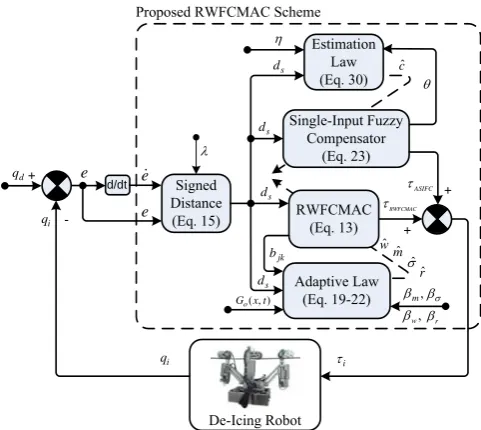
exactly unknown for practical applications. So, in order to this problem, a proposed control system is shown in Fig. 2 which consists of a RWFCMAC and an adaptive single
input fuzzy compensator with the following form:
ˆ
ˆT ,
RWFCMAC ASIFC w b ASIFC
(8)
Where RWFCMAC is used to mimic the ideal controller in (6) and an adaptive single input fuzzy compensator ASIFC is used to efficiently suppress the influence of the residual approximation error between the ideal controller and the RWFCMAC approximation.
III. ADAPTIVERWFCMACCONTROLSYSTEM
A. Brief of the RWFCMAC
The main difference between the FCMAC and the original CMAC is that association layer in the FCMAC is the rule layer which is represented as follows.
:
l
R if X1 is 1jk and X2 is
i
n jk, ,X
2
is ijk then Ojk wjk For i1,2,,ni, j1,2,,nj, k1,2,,nk and l1,2,,nknj. (9)
Where ni is the number of the input dimension, nj is the number of the layers for each input dimension, nk is the number of blocks for each layer, lnknj is the number of the fuzzy rules and ijk is the fuzzy set for ith input, jth layer and kth block, wjk is the output weight in the consequent part.
Based on the [29] a novel RWFCMAC is represented and shown in Fig. 3. It is combines a wavelet function with the
FCMAC including input, association memory, receptive field, and output spaces, is proposed to implement the RWFCMAC estimate in RWFCMAC control system shows in Fig. 2. The signal propagation is introduced according to functional mapping as follows:
The first mapping X :X A: assume that each input
state variable [ 1 2 ]
i
n
X X
X
X can be quantized
into nediscrete states and that the information of a quantized state is regarded as region a wavelet receptive-field basic function for each layer. The mother wavelet is a family of wavelets. The first derivative of basic Gaussian function for each layer is given here as a mother wavelet which can be represented as follows:
2
( ) exp
2
ijk ijk ijk ijk
F
F F
(10)
i1,2,,ni, k1,2,,nk Where Fijk (drsi( )k mijk) ijk , mijk is a translation parameter andijk is dilation. In addition, the input of this block can be represented as
e e
0
s
d
s
d
) , (e e E
0
e e
0
s
[image:3.595.308.545.59.468.2] [image:3.595.48.289.171.386.2]d
Fig. 5. Derivation of a signed distance bjk
Input Space X
Weight Memory Space W
Association Me-mory Space A
o1
Output Space O
Receptive Field Space R
om
l
w1
ml
w
1
X
k
11
i
X
ijk
i
n i
ijk ijk jk F
b
1 ) ( Layer 1 nk
Recurrent Unit
ijk
r
si
d ijk( )k
( 1)
ijkk
rsi
d
1
Z
Fig. 3. Architecture of a RWFCMAC
f
e
d
i
h
g
c
b
a
Fig. 4. Block division of RWFCMAC with wavelet function
d/dt
s
d
e
+
-d
q
i
q
mˆ
ˆ
wˆ
i
q
Signed Distance
(Eq. 15) RWFCMAC (Eq. 13)
Adaptive Law (Eq. 19-22) Proposed RWFCMAC Scheme
i
De-Icing Robot
Single-Input Fuzzy Compensator
(Eq. 23) Estimation
Law (Eq. 30)
+
+
,
w
,
m
jk
b
s
d
s
d
s
d
cˆ
RWFCMAC
ASIFC
e
e
) , (xt Go
ˆ
r
r
( ) ( ) ( 1)
rsi si ijk ijk
d k d k r k (11)
Where rijk is the recurrent gain, k is denotes the time step,
and ijk(k1) denotes the value of ijk( )k through a time
delay. Clearly, the input of this block contains the memory termijk(k1), which stores the past information of the network and presents the dynamic mapping.
The second mappingA:AR: the informationijkof
each kth block and each jth layer relates to each location of
receptive field space. The Fig. 4 illustrates a structure of two-dimension (ni 2) RWFCMAC with wavelet basic
function with nj 3 and nk 3 case. Areas of receptive field space is formed by multiple-input regions are called hypercube; i.e. in the fuzzy rules in (9), the product is used as the “and” computation in the consequent part. The firing of each state in jth each layer and kth each block can be
obtained the weigh of each hypercube corresponding. Assume that in 2-D RWFCMAC case is shown in Fig. 4, where input state vector is (6, 3), then, the content of lth
hypercube can be obtained as follows:
i n i ijk ijk jk F b 1 ) ( (12)
For j1,2,,nj and k1,2,,nk Finally, The RWFCMAC output is the algebraic sum of the activated weighs with the hypercube elements. The output mathematic form can be expressed as follows:
11
1
11 1 1
1
1 1
1 1 1
( )
j k
j k i
k
k j jk
j
jk n n
jk jk ijk j k
n n n
jk ijk ijk j k i
b
b
w w w w
b
b
w b F
w F
(13)For j1,2,,nj,k1,2,,nk and i1,2,,ni.
B. On-line learning algorithm
Based on [30–31], the system tracking error vector n
R
E is transformed into a single variable, termed the
signed distance m, si R
d which is the distance from an
actual state n
R
E to the switching line as shown in Fig. 5
for a 2-D input. The switching line is defined as follows:
1 0
ee (14)
Where n1Rn1 is a constant. Then, the signed
distance between the switching line and operating point n
R
E can be expressed by the following equation:
1 1 2 1 1 s e ed e e
(15)
Where
2
1
1 1
is a positive constant, by taking the time derivative of (15) and using (3), (8). We have
1 0 0 1 ˆ ˆ ( , ) ( , )( ) ( ) ( , ) s T FC dd e e
F x t G x t w b
q t L x t e
(16)
The energy function is defined as
2
1 ( ( )) ( )
2
s s
V d t d t (17)
By multiplying both sides of (16) byds(t), yields
0 0 1 ˆ ˆ ( ) ( ) ( ) ( , ) ( ) ( , )( ) ( )( ( ) ( , ) ) Ts s s s
FC s d
d t d t d t F x t d t G x t w b
d t q t L x t e
(18)
With the energy functionV(ds(t)),the parameters updating law based on the normalized gradient descent method can be derived as follows
The updating law for the kth weight memory can be
derived according to
0 ( ) ( ) ˆ ˆ ˆ ( ) ( , ) ( )
s s RWFCMAC jk w
RWFCMAC jk
w s jk ijk
d t d t w
w
d t G x t b F
(19)
Where wis positive learning rate for the output weight memory wjk.
The translations, dilations and recurrent gain of the kth
mother wavelet function can be also updated according to
2 0 ( ) ( ) ˆ ˆ ˆ 1 ˆ ( ) ( , ) ˆ ( ) jk ijk s s RWFCMAC
ijk m
RWFCMAC jk ijk ijk
ijk
m s jk jk
i ijk
b f
d t d t m
f m
b
F d t G x t w b
X m (20) 2 0 ( ) ( ) ˆ ˆ ˆ 1 ˆ ( ) ( , ) ˆ jk ijk s s RWFCMAC
ijk
RWFCMAC jk ijk ijk
ijk
s jk jk
ijk
b f
d t d t
f b
F d t G x t w b
(21) 2 0 ( ) ( ) ˆ 1 ˆ
( ) ( , ) ( 1)
ˆ
( )
ij ij s s RWFCMAC
ijk r
RWFCMAC ij ij ij
ijk
r s jk jk ijk
s ijk
F d t d t
r
F r
F
d t G x t w b k
d m (22)
Where m, and rare positive learning rates for the i e i e 0 si d 0 si d si d
( , )e ei i
0 i i e e
translation ˆmijk, dilation ˆ and recurrent gain ˆijk rijk.
C. Single input fuzzy controller Design
The update laws of equations (19), (20), (21) and (22) require a proper choice of the learning ratesw, m, and r in order to the convergence of the output errors are guaranteed; however, this is not easy which depends on each person’s experience. In addition, the RWFCMAC is used to approximate the imprecise model or un-model of the
n-link robot manipulator through learning. However, there
exist errors between the estimating RWFCMAC and the ideal controller. So, to deal with these problems, the single input fuzzy compensator is designed to cope with the approximation errors and the stability of system is guarantied.
In this section, an adaptive single-input fuzzy compensator (ASIFC) strategy combines an adaptive fuzzy rule and a single variable, termed the signed distance
m si R
d [30–31] which reduce the n-dimensional fuzzy
rules table into one-dimensional fuzzy rules for this fuzzy compensator. Every fuzzy rule is composed of an antecedent and a consequent part, a general form of the fuzzy rules can be represented as follows:
: o
R If dsi isio, Then i is cio (23) i1,2ni, o1,2,no
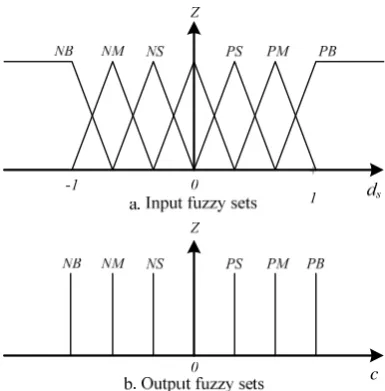
Where Rj,ioand wio are the oth rule, the fuzzy subsets of the input and output, respectively. Here, the membership functions for the input are chosen to be a triangular type as show in Fig. 6. The can be expressed as the following form:
si io i
i
io d b a
a
1
(24)
Where dsi is ith input variable, ai is the ith distribution span of the membership function and bio is the parameter corresponding to the value 1 of the membership function. In this paper, the de-fuzzification of the output is obtained by the height method.
i
T i n
o io n
o io io
ASIFC
i C
c
o o
1
1 (25)
Where
T oio i
i
i R
1 2 is a firing
strength vector of rule and
T o io ii
i c c c R
C 1 2
is the consequent parameter vector which is adjusted by the adaptive rule.
Assume that, the approximation error between the ideal controller and the estimating RWFCMAC is (t). Thus; the
ideal controller can be represented as the following form:
( )
RWFCMAC t
(26)
Substituting (26) and (6) into (16), then, the closed-loop filtered error dynamics becomes:
1
0( , )( ( ) )
s ASIFC
d e e G x t t (27)
Theorem 1: Consider an n-link robot manipulator
represented (2). If the control law of RWFCMAC is designed as (8) which in RWFCMACis represented in (13) with the online parameter update law of RWFCMAC given as (19)-(22) and the adaptive estimation law and
ASIFC are designed as (30) and (25), then the stability of the proposed RWFCMAC control system can be ensuredProof:Define a Lyapunov function candidate as 2
1 1
( ( ), ) ( ) ( )
2 2
T
s s
V d t c d t tr c c
(28)
Where is the learning rate for the single input fuzzy compensator. By differentiating (28) with respect to time and using (25) and (27), we can obtain.
1 1
( , ) ( ) ( ) ( )
1 ˆ
( , ) ( ) ( ) ( ) ( )
ˆ
( , ) ( ) ( ) ( ) ( )
1
( ) ( )
( , ) ( ) ( ) ( ) ( )
1 ( )
T
s s s
T T
o s s
T T
o s s s
T T
s
T T
o s s s
T
V d c d t d t tr c c
G x t d t t c d t tr c c
G x t d t t c d t c d t
c d t tr c c
G x t d t t c d t c d t
tr c c
1
( , ) ( ) ( ) ( )
( )
T
o s s
s
G x t c d t c d t t
c d t
(29)
If the estimation law and the optimal value of c are
chosen as (30) and (31).
() ~
ˆ c d t
c s (30)
) ( ) (
norm t
c (31)
Where is a positive constant. Then, from (29) becomes:
[image:5.595.324.517.52.248.2]c
0) ( ) , ( ) ( ) ( ) ( ) ( ) ( ) , ( norm t d t q G norm t t d t t d t x G V s o s s o (32) Since V(ds(t),c(t)) is a negative semi-definite function,
i.e. V(ds(t),c(t))V(ds(0),c(0)), it implies that ds(t)
and
c
is bounded functions. Letfunction h(t)Go(x,t)ds(t)norm
V(ds(t),c(t))and integrate function h(t) with respect to time )) ( ), ( ( )) 0 ( ), 0 ( ( ) ( 0 t c t d V c d V d t
h s s
t
(33)BecauseV(ds(0), c(0)) is a bounded function, and ))
( ), (
(d t ct
V s is a non-increasing and bounded function, the
following result can be concluded:
h d
t
t
0
) (
lim (34)
In addition, h(t) is bounded; thus, by Barbalat’s lemma
can be shown that lim ()0 ht
t . It can imply that s
d will be
converging to zero as time tends to infinite. IV. SIMULATIONRESULTS
[image:6.595.309.546.91.769.2]A three-link De-icing robot manipulator as shown in Fig.1 is utilized in this paper to verify the effectiveness of the proposed control scheme. The detailed system parameters of this robot manipulator are given as: link mass m1,m2,m3(kg), lengths l1,l2 (m),angular positions
) (
, 2
1 q rad
q and displacement position d3(m).
The parameters for the equation of motion (1) can be represented as follow:
33 32 31 23 22 21 13 12 11 M M M M M M M M M q M2 2 2
11 1 1 2 2 2 1 2 1 1 1
2 2
3 2 2 2 2 1 2
9 / 4 (1/ 4 ( ))
( 2 )
M m l m c l l l l c s
m c l l c l l
2 1 1 2 2 3 2 2 2
22 1/4m l m l 4/3ml
M
2 2 3 32
23 M mcl
M
3 33 m M 0 31 21 13
12 M M M
M 33 32 31 23 22 21 13 12 11 ) ( C C C C C C C C C q C 2 2 1 2 2 2 2 2 3 2 2 2 2 2 1 1 1 2 1 2 11 ) 2 2 ( 2 / 1 ( 8 q l l s l c s m l c s m q s c l l m C 1 2 1 2 2 2 2 2 3 2 2 2 2 2
21 ( 1/2m s c l m ( 2s c l 2s ll )q
C
3 2 2 3
22 m s l d
C
2 2 2 3 23 2m s l q
C
2 2 2 3
32 m s l q
C
0
33 31 13
12 C C C
C g m g m l c m l s s g m l c l c c q G 3 3 2 2 2 2 2 1 2 1 1 2 2 1 ) 2 / 1 ( ) 2 / 1 ( )
( (33)
Where the shorthand notations c1cos(q1), c2cos(q2), )
sin( 1
1 q
s and s2sin(q2) are used.
For the convenience of the simulation, the nominal parameters of the robotic system are given as
] 8 . 9 , 32 . 0 , 14 . 0 , 5 . 2 , 2 , 3 [ ] , , , , ,
[m1 m2 m3 l1 l2 g and the
Posi tion fo r li nk 1 (r ad ) Posi tion for li
nk 2 (r
[image:6.595.62.275.470.792.2]ad) P os iti on fo r li nk 3 (m ) E rr or for Jo int 1 (r ad) E rr or for Jo int 2 (r ad) E rror fo r Join t 3 (m )
initial conditions [ ,q q d1 2, 3, ,q q d 1 2, 3] [0.5, 0, 0.5, 0.5, 0] .
The desired reference trajectories are
1( ) sin(2 ),
q t t q t2( ) cos(2 ), t d t3( ) cos(2 ). t
The parameters of proposed control system are chose in the following: w0.02, m 0.02, r 0.02
and 0.02, the inputs of RWFCMAC ds1, ds2 and ds3,
the translation mijk and the dilationijk are selected to cover the input space
1 1
1 1
1 1
. The number of layers for each input dimension, the number of blocks for each layer and the rules for each state variable are set respectively as follows nj 3, nk 3 and lnjnk 9. For the adaptive single input fuzzy compensator, the signed distance variable was divided into 7 equal-span fuzzy input subsets within
1,1
by using the triangular membership function, the learning rate, the distribution span of the membership function and the parameter corresponding to the value of the membership function are selected as, 01 . 0
ai 0.2,bi11, bi2 0.6,bi3 0.3,bi4 0, ,
1
1
i
b bi5 0.3, bi6 0.6, bi7 1, for i1,2,3
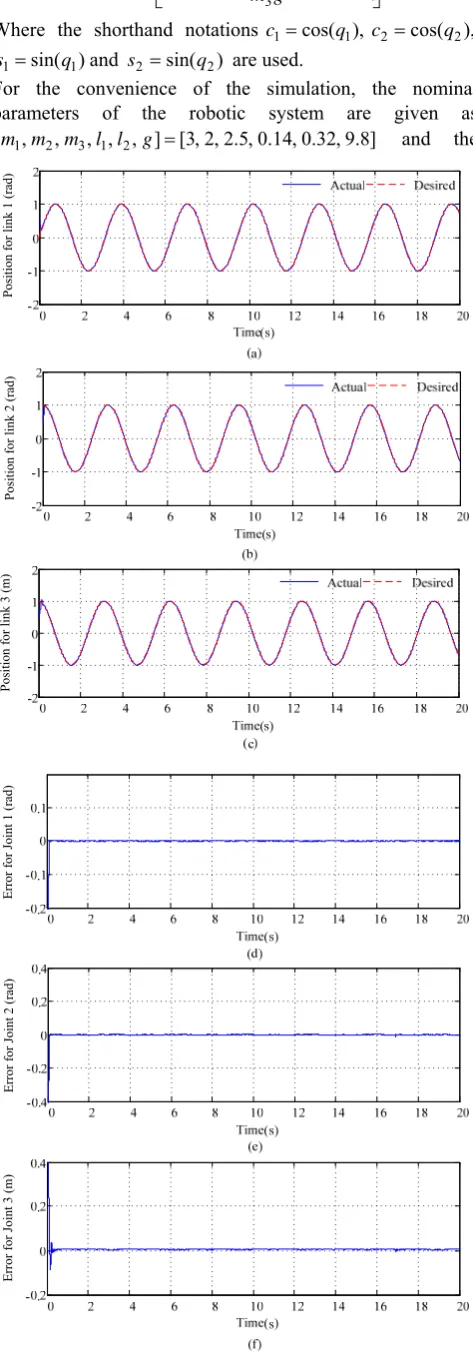
respectively. Finally, the simulation results of the proposed WFCMAC system, the responses of joint position and tracking errors are provided in Fig. 7 (a), (b), (c) and (d), (e), (f), respectively. According to the simulation results as shown in Fig. 7, the joint-position tracking responses of the proposed RWFCMAC control system can achieve favorable tracking performance for three-link De-icing robot manipulator.
V. CONCLUSION
Due to dynamical system has a non-linear characteristic and time-varying behavior. It is difficult to establish exactly mathematical model for the design of a model-based control system. To due with these problems, the most of the control system was proposed based on the intelligent control theory to approximate non-linear function. In this paper, the novel RWFCMAC approximation with ASIFS compensator is also developed and successfully used to control the De-icing robot manipulator. In this proposed scheme, the main RWFCMAC controller incorporates the advantages of the wavelet decomposition property, dynamic response with fuzzy CMAC fast learning ability and the ASIFC compensator is designed to attenuate the effect of the approximation error. It not only ensures the stability of the system but also the input space can be reduced through the signed distance. The online tuning laws of RWFCMAC and ASIFC parameters are derived based on gradient descent method and Lyapunov function. Finally, though the simulation results of the proposed RWFCMAC system can achieve favorable tracking performance for three-link De-icing robot manipulator.
ACKNOWLEDGMENT
The authors would like to thank the associate editor and the reviewers for their valuable comments.
REFERENCES
[1] A. Vemuri, M.M. Polycarpou, S.A. Diakourtis, “Neural network based fault detection in robotic manipulators,” IEEE Robotics Automation, vol. 14, no. 2, pp. 342-348, Apr. 1998.
[2] Wenzhi. Gao, R.R. Selmic, “Neural network control of a class of nonlinear systems with actuator saturation,” IEEE Trans., Neural Net., vol. 17, no. 1, pp. 147-156, Jan. 2006.
[3] Yi Zou, Yaonan Wang, XinZhi Liu, “Neural network robust H∞ tracking control strategy for robot manipulators,” Applied Mathematical Modelling, vol. 34, pp. 1823-1838, Sep. 2010.
[4] B. S. Chen, H. J. Uang, and C. S. Tseng, “Robust tracking enhancement of robot systems including motor dynamics: A fuzzy-based dynamic game approach,” IEEE Trans. Fuzzy syst., vol. 11, no. 4, pp. 538-552, Nov. 1998.
[5] H. X. Li and S.C. Tong, “A hybrid adaptive fuzzy control for a class of nonlinear MIMO systems,” IEEE Fuzzy Syst., vol. 11, no. 1, pp. 24-34, Feb. 2003.
[6] Salim Labiod, M. S. Boucherit, T. M. Guerra, “Adaptive fuzzy control of a class of MIMO nonlinear systems,” Fuzzy Set Syst., vol. 151, no. 1, pp. 59-77, Apr. 2005.
[7] Y. G. Leu, W. Y. Wang, and T. T. Lee, “Observe based direct adaptive fuzzy neural control for non-affine nonlinear systems,” IEEE Neural Netw., vol. 16, no. 4, pp. 853-861, July 2005.
[8] R. J. Wai and Z. W. Yang, “Adaptive fuzzy neural network control design via a T-S fuzzy model for a robot manipulator including actuator dynamics,” IEEE Syst. Man Cybern. B, vol. 38, no. 5, pp. 1326-1346, Oct. 2008.
[9] Faa-Jeng Lin, Po-Huang Shieh and Po-Huan Chou, “Robust adaptive backstepping motion control of linear ultrasonic motors using fuzzy neural network,” IEEE Trans. Fuzzy Syst., vol. 16, no. 3, pp. 676-692, June. 2008.
[10] R.-J. Wai, Y._C. Huang, Z. -W. Yang, C.-Y. Shih, “Adaptive fuzzy-neural-network sensorless control for robot manipulator position tracking,” IET Control Theory Appl., Vol. 4, Iss. 6, pp. 1079-1093, 2010.
[11] Chaio-Shiung Chen, “Dynamic structure neural-fuzzy-networks for robust adaptive control of robot manipulator,” IEEE Trans Ind. Elect., vol. 55, no. 9, pp. 3402-3414, Apr. 2008.
[12] Chaio-Shiung Chen, “Robust self-organizing Neural-fuzzy control with uncertainty observer for MIMO nonlinear systems,” IEEE Trans, Fuzzy Syst., vol. 19, no. 4, pp. 694-706, Aug. 2011.
[13] S.H. Park, S.I. Han, “Robust-tracking control for robot manipulator with deadzone and friction using backstepping and RFNN controller,” IET Control Theory Appl., Vol. 5, Iss. 12, pp. 1397-1417, 2011. [14] R. J. Wai, “ Development of new training algorithms for
neuro-wavelet systems on the robust control of induction servo motor drive,” IEEE Trans. Ind. Electron., vol. 49, no. 6, pp. 1323-1341, Dec. 2002. [15] F.F.M. EI-Sousy, “Robust wavelet-neural network sliding-mode
control system for permanent magnet synchronous motor drives,” IET Electr. Power Appl., vol. 5, Iss. 1, pp. 113-132, 20011.
[16] C. H. Lu, “ Design and application of stable predictive controller using recurrent wavelet neural networks,” IEEE Trans. Ind. Electron., vol. 56, no. 9, pp. 3733-3742, Sep. 2009.
[17] F.-J. Lin, S.-Y. Chen, Y.-C. Hung “Field-programmable gate array-based recurrent wavelet neural network control system for linear ultrasonic motor,” IET Electr. Power Appl., vol. 3, Iss. 4, pp. 289-312, 2009.
[18] J. S. Albus, “A new approach to manipulator control: The cerebellar model articulation controller (CMAC),” J. Dyn. Syst. Meas. Control, vol. 97, no. 3, pp. 220–227, 1975.
[19] H. Shiraishi, S. L. Ipri, and D. D. Cho, “CMAC neural network controller for fuel-injection systems,” IEEE Trans. Control Syst. Technol., vol. 3, no. 1, pp. 32–38, Mar. 1995.
[20] S. Jagannathan, S. Commuri, and F. L. Lewis, “Feedback linearization using CMAC neural networks,” Automatica, vol. 34, no. 3, pp. 547– 557, 1998.
[21] Y. H. Kim and F. L. Lewis, “Optimal design of CMAC neural-network controller for robot manipulators,” IEEE Trans. Syst. Man Cybern. C, Appl. Rev., vol. 30, no. 1, pp. 22–31, Feb. 2000.
[22] C. T. Chiang and C. S. Lin, “CMAC with general basis functions,” J. Neural Netw., vol. 9, no. 7, pp. 1199–1211, 1996.
[23] C. M. Lin and Y. F. Peng, “Adaptive CMAC-based supervisory control for uncertain nonlinear systems,” IEEE Trans. Syst. Man Cybern. B, Cybern., vol. 34, no. 2, pp. 1248–1260, Apr. 2004. [24] S. F. Su, T. Tao, and T. H. Hung, “Credit assigned CMAC and its
[25] H. C. Lu, C. Y. Chuang, M. F. Yeh, “Design of hybrid adaptive CMAC with supervisory controller for a class of nonlinear system,” Neurocomputing, vol. 72, no. 7-9, pp. 1920-1933, Aug. 2009. [26] Y. F. Peng and C. M. Lin, “Intelligent hybrid control for uncertain
nonlinear systems using a recurrent cerebellar model articulation controller,” IEE Proc. Control Theory Appl., vol. 151, no. 5, pp. 589-600, Sep. 2004.
[27] S.-Y. Wang, C.-L. Tseng, C.-C Yeh, “Adaptive supervisory Gaussian-cerebellar model articulation controllers for direct torque control induction motor drive,” IET Electr. Power Appl., vol. 5, Iss. 3, pp. 295-306, June 2011.
[28] M. F. Yeh and C. H. Tsai, “Standalone CMAC control systems with online learning ability,” IEEE Trans. Syst. Man Cybern. B, vol. 40, no. 1 pp. 43-53, Feb. 2010.
[29] Chih-Min Lin, and Hsin-Yi Li, “A Novel Adaptive Wavelet Fuzzy Cerebellar Model Articulation Control System Design for Voice Coil Motors” IEEE Trans. Ind. Electron., vol. 59, no. 4, pp. 2024-2033, Sep. 2012.
[30] B. J. Choi, S. W. Kwak, B. K. Kim, “Design of single-input fuzzy logic controller and its properties,” Fuzzy Sets Syst., 106(1999), 299-308.