Proceedings of the 22nd Conference on Computational Natural Language Learning (CoNLL 2018), pages 583–592 583
Sequence to Sequence Mixture Model for Diverse Machine Translation
Xuanli He Gholamreza Haffari Mohammad Norouzi
Monash University, Australia Google Brain
{xuanli.he1, gholamreza.haffari}@monash.edu [email protected]
Abstract
Sequence to sequence (SEQ2SEQ) models of-ten lack diversity in their generated transla-tions. This can be attributed to the limitation of SEQ2SEQ models in capturing lexical and syntactic variations in a parallel corpus result-ing from different styles, genres, topics, or am-biguity of the translation process. In this pa-per, we develop a novel sequence to sequence mixture (S2SMIX) model that improves both translation diversity and quality by adopting a committee of specialized translation models rather than a single translation model. Each mixture component selects its own training dataset via optimization of the marginal log-likelihood, which leads to a soft clustering of the parallel corpus. Experiments on four lan-guage pairs demonstrate the superiority of our mixture model compared to a SEQ2SEQ base-line with standard or diversity-boosted beam search. Our mixture model uses negligible ad-ditional parameters and incurs no extra com-putation cost during decoding.
1 Introduction
Neural sequence to sequence (SEQ2SEQ) models have been remarkably effective machine transla-tion (MT) (Sutskever et al.,2014;Bahdanau et al.,
2015). They have revolutionized MT by provid-ing a unified end-to-end framework, as opposed to the traditional approaches requiring several sub-models and long pipelines. The neural approach is superior or on-par with statistical MT in terms of translation quality on various MT tasks and do-mains e.g. (Wu et al.,2016;Hassan et al.,2018).
A well recognized issue with SEQ2SEQ mod-els is the lack of diversity in the generated trans-lations. This issue is mostly attributed to the de-coding algorithm (Li et al., 2016), and recently to the model (Zhang et al., 2016; Schulz et al.,
2018a). The former direction has attempted to design diversity encouraging decoding algorithm,
particularly beam search, as it generates transla-tions sharing the majority of their tokens except a few trailing ones. The latter direction has investi-gated modeling enhancements, particularly the in-troduction of continuous latent variables, in order to capture lexical and syntactic variations in train-ing corpora, resulted from the inherent ambiguity of the human translation process.1 However, im-proving the translation diversity and quality with SEQ2SEQ models is still an open problem, as the results of the aforementioned previous work are not fully satisfactory.
In this paper, we develop a novel sequence to sequence mixture (S2SMIX) model that improves both translation quality and diversity by adopt-ing a committee of specialized translation models rather than a single translation model. Each mix-ture component selects its own training dataset via optimization of the marginal log-likelihood, which leads to a soft clustering of the parallel corpus. As such, our mixture model introduces a conditioning global discrete latent variable for each sentence, which leads to grouping together and capturing variations in the training corpus. We design the ar-chitecture of S2SMIXsuch that the mixture com-ponents share almost all of their parameters and computation.
We provide experiments on four transla-tion tasks, translating from English to Ger-man/French/Vietnamese/Spanish. The experi-ments show that our S2SMIXmodel consistently outperforms strong baselines, including SEQ2SEQ
model with the standard and diversity encouraged beam search, in terms of both translation diversity and quality. The benefits of our mixture model comes with negligible additional parameters and no extra computation at inference time, compared to the vanilla SEQ2SEQmodel.
1For a given source sentence, usually there exist several
2 Attentional Sequence to Sequence
An attentional sequence to sequence (SEQ2SEQ)
model (Sutskever et al., 2014; Bahdanau et al.,
2015) aims to directly model the conditional dis-tribution of an output sequencey ≡(y1, . . . , yT)
given an input x, denoted P(y | x). This fam-ily of autoregressive probabilistic models decom-poses the output distribution in terms of a product of distributions over individual tokens, often or-dered from left to right as,
Pθ(y|x) = Y|y|
t=1Pθ(yt|y<t,x), (1)
where y<t ≡ (y1, . . . , yt−1) denotes a prefix of the sequencey, andθdenotes the tunable param-eters of the model.
Given a training dataset of input-output pairs, denoted by D ≡ {(x,y∗)d}D
d=1, the conditional
log-likelihood objective, predominantly used to train SEQ2SEQmodels, is expressed as,
`CLL(θ) = X
(x,y∗)∈D
|y∗| X
t=1
logPθ(y∗t |y∗<t,x). (2)
A standard implementation of the SEQ2SEQ
model is composed of an encoder followed by a decoder. The encoder transforms a sequence of source tokens denoted (x1, . . . , xN), into a
se-quence of hidden states denoted(h1, . . . ,hN)via
a recurrent neural network (RNN). Attention pro-vides an effective mechanism to represent a soft alignment between the tokens of the input and out-put sequences (Bahdanau et al., 2015), and more recently to model the dependency among the out-put variables (Vaswani et al.,2017).
In our model, we adopt a bidirectional RNN with LSTM units (Hochreiter and Schmidhuber,
1997). Each hidden state hn is the concatenation
of the states produced by the forward and back-ward RNNs, hn = [h→n,hn←]. Then, we use a
two-layer RNN decoder to iteratively emit individ-ual distributions over target tokens(y1, ..., yT). At
time stept, we compute the hidden representations of an output prefixy≤tdenoteds1t ands2tbased on
an embedding of ytdenotedM[yt], previous
rep-resentationss1t−1,s2t−1, and a context vectorctas,
s1t = LSTM(s1t−1,M[yt];ct), (3)
s2t = LSTM(s2t−1,s1t;ct), (4) Pθ(yt+1|y≤t,x) = softmax(Ws2t+W0ct),(5)
whereMis the embedding table, andW andW0
are learnable parameters. The context vectorctis
computed based on the input and attention,
et,n = v>tanh(Whhn+Wss1t−1+ba), (6)
at = softmax(et), (7)
ct =
X
n
at,nhn, (8)
whereWh,Ws,ba, and vare learnable
parame-ters, and at is the attention distribution over the
input tokens at time stept. The decoder utilizes the attention information to decide which input tokens should influence the next output tokenyt+1.
3 Sequence to Sequence Mixture Model
We develop a novel sequence to sequence mix-ture(S2SMIX) model that improves both transla-tion quality and diversity by adopting a commit-tee of specialized translation models rather than a single translation model. Each mixture component selects its own training dataset via optimization of the marginal log-likelihood, which leads to a soft clustering of the parallel corpus. We design the ar-chitecture of S2SMIXsuch that the mixture
com-ponents share almost all of their parameters except a few conditioning parameters. This enables a di-rect comparison against a SEQ2SEQbaseline with
the same number of parameters.
Improving translation diversity within SEQ2SEQ models has received considerable
recent attention (e.g., Vijayakumar et al. (2016);
Li et al.(2016)). Given a source sentence, human translators are able to produce a set of diverse and reasonable translations. However, although beam search for SEQ2SEQ models is able to generate various candidates, the final candidates often share majority of their tokens, except a few trailing ones. The lack of diversity within beam search raises an issue for possible re-ranking systems and for scenarios where one is willing to show multiple translation candidates to the user. Prior work attempts to improve translation diver-sity by incorporating a diverdiver-sity penalty during beam search (Vijayakumar et al., 2016; Li et al.,
2016). By contrast, our S2SMIX model naturally incorporates diversity both during training and inference.
The key difference between the SEQ2SEQ and S2SMIXmodels lies in the formulation of the
x) by marginalizing out a discrete latent variable
z ∈ {1, . . . , K}, which indicates the selection of the mixture component,i.e.,
Pθ(y|x) = K
X
z=1
Pθ(y|x, z)P(z|x), (9)
where K is the number of mixture components. For simplicity and to promote diversity, we assume that the mixing coefficients follow a uniform dis-tribution such that for allz∈ {1, . . . , K},
P(z|x) = 1/K . (10)
For the family of S2SMIX models with
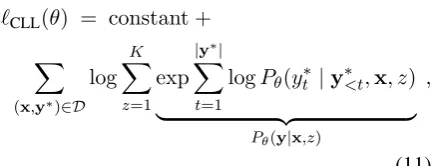
uni-form mixing coefficients (10), the conditional log-likelihood objective (2) can be re-expressed as:
`CLL(θ) = constant +
X
(x,y∗)∈D
log K
X
z=1
exp |y∗|
X
t=1
logPθ(yt∗|y∗<t,x, z)
| {z }
Pθ(y|x,z)
,
(11)
where log(1/K) terms were excluded because they offset the objective by a constant value. Such a constant has no impact on learning the param-eters θ. One can easily implement the objective in (11) using automatic differentiation software such as tensorflow (Abadi et al.,2016), by adopt-ing aLogSumExp operator to aggregate the loss of the individual mixture components. When the number of componentsKis large, computing the terms Pθ(y∗t | y∗<t,x, z) for all values of z ∈ {1, . . . , K}can require a lot of GPU memory. To mitigate this issue, we will propose a memory ef-ficient formulation in Section3.3 inspired by the EM algorithm.
3.1 S2SMIXArchitecture
We design the architecture of the S2SMIXmodel such that individual mixture components can share as many parameters and as much computation as possible. Accordingly, all of the mixture compo-nents share the same encoder, which requires pro-cessing the input sentence only once. We consider different ways of injecting the conditioning signal into the decoder. As depicted in Figure1, we con-sider different ways of injecting the conditioning on z into our two-layer decoder. These different variants require additional lookup tables denoted
M1,M2, orMb.
LSTM Logits
LSTM
+
+
+
LSTM Logits
LSTM
+
+
[image:3.595.74.293.290.373.2]+
Figure 1: An illustration of a two-layer LSTM de-coder with different ways of injecting the condi-tioning signal.
When we incorporate the conditioning onzinto the LSTM layers, each lookup table (e.g., M1 andM2) hasK rows andDLSTMcolumns, where
DLSTM denotes the number of dimensions of the LSTM states (512in our case). We combine the state of the LSTM with the conditioning signal via simple addition. Then the LSTM update equations take the form,
sit = LSTM(sit−1+ Mi[z], input), (12)
fori∈ {1,2}. We refer to the addition of the con-ditioning signal to the bottom and top LSTM lay-ers of the decoder as btandtprespectively. Note that in the bt configuration, the attention mask de-pends on the indicator variablez, whereas in the tp configuration that attention mask is shared across different mixture components.
We also consider incorporating the condition-ing signal into the softmax layer to bias the selec-tion of individual words in each mixture compo-nent. Accordingly, the embedding tableMbhasK
rows andDvocabentries, and the logits from (5) are added to the corresponding row ofMbas,
Pθ(yt+1|y≤t,x, z) = softmax(logits+Mb[z]).
(13)
We refer to this configuration assfand to the con-figuration that includes all of the conditioning sig-nals asall.
3.2 Separate Beam Search per Component
search independently for each component encour-ages diversity among the translation candidates as different mixture components often prefer certain phrases and linguistic structures over each other. Let yˆz denote the result of the beam search for a mixture component z. The final output of our model, denoted yˆ is computed by selecting the translation candidate with the highest probability under the corresponding mixture component,i.e.,
ˆ
y = argmax
1≤z≤K
logPθ(ˆyz |x, z). (14)
In order to accurately estimate the conditional probability of each translation candidate based on (9), one needs to evaluate each candidate using all of the mixture components. However, this process considerably increases the inference time and la-tency. Instead, we approximate the probability of each candidate by only considering the mixture component based on which the candidate transla-tion has been decoded, as outlined in (14). This approximation also encourages the diversity as we emphasized in this work.
Note that we haveKmixture components and a beam search ofbper component. Overall, this re-quires processingK×bcandidates. Accordingly, we compare our model with a SEQ2SEQmodel
us-ing the same beam size ofK×b.
3.3 Memory Efficient Formulation
In this paper, we adopt a relatively small number of mixture components (up to16), but to encompass various clusters of linguistic content and style, one may benefit from a large number of components. Based on our experiments, the memory footprint of a S2SMIX with K components increases by about K folds, partly because the softmax layers take a big fraction of the memory. To reduce the memory requirement for training our model, in-spired by prior work on EM algorithm (Neal and Hinton, 1998), we re-express the gradient of the conditional log-likelihood objective in (11)exactly
as,
d
dθ`CLL(θ) =
X
(x,y∗)∈D
K
X
z=1
P(z|x,y∗) d
dθlogPθ(y
∗ |x, z),
(15)
where with uniform mixing coefficients, the pos-terior distributionP(z|x,y∗)takes the form,
P(z|x,y) = Pexp`z(y|x)
kexp`k(y|x)
, (16)
where`z(y|x) = logPθ(y|x, z).
Based on this formulation, one can compute the posterior distribution in a few forward passes, which require much less memory. Then, one can draw one or a few Monte Carlo (MC) samples from the posterior to obtain an unbiased estimate of the gradient in (15). As shown in algorithm1, the training procedure is divided into two parts. For each minibatch we compute the component-specific log-loss for different mixture components in the first stage. Then, we exponentiate and nor-malize the losses as in (16) to obtain the poste-rior distribution. Finally, we draw one sample from the posterior distribution per input-output exam-ple, and optimize the parameters according to the loss of such a component. These two stages are al-ternated until the model converges. We note that this algorithm follows anunbiasedstochastic gra-dient of the marginal log likelihood.
Algorithm 1Memory efficient S2SMIX
Initialize a computational graph: cg Initialize a optimizer: opt
repeat
draw a random minibatch of the data empty listΓ
forz= 1toKdo
`z:= cg.forward(minibatch,z) Γ:= addexp(`z)toΓ
end for
Γ:= normalize(Γ)
˜
z:= sample(Γ)
`:= cg.forward(minibatch,z˜) opt.gradient_descent(`)
untilconverge
4 Experiments
Dataset. To assess the effectiveness of the S2SMIX model, we conduct a set of translation experiments on TEDtalks on four language pairs: English→French (en-fr), English→German (en-de), English→Vietnamese (en-vi), and English→Spanish (en-es).
We use IWSLT14 dataset2 for en-es, IWSLT15
Data en-fr en-de en-vi en-es Train 208,719 189,600 133,317 173,601
Dev 5,685 6,775 1,553 5,401
Test 2,762 2,762 1,268 2,504
Table 1: Statistics of all language pairs for IWSLT data after preprocessing
dataset for en-vi, and IWSLT16 dataset3 for en-fr and en-de. We pre-process the corpora by Moses tokenizer4, and preserve the true case of the text. For en-vi, we use the pre-processed corpus dis-tributed byLuong and Manning(2015)5. For train-ing and dev sets, we discard all of the sentence pairs where the length of either side exceeds 50
tokens. The number of sentence pairs of different language pairs after preprocessing are shown in Table1. We apply byte pair encoding (BPE) ( Sen-nrich et al.,2016) to handle rare words on en-fr, en-de and en-es, and share the BPE vocabularies between the encoder and decoder for each lan-guage pair.
Implementation details. All of the models use a one-layer bidirectional LSTM encoder and a two-layer LSTM decoder. Each LSTM two-layer in the en-coder and deen-coder has a 512 dimensional hid-den state. Each input word embeddings is 512
dimensional as well. We adopt the Adam opti-mizer (Kingma and Ba,2014). We adopt dropout with a0.2dropout rate. The minibatch size is64
sentence pairs. We train each model 15 epochs, and select the best model in terms of the perplexity on the dev set.
Diversity metrics. Having more diversity in the candidate translations is one of the major advan-tages of the S2SMIXmodel. To quantify diversity within a set {yˆm}M
m=1 of translation candidates, we propose to evaluate average pairwise BLEU be-tween pairs of sentences according to
div_bleu≡100− M
X
i=1
M
X
j=i+1
BLEU(ˆyi,yˆj)
M(M−1)/2 (17)
As an alternative metric of diversity within a set {yˆm}M
m=1 of translations, we propose a met-ric based on the fraction of the n-grams that are
3https://sites.google.com/site/iwsltevaluation2016 4
https://github.com/moses-smt/mosesdecoder
[image:5.595.309.500.66.232.2]5https://nlp.stanford.edu/projects/nmt
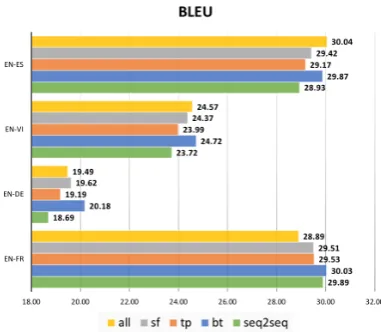
Figure 2: BLEU scores of the different variants of S2SMIXmodel and SEQ2SEQmodel.
not shared among the translations,i.e.,
div_ngram≡1−
∩Mm=1ngrams(ˆym)
∪Mm=1ngrams(ˆym)
(18)
where ngram(y)returns the set of unique n-grams in a sequencey. We report average div_bleu and average div_ngram across the test set for the trans-lation candidates found by beam search. We mea-sure and report bigram diversity in the paper and report unigram diversity in the supplementary ma-terial.
4.1 Experimental results
S2SMIX configuration. We start by investigat-ing which of the ways of injectinvestigat-ing the condition-ing signal into the S2SMIX model is most effec-tive. As seen in Section3, the mixture components can be built by adding component-specific vec-tors to the logits (sf), the top LSTM layer (tp) or the bottom LSTM layer (bt) in the decoder, or all of them (all). Figure 2shows the BLEU score of these variants on the translation tasks across four different language pairs. We observe that adding a component-specific vector to the recurrent cells in the bottom layer of the decoder is the most ef-fective, and results in BLEU scores superior or on-par with the other variants across the four language pairs.
Therefore, we use this model variant in all ex-periments for the rest of the paper.
en-fr en-de en-vi en-es SEQ2SEQ 173.22 173.78 112.76 173.21 S2SMIX-4
bt 173.23 173.79 112.77 173.22
tp 173.23 173.79 112.77 173.22
sf 173.70 174.27 112.88 173.70
[image:6.595.78.286.61.159.2]all 173.72 174.29 112.90 173.72
Table 2: Size of the parameters (MB) for the base SEQ2SEQmodel and the variants of S2SMIXwith four mixtures.
beam en-fr en-de en-vi en-es
SEQ2SEQ
4 30.26 19.52 24.82 29.40 8 30.18 19.77 23.55 29.76 16 27.63 19.13 19.05 28.19
S2SMIX-4
1 30.61 20.18 25.16 31.17 2 31.22 20.71 25.28 31.47 4 31.97 21.08 25.36 31.21
Table 3: BLEU scores of different systems over dif-ferent search space.
of new parameters compared to the base SEQ2SEQ
model. Specifically, only up to0.002%increase in the parameter size are introduced, across all of the language pairs and mixture model variants.
S2SMIX vs. SEQ2SEQ. We compare our mix-ture model against a vanilla SEQ2SEQmodel both
in terms of translation quality and diversity. To be fair, we compare models with the same number of beams during inference,e.g.,we compare vanilla SEQ2SEQusing a beam size of 8with S2SMIX-4 with4component and a beam size of2per com-ponent.
As an effective regularization strategy, we adopt label smoothing to strengthen generalisation per-formance (Szegedy et al., 2016; Pereyra et al.,
2017; Edunov et al., 2018). Unlike conventional cross-entropy loss, where the probability mass for the ground truth wordy is set to 1 andq(y0) = 0
fory0 6=y, we smooth this distribution as:
q(y) = 1−, (19)
q(y0) =
V −1 (20)
where is a smoothing parameter, and V is the vocabulary size. In our experiments,is set to 0.1.
Table 3shows the results across four language pairs. Each row in the top part should be compared
en-fr en-de en-vi en-es BLEU
SEQ2SEQ-d 29.85 19.18 24.62 29.72
S2SMIX-4 30.61 20.18 25.16 31.17
DIV_BLEU
SEQ2SEQ-d 20.43 22.66 14.51 18.83
[image:6.595.307.530.63.160.2]S2SMIX-4 34.85 47.85 37.40 38.31
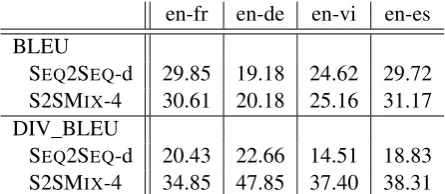
Table 4: S2SMIXwith 4 components vs SEQ2SEQ
endowed with the beam-diverse decoder (Li et al.,
2016) with the beam size of 4.
with the corresponding row in the bottom part for a fair comparison in terms of the effective beam size. Firstly, we observe that increasing the beam size deteriorates the BLEU score for the SEQ2SEQ
model. Similar observations have been made in the previous work (Tu et al., 2017). This behavior is in contrast to our S2SMIXmodel where increas-ing the beam size improves the BLEU score, ex-cept en-es, which demonstrates a decreasing trend when beam size increases from 2 to 4. Secondly, our S2SMIX models outperform their SEQ2SEQ
counterparts in all settings with the same number of bins.
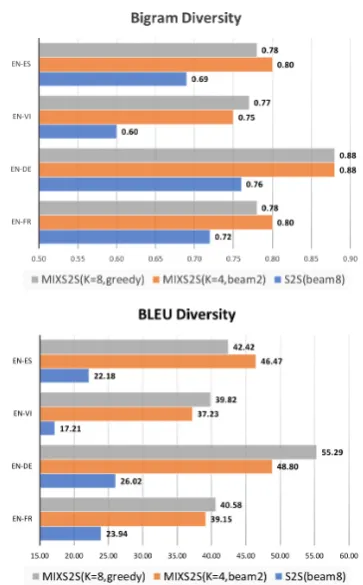
Figure 3 shows the diversity comparison between the S2SMIX model and the vanilla SEQ2SEQ model where the number of decoding beams is 8. The diversity metrics are bigram and BLEU diversity as defined earlier in the section. Our S2SMIX models significantly dominate the SEQ2SEQmodel across language pairs in terms of
the diversity metrics, while keeping the translation quality high (c.f. the BLEU scores in Table3).
We further compare against the SEQ2SEQ
model endowed with the beam-diverse decoder (Li et al., 2016). This decoder penalizes sibling hy-potheses generated from the same parent in the search tree, according to their ranks in each de-coding step. Hence, it tends to rank high those hy-potheses from different parents, hence encourag-ing diversity in the beam.
[image:6.595.73.290.225.323.2]en-fr en-de en-vi en-es
BLEU time BLEU time BLEU time BLEU time
S2SMIX-4 30.61 1.25 20.18 1.33 25.16 1.14 31.17 1.30
MC sampling:
S2SMIX-4 30.43 1.67 19.74 1.67 24.93 1.58 31.27 1.67
S2SMIX-8 30.66 2.08 20.41 2.05 24.86 2.00 31.44 2.06
[image:7.595.115.482.63.160.2]S2SMIX-16 30.74 3.10 20.43 2.88 24.90 2.83 30.82 3.02
Table 5: BLEU scores using greedy decoding and training time based on the original log-likelihood objective and online EM coupled with gradient estimation based on a single MC sample. The training time is reported by taking the average running time of one minibatch update across a full epoch.
Large mixture models. Memory limitations of the GPU may make it difficult to increase the number of mixture components beyond a certain amount. One approach is to decrease the number of sentence pairs in a minibatch, however, this re-sults in a substantial increase in the training time. Another approach is to resort to MC gradient esti-mation as discussed in Section3.3.
The top-part of Table 5 compares the models trained by online EM vs the original log-likelihood objective, in terms of the BLEU score and the training time. As seen, the BLEU score of the EM-trained models are on-par with those EM-trained on the log-likelihood objective. However, online EM leads to up to 35% increase in the training time for S2SMIX-4 across four different language pairs, as
we first need to do a forward pass on the mini-batch in order to form the lower bound on the log-likelihood training objective.
The bottom-part of Table5shows the effect of online EM coupled with sampling only one mix-ture component to form a stochastic approxima-tion to the log-likelihood lower bound. For each minibatch, we first run a forward pass to compute the probability of each mixture component given each sentence pair in the minibatch. We then sam-ple a mixture component for each sentence-pair to form the approximation of the log-likelihood lower bound for the minibatch, which is then optimized using back-propagation. As we increase the num-ber of mixture components from 4 to 8, we see about 0.7 BLEU score increase for en-de; while there is no significant change in the BLEU score for en-fr, en-vi and en-es.
Increasing the number of mixture components further to 16 does not produce gains on these datasets. Time-wise, training with online EM cou-pled with 1-candidate sampling should be signif-icantly faster that the vanilla online EM and the
original likelihood objective in principle, as we need to perform the backpropagation only for the selected mixture component (as opposed to all mixture components). Nonetheless, the additional computation due to increasing the number of mix-tures from 4 to 8 is about 26%, which increases to about 55% when going from 8 to 16 mixture com-ponents.
Figure 3: Diversity bigram (top) and BLEU (bot-tom) for the SEQ2SEQmodel vs S2SMIXmodels,
with the number of decoding beams set to 8.
4.2 Qualitative Analysis
[image:7.595.323.505.355.648.2]im-Source And this information is stored for at least six months in Europe , up to two years .
Reference Và những thông tin này được lưu trữ trong ít nhất sáu tháng ở châu Âu , cho tới tận hai năm . SEQ2SEQ
Và thông tin này được lưu trữ trong ít sáu tháng ở Châu Âu , hai năm tới . Và thông tin này được lưu trữ trong ít sáu tháng ở Châu Âu , trong hai năm tới . Và thông tin này được lưu trữ trong ít sáu tháng ở Châu Âu , hai năm tới Và thông tin này được lưu trữ trong ít sáu tháng ở Châu Âu , trong hai năm tới S2SMIX
Và thông tin này được lưu trữ trong ítnhất6 tháng ở châu Âu ,đến 2năm . Và thông tin này được lưu trữ trong ítnhất6 tháng ở châu Âu ,lên tới hainăm . Và thông tin này được lưu trữ trong ítnhất6 tháng ở châu Âu ,trong vòng hainăm . Và thông tin này được lưu trữ trong ítnhất6 tháng ở châu Âu ,lên tới hainăm
Table 6: Words indicate diversity compared with the references, whileredwords denote translation im-provement.
prove the translation quality. As shown in Table6, compared with SEQ2SEQ, which mistranslates the second clause, our S2SMIXis not only capable of generating a group of correct translation, but also emitting synonyms for different mixture compo-nents. We provide more examples in the supple-mentary material.
5 Related Work
Obviously, different domains aim at different read-ers, thus they exhibit distinctive genres compared to other domains. A well-tuned MT system cannot directly apply to new domains; otherwise, trans-lation quality will degrade. Based on this fac-tor, out-domain adaptation has been widely stud-ied for MT, ranging from data selection (Li et al.,
2010;Wang et al.,2017), tuning (Luong and Man-ning, 2015;Farajian et al., 2017) to domain tags (Chu et al.,2017). Similarly, in-domain adaptation is also a compelling direction. Normally, to train an universal MT system, the training data consist of gigantic corpora covering numerous and vari-ous domains.This training data is naturally so di-verse thatMima et al.(1997) incorporated extra-linguistic information to enhance translation qual-ity. Michel and Neubig (2018) argue even with-out explicit signals (gender, politeness etc.), they can handle domain-specific information via anno-tation of speakers, and easily gain quality improve-ment from a larger number of domains. Our ap-proach is considerably different from the previ-ous work. We remove any extra annotation, and treat domain-related information as latent vari-ables, which are learned from corpus.
Prior to our work, diverse generation has been studied in image captioning, as some of the train-ing set are comprised of images paired with multi-ple reference captions. Some work puts their ef-forts on decoding stages, and form a group of beam search to encourage diversity (Vijayakumar et al., 2016), while others pay more attention to adversarial training (Shetty et al., 2017;Li et al.,
2018). Within translation, our method is similar to Schulz et al. (2018b), where they propose a MT system armed with variational inference to ac-count for translation variations. Like us, their di-versified generation is driven by latent variables. Albeit the simplicity of our model, it is effective and able to accommodate variation or diversity. Meanwhile, we propose several diversity metrics to perform quantitative analysis.
Finally, Yang et al. (2018) proposes a mixture of softmaxes to enhance the expressiveness of lan-guage model, which demonstrate the effectiveness of our S2SMIXmodel under the matrix factoriza-tion framework.
6 Conclusions and Future Work
fol-lowed by Monte Carlo sampling to estimate the gradients. We observe significant gains both in terms of BLEU scores and translation diversity with a mixture of4components. In the future, we intend to replace the uniform mixing coefficients with learnable parameters, since different compo-nents should not necessarily make an equal con-tribution to a given sentence pair. Moreover, we will consider applying our S2SMIXmodel to other NLP problems in which diversity plays an impor-tant role.
7 Acknowledgements
We would like to thank Quan Tran, Trang Vu and three anonymous reviewers for their valuable com-ments and suggestions. This work was supported by the Multi-modal Australian ScienceS Imaging and Visualisation Environment (MASSIVE)6, and in part by an Australian Research Council grant (DP160102686).
References
Martín Abadi, Ashish Agarwal, Paul Barham, Eugene Brevdo, Zhifeng Chen, Craig Citro, Gregory S. Cor-rado, Andy Davis, Jeffrey Dean, Matthieu Devin, Sanjay Ghemawat, Ian J. Goodfellow, Andrew Harp, Geoffrey Irving, Michael Isard, Yangqing Jia, Rafal Józefowicz, Lukasz Kaiser, Manjunath Kudlur, Josh Levenberg, Dan Mané, Rajat Monga, Sherry Moore, Derek Gordon Murray, Chris Olah, Mike Schuster, Jonathon Shlens, Benoit Steiner, Ilya Sutskever, Ku-nal Talwar, Paul A. Tucker, Vincent Vanhoucke, Vi-jay Vasudevan, Fernanda B. Viégas, Oriol Vinyals, Pete Warden, Martin Wattenberg, Martin Wicke, Yuan Yu, and Xiaoqiang Zheng. 2016. Tensorflow: Large-scale machine learning on heterogeneous dis-tributed systems. arXiv:1603.04467.
Dzmitry Bahdanau, Kyunghyun Cho, and Yoshua Ben-gio. 2015. Neural machine translation by jointly learning to align and translate.ICLR.
Chenhui Chu, Raj Dabre, and Sadao Kurohashi. 2017. An empirical comparison of simple domain adapta-tion methods for neural machine translaadapta-tion. CoRR, abs/1701.03214.
Sergey Edunov, Myle Ott, Michael Auli, David Grang-ier, and Marc’Aurelio Ranzato. 2018. Classical structured prediction losses for sequence to sequence learning. In Proceedings of NAACL-HLT 2018.
M Amin Farajian, Marco Turchi, Matteo Negri, and Marcello Federico. 2017. Multi-domain neural ma-chine translation through unsupervised adaptation. In Proceedings of the Second Conference on Ma-chine Translation, pages 127–137.
6https://www.massive.org.au/
Hany Hassan, Anthony Aue, Chang Chen, Vishal Chowdhary, Jonathan Clark, Christian Federmann, Xuedong Huang, Marcin Junczys-Dowmunt, William Lewis, Mu Li, et al. 2018. Achieving human parity on automatic chinese to english news translation.arXiv:1803.05567.
Sepp Hochreiter and J¨urgen Schmidhuber. 1997. Long short-term memory. Neural computation, 9(8):1735–1780.
Diederik P. Kingma and Jimmy Ba. 2014. Adam: A method for stochastic optimization. CoRR, abs/1412.6980.
Dianqi Li, Xiaodong He, Qiuyuan Huang, Ming-Ting Sun, and Lei Zhang. 2018. Generating diverse and accurate visual captions by comparative adversarial learning. arXiv preprint arXiv:1804.00861.
Jiwei Li, Will Monroe, and Dan Jurafsky. 2016. A sim-ple, fast diverse decoding algorithm for neural gen-eration. CoRR, abs/1611.08562.
Mu Li, Yinggong Zhao, Dongdong Zhang, and Ming Zhou. 2010. Adaptive development data selection for log-linear model in statistical machine transla-tion. InProceedings of the 23rd International Con-ference on Computational Linguistics, pages 662– 670. Association for Computational Linguistics.
Minh-Thang Luong and Christopher D Manning. 2015. Stanford neural machine translation systems for spo-ken language domains. InIWSLT.
Paul Michel and Graham Neubig. 2018. Extreme adap-tation for personalized neural machine translation. InIn Proceedings of the 56th Annual Meeting of the Association for Computational Linguistics (ACL), Melbourne, Australia.
Hideki Mima, Osamu Furuse, and Hitoshi Iida. 1997. Improving performance of transfer-driven machine translation with extra-linguistic informatioon from context, situation and environment. In IJCAI (2), pages 983–989.
Radford M Neal and Geoffrey E Hinton. 1998. A view of the em algorithm that justifies incremental, sparse, and other variants. Learning in graphical models.
Gabriel Pereyra, George Tucker, Jan Chorowski,
Łukasz Kaiser, and Geoffrey Hinton. 2017. Regular-izing neural networks by penalRegular-izing confident output distributions.arXiv preprint arXiv:1701.06548.
Philip Schulz, Wilker Aziz, and Trevor Cohn. 2018a. A stochastic decoder for neural machine translation.
CoRR, arXiv:1805.10844.
Philip Schulz, Wilker Aziz, and Trevor Cohn. 2018b. A stochastic decoder for neural machine translation. In
Rico Sennrich, Barry Haddow, and Alexandra Birch. 2016. Neural machine translation of rare words with subword units. In Proceedings of the 54th Annual Meeting of the Association for Computational Lin-guistics (Volume 1: Long Papers), volume 1, pages 1715–1725.
Rakshith Shetty, Marcus Rohrbach, Lisa Anne Hen-dricks, Mario Fritz, and Bernt Schiele. 2017. Speak-ing the same language: MatchSpeak-ing machine to human captions by adversarial training. InIn Proceedings of the IEEE International Conference on Computer Vision (ICCV).
Ilya Sutskever, Oriol Vinyals, and Quoc V. Le. 2014. Sequence to sequence learning with neural net-works.NIPS.
Christian Szegedy, Vincent Vanhoucke, Sergey Ioffe, Jon Shlens, and Zbigniew Wojna. 2016. Rethinking the inception architecture for computer vision. In
Proceedings of the IEEE conference on computer vi-sion and pattern recognition, pages 2818–2826.
Zhaopeng Tu, Yang Liu, Lifeng Shang, Xiaohua Liu, and Hang Li. 2017. Neural machine translation with reconstruction. AAAI.
Ashish Vaswani, Noam Shazeer, Niki Parmar, Jakob Uszkoreit, Llion Jones, Aidan N Gomez, Łukasz Kaiser, and Illia Polosukhin. 2017. Attention is all you need.NIPS.
Ashwin K Vijayakumar, Michael Cogswell, Ram-prasath R Selvaraju, Qing Sun, Stefan Lee, David Crandall, and Dhruv Batra. 2016. Diverse beam search: Decoding diverse solutions from neural se-quence models. arXiv preprint arXiv:1610.02424.
Rui Wang, Masao Utiyama, Lemao Liu, Kehai Chen, and Eiichiro Sumita. 2017. Instance weighting for neural machine translation domain adaptation. In
Proceedings of the 2017 Conference on Empiri-cal Methods in Natural Language Processing, pages 1482–1488.
Yonghui Wu, Mike Schuster, Zhifeng Chen, Quoc V Le, Mohammad Norouzi, Wolfgang Macherey, Maxim Krikun, Yuan Cao, Qin Gao, Klaus Macherey, et al. 2016. Google’s neural machine translation system: Bridging the gap between human and machine translation. arXiv:1609.08144.
Zhilin Yang, Zihang Dai, Ruslan Salakhutdinov, and William W. Cohen. 2018. Breaking the softmax bot-tleneck: A high-rank RNN language model. In Inter-national Conference on Learning Representations.